Case study: Gumlet turned ChatGPT mentions into 20% of inbound revenue. Read it →

B2B SaaS SEO Strategy in 2026: 10 Steps From Keywords to Pipeline

Google's AI Overview already lists the generic pillars. This is the part it skips: the order to build pages, how to score keywords by revenue, how to get named in AI answers, and how to report pipeline.


Last updated: October 20, 2026. Statistics link to their original studies. DerivateX citation data comes from our own Peec AI tracking.
A B2B SaaS SEO strategy is the plan that decides which buyer queries your company will own, which page answers each one, and how every visit from Google and AI search is traced to demos and pipeline. In 2026 the strategy that works starts at the bottom of the funnel, scores keywords by revenue instead of volume, earns mentions on the third-party sources ChatGPT and Google AI Overviews read, and reports pipeline instead of rankings.
Google’s own AI Overview for “b2b saas seo strategy” now lists the basic pillars for free: buyer-intent keywords, product-led content, technical SEO, links and pipeline metrics. Explaining those pillars is no longer a reason for a buyer to click. What Google cannot summarize is the order of operations, the scoring math, and the reporting chain that turns them into revenue. That is what the 10 steps below cover, with a worked example, tables you can copy, and a 90-day plan.
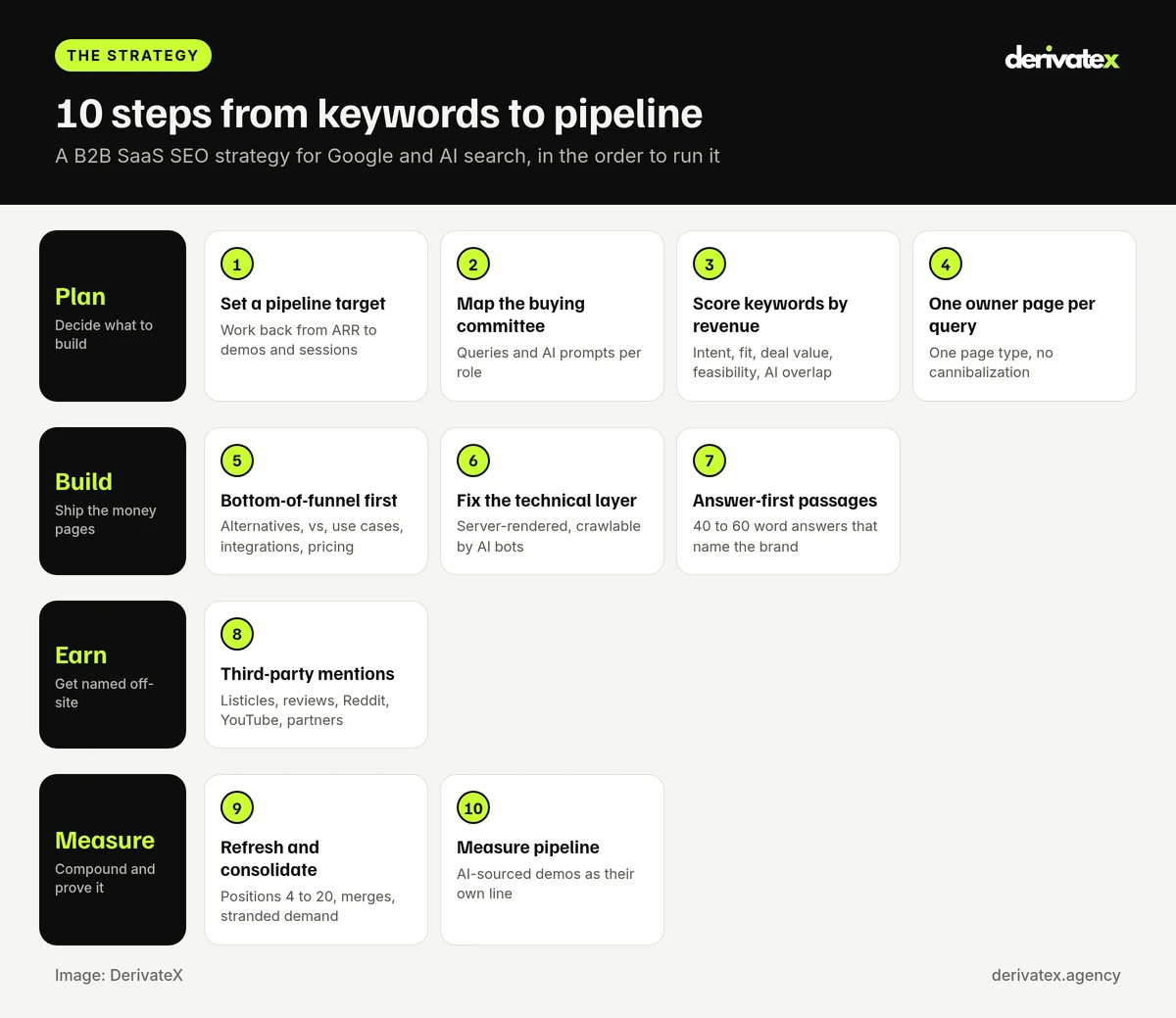
The 10 steps at a glance
- Set a pipeline target and work backward to the number of demos and pages it needs.
- Map the buying committee and the Google queries and AI prompts each role uses.
- Score keywords by revenue, not by search volume.
- Give every money query one owner page and one page type.
- Ship bottom-of-funnel pages first: alternatives, comparisons, use cases, integrations, pricing.
- Fix the technical layer so Googlebot and AI crawlers can read every money page.
- Write answer-first passages that AI engines can lift and attribute.
- Earn mentions on third-party sources AI engines already cite.
- Refresh and consolidate before you publish anything new.
- Measure pipeline, with a separate line for AI-sourced demos.
What Is a B2B SaaS SEO Strategy in 2026?
A B2B SaaS SEO strategy is a ranked plan of buyer queries, the pages that own them, and the measurement that ties those pages to pipeline. It is different from an SEO checklist. A checklist tells you what good pages look like. A strategy tells you which 20 pages to build first, which 200 to ignore, and how you will know in month four whether it is working.
Two things changed the shape of that plan. Buyers now research inside ChatGPT, Perplexity, Gemini and Google AI Mode as well as the classic results page. And Google answers most informational queries itself before anyone scrolls. A 2026 strategy therefore covers two surfaces with one set of pages: the Google results page, and the AI answer that names a shortlist of vendors.
| Traffic-era SaaS SEO playbook | 2026 B2B SaaS SEO strategy | |
|---|---|---|
| Starting point | Keyword tool export sorted by volume | Pipeline target and the buying committee |
| First pages built | Top-of-funnel blog posts and glossaries | Alternatives, comparisons, use cases, integrations, pricing |
| Keyword priority | Volume and difficulty | Revenue score: intent, fit, deal value, feasibility, AI overlap |
| Authority | Backlink count and domain rating | Mentions on the listicles, reviews, threads and videos AI engines cite |
| Content format | Long intros, keyword density | Answer-first passages, tables, named entities, dated facts |
| Surfaces covered | Google blue links | Google, AI Overviews, AI Mode, ChatGPT, Perplexity, Gemini, Claude |
| Headline metric | Sessions and rankings | Demos, pipeline and revenue, with AI-sourced demos as their own line |
Why the Traffic Playbook Stopped Paying for B2B SaaS
Informational rankings lost most of their clicks, and buyers decide before they talk to sales. Four numbers explain why a 2026 plan starts at the bottom of the funnel:
- 58% fewer clicks at position one. When an AI Overview appears, the top-ranking page earns 58% fewer clicks than it would without one, in Ahrefs’ study of 300,000 keywords comparing December 2023 with December 2025. The effect was 34.5% in the April 2025 version of the same study.
- 8% versus 15%. Google users clicked a traditional result on 8% of searches that showed an AI summary, against 15% of searches without one, in Pew Research Center’s analysis of 68,879 real searches. Only 1% clicked a source link inside the summary.
- 94% rank vendors before first contact. In 6sense’s 2025 Buyer Experience Report of nearly 4,000 B2B buyers, 94% of buying groups ranked their preferred vendors before speaking to a seller, and four out of five deals went to the pre-contact favorite.
- 15.9% versus 1.76%. ChatGPT referrals converted at 15.9% against 1.76% for Google organic for one B2B software client in Seer Interactive’s case study. AI referrals were 0.07% of that site’s organic sessions: small volume, high intent, and one site rather than a benchmark.
Put together, the shortlist forms before the demo request, and a growing share of it forms inside an AI answer. The job of SaaS SEO in 2026 is to be on that shortlist when it forms, on Google and inside the answer, for the queries that carry buying intent.
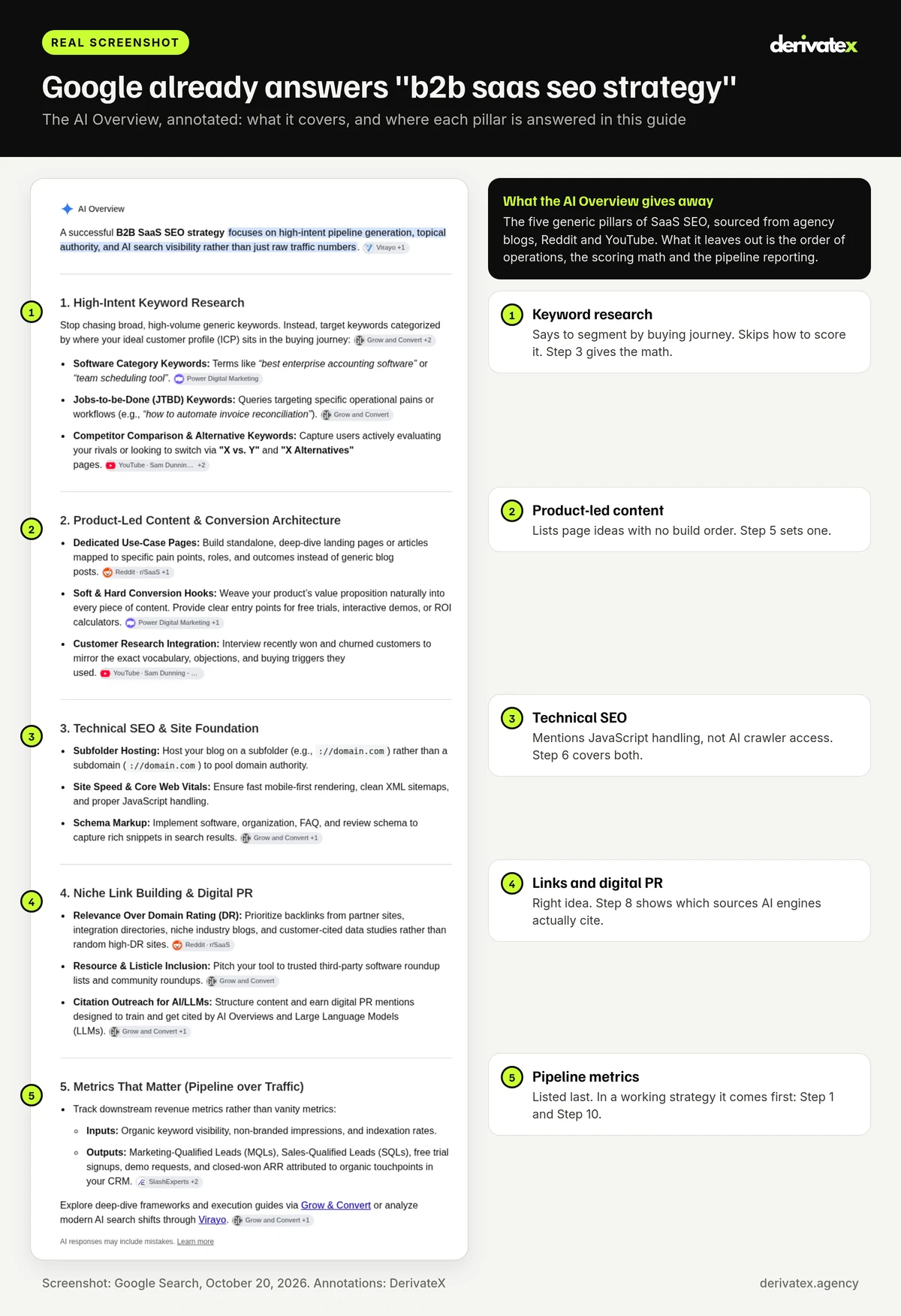
Notice what the overview cites: agency blogs, a Reddit thread and two YouTube videos. That pattern repeats on buying prompts too, and it shapes Step 8.
Step 1: Set a Pipeline Target Before You Pick a Keyword
Start with the revenue SEO has to produce, then work backward to demos, sessions and pages. A target turns “grow organic” into a number the CFO can check, and it decides how many bottom-of-funnel pages you need before anyone opens a keyword tool.
Use four inputs from your CRM: average contract value, opportunity-to-close rate, demo-to-opportunity rate, and the conversion rate of your existing high-intent pages. Here is a worked example for a mid-market HR software company at $15M ARR:
| Input | Worked example | Where it comes from |
|---|---|---|
| 12-month organic new-ARR target | $600,000 | Board plan: organic share of new business |
| Average contract value | $24,000 | CRM, last four quarters |
| Closed-won deals needed | 25 | $600,000 ÷ $24,000 |
| Opportunity-to-close rate | 25% | CRM, organic-sourced opportunities |
| Opportunities needed | 100 | 25 ÷ 0.25 |
| Demo-to-opportunity rate | 50% | CRM or sales ops |
| Demos needed | 200 a year, about 17 a month | 100 ÷ 0.50 |
| Demo rate on high-intent pages | 2% | GA4 key events on existing comparison and pricing pages |
| High-intent sessions needed | About 850 a month | 17 ÷ 0.02 |
The last row is the useful one. 850 high-intent sessions a month is a small number. It comes from 15 to 25 well-built commercial pages, not from 300 blog posts. That is why the plan starts at the bottom of the funnel: the math says so.
Step 2: Map the Buying Committee and the Questions Each Role Asks
B2B SaaS deals are bought by a committee, and each member searches for different things. 6sense puts the typical buying group at more than 10 people. You do not need a page for every person. You need a page for every question that can remove you from the shortlist.
| Role | What they type into Google | What they ask an AI assistant | Page that answers it |
|---|---|---|---|
| Champion (HR ops lead) | “best hris for 200 employees” | “Which HRIS works for a 200-person company with US and India payroll?” | Category page, use-case page |
| Economic buyer (VP People, CFO) | “bamboohr pricing” | “Is BambooHR worth it or is there something cheaper for mid-market?” | Pricing page, alternatives page |
| Technical evaluator (IT, RevOps) | “[product] okta integration” | “Does [product] support SCIM provisioning with Okta?” | Integration page, docs |
| Security and legal | “[product] soc 2” | “Is [product] SOC 2 Type II and GDPR compliant?” | Trust center, security page |
| The incumbent’s user | “[competitor] alternatives” | “What are better alternatives to [competitor] for a growing company?” | Alternatives page, vs page |
Pull the wording from sales call recordings, lost-deal notes, support tickets, G2 reviews and Reddit threads, not from a keyword tool. The AI prompt column matters because buyers write full sentences with constraints, like company size, region and stack. Pages that state those constraints plainly get matched to those prompts.
For a full list of buyer prompts to test, use our library of 50 ChatGPT prompts for auditing B2B SaaS AI visibility, and read how B2B SaaS buyers use ChatGPT to evaluate vendors.
Step 3: Score Every Keyword by Revenue, Not Volume
Search volume is the weakest input in a B2B SaaS keyword plan. The queries closest to a purchase have low volume by definition. A query searched 90 times a month by people comparing two vendors is worth more than one searched 9,000 times a month by students.
Score each keyword cluster from 1 to 5 on five factors, then multiply:
- Buying intent: 5 for “alternatives”, “vs”, “pricing” and “software for [use case]”; 1 for “what is”.
- Product fit: 5 if the product solves exactly this; 1 if it is adjacent.
- Deal value: 5 if the searcher matches your highest-ACV segment.
- Feasibility: 5 if pages with your authority already rank on page one; 1 if the page is all enterprise brands and review sites.
- AI overlap: 5 if the same question shows up as a buyer prompt where AI engines name vendors.
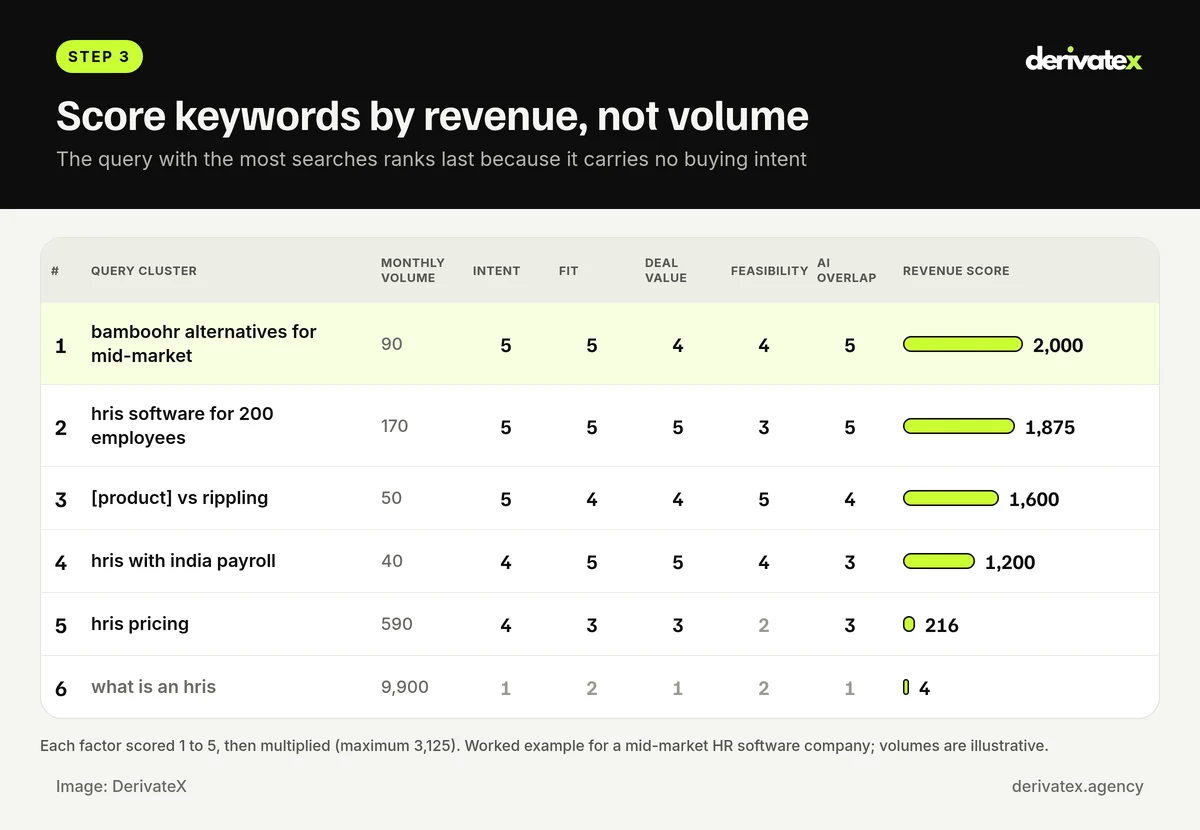
In the example above, “what is an hris” has the most volume and ranks last. “bamboohr alternatives for mid-market” has a fraction of the volume and ranks first. The full method, including how to pull buyer language and weight deal value, is in our B2B SaaS keyword research guide.
Step 4: Give Every Money Query One Owner Page
Every commercial keyword cluster gets exactly one page that owns it, and that page has one job. Two pages chasing the same query split links, confuse Google, and give AI engines two weaker passages instead of one strong one.
| Query pattern | Page type | Buyer stage | What the page must contain |
|---|---|---|---|
| “[category] software for [segment]” | Category or solution page | Shortlisting | Who it is for, core use cases, proof, pricing range, demo CTA |
| “[competitor] alternatives” | Alternatives page | Switching | Honest list including you, where each fits, migration notes |
| “[you] vs [competitor]” | Comparison page | Final two | Feature and pricing table, who should pick each, dated facts |
| “[use case] tool” or “how to [job]” | Use-case page | Problem-aware | The workflow, screenshots, outcome numbers, related integrations |
| “[product] [tool] integration” | Integration page | Technical check | What syncs, setup steps, limits, link to docs |
| “[product] pricing” or “[category] cost” | Pricing page or pricing guide | Budget check | Plans, what is included, total cost, who each plan fits |
| “[category] for [industry]” | Industry page | Fit check | Industry-specific workflows, compliance, named customers |
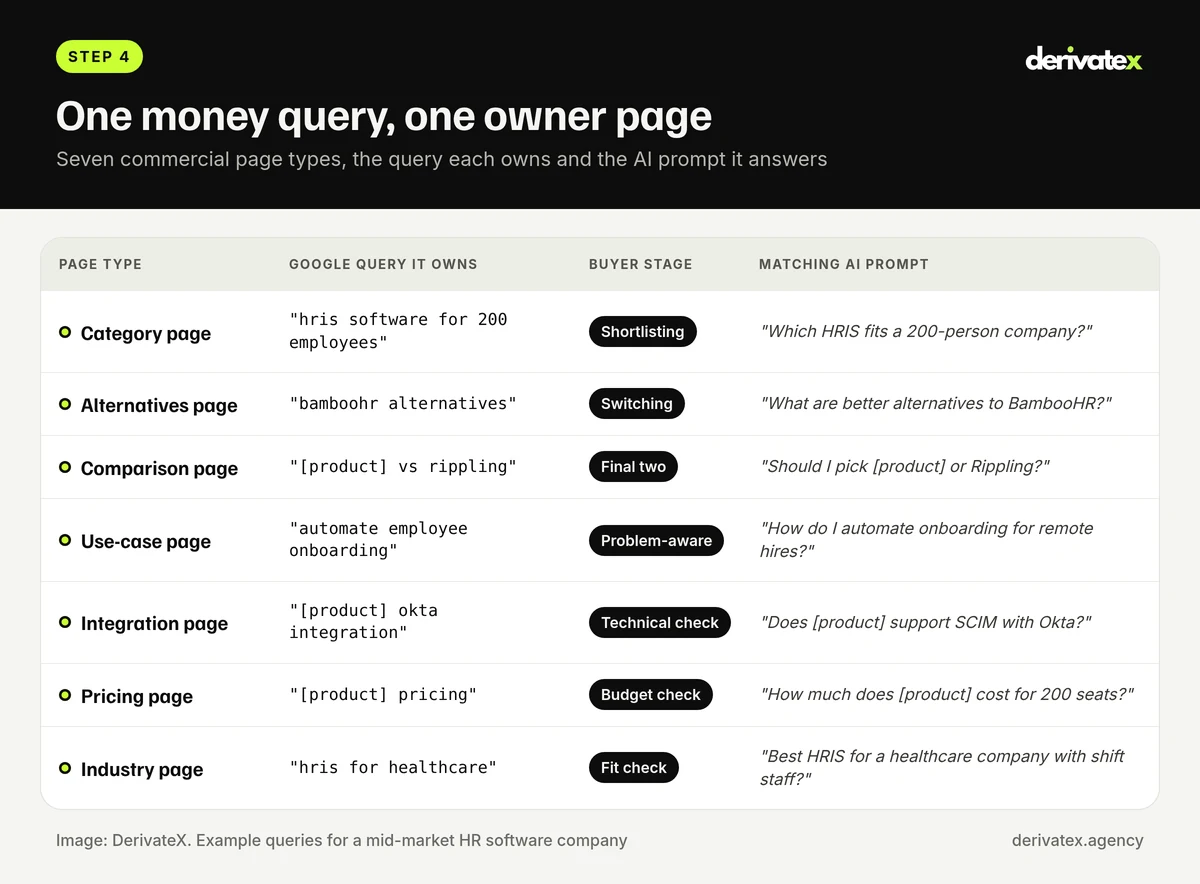
Write the ownership down in one sheet: cluster, owner URL, page type, status. Before any new brief, check the sheet. If a page already owns the cluster, improve that page instead. Our SaaS keyword mapping guide covers the cannibalization rules in detail.
Step 5: Ship Bottom-of-Funnel Pages First
Build the pages that catch buyers who are already comparing vendors, then work up the funnel. These pages have the lowest volume and the highest conversion rate, and they are the pages AI engines pull from when a buyer asks for a shortlist.
A practical build order for the first batch of pages:
- First: fix and expand the pages you already have: pricing, the top two competitor comparisons, and the main category page.
- Second: alternatives pages for your three most common incumbents, plus use-case pages for the two workflows that close fastest.
- Third: integration pages for the tools in most of your deals, and industry pages for your top two verticals.
Each bottom-of-funnel page should pass this checklist before it ships:
- The first 60 words answer the query and name who the product is for.
- A comparison or pricing table with dated facts.
- At least one named customer result, or a specific product screenshot of the workflow.
- Who should not buy it. Honest limits make the rest of the page credible to readers and to AI engines.
- One primary CTA that matches intent: demo on comparison pages, trial or pricing on use-case pages.
- Internal links to the two or three pages a buyer reads next.
Useful references: what to put on a use-case page so AI search cites it and how to structure case studies so ChatGPT can reuse the proof.
Should you still publish top-of-funnel content? Yes, but less of it and with a job. Publish an explainer only when it carries original data, a strong point of view, or a tool, and when it links naturally to a commercial page. Google’s AI answers already cover the generic version of most “what is” topics.
Step 6: Fix the Technical Layer for Google and AI Crawlers
If a crawler cannot read the page, nothing else in the strategy matters. SaaS sites fail here more than most, because marketing sites built on JavaScript frameworks often ship empty HTML to bots that do not run scripts. Most AI crawlers do not render JavaScript.
| Check | Pass looks like | How to test |
|---|---|---|
| Server-rendered content | Headings, body copy and tables are in the raw HTML | View source, or fetch the page with curl and search for a sentence from the body |
| AI crawler access | robots.txt allows OAI-SearchBot, ChatGPT-User, PerplexityBot and Googlebot on money pages | Read robots.txt; check OpenAI’s and Perplexity’s published bot names |
| Google-Extended decision | A deliberate choice, knowing it governs Gemini apps and model training, not Google Search or AI Overviews | Google’s crawler documentation |
| Indexation | Every money page indexed, no orphan pages, one canonical per cluster | Search Console page indexing report, site crawl |
| Structured data | Organization, Article, FAQ and Product or SoftwareApplication where they fit | Schema validator and Rich Results Test |
| Internal links | Every bottom-of-funnel page is two clicks from the homepage and linked from related posts | Crawl depth and inlink counts in a site crawler |
| Speed | Core Web Vitals pass on mobile for templates that carry money pages | PageSpeed Insights and the Search Console Core Web Vitals report |
Go deeper with 9 JavaScript rendering failures that hide SaaS content from LLM crawlers, Next.js SEO traps for B2B SaaS, common robots.txt mistakes and schema markup for LLM SEO. llms.txt is optional; server-rendered HTML is not.
Step 7: Write Answer-First Passages AI Engines Can Quote
AI engines lift passages, not pages. A section that opens with a direct, self-contained answer, names the entity, and gives a specific fact is far easier to quote and attribute than one that warms up for three paragraphs.
Write every H2 section on a money page to this pattern:
- Question-style heading that matches how the buyer phrases it.
- A 40 to 60 word answer first, in “X is Y” form, that still makes sense if lifted out alone.
- Your brand named in the passage, not only “we”. A passage that never names you cannot be attributed to you.
- One specific, dated fact: a price, a limit, a time frame, a customer result.
- A table or list for anything with more than three attributes.
| Before | After |
|---|---|
| “When it comes to choosing the right HR platform, there are many factors to consider, and every company is different.” | “[Product] is an HRIS for 100 to 1,000-employee companies that run payroll in the US and India. Plans start at $8 per employee per month, and setup takes about three weeks.” |
Being cited is not the same as being recommended. In DerivateX’s own Peec AI tracking of 50 buyer prompts across 6,650 AI answers (July to September 2026), derivatex.agency was the most-cited domain, yet 42.7% of those citations did not name DerivateX in the answer. The engines used our pages as a source and recommended someone else. Passages that state who the product is for, with proof, close that gap. More on this in how LLMs decide what to cite and what content gets cited in Google AI Overviews.
Step 8: Earn Mentions on the Third-Party Sources AI Engines Read
AI engines build vendor shortlists from what other sites say about you, not only from your own pages. For B2B SaaS that means listicles, review sites, community threads, videos and partner pages.
DerivateX tracks the prompt “seo agency for saas” across ChatGPT, Google AI Overviews, AI Mode and Gemini in Peec AI. Across 28 answers between October 8 and October 19, 2026, the most-cited pages were agency listicles and guides, YouTube videos appeared in 13 of the 28 answers and Reddit threads in 8. Your category will have its own mix. Find it before you spend a dollar on links.
| Source type | Why AI engines use it | What to do |
|---|---|---|
| “Best [category]” listicles | A ready-made shortlist with reasons | Get included on the lists engines already cite, with accurate positioning |
| Review sites (G2, Capterra, TrustRadius) | Volume of independent opinions | Run a steady review ask after onboarding milestones |
| Reddit and communities | Real users comparing options | Have real team members answer questions in their own name, with disclosure |
| YouTube | Walkthroughs and comparisons | Publish demos and honest comparisons with full transcripts |
| Partner and integration pages | Confirms the integration exists | Ask every integration partner for a listing with a description |
| Digital PR and original data | Specific numbers worth quoting | Publish one data asset a quarter and pitch it to trade press |
Keep your facts identical everywhere: category, who you serve, pricing, founding year, headquarters. Conflicting descriptions make engines hedge or skip you. See 9 third-party assets every B2B SaaS brand needs, 12 SaaS link building strategies and digital PR story angles that earn AI mentions.
Step 9: Refresh and Consolidate Before You Publish More
The fastest wins usually sit in pages you already have. Pages ranking in positions 4 to 20 for commercial queries need an update, not a sibling. Overlapping posts need merging. Dead URLs that still collect impressions need a home.
- Refresh: update facts, prices, screenshots and dates on commercial pages every quarter. Stale numbers are the first thing AI engines and buyers distrust.
- Consolidate: merge posts that target the same cluster into the owner page and 301 the rest.
- Rescue stranded demand: check Search Console for retired URLs that still collect impressions, and give that demand a live page.
- Prune: remove or noindex thin pages with no traffic, no links and no commercial role.
This guide is an example of the third rule. When DerivateX retired its old /seo/b2b-saas-seo/ page, Search Console still showed about 2,985 impressions over 16 months for “b2b saas seo” variants, plus 279 for “saas seo strategy”. That demand now has a live page.
Step 10: Measure Pipeline, With AI Search as Its Own Line
Report SEO in the same units as the rest of go-to-market: demos, pipeline and revenue. Rankings and sessions are inputs. Keep them on the dashboard, but never as the headline.
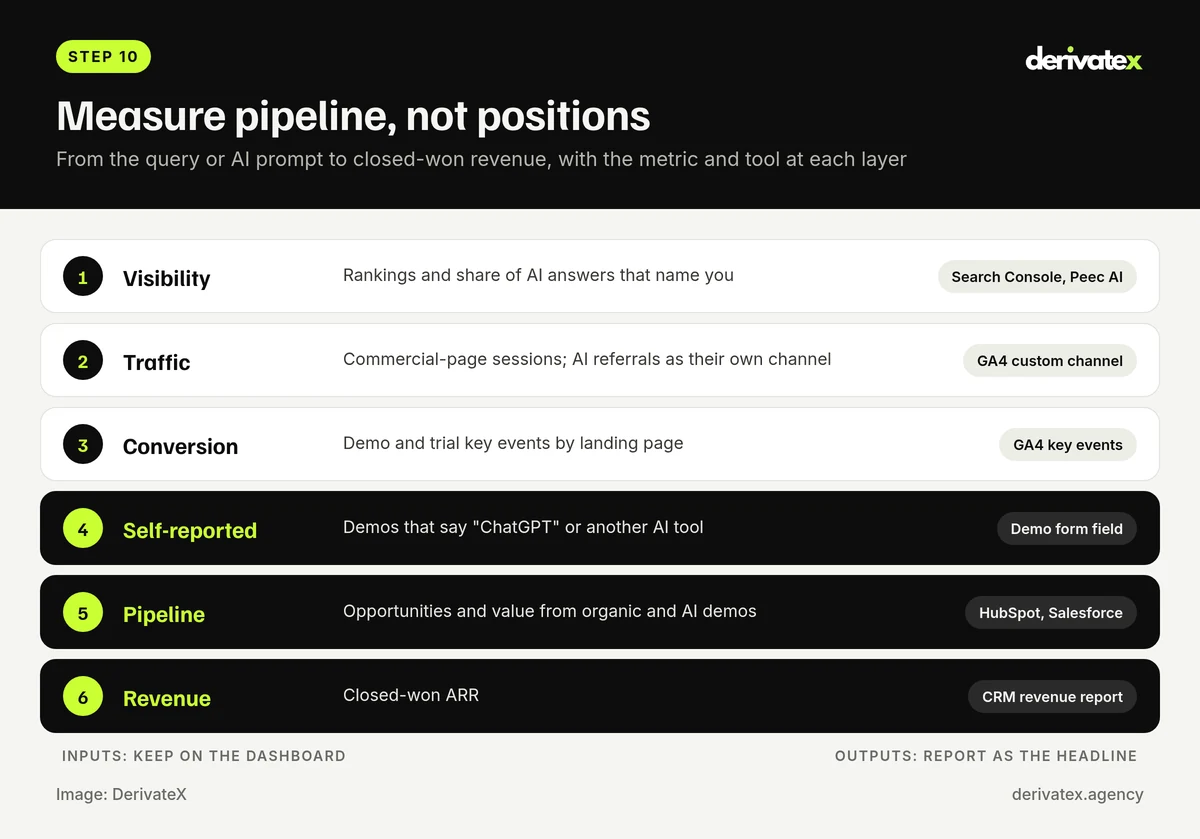
| Layer | Metric | Tool |
|---|---|---|
| Visibility | Rankings for owner pages; share of AI answers that name you for buyer prompts | Search Console, rank tracker, an AI visibility tracker such as Peec AI |
| Traffic | Sessions to commercial pages; AI-referred sessions as a separate channel | GA4 with a custom channel for chatgpt.com, perplexity.ai, gemini.google.com, copilot.microsoft.com and claude.ai |
| Conversion | Demo and trial key events by landing page | GA4 key events, form source fields |
| Self-reported source | Share of demos that say they found you through ChatGPT or another AI tool | A required “How did you hear about us?” field with AI options |
| Pipeline | Opportunities and pipeline value from organic and AI-sourced demos | CRM: HubSpot or Salesforce, with original source and self-reported source |
| Revenue | Closed-won ARR from those opportunities | CRM revenue reports |
The self-reported field matters most for AI search, because a buyer who reads a ChatGPT answer often types your URL later and shows up as direct traffic. Ask the question on every demo form. Gumlet, a DerivateX client, now tracks this channel as a revenue line. Co-founder and CMO Divyesh Patel wrote in his TechBehemoths review:
“Today, close to 20 percent of our inbound revenue can be traced back to users who first discovered Gumlet through AI tools.”
Divyesh Patel, Co-founder and CMO, Gumlet
Setup guides: prompt-to-pipeline attribution in HubSpot, the AI search funnel from prompt to closed-won and tracking Gemini traffic in GA4.
A 90-Day B2B SaaS SEO Plan
Ninety days is enough to build the foundation, ship the first commercial pages and read early signals. It is not enough to judge the whole program. Plan the quarter like this:
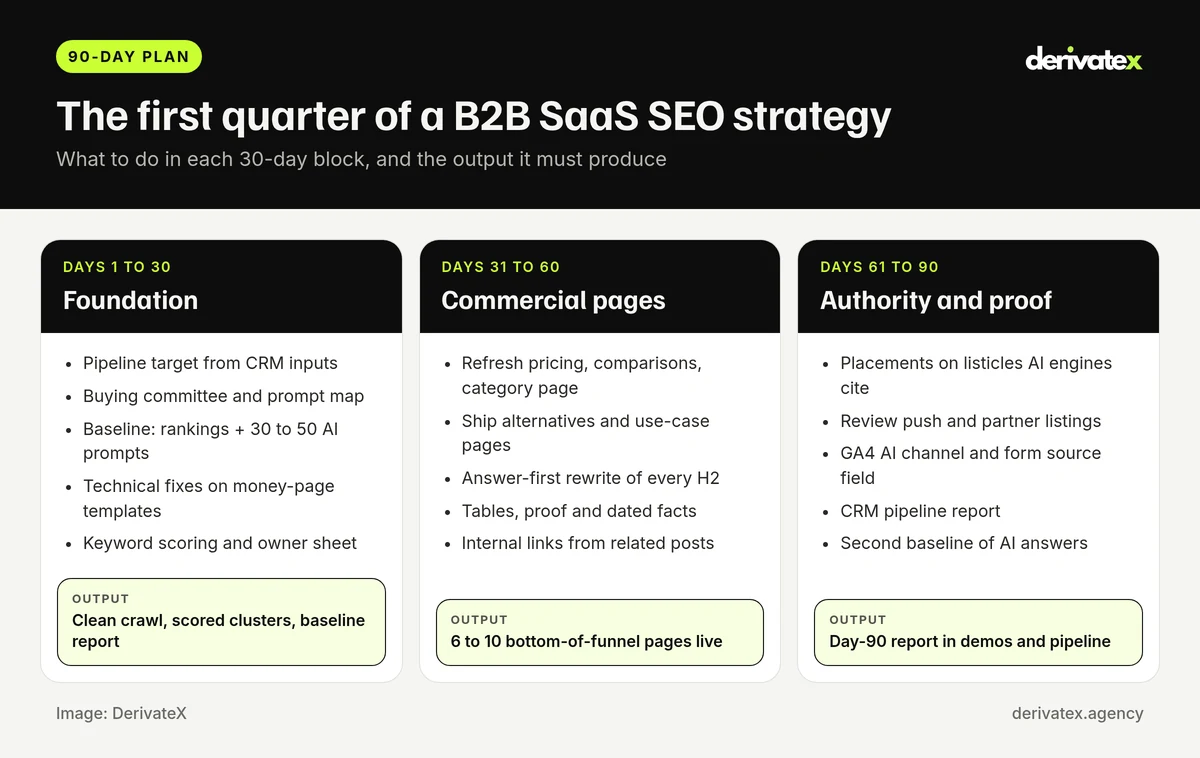
| Weeks | Focus | Output |
|---|---|---|
| 1 to 2 | Pipeline target, CRM inputs, buying committee map, baseline of rankings and AI answers | Target sheet and a baseline report for 30 to 50 buyer prompts |
| 3 to 4 | Technical audit and fixes on money-page templates; keyword scoring; ownership sheet | Clean crawl, scored cluster list, owner URL for every cluster |
| 5 to 8 | Refresh existing commercial pages; ship the first alternatives, comparison and use-case pages | 6 to 10 bottom-of-funnel pages live, answer-first, with tables and proof |
| 9 to 10 | Third-party placements on cited listicles, review push, partner listings | First placements live on sources AI engines already cite |
| 11 to 12 | Measurement: AI channel in GA4, self-reported field, CRM report; second baseline | Day-90 report: prompts won, sessions, demos and pipeline against the target |
Typical timing: technical fixes show within weeks, refreshed commercial pages within one to three months, new pages within three to six, and AI answer changes vary by engine. Our guide to how long it takes to show up in ChatGPT citations breaks down the AI side.
What This Looks Like in Practice
Three DerivateX clients show different outcomes of the same approach. Each result is separate and specific to that client:
- REsimpli became the most cited and recommended real estate CRM for investors in ChatGPT within 90 days.
- Gumlet co-founder Divyesh Patel says close to 20 percent of its inbound revenue can be traced back to users who first discovered Gumlet through AI tools.
- Verito moved from an average Google position of 40 to the first page, and is cited and recommended on ChatGPT and Google AI Overviews for 40 of its commercial hosting queries.
None of these came from publishing more top-of-funnel posts. They came from the steps above: commercial pages, answer-first content, third-party placements and pipeline measurement. Results depend on the category, the starting point and the competition, which is why DerivateX commits to process, cadence and measurement, never to a ranking.
Who Should Run It: Budget and Team by Stage
The right setup depends on ARR, deal size and how much of the work your team can do in house. Content production is the part most teams can hire for. Third-party placement and AI measurement are the parts most teams struggle to staff.
| Stage | Typical setup | What to prioritize |
|---|---|---|
| Below $5M ARR | Founder or growth generalist plus freelancers | Pricing, two comparisons, one alternatives page, demo form source field |
| $5M to $50M ARR | One SEO lead plus an agency or senior partner for strategy, placement and measurement | The full 10 steps, with a quarterly pipeline target |
| Above $50M ARR | In-house SEO team with specialist support | Governance, scale across products and regions, programmatic pages |
DerivateX works with B2B SaaS companies between $5M and $50M ARR. Engagements start with a 90-day pilot at $5,000 a month plus about $1,100 in placement budget, so about $6,100 all in. See pricing, how much B2B SaaS companies spend on SEO and GEO by ARR stage and agency vs in-house hire.
8 Mistakes That Stall SaaS SEO Pipeline
- Starting with a keyword tool instead of a pipeline target. The plan fills with volume, not buyers.
- Publishing generic explainers Google already answers. They earn impressions and almost no clicks.
- Two pages for one query. Split signals, weaker rankings and weaker AI passages.
- Comparison pages that dodge the comparison. Buyers and AI engines both skip pages that will not name the competitor or the price.
- JavaScript-only content on money pages. Invisible to most AI crawlers.
- Counting backlinks instead of cited sources. A link from a page no engine reads does little for AI shortlists.
- No self-reported source field. AI-influenced demos hide inside “direct”.
- Judging the program at week six. Commercial pages need a quarter to read properly.
For agency-side warning signs, see 27 SaaS SEO agency red flags.
B2B SaaS SEO Strategy Checklist
Copy this into your planning doc and work down it.
- 12-month organic pipeline target agreed with finance.
- ACV, close rate, demo-to-opportunity rate and page conversion rate pulled from CRM and GA4.
- Buying committee mapped with the Google query and AI prompt for each role.
- Buyer language pulled from calls, tickets, reviews and Reddit.
- Every cluster scored on intent, fit, deal value, feasibility and AI overlap.
- One owner URL and page type per cluster, in one shared sheet.
- Pricing, top comparisons and category page refreshed first.
- Alternatives pages for the top three incumbents.
- Use-case and integration pages for the workflows and tools in most deals.
- Money pages server-rendered and readable without JavaScript.
- robots.txt reviewed for Googlebot, OAI-SearchBot, ChatGPT-User and PerplexityBot.
- Organization, Article, FAQ and product schema validated.
- Every H2 on money pages opens with a 40 to 60 word answer that names the brand.
- Baseline of 30 to 50 buyer prompts across ChatGPT, Perplexity, Gemini and Google AI.
- List of the third-party pages those engines cite, with a plan to appear on them.
- Review program running on G2 or Capterra.
- Overlapping posts merged; retired URLs with impressions given a live home.
- GA4 custom channel for AI referrals.
- “How did you hear about us?” field with AI options on every demo form.
- Monthly report in demos, pipeline and revenue, with AI-sourced demos as a separate line.
Frequently Asked Questions
What is a B2B SaaS SEO strategy?
A B2B SaaS SEO strategy is a ranked plan of the buyer queries a software company will own, the page that answers each one, and the measurement that ties those pages to demos and pipeline. In 2026 it covers Google results and AI answers from ChatGPT, Perplexity, Gemini and Google AI Overviews with the same set of pages.
How long does B2B SaaS SEO take to produce pipeline?
Technical fixes show within weeks, refreshed commercial pages within one to three months, and new commercial pages within three to six months. Plan to judge the program after a full quarter, measured in demos and pipeline, not after the first month of rankings.
Should B2B SaaS companies still write top-of-funnel content?
Yes, but less of it. Google AI Overviews answer most generic “what is” queries without a click, so top-of-funnel content earns its place only when it carries original data, a clear point of view or a tool, and links to a commercial page.
How is AI search changing SaaS SEO strategy?
AI search moves part of the shortlist into the answer itself. That raises the value of answer-first commercial pages, consistent brand facts, and mentions on the listicles, review sites, Reddit threads and YouTube videos AI engines cite. It also adds a new reporting line: demos from buyers who found you through an AI tool.
What is the 3-3-2-2-2 rule in SaaS?
The 3-3-2-2-2 rule, also called T2D3, is a growth benchmark from Battery Ventures: triple ARR for two years, then double it for three. For SEO planning it is a reminder to set the organic pipeline target from the growth plan, then size the number of commercial pages to hit it.
What is the 80/20 rule in SaaS SEO?
In SaaS SEO, the 80/20 rule means a small set of commercial pages produces most organic pipeline. In practice, 15 to 25 pages such as pricing, comparisons, alternatives, use cases and integrations usually carry the majority of demos, so they get built and refreshed first.
How much should a B2B SaaS company spend on SEO?
Spend follows stage and deal size. Companies between $5M and $50M ARR typically fund one in-house SEO lead plus an outside partner. DerivateX engagements start at $5,000 a month plus about $1,100 in placement budget, with a 90-day pilot.
The Bottom Line
A 2026 B2B SaaS SEO strategy is short and specific: a pipeline target, a scored list of buying queries, one owner page per query, bottom-of-funnel pages first, a clean technical layer, answer-first writing, mentions on the sources AI engines read, regular refreshes, and reporting in pipeline. Build the 20 pages that sit closest to a purchase before you build the 200 that sit furthest from it.
Want this run for you? DerivateX runs SEO and AI search for B2B SaaS companies between $5M and $50M ARR, measured through to pipeline. See our SaaS SEO agency service or get a free AI visibility audit to see which buyer prompts name your competitors instead of you.
Related reading
- B2B SaaS keyword research: 9 steps to a revenue-weighted keyword map
- SaaS keyword mapping: 7 page types every money keyword should belong to
- How B2B SaaS companies generate pipeline from SEO and AI search
- SaaS SEO pricing in 2026
- 10 best B2B SaaS SEO agencies
Written byApoorv SharmaCo-founder, DerivateX
Apoorv Sharma is the co-founder of DerivateX, a B2B SaaS SEO and Generative Engine Optimization agency that engineers AI citations in ChatGPT, Perplexity, Claude, and Gemini and connects them to demo bookings and revenue pipeline. He is the author of the 2026 AI Visibility Benchmark Report and the Citation Engineering methodology. He's also the brain behind "Found On AI" and has sold 2 of his companies previously
Reviewed byAyush SharmaHead of SEO & Content, DerivateX
Ayush Sharma is Head of SEO and Content at DerivateX, a full-service SEO and GEO agency for B2B SaaS. He focuses on SEO, GEO, and AI visibility for software brands, helping them get found and cited across Google, AI Overviews, ChatGPT, Perplexity, Gemini, and Claude, with results measured through to pipeline. On the DerivateX blog he covers AI visibility tracking, how LLMs choose which sources to cite, technical and JavaScript SEO for SaaS sites, and attributing AI search to revenue in HubSpot.
Cited by AI