Case study: Gumlet turned ChatGPT mentions into 20% of inbound revenue. Read it →

50 ChatGPT Prompts to Audit Your B2B SaaS AI Visibility (Copy-Paste Library)

The exact prompts, setup, and scoring we use to find out whether ChatGPT, Perplexity, Claude, and Gemini actually recommend a B2B SaaS brand, and what to fix when they don't.

TL;DR
- Asking ChatGPT one question about your category is a vibe check, not an audit, because AI answers shift across runs, across models, and depending on whether you are logged in.
- This library gives you 50 copy-paste prompts split into nine buckets that test whether AI knows your brand, shortlists it, recommends it, and describes it correctly.
- Run every prompt logged out with memory off, three times each, across ChatGPT, Perplexity, Claude, and Gemini, then score each answer as fail, partial, or pass.
- Each failing bucket points to a specific layer of your off-site citation surface, so the audit tells you what to fix first instead of leaving you with screenshots.
- When we scored 50 B2B SaaS brands in our 2026 benchmark, almost half would not earn a spot in an AI top-three for their own category, so expect your first run to sting.
You typed your category into ChatGPT, asked it for the best tools, and watched a competitor get named while your brand sat in silence. Maybe it named you but described the wrong product, or quoted a price you retired two years ago. The honest problem is that you have no idea how often this happens, because you checked once and moved on.
That single check is the mistake. AI answers are not fixed, since the same prompt returns different brands across runs, across models, and depending on whether you are signed in, so one screenshot tells you almost nothing about your real AI visibility. A proper AI visibility audit is a structured set of prompts you run the same way every time and score against a rubric, not a question you ask on a slow afternoon.
This piece hands you 50 ChatGPT prompts you can paste today, a five-minute setup that makes the results repeatable, and a clear map from every failed prompt to the fix that closes the gap. The prompts are written as the actual questions your buyers type, so the audit reflects real demand instead of vanity queries. Before the prompts, you need to know what this audit is measuring, and why your Google rankings cannot answer that for you.
What an AI visibility audit actually measures (and why one ChatGPT query lies to you)
An AI visibility audit measures three things: whether AI engines recognize your brand, whether they include it in category shortlists, and whether they recommend it for specific buyers. It scores those across repeated runs and multiple platforms, which is exactly what a single ChatGPT query cannot do.
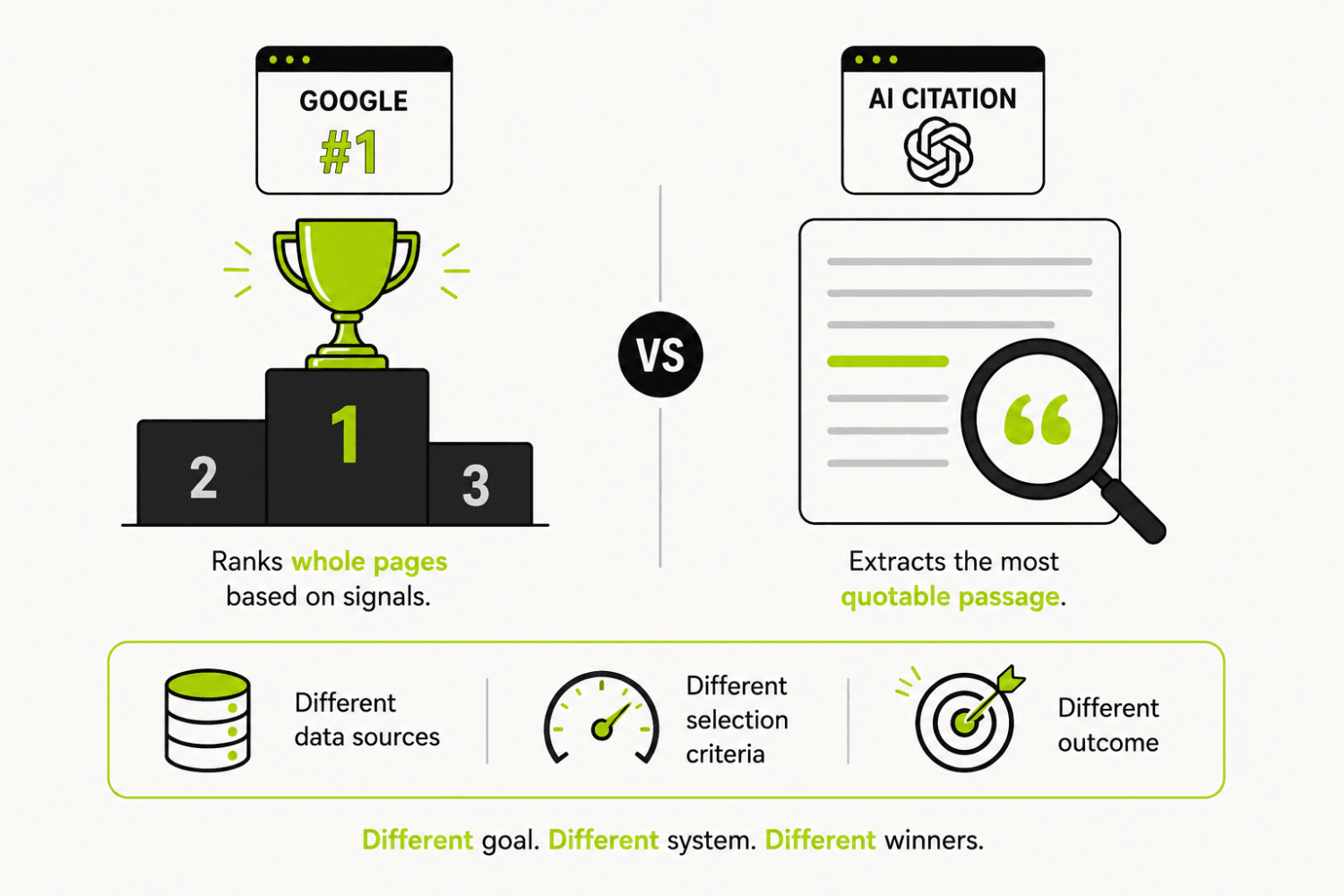
Your Google ranking answers a different question than your AI visibility does. You can sit at position one for a keyword and stay completely absent when a buyer asks ChatGPT to recommend a tool, because AI engines pull from review sites, forums, and third-party roundups rather than the live search results you optimized for. Treating the two as the same scoreboard is how teams convince themselves they are fine while deals quietly route to competitors. We unpack that split in our B2B SaaS AI search visibility guide.
The overlap between the two is smaller than most teams assume. Semrush’s 2025 analysis found that only about one in nine domains gets cited by both ChatGPT and Perplexity, and audits by VisibleIQ put the average company at visibility on just two of five major AI platforms. Your presence on one engine says little about the other four.
There is a second reason one query lies to you, and it is mechanical. Ask the same question twice and the model can name a different set of brands each time, which means a single answer is a roll of the dice, NOT a reading. That variance is why repetition is built into the setup below.
How to run these prompts so your results are actually reproducible
Run every prompt in a clean, logged-out session, repeat it three times per platform, and test all four major engines before you trust a single number. Reproducibility is the difference between an audit and an anecdote.
The five-minute setup
Follow these steps in order before you paste a single prompt:
- Open a fresh incognito window or log out of each AI tool, so past chats and personalization do not skew the answer.
- Turn off ChatGPT memory and clear any custom instructions, which otherwise feed the model context your buyers will never have.
- Run each prompt three separate times per platform, in new chats, and record all three outputs.
- Repeat the full set across ChatGPT, Perplexity, Claude, and Gemini, because each engine weighs sources differently.
- Log four data points per answer: was the brand named, described correctly, recommended, and which sources were cited.
The repetition is the part teams skip and the part that matters most. One pass gives you a mood, while three passes per engine give you a pattern you can act on. When a brand shows up in two of three runs on ChatGPT but zero of three on Gemini, that gap is a real finding, not noise.
How to score each answer as a fail, partial, or pass
Score every answer on a simple four-point scale: fail if your brand is not named, partial if it is named without description, pass if it is described correctly, and strong pass if it is recommended for a specific buyer. Tally those across all prompts and engines to get one comparable number.
| Score | What the answer did | What it means | Priority |
|---|---|---|---|
| Fail (0) | Brand not mentioned at all | AI does not know you exist for this query | Highest |
| Partial (1) | Named in a list, no description | Recognized but not understood | High |
| Pass (2) | Described correctly with what it does | Understood, not yet preferred | Medium |
| Strong pass (3) | Recommended for a specific buyer or use case | AI actively steers buyers to you | Maintain |
Add up your scores and convert them to a percentage of the maximum possible. Averi’s 2026 benchmarking suggests a recommendation rate between 20 and 30 percent across your tracked prompts marks meaningful visibility, while anything under 10 percent means you are effectively invisible. This rolls up neatly into our AI Visibility Score framework, which puts the same idea on a 0 to 100 scale.
The 50 ChatGPT prompts to audit your B2B SaaS AI visibility
Here is the library. Swap the placeholders for your real brand, category, ICP, competitor, and constraints, then run each prompt through the setup above. The prompts move from basic recognition to sharp, buyer-specific questions, because that is the order in which AI visibility tends to break.
Entity recognition prompts (does AI even know who you are)
These six prompts test the floor: whether the model can identify your brand and describe it without inventing details. If a model cannot clear this, nothing downstream works.
- "What is [Brand] and what does it do?"
- "Tell me about [Brand] as a company, including its main product and who it serves."
- "What category of software does [Brand] belong to?"
- "Who is [Brand] best suited for?"
- "What problem does [Brand] solve, and for which type of team?"
- "Summarize [Brand] in three sentences for someone who has never heard of it."
A blank or wrong answer here is an entity problem, not a content problem. The fix lives in your knowledge graph signals and consistent brand descriptions across the web, which is also how you fix brand hallucinations on ChatGPT. This is where most brands fail first: in a 2026 audit of 40 SaaS brands, fewer than a third cleanly passed basic entity recognition, and upgrading the model did not move the number.
Category inclusion prompts (are you on the “best [category]” shortlist)
These six prompts check whether you appear when a buyer asks AI to list the best options in your category. Shortlists are where most B2B deals now begin.
- "What are the best [category] tools in 2026?"
- "List the top [category] platforms for [ICP]."
- "Which [category] software should a growing [ICP] consider?"
- "Give me a shortlist of [category] tools to evaluate."
- "What are the leading alternatives in the [category] space right now?"
- "If I am comparing [category] vendors, which ones should be on my list?"
Missing from the shortlist usually means your comparison and roundup presence is thin off your own domain. VisibleIQ’s audits find that comparison and best-for queries account for most of the prompts that influence B2B SaaS pipeline, so this bucket carries real weight.
Recommendation prompts (does AI recommend you for a specific buyer)
These six prompts test the highest-value outcome: a fit-based recommendation tied to a real buyer and constraint.
- "Which [category] tool is best for a [ICP] that needs [constraint]?"
- "I run [ICP] and care most about [priority]. Which [category] tool should I pick?"
- "What is the best [category] software for a team of [size] on a [budget] budget?"
- "Recommend a [category] tool that integrates with [tool] and handles [use case]."
- "We are switching from spreadsheets to a [category] tool. What do you recommend for [ICP]?"
- "What [category] tool do you recommend for [specific industry] companies?"
A recommendation is the difference between being known and being chosen. When AI describes you but recommends someone else, the gap is usually validation: case studies, third-party reviews, and use-case content that proves fit. This is the most expensive bucket to fail and the slowest to fix.
Competitor and alternative prompts (do you show up against rivals)
These six prompts reveal whether you surface in the comparisons and switching moments where shortlists narrow.
- "What are the best alternatives to [Competitor]?"
- "[Competitor] vs [Brand]: which is better for [use case]?"
- "I am unhappy with [Competitor]. What should I switch to?"
- "Compare the top three [category] tools on pricing and features."
- "Who competes with [Competitor], and how do they differ?"
- "Is there a cheaper alternative to [Competitor] for [ICP]?"
If rivals own the alternative-to queries and you are absent, you are losing buyers at the exact moment they are ready to leave someone else. Two reads worth your time here: our competitor citation steal prompt for taking those queries back, and what to do when ChatGPT recommends a competitor instead of you.
Objection and buying-risk prompts (what AI says when buyers get specific)
These five prompts surface how AI handles the doubts that kill deals: price, security, reliability, and switching cost.
- "Is [Brand] worth the price?"
- "Is [Brand] secure and enterprise-ready?"
- "What are the downsides or limitations of [Brand]?"
- "Is [Brand] hard to migrate to from [Competitor]?"
- "What do users complain about with [Brand]?"
Buyers ask AI the awkward questions they would never ask your sales team. If the model parrots an outdated complaint or invents a weakness, that answer shapes the deal before you are in the room. Treat anything false here as urgent.
Query fan-out prompts (test the sub-questions AI runs in the background)
These six prompts mirror the fan-out an engine performs, where one buyer question quietly expands into several sub-queries before the answer is built.
- "Break my question 'best [category] tool for [ICP]' into the sub-questions you would research to answer it."
- "What related questions would you check before recommending a [category] tool?"
- "When someone asks for the best [category] software, what criteria do you compare vendors on?"
- "What would you need to know about [Brand] to confidently recommend it for [use case]?"
- "List the follow-up questions a buyer usually asks after 'what are the best [category] tools'."
- "What sources and data points would you gather to compare [Brand] and [Competitor]?"
This bucket tells you which sub-topics decide the answer, so you can see the gaps before the model does. If the fan-out surfaces criteria you have no content for, that is your next brief. Understanding how LLMs decide what to cite makes these outputs far more useful.
Citation source prompts (which sources AI trusts in your category)
These five prompts expose the off-site surfaces an engine leans on, so you learn where to earn presence next.
- "What sources would you cite to recommend a [category] tool?"
- "Which review sites do you trust most for [category] software?"
- "Where do you get information about [category] vendors?"
- "What publications or communities cover [category] tools well?"
- "If you compared [category] tools, which websites would you pull data from?"
The named sources are your roadmap. If the model leans on a review site or a roundup where you have no presence, that absence is a direct line to a missing citation. Our B2B SaaS AI Citation Study breaks down which source types carry the most weight across categories.
Hallucination and accuracy prompts (is AI confidently wrong about you)
These five prompts check whether the model states false facts about your brand with total confidence.
- "Summarize [Brand]'s pricing and plans."
- "What features does [Brand] offer?"
- "When was [Brand] founded and where is it based?"
- "What integrations does [Brand] support?"
- "Who are [Brand]'s typical customers?"
A confident wrong answer is worse than no answer, because the buyer has no reason to doubt it. Log every factual error, then trace it to the outdated or missing source the model is reading. Correcting the source is how the correction sticks.
Self-scoring meta-prompts (make the model grade itself)
These five prompts turn the model into your scorer, so half the audit runs itself.
- "Score from 0 to 3 how well you can recommend [Brand] for [ICP], and explain the score."
- "On a scale of 0 to 100, how visible is [Brand] in your knowledge of the [category] space? Justify it."
- "Rate your confidence in describing [Brand] accurately, and list what you are unsure about."
- "Compare [Brand] and [Competitor] on recognition, description quality, and recommendation, in a table."
- "If a buyer asked you for the top three [category] tools, where would [Brand] rank, and why?"
The model’s self-assessment is not gospel, but it is a fast way to structure your notes and spot where your weakest signals sit. Paste the table it returns straight into your tracking sheet. Treat it as a starting hypothesis, then confirm it against the runs you logged.
How to turn your audit results into an action plan
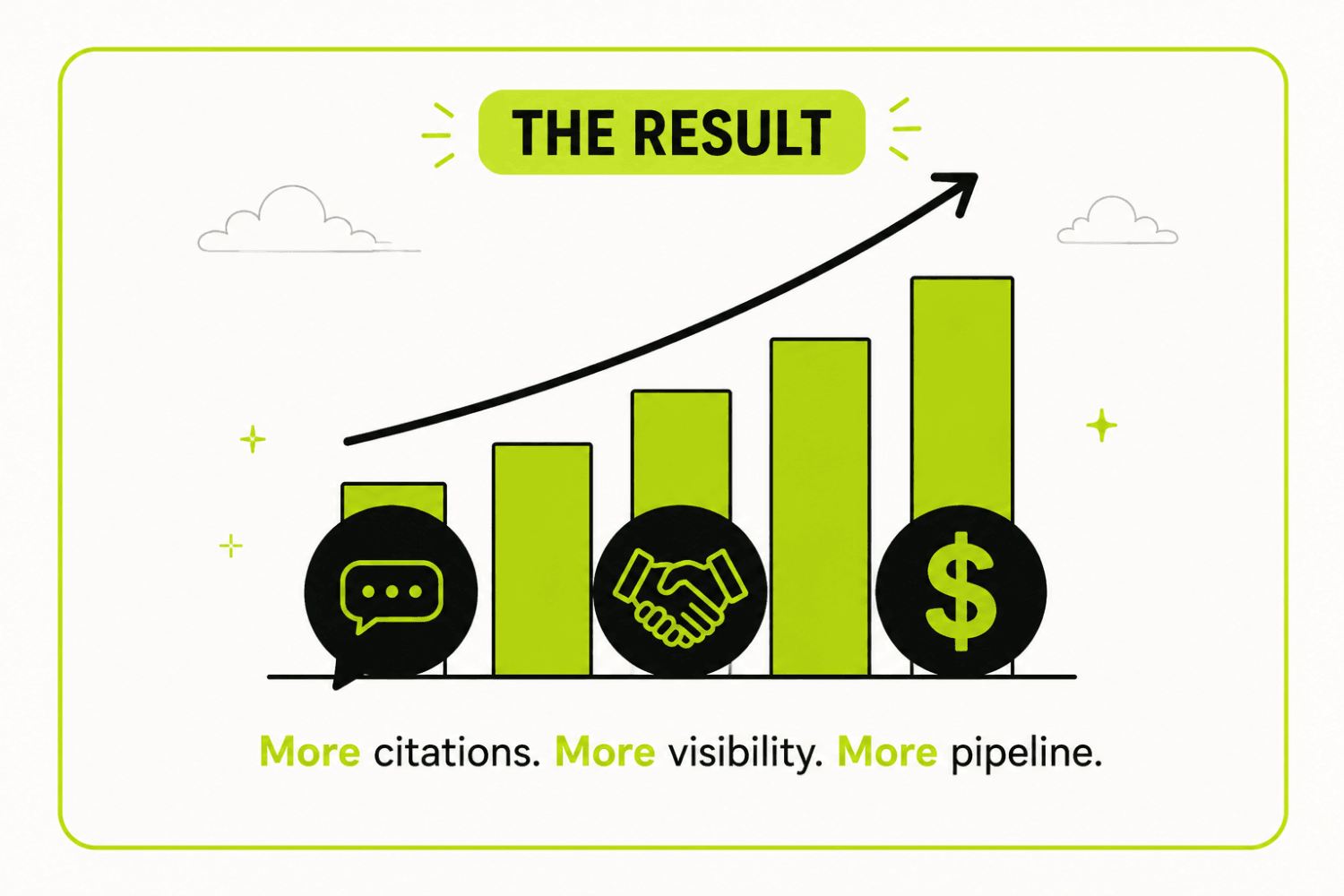
Your results are not a report card, they are a map: every failing bucket points to a specific layer of your off-site presence that needs work. The skill is fixing the layer that is leaking, not pouring more effort into the one that already works.
Most of what gets a B2B SaaS brand cited lives off your own domain, on what we call the citation surface. Entity failures trace back to knowledge graph and brand consistency, shortlist failures to comparison and roundup presence, and recommendation failures to validation and use-case proof. Map each weak bucket to its layer using the citation surface map, then work the leak.
Once you know the layer, the LLM SEO checklist gives you the on-page and technical steps to act on it. The order matters more than the volume: a brand with strong content and weak entity signals should fix the entity signals first, because the content cannot get cited if the model does not know who wrote it.
This sequencing is how results actually happen. REsimpli went from invisible to the top ChatGPT recommendation for real estate CRM within 90 days by repairing the leaking layers in order, not by publishing more. Gumlet now credits roughly a fifth of its inbound revenue to AI engines and holds well over a hundred active citations across its category, a pattern we documented in our 2026 AI Visibility Benchmark.
How often to re-run the audit and which metrics to track
Re-run the full audit monthly for the first quarter, then quarterly, because AI retrieval patterns shift and a win in March can quietly erode by June. Track four metrics over time, not raw citation counts:
- Inclusion rate: the share of prompts where your brand is named at all.
- Recommendation rate: the share where AI actively recommends you, which is the number tied to pipeline.
- Share of voice: how often you appear versus named competitors on the same prompts.
- Description accuracy: whether the model gets your product, pricing, and positioning right.
Weight your prompt set toward revenue queries, the ICP-specific, use-case, and competitor-alternative questions, rather than broad definitional ones. A high score on “what is [category]” feels good and books no demos. Most teams discover on their first audit that the bulk of their visibility sits on prompts that never produce a buyer.
The reason this is worth the monthly effort is conversion. Across our client base, traffic that arrives from AI engines converts at roughly 14 percent, against under 3 percent from Google organic, which makes AI visibility a pipeline lever and not a vanity dashboard.
FAQ
How do I check if my brand shows up in ChatGPT?
Open ChatGPT in a logged-out or incognito window with memory turned off, then ask it the questions your buyers ask, like “what are the best [your category] tools” and “which [category] tool is best for [your buyer type].” Run each question three times, because answers vary between runs. Note whether your brand is named, described correctly, and recommended. Repeat the same prompts in Perplexity, Claude, and Gemini, since each engine pulls from different sources. The pattern across all three runs and four engines, not any single answer, tells you how visible you actually are.
Does ChatGPT give different answers to the same question every time?
Yes. The same prompt can return a different set of brands across runs, across models, and depending on whether you are signed in or have memory enabled. That is why a single screenshot is unreliable as an audit. The fix is repetition: run each prompt at least three times in fresh chats and read the pattern rather than one output. If your brand appears in two of three runs, that is a partial result worth tracking. If it never appears across repeated runs and multiple engines, that is a genuine visibility gap, not a fluke.
How many prompts do I need for a real AI visibility audit?
Aim for at least 40 to 50 prompts per category, spread across entity recognition, category shortlists, recommendations, competitor comparisons, and objections. Fewer than that and you are sampling too little of how buyers actually ask. The exact count matters less than the spread: a set heavy on definitional questions will flatter you, while a set weighted toward buyer-specific and competitor-alternative questions reflects real pipeline. If you sell to more than one buyer type, run a separate set for each, because AI recommends differently for a startup than for an enterprise.
Isn’t running 50 prompts overkill when I can just ask ChatGPT once?
Asking once feels efficient and produces the wrong conclusion. A single answer is shaped by your login state, your past chats, and the random variation built into how models respond, so it can show your brand on a lucky run and hide it on the next. Fifty prompts run three times across four engines costs you two to three hours and replaces a guess with a pattern you can act on. The point is not volume for its own sake, it is reading direction instead of reacting to one screenshot. That is the line between an audit and an anecdote.
Why does ChatGPT recommend my competitor instead of me?
Usually because your competitor has stronger presence on the off-site sources AI trusts, like review sites, comparison roundups, and third-party articles, even if you outrank them on Google. AI engines build recommendations from this wider surface, not from your live search position. The fix is to find which sources the model cites for your category, using the citation-source prompts in this library, then earn presence where you are missing. Accurate, well-structured pages on your own site help, but the recommendation usually turns once the third-party signals catch up.
Is my Google ranking the same as my AI visibility?
No, and treating them as the same is a common and costly mistake. You can rank first on Google for a term and still be absent when a buyer asks ChatGPT to recommend a tool, because AI engines pull from sources that sit outside the search results you optimized for. The two are separate scoreboards measured against different surfaces. Checking your rankings tells you nothing about whether AI recommends you, which is why a dedicated AI visibility audit exists. For how long the gap takes to close, see our piece on how long it takes to get cited by ChatGPT.
The audit is the cheap part
The brands that win AI search are not the ones with the most content, they are the ones who treat AI visibility as something they can measure and repair on a schedule. Running this library once will tell you more about your real standing with buyers than a year of rank tracking.
Block two hours this week, paste these 50 prompts through the five-minute setup, and score every answer. You will end with a ranked list of leaking layers and a clear first fix, which is more than most of your competitors have. If you want the short version before you run all 50 by hand, our free AI visibility checker scores where you sit on a 0 to 100 scale in a few minutes.
AI engines are getting better at recommending the right vendor, not just the loudest one, which means the gap between brands that audit and brands that guess will only widen. The teams running this audit monthly are building a record of what moves their visibility, while everyone else is still asking ChatGPT one question and hoping. Start that record now.
Written byApoorv SharmaCo-founder, DerivateX
Apoorv Sharma is the co-founder of DerivateX, a B2B SaaS SEO and Generative Engine Optimization agency that engineers AI citations in ChatGPT, Perplexity, Claude, and Gemini and connects them to demo bookings and revenue pipeline. He is the author of the 2026 AI Visibility Benchmark Report and the Citation Engineering methodology. He's also the brain behind "Found On AI" and has sold 2 of his companies previously
Cited by AI