Case study: Gumlet turned ChatGPT mentions into 20% of inbound revenue. Read it →

What Is Brand Grounding? How LLMs Verify B2B Vendor Claims


TL;DR
- LLMs do not take your website at face value. Before citing a vendor, they cross-reference your claims against editorial mentions, review platforms, and third-party sources to build a trust profile for your brand.
- Brand grounding is the deliberate practice of engineering the signals LLMs need to cite your company confidently: consistent entity definition, external corroboration, and structured, extractable content.
- Most B2B SaaS companies are invisible in AI search, not because their content is weak, but because nothing outside their own properties confirms what they claim.
- Brand grounding is measurable. The AI Visibility Score (AVS) tracks citation presence across ChatGPT, Perplexity, Claude, and Gemini across the prompts your buyers are actually running.
Strong Google rankings and consistent content output used to mean you were in the conversation. In AI search, they mean almost nothing on their own.
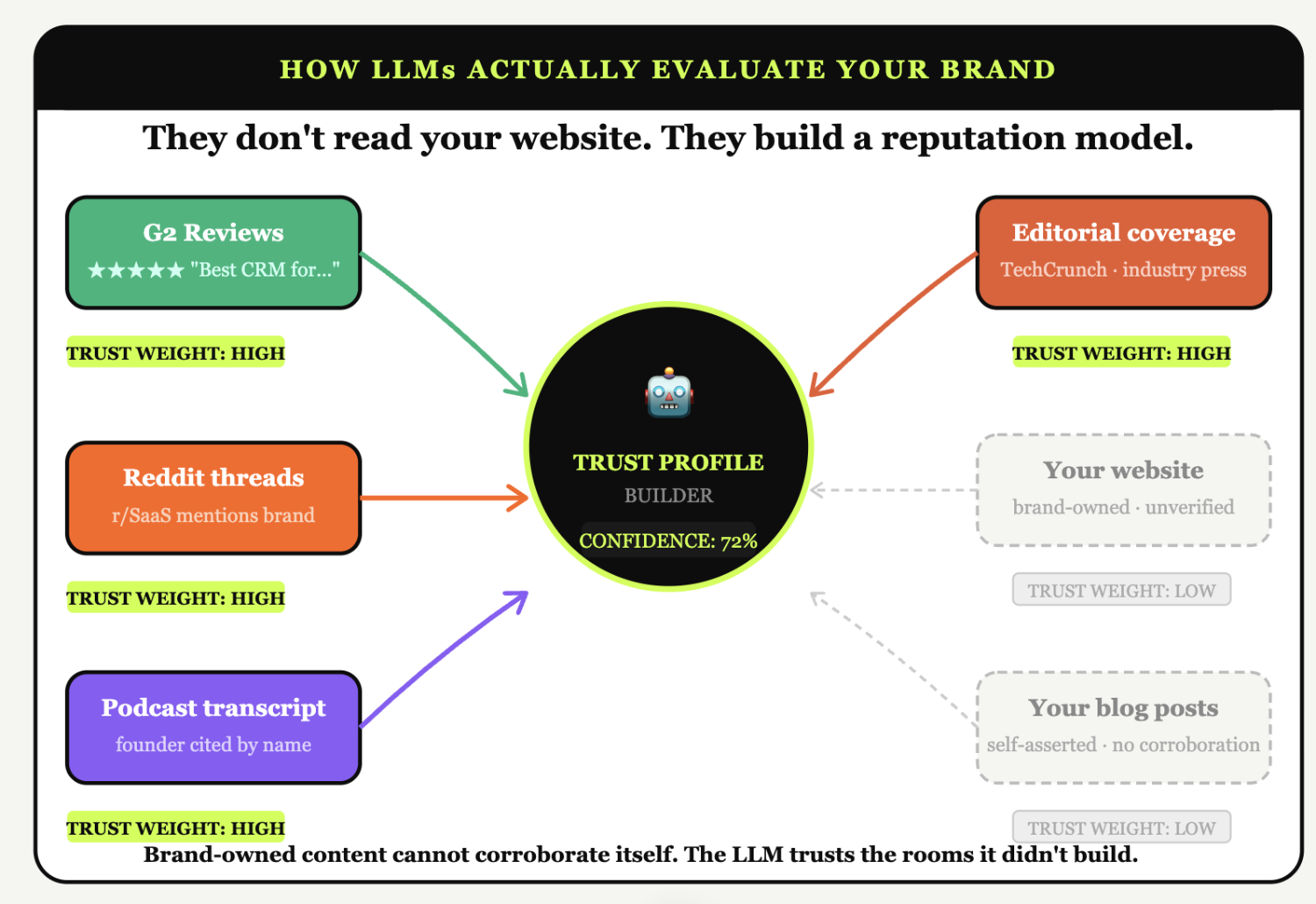
The brands showing up in ChatGPT and Perplexity vendor recommendations aren’t necessarily the best-ranked. They’re the most legible to a language model.
This is not a content problem. A DerivateX benchmark report across 50 B2B SaaS companies and 1,400 buyer-intent prompts found that 44% scored below 50 out of 100 on AI presence, and the gap between the best and worst performers was 87 points despite both running active marketing programs.
The variable wasn’t content volume. It was whether LLMs had enough consistent, independently corroborated information to trust the brand enough to cite it.
This is not a niche concern. By 2026, roughly a quarter of B2B buyers will be using generative AI instead of traditional search for vendor research, which means the shortlist is increasingly built before a buyer ever lands on your site.
The mistake most marketing teams make is treating AI search visibility as a downstream effect of SEO. Get the rankings, publish the content, and the citations follow. They don’t. LLMs build something closer to a reputation model for each brand they encounter. They cross-reference what you say about yourself against what independent sources say, look for consistency, and assign a confidence level to your entity.
Low confidence means the model cites someone else, and you lose the deal before a rep is ever in the room.
That process has a name: Brand grounding. This piece explains what it means in a B2B marketing context, how LLMs actually verify vendor claims, why most SaaS companies fail that verification, and what a systematic fix looks like.
What Is Brand Grounding?
Brand grounding is the deliberate practice of ensuring LLMs have consistent, corroborated, and structured information about your B2B company across enough independent sources to cite you confidently in vendor-recommendation responses.
It is not a technical infrastructure concept, though the term gets used that way in machine learning circles (where “grounding” refers to connecting AI outputs to live external data via RAG). That is a different problem with a different solution.
Brand grounding, as it applies to B2B marketing, is about what an LLM finds when it looks for your company specifically: whether the information is consistent, whether independent sources confirm what you claim, and whether the content is structured well enough for the model to extract and attribute it accurately.
Most B2B SaaS companies have never thought about this deliberately. They publish content, run SEO, and assume visibility follows. In traditional search, that assumption held well enough. In AI search, it doesn’t, because LLMs evaluate brands differently than search engines rank pages.
How LLMs Actually Verify Vendor Claims
It also doesn’t treat your buyer’s question as one query. A prompt like “best [category] tool for a mid-market B2B team” gets broken into smaller sub-queries: the category, the segment, the use case, the price tier. The model resolves each one separately, then assembles a shortlist from the brands that surface cleanly across all of them.
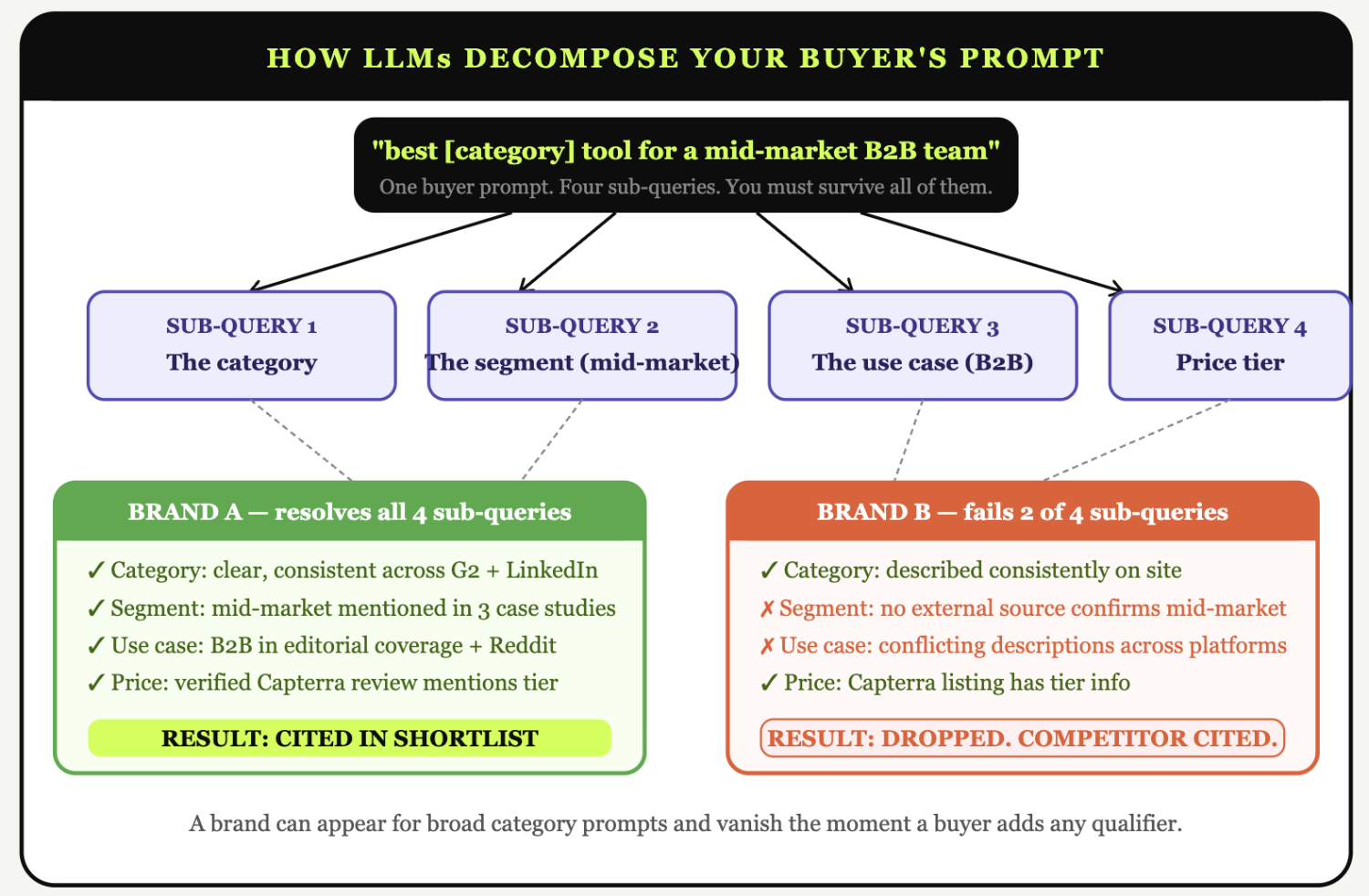
This is why a brand can show up for a broad category prompt and vanish the moment the buyer adds a qualifier. If your entity isn’t consistent across every sub-query, you never make the composite answer.
Your Own Content Is Not Enough
The single most important thing to understand about LLM citation behavior is that brand-owned content cannot corroborate itself.
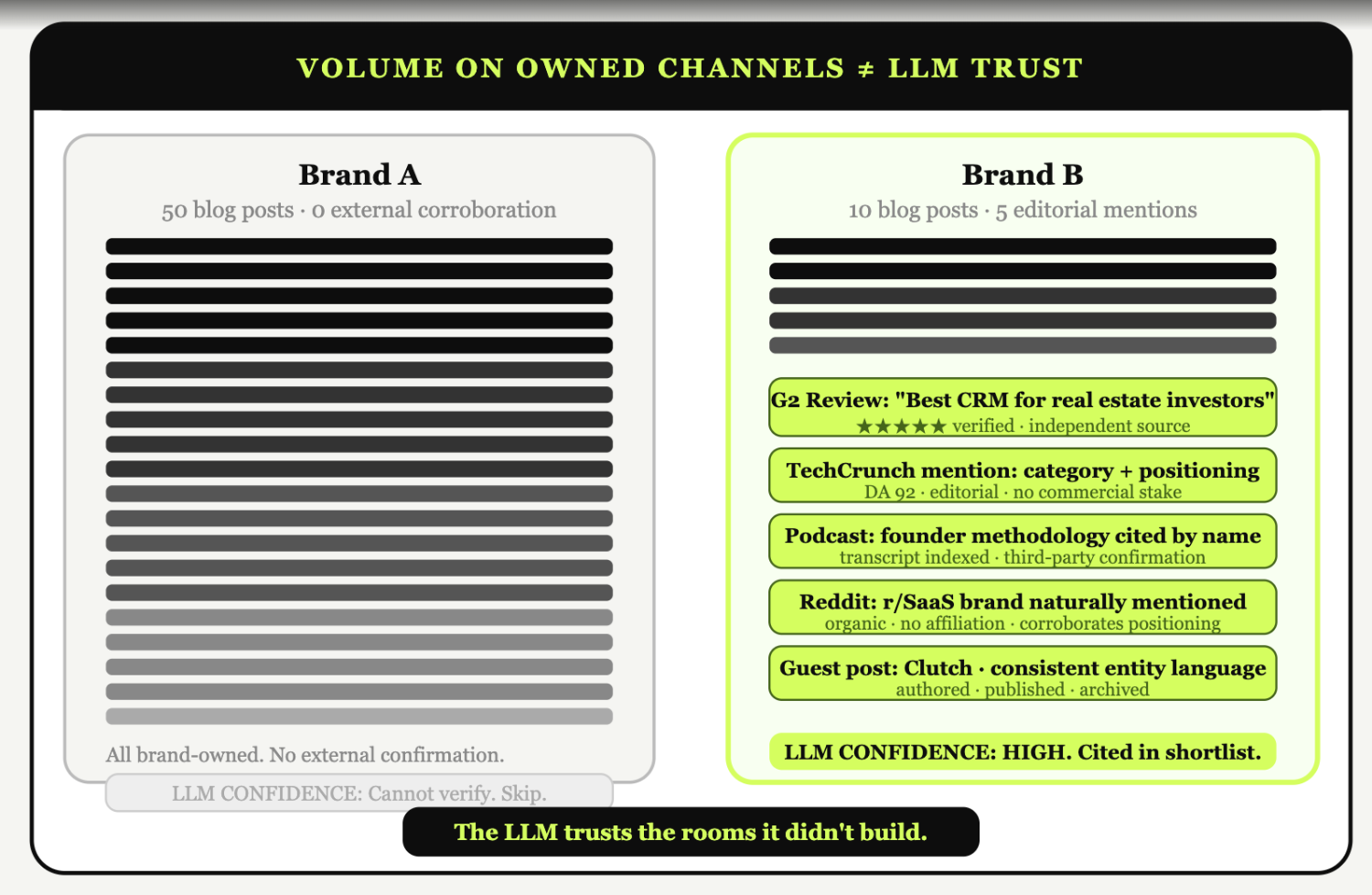
Your website, your blog, your LinkedIn company page, and your case studies are all properties you control. An LLM recognizes this. When it encounters a claim on your website, it looks for confirmation of that claim somewhere you don’t control. If it doesn’t find it, the claim is effectively unverified.
This is fundamentally different from how Google evaluates content. A well-optimized page can rank because it earns links and demonstrates topical authority. That same page may not earn an LLM citation because the model finds no external confirmation for what it says.
The signals that move AI citations are not page-level. Research consistently points to three off-site factors as the strongest predictors of LLM citation:
- branded web mentions,
- branded anchor text, and
- branded search volume.
None of them lives in your domain.
The asymmetry is large. Independent analyses have found that brands are several times more likely to be cited through third-party sources than through their own domains. The model trusts the rooms it didn’t build.
The Corroboration Test
LLMs weight claims that appear consistently across multiple independent sources far more heavily than claims that appear on a brand’s properties alone.
Independent means sources the brand does not control: guest posts on legitimate publications, verified customer reviews on G2 or Capterra, podcast transcripts where the brand’s methodology is discussed by name, analyst mentions, and editorial coverage. Each of these tells the model that a source with no stake in your success has confirmed your category, your positioning, or your results.
A brand with 50 blog posts and no external footprint is less legible to an LLM than a brand with 10 blog posts and five independent editorial mentions. Volume on owned channels does not substitute for external confirmation.
What Happens When the Model Can’t Resolve Your Brand
When an LLM encounters inconsistent or unconfirmed information about a brand, it doesn’t guess. It defaults to a competitor that it can resolve cleanly.
If your website describes you as “an AI-powered sales automation platform,” your G2 profile says “CRM software,” and a TechCrunch mention calls you “a sales engagement tool,” the model encounters three competing entity definitions. That fragmentation signals unreliable data. The brand gets excluded from the recommendation output, not because the model dislikes it, but because the model can’t construct a stable, confident answer that includes it.
This is why companies with strong SEO rankings disappear from AI vendor shortlists. The page-level signals that earned the ranking don’t resolve the entity-level ambiguity that determines the citation.
How to Fix It: The Citation Engineering Framework
Brand grounding doesn’t happen by publishing more content. It happens by engineering specific, measurable signals across five levers. Here is what each lever does and why it matters to an LLM’s verification process.
Lever 1: Entity Clarity
The brand name, category, value proposition, and target customer must be defined identically across every touchpoint: website, LinkedIn, G2 profile, guest post bios, press coverage, and partner directories.
This is not brand consistency in the traditional marketing sense. It is machine legibility, what practitioners increasingly call entity optimization. The goal is a single, stable entity definition that the LLM can resolve without ambiguity.
A quick diagnostic: pull your website’s About section, your LinkedIn company description, your G2 listing headline, and your most recent guest post bio into one document. If they describe the company differently, you have an entity clarity problem, and it is costing you citations.
Lever 2: Citable Depth
Citable depth means publishing on your own domain at sufficient depth that LLMs can extract specific, attributable claims from your content.
Citable claims are specific and verifiable. “We help SaaS companies grow” is not citable. It is the kind of generic category language that leaves B2B SaaS brands invisible in AI search.
“REsimpli became the top ChatGPT recommendation and citation for ‘Real Estate CRM’ within 90 days” is citable because it is specific, attributed, and verifiable. Every major section of your content needs at least one claim of that quality. FAQ sections, comparison tables, and definition-forward H2 structures are the formats LLMs extract from most reliably.
Lever 3: Third-Party Corroboration
Corroboration is the lever most B2B SaaS companies have never touched, and it is the one that moves AI citations most directly.
Guest posts on relevant publications, Reddit threads where your methodology is referenced by name, podcast appearances, G2 and Clutch reviews that use the same language your brand uses to describe itself, and editorial mentions all serve the same function: they tell the LLM that an independent source with no stake in your success has confirmed your category, your positioning, or your results.
Gumlet now attributes more than 20% of its direct monthly inbound revenue to ChatGPT, Perplexity, and Claude after a GEO engagement that specifically built this corroboration layer. The corroboration layer is what converted Gumlet’s owned content into something LLMs were willing to cite at scale.
Lever 4: Result Documentation
LLMs weight branded proof points heavily in recommendation contexts. A brand that has published specific, attributed, quantified client outcomes is more citable than one making category claims without evidence.
Result documentation means named case studies with specific outcomes, attributed quotes from named clients with their title and company, and proprietary data points tied to the brand. Verito moved from an average position of 40 on Google to the top LLM answer across high-intent buyer prompts like “QuickBooks hosting” after structured result documentation and entity clarity work. That outcome is citable precisely because it is specific, named, and verifiable.
Lever 5: Structured Parsability
Content architecture determines whether LLMs can extract, attribute, and reproduce your claims accurately, regardless of how good the underlying content is.
This means schema markup, consistent heading hierarchies, short answers placed before long explanations, and comparison tables with factual column values. A page that reads well for humans but buries the answer in the fourth paragraph fails the machine extraction test. The answer has to come first. Every time.
The five levers, side by side:
| Lever | What it signals to an LLM | Quick check |
|---|---|---|
| Entity clarity | One stable, resolvable definition of who you are | Do your site, LinkedIn, G2, and guest bios describe you identically? |
| Citable depth | On-domain claims specific enough to extract and attribute | Can you pull one named, quantified claim from every major section? |
| Third-party corroboration | Independent sources confirm your category and results | Do sources you don’t control use the same language you do? |
| Result documentation | Named, quantified outcomes the model can cite | Do your case studies name the client, the metric, and the timeframe? |
| Structured parsability | Content the extraction layer can read cleanly | Does the answer come before the explanation, with schema and clean headings? |
How to Measure Brand Grounding: The AI Visibility Score
Brand grounding without measurement is guesswork. The AI Visibility Score (AVS) is a 0-to-100 metric that tells you exactly where your brand stands in AI-generated vendor recommendations right now.
The scoring works across 20 target prompts run on ChatGPT, Perplexity, Claude, and Gemini simultaneously. Each prompt reflects a query your buyers are actually running. A named citation in the response earns 5 points. A linked citation earns 3 points. A contextual mention without a direct citation earns 1 point. The aggregate score across all prompts and all platforms is your AVS.
What the score tells you is not just whether you’re visible, but where specifically you’re losing.
You might be cited consistently on Perplexity but absent from ChatGPT entirely. You might appear for broad category queries, but disappear the moment a buyer asks something purchase-specific. You might be named but never linked, which signals that the model recognizes your brand but doesn’t trust it enough to send traffic. Each of those patterns points to a different lever in the Citation Engineering framework.
The AVS is a diagnostic, not a destination. The point is to identify the highest-leverage gaps, then close them systematically.
The Bottom Line
The brands appearing consistently in ChatGPT, Perplexity, and Gemini vendor recommendations are not there by accident. They have built the conditions LLMs require to cite brands confidently: a stable, consistent entity definition, enough independent corroboration to verify their claims, and content structured so the extraction layer can pull and attribute specific facts.
Brand grounding is the name for that process when it is done deliberately. Most B2B SaaS companies are not doing it deliberately. They are publishing content, running SEO, and assuming AI visibility will follow. It won’t, not without the corroboration layer and the entity consistency that LLMs actually evaluate.
If you want to know where your brand currently stands across the prompts your buyers are running, the AI Visibility Score audit is the starting point. It maps your citation presence across ChatGPT, Perplexity, Claude, and Gemini, identifies the specific gaps, and gives you a prioritized action list across the five Citation Engineering levers.
Frequently Asked Questions
1. How is brand grounding different from generative engine optimization (GEO)?
Brand grounding is the foundation GEO builds on. GEO covers the full scope of optimizing for AI-generated search: content architecture, structured data, entity signals, and corroboration building. Brand grounding specifically refers to the trust verification layer, the set of conditions LLMs require before they’ll cite a brand at all. You can’t do GEO effectively without solving brand grounding first.
AEO (answer engine optimization) is often used interchangeably with GEO. The same logic applies either way: brand grounding is the trust layer sitting underneath all of it.
2. Why isn’t my brand showing up in ChatGPT or Perplexity results?
The most common reason is that LLMs can’t verify your claims independently. If your external footprint is thin, meaning few editorial mentions, no consistent G2 or Clutch presence, and no third-party sources that use the same language your brand uses to describe itself, the model has no way to corroborate what your own site says.
It defaults to a competitor that it can resolve with confidence. The fix is not to have more content on your own domain. It is the same groundwork that decides whether you rank in ChatGPT at all: the corroboration layer and the entity consistency that make your owned content credible.
3. How long does it take to see results from brand grounding work?
Perplexity uses live retrieval, so new corroboration signals can influence citation within days. ChatGPT’s training-time knowledge updates on a longer cycle, but its search integrations respond faster. Most brands see measurable movement in their AI Visibility Score within 60 to 90 days of structured corroboration building, entity clarity work, and result documentation.
4. Does brand grounding apply to early-stage SaaS companies with limited content?
Yes, and early-stage companies actually have an advantage: there’s no corroboration debt to unwind. Building entity clarity and external corroboration from the start is significantly easier than correcting fragmented signals that have accumulated over the years. The five levers apply regardless of company size.
5. Can a brand be over-cited by LLMs in ways that hurt credibility?
Yes. If third-party sources describe your brand inconsistently, high citation volume can reinforce a fragmented entity definition rather than a clear one. Volume of mentions matters less than consistency of mentions. Ten corroborating sources that use identical category language outperform fifty that describe the brand differently.
6. What is the AI Visibility Score, and how is it calculated?
The AI Visibility Score (AVS) is a 0-to-100 metric scored across 20 target prompts on ChatGPT, Perplexity, Claude, and Gemini. A named citation earns 5 points, a linked citation earns 3 points, and a contextual mention earns 1 point. The aggregate score tells you where your brand currently stands and which platforms and prompt types represent the largest gaps.
7. How do LLMs decide which vendors to recommend?
They build a trust profile for each brand from every source they can reach, then look for consistency across those sources. Brands with a clear, corroborated, well-structured entity get cited. Brands the model can’t resolve cleanly get dropped in favor of a competitor it can.
8. Do third-party mentions really affect whether AI cites my brand?
More than anything, you publish yourself. Brand-owned content cannot corroborate itself, so independent sources (editorial coverage, G2 and Clutch reviews, podcast mentions, guest posts) are what move citations most directly. Ten sources describing you the same way outperform fifty pages on your own domain.
9. What makes a brand citable by an LLM?
A specific, verifiable claim that the model can attribute. “We help SaaS companies grow” is not citable. “REsimpli became the top ChatGPT recommendation for real estate CRM within 90 days” is, because it is named, quantified, and confirmable. Every major section of your content needs at least one claim of that quality.
Written byAlekhya RContent Writer, DerivateX
Focuses on SEO, AI search, and content, with an emphasis on how structured content drives visibility and pipeline for B2B SaaS companies.
Cited by AI