Case study: Gumlet turned ChatGPT mentions into 20% of inbound revenue. Read it →

What Signals Do LLMs Actually Use When Selecting Sources? (Beyond E-E-A-T)

The seven selection-layer signals B2B SaaS brands lose on, with the studies behind each one and the Monday move to close the gap.


TL;DR
- LLMs work in two layers: retrieval (which pages enter the candidate pool) and selection (which pages get cited from inside it). E-E-A-T mostly shapes retrieval. The selection layer is where most B2B SaaS brands actually lose visibility.
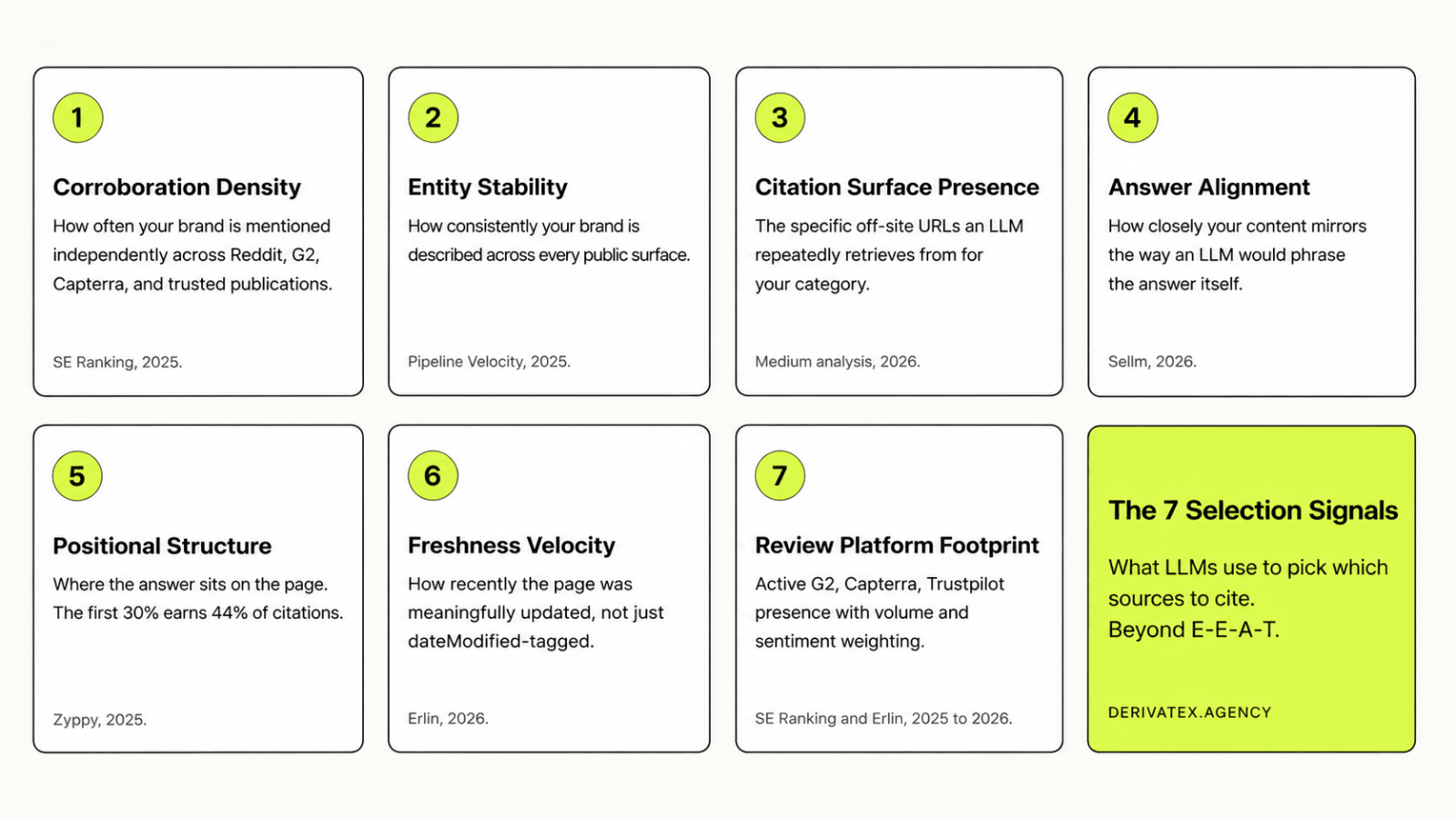
- Seven signals decide selection: corroboration density, entity stability, citation surface presence, answer alignment, positional structure, freshness velocity, and review platform footprint.
- A 2025 analysis of 129,000 domains by SE Ranking found that brands with millions of mentions on Reddit and Quora were roughly 4x more likely to be cited by ChatGPT than brands with minimal community presence.
- Roughly 44% of ChatGPT citations are pulled from the top third of a page, based on Zyppy’s 2025 positional analysis. Burying the answer is the single most common reason a strong page gets skipped.
- llms.txt files show a negligible impact on citation rates in the current public datasets. The real moves live off-site, in your citation surface and entity consistency.
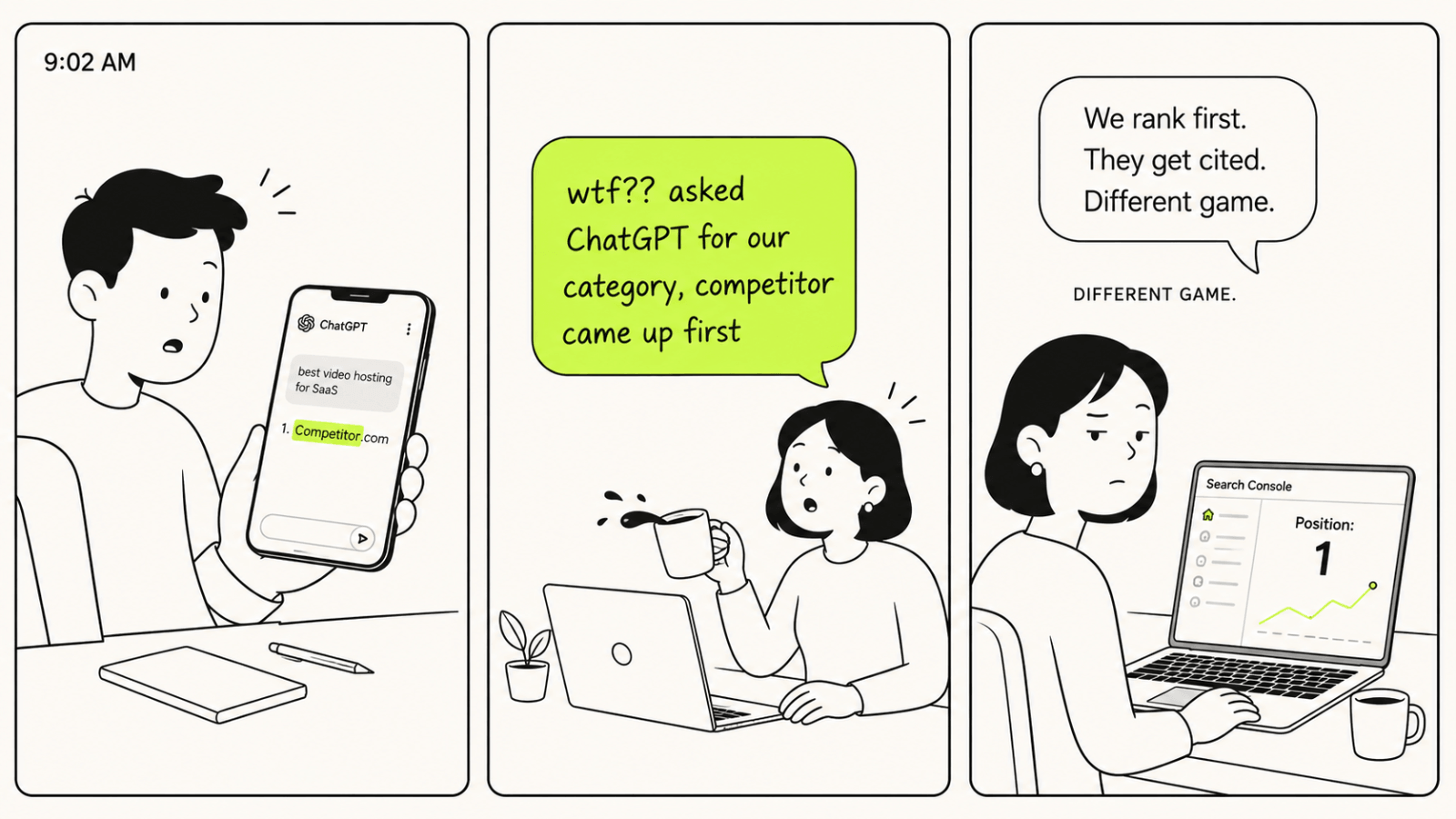
Your competitor showed up in ChatGPT. You didn’t. Here’s the actual reason.
Your founder typed a buyer-intent question into ChatGPT this week. A competitor’s name came back first. Your brand wasn’t mentioned at all. You rank on the first page of Google for that exact query. The Slack message hit your DMs by 9 AM, and you don’t have a clean answer.
The instinct most marketing teams reach for is content. Rewrite the page. Add an FAQ block. Drop an llms.txt file in the root directory. Sometimes those moves help, but they rarely move the needle on their own. The reason is that LLMs do not rank pages the way Google does. They run a two-stage process, and the signals that decide each stage are different.
Most GEO guides flatten these two stages into one and serve up the same E-E-A-T checklist. That framing is incomplete. E-E-A-T affects whether your page enters the candidate pool. A second set of signals decides whether it gets pulled out of that pool and cited.
This piece names the seven selection-layer signals, points to the public study behind each, and gives you a single action you can take on Monday. By the end, you will be able to look at your own site and say with confidence which signal you are losing on.
Retrieval vs. Selection: The Distinction Most GEO Guides Skip
Retrieval is the indexing layer. Selection is the citation layer. Different signals govern each, and optimizing only for retrieval is why so many well-ranked SaaS brands remain invisible in AI responses.
When ChatGPT, Perplexity, or Gemini answers a buyer query, the underlying system first pulls a candidate set of pages from its index. Bing rankings, backlinks, domain trust, and traditional SEO signals largely decide this stage. Your Google rank is a strong proxy for whether you clear it.
After retrieval, the model evaluates the candidate set against a different set of signals to decide which pages and brands to actually cite. Sellm’s 2026 analysis of 400,000 pages found that content-answer fit was the strongest predictor of citation at this second stage, and that classic domain authority signals played a much larger role in retrieval than in the final pick.
The practical implication: if you rank well on Google but your brand never appears in ChatGPT answers for your category, you are not failing at retrieval. You are failing at selection. That is the layer worth fixing.
Why E-E-A-T Alone Won’t Get Your SaaS Cited by ChatGPT
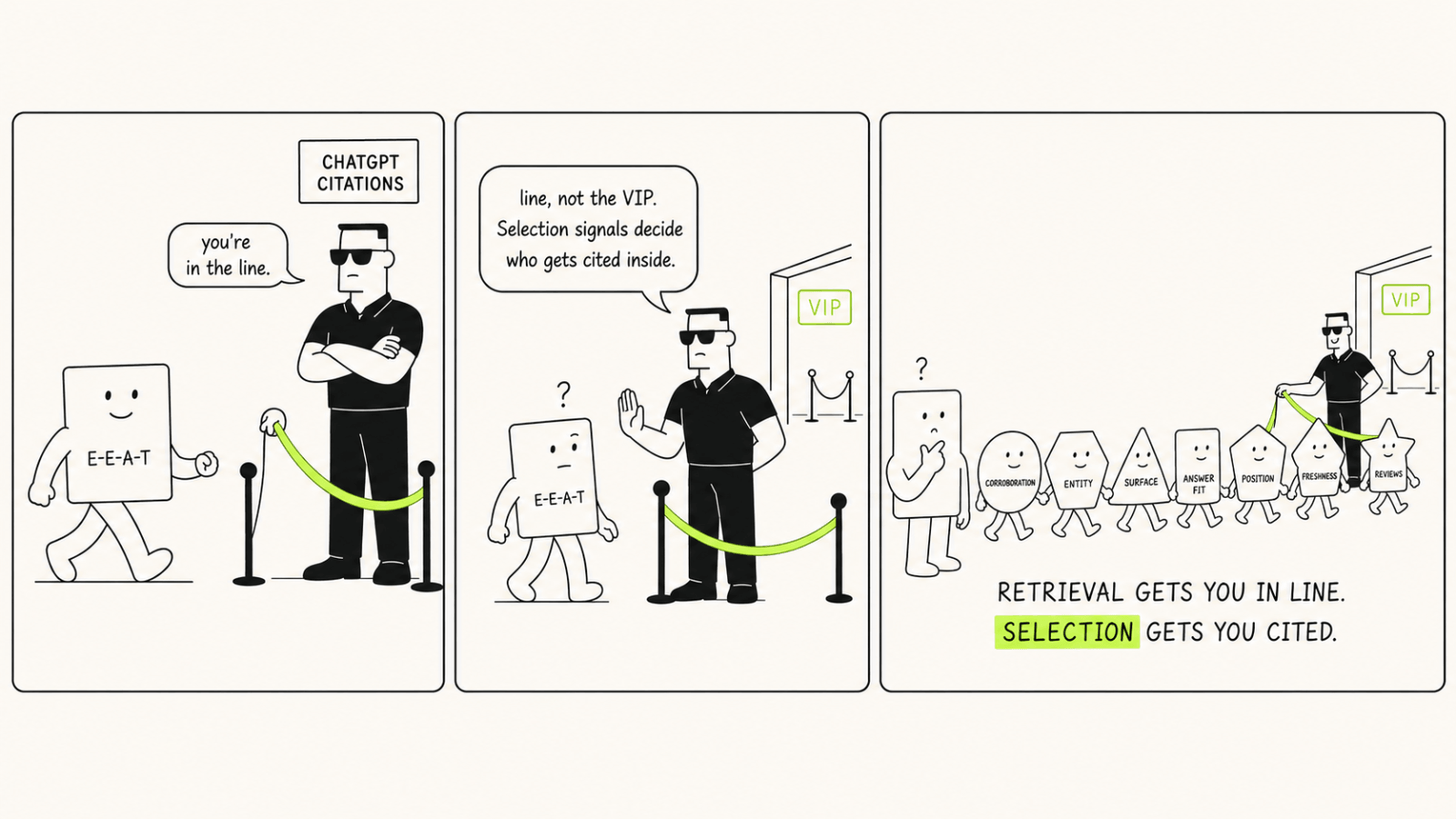
E-E-A-T is a floor, not a ceiling. It improves your odds of being considered, but it does not determine the citation. Three of its four dimensions are inferred from off-site signals that LLMs read across the web, which is why a well-authored blog post on your own site rarely shifts citation behavior on its own.
B2B SaaS brands routinely have strong on-page E-E-A-T (named authors, technical accuracy, original data) and still get skipped. The reason is that the selection layer looks at signals beyond your domain. What other sources say about you. How stably your brand is described across the web. Whether comparison pages and review sites name you. Whether the structure of your content lets the model extract a clean, attributable answer in a single pass.
The 7 Signals LLMs Use to Select Sources (Beyond E-E-A-T)
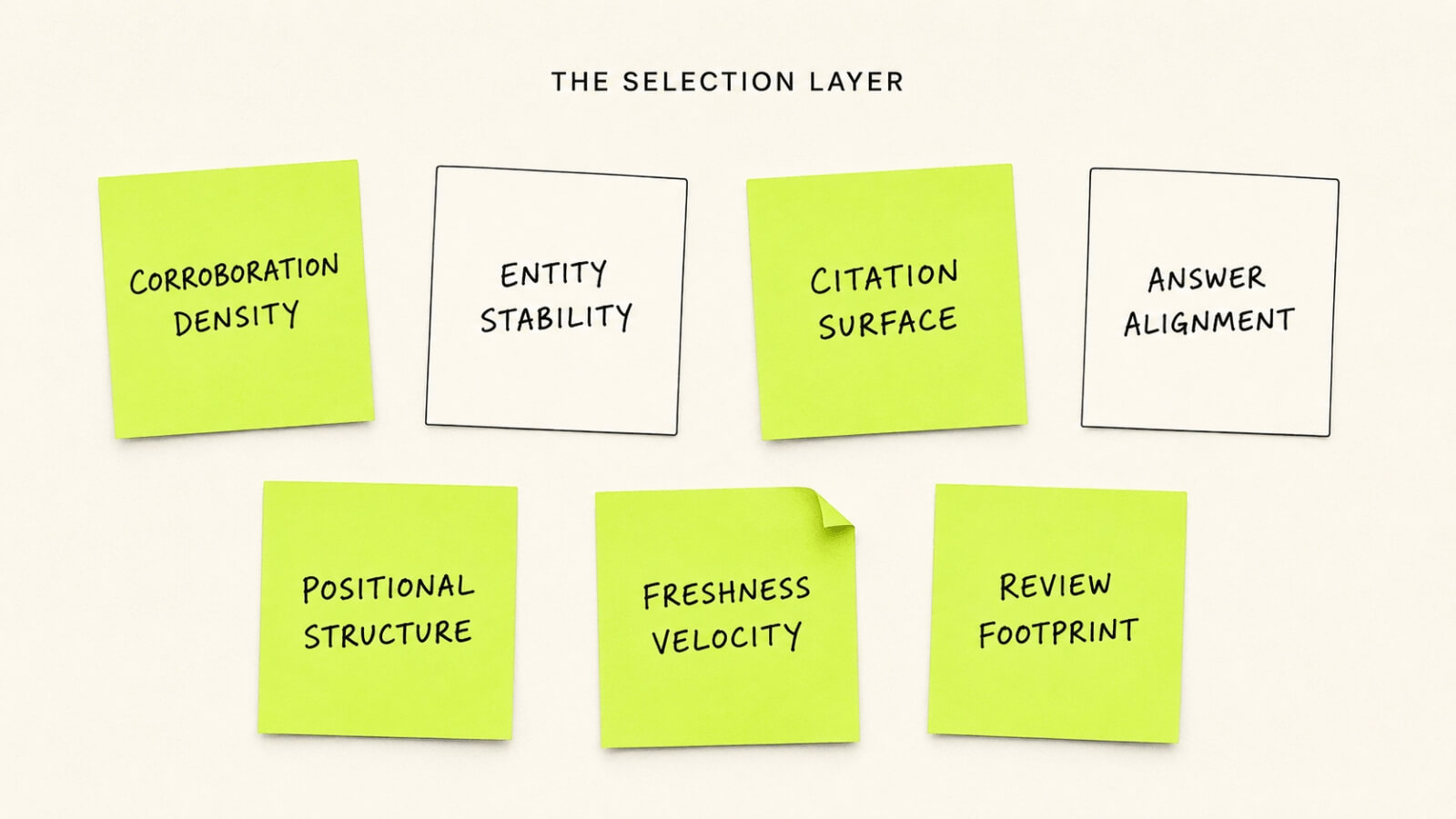
Each signal below maps to a real, attributable study published between late 2025 and early 2026. Where it helps, I’ll show how we have applied each one in client work at DerivateX.
1. Corroboration Density Across Third-Party Surfaces
Corroboration density is the strongest off-site selection signal. It measures how often your brand is independently mentioned on platforms the LLM treats as ground truth: Reddit, Quora, G2, Capterra, Trustpilot, and mainstream publications.
SE Ranking’s 2025 study of 129,000 domains found that brands with millions of mentions across Reddit and Quora had roughly 4x the likelihood of being cited than brands with minimal community presence. A separate dataset from Erlin and SE Ranking, published in late 2025, found that domains with active profiles on Trustpilot, G2, Capterra, or Yelp showed about 3x the citation probability of sites without those profiles.
For B2B SaaS specifically, this means a single well-placed mention inside a Reddit thread about your category often carries more weight than a thousand words you publish on your own blog. The model treats independent voices as corroboration. It treats your own claims as marketing.
Monday move: Run 10 buyer prompts in ChatGPT for your category. Log every domain ChatGPT cites underneath each answer. That cluster is your corroboration target list for the next 90 days.
2. Entity Stability and Category Consistency
Entity stability is how consistently your brand is described across every public surface. Stable descriptions build LLM confidence. Drift kills it.
If your homepage calls you a “video infrastructure platform,” your G2 profile says “video hosting tool,” and a third-party comparison article calls you a “video CDN,” the model’s internal picture of your brand fragments.
Fragmented entities get deprioritized at the selection stage because the model has no high-confidence answer to the question “what is this brand, exactly?”
Pipeline Velocity’s December 2025 breakdown of LLM ranking signals highlights that listed-entity coherence and consistent topical association are core ingredients of citation eligibility.
The Verito case study sits on this signal. Verito ranked at position 40 on Google for high-intent buyer prompts, and ChatGPT was citing competitors instead. After we tightened entity descriptions across the website, G2, comparison content, and founder author pages, ChatGPT started returning Verito as the #1 recommendation for those same prompts. The Google rank didn’t change. The entity signal did.
Monday move: Pull your top three category terms. Search them on G2, Capterra, your homepage, and your last five blog posts. If the wording materially varies, you have an entity stability problem.
3. Citation Surface Presence (G2, Capterra, Reddit, Comparison Pages)
Citation surface is the specific set of off-site URLs an LLM repeatedly retrieves for your category. For B2B SaaS, it’s usually a cluster of 10 to 15 domains, and the model returns to them over and over.
A 2026 analysis of how ChatGPT, Claude, and Perplexity recommend software, published on Medium, found that, effectively, every cited SaaS tool had a Capterra presence and that almost all of them appeared on G2. That’s not a correlation. It’s closer to a prerequisite for your category to be visible in the candidate set at all.
This is the mechanism behind Gumlet’s 20% inbound revenue attribution from AI search. We mapped the exact pages ChatGPT and Perplexity were pulling from when users asked about video hosting, video security, and image optimization. We then engineered placements, comparisons, and editorial coverage on those specific surfaces. The citations followed.
Monday move: Build a Citation Surface Map for your category. Run 30 buyer prompts across ChatGPT and Perplexity, log every URL cited, and rank them by frequency. That list is your off-site content roadmap for the next two quarters.
4. Answer Alignment (Content-Answer Fit)
Answer alignment measures how closely your content matches the way an LLM would phrase the answer itself. It was the strongest single predictor of citation in Sellm’s 2026 study of 400,000 ChatGPT-cited pages, with a model F1 score of 0.74 when predicting citation likelihood.
In practice, this means H2s phrased as the question users actually ask, followed by a 40 to 80 word direct answer, get extracted far more reliably than long narrative prose with the answer buried in paragraph four. The closer your page reads to how ChatGPT itself would explain the concept, the higher its selection probability.
The REsimpli case study shows this signal in action. We rewrote the page architecture for “real estate CRM” buyer queries so the H2s mirrored the exact ChatGPT phrasing for those questions, and the direct answer sat in the first two sentences of each section. REsimpli reached the #1 spot on ChatGPT for “real estate CRM” within 90 days, and the page also climbed to #1 on Google.
Monday move: Pick your three highest-priority pages. Ask ChatGPT the buyer-intent question for each one. Compare its phrasing and structure to your H2s. The gap between the two is your rewrite target.
5. Positional Structure (Where the Answer Lives on the Page)
Position on the page matters. Zyppy’s 2025 analysis of ChatGPT citations found that the first 30% of a page accounted for 44.2% of all LLM citations. The middle 30% to 70% contributed 31.1%. The final 30% picked up 24.7%.
The takeaway is simple. A TL;DR block at the top, a definition-forward H2 within the first 200 words, and direct answers at the start of each section change citation rates measurably. Burying the answer below a long introduction is the single most common structural mistake on otherwise strong SaaS blog posts.
For a deeper breakdown of how URL and on-page structure interact with citation likelihood, see our breakdown of what makes a URL likely to be cited by LLMs.
Monday move: Open your top five blog posts. If the answer to the H2’s implicit question is not in the first two sentences of that section, restructure the section.
6. Freshness Velocity
Freshness velocity is the time since a page was last meaningfully updated. Stale content gets skipped, even when authoritative.
SE Ranking’s 2025 dataset showed that pages updated within the last three months received, on average, noticeably more citations than pages left untouched for longer periods. Separate analysis from Lureon and Erlin in 2025 and 2026 puts the freshness multiplier at roughly 3x for pages updated within 30 days, particularly for ChatGPT Search and Perplexity.
The catch: changing the dateModified tag is not enough. The content itself has to change in a way the model can detect. Updating a statistic to a current-year figure, adding a 2026 example, or rewriting an H2 to mirror current buyer language all count. Touching nothing but the date does not.
Monday move: Identify your top 10 pages by traffic or pipeline contribution. Schedule a substantive content refresh every 90 days, and treat it as a recurring sprint, not a one-off project.
7. Review Platform Footprint and Sentiment
Active review platform presence is a near-baseline requirement for B2B SaaS citation visibility. Volume and sentiment both matter.
The SE Ranking and Erlin datasets cited above identified active profiles on G2, Capterra, Trustpilot, and Yelp as a strong selection signal. Late-2025 algorithm updates also introduced sentiment-aware weighting, which deprioritizes brands with consistently negative review patterns in citation selection.
For B2B SaaS specifically, being in the top three on G2 for your category is the most reliable single AI visibility signal I have observed in our client work.
Monday move: Set up a systematic review generation program. Email your 30 most successful customers personally, asking for a G2 review. Bulk-blasting an automated email sequence will not produce the same quality of reviews or the same citation lift.
What Doesn’t Move the Needle (Despite the Hype)
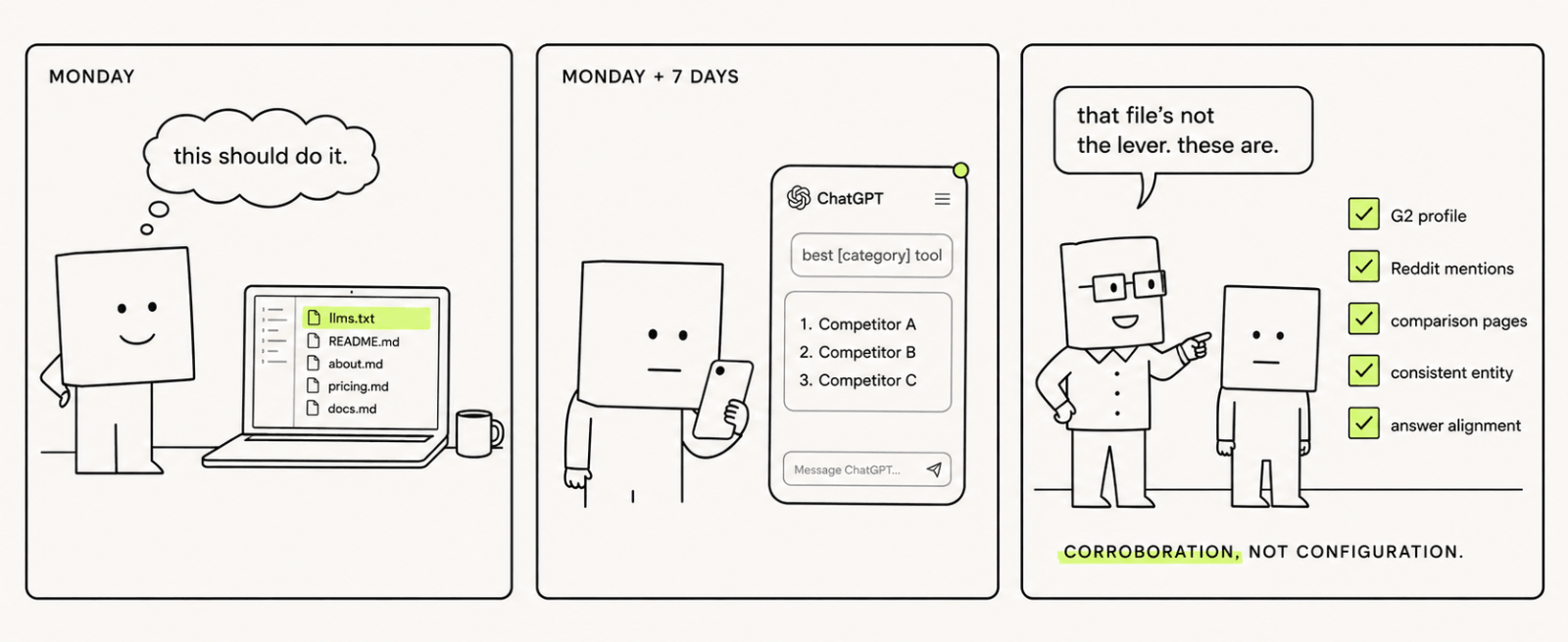
A few tactics are repeated across GEO content, with little or no effect on citation rates. Treat these as low-priority hygiene, not high-leverage moves.
- llms.txt files. SE Ranking’s 129,000-domain dataset found
llms.txtshowed a negligible impact on citation likelihood. The file is cheap to ship, but it is not the lever. We covered the nuance in our llms.txt guide. - Keyword-stuffed URLs. The same study found that broad, topic-describing URLs outperformed tightly keyword-optimized ones for ChatGPT citations.
- Pure backlink volume past a threshold. Referring domains matter for retrieval, but once you are inside the index, more backlinks stop adding citation lift. Corroboration diversity outperforms raw link count at the selection stage.
How DerivateX Engineers Citation Visibility for B2B SaaS
We call the operational version of all this work Citation Engineering. The AI Visibility Score (AVS) measures where a brand currently stands on each of the seven signals, and the Citation Surface Map locates the specific off-site URLs to win first. The seven-signal framing isn’t theoretical. It’s the same sequence behind the Gumlet, Verito, and REsimpli results.
FAQ
Why does my competitor show up in ChatGPT and we don’t?
Your competitor has built corroboration signals that ChatGPT treats as ground truth: independent mentions on Reddit and Quora, active G2 and Capterra profiles, and placements on the comparison pages the model retrieves from.
Your Google ranking is enough to clear retrieval, but it doesn’t decide the citation. The selection layer is a different set of signals, and the gap between your brand and theirs almost always shows up in third-party citation surface and entity consistency, not on your own website.
Audit the cited domains in 20 ChatGPT answers for your category to see exactly what they hold, and you don’t.
Does llms.txt actually do anything for ChatGPT citations?
Not really. SE Ranking’s 2025 analysis of 129,000 domains found that llms.txt files had a negligible impact on citation likelihood across the dataset. It is reasonable as part of a complete hygiene checklist, but it is not the lever that moves brands from invisible to cited inside ChatGPT or Perplexity.
The real leverage in 2026 sits in corroboration density, answer alignment, and freshness velocity, and citation surface presence on G2, Capterra, Reddit, and comparison pages.
How long does it take to start showing up in AI search?
For Perplexity and ChatGPT with browsing enabled, meaningful citation changes can surface in 4 to 8 weeks once content structure and citation surface work are running in parallel.
For default ChatGPT, which leans more heavily on training data, the realistic window is 3 to 6 months. Most B2B SaaS engagements see first measurable citation lifts inside 90 days when the seven selection signals are addressed together, rather than treated as isolated checklists. Speed depends almost entirely on the starting state and the category’s competitiveness.
Are backlinks still the main signal for AI citations?
No, not at the selection layer. Referring domains influence retrieval, which decides whether your page enters the candidate pool, but they don’t decide which page gets pulled out and cited. Corroboration density, meaning the volume and diversity of independent third-party mentions, consistently outranks raw backlink count in current ChatGPT citation studies.
SaaS brands with thinner backlink profiles but strong community footprints (Reddit, G2, Capterra, niche publications) often outperform competitors with heavier link profiles but weaker corroboration.
Is this just SEO with a new coat of paint?
No, but it sits on top of SEO. Retrieval still depends on traditional SEO signals like indexing, rankings, and authority. Selection is a different game with its own signals. The work overlaps in places (structured content, clarity, freshness) and diverges in others (citation surface mapping, entity stability, off-site corroboration).
Treating it as “more SEO” is exactly why most B2B SaaS brands stay invisible in ChatGPT despite ranking well on Google. The seven signals are the part that doesn’t translate.
Do I need to be on G2 and Capterra to get cited by ChatGPT for B2B SaaS queries?
For practical purposes, yes. A 2026 analysis of how ChatGPT, Claude, and Perplexity recommend software found that almost every cited SaaS tool had an active G2 and Capterra profile. The platforms are structured, high-authority, category-mapped data sources that LLMs treat as canonical for software comparisons.
Without presence on at least one of them, your brand is missing from the source pages the model retrieves before generating its answer. Being in the top three of your G2 category is the strongest single AI visibility signal for B2B SaaS.
What to do this week?
The brands winning in AI search are not writing better blog posts. They are engineering 7 selection-layer signals that determine which brand is cited when a buyer asks ChatGPT for a recommendation. E-E-A-T puts you in the candidate pool. Corroboration density, entity stability, citation surface presence, answer alignment, positional structure, freshness velocity, and review platform footprint pull you out of it.
The fastest first step is an honest audit. Run 30 buyer prompts through ChatGPT and Perplexity for your category. Log every cited domain. Compare that list against where your brand currently sits on each of the seven signals. The gaps you find will tell you exactly where the next 90 days of work should go, in priority order.
If you would rather have us run that audit and build a citation engineering sequence for your category, get in touch with the DerivateX team.
Written byAyush SharmaVP, SEO & AI Search, DerivateX
VP, SEO & AI Search at DerivateX. We're a B2B SaaS SEO and Generative Engine Optimization agency that engineers AI citations in ChatGPT, Perplexity, Claude, and Gemini and connects them to demo bookings and revenue pipeline.
Reviewed byApoorv SharmaCo-founder, DerivateX
Apoorv Sharma is the co-founder of DerivateX, a B2B SaaS SEO and Generative Engine Optimization agency that engineers AI citations in ChatGPT, Perplexity, Claude, and Gemini and connects them to demo bookings and revenue pipeline. He is the author of the 2026 AI Visibility Benchmark Report and the Citation Engineering methodology. He's also the brain behind "Found On AI" and has sold 2 of his companies previously
Cited by AI