Case study: Gumlet turned ChatGPT mentions into 20% of inbound revenue. Read it →

What Makes a URL More Likely to Appear in LLM Citations: 6 Page-Level Factors, Ranked by Impact

ChatGPT cites pages with fewer backlinks than the ones they beat. We broke down 6 page-level factors that decide LLM citations, ranked by what actually moves the needle in 30 to 90 days.


Citation likelihood is decided one URL at a time, not one domain at a time. Most B2B SaaS teams are still optimizing the wrong unit.
TL;DR
- LLMs do not read pages the way humans do. They break a user’s prompt into sub-questions, retrieve roughly 16 candidate URLs per prompt, and cite the URL whose chunk of 100 to 300 words is the cleanest self-contained answer to one of those sub-questions (Ahrefs, 1.4 million prompt study, 2026).
- Six page-level factors decide whether a URL gets cited. Ranked by impact: page type alignment with query intent, content position and chunk structure, claim density and entity clarity, technical parsability, domain and topical authority, and freshness.
- Domain authority sits FIFTH on that list. Top-cited AI pages often carry fewer backlinks than the pages they beat, based on Evertune’s 2025 analysis of 75,000 brands.
- 76 percent of Google AI Overview citations rank in Google’s top 10. Roughly 80 percent of ChatGPT citations do not rank in Google’s top 100 (Ahrefs, 17 million citations, 2025). Both sentences are true. The fix for each is different.
- A marketer can run the 10-point audit at the end of this piece on their top URLs in an afternoon and surface the two or three pages that are closest to citation-ready.
A buyer tells your founder, “I found you on ChatGPT.” The founder forwards the message to marketing and asks how to reproduce it. Marketing opens ChatGPT, runs the same prompt, and the page that gets cited is the company’s old comparison post from 2023, not the pillar guide that ranks third on Google for the head term.
That gap between what ranks and what gets cited is where most B2B SaaS teams currently sit. Throughout 2026, the assumption that domain authority and a steady publishing cadence carry over from Google to ChatGPT has broken down in plain sight. Citation selection happens at the URL level, not the brand level, and the rules are different from the ones a senior SEO learned in the past decade.
This piece breaks down the SIX factors that decide whether a URL gets cited by ChatGPT, Perplexity, Claude, Gemini, and Google AI Overviews, ranked by impact. Each factor is paired with the diagnostic question a marketer can run today and tied back to a specific writing or technical fix. By the end, you will know which two or three of your top URLs are close to citation-ready and which need a rewrite.
How LLMs Actually Decide What to Cite
LLMs do not score documents. They score chunks of 100 to 300 words against a list of sub-questions the model itself wrote, then cite the URL the winning chunk came from.
The mechanic, in plain language. When a user enters a prompt, the model breaks it into sub-questions, sometimes called “fan-out queries.” For “best video hosting platform for SaaS,” the model will internally generate sub-questions like:
- “video hosting pricing comparison”
- “video CDN options for B2B”
- “Mux vs Gumlet vs Cloudflare Stream”
- “video DRM for enterprise SaaS”
For each sub-question, the model runs a separate search. Ahrefs’ February 2026 analysis of 1.4 million ChatGPT prompts found that the model retrieves roughly 16 cited and 16 non-cited URLs per prompt. Each candidate URL comes back with its title, slug, and a short snippet, and the model uses those three fields to decide which pages are worth opening.
Once a page is opened, the model pulls a section of roughly 100 to 300 words and decides whether that section answers one of the sub-questions cleanly. If it does, the URL gets cited. If it does not, the model moves on, even if the page is technically the highest-ranking result in Google.
Your URL gets cited when it contains the best self-contained answer to one of the sub-questions the model is asking behind the scenes.
Every factor below is a way to make that answer easier to find, easier to extract, and easier to attribute. For a fuller breakdown of the retrieve-rank-extract-attribute pipeline, our explainer on how LLMs decide what to cite walks through the mechanics in detail.
The Cited-But-Not-Ranked Paradox
Two findings from late 2025 and early 2026 look like they contradict each other. They do not.
- Google AI Overviews cites pages that rank in Google’s top 10 organic results 76 percent of the time, based on multiple independent studies referenced across Search Engine Land and Ahrefs coverage.
- ChatGPT thinking models go the opposite direction. Roughly 80 percent of the URLs ChatGPT cites do not rank in Google’s top 100, per Ahrefs’ 17 million citation analysis published in late 2025.
The reason is structural. AI Overviews uses Google’s organic index as its retrieval pool, so ranking is a prerequisite. ChatGPT’s thinking models query brand sites directly, supplement Bing-indexed search results with Reddit, news, YouTube, and academia channels, and apply their own semantic match scoring on top.
Same URL, two different selection systems.
The practical implication: if you want both engines to cite you, optimize the URL against the six factors below. Five of them apply to every engine. The sixth (domain and topical authority) matters most for AI Overviews and is more forgiving in ChatGPT.
Factor 1 — Page Type Alignment With Query Intent
A blog post will not get cited for a comparison query, no matter how well written. The model wants a comparison page.
For non-branded queries on GPT-5.4, citation distribution looks roughly like this:
- Pricing pages: 19 percent of citations
- Homepages: 22 percent
- Product pages: 10 percent
- Blog posts: 8 percent
(Source: Passionfruit, 2026 citation analysis.)
For branded queries, third-party reviews and listicles dominate at 57 percent. For “what is” or “how does” queries, definition-led blogs and explainers are the format the model expects.
Page type is the single highest-leverage match signal because it filters the candidate pool BEFORE the model ever opens a page. If the title and URL look like the wrong page type for the sub-question, the model passes. The page never gets a chance to be read.
The diagnostic question to run today: pick three buyer-intent prompts you want to win. Ask each one in ChatGPT, Perplexity, and Gemini. Note the page type the model is already citing in your category. Match that page type or accept that you will not be cited for that query.
DerivateX has documented this pattern across client engagements.
Verito moved from average position 40 to position 12 on Google and earned 12 ChatGPT #1 rankings in 10 months, in part because the GEO mandate started with rebuilding existing pages to match query intent before any new content was published.
Factor 2 — Content Position and Chunk Structure
44.2 percent of LLM citations come from the first 30 percent of the page (Indig, 1.2 million ChatGPT response analysis, 2026).
The writing instruction this becomes is direct. Every URL has roughly three paragraphs of citation real estate at the top of the page. Treat them like the lede of a press release. Lead with the named entity, the specific number, and the direct claim. Save context, narrative, and history for later sections.
Cited passages are nearly twice as likely to use definition-led language (“X is,” “X refers to”) and direct subject-verb-object construction. Indig’s analysis also found cited content was twice as likely to include a question mark in a heading, which signals to the model that the section answers a specific query.
The 120 to 180 Word Chunk
Sections of 120 to 180 words between subheadings earn roughly 70 percent more citations than pages with sparse heading structure or sections that run past 300 words without a break (multiple sources including LLM Pulse and Passionfruit benchmarks, 2025 to 2026).
The mechanic is mechanical, not editorial:
- A 120 to 180 word section is long enough to contain a complete answer with one supporting fact.
- It is short enough for the model to lift cleanly without truncating mid-thought.
- Sections longer than 300 words force the model to scan a wall of prose, which lowers extraction probability.
- Sections shorter than 50 words rarely contain enough context to stand alone in an answer.
For the specific heading hierarchy that supports this structure, our SEO blueprint for H1, H2, and H3 tags covers the technical implementation.
Answer First, Context Second
Every H2 should open with a 1 to 3 sentence direct answer to the implied question, then expand. Search Engine Land’s audit of 15 domains and 7,500 ChatGPT referral sessions in late 2025 found that “answer capsules” at the top of sections were the single strongest commonality among posts that earned ChatGPT citations.
The cost of a buried answer is invisibility.
If a page opens with 200 words of context-setting before the answer, the model often pulls from elsewhere or from a competitor that led with the answer.
Factor 3 — Claim Density and Entity Clarity
Adding statistics increases AI citation rates by 30 to 40 percent, even when no other change is made (Princeton GEO study, 10,000 queries across the GEO-bench benchmark, 2024).
Citable claims share three properties:
- A NAMED entity
- A SPECIFIC number or qualifier
- A SOURCE
Compare these two sentences:
- ❌ “Video hosting affects page speed.”
- ✅ “Self-hosted video pages load 3 to 5 times slower than CDN-hosted equivalents (Gumlet benchmark data).”
The model can attribute the second sentence. It paraphrases the first into its own voice and the URL gets nothing.
Ahrefs’ analysis of ChatGPT’s top 1,000 cited pages found that 67 percent of citations came from original research, first-hand data, or academic sources. Pages built around restated industry consensus rarely break into the citation pool, regardless of how well written they are. Our 2026 B2B SaaS AI Visibility Benchmark Report is built on this principle: the report scored 50 B2B SaaS companies across 1,400 buyer-intent prompts on ChatGPT, Perplexity, Claude, and Gemini, with an average AI Presence Score of 56.9 out of 100.
Named Examples Beat Anonymous Ones
“Many SaaS companies use this approach” gets summarized away. “Figma and Notion use this approach” gets cited verbatim.
AI models extract named entities reliably and compress anonymous patterns into the model’s own voice, which removes attribution. This is one place where most marketer-facing GEO content fails. A page filled with “industry leaders” and “many teams” reads fine to a human and is functionally INVISIBLE to the model. Replace every anonymous reference with a specific brand, person, or numbered cohort.
Define Every Technical Term on First Use
Definition-led sentences are extracted at high rates because they fit the “what is X” sub-query pattern that almost every fan-out generates. The phrase pattern “X is a Y that does Z for A” is the citation-friendly form.
This is not a writing tic. It is the structural feature that lets the model use your URL as the source of a definition for that term across hundreds of related queries. Definitions compound. REsimpli became the #1 cited CRM in ChatGPT for real estate investor queries in 90 days in part because it owned the definitional content for the category before its competitors did.
Factor 4 — Technical Parsability
GPTBot, ClaudeBot, and PerplexityBot do not execute JavaScript. If your page renders client-side, your content is invisible to them, regardless of how well it ranks in Google.
This is the factor almost no marketer-aimed GEO post mentions. It is also the reason teams who fix everything else still see no movement after 60 days.
Three checks every URL must pass:
- Pre-rendered HTML. View the page with JavaScript disabled (or run curl against the URL) and confirm the body content is present in the HTML response. If the body is empty until JavaScript loads, AI crawlers see NOTHING. The fix is server-side rendering, static generation, or a pre-rendering service. This usually requires engineering time.
- First Contentful Paint under 0.4 seconds. AI crawlers timeout aggressively on slow pages. Pages that take more than a second to start rendering get deprioritized in retrieval, even when the content is otherwise strong.
- GPTBot, OAI-SearchBot, ClaudeBot, and PerplexityBot allowed in robots.txt. A surprising share of sites that complain about invisibility have inadvertently blocked these crawlers, often through default settings on their CDN’s bot-management rules.
Two of the three checks a marketer can run in 10 minutes. The first usually needs an engineer. Skipping this factor is the most common reason a clean content audit fails to produce citations.
Factor 5 — Domain and Topical Authority (and Why It Ranks Lower Than You Think)
Top-cited AI pages often carry FEWER backlinks than the pages they beat (Evertune, 2025 analysis of 75,000 brands). Backlinks and AI citations show a weak, sometimes inverse, relationship.
This is the counterfactual hook of the piece. Every B2B SaaS team has been told for a decade that domain authority is the lever. For Google rankings it remains a lever. For LLM citations, the data tells a different story.
What does carry weight is topical relevance and brand mention frequency across the sources the model treats as consensus. The 2025 Digital Bloom analysis found brand search volume correlates with LLM citation rate at 0.334, a stronger predictor than backlink count.
A DR-30 site that has covered one B2B SaaS category in depth for two years can out-cite a DR-80 generalist publication on that category. Kroto scaled from 3,500 to 326,000 search impressions without a single paid backlink, which is a direct illustration of how topical authority compounds when domain authority is held flat.
The Sources LLMs Treat as Consensus
The platform mix has changed sharply in the past 12 months:
- ChatGPT, pre-September 2025: Reddit accounted for roughly 14 percent of citations.
- ChatGPT, post-September 2025: Reddit dropped under 1 percent (Spotlight, 3 million citation analysis).
- Perplexity: Reddit still drives 46.7 percent of citations.
- All major engines: G2, Capterra, named industry publications, and category listicles consistently feed the citation pool.
The fix is not “be on every platform.” It is “be present on the two or three sources your category’s queries actually pull from today.” DerivateX’s Citation Engineering framework treats third-party corroboration as one of five levers, not THE lever, because brand mention frequency only compounds when the URL itself is structurally citable.
Factor 6 — Freshness and Update Cadence
The median age of a ChatGPT-cited page is roughly 500 days (Ahrefs, 1.4 million prompts, 2026). Freshness preference is real at the macro level, but inside any single retrieval set the older, more established page tends to win on relevance.
This contradicts the dominant “publish daily, refresh constantly” narrative in the GEO space, and it is supported by the data. ChatGPT does cite content roughly 458 days newer than Google’s organic results on average, based on Ahrefs’ parallel 17 million citation study. Within a given prompt’s retrieval set, the older page that matches the fan-out query usually beats the newer page that does not.
The implication for a content team is specific:
- Pages with no rankings and no citations will not start getting cited because you refreshed them. Refresh is a tiebreaker, not a primary signal.
- Pages that already meet factors 1 through 5 should go on an 8 to 12 week refresh cadence with new data, a visible Last Updated date, and at least one new named example.
- Pages that fail the first five factors need a rewrite, not a refresh.
For a deeper view of how on-site changes compound over time, our breakdown of what an LLM SEO agency really does covers the 30-60-90 day movement curve we see across client engagements.
The Cited-But-Not-Ranked Decision Tree (When to Fix vs. When to Rewrite)
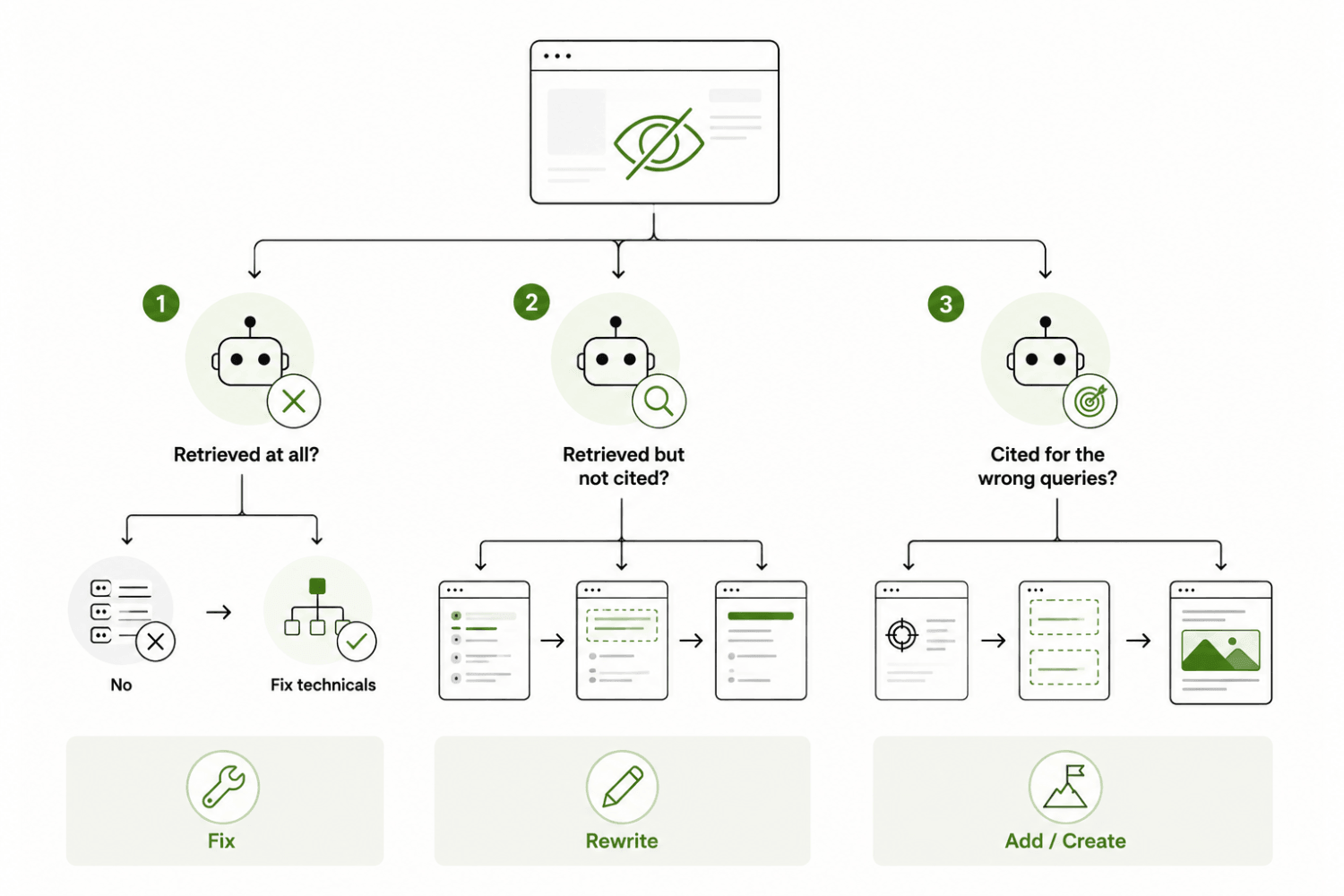
Most teams react to invisibility by rewriting everything. That is expensive and usually wrong. Three diagnostic questions, run IN ORDER, will tell you whether a specific URL needs a fix, a rewrite, or a new page.
Question 1: Is the URL being retrieved at all? Check server logs for hits from GPTBot, OAI-SearchBot, ClaudeBot, or PerplexityBot in the last 30 days. Zero hits means the problem is technical parsability, robots.txt, or sitemap inclusion. Fix Factor 4 before touching the content.
Question 2: Is the URL retrieved but not cited? If GPTBot is hitting the page but the page is not in the citation list for your target prompts, the issue sits in the title, the URL slug, or the first 30 percent of the content. Rewrite the title and the opening section against Factors 1 and 2 before doing anything else.
Question 3: Is the URL cited for the wrong queries? If the page is cited but for sub-questions you did not intend to win, the chunk-level extraction is working but the answer capsules do not match your priority queries. Add explicit answer capsules for the target sub-queries and consider a separate dedicated page for the highest-value query.
This diagnostic takes 30 to 60 minutes per URL. Across DerivateX’s client engagements, running the diagnostic before any rewriting consistently saves 60 to 80 percent of the content production time the same audit would generate without it.
The 10-Point URL Audit Checklist
Run this on your top 10 URLs this afternoon. Each item is a yes or no question with a one-sentence reason behind it. Use the AI Visibility Checker to automate items 4 through 9 across multiple URLs at once.
| # | Audit Question | Why It Matters |
|---|---|---|
| 1 | Does the page TYPE match the query intent? | The model filters by page type before opening anything. Pricing query needs a pricing page. Comparison query needs a comparison page. |
| 2 | Does the H1 contain the primary sub-query in semantically natural language? | Title-to-fan-out-query similarity is the strongest predictor of citation in the Ahrefs 1.4 million prompt study. |
| 3 | Is the URL slug human-readable and keyword-aligned? | Search results with natural-language URLs were cited at 89.78 percent versus 81.11 percent for opaque URLs (Ahrefs, 2026). |
| 4 | Does the first 30 percent of the page contain the direct answer with a named entity and a specific number? | This is the section that produces 44.2 percent of all citations. |
| 5 | Are H2 sections 120 to 180 words apart, each opening with an answer capsule of 1 to 3 sentences? | This is the chunk size LLMs extract most cleanly. |
| 6 | Does the page include at least one comparison table, numbered list, or definition block? | Comparative listicle and table formats account for 32.5 percent of all AI citations (Profound, 30 million citation analysis). |
| 7 | Is the page rendered server-side, with body content present in the HTML before JavaScript loads? | GPTBot, ClaudeBot, and PerplexityBot do not execute JavaScript. |
| 8 | Are GPTBot, OAI-SearchBot, ClaudeBot, and PerplexityBot allowed in robots.txt and not blocked by the CDN? | Blocked crawlers cannot retrieve the page at all. |
| 9 | Has the page been updated in the last 90 days with a visible Last Updated date? | 65 percent of AI bot crawl activity targets content from the past year. |
| 10 | Is the brand mentioned with the same name and same one-sentence description on at least three off-site sources? | G2, named publications, and category listicles are the consensus signals models trust. |
Scoring:
- 8 to 10 of 10: Citation-ready. The page is likely already cited or close to it.
- 5 to 7 of 10: Fixable in a sprint. Tackle the failed items in order.
- Below 5: Rewrite candidate. Refreshing this URL will not move the needle.
FAQ
1. Why does my competitor get cited by ChatGPT when their domain authority is lower than mine?
Domain authority is the FIFTH most important factor in URL-level citation selection, behind page type alignment, content position, claim density, and technical parsability. The competitor is most likely getting cited because their page opens with a definition-led answer in the first 30 percent, contains specific numbers tied to named entities, and is rendered server-side so AI crawlers can read it.
Their backlinks may matter for Google rankings, but Evertune’s 75,000-brand 2025 analysis found AI citation rates correlate weakly and sometimes inversely with backlink volume. The lever is page-level structure, not domain strength.
2. How do I know if ChatGPT is even retrieving my page?
Check your server logs over the last 30 days for hits from the user agents GPTBot, OAI-SearchBot, ChatGPT-User, ClaudeBot, PerplexityBot, and Google-Extended.
If those user agents are not present, ChatGPT and the other engines have not retrieved your page in that window, which means the problem is either technical (JavaScript rendering, robots.txt, sitemap exclusion) or upstream (the URL is not in any retrieval channel the model uses). Fix retrieval before you touch the content.
A page the model never retrieves cannot be cited regardless of how well it is written.
3. Should I rewrite an existing page or create a new one to win a citation for a specific query?
Run the diagnostic first. If the existing URL is being retrieved but not cited, rewrite the title, the URL slug, and the first 30 percent of the page against the query you want to win. If the existing URL is being cited for a different sub-query already, leave it alone and create a new dedicated page for the high-value query, since splitting an already-cited page risks losing the citation you have.
The default decision rule across DerivateX’s Citation Engineering framework is to rewrite first and create new only when page type alignment forces it.
4. Does llms.txt actually do anything for citation rates?
No major LLM provider has confirmed that llms.txt influences retrieval or citation as of Q1 2026. The file is a proposed standard for telling AI crawlers which content is okay to use, similar to robots.txt for traditional search engines. Adding llms.txt to a site does not directly increase citation likelihood.
The factors that do are the six covered in this guide. Our complete guide to llms.txt for SEO and AI search covers what the file actually does and where it fits in a broader GEO program.
5. How long does it take for URL-level changes to show up in ChatGPT citations?
Retrieval-side changes (title rewrites, content position fixes, technical parsability fixes) typically show up in ChatGPT citation patterns within 30 to 90 days, based on observation across DerivateX client engagements. Off-site authority signals (G2 reviews, third-party listicle placements, Reddit presence in categories where Perplexity still cites Reddit) take 3 to 6 months to compound.
Brand-level signals like consistent mention frequency across trusted sources take 6 to 12 months. The fastest wins are page-level fixes on URLs that are already being retrieved and indexed.
6. Is content length a citation factor?
Content length is a weak signal on its own. Pages with 2,900 plus words average 5.1 ChatGPT citations versus 3.2 for pages under 800 words (Virayo benchmark, 2026), but the lift comes from what longer pages tend to contain (more data tables, more named entities, more definition blocks), not from word count itself.
A 2,500 word data-rich comparison page will out-cite a 5,000 word opinion essay across every engine. Optimize for chunk density and entity coverage, not for word count.
7. How do I identify the types of pages AI is most likely to cite in my category?
Run your top five buyer-intent prompts in ChatGPT, Perplexity, and Gemini in an incognito window. Note the page type, the title pattern, and the publication source for every cited URL. If the model consistently cites comparison pages for a query, your pricing page will not win that query no matter how well it ranks.
If the model cites definition-led blogs for a “what is” query, a product page will not win it. The page type the model is already citing is the page type you need to match before any other optimization matters.
Conclusion
The most controllable lever in AI citation is the URL, not the domain. Page type alignment with query intent, content position in the first 30 percent, claim density tied to named entities, and technical parsability sit ABOVE domain authority on the list of factors that decide whether ChatGPT, Perplexity, Gemini, or Google AI Overviews will cite a specific page. The first four are fixable in a sprint by anyone with editorial control of the site. The fifth and sixth take longer and matter less in the short term.
Run the 10-point checklist on your top 10 URLs this afternoon. Use the AI Visibility Checker to automate the technical and structural checks, identify the two or three pages closest to citation-ready, and start there. If the diagnostic surfaces a structural problem you would rather have a second set of eyes on, book a free AI Visibility Audit, and we will run the full citation surface map across your top 25 URLs.
Citations in 2026 reward the team that audits before it writes.
Related Reading
- How LLMs Decide What to Cite: Full Breakdown of the 5 Signals
- What an LLM SEO Agency Really Does (And Why Traditional SEO Falls Short)
- LLMs.txt: The Complete Guide for SEO and AI Search (2026)
Written byRakhi SharmaSEO & Ops at DerivateX
Hi, I’m Rakhi - I write about SEO, content strategy, AI tools, productivity, and the systems that make modern marketing work better. Through my blogs, I share practical insights, experiments, and ideas that help teams work smarter.
Reviewed byShivanshi BhatiaCo-founder, DerivateX
Shivanshi Bhatia is the co-founder of DerivateX, a B2B SaaS SEO and Generative Engine Optimization agency that engineers AI citations in ChatGPT, Perplexity, Claude, and Gemini and connects them to demo bookings and revenue pipeline. She runs operations and delivery, which means every audit, content brief, and published page ships through a system she built. She owns the client relationship from kickoff through reporting, so clients spend their time on decisions instead of chasing updates. She has worked in SaaS since 2019 and reviews client work before it goes live.
Cited by AI