Case study: Gumlet turned ChatGPT mentions into 20% of inbound revenue. Read it →

Should You Hire an AI Search Optimization Agency? A Founder’s Guide (2026)


Here is a scenario I have seen play out more times than I can count.
A founder is six months into a content-heavy SEO engagement. Traffic is up, rankings look solid, and the monthly report arrives with green arrows everywhere.
And then they open ChatGPT, type in the question their buyers are actually asking: “What is the best [their category] tool for [their use case]?” Three competitors appear in the answer. Their product is not one of them.
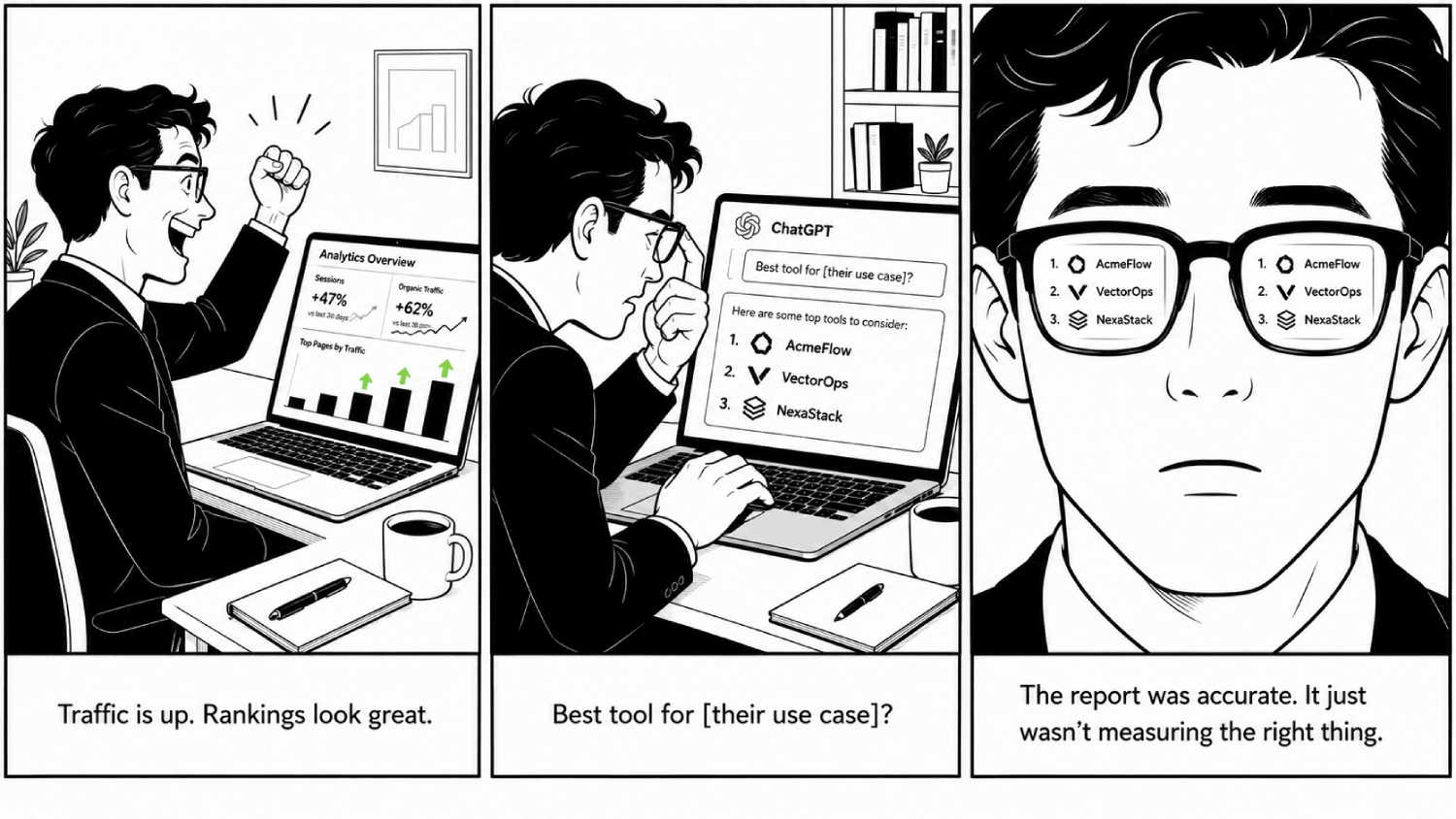
The SEO is working. The AI search channel is completely empty. And the most unsettling part? There is no metric in their current reporting stack that tells them they are missing.
This is the situation driving the question I get almost every week: “Should we hire an AI search optimization agency, or can we handle this ourselves?”
This article is my honest attempt to answer it. Not as a pitch, but as someone who has built an agency in this space and watched what works and what does not at different company stages and budget levels.
Key Takeaways
- AI search is no longer a future trend. B2B buyers are shortlisting vendors in ChatGPT, Perplexity, Gemini, and Claude before they ever open a browser tab. If you are absent from those answers, you are off the shortlist before the conversation even starts.
- The question is not whether AI search matters. It is whether your team has the infrastructure to compete in it without outside help. Most do not.
- A stage-based framework applies: DIY works under $1M ARR, a specialist agency makes the most sense between $5M and $25M ARR, and a hybrid model is the right call above $25M.
- Real AI search optimization costs between $3,000 and $15,000 per month from a legitimate agency. Anything below that cannot cover the actual work: citation engineering, entity optimization, prompt-set testing, and off-page authority building simultaneously.
- The fastest vetting test: ask any agency you evaluate to show you a client’s AI citation data connected to demo requests or pipeline records. If they cannot, they are measuring the wrong thing.
- Not sure where your brand stands right now? The DerivateX free AI visibility audit runs 20 buyer-intent prompts across ChatGPT, Perplexity, Claude, and Gemini and returns a citation gap analysis within 48 hours.
What is an AI Search Optimization Agency?
An AI search optimization agency, also referred to as a GEO agency (Generative Engine Optimization) or LLM SEO agency, is a firm that engineers brand visibility inside the responses generated by large language models.
The target is not a search engine results page. It is the synthesis layer: the moment ChatGPT, Perplexity, Gemini, or Claude decides which brand to name, which product to recommend, and which source to cite when a buyer asks a question in your category.
This is not traditional SEO with a new coat of paint. Google’s ranking algorithm responds to signals for backlinks, page speed, and keyword relevance that have been documented and refined for over two decades.
LLM citation behavior responds to a different set of inputs entirely: citation source quality, entity consistency, content structured for AI retrieval, third-party mention ecosystems, and the degree to which a brand’s knowledge graph signals are coherent and credible.
A company can rank on page one of Google and still be completely absent from every AI-generated recommendation in its category. These are two separate systems. For a full breakdown of how the second system actually works, see the complete LLM SEO guide.
An AI search optimization agency builds strategy, content, and authority around the second one.

Why This Question is Hitting Founders Right Now
The shift in B2B buyer behavior is real, and it is happening faster than most marketing teams have adjusted to.
The pattern is documented. AI Overviews now appear at the top of a significant share of B2B software queries on Google, and when they do, the organic results below them receive a fraction of the clicks a standard SERP would generate.
The buyers who get their answer from the AI summary never scroll down. They never see your listing. The shortlist forms before any blue link is clicked.
That means the brands appearing inside those answers are capturing attention and shortlist consideration that the ones below them never see at all.
And it gets more specific than that. DerivateX’s 2026 AI Visibility Benchmark Report, which scored 50 B2B SaaS companies across 1,400 buyer-intent prompts, found that the average AI Presence Score (APS) across those companies was 56.9 out of 100. That means the average B2B SaaS company is absent from AI-generated answers roughly half the time their buyers are actively researching solutions.
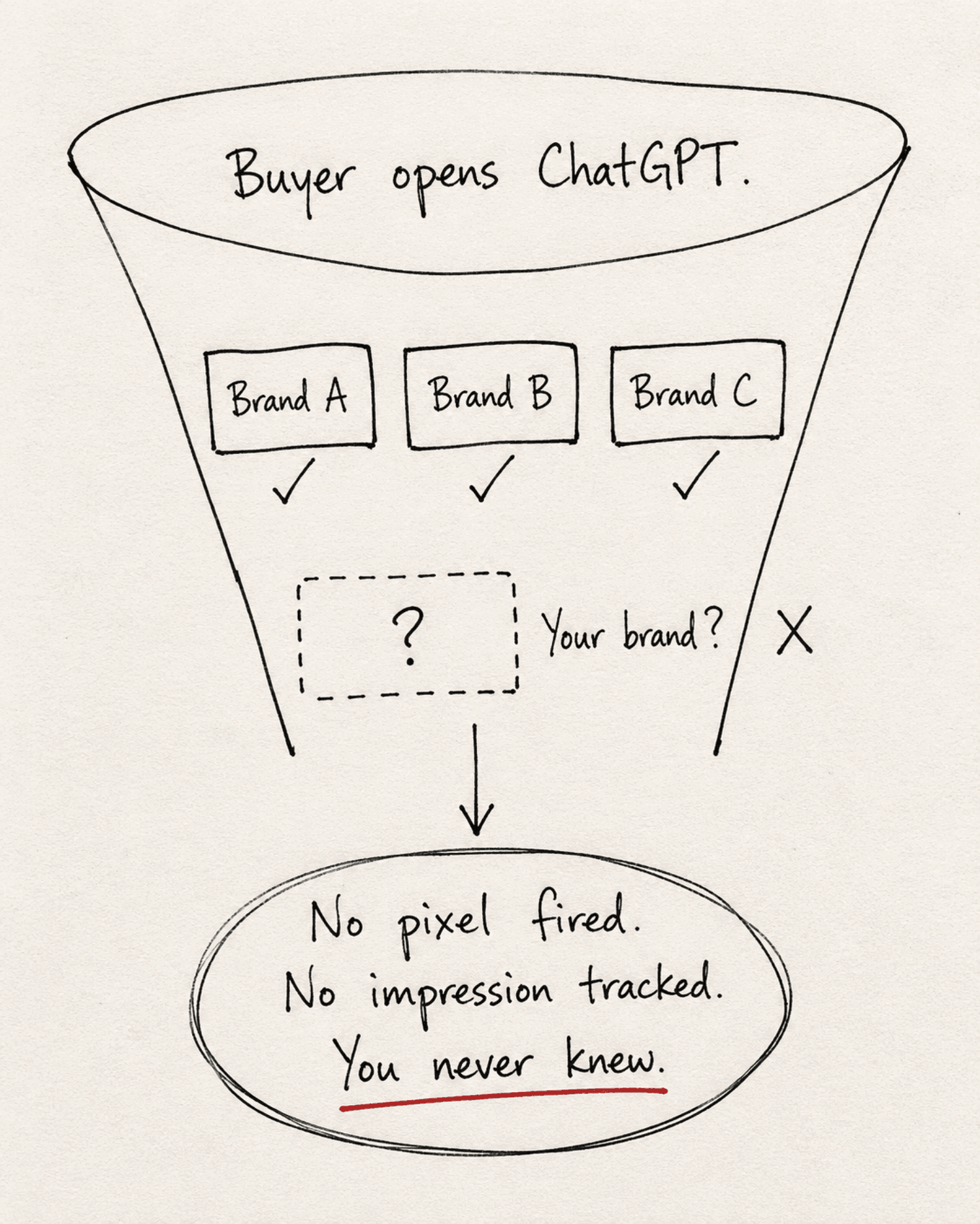
Think about what that means for your pipeline. If a meaningful share of your buyers are opening ChatGPT or Perplexity to research before they Google anything, and your brand does not appear in those responses, you are invisible to that buyer cohort before the evaluation process even begins.
No landing page, no retargeting pixel, no demo booking flow can recover a buyer who never discovered you.
That is the real reason this question is hitting founder desks right now. It is not hype. It is a channel gap with a measurable cost.
Should You Hire an Agency, Build In-house, or DIY it?
The honest answer is that it depends almost entirely on your company stage, the maturity of your current search foundation, and how quickly you need AI search to contribute to the pipeline. Here is the framework I use when evaluating fit.
| ARR Stage | Recommended Approach | Reasoning | Monthly Cost Range |
| Under $1M | DIY or freelance GEO specialist | Agency overhead does not make economic sense yet; focus on entity hygiene and structured content basics | $0 to $1,500 |
| $1M to $5M | Freelance specialist or lean agency engagement | Speed matters; internal hiring is too slow, but full retainers may strain the budget | $1,500 to $3,500 |
| $5M to $20M | Specialist AI search or GEO agency | This is the sweet spot; agencies deliver faster time-to-value than internal hiring at this stage | $3,000 to $8,000 |
| $20M to $50M | Full-service agency or hybrid model | Enough internal bandwidth to co-own strategy; need external scale and measurement infrastructure | $5,000 to $15,000 |
| $50M and above | Hybrid: in-house strategy lead plus agency execution | Sufficient internal team for direction; agency handles citation engineering, off-page, and prompt testing | $8,000 and above |
The table above gives you the macro decision, but the real nuance lives in the three scenarios below. Read the one that matches where you are.
For a side-by-side of what an agency costs vs a senior in-house SEO hire, including commitment terms, read the full comparison.
1. When DIY Actually Works
DIY AI search optimization is viable under specific conditions. If your in-house SEO lead understands entity optimization and structured data, your content team has the bandwidth to restructure existing pages for AI retrieval (answer-first headings, named entities, precise claims), and you are not yet in a category where competitors have a significant citation head-start, you can make real progress without agency support.
Specifically, DIY makes sense when: your category has low LLM citation competition, you have 6 to 9 months before AI search becomes a critical pipeline channel, your existing Google SEO foundation is strong (strong domain, indexed content, clean site structure), and you have someone internally who can run basic prompt-set testing to measure progress.
If you are going the DIY route, start with the LLM SEO checklist; it is the exact sequence we run before any execution begins.
The key constraint is measurement infrastructure. LLM outputs are non-deterministic, which means a single prompt test tells you almost nothing. Statistical significance requires volume, repetition, and controlled variation in prompts. If you cannot build that internally, DIY has a ceiling.
2. When an Agency Makes Sense
A specialist AI SEO agency (or more specifically) a B2B SaaS SEO agency) running both channels becomes the right call when any of the following apply:
- Your brand is absent from category-level prompts in ChatGPT or Perplexity, while competitors are being recommended.
- Your current SEO agency has added “GEO” to their deck without changing a single thing about their content brief or outreach strategy. (If you are in this spot, here is how to actually fire an SEO company cleanly.)
- Your team has content production capacity but lacks the citation engineering infrastructure to connect that content to LLM visibility.
- You need a measurable pipeline impact within 6 months.
- Or your CAC from paid channels is rising, and you need an organic channel that compounds.
Any one of those conditions justifies the conversation. Three or more of them and you are almost certainly leaving revenue on the table every week you wait.
3. The Hybrid Model
At the $20M to $50M ARR tier, a hybrid model is increasingly common and often the smartest structure.
In-house owns strategy, content direction, product context, and internal measurement. The agency owns citation engineering, prompt-set testing, entity optimization, structured data implementation, and off-page authority building on LLM-relevant sources.
The split works because the things agencies are genuinely better at (cross-client pattern libraries, proprietary testing infrastructure, source network relationships) are different from what an in-house team is uniquely positioned to do (product knowledge, brand voice consistency, internal stakeholder alignment).
Treating them as complementary rather than substitutes gives you the best of both.
Here is how that split typically looks in practice:
| Agency owns | In-house owns |
|---|---|
| Citation engineering and off-page placements | Product positioning and messaging direction |
| Prompt-set testing infrastructure and tooling | Brand voice and editorial standards |
| Entity optimization and structured data implementation | Competitive intelligence and product context |
| LLM-relevant source network and publication relationships | CRM and pipeline attribution oversight |
| Cross-client benchmark data and pattern recognition | Internal stakeholder reporting and buy-in |
The rule of thumb: if it requires deep knowledge of your product, it stays in-house. If it requires infrastructure, source networks, or cross-client data that you cannot build quickly, it goes to the agency.
What an AI Search Optimization Agency Actually Does
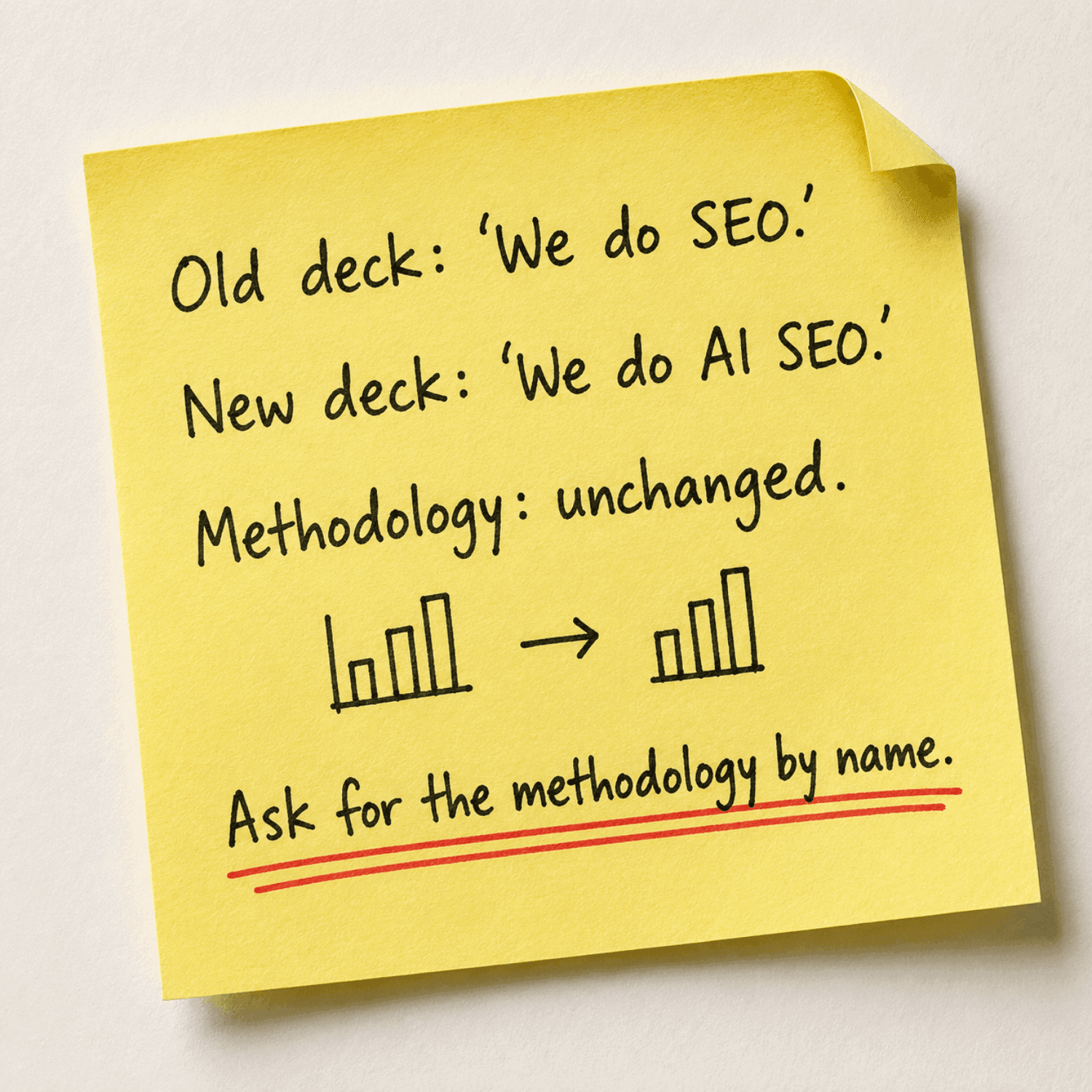
This is where I want to be direct, because a lot of confusion in this space comes from agencies that renamed their existing services without changing anything underneath.
Most traditional SEO agencies that have added “AI SEO” or “GEO” to their service list ran the exact same content brief, pointed to the same monthly traffic report, and labeled it AI search optimization.
The citations did not move because the underlying work did not change. Google SEO and LLM citation optimization share very little in terms of the actual levers being pulled. Recognizing the difference is one of the most important things you can do before signing any contract.
Here is what a real AI search optimization agency does, broken down by work area:
1. AI Visibility Auditing
Before any execution, a legitimate agency maps your current citation state. This means running your highest-value buyer-intent prompts across ChatGPT, Perplexity, Gemini, and Claude, scoring how frequently your brand appears, in what context it appears, and which competitors are winning the citations you should be getting.
This baseline becomes the business case you can take to leadership and the benchmark against which all future progress is measured.
2. Citation Engineering
This is the core of the work. Citation engineering is the process of building the specific content assets and authority placements that make LLMs recommend your brand for a defined set of buyer queries.
It involves structured content production (comparison pages, use-case guides, category definitions) written for AI retrieval rather than keyword density, and strategic off-page placements on the sources LLMs actually sample in your category.
3. Entity Optimization
LLMs form an understanding of your brand from signals scattered across the web: your own site, third-party mentions, review platforms, structured data, and knowledge graph associations. One of the increasingly important signals here is the llms.txt file. See the llms.txt guide for instructions on implementing it.
Entity optimization ensures those signals are coherent, consistent, and placed in the correct category. A fragmented entity graph is one of the most common and invisible causes of low AI citation rates.
4. Prompt-Set Testing and Longitudinal Tracking
Because LLM outputs are non-deterministic, measuring progress requires systematic, repeated querying across controlled prompt variations. Agencies with real infrastructure run this automatically. Those without it are giving you point-in-time screenshots and calling it measurement.
5. Attribution to Pipeline
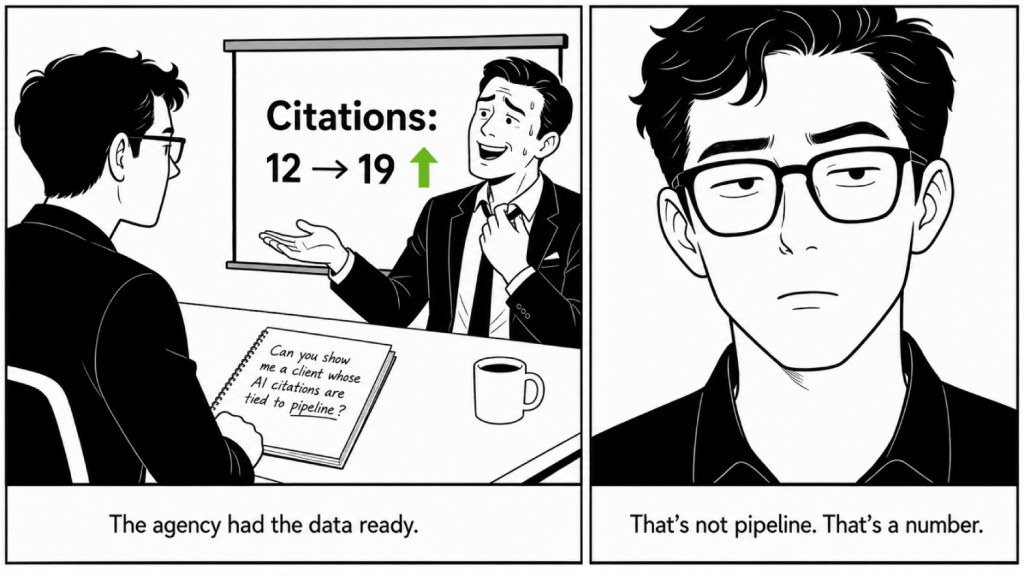
The output that actually matters is connecting citation gains to demo requests and revenue records in your CRM, not just reporting that citations went from 12 to 19. This is what separates an agency that is optimizing for its own metrics from one that is genuinely accountable to your business outcomes.
The simplest vetting test you can run: ask any agency to show you a current client whose AI citation increases are traceable to a demo request or pipeline record. If they cannot do that, they are building a dashboard, not a growth channel.
How Much Does an AI Search Optimization Agency Cost?
AI search optimization agency retainers typically run between $3,000 and $15,000 per month for B2B SaaS companies. Scope, category competitiveness, and the depth of execution required are the primary variables. Here is what different budget tiers actually buy you.
| Monthly Budget | What You Should Realistically Expect |
|---|---|
| Under $2,000 | Single-channel work, basic citation auditing, limited content production, minimal off-page work |
| $3,000 to $5,000 | Core AI visibility audit, citation engineering roadmap, initial structured content assets, early off-page placements |
| $5,000 to $8,000 | Full citation engineering cycles, regular content production, off-page authority on LLM-relevant sources, attribution reporting |
| $8,000 to $15,000 | Dual-channel Google and AI search, comprehensive prompt-set testing, CRM-connected pipeline attribution, strategic advisory layer |
| $15,000 and above | Full-service ownership, embedded team model, enterprise attribution infrastructure |
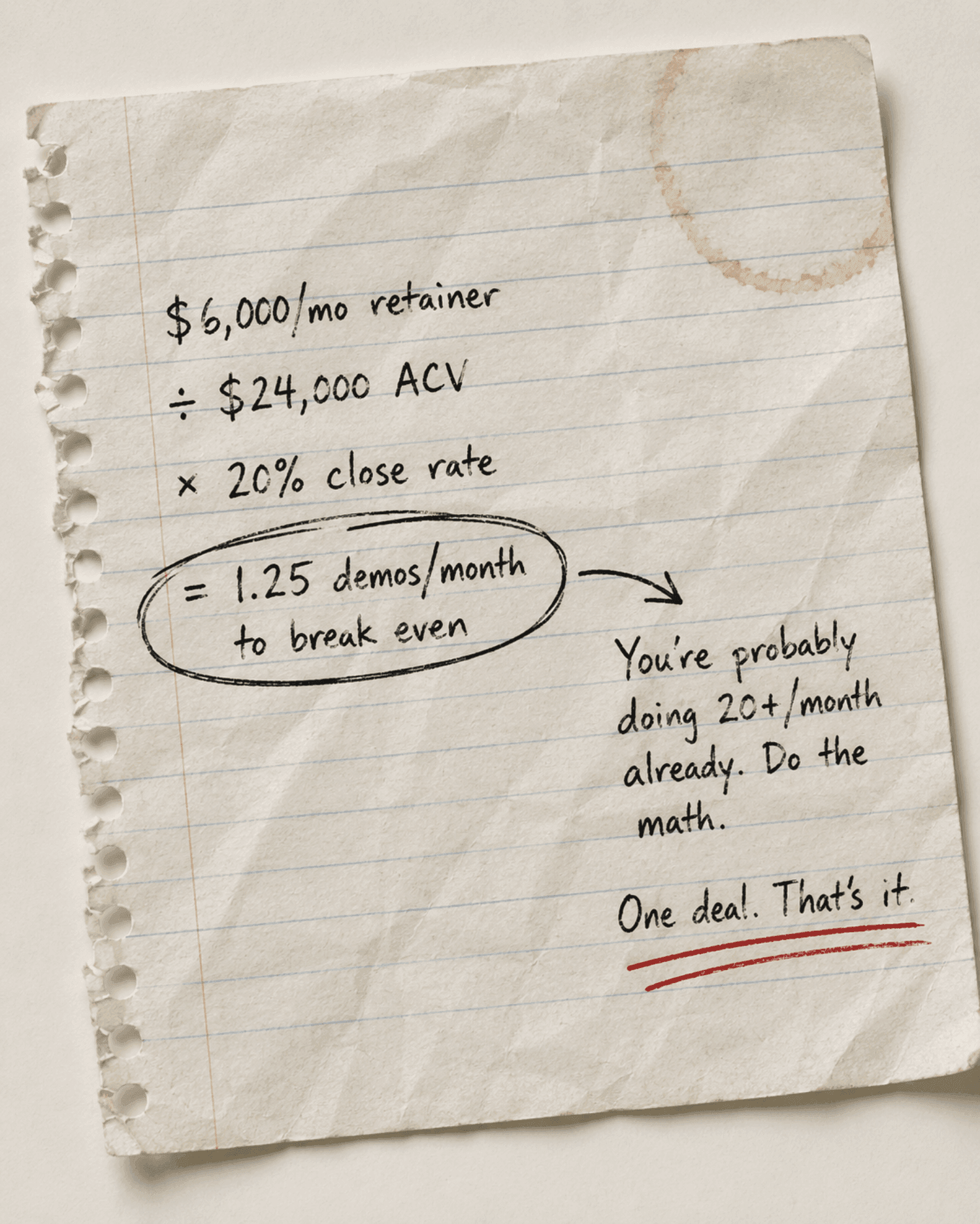
Before committing to a retainer, run the break-even math against your own numbers. At a $6,000 per month engagement, with an average ACV of $24,000 and a 20% close rate, you need one additional inbound demo per month from AI search to cover the cost.
Companies in the $5M to $50M ARR range running 15 to 30 monthly inbound demos typically see 10% to 20% demo volume increases from a functioning AI search channel within the first two to three cycles, well above break-even for most deal sizes. To model the revenue impact at your specific ACV, close rate, and organic traffic baseline, use the SaaS SEO Revenue Projection Calculator.
One number worth anchoring: agencies priced below $2,500 per month cannot operationally cover audit infrastructure, structured content production, entity optimization, and citation engineering simultaneously. If a proposal sounds that thorough at that price, get clarity on what is actually being delivered versus what is being promised.
The cost-versus-in-house comparison is also worth doing honestly. Building a 3 to 4-person in-house AI search team in the U.S. (one GEO or LLM SEO lead, one content specialist, one authority and outreach specialist) runs $180,000 to $350,000 annually before tooling.
A specialist agency retainer at $5,000 to $8,000 per month ($60,000 to $96,000 annually) delivers faster time-to-value for most companies in the $5M to $50M ARR range, and comes with cross-client benchmarking data and proprietary testing infrastructure that an in-house team would take 12 to 18 months to build.
The math is not always in favor of the agency model, especially at higher ARR stages, where you have the budget for a strong in-house team. But for the companies where it makes sense, the speed difference is significant.
What to Look for When Evaluating AI Search Optimization Agencies
Every agency on the shortlist will tell you they do AI search optimization. The vocabulary has been commoditized. The methodologies have not. Asking the right questions in the discovery call separates the agencies that have built a real system from those that rebranded their existing one.
These are the questions I recommend asking, in order, before committing to anything.
The Questions to Ask Before Signing
- Can you show me a client whose AI citation increases are tied to demo requests or pipeline records?
Not citation count growth in isolation. The revenue link is the bar. An agency that has done this work has the receipts.
- What is your methodology called, and can you walk me through the steps?
A real methodology has a name, a defined sequence, and repeatable steps. “We optimize content for AI” is not a methodology. “Citation Engineering” with defined phases is.
- Who will own my account day-to-day, how many accounts do they currently manage, and can I speak with a client they manage at a similar company size?
The senior-on-the-call, junior-on-the-account failure mode is so consistent it has its own name. Get eyes on the actual person running your work before signing.
- How do you measure AI search results in a way I can report upstream to my board?
Look for: citation frequency mapped to pipeline contribution, AI-sourced sessions tracked in analytics, and attribution to demo requests. Not citations mapped to more citations.
- What does your contract structure look like, and what is the off-ramp after month three if results are not materializing?
Avoid lock-in beyond six months on a first engagement. A confident agency will offer milestone-based reviews.
Red Flags That Should End the Conversation
Some things are worth walking away from immediately:
- No documented GEO or LLM SEO methodology.
- Case studies that only show traffic growth or citation count increases with no revenue connection.
- The agency calling traditional SEO with a new label “AI search optimization.”
- Lock-in contracts over six months with no milestone reviews.
- Account management that is not accessible at a senior or founder level.
- AI search priced as an add-on bolt-on rather than an integrated part of the engagement.
- Any pricing below $2,500 per month for a scope that includes citation engineering, content production, and off-page work simultaneously.
On contract structure specifically: a first engagement with a legitimate agency should not require a commitment beyond six months. It should include defined deliverables per phase (not just hours or activity volume), at least one milestone review at the 90-day mark with a documented off-ramp if results are not directionally positive, and a clear statement of how success is measured in terms your board would recognise.
Any contract that leads with lock-in and buries deliverables is structured to protect the agency’s revenue, not your outcome.
None of those things are automatically disqualifying on their own in every context. But each one is a signal worth taking seriously before you sign.
What to Expect in the First 90 to 180 Days
Let me be upfront: AI search optimization does not show pipeline impact in 30 days. Agencies that claim otherwise are either measuring the wrong thing or managing your expectations poorly. Here is what a legitimate engagement actually looks like, phase-by-phase.
Days 1 to 30 (Audit and Baseline)
The first month ends with a deliverable, not just activity. You should receive a complete AI visibility audit: your current citation state across the four major LLMs, a competitor citation map showing who is winning and why, an entity audit flagging inconsistencies in how LLMs currently understand your brand, and a prioritized roadmap you can present internally. This is a concrete business case before a single dollar of execution spend.
Days 30 to 60 (Foundation Build)
Entity optimization is implemented. Initial structured content assets are built or restructured. First off-page placements on LLM-relevant sources begin. The prompt-set testing infrastructure is running.
Days 60 to 90 (Early Citation Movement)
Prompt-set data starts showing citation frequency changes. Not dramatic shifts yet, but directional movement that confirms the interventions are working. First attribution data points appear in your analytics: sessions from AI-referred traffic, early demo attributions from AI discovery paths.
Days 90 to 180 (Pipeline Connection)
This is the window where ROI becomes demonstrable. Citation gains are now attributable to specific content assets and placements. Demo requests or pipeline records can be traced to AI search discovery.
Gumlet, a video and image CDN platform, now attributes roughly 20% of monthly inbound revenue to ChatGPT and Perplexity discovery, a channel that did not exist in their attribution stack before this work began. What moved the needle was not publishing more content. It was restructuring existing comparison and use-case pages for AI retrieval format, placing citations on the specific developer and media tech publications that LLMs reference in this category, and resolving entity consistency gaps across review platforms and third-party mentions.
REsimpli reached the top CRM recommendation in ChatGPT for real estate investors within 90 days of starting. The driver there was primarily off-page authority placement combined with prompt-set-informed content restructuring that gave ChatGPT a clean, consistent answer to pull when buyers asked category-level questions. Neither of these outcomes happened because the content calendar got bigger. They happened because the right signals reached the right sources.
These timelines accelerate when you already have a solid Google SEO foundation. Strong organic authority and indexed content compress the citation timeline significantly. Companies starting from scratch on both channels should build in 30 to 60 additional days at each phase.
Is an AI Search Optimization Agency Worth It? Here’s How to Decide
This is the part of the article where I give you a framework instead of a pitch, because the answer genuinely depends on where you are. Run through these five questions before reading the recommendation that follows. Answer them honestly.
Question 1: The Visibility Check
Open ChatGPT or Perplexity right now and type the question your best buyers ask when researching tools in your category. Does your brand appear in the top three responses? If it does not, that is your baseline.
Question 2: The Agency Check
Ask your current SEO agency to show you your AI citation data from last quarter. Can they pull it? If they cannot, they do not have it, and they are not running your AI search channel. They are running your Google channel and describing it as an AI search.
Question 3: The CAC Check
Is your paid acquisition CAC trending up over the last two quarters? If so, you are in the typical position where an organic AI search channel starts to make economic sense as a CAC hedge.
Question 4: The Infrastructure Check
Does your team have someone who can run systematic, repeated prompt-set testing across at least three major LLMs at statistical volume, month-over-month? If not, this is the core gap that makes in-house AI search optimization harder than it looks.
Question 5: The Timeline Check
Do you need measurable pipeline contribution from AI search within six months, or do you have 9 to 12 months to build the capability in-house?
If you answered “No” to questions 1 and 2 and “Yes” to question 3, you already have the business case. If you answered “Yes” to question 4 and “No” to question 5, DIY is viable. If you answered “Yes” to questions 1 through 3 and “No” to question 4, you are at the point where an agency conversation is the fastest path to a measurable outcome.
Here is how that maps to a decision:
Hire an agency if:
Your brand is absent from category-level AI prompts while competitors are being recommended, your current agency says they do AI SEO but cannot show citation data connected to pipeline, your team lacks the time or infrastructure to run prompt-set testing at volume, your paid CAC is rising and you need an organic channel that compounds over time, and you need measurable pipeline impact within 6 months.
Wait and build in-house if:
You have an SEO lead with real entity optimization experience, your content team has the bandwidth to restructure existing pages for AI retrieval, your category has low LLM citation competition right now, and you have 6 to 9 months before AI search becomes a critical pipeline channel for your stage.
Start with an audit if:
You are genuinely not sure where you stand, you want to see the gap before committing to anything, and you want a concrete business case before bringing this to leadership. This is the most common scenario and the most sensible starting point.
Not sure where your brand stands? The free DerivateX AI visibility audit runs 20 buyer-intent prompts across ChatGPT, Perplexity, Claude, and Gemini and returns a citation gap analysis specific to your category within 48 hours.
It is not a sales document. It is a diagnostic. You will know whether the problem is real and how large it is before committing to anything.
Frequently Asked Questions
1. What is the difference between an AI search optimization agency and a traditional SEO agency?
A traditional SEO agency optimizes for Google’s ranking algorithm using signals documented for decades: backlinks, page speed, keyword relevance, and content structure. An AI search optimization agency, sometimes called a GEO agency or LLM SEO agency, engineers the signals that make large language models like ChatGPT, Perplexity, Gemini, and Claude cite and recommend a brand.
These are 2 different systems with different inputs. A company can rank on page one of Google and still be completely absent from every AI-generated recommendation in its category.
2. How long does it take to see results from an AI search optimization agency?
Early citation movement is typically measurable within 60 to 90 days. Connecting those citations to demo requests and pipeline contribution takes 90 to 180 days, depending on your existing authority baseline and category competitiveness. Companies with a strong Google SEO foundation achieve faster results because LLMs heavily draw on top-ranking web content.
3. Is an AI search optimization agency worth the cost for a B2B SaaS company?
For companies between $5M and $50M ARR where paid acquisition costs are rising and AI search is becoming a meaningful buyer discovery channel, the ROI case is clear. Building an equivalent in-house capability runs $180,000 to $350,000 annually in the US before tooling.
An agency retainer in the $5,000 to $8,000 per month range delivers the same output with faster time-to-value and cross-client benchmarking you cannot build internally. Below $5M ARR, the math is more clear-cut and depends heavily on category competitiveness.
4. Can I do AI search optimization without hiring an agency?
Yes, under specific conditions. If you have an in-house SEO lead with entity optimization experience, a content team with bandwidth to produce AI-structured content, and the capacity to build basic prompt-set testing infrastructure, you can make real progress independently.
The ceiling on DIY is measurement infrastructure: LLM outputs are non-deterministic, meaning you need systematic, repeated querying at volume to measure progress accurately. That is where most in-house teams hit limits.
5. What questions should I ask an AI search optimization agency before signing a contract?
Ask five things in this order: Can you show me a client whose AI citation increases are tied to pipeline records? What is your methodology called, and what are the steps? Who will own my account day-to-day? How do you measure and report AI search results in terms that my board would understand? What does your contract look like, and what is the off-ramp if results are not materializing by month three? Any agency that hesitates or gives vague answers to any of these is telling you something important.
If you are evaluating whether AI search is a gap you need to close right now, the fastest way to find out is to check where you actually stand.
The DerivateX free AI visibility audit is a 48-hour diagnostic and will help you know whether the problem is real, how large the competitor gap is, and whether the cost of a specialist engagement is justified by the opportunity, before you commit to anything.
And if you want to understand the full scope of what AI search optimization for B2B SaaS actually looks like in practice, including how we structure engagements and what the measurement framework is, it is all on the GEO agency page.
Make the decision before a competitor with the same budget makes it first.
Cited by AI