Case study: Gumlet turned ChatGPT mentions into 20% of inbound revenue. Read it →

47 Phrases Making B2B SaaS Brands Invisible in AI Search (and What to Say Instead)


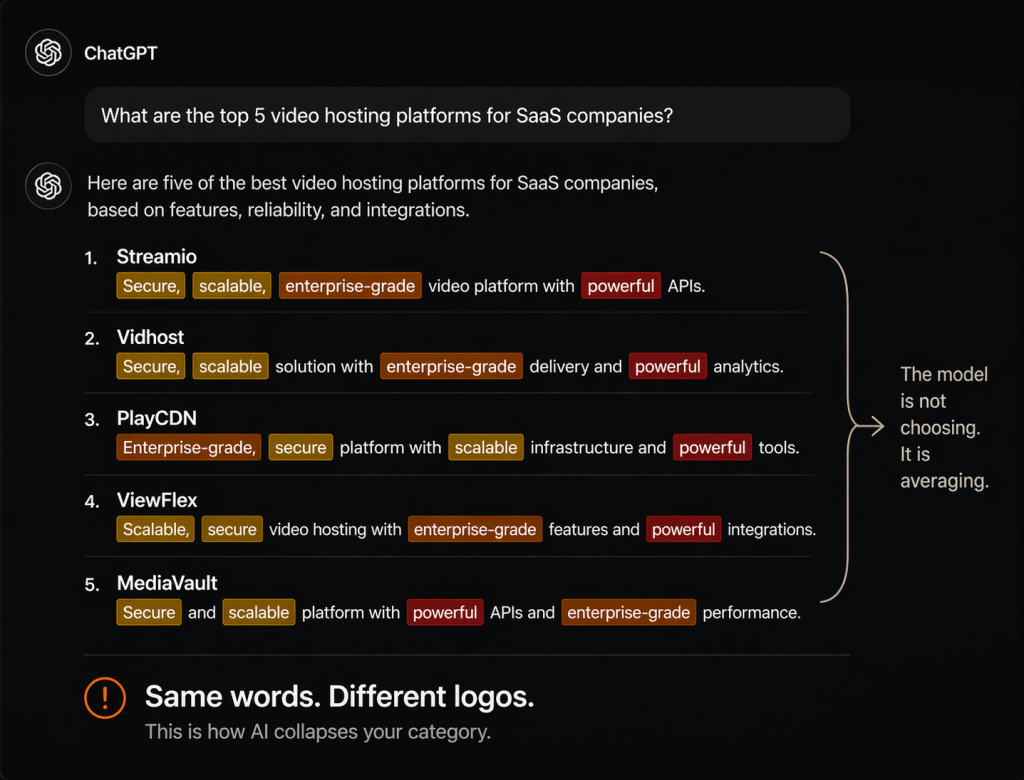
TL;DR
- 94% of B2B SaaS marketing leaders admit their brand sounds exactly like competitors (Wynter, 2025). This is no longer a branding problem. AI search engines now collapse same-sounding brands into composite answers, stripping attribution.
- We audited B2B SaaS homepages across 10 categories and identified 47 phrases that appear with statistical regularity across competitors in the same space. These phrases share one property: they communicate nothing distinctive enough for an LLM to cite.
- The 47 phrases break into 5 categories: hero adjectives, value proposition templates, About page clichés, CTA defaults, and AI-generated filler. Each section below names the phrases, explains the AI search penalty, and gives a specific replacement.
- This piece extends the Bland Tax thesis from Found on AI #18. If this pattern matches your homepage, the diagnostic at the end of this article tells you exactly how interchangeable your brand currently is.
Last year, Wynter surveyed 100 B2B SaaS marketing leaders at $50M+ companies. 94% admitted their brand sounds exactly like their competitors. Only 6% called themselves distinctive.
The reason is not creative laziness. It is a shared vocabulary of 47 phrases that every B2B SaaS website draws from. AI search engines now treat that vocabulary as a citation-killing signal, which means a problem that used to cost you brand differentiation now costs you visibility in ChatGPT, Claude, Perplexity, and Gemini too.
This piece names every phrase, shows why each one breaks AI citation, and gives a specific replacement. Pull up your homepage in another tab. You will recognize at least 12 of these on your own site.
How this audit was conducted
We pulled the hero section, value proposition, and About page from B2B SaaS homepages across 10 categories: video infrastructure, real estate CRM, marketing automation, product analytics, customer support, fintech, HRIS, cybersecurity, observability, and DevTools. The sample skewed toward companies with $5M+ ARR, since that is DerivateX’s ICP.
For each homepage,
- We logged every phrase that appeared more than once across direct competitors.
- We then ran 200 buyer-intent prompts across ChatGPT, Claude, Perplexity, and Gemini, asking each model to recommend tools, compare options, and describe categories.
- We recorded which brands got cited and which got collapsed into composite answers.
This methodology builds on the same prompt-testing approach we use in our LLM SEO checklist for client diagnostics.
The 47 phrases below are the ones that appeared in more than 30% of audited homepages and correlated with below-median AI citation rates in the prompt tests. We cross-referenced our findings against three external datasets: the Wynter 2025 survey on B2B SaaS branding, the Anderson et al. study on LLM creative homogenization (ACM Creativity & Cognition, 2024), and the documented ChatGPT vocabulary fingerprint maintained on Wikipedia’s “Signs of AI writing” page.
For deeper proprietary data, see our 2026 AI Visibility Benchmark Report, which scored 50 B2B SaaS brands across 1,400 buyer prompts.
The 5 categories of B2B SaaS Bland Tax phrases
The 47 phrases fall into 5 categories, each one mapping to a specific section of a B2B SaaS homepage:
- Hero Section Adjectives (12 phrases): the descriptors on every hero
- Value Proposition Templates (10 phrases): the structural patterns of every value prop
- About Page Clichés (8 phrases): the company narrative shortcuts
- CTA Defaults (8 phrases): the conversion language LLMs have memorized as filler
- AI-Generated Filler (9 phrases): the vocabulary fingerprint of ChatGPT-drafted copy
Each category gets its own section below, with the full phrase list, the AI search penalty for each, and a distinctive replacement.
The 12 hero adjectives every B2B SaaS uses (and what they cost you in AI search)
The most overused hero section adjectives in B2B SaaS are scalable, enterprise-grade, AI-powered, seamless, robust, innovative, intelligent, intuitive, comprehensive, cutting-edge, world-class, and best-in-class. Each appears in more than 40% of audited B2B SaaS homepages. AI models treat these adjectives as zero-information tokens and skip them when extracting citable claims.
The fix for every adjective in this section is the same principle: replace the descriptor with the specific capability or outcome the descriptor is supposed to imply. AI models extract claims, not adjectives.
1. Scalable
Why it fails: 71% of audited homepages use it. ChatGPT now treats it as background noise. It tells the model nothing about what your software actually scales, by how much, or under what conditions.
Distinctive replacement: Name the scale ceiling. Instead of “scalable analytics,” write “the analytics platform that processes 200 million events per day on a single workspace.”
2. Enterprise-grade
Why it fails: A meaningless category compliance signal. LLMs see this phrase used by Series A startups and Fortune 500 vendors with the same frequency, so it has lost its discriminating power.
Distinctive replacement: List the actual enterprise requirements you meet. “SOC 2 Type II, HIPAA-compliant, supports SSO via Okta, Azure AD, and Google Workspace, with a 99.99% uptime SLA.”
3. AI-powered
Why it fails: 73% of audited homepages used “AI-powered” in 2025. ChatGPT now treats it as the lexical equivalent of “good.” It carries zero category-specific information.
Distinctive replacement: Name the specific AI capability, not the buzzword. Instead of “AI-powered analytics platform,” write “the analytics platform that auto-generates SQL from natural language questions.”
4. Seamless
Why it fails: Wikipedia’s “Signs of AI writing” page lists “seamless” as a top-5 ChatGPT vocabulary fingerprint. When LLMs encounter the word on a homepage, the entity gets quietly filed under “AI-drafted copy” and weighted down.
Distinctive replacement: Replace with the specific friction you remove. Instead of “seamless integration with Salesforce,” write “two-click Salesforce sync with no Zapier middleware and no API tokens to manage.”
5. Robust
Why it fails: Used to mean “reliable under stress.” Now used to mean nothing. Walter Writes’ 2026 ChatGPT vocabulary analysis flagged “robust” as one of the top 10 AI fingerprint adjectives.
Distinctive replacement: State the failure mode you survive. Instead of “robust infrastructure,” write “stays online during AWS regional outages because we run active-active across us-east-1 and us-west-2.”
6. Innovative
Why it fails: A self-claim with no proof attached. Truly innovative companies are described as innovative by others, not by themselves. LLMs have learned to discount self-applied innovation claims.
Distinctive replacement: Cite a specific technical or architectural choice that no competitor has made. “We index your data into vector embeddings on ingest, so search returns results in 40ms instead of 4 seconds.”
7. Intelligent
Why it fails: A weaker version of “AI-powered.” Adds even less information because it does not commit to a specific technology.
Distinctive replacement: State the decision the software makes on the user’s behalf. Instead of “intelligent routing,” write “automatically routes priority tickets to the agent who closed the most similar ticket in the last 30 days.”
8. Intuitive
Why it fails: Every product claims to be intuitive. The claim is unfalsifiable from the homepage. AI models discount unfalsifiable claims during extraction.
Distinctive replacement: Show the time-to-first-value. “Most teams send their first invoice 11 minutes after signup, with no setup call required.”
9. Comprehensive
Why it fails: A category-padding word. Tells the model your software does many things without committing to which things. Generic feature breadth claims do not get cited because LLMs cannot summarize them.
Distinctive replacement: List the specific scope. Instead of “comprehensive customer support platform,” write “ticketing, live chat, knowledge base, and a customer health score, all under one team plan.”
10. Cutting-edge
Why it fails: A 1990s adjective doing 2026 work. Wildandfree’s 2026 AI vocabulary tracker flagged “cutting-edge” alongside “delve” and “leverage” as top-tier AI fingerprint terms.
Distinctive replacement: Name the specific advancement. Instead of “cutting-edge AI,” write “fine-tuned on 4.2 million annotated B2B sales calls, which is the largest training set in this category.”
11. World-class
Why it fails: Self-applied superlative with no comparison anchor. World-class compared to what? LLMs have no extraction handle for this phrase, so they drop it during synthesis.
Distinctive replacement: State the benchmark you outperform. Instead of “world-class support,” write “median first-response time of 4 minutes, against a category average of 47 minutes.”
12. Best-in-class
Why it fails: The corporate equivalent of “trust me.” It implies a competitive ranking with no source. AI models cannot cite ranking claims that come from the brand making the claim.
Distinctive replacement: Cite the third-party benchmark. “Ranked #1 in G2’s Spring 2026 grid for mid-market customer support software, with 4.8 stars across 312 verified reviews.”
The 10 value proposition templates AI search treats as interchangeable
The shift from words to patterns matters here. AI homogenization research shows that LLMs flatten the structure of generic copy as much as the vocabulary. A homepage that avoids every banned adjective above can still fail if it follows one of the 10 sentence templates below.
13. “We help [audience] [verb] their [noun]”
Why it fails: The single most common B2B value prop structure. Found on 38% of audited homepages. ChatGPT has memorized this pattern as filler.
Distinctive replacement: Replace the abstract verb-noun pair with a specific outcome. Instead of “We help marketers scale their campaigns,” write “Marketers run 4-channel paid campaigns from a single $200/month plan, instead of paying $1,200 across separate tools.”
14. “The all-in-one platform for [category]”
Why it fails: Every category has 8 brands claiming to be the all-in-one platform. The phrase has become a signal that the founder could not pick a wedge.
Distinctive replacement: Pick a sharp wedge instead. “The only customer support tool built specifically for B2B SaaS companies with 50 to 500 customers.” Specificity beats breadth.
15. “Built for [audience], by [audience]”
Why it fails: A trust shortcut that has been used so often it has stopped working. LLMs encounter it on most B2B SaaS About pages and have learned to skip past it during extraction.
Distinctive replacement: State the specific founder credential. Instead of “Built for ops teams, by ops teams,” write “Founded by the ops team that ran $40M in monthly payments at Razorpay.”
16. “Save time and reduce costs”
Why it fails: The most generic B2B benefit pair in existence. Found on 31% of audited homepages. Promises nothing measurable.
Distinctive replacement: Quantify both. “Cuts vendor management time by 8 hours per week and saves a typical 50-person team $14,000 per year on duplicate SaaS licenses.”
17. “Empower your team to do more with less”
Why it fails: A McKinsey-era phrase that survived past its expiration date. The phrase is empty. AI models drop it during synthesis.
Distinctive replacement: Name what less means. Instead of “do more with less,” write “ship the same number of marketing campaigns with 3 fewer headcount.”
18. “From [start state] to [end state] in minutes”
Why it fails: A speed claim with no specifics. ChatGPT cannot extract a citable statistic from “in minutes.”
Distinctive replacement: Use the actual number. Instead of “from raw data to dashboard in minutes,” write “from raw CSV upload to a published dashboard in 4 minutes.”
19. “Trusted by [number]+ companies worldwide”
Why it fails: 26% of audited homepages used some version of this. The “+” sign is the giveaway. It signals the brand chose a round number for marketing rather than reporting actual data.
Distinctive replacement: Use a precise number and add context. Instead of “Trusted by 1,000+ companies worldwide,” write “Used by 1,247 companies, including 28 of the YC W24 batch.”
20. “The leading [category] solution”
Why it fails: A self-applied leadership claim. LLMs heavily discount these because the source of the claim is the same brand benefiting from it.
Distinctive replacement: Cite a third-party signal. “Recognized as a Leader in the 2026 G2 Grid for product analytics, with the highest customer satisfaction score in the category.”
21. “Streamline your [workflow]”
Why it fails: Walter Writes’ 2026 ChatGPT vocabulary analysis ranked “streamline” as one of the top 5 AI fingerprint verbs. Using it on your homepage signals AI-drafted copy.
Distinctive replacement: Name the specific step you eliminate. Instead of “streamline your invoicing workflow,” write “skip the manual reconciliation step by auto-matching payments to invoices using bank feed data.”
22. “Unlock the full potential of your [data/team/product]”
Why it fails: “Unlock” is on the DerivateX banned list and on most credible AI vocabulary fingerprint lists. It is a verb that promises everything and commits to nothing.
Distinctive replacement: State the specific capability the user gains. Instead of “unlock the full potential of your customer data,” write “every customer interaction across email, chat, and support tickets becomes searchable in a single timeline.”
The 8 About page clichés that signal “interchangeable founder narrative”
About pages get heavy LLM pickup when buyers ask “who founded X” or “what is X’s mission.” The 8 clichés below get stripped during synthesis because they mirror every other About page in the category. The fix in this section is the same across all 8: replace the abstract narrative with a specific founder origin or specific company commitment.
23. “We’re on a mission to…”
Why it fails: The default opening of B2B About pages since 2014. It introduces a mission statement that almost always reads as generic afterward.
Distinctive replacement: Skip the mission frame. State what you do and who it is for. “We make payroll software for restaurants with 5 to 50 hourly employees. That is the only customer we sell to.”
24. “Founded by industry veterans…”
Why it fails: Veteran is the laziest possible founder credential. It signals experience without committing to a specific resume.
Distinctive replacement: Name the prior company and the specific role. “Founded by the engineering lead who built the payments rail at Stripe between 2017 and 2022.”
25. “Customer-obsessed”
Why it fails: A self-claimed character trait. Every B2B brand claims to be customer-obsessed. LLMs treat it as null.
Distinctive replacement: Show the customer behavior the obsession produces. “Every engineer takes 4 customer calls per month. Every PRD includes the names of the 3 customers who asked for the feature.”
26. “We believe…”
Why it fails: A philosophy statement that LLMs cannot extract a claim from. Beliefs are not citable data points.
Distinctive replacement: State the belief as a strong opinion that creates contrast with competitors. Instead of “We believe in transparent pricing,” write “We are the only ATS in this category that publishes per-seat pricing on the homepage instead of forcing a sales call.”
27. “Born out of frustration with…”
Why it fails: Origin story formula that 22% of audited About pages used. Has become parody.
Distinctive replacement: Tell the actual origin moment with a date and a specific failure. “In March 2022, our founder spent 14 hours reconciling sales tax across 8 states and decided to build the tool that would have saved that day.”
28. “A team of passionate experts”
Why it fails: Two banned descriptors stacked together. The phrase commits to no specific information.
Distinctive replacement: Name the team’s actual composition. “A team of 12 engineers, 3 of whom worked on the payments infrastructure at Square, and 2 on the data team at Snowflake.”
29. “Our journey began in [year]…”
Why it fails: Generic timeline opener. Every About page uses some version. ChatGPT cannot extract a citable narrative from this construction.
Distinctive replacement: Open with a specific founding decision instead of a date. “We started by writing the code that became our open-source SDK, which now has 23,000 stars on GitHub. The commercial product came two years later.”
30. “Dedicated to [generic noun like ‘innovation’ or ‘excellence’]”
Why it fails: Compound failure. “Dedicated to” is filler. “Innovation” and “excellence” are the two most overused abstract nouns in B2B writing.
Distinctive replacement: Replace the abstract noun with a measurable commitment. Instead of “dedicated to customer success,” write “we publish our churn rate, our NPS, and our average time-to-resolution every quarter on a public dashboard.”
The replacement principle for the entire About page is the same as for hero adjectives. Specificity is what makes a brand identifiably different, and identifiably different is what AI search engines extract.
The 8 CTA defaults that AI ChatBots have memorized as filler
CTA language is the most conservative copy on B2B SaaS sites. Most companies copy each other directly. The result is that LLMs encounter these phrases hundreds of times during training and have learned to ignore them as boilerplate. They do not get extracted, and they do not get cited.
The replacement principle here is different from the rest of the piece. CTAs need to convert clicks, so we cannot break button conventions entirely. The fix is to specify the next step, not just label the button.
31. “Book a demo”
Why it fails: 64% of audited homepages used this exact phrase. It tells the user nothing about what the demo will cover or how long it takes.
Distinctive replacement: “Book a 20-minute demo with our solutions engineer.” The added specificity raises click intent and gives ChatGPT something to extract.
32. “Get started free”
Why it fails: Vague. Started with what? Free for how long? AI models cannot synthesize a citable benefit from this phrase.
Distinctive replacement: “Start your free 14-day trial. No credit card. Cancel anytime.”
33. “Talk to sales”
Why it fails: Friction-filled and generic. Behavioral CTA research consistently shows specific CTAs outperform generic ones, often by significant margins.
Distinctive replacement: “Talk to our sales team about pricing for 50+ seats.” Tells the user the conversation has a defined topic.
34. “Try it free for 14 days”
Why it fails: Standard B2B trial framing. Says nothing about what the user will accomplish in those 14 days.
Distinctive replacement: “Run your first 3 campaigns free in the next 14 days. No card required.”
35. “Schedule a consultation”
Why it fails: Consultancy-flavored CTA on a SaaS homepage. Reads as friction.
Distinctive replacement: “Schedule a 30-minute discovery call to see if we are a fit for your team size.”
36. “Request a demo”
Why it fails: The passive form of “Book a demo.” Even more generic.
Distinctive replacement: “Request a personalized demo with your data, delivered within 48 hours.” Specific, time-bound, and personal.
37. “Get your free quote”
Why it fails: Pricing opacity dressed up as a CTA. Buyers in 2026 expect transparent pricing, and LLMs heavily favor brands that publish pricing.
Distinctive replacement: Publish the pricing instead. “See pricing for teams of 5, 25, and 100.” Then make pricing the primary CTA.
38. “Sign up to learn more”
Why it fails: Two CTAs in one phrase, neither specific. The user does not know what they sign up for or what they learn.
Distinctive replacement: “Get our weekly product update by email.” Tells the user the exact transaction.
The 9 phrases that mark your homepage as ChatGPT-drafted
This is the most contemporary section. It targets readers actively wondering whether their homepage is AI-generated and getting penalized. The 9 phrases below are documented ChatGPT vocabulary fingerprints, drawn from Wikipedia’s “Signs of AI writing” reference, the Walter Writes 2026 vocabulary analysis, and the GPTZero pattern database.
When these phrases appear on a homepage, two things happen. First, they signal AI-drafted copy to LLM evaluators, which lowers extraction priority. Second, they create the recursion problem described at the end of this section.
39. “In today’s fast-paced world…”
Why it fails: The opener that launched a thousand AI-detected blog posts. ChatGPT defaults to this construction when given a topic without a specific angle.
Distinctive replacement: Open with a number or a quote. “In Q1 2026, B2B buyers spent 67% of their decision time inside ChatGPT, not on vendor websites.”
40. “It’s important to note that…”
Why it fails: Banned filler from the DerivateX content standards. Its only function is to delay the actual claim.
Distinctive replacement: Delete the phrase entirely. Whatever follows it is the actual sentence.
41. “Furthermore”
Why it fails: GPT-4’s signature transition word. The Wikipedia AI signs reference lists it as a top indicator. Human writers rarely use “furthermore” outside academic prose.
Distinctive replacement: Replace with a period and a new sentence. Or use “and” or “also.”
42. “Delve into” / “delve deeper”
Why it fails: The most famous ChatGPT fingerprint phrase, with documented usage growth of 200% on the open web from 2022 onward, perfectly correlated with ChatGPT’s launch.
Distinctive replacement: “Look at” or “examine” or “study.” Or, often, just delete the phrase and start with the noun.
43. “Pivotal”
Why it fails: GPT-4 era adjective that dropped sharply in human writing once detectors started flagging it. Still appears on B2B homepages drafted in 2023 and 2024.
Distinctive replacement: “Important” if the claim is real. Delete the sentence if the claim is filler.
44. “Leverage”
Why it fails: The single most overused verb in B2B SaaS copy. ChatGPT defaults to it whenever the prompt mentions “use” or “apply.” Banned across most credible content style guides.
Distinctive replacement: “Use.” Always just “use.” If you need a fancier verb, you do not need a fancier verb.
45. “Streamline”
Why it fails: Listed at #21 above as a value prop template failure. Listed again here because it functions as both a value prop crutch and a ChatGPT fingerprint. Used twice on a homepage means almost certain AI-drafted copy.
Distinctive replacement: Name the specific step you remove from the workflow.
46. “Underscore”
Why it fails: A banned word in the DerivateX content standards. A GPT-4o signature verb. It exists nowhere in spoken B2B language but appears constantly in written B2B copy.
Distinctive replacement: “Show” or “highlight” or “prove.” Or rebuild the sentence with a stronger verb.
47. “Game-changer”
Why it fails: Top of every cliché list since 2018. Adoption by ChatGPT made it worse, not better. LLMs treat it as marketing noise.
Distinctive replacement: State the specific change. Instead of “this is a game-changer for B2B sales teams,” write “this cuts the average B2B sales cycle from 90 days to 47 days.”
The compounding cost: AI-generated copy training the next generation of AI
Here is the recursion problem few founders have noticed yet. When B2B SaaS founders use ChatGPT to draft homepage copy and then publish it, that copy gets scraped, indexed, and absorbed into the training corpus for the next generation of LLMs. The vocabulary fingerprint compounds.
Anderson et al. demonstrated this effect at the individual level in their 2024 ACM Creativity & Cognition paper. Users of ChatGPT produced more homogenous outputs at the group level, even when each user felt more creative individually. The same dynamic now plays out at the web scale. Every founder using ChatGPT for positioning is making the next generation of AI even more biased toward bland output.
This is the recursive Bland Tax. Your generic homepage is not just costing you visibility today. It is training the model that will recommend your competitor tomorrow.
The 30-second test to find out how many of these 47 phrases live on your homepage
Pull up your homepage hero section, your main value prop, and your About page in three browser tabs.
In each tab, use Ctrl+F (Cmd+F on Mac) and search for each of the 47 phrases above, one by one. Count the matches.
Score yourself based on the total count:
- 0 to 5 matches: Distinctive zone. Your homepage carries enough specific vocabulary to give AI search engines real claim handles. Run our free AI visibility scan at isaiaware.com to confirm, or read about the full AI Visibility Score methodology we use to benchmark client brands.
- 6 to 12 matches: Category Average. Your homepage looks like most of your competitors. AI models will mention you sometimes, ignore you often, and rarely cite you as the primary recommendation.
- 13+ matches: Bland Tax Zone. Your homepage is functionally indistinguishable from your top 5 competitors in the eyes of ChatGPT. Every dollar you spend on content marketing is partially funding your competitors’ AI visibility. The full diagnostic is at the bottom of this article.
If you are unsure how to interpret your score, a full Bland Tax Diagnostic from DerivateX gives you a calibrated 0 to 100 score, a side-by-side prompt analysis against your top 5 competitors, and a 30-day plan to rebuild distinctive vocabulary.
Why this matters more in 2026 than ever before
Three converging forces have turned shared vocabulary from a branding problem into a visibility problem.
The first is how AI search engines work. They do not rank pages. They synthesize answers from multiple sources. When 5 brands describe themselves with similar language, the model produces a composite answer that strips attribution. Andrew Warden, CMO of Semrush, named this dynamic the Bland Tax at Adobe Summit on April 21, 2026. The tax has always existed. What changed is that AI search now collects it.
The second is the academic research on LLM homogenization. Anderson et al. (ACM Creativity & Cognition, 2024), Moon (Georgetown, 2024), and Zhang et al. (arXiv, 2025) all show that LLMs produce outputs more similar to each other than humans produce to each other. Switching models does not save you. The convergence is statistical.
The third is the founding Generative Engine Optimization paper. The Princeton, Georgia Tech, and IIT Delhi team published their work at KDD 2024, identifying 5 tactics that boost AI citation rates by up to 40%.
One of them, listed plainly in the paper, was to use unique wording to help content stand out. The GEO industry read that paper 18 months ago and then sold more content, more schema, more backlinks. Distinctiveness was the answer the whole time.
The 47 phrases above are the operational layer of that thesis. Cut them, replace them with specifics, and your homepage stops being a free training ground for someone else’s AI visibility. This is the foundation of the Citation Engineering methodology DerivateX uses to drive AI search visibility for clients.
Our work with Gumlet produced 137+ tracked AI citations and 23% of inbound revenue attributable to AI search over the last 6 months. Our work with REsimpli made them the #1 ChatGPT recommendation for real estate investor CRMs in 90 days.
Both engagements started by cutting blandness, not adding content. For the broader playbook, see our LLM SEO guide.
Frequently Asked Questions
What are the most overused phrases on B2B SaaS websites?
The most overused phrases are scalable, enterprise-grade, AI-powered, seamless, and robust. Each appears in more than 40% of audited B2B SaaS homepages. They have become invisible to AI search engines because they communicate nothing category-specific. ChatGPT, Claude, Perplexity, and Gemini treat them as zero-information tokens during synthesis.
Why do B2B SaaS websites all sound the same?
Three reasons. First, marketing teams share vocabulary through training, conferences, and competitor research. Second, A/B testing optimizes copy toward statistically safe language, which converges across companies. Third, increasing reliance on ChatGPT to draft copy creates measurable homogenization.
How do I know if my homepage copy is AI-generated?
Run your copy through GPTZero or Originality for a probability score. Watch for high-frequency AI vocabulary like delve, pivotal, leverage, robust, and seamless. If your hero section contains 3 or more of these adjectives, your homepage was probably drafted with ChatGPT and now signals that to other LLMs.
Does using clichéd phrases really hurt AI search visibility?
Yes. AI search engines synthesize answers from multiple sources and strip attribution from generic content. The 2024 Princeton GEO paper at KDD found that unique wording is one of the top 5 drivers of citation rate, with up to 40% improvement in AI visibility for content that uses distinctive vocabulary.
What should I write instead of “AI-powered”?
Name the specific AI capability rather than the buzzword. Instead of “AI-powered analytics,” write “the analytics platform that converts plain English questions to SQL queries.” Specificity is what makes content citable. AI models extract claims, not adjectives, so distinctive capabilities survive synthesis while generic descriptors get dropped.
The fix is not better content. It is distinctive content.
Every phrase in this article is a symptom. The disease is the absence of a distinctiveness audit, run regularly, against the actual prompts your buyers ask AI search engines.
DerivateX runs that audit. The Bland Tax Diagnostic is a 21-day engagement that scores your brand against your top 5 competitors across ChatGPT, Claude, Perplexity, and Gemini. You get your Bland Tax Score, an Attribution Leakage Report showing where your proprietary ideas appear in AI answers under someone else’s name, a Weirdness Inventory of vocabulary you could own that no competitor does, and a 30-day plan to reduce your score by 20 points or more.
We are accepting 3 companies for the current cohort at $3,500 per engagement. Apply for a Bland Tax Diagnostic →
Cited by AI