Case study: Gumlet turned ChatGPT mentions into 20% of inbound revenue. Read it →

What Does an SEO Strategist Do? Everything You Need to Know


Ask 10 SEO strategists what their job is and 9 of them will give you some version of the same answer: keyword research, technical SEO, content, links, rankings.
An SEO strategist designs and executes the strategy that determines where a brand shows up when buyers search: across Google, AI answer engines like ChatGPT and Perplexity, and the off-site platforms that determine whether AI models trust and cite you at all.
They are not wrong. They are just describing a job that was fully defined before ChatGPT had 800 million monthly users.
In 2026, a buyer researching your category is just as likely to ask Perplexity “which tool should I use” as they are to Google it. And Google rankings do not predict whether you show up in that answer.
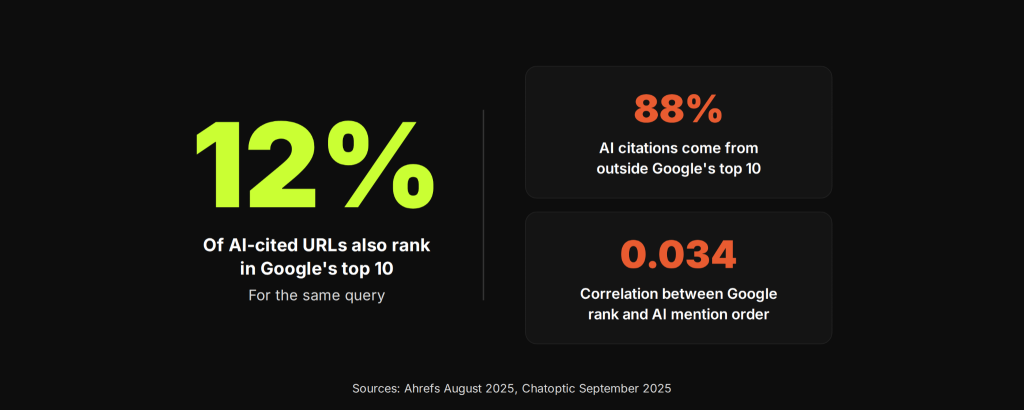
According to Ahrefs’ August 2025 study, only 12% of URLs cited by major AI assistants rank in Google’s top 10 for the same query. The SEO strategist who does not know this is optimizing for one channel while their client goes invisible in another.
TL;DR
- The SEO strategist role now covers three distinct functions: Google visibility, AI answer engine visibility, and the off-site brand presence layer that determines AI citation likelihood. According to Lumar’s December 2025 survey of SEO professionals globally, most existing job descriptions still only address the first.
- Only 12% of URLs cited by ChatGPT, Perplexity, and Copilot rank in Google’s top 10 for the same query (Ahrefs, August 2025), which means strong Google rankings no longer predict whether a brand appears in AI responses.
- Distributing content across third-party publications increases AI citation frequency by up to 325% compared to publishing on owned domains alone (Stacker, December 2025), making earned media a direct SEO responsibility rather than a PR team’s side task.
- 44.2% of all LLM citations are extracted from the first 30% of a piece of content (Growth Memo, February 2026), meaning where a key claim appears on a page is now an optimization variable with measurable AI citation impact.
- According to Lumar’s December 2025 global survey of SEO professionals, GEO and AEO fluency has moved from specialist knowledge to the baseline skill set the market expects from a senior SEO strategist in 2026.
What an SEO Strategist Actually Does in 2026 (And Why the Standard Definition Is Behind)
An SEO strategist designs and executes the strategy that determines where and how a brand shows up when buyers search for anything connected to its category.
In 2024 that meant Google. In 2026 it means Google plus several other surfaces where buyers form opinions, compare options, and narrow shortlists before they ever visit a website.
The traditional definition, covering keyword research, on-page optimization, link building, technical audits, and performance reporting, is not wrong.
It describes roughly half of what the role requires in 2026. The other half involves a set of channels, signals, and measurement frameworks that most job descriptions and career guides have not yet incorporated.
The Visibility Architect Framework: Three Functions an SEO Strategist Is Actually Responsible For
The clearest way to understand the expanded role is through what practitioners are increasingly calling the Visibility Architect Framework: three distinct but connected functions that together define the modern SEO strategist’s full remit.
The strategist who operates across all three is doing the full job, and the Lumar’s December 2025 skills survey found that most practitioners are currently only delivering the first.
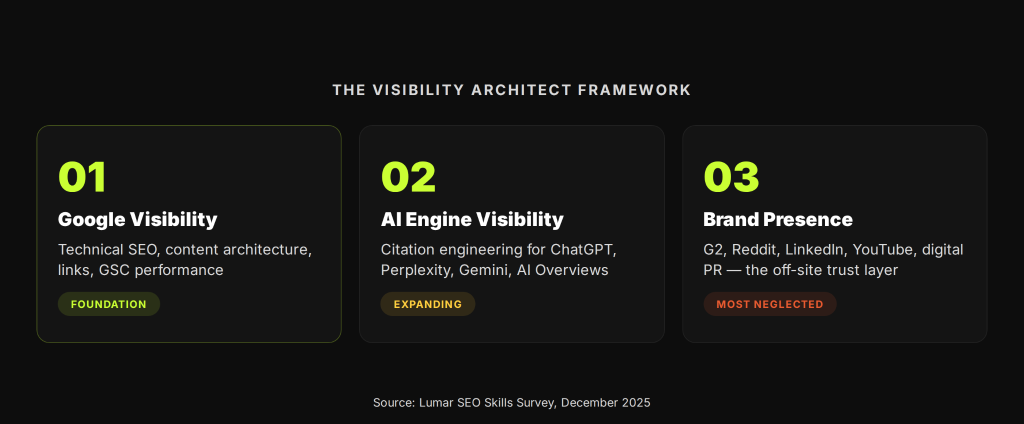
The first is Google visibility: the traditional function, still the foundation, still the largest traffic volume by orders of magnitude. Technical SEO, on-page optimization, content architecture, link building, and performance in Google Search Console all belong here. Nothing in the AI era has made this layer less important. It remains the prerequisite for everything else.
The second is AI answer engine visibility: structuring content and brand signals so that ChatGPT, Perplexity, Gemini, and Google AI Overviews cite the brand reliably in responses to relevant buyer queries. This is what the GEO and AEO discipline addresses.
It requires understanding how retrieval-augmented generation systems select sources, how prompt intent maps to content format, and how to track visibility at the prompt-cluster level rather than the keyword level.
The third is brand presence architecture: the off-site signal layer that most SEO strategists still treat as someone else’s job. It covers maintaining an updated G2 profile with recent reviews, a LinkedIn company page with accurate positioning language, active Reddit presence in relevant communities, YouTube content with clearly structured transcripts, and digital PR placements in industry publications that AI models already treat as authoritative.
This layer is not optional. Domains with profiles on review platforms like G2, Trustpilot, and Capterra are 3x more likely to be cited by ChatGPT than domains without them (SE Ranking, November 2025).
Reddit and Quora presence correlates with 4x higher citation rates for the same domains (SE Ranking, November 2025). These were previously community management responsibilities. They are now direct inputs to AI visibility, which makes them SEO inputs.
How the SEO Strategist Role Has Changed and Why Most Job Descriptions Are Still Catching Up
The role did not shift gradually. It moved in two sharp breaks, and most hiring managers are still working from the job description that existed before the first one.
Before 2022, the job was clean. Pick the right keywords, rank for them, report on the numbers. The strategic question was always some version of “what should we target next?” The work was concentrated and measurable in a way that made it easy to evaluate a strategist’s output. Rankings went up or they did not.
The first break came with Google’s Helpful Content updates and the formalization of E-E-A-T as a genuine quality signal. A keyword list was no longer a strategy. The strategist needed to build topical authority across clusters, coordinate with editorial and development teams, and think about trust signals that did not show up in a rank tracker.
The job got harder to scope because the inputs expanded. You were no longer optimizing pages. You were building systems.
The second break is the one most job descriptions have not processed yet. When AI answer engines became a real B2B discovery channel, the Visibility Architect Framework stopped being a theoretical model and became a practical requirement.
A brand that only invested in function one, Google visibility, was now missing two entire surfaces where buyers were forming opinions. One senior SEO leader at NP Digital described the shift directly in Search Engine Land’s 2026 predictions: “The so-called messy middle is now managed by AI.”
A brand invisible in AI responses during the research phase loses consideration before the buyer ever opens a browser tab.
The modern SEO is not someone who tinkers with page titles. They are the architect of visibility on the modern SERP, and increasingly, inside AI responses that never produce a SERP at all. (Search Engine Land, 2025)
What Does an SEO Strategist Do Day-to-Day in 2026?
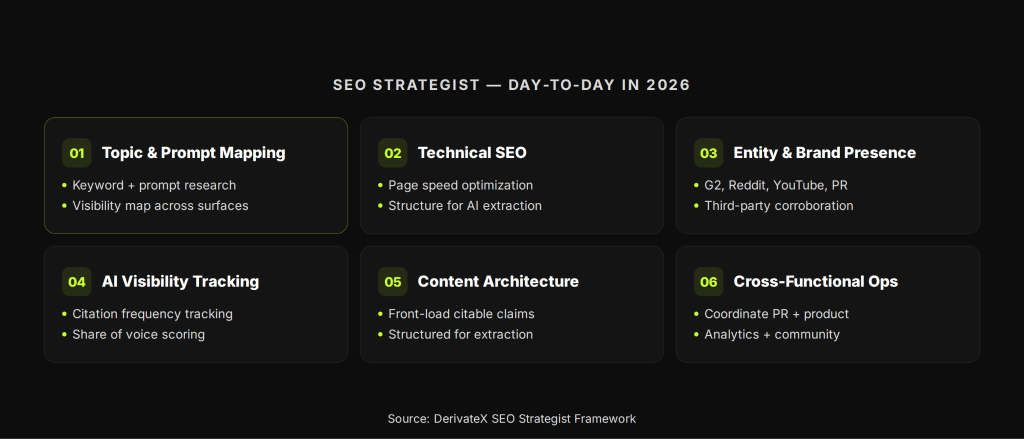
The most significant change to the day-to-day function is that keyword research no longer drives the work. Five distinct areas now define the role, each meaningfully different from its 2022 version.
Keyword Research and Topic Strategy
A 2026 SEO strategist does not start keyword research by sorting for volume. They start by mapping what buyers ask at each stage of a decision and identifying which questions are answered by Google, which by AI assistants, and which by community platforms like Reddit.
A query like “which project management tool is best for remote engineering teams” is more likely to be asked conversationally in Perplexity than typed into Google. That changes which topics matter, how they need to be structured, and what format earns visibility in each channel. The output is a visibility map across surfaces, not a keyword list.
Technical SEO and Content Architecture
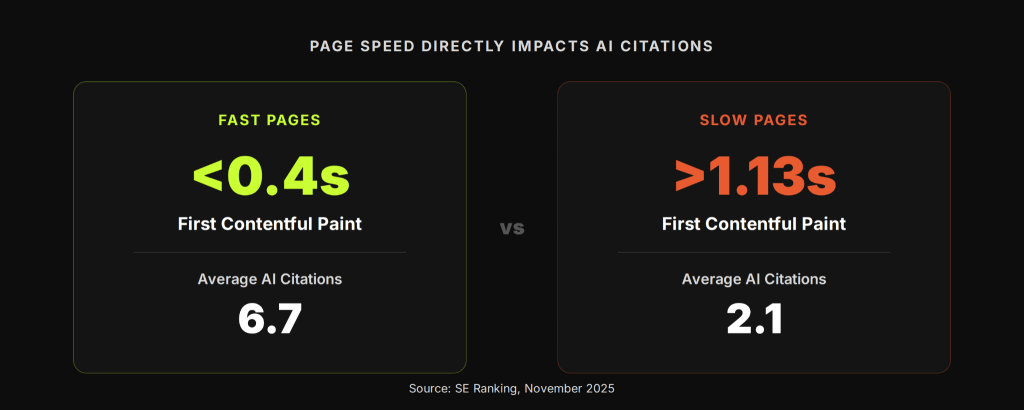
Technical SEO is still the foundation. That has not changed. What has changed is the scope of what counts as a technical variable. Page speed is no longer just a UX consideration: pages with a first contentful paint under 0.4 seconds average 6.7 AI citations while pages loading slower than 1.13 seconds average just 2.1 (SE Ranking, November 2025). AI crawlers have the same patience as impatient humans.
Content architecture in 2026 also means thinking about where claims appear within a page, not just whether they appear. The Growth Memo’s February 2026 analysis found that 44.2% of LLM citations are pulled from the first 30% of a piece of content. The middle section gets 31.1% and the final third just 24.7%.
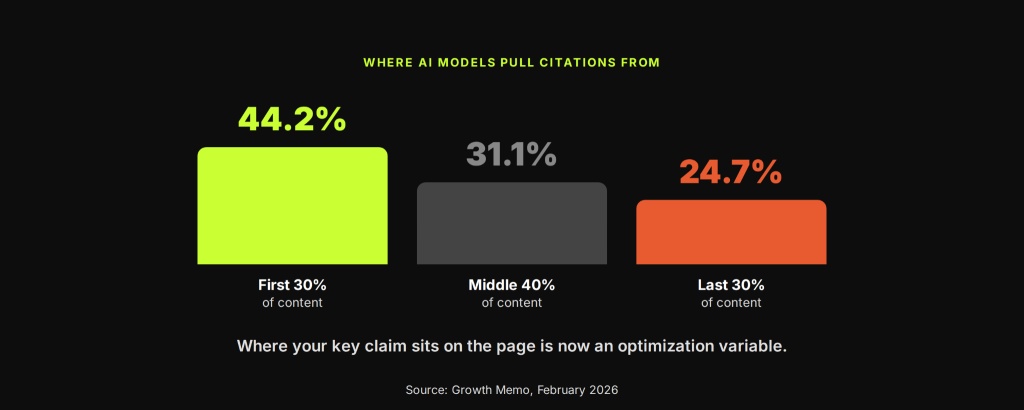
A strategist who buries the most important claim in paragraph eight is not just making the page harder to read, they are reducing the probability of an AI citation.
Entity Authority and Off-Site Brand Presence
This is the part of the job that most SEO job descriptions still do not mention, and it has the most direct impact on AI visibility. The practical scope: a current G2 profile with recent reviews, a LinkedIn page with accurate positioning language, active Reddit participation in relevant communities, YouTube content with structured transcripts, and digital PR placements in publications that LLMs already treat as authoritative.
As one senior SEO strategist put it in Lumar’s December 2025 skills survey, the ambition is “building trust signals so strong that AI would be foolish not to put you front and centre.”
AI Visibility Tracking and Attribution
Rankings and organic traffic still matter but no longer tell the whole story. The most practical proxy for AI-driven discovery is branded search volume growth. When a buyer encounters a brand in ChatGPT and searches for it directly three days later, that session logs as branded organic in GA4 with no AI referral attached.
A rising branded search trend alongside stable or declining organic click-through rates is the specific signal that AI visibility is working even when the dashboard does not show it. AI share of voice across ChatGPT, Perplexity, and Gemini should be tracked separately per platform since each draws on different source pools and behaves differently.
Cross-Functional Coordination
The single best structural change to the SEO strategist role in 2026 is organizational, not technical. The strategist who operates inside a content or marketing silo cannot execute function 2 or function 3 of the Visibility Architect Framework.
AI visibility requires coordinated inputs from PR for earned media placements, from product for review platform profiles, from community management for Reddit and forum presence, and from analytics for CRM-connected attribution.
Search Engine Land’s January 2026 piece on breaking the SEO silo said it directly: the SEO function needs to move from a technical department to “the strategic quarterback for brand authority.” That shift has real organizational consequences.
Where the strategist sits in the company, who they report to, and what teams they have access to all determine whether they can actually do the job the role now requires.
SEO Strategist vs. GEO Strategist: Is There Actually a Difference in 2026?
The short answer is that the distinction is collapsing, and the cleaner answer in 2026 is that GEO is the AI channel layer of SEO rather than a separate discipline.
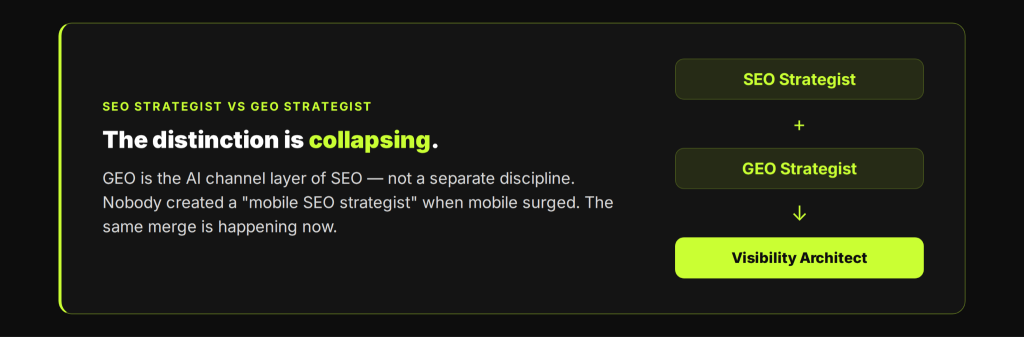
In 2024, Generative Engine Optimization was being treated as specialized knowledge that required its own hire. The consensus among senior practitioners surveyed by Lumar in December 2025 is that the two functions belong in the same role, executed by the same strategist with an expanded skill set.
The analogy that holds: when mobile search surged, nobody created a “mobile SEO strategist” as a separate job title. The existing role absorbed mobile optimization. The same transition is happening with AI, and it is moving faster.
What the convergence means practically: a strategist needs to understand how AI retrieval systems select sources differently from how Google ranks pages, how entity clarity affects citation likelihood, and how to measure AI-influenced pipeline when referral attribution is unreliable. These are not different jobs. They are a larger version of the same one.
DerivateX operates at exactly this intersection for B2B SaaS companies. For REsimpli, the integrated approach to traditional SEO and GEO produced the number one CRM recommendation in ChatGPT for real estate investors. For Gumlet, it produced 20% of inbound revenue attributed to ChatGPT and Perplexity. Neither result came from treating SEO and GEO as separate programs with separate owners. Both came from treating them as a single visibility system and measuring them as such.
What Skills Does an SEO Strategist Need in 2026?
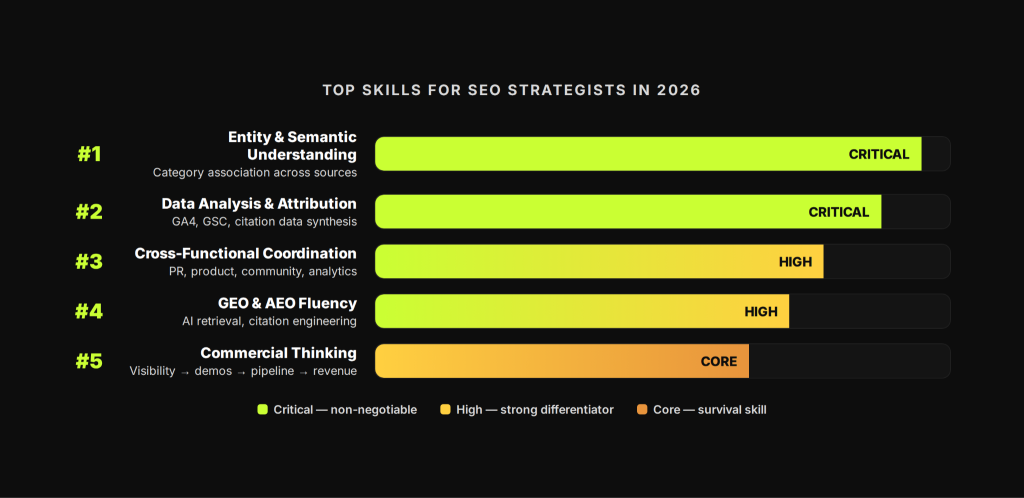
The most critical skill in 2026, according to Lumar’s December 2025 global survey, is entity and semantic understanding: moving from keyword targeting to entity association, connecting a brand consistently with the concepts and categories it wants to own across the web.
The strategist who still thinks primarily in keywords is optimizing for a retrieval model that no longer fully describes how either Google or AI systems select sources.
After entity understanding, data analysis and attribution fluency has become the differentiating skill. Organic measurement is getting messier. Branded search, GA4 referral data, and prompt-level citation data all need to be read together and synthesized into a coherent picture of what is actually driving discovery and pipeline.
No single metric tells the full story anymore, which means the strategist who can only report on rankings is delivering incomplete information.
Cross-disciplinary coordination has shifted from a soft skill to a hard requirement. Senior SEO Strategist Tina Reis said it plainly in the Lumar survey: a holistic understanding of how different marketing channels work together has become necessary because focusing only on SEO no longer produces results in isolation.
The role now intersects daily with digital PR, content, UX, and community management. Strategists who cannot work across those disciplines cannot deliver function 2 or function 3 of the Visibility Architect Framework.
GEO and AEO fluency, meaning understanding how AI answer engines retrieve and attribute content and how to structure pages for extraction, was specialist knowledge in 2024. By the end of 2025, Lumar’s survey found it had become the baseline expectation for any senior hire.
Commercial thinking, the ability to connect organic visibility to demo bookings, lead quality, and revenue, has become a survival skill in budget conversations. The strategist who reports on traffic without connecting it to the pipeline is increasingly difficult to justify in a CFO review.
The Bottom Line
The SEO strategist job title has stayed the same. The job has not.
In 2026, the role covers three distinct functions: building Google visibility as the foundation, engineering AI answer engine presence so the brand appears when buyers ask ChatGPT and Perplexity which tool to use, and managing the off-site brand presence layer that determines whether AI models trust and cite you at all.
Most strategists are delivering the first function well. The second and third are where B2B SaaS companies are losing ground to competitors they outrank on Google.
The strategists doing the full job are not running two separate programs. They are treating Google and AI visibility as a single system, measuring both, and coordinating across PR, product, and community teams to build the kind of entity authority that neither channel can produce from content alone.
That integration is what produced a 20% revenue attribution to ChatGPT for Gumlet and the number one CRM recommendation in AI search for REsimpli. Neither of those results came from a keyword strategy. Both came from a visibility architecture.
If you want to understand what that looks like as an engagement, here is how DerivateX approaches it for B2B SaaS companies.
Frequently Asked Questions About the SEO Strategist Role in 2026
1. Is SEO still worth investing in for B2B SaaS in 2026?
Yes, and the return on a well-structured program has gone up rather than down. B2B organic revenue accounts for 44.6% of total revenue on average, and disciplined SEO programs deliver up to 702% ROI over three years (Media House, 2026).
The companies treating Google SEO and AI visibility as a single integrated function are outperforming those that ignore either channel or separate them into disconnected work streams.
2. What is the difference between an SEO strategist and an SEO specialist?
An SEO specialist executes within a defined area: technical SEO, link building, or content optimization. An SEO strategist designs the system that connects all those areas to a business outcome and in 2026 extends that system to include AI visibility tracking, brand presence architecture, and cross-channel coordination. The strategist decides what gets built and why. The specialist builds it.
3. What is GEO and how does it relate to the SEO strategist role?
Generative Engine Optimization is the practice of structuring content and brand presence so that AI answer engines like ChatGPT, Perplexity, and Gemini cite a brand reliably in responses to relevant buyer queries.
In 2026, GEO is converging into the standard SEO strategist remit rather than remaining a separate discipline. The strategist who understands both Google optimization and AI citation engineering is the role most B2B SaaS companies are actively trying to hire.
4. How do I measure SEO results when AI traffic doesn’t show up in Google Analytics?
Three signals work together: self-reported attribution on intake forms, GA4 referral monitoring for the AI platforms that do pass referrer headers, and branded search trend analysis in Google Search Console.
Rising branded search volume alongside flat or declining organic click-through rates is the specific pattern that signals AI-driven discovery happening outside standard analytics. Teams measuring this accurately are building custom attribution layers connecting these signals to CRM pipeline stages rather than relying on any single metric.
5. What does an SEO strategist earn in 2026?
According to Glassdoor’s February 2026 data, the average SEO strategist earns $94,575 per year, with a typical range of $74,000 to $121,000. Senior-level roles average $125,263. Strategists with GEO and AI visibility experience command a premium at the upper end because that skill set remains scarce.
Written byApoorv SharmaCo-founder, DerivateX
Apoorv Sharma is the co-founder of DerivateX, a B2B SaaS SEO and Generative Engine Optimization agency that engineers AI citations in ChatGPT, Perplexity, Claude, and Gemini and connects them to demo bookings and revenue pipeline. He is the author of the 2026 AI Visibility Benchmark Report and the Citation Engineering methodology. He's also the brain behind "Found On AI" and has sold 2 of his companies previously
Cited by AI