Case study: Gumlet turned ChatGPT mentions into 20% of inbound revenue. Read it →

8 GEO Myths B2B SaaS Founders Still Believe (And What the Data Says)
 ByFouzia

Eight beliefs about AI search that sound reasonable, quietly cost you pipeline, and fall apart the moment you check the data.

TL;DR
- GEO and SEO are different competitions. Only about 12% of the URLs that ChatGPT, Perplexity, and Copilot cite also rank in Google’s top 10 for the same query.
- Ranking first does not earn a citation. A page can sit at Google position 40 and still become the top recommendation an AI assistant gives.
- Schema and llms.txt help machines read your pages, but a controlled test found that schema did not move citation counts on its own.
- Volume loses to information gain. Adding statistics, citations, and expert quotes raised AI visibility by up to 40% in a Princeton-led study, while keyword stuffing did nothing.
- Most AI authority is borrowed from third parties. In software, roughly 73% of US AI citations point to independent sources, not the vendor’s own site.
- AI visibility can be tied to revenue. AI sessions can be tagged in analytics and traced to demos and signups, and they tend to convert several times higher than organic search.
Most of what founders believe about GEO is wrong in a way you can measure, and two of these beliefs cost pipeline, not just visibility.
The problem isn’t your SEO. It’s what you can’t see.
You publish content, you rank for your terms, and your traffic dashboard looks healthy. Then a prospect opens ChatGPT, asks for the best tool in your category, and your competitor gets named while you do not. The reason usually traces back to a handful of GEO myths that sound reasonable and quietly cost you, customers.
Generative engine optimization, or GEO, is the practice of getting your brand named and cited inside AI answers from ChatGPT, Perplexity, Gemini, and Claude, the way SEO got you ranked on Google. Some people call it answer engine optimization, or AEO. Same idea.
We see this gap constantly across our portfolio. DerivateX is a GEO agency for B2B SaaS that we run. In our 2026 AI Visibility benchmark of 50 B2B SaaS companies tested across 1,400 buyer prompts, 44% scored below 50 out of 100 on AI presence, meaning nearly half were close to invisible in the tools their buyers now use to build shortlists. The pattern behind those low scores was not that AI disliked these brands. It was that AI rarely mentioned them at all.
This piece breaks down eight myths about generative engine optimization (GEO) that keep B2B SaaS teams stuck, and what the evidence actually shows. By the end, you will know which beliefs are costing you visibility, which are costing you pipeline, and what to check first. The myth that creates most of the others is the place to start.
Myth 1: GEO Is Just SEO With a New Name
GEO and SEO are not the same discipline, and the pages that win one rarely win the other. They share fundamentals like clear writing and clean structure, but they compete on different surfaces with different rules.
Ahrefs studied the URLs that ChatGPT, Perplexity, and Copilot actually cite and found that only about 12% of them rank in Google’s top 10 for the same prompt. Google’s own AI Overviews, and the newer AI Mode, show the same drift: the share of cited pages that also ranked in the top 10 fell from roughly 76% in mid-2025 to about 38% by early 2026. Two discovery systems are pulling apart in real time. We go deep on the mechanics in the full LLM SEO playbook.
The mechanics explain why. Google ranks individual pages in order, so position is the prize. An AI assistant assembles one answer from many sources at once, so the prize is being part of the synthesis, not topping a list.
| Signal | Traditional SEO | GEO (AI search) |
|---|---|---|
| Success condition | A ranking position on a list | A mention inside a synthesized answer |
| Primary authority | Backlinks | Earned media, brand mentions, entity clarity |
| What AI values | The page | The individual claim |
| What you measure | Rankings and sessions | Citation share and AI-attributed pipeline |
| Main content lever | Coverage and volume | Information gain |
ChatGPT, Perplexity, Gemini, and Claude cite B2B SaaS differently. If you want the full model behind this, our GEO agency for B2B SaaS page lays it out end-to-end.
Myth 2: If I Rank #1 on Google, AI Will Cite Me
Ranking first earns you a spot on a list. Getting cited earns you a place inside the answer, and those are two separate contests. One does not guarantee the other.
The numbers make this concrete. One analysis found that a page ranking first in Google has only about a one-in-three chance of also appearing in the matching AI Overview. Strong rankings help, but they are no longer a reliable shortcut to being recommended, which comes down to what makes a URL likely to earn LLM citations.
Verito, a DerivateX client, is the cleanest example we have seen. It moved from position 40 on Google to AI’s first pick across ChatGPT, Perplexity, and Claude for high-intent prompts like “QuickBooks hosting,” which shows the two results can move independently. This is also why some teams watch traffic fall even when their rankings hold: the answer engine routed around them.
Don’t miss: Here’s how to actually rank in ChatGPT
Myth 3: Schema and llms.txt Are What Get You Cited
Schema markup and an llms.txt file help machines read and categorize your pages. They do not manufacture the trust that earns a citation. Treat them as plumbing that supports your case, not the case itself.
The evidence here is blunt. In a controlled Ahrefs test, adding schema markup did not move citation counts, though the study could only measure pages that were already cited often, so it says little about brand-new pages. Useful infrastructure, not a switch you flip for instant mentions.
What schema does well is reinforce who you are. Clear, consistent entity signals across your site and the wider web help models understand your category and associate your brand with it, which is the foundation on which entity optimization is built. Skip it, and you risk being misread. Rely on it alone, and you stay invisible.
Myth 4: Publishing More Content Means More Citations
Volume is not the lever. AI rewards information gain, meaning content that adds something verifiable other sources have not already said. Ten thin posts lose to one page with a real number in it.
A Princeton-led study presented at KDD 2024 tested nine content changes across 10,000 queries. It found that adding citations, statistics, and credible quotes raised a source’s visibility in AI answers by over 40%, with gains up to 37% confirmed live on Perplexity. The same research found keyword stuffing produced no benefit at all. We unpack the full method in our plain-English breakdown of the Princeton GEO study.
There is a retrieval reason too. AI systems pull in far more pages than they ever use, and in one analysis, only about 15% of retrieved pages made it into the final answer. More pages do not help if none of them say anything that the model cannot get elsewhere.
Myth 5: AI Citations Come From Your Own Website
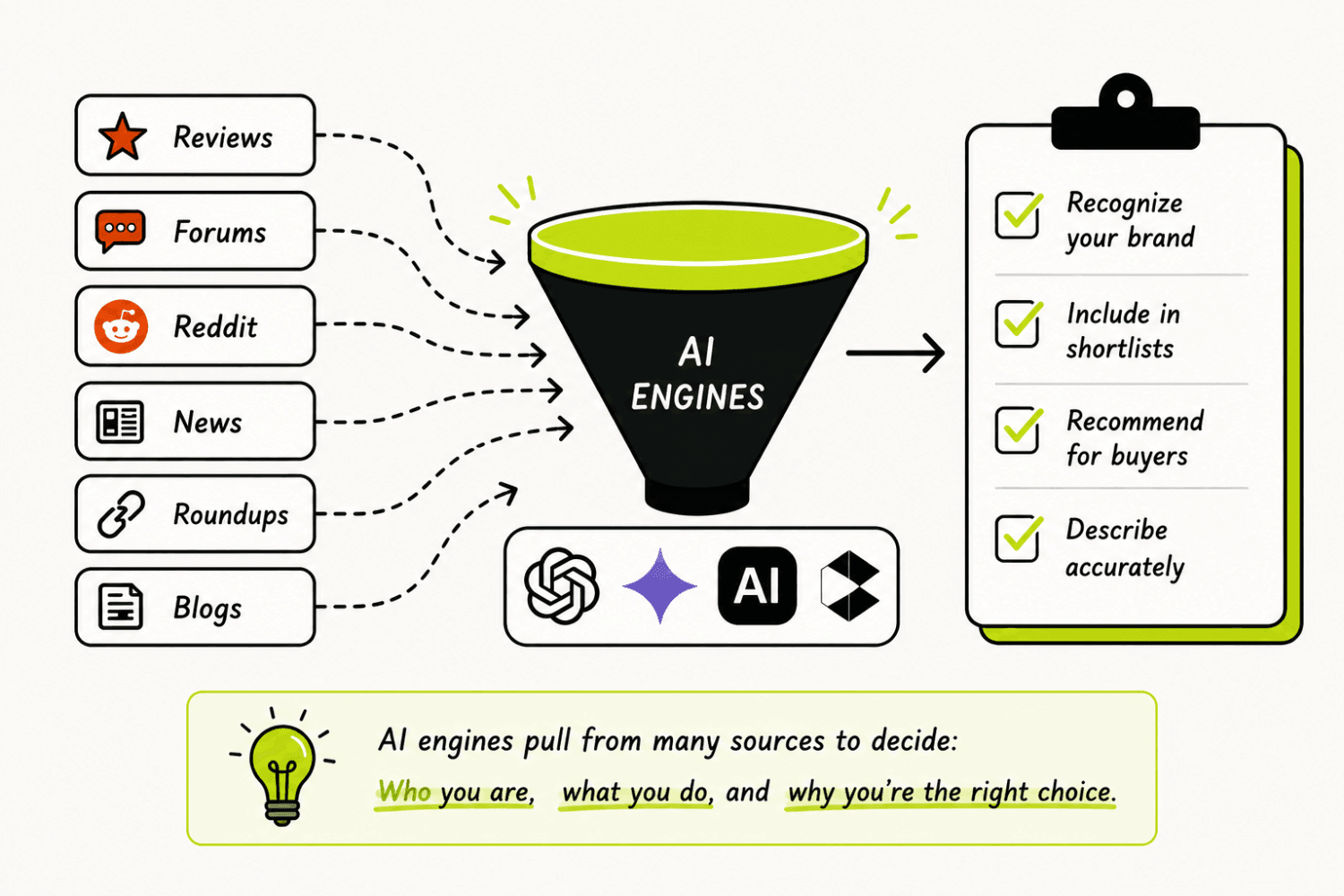
Most of the authority AI draws on is borrowed from third parties, not published on your domain. Your own site confirms who you are. Other sites convince the model that you matter.
Researchers at the University of Toronto ran controlled tests across AI search engines and found a strong, consistent tilt toward earned media, independent publishers, reviews, and analyst coverage over brand-owned pages. For software specifically, roughly 73% of US citations went to third-party sources rather than vendor sites, and social posts barely registered. Muck Rack’s analysis of more than one million AI citations, which found roughly 82 to 89% came from earned media and about 94% from non-paid sources.
This is why a brand can have flawless on-page SEO and still go unmentioned. The model is waiting for independent validation. REsimpli, a DerivateX client, is a good case in point: deliberate third-party coverage helped it become ChatGPT’s default real estate CRM for investors within 90 days.
Myth 6: Backlinks Are the Only Authority Signal That Matters
Backlinks still count, but they now sit beside brand mentions and entity signals rather than above them. An unlinked mention in a trusted publication can carry real weight.
Ahrefs‘ late-2025 work across tens of thousands of brands found that consistent brand mentions tracked more closely with AI visibility than raw backlink counts across ChatGPT, AI Mode, and AI Overviews, with mentions on YouTube standing out as the single strongest signal. The job shifted from collecting links to becoming a name that shows up, in context, across many credible places.
Our own benchmark pointed the same way. The brands that scored highest were not just present in their category. They were the names AI used to define the category, which comes from broad, repeated third-party coverage.
Myth 7: You Can’t Tie AI Visibility to Revenue
You can, and this is the myth that costs the most
AI sessions can be tagged in your analytics and followed all the way to demos, signups, and closed revenue. The reason most teams call it unmeasurable is that they have not set up the tracking, not that the data is missing.
AI traffic usually converts better than organic
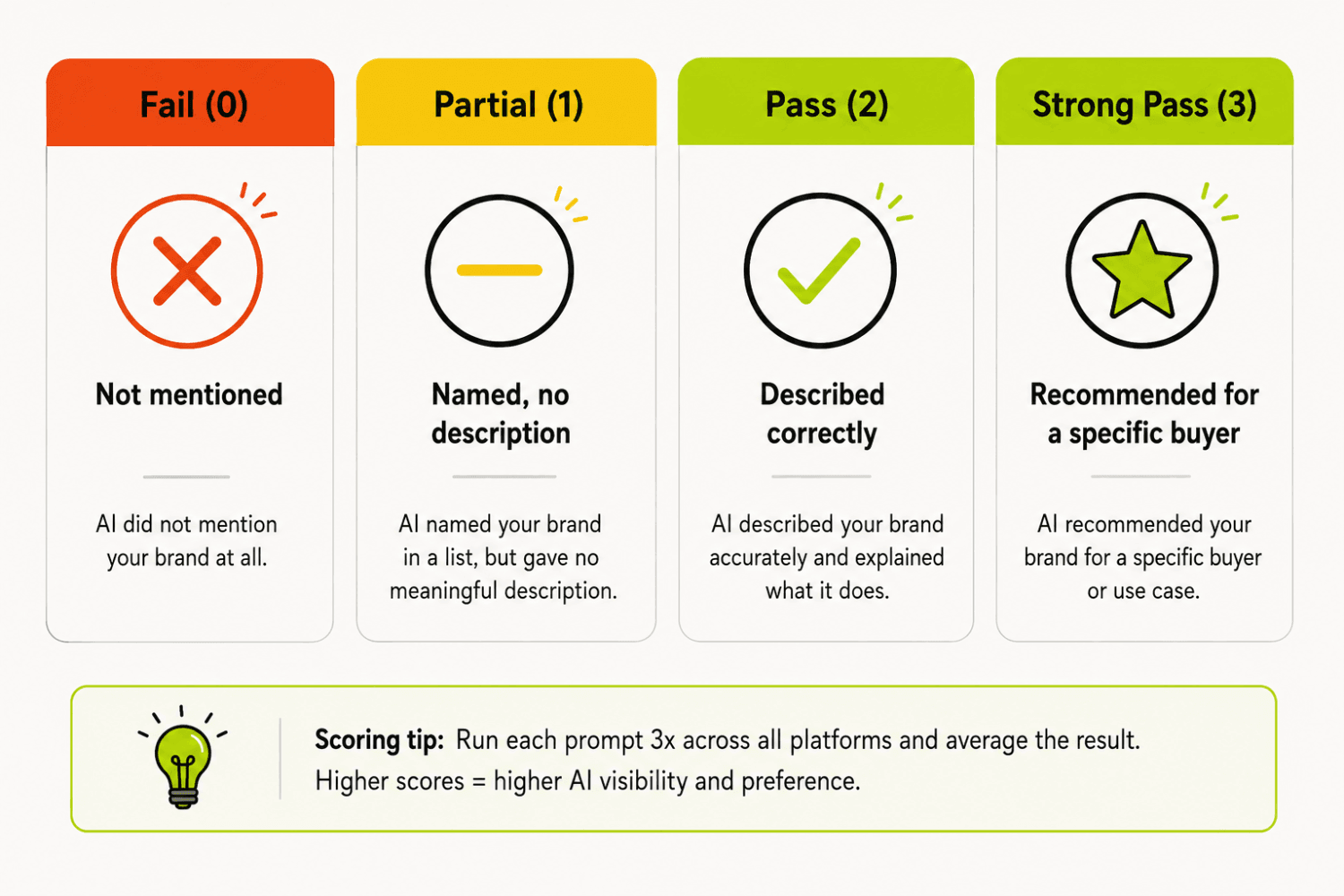
When AI sends someone to your site, the model has already vetted you, so that visitor arrives pre-qualified. Seer Interactive measured ChatGPT referrals converting at 15.9%, Perplexity at 10.5%, and Claude at 5%, against Google organic’s 1.76%.
The broader category average lands near 4.4 times the conversion rate of standard organic traffic, and B2B software tends to see some of the largest lifts because the buying cycle is research-heavy.
Why your analytics hides it
Out of the box, GA4 has no default channel grouping for AI traffic, so those sessions get bucketed into direct or referral and disappear. Worse, many buyers get a recommendation from ChatGPT, then search your brand on Google before converting, so the credit lands on branded search. The channel looks tiny because it is mislabeled, not because it is small.
How to track AI traffic in GA4
- Build a custom channel group in GA4 that captures sessions from sources like chatgpt.com, perplexity.ai, gemini.google.com, claude.ai, and copilot.microsoft.com.
- Segment by engine, since ChatGPT, Perplexity, and Gemini visitors behave differently.
- Map your real conversion events, such as demo booked, trial started, and form submitted, to that channel.
- Add a “how did you hear about us” question on demo and signup forms to catch AI-influenced deals that show up as branded search.
This is exactly what makes results repeatable rather than lucky. Gumlet, a DerivateX client, is the clearest proof. With the right content architecture, entity signals, and third-party corroboration in place, Gumlet now attributes 20% of its monthly inbound revenue to ChatGPT, Claude, and Perplexity, a figure its co-founder can point to in an attribution dashboard, which is not a marketing estimate.
The same applies to our own numbers. DerivateX logged more than 9,847 AI citations in a single quarter and a 3.9% session-to-signup rate from ChatGPT, which is the kind of measuring AI search ROI that turns visibility into a board-level metric.
Myth 8: Optimizing for ChatGPT Answers Is the Whole Game
Winning ChatGPT answers is necessary, but it is no longer the finish line. The next surface is AI agents that browse, compare, and act on a buyer’s behalf, and almost nobody is optimizing for it yet.
Tools like Perplexity Comet, ChatGPT’s agent mode, and Claude for Chrome do not just answer questions. They open pages, read pricing and specs, and assemble shortlists on the user’s behalf. If your key pages are slow, gated, or hard for an agent to parse, you get dropped from the consideration set silently, with no impression and no click to tell you it happened.
This is the frontier the already-visible brands are starting to prepare for, and it has a name: agent search optimization. It is early, the public data is thin, and that is exactly why moving now is an advantage rather than a catch-up cost.
FAQ
Is GEO just SEO with a different name?
No. GEO and SEO share fundamentals like clear structure and useful content, but they target different outcomes on different surfaces. SEO competes for a ranking position on a list of links. GEO competes to be cited inside a synthesized AI answer. The overlap is smaller than most people expect: only around 12% of URLs cited by ChatGPT, Perplexity, and Copilot rank in Google’s top 10 for the same query. You can dominate Google and still be absent from AI search, which is why the two need separate strategies and separate measurement.
If I rank number one on Google, will ChatGPT recommend me?
Not reliably. Ranking first earns a place on Google’s results page, but AI assistants build answers from many sources at once rather than reading the top result. One analysis found a first-place Google page has only about a one-in-three chance of appearing in the matching AI Overview. We have seen brands ranking on page four become the top AI recommendation, and brands ranking first go unmentioned. Treat AI citation as a separate goal that depends on third-party authority and clear entity signals, not on rank alone.
Does schema markup or llms.txt actually get you cited by AI?
They help, but not the way most people hope. Schema and llms.txt make your pages easier for machines to read and categorize, which supports your overall case. They do not create the trust that earns a citation. In a controlled Ahrefs test, adding schema did not move citation counts by itself. Think of these as infrastructure that removes friction, then put your real effort into clear entity signals, genuinely useful content, and independent coverage that gives AI a reason to mention you.
Where do AI citations actually come from?
Mostly from third parties, not your own website. University of Toronto research found AI search engines lean heavily on earned media, independent publishers, reviews, and analyst coverage. For software, roughly 73% of US citations went to outside sources rather than the vendor’s site. Your own pages establish who you are and what you do. Other sites supply the independent validation models trust. The practical takeaway is to invest in being mentioned and reviewed across credible places, not only in publishing more on your own blog.
How do I track AI traffic and tie it to revenue in GA4?
Start by building a custom channel group in GA4 that captures sessions from chatgpt.com, perplexity.ai, gemini.google.com, claude.ai, and copilot.microsoft.com, because GA4 has no default AI channel. Segment by engine, then connect your real conversion events like demo bookings and signups to that channel. Add a “how did you hear about us” field on key forms to catch AI-influenced deals that get credited to branded search. AI sessions often convert several times higher than organic, so even small volume can carry real pipeline.
AI traffic is tiny right now, so is GEO even worth it for B2B SaaS?
Volume is small, but value is concentrated. AI referrals convert at roughly 4.4 times the rate of standard organic on average, and in B2B contexts the gap is often wider because buyers arrive already vetted by the model. The channel is also compounding quickly, and citations earned now keep paying out as AI engines reference the same trusted sources repeatedly. Waiting means your competitors build the citation consensus first, and that consensus is slow and expensive to reverse once it forms.
What to do with this
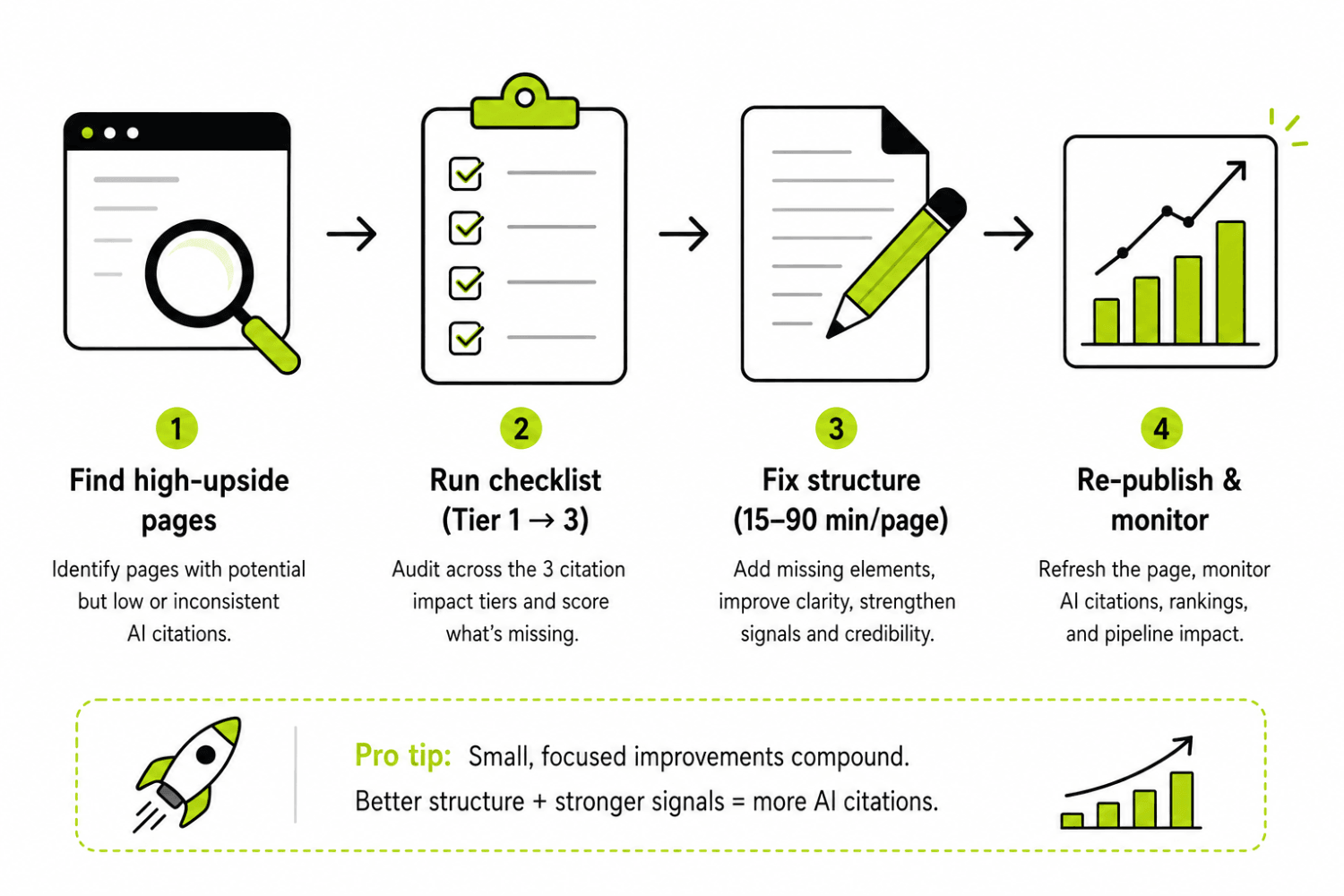
The brands that AI recommends did not get there by accident, and the ones that are invisible are not being punished. They are simply not mentioned, because nobody built the third-party authority, entity clarity, and measurable structure that earns a citation. Visibility in AI search is a built outcome, not a lucky one.
Your next step is to find out where you actually stand. Run the free AI Visibility Checker to see how often ChatGPT, Perplexity, Gemini, and Claude mention you across real buyer prompts, then check that number against the four signals in this piece. If the gap is wide, you now know it is a measurement and authority problem you can fix, and you can see how a DerivateX engagement works.
The teams that move first will own one more advantage soon. As AI agents start browsing and shortlisting on buyers’ behalf, the brands already structured to be read and trusted by machines will be the ones those agents pick.
Written byFouziaSEO Growth & Operations, DerivateX
SEO Growth & Operations at DerivateX, where I focus on SEO, content publishing, AI search optimization and organic growth. Through my blogs, I share practical insights on SEO, AI tools, content strategy, digital marketing and workflows that help businesses improve search visibility and grow sustainably.
Cited by AI