Case study: Gumlet turned ChatGPT mentions into 20% of inbound revenue. Read it →

Do Pull Quotes, Stats & Block Quotes Actually Increase LLM Citations? Tested

Two studies, three different tools, and one number everyone quotes about the wrong thing. Here is what the research actually shows, and how to format stats, pull quotes, and block quotes so AI engines cite your pages.


TL;DR
- Statistics are the strongest of the three for winning LLM citations. The Princeton GEO study measured roughly a 41% gain on its position-adjusted visibility metric when writers added statistics, and a real-world check on Perplexity showed about a 37% gain on its impression metric.
- Adding a quotation from a named source helps too, though less than stats. The same Perplexity check found close to a 22% visibility gain from quotation additions.
- The “37% from pull quotes” figure everyone repeats is not from Princeton. It comes from a separate 2025 report by The Digital Bloom, and it only held when the pull quote carried a real statistic inside it.
- A pull quote that restyles a vague sentence does nothing, because it usually duplicates text already sitting in your body copy and hands the AI no new claim to extract.
- The lever behind all three is identical: a specific, sourced claim an AI can lift and trust. Formatting matters only when it isolates that claim.
- Mid-ranked pages gain the most. Pages sitting around position 5 saw close to a 115% visibility jump in the study, while pages already at the top barely moved.
You added pull quotes to your best posts, wrapped a few block quotes in tidy formatting, and waited for ChatGPT and Perplexity to start citing you. Weeks later, nothing changed. The tactic was copied correctly, and the result never showed up.
Here is what almost everyone misses. Pull quotes, block quotes, and statistics get lumped into one bucket labeled “formatting that boosts AI citations,” and a single number, 37%, gets stapled to all of them. That number is real, but it belongs to one specific study testing one specific thing, and most writers apply it to the wrong element entirely.
This piece separates the three, shows what the research actually measured versus what people claim it measured, and gives you a build spec for each one. By the end you will know which element earns LLM citations, which one is mostly decoration, and how to format your own pages so AI engines quote them. It starts with the studies everyone cites but few have read.
What the Research Actually Tested About Quotes, Stats, and AI Citations
The two studies people quote were testing different things. One measured what happens when you add quotes and statistics to the text, and the other measured the pull quote as a design element.
The most cited source here is the Princeton GEO study, published at the KDD 2024 conference by Aggarwal and colleagues. They ran roughly 10,000 queries through a system built to behave like Bing Chat, tested nine different content changes, then validated the winners on Perplexity. Their goal was simple to state: find out which edits make a generative engine more likely to cite your page.
The Princeton findings, in plain numbers
Three edits stood out above the rest: adding statistics, citing sources, and adding quotations. Each of the top three produced improvements in the range of 30 to 40 percent on the study’s visibility metrics. Adding statistics led the pack.
| Content edit | Effect on AI visibility | Verdict |
|---|---|---|
| Adding statistics | Around 41% gain on the position-adjusted metric | Strongest |
| Citing sources | Top-three performer | Strong |
| Adding quotations | Around 22% gain on the Perplexity check | Strong |
| Improving fluency | Positive | Helpful |
| Authoritative tone | Positive | Helpful |
| Keyword stuffing | Roughly 10% below the starting baseline | Actively hurts |
One result deserves a flag: keyword stuffing scored below the untouched control. The old SEO reflex of cramming in terms does not just fail with AI engines, it drags you backward.
Where the 37% pull quote number really comes from
The 37% figure attached to pull quotes did not come from Princeton at all. It comes from The Digital Bloom’s 2025 AI Citation Report, which studied articles carrying two or three prominent pull quotes. The catch is that those pull quotes contained key statistics or findings, not decorative filler.
So the lift was never about the styled box. It was about the stat riding inside it. Some posts now credit “Princeton / Digital Bloom” as one source for a single number, which fuses two separate experiments into one myth.
Do these effects hold across ChatGPT, Perplexity, Gemini, and Claude?
The direction holds across engines, but the specifics do not, because each engine pulls from a different pool of sources. Citation analysis has found that only about 11% of domains get cited by both ChatGPT and Perplexity. A page can win a citation on one engine and stay invisible on another, which means you test each engine separately rather than assuming one result transfers.
Pull Quotes vs Block Quotes vs Statistics: What Each One Actually Is
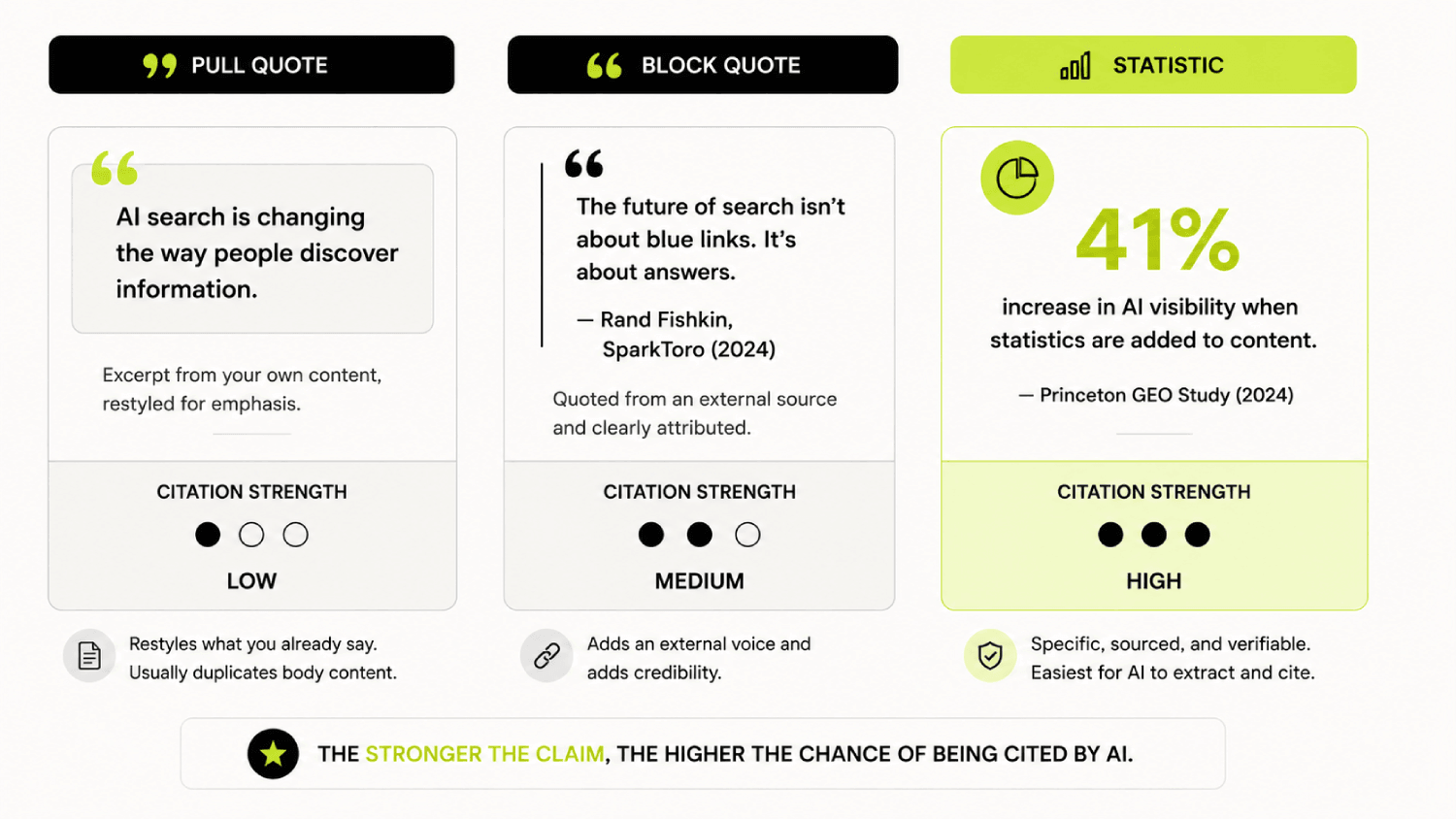
These are three different tools, and treating them as one is why so much GEO advice misfires. Here is the clean split.
- Pull quote: a visually styled excerpt of your own writing, usually duplicated from the body text to catch a skimming reader.
- Block quote: an indented quotation of an outside source, marked up with the HTML blockquote element and attributed to a named person or publication.
- Statistic: a specific number tied to a named source and year, such as “47% of B2B buyers, per HubSpot’s 2025 data.”
| Element | What it adds for humans | What it adds for an AI parser | Moves citations? |
|---|---|---|---|
| Pull quote | Visual emphasis, scannability | Often duplicate text, no new claim | Only if it carries a stat |
| Block quote | Credibility, an outside voice | An attributed external claim | Yes, when sourced |
| Statistic | A concrete data point | A discrete, verifiable unit | Yes, strongest of the three |
The pattern jumps out once it is laid side by side. Two of these add new, extractable information, and one mostly adds styling.
Do Statistics Increase LLM Citations?
Yes, and statistics are the strongest of the three, because a number is the most concrete thing an AI can lift and attribute. A percentage is verifiable, and a vague claim is not.
The Princeton work backs this directly. Adding statistics produced the largest single gain of any edit tested, and it held up when the researchers re-ran their top methods on Perplexity in the real world.
The mechanism is worth internalizing: models reach for discrete, checkable units when they build an answer. A sentence like “video hosting affects speed” gives a model nothing to grab. A sentence with a number gives it a citation-ready fact.
Compare these two lines:
- Before: “Self-hosted video slows down your site.”
- After: “Pages that self-host video load 3 to 5 times slower than pages served from a CDN, based on 2024 performance data.”
The second version is quotable. The first disappears into summary.
One rule protects you here: a number without a source is weaker than a number with one. An AI has nothing to corroborate an unsourced figure, and inventing statistics to game citations will eventually cost you trust. Every stat you add should carry a named source and a year.
Do Pull Quotes Increase LLM Citations?
Only when the pull quote carries a statistic or a specific, named claim. The box itself does nothing, and a pull quote that repeats a vague sentence can read as redundant to a parser.
Remember what a pull quote actually is at the code level. It usually duplicates a line already present in your article, restyled to stand out.
That duplication is the whole problem. You are handing the AI the same words twice with fancier formatting, not a new fact. Emphasis helps a human skim, but the parser already had that sentence.
The Digital Bloom result only showed a lift when the pull quotes held real findings. Two or three stat-carrying pull quotes per article moved the needle, and decorative ones did not.
Compare these two pull quotes:
- Decorative, earns nothing: “AI search is changing everything.”
- Working, earns the citation: “The AI Overview shared only 35% of its sources with the ten results ranking below it, per our 2026 benchmark.”
The second one is a fact an engine can quote. The first is a mood.
Do Block Quotes Increase LLM Citations?
Yes, when they quote a named external source with clear attribution, because that is exactly the quotation pattern Princeton found effective. Attributed block quotes also parse more cleanly than quotes trapped inside images or JavaScript-heavy components.
There is a second reason block quotes pull weight. Research from AirOps found that around 85% of brand discovery in AI search happens through third-party sources, so an attributed outside quote doubles as a corroboration signal the model trusts.
How to build a block quote an AI will actually pull
- Pick an authoritative outside source that states a specific claim or number.
- Quote one self-contained sentence and keep it short.
- Attribute it inline with the full name, title, organization, and year, wrap it in a real blockquote tag, and place it right next to the claim it supports.
Skip any of those steps and the quote loses its citation value. An unattributed block quote is just indented text.
Why the Format Is Not the Lever: How AI Picks What to Cite
AI models extract and attribute at the claim level, not the article level, so the thing that gets cited is the specific, sourced, self-contained statement, whatever wrapper holds it. The format only helps when it isolates that statement.
Placement compounds this. An analysis by SparkToro in 2026 found that roughly 44% of LLM citations come from the first third of a page, so a strong claim buried near the bottom loses no matter how nicely it is styled.
Here is the unit that actually gets cited: a statement that still makes complete sense when you rip it out of its paragraph. If your sentence needs the three sentences before it to be understood, an AI cannot lift it cleanly. Self-contained claims win.
What Happened When We Applied This to Our Own Benchmark Reports
We built our benchmark reports on this exact principle, one hard statistic per headline and a named method behind every number, and they became the DerivateX assets that AI engines quote most.
Look at how the reports are titled. Our AI Overview study leads with the finding that the Overview shares only about 35% of its sources with the results below it. Our Listicle Layer report leads with Google AI Overviews citing third-party blogs several times more often than the products they actually recommend.
Each headline is a single extractable claim, which is the entire point.
The client results point the same direction. Gumlet now attributes close to 20% of its monthly inbound revenue to AI engines like ChatGPT and Perplexity after this kind of work. REsimpli became the top ChatGPT recommendation for “real estate CRM” inside 90 days.
Neither of those is a controlled lab test, and I will not pretend otherwise. They are consistent, real-world signals that claim density beats decoration.
How Many Stats, Quotes, and Pull Quotes Should One Page Have?
Enough that every major section carries at least one citable claim, and no more, because volume without specificity backfires. This is about coverage, not stuffing.
- Pull quotes: two to three per article works, and each one should carry a statistic, matching the Digital Bloom finding.
- Statistics and block quotes: aim for one solid citable claim per H2 section rather than a fixed quota.
The cautionary evidence sits right in the Princeton data: keyword stuffing landed about 10% below the untouched baseline. More is not better once the words stop carrying meaning. Density should be a byproduct of writing well, never the target.
Do These Tactics Work on Posts You Have Already Published?
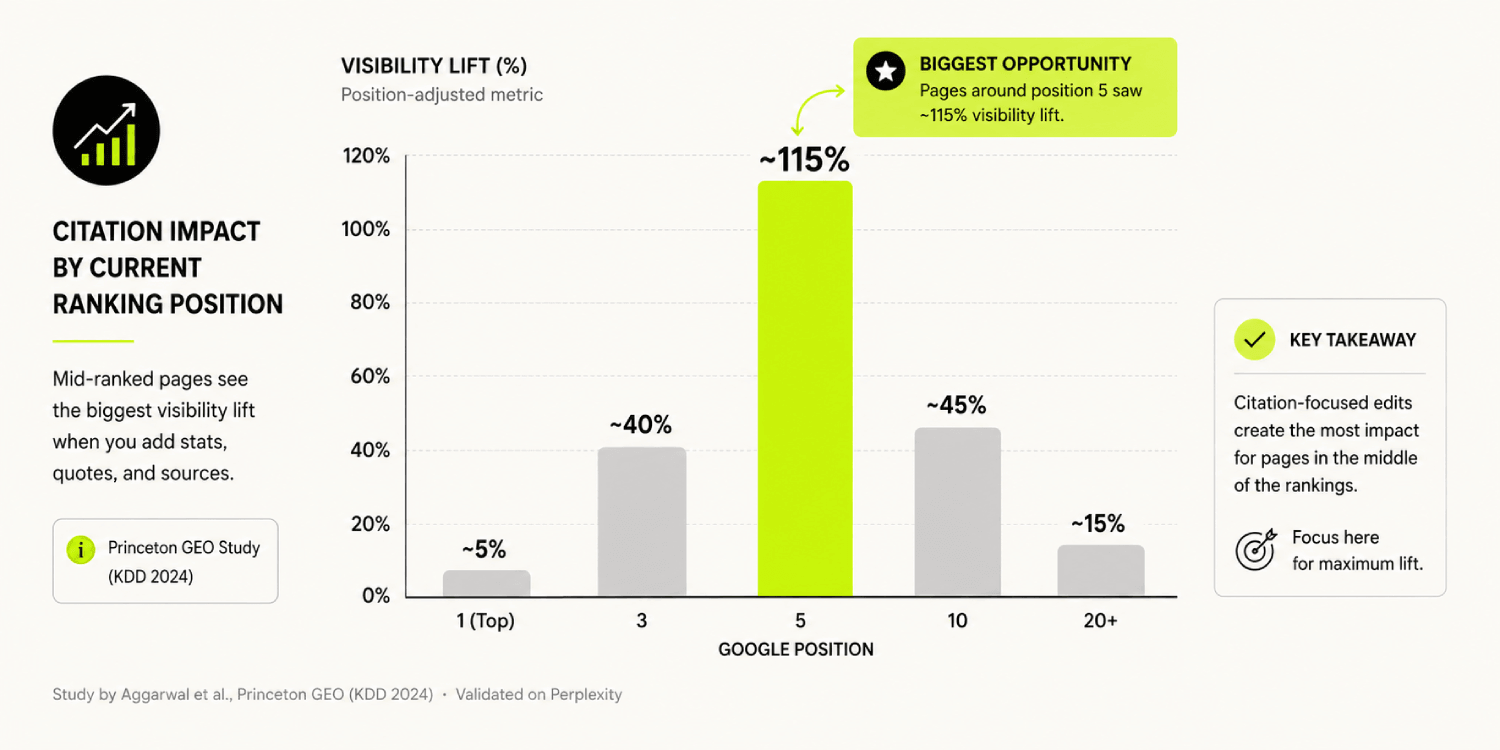
Yes, and retrofitting an existing page is often the higher-return move, because mid-ranked pages gain the most from these edits.
The Princeton study called this the equalizer effect. Pages sitting around position 5 saw close to a 115% visibility gain after optimization, while pages already at the top saw little change.
The practical read is clear: start with pages that already rank on Google’s first page but never get cited by AI. Add one sourced statistic and one attributed quote per section, then re-run the prompt you want to win. Those pages have the most room to move.
Timing depends on re-crawling, which varies by engine, so I would not promise a fixed number of days. Re-test the prompt on a schedule instead of waiting for a magic date.
Where Formatting Ranks Against Schema, FAQs, and Answer-First Structure
Put claim density and sourcing first, answer-first structure second, FAQ sections and schema third, and the visual box last. The wrapper is the lowest-leverage item on that list.
FAQ sections earn their placement because the question-and-answer pair is the chunk AI engines pull most readily. That is why every section in this piece opens with its answer before expanding.
The takeaway fits in one line: fix what the sentence says before you fix how it looks. A beautifully styled page full of vague claims stays invisible. A plain page full of sourced, specific claims gets quoted.
FAQ
Is the 37% pull quote statistic actually from the Princeton GEO study?
No. The 37% figure comes from The Digital Bloom’s 2025 AI Citation Report, not the Princeton GEO study. It applied to articles that used two or three prominent pull quotes containing real statistics, so the gain traced back to the data inside the quote rather than the styled box. The Princeton study measured different numbers, including roughly a 41% gain on its position-adjusted metric for adding statistics. Treat the two as separate findings, because merging them into one “37% from pull quotes” claim misrepresents what either study tested.
Do I need HTML blockquote tags, or is an indented quote good enough?
Use a real HTML blockquote element with inline attribution. AI parsers handle properly marked-up, attributed block quotes more reliably than quotes styled only with indentation, or worse, quotes baked into images or JavaScript-rendered components. The tag tells the machine this is a quotation and who said it, which is precisely the signal that helps it extract and attribute the claim. Pair the blockquote tag with the source’s full name, title, organization, and year, and place it next to the claim it supports. Formatting alone will not save an unattributed quote.
Do unsourced or made-up statistics still get cited by AI?
Weakly, if at all, and inventing them is a bad idea. A statistic earns citations because an AI can treat it as a discrete, verifiable unit, and that verifiability depends on a named source and year. An unsourced number gives the model nothing to corroborate, so it carries far less weight than a sourced one. Fabricated statistics may occasionally slip through, but they damage trust the moment they get checked, and engines increasingly cross-reference claims. Always attach a real source and date to every number you publish.
How many pull quotes should a blog post have for LLM citations?
Two to three per article, and each one should carry a statistic or a specific named claim. That range matches The Digital Bloom’s finding, where articles with two or three stat-bearing pull quotes saw higher AI citation rates than comparable articles without them. Adding more than that does not compound the benefit, and pull quotes that only restyle vague sentences add nothing at all. Think of each pull quote as a slot reserved for a real fact, not decoration. If you cannot fill it with a statistic or concrete claim, leave it out.
Will these tactics help a page that does not rank on Google yet?
Yes, and mid-ranked pages benefit the most. The Princeton study found an equalizer effect where pages around position 5 gained close to 115% in visibility after optimization, while pages already at the top barely moved. That makes these edits especially worthwhile for pages that rank on page one but never get cited by AI. The one place returns shrink is content that already dominates both search and AI answers. For everything below the very top, adding sourced statistics and attributed quotes is one of the higher-leverage moves available.
Which matters more for AI citations, statistics or quotes?
Statistics, based on the available research. In the Princeton GEO study, adding statistics produced the single largest visibility gain of any edit tested, ahead of quotation additions. The reason is mechanical: a number is a discrete, checkable unit an AI can lift straight into an answer, while a quote helps most when it also contains a number or a specific named claim. Use both, but if you only have time for one, lead with a sourced statistic in the section you most want cited. Quotes then reinforce it with an outside voice.
Conclusion
The format was never the point, and that is the one idea worth carrying out of this piece. Pull quotes, block quotes, and statistics do not share a mechanism, and dressing up a vague sentence in a styled box will not earn you a single AI citation. What gets quoted is a specific, sourced claim an engine can lift and trust, and everything else is just packaging around that claim.
So audit your best pages with one question: does each major section contain a real, sourced number or a named, attributed claim? Where the answer is no, add one. Start with the pages that already rank on Google’s first page but stay absent from ChatGPT and Perplexity answers, since those have the most room to climb.
The teams that win LLM citations over the next year will not be the ones with the prettiest pull quotes. They will be the ones whose every section says something specific enough to quote, and that is a standard any writer can start meeting today.
Written byAyush SharmaHead of SEO & Content, DerivateX
Ayush Sharma is Head of SEO and Content at DerivateX, a full-service SEO and GEO agency for B2B SaaS. He focuses on SEO, GEO, and AI visibility for software brands, helping them get found and cited across Google, AI Overviews, ChatGPT, Perplexity, Gemini, and Claude, with results measured through to pipeline. On the DerivateX blog he covers AI visibility tracking, how LLMs choose which sources to cite, technical and JavaScript SEO for SaaS sites, and attributing AI search to revenue in HubSpot.
Reviewed byShivanshi BhatiaCo-founder, DerivateX
Shivanshi Bhatia is the co-founder of DerivateX, a B2B SaaS SEO and Generative Engine Optimization agency that engineers AI citations in ChatGPT, Perplexity, Claude, and Gemini and connects them to demo bookings and revenue pipeline. She runs operations and delivery, which means every audit, content brief, and published page ships through a system she built. She owns the client relationship from kickoff through reporting, so clients spend their time on decisions instead of chasing updates. She has worked in SaaS since 2019 and reviews client work before it goes live.
Cited by AI