Case study: Gumlet turned ChatGPT mentions into 20% of inbound revenue. Read it →

The Real ROI of GEO: What AI Search Visibility Drove for Gumlet (Full P&L Breakdown)


In April 2026, 27% of Gumlet’s new signups self-reported ChatGPT, Perplexity, or Claude as how they discovered the company. Google Analytics, looking at all site sessions in the same month, attributed 0.5% to those same AI assistants.
Both numbers are right. They answer different questions. The 27% is AI’s share of new buyers. The 0.5% is AI’s share of total site traffic.
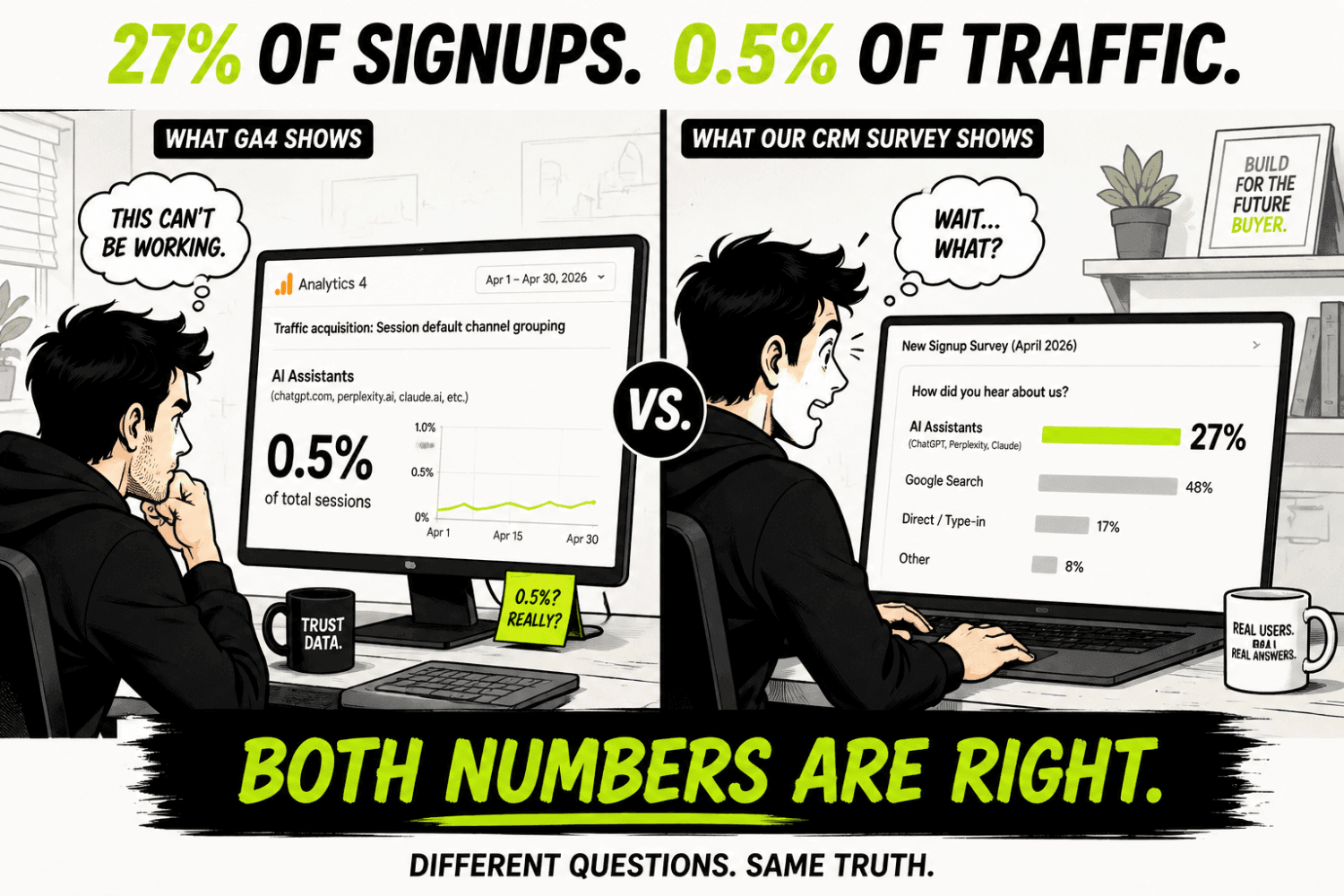
The ratio between them is the story: AI accounts for 27% of new signups while showing up as just 0.5% of tracked sessions, over-indexing roughly 54x on signups versus its measured traffic.
Most AI-influenced buyers never click the AI’s link. They hear about Gumlet in a chat, then arrive via branded Google search or direct URL, where GA logs them as organic.
Most public GEO ROI reports publish only one of these numbers, which is how the category ended up with no defensible standard for what AI actually delivers.
Generative Engine Optimization (GEO) is the practice of optimizing content and entity signals to be cited by AI assistants like ChatGPT, Perplexity, Claude, and Gemini in their generated answers.
GEO ROI is the measurable revenue and pipeline attributed to that work, captured across self-reported discovery, referrer-based session tracking, and citation supply monitoring.
This piece publishes all. A Gumlet engagement now in its 16th month as of April 2026 (started January 2025; the Gumlet case study documents the first 8 months, when the 20% inbound-revenue milestone was reached), four months of recent monthly attribution data, the dual methodology behind the numbers, the full P&L breakdown, and the implementation framework, so the ROI math is yours to do against your own engagement assumptions.
Every claim that follows is attributable to a dated source, your own measurement layer, or ours.
What you’ll have by the end of this article, as of mid-2026: the numbers, the method, the P&L, and the steps to replicate.
6 facts in 60 seconds
- 27% of Gumlet’s April 2026 signups self-reported AI assistants (ChatGPT, Perplexity, Claude) as their discovery source.
- Google Analytics tracked 0.5% of all April site sessions as AI-sourced. The direct-click slice converts at roughly 9x the site average, while AI’s overall signup influence (27%) over-indexes its tracked traffic share by ~54x.
- Monthly AI attribution share: ~14% (Feb 2026), ~22% (Mar), ~27% (Apr), ~21% (May, first 20 days only).
- 83% of AI-aware Gumlet users entered the site via Google search or direct URL, not via an AI assistant click.
- DerivateX tracks 500+ buyer-intent queries weekly for Gumlet across ChatGPT, Perplexity, Claude, and Gemini, monitoring citation frequency and position as of May 20th, 2026.
- Roughly 80% of what determines AI citation lives off your own domain.
Bias check: DerivateX runs Generative Engine Optimization for Gumlet
- Our scope of work: Citation Engineering, monthly citation tracking, content commissioning, and the dual-methodology measurement layer behind this article. So when the data ahead reads as flattering to DerivateX, it should. We built the measurement layer that surfaces it.
- What we’re not publishing: Gumlet’s ACV, ARR, or absolute monthly signup volume. Those numbers aren’t authorized.
What we are publishing: the attribution share, the methodology, the query tracking coverage, and the asset-level P&L.
What’s left to you: the revenue math, applied against your own assumptions.
What GA’s 0.5% AI traffic share actually means
The instinct, when the survey says 27% and GA says 0.5%, is to assume GA is missing something. It’s not. The two numbers measure different populations.
What the 0.5% actually captures
ChatGPT, Perplexity, Gemini, and Copilot now append UTM parameters (utm_source=chatgpt.com, etc.) to outbound links they cite. When a user clicks from an AI answer, the URL carries the source. GA reads the UTM and attributes correctly. The 0.5% is what GA correctly logged as AI-sourced.
What the 27% captures
The 27% is AI’s share of new signups self-reporting AI as their discovery source. It includes two distinct populations:
- Direct AI clickers: users who clicked from an AI answer, arrived with UTM intact, and later signed up. These show up in both the survey (27%) and the GA AI-source share (0.5%).
- Indirect AI discoverers: users who heard about Gumlet inside an AI conversation, closed the chat, Googled the brand, and arrived via Google organic. These show up in the survey but not in the GA AI-source share.
Why the two numbers diverge
The 27% spans both populations. The 0.5% is only the first one. The gap between them is the indirect-discovery channel: a real, valuable population of buyers that arrives via Google but whose discovery was AI.
What the gap actually proves
Two structural facts about AI traffic in 2026:
- The AI clicks GA does capture convert far above average. The 0.5% of sessions tagged AI map to ~5% of new signups (the direct-click portion of the 27%), roughly a 9x conversion-quality multiplier versus average traffic.
- AI’s influence on signups dwarfs its click volume. The other ~22 points of the 27% are indirect: buyers who heard about Gumlet in an AI answer, then arrived via Google or direct. That is why AI’s signup share (27%) over-indexes its tracked traffic share (0.5%) by ~54x.
Neither of these reads as a tracking failure. They read as channel economics: AI is small in volume, large in influence, and disproportionately effective at converting buyers.
The three layers of GEO measurement
There is no single number that captures GEO ROI cleanly. Each measurement layer captures a different point in the funnel, and each has a different bias. Stacking three layers together is what produces a defensible read.
The three measurement layers:
1. Self-reported attribution (survey)
The onboarding “How did you hear about us?” field, with the four major AI assistants broken out as discrete options. Tracked in Mixpanel, Amplitude, or similar tools.
The field captures the AI conversation that came before any click, in the user’s own words.
- Measures well: discovery.
- Misses: users who don’t remember, or who pick wrong when AI and Google blur together in their journey.
- What this means: the number is the upper bound of AI’s contribution.
2. Referrer-based session tracking (GA4)
A custom channel grouping in GA4 that flags any session where the source parameter matches an AI assistant domain: chatgpt.com, chat.openai.com, perplexity.ai, claude.ai, gemini.google.com, copilot.microsoft.com. ChatGPT, Perplexity, Gemini, and Copilot auto-append these as UTMs on outbound links, so the channel grouping captures them reliably.
- Measures well: direct AI clicks.
- Misses: users who leave the AI before clicking, and branded search inflation downstream.
- What this means: the number is a precise count of AI-direct-click sessions, not the full AI-influenced population.
3. Citation supply tracker (weekly prompt run)
A standing list of 15 to 25 buyer-intent prompts runs weekly across ChatGPT, Perplexity, Claude, and Gemini.
Each prompt is tracked for brand mention, position, and competitor co-mention. The dataset accumulates over months and produces a trajectory of citation share over time.
- Measures well: upstream supply.
- Misses: revenue impact directly.
- What this means: citation count is the leading indicator that survey and GA numbers respond to 8 to 12 weeks later.
Reading the three layers together
The diagnostic value is in the gaps between them:
- GA referrer low, survey high: AI is doing the discovery, Google is closing the click. The most common B2B SaaS pattern in 2026.
- GA referrer high, survey low: clicks are landing but signups aren’t following. Usually bot traffic, agentic scrapers, or wrong-fit ICP that bounces before converting.
- Both low: the site isn’t in AI answers at all. Citation supply is the constraint.
- Both high: rare. Direct AI-to-click pattern in a high-trust vertical.
The citation supply tracker explains both. Survey and GA report what’s happening. The tracker explains why.
What this looks like in practice: the Gumlet engagement
Gumlet is a B2B video infrastructure platform. DerivateX runs Generative Engine Optimization for them, applying the three-layer measurement framework above against monthly attribution data. The pattern that follows is theirs, with permission to publish what’s authorized.
Gumlet’s three-layer attribution data:
1. Self-reported attribution trajectory (survey)
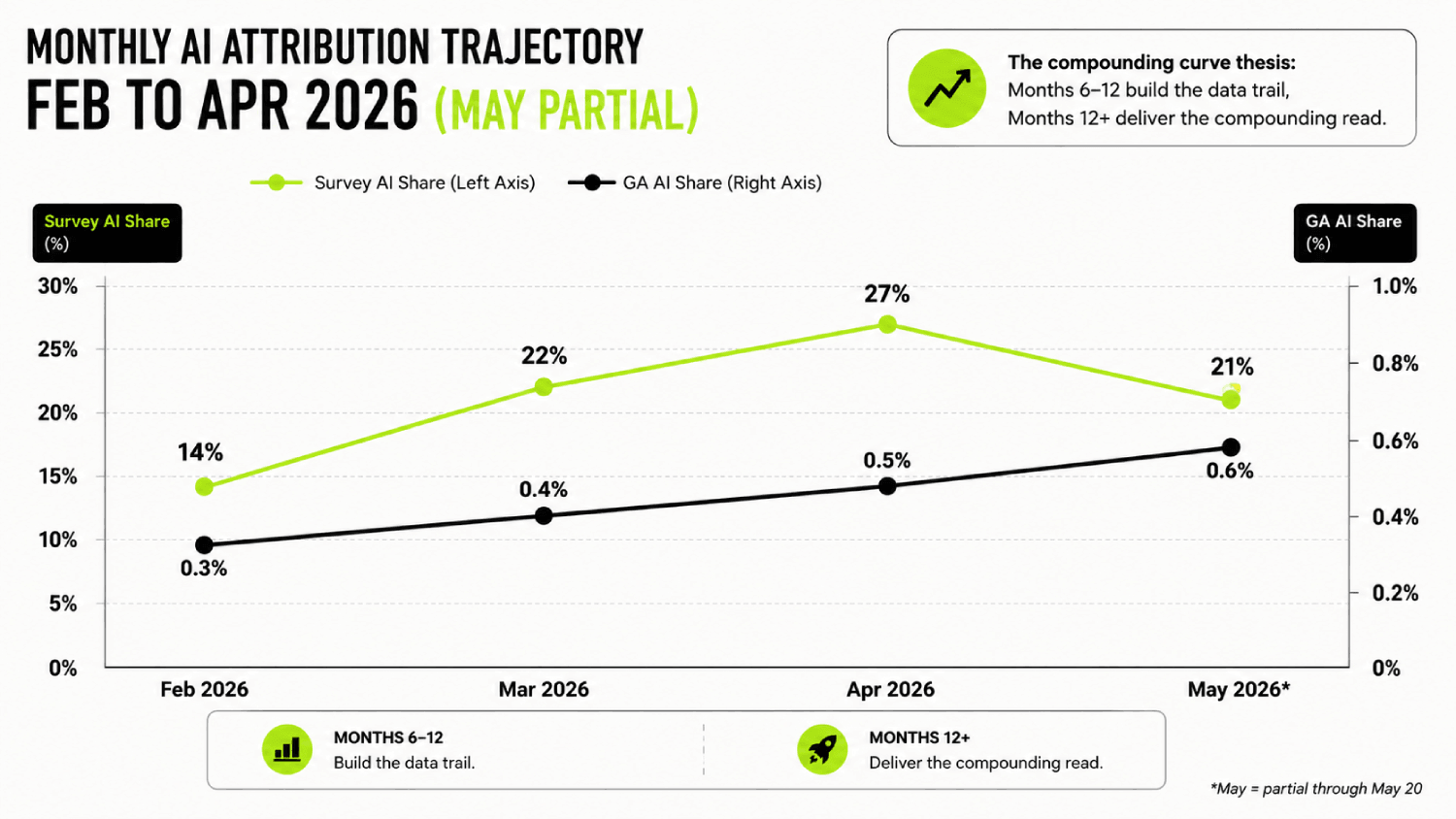
The Mixpanel onboarding survey shows AI’s discovery share growing month over month between February and April 2026:
| Month | Survey AI Share | GA Referrer AI Share |
|---|---|---|
| Feb 2026 | ~14% | ~0.3% |
| Mar 2026 | ~22% | ~0.4% |
| Apr 2026 | ~27% | ~0.5% |
| May 2026* | ~21% | ~0.6% |
*May 2026 figures are partial. Survey data through May 20, 2026 (Mixpanel pull). GA referrer data through May 27, 2026 (GA4 pull). April 2026 is the methodologically clean like-for-like comparison.
The April peak is real, but not a guaranteed ceiling. Monthly variance is normal at this granularity. The signal is the 16-month trajectory, not any single month. What has been consistent is the floor: every month since February has cleared the mid-teens.
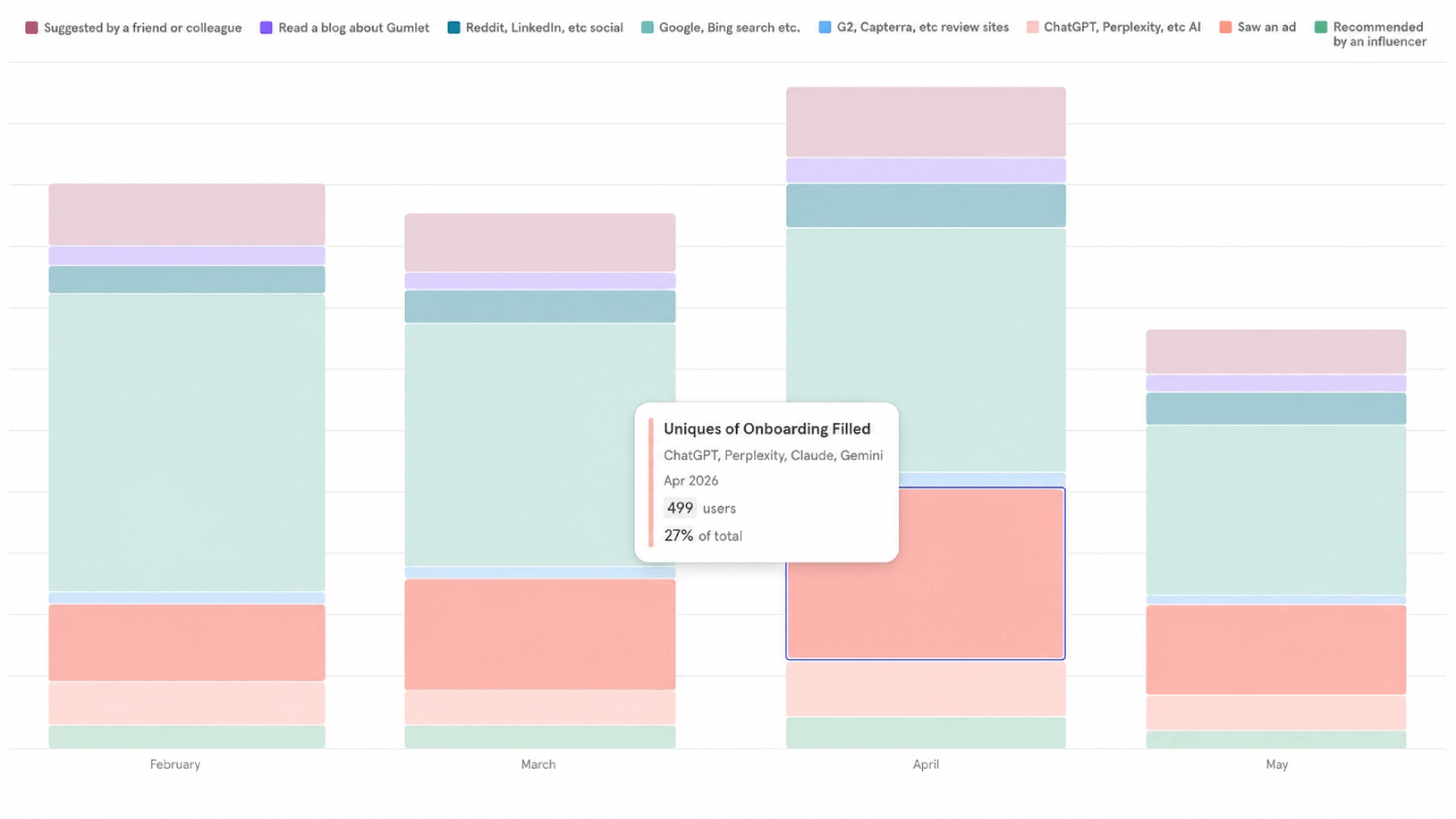
2. GA referrer share (GA4)
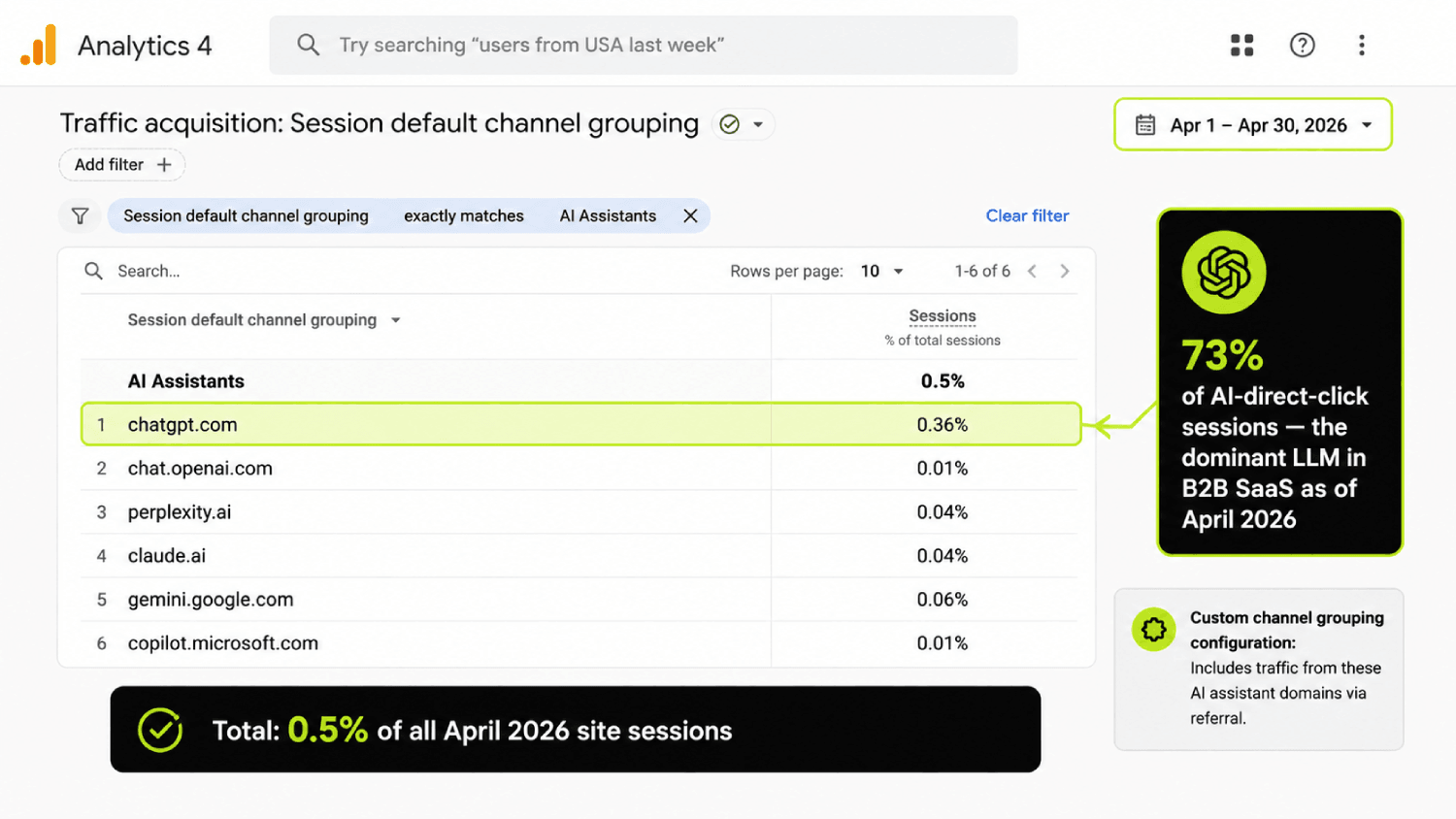
GA4 captured 0.5% of all April 2026 site sessions as AI-sourced. The AI clicks GA does capture convert at roughly 9x the site average, while AI’s overall signup influence (27%) over-indexes its tracked traffic share (0.5%) by ~54x.
83% of AI-aware Gumlet users land via branded Google search or direct URL after first hearing about Gumlet in an AI conversation, which is AI’s indirect influence layer on top of its direct-click contribution.
The AI-internal split inside that 0.5% is heavily ChatGPT-weighted:
| AI Assistant | Share of AI-referred sessions |
|---|---|
| ChatGPT | 73% |
| Gemini | 11% |
| Claude | 7% |
| Perplexity | 7% |
| Copilot | 1% |
Survey responses don’t break out individual AI assistants. The split above reflects GA referrer sessions only.
3. Citation supply count (prompt tracker)
DerivateX tracks 500+ buyer-intent queries for Gumlet across ChatGPT, Perplexity, Claude, and Gemini as of May 29, 2026, run weekly to monitor citation share and position.
Roughly 80% of what determines citation share lives off Gumlet’s own domain, on third-party surfaces, and the prompt tracker monitors weekly.
What Gumlet’s CMO has said publicly
“Today, close to 20% of our inbound revenue can be traced back to users who discovered Gumlet through AI.”
Divyesh Patel, Co-founder & CMO,
Gumlet. Source: Gumlet case study published on DerivateX.
That 20% reflects revenue at an earlier moment in the engagement. The 27% survey share above reflects continued compounding since.
Why a 0.5% traffic channel drives 27% of signups
The 27% survey-attribution and 0.5% GA-source figures aren’t competing measurements. They’re two stages of the same buyer journey, each capturing something different.
What GA captures (0.5% of total traffic)
Direct clicks from AI answers, tagged via auto-UTMs. These users land on Gumlet with utm_source=chatgpt.com (or similar) already attached. GA reads the URL and attributes accurately. This is the entire AI-direct-click population.
What the survey adds on top
Users who heard about Gumlet inside an AI conversation but didn’t click the AI’s link. They closed the chat, Googled the brand, and arrived via organic search or direct URL. Their GA session is not AI-sourced (it’s Google or direct). Their survey response is AI. This is the indirect-influence population.
What this means for AI’s value
A B2B SaaS site that appears in ChatGPT or Perplexity answers usually sees a measurable lift in branded search traffic. GA attributes that lift entirely to organic search, but the survey shows it tracks closely with AI mention volume. AI is doing awareness work that Google is closing the click on.
In 2023, Google held both the awareness layer and the validation layer. In 2026, awareness has migrated to AI assistants, while Google has kept validation.
Roughly 80% of what determines AI citation lives off your own domain, on G2 reviews, Reddit threads, comparison directories, and listicles. The brand mention happens there. The user remembers. Then Googles to validate.
The GEO P&L breakdown for Gumlet
A P&L for a GEO engagement has four lines. Three are publishable for Gumlet. The fourth is the variable you fill in for your own SaaS.
Asset side: what 16 months of Citation Engineering built
| Asset | Status as of May 29, 2026 |
|---|---|
| Buyer-intent queries tracked weekly across ChatGPT, Perplexity, Claude, Gemini | 500+ |
| Survey-level AI attribution share | ~27% (April 2026) |
| Measurement infrastructure on Gumlet’s stack | Survey field + GA4 filter + weekly prompt tracker |
| Monthly attribution data trail | 16 months running |
| Off-domain citation surface | G2, Reddit, comparison directories, listicles |
Every asset compounds. Citations don’t reset month-over-month. The measurement infrastructure runs without ongoing input cost once configured.
Time investment: what was spent
| Investment | Duration |
|---|---|
| Total engagement | 16 months as of April 2026, ongoing (started January 2025) |
| Time to first measurable AI attribution | ~8 to 12 weeks |
| Time to double-digit attribution share | ~6 months |
| Time to ~27% attribution share | ~16 months (April 2026) |
The compounding curve is the investment thesis. Months 1–6 build citation supply. Months 6–12 build the data trail. Months 12+ deliver the compounding read.
Return side: what came back
| Return | Source |
|---|---|
| Inbound revenue traceable to AI | ~20% (Gumlet CMO public statement) |
| Monthly signups self-reporting AI as discovery | ~27% (April 2026 Mixpanel survey) |
| Branded search volume lift | Captured in Google Search Console, downstream of AI citations |
| Weekly query tracking coverage | 500+ buyer-intent prompts monitored across four LLMs |
Illustrative ROI example
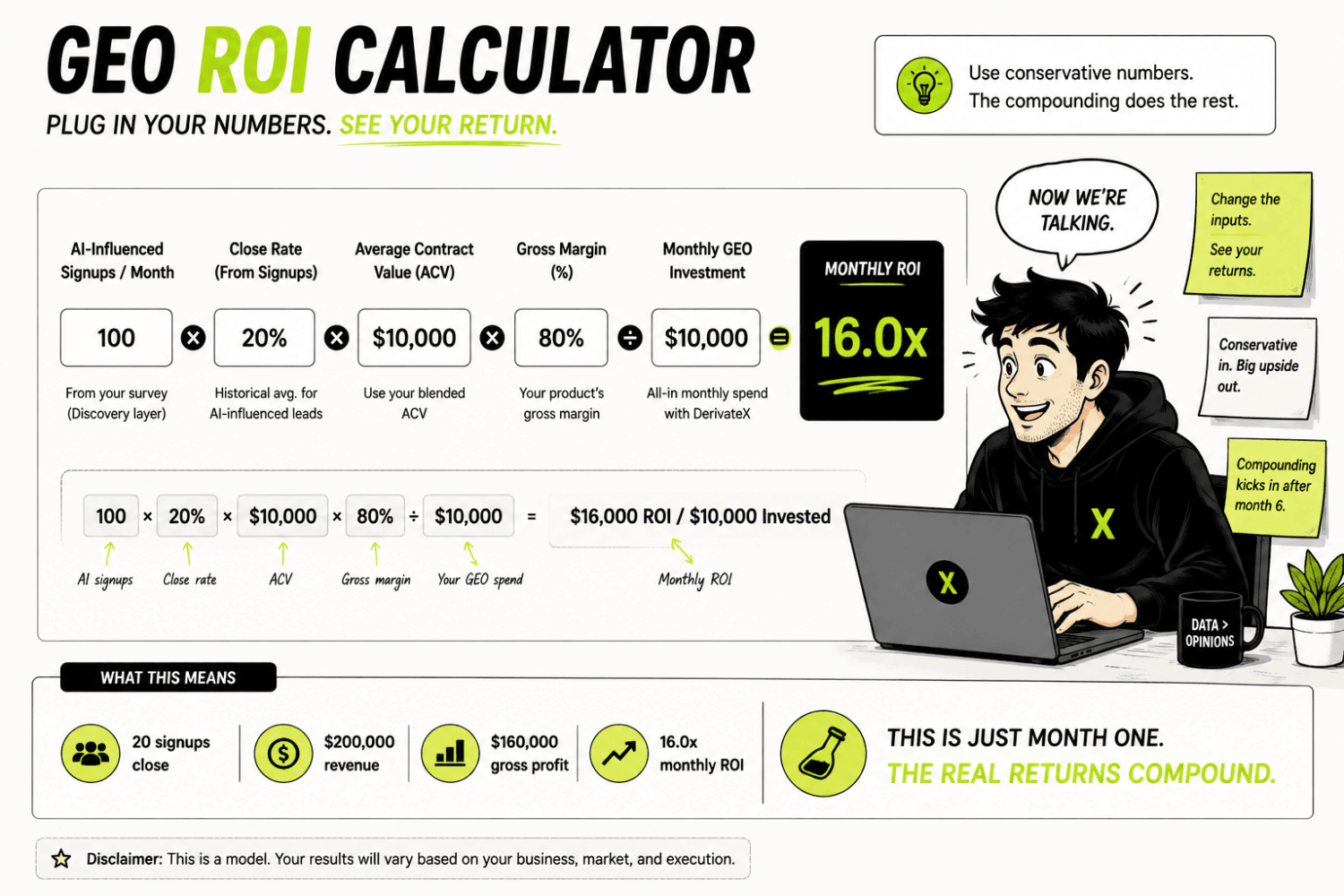
The math below uses round, illustrative numbers, not Gumlet’s actuals. Substitute your own for an answer specific to your business.
| Input | Value |
|---|---|
| Monthly signups | 200 |
| AI attribution share (from onboarding survey) | 20% |
| Close rate (signup to paid) | 3% |
| Average contract value | $20,000 |
| Monthly AI-attributed pipeline | 200 × 20% × 3% × $20,000 = $24,000 |
| Monthly GEO engagement cost (illustrative) | $5,000 |
| Monthly payback multiple | $24,000 ÷ $5,000 = 4.8x |
A mid-market B2B SaaS with 200 monthly signups, 20% AI attribution from onboarding survey, 3% close rate, and $20,000 average contract value would generate approximately $24,000 in monthly AI-attributed pipeline.
Against a starting basic $5,000 monthly GEO engagement cost, that is a 4.8x payback multiple per month. Higher-volume or higher-ACV businesses scale this rapidly. Lower-volume or lower-ACV businesses should fix funnel economics first.
Illustrative monthly P&L
The same example expressed as a traditional monthly P&L. Illustrative numbers, not Gumlet’s actuals.
| P&L line | Monthly | Annualized (12 months) |
|---|---|---|
| AI-attributed revenue | $24,000 | $288,000 |
| GEO engagement cost | ($5,000) | ($60,000) |
| Net contribution from GEO | $19,000 | $228,000 |
| Return on investment | 4.8x | 4.8x |
The summary line: At the illustrative inputs above (200 monthly signups, 20% AI attribution share, 3% close rate, $20,000 ACV, $5,000 monthly GEO engagement), the net contribution from GEO is $19,000 per month, $228,000 annualized, at a 4.8x return on engagement spend. Substitute your own inputs for a P&L specific to your business.
The cost line: yours to fill in
DerivateX has not been authorized to publish the engagement cost for the Gumlet work, and the article doesn’t owe you a number it can’t defend.
Use the worksheet below with whatever engagement cost you’re paying or considering. The math holds regardless of the dollar value on that line.
Buyer worksheet
| Line | Source |
|---|---|
| Survey AI attribution share, monthly | Your own onboarding survey field |
| × Monthly signups | Your CRM |
| × Close rate (signup to paid) | Your funnel data; typically 1.5%–8% |
| × Average contract value | Your finance team |
| = Monthly AI-attributed pipeline | Calculated |
| ÷ Monthly GEO engagement cost | Whatever you’re paying |
| = Payback multiple per month | Calculated |
If the payback multiple is below 1.0 after three months: GEO isn’t right for your motion yet. Fix upstream funnel issues first. If a single converted AI-attributed customer would cover six months of engagement cost: you’re under-investing.
The ROI math framework
The ROI math framework treats Gumlet’s 27% survey share as the upstream variable. Throughout 2026, what that share produces in actual revenue depends on the close rate, contract value, and the cost of the work behind the number.
The equation is:
AI-attributed signups × close rate × ACV ÷ monthly engagement cost = payback multiple
Each variable is owned by the reader running it against their own SaaS.
The four inputs
- AI-attributed signups per month: Pull from your own survey field. Gumlet’s number is 27% of monthly signups in April 2026. Yours will be different.
- Close rate: Your own funnel data. B2B SaaS typically lands between 1.5% and 8% from signup to paid, depending on motion.
- Average contract value: Your own number.
- Monthly cost of the GEO engagement: Whatever you’re paying or considering paying.
Two decision rules
- If your AI-attributed signup volume × close rate × ACV doesn’t cover the monthly engagement cost within three months, GEO isn’t the right channel for your current motion. Fix CAC or pipeline first.
- If a single converted AI-attributed customer would cover six months of agency cost, you’re probably under-investing in GEO across the rest of your stack.
Expectations on timeline
First measurable AI attribution typically surfaces within 8 to 12 weeks of a properly engineered GEO engagement. Compounding effects, including citation share growth, branded search lift, and survey attribution growth, take 6 to 16 months to fully materialize.
Gumlet’s trajectory ran ~14% in February 2026 to ~27% in April 2026, 14 to 16 months into an engagement that is still running.
Warning: If an agency promises material attribution in under 8 weeks, ask for the tracked dataset before signing. The math is in the citation supply lag, not in the agency’s effort.
The compound effect matters more than any single month. Citation count is the leading indicator. Survey share is the trailing indicator. GA referrer share is the noise floor underneath both.
5 things every B2B SaaS should track for GEO ROI
Five discrete metrics every B2B SaaS should be tracking monthly, regardless of agency involvement:
- Self-reported AI attribution share, by AI assistant. A “How did you hear about us?” survey field in your onboarding flow, with ChatGPT, Perplexity, Claude, and Gemini broken out individually. Tracked monthly in Mixpanel, Amplitude, or Heap. The number is the upper bound of AI’s contribution.
- GA4 referrer share for AI assistant domains. Custom channel grouping flagging sessions from chatgpt.com, perplexity.ai, claude.ai, gemini.google.com, and copilot.microsoft.com. The direct-click volume.
- Citation count and share across all four LLMs. Weekly prompt tracker running 15–25 buyer-intent prompts, scored for brand mention, position, and competitor co-mention. The upstream supply indicator.
- Branded search volume, month over month. Pull from Google Search Console. AI mentions drive a measurable branded search lift that GA attributes to organic, so this is the only way to surface AI’s downstream effect on Google traffic.
- Pipeline value attributed to AI-discovery signups. Survey-attributed signups × close rate × ACV. The output your CFO actually cares about.
The first three are measurement. The last two are outcome. Most B2B SaaS GEO programs track at most one or two of these. The compounding read requires all five.
How to set up GEO ROI measurement at your SaaS
Replicating the three-layer measurement stack takes three components. None requires a vendor. None takes longer than a sprint to ship.
Step 1: Add the onboarding survey field
Insert a “How did you hear about us?” question into your signup flow with these discrete options:
- Google search
- Social media
- A friend or colleague
- Read about it on a blog or article
- A review site like G2 or Capterra
- An ad
- An influencer
- ChatGPT
- Perplexity
- Claude
- Gemini
The four AI assistants must be individual options, not a single “AI / Other AI tool” bucket. The coarse bucket loses the signal of which AI assistant is moving for your category, and that signal is what tells you to add a prompt tracker for a specific LLM later.
Track the percentage of new signups who select an AI option. That percentage is your survey AI attribution number. Mixpanel, Amplitude, Heap, and most product analytics tools support this natively.
Step 2: Build the GA4 referrer filter
In GA4, create a custom channel grouping that flags sessions where the source parameter contains any of: chatgpt.com, chat.openai.com, perplexity.ai, claude.ai, gemini.google.com, copilot.microsoft.com.
Compare that share to your survey number monthly. The gap is your diagnosis:
- Wide gap, survey high: AI is doing awareness, Google is closing the click. Most common B2B pattern, the same one Gumlet’s 54x quality multiplier reflects.
- Narrow gap, both low: you’re not in AI answers at all. Citation supply is the issue.
- Narrow gap, both high: rare, usually high-trust verticals with direct AI-to-click behavior.
Step 3: Run the citation supply tracker
Define 15 to 25 buyer-intent prompts that your ICP would actually type into an AI tool. Run them weekly across ChatGPT, Perplexity, Claude, and Gemini. Track which prompts cite your brand and where you appear in the response.
This is your supply layer. The citation count is the upstream indicator that predicts what survey and GA will report 8 to 12 weeks later.
Warning: If your weekly prompt tracker only watches ChatGPT, you’re measuring roughly 70-75% of AI traffic and missing the rest. Track all four LLMs from day one. Adding the others later means losing the baseline trajectory.
One honest constraint
The 27% Gumlet figure sits at the upper bound of what self-reporting can capture. Some users misremember their first touchpoint or pick whichever option feels right in the moment. Real AI-driven share sits between the GA floor and the survey ceiling, likely closer to survey for high-intent verticals.
As of Q2 2026, the implementation above doesn’t solve the imperfection. It gives you the only defensible read available across the AI search stack today.
How DerivateX measures GEO ROI
DerivateX measures GEO ROI through three proprietary frameworks working in sequence. Citation Engineering is the upstream content and entity architecture that drives a brand into AI answers across ChatGPT, Perplexity, Claude, and Gemini.
ATLAS is the 90-day execution system that ships the work predictably, not as wait-and-see SEO. AI Visibility Score (AVS) is the 0–100 weekly measurement tracking citation frequency and prominence across all four LLMs, normalized to a single trackable number.
Survey share, GA referrer share, and query tracking coverage are the outputs visible in this article. The three frameworks above are how those inputs get built across a 16-month engagement.
Why this article exists
Most public GEO ROI artifacts in 2026 publish a single number, an anonymized sample, or a framework without client data. None pair a named-client revenue trajectory with dual measurement methodology, a publishable P&L, and the engagement structure behind it.
The closest reference points are LinkedIn posts with anonymous ROI deltas, qualitative agency framings, theoretical frameworks, and industry observations.
This article is the artifact the category was missing. One named B2B SaaS client (Gumlet). Sixteen months of monthly data. Two attribution methodologies stacked against each other. A four-line P&L with three lines published and the fourth handed to the reader. The implementation framework so the reader can replicate it. Every claim is attributed to a dated source.
Frequently asked questions
1. How is GEO ROI measured?
GEO ROI is measured through three stacked layers: self-reported onboarding attribution (a “how did you hear about us” survey field), referrer-based session tracking in GA4, and weekly buyer-intent prompt monitoring across ChatGPT, Perplexity, Claude, and Gemini.
The survey captures discovery. GA captures clicks. The prompt tracker captures citation supply. Publishing all three is the only defensible position. Picking one in isolation flatters or misleads.
2. What percentage of revenue can come from AI search for B2B SaaS?
Gumlet’s CMO has publicly stated roughly 20% of inbound revenue is traceable to users who discovered the company through AI. The April 2026 onboarding survey share of new signups grew to 27% in the same engagement.
Outcomes vary by category, ICP behavior, citation supply, and engagement maturity. Run a survey field for a month before estimating your own number.
3. How long until GEO produces measurable revenue for B2B SaaS?
First measurable AI attribution typically surfaces within 8 to 12 weeks of a properly engineered GEO engagement. Compounding effects, including citation share growth, branded search lift, and survey attribution growth, take 6 to 16 months to fully materialize.
Gumlet’s data ran ~14% in February 2026 to ~27% in April 2026, 14 to 16 months into Citation Engineering work. If an agency promises material attribution in under 8 weeks, ask for the tracked dataset before signing.
4. Why does Google Analytics show such a small percentage of AI traffic compared to onboarding surveys?
The 27% and 0.5% measure different populations. The 27% is AI’s share of new signups self-reporting AI discovery. The 0.5% is AI’s share of all site sessions tracked by GA, which captures direct AI clicks accurately since LLMs auto-tag outbound URLs with UTMs.
The gap exists because most AI-discovered buyers close the AI conversation and arrive at the site via Google or direct URL. Their GA session is logged correctly as Google organic, but their survey response correctly attributes the discovery to AI. Together the two numbers show AI’s signup influence (27%) runs about 54x its tracked traffic share (0.5%), while the directly-clicked slice converts at roughly 9x the site average.
5. How do I know if GEO is worth the investment for a $5M to $50M ARR B2B SaaS?
Run the math: AI-attributed signups times close rate times ACV, divided by the monthly engagement cost. If the engagement doesn’t pay for itself within three months at a conservative close rate, GEO is the wrong investment until upstream funnel issues are fixed.
If a single converted AI-attributed customer would cover six months of agency cost, you’re probably under-investing. The ROI math is yours to apply against your own assumptions.
What this means for your SaaS
Gumlet’s 27% AI attribution share in April 2026, against 0.5% on GA4, is what 16 months of disciplined Citation Engineering produces. The data isn’t the goal. The measurement layer that makes the data legible is.
If you’re spending on GEO and not measuring it this way, you don’t know whether it’s working. The action is the three-layer measurement stack: a survey field for discovery, a GA4 referrer filter for clicks, a weekly prompt tracker for supply.
The diagnostic is the gap between survey and GA. If the gap is wide and survey is high, AI is doing the awareness work and Google is capturing the validation.
The category will catch up to publishing all three numbers, plus the P&L behind them. Until then, the data is the moat.
Get the same measurement system
As of mid-2026, DerivateX builds and runs the three-layer GEO ROI measurement system and the publishable P&L behind it, applied to B2B SaaS engagements like Gumlet’s.
If you want to see what Citation Engineering looks like applied to your category, or want help setting up the same stack at your own SaaS:
Get a free AI visibility audit →
Written byAyush SharmaVP, SEO & AI Search, DerivateX
VP, SEO & AI Search at DerivateX. We're a B2B SaaS SEO and Generative Engine Optimization agency that engineers AI citations in ChatGPT, Perplexity, Claude, and Gemini and connects them to demo bookings and revenue pipeline.
Reviewed byApoorv SharmaCo-founder, DerivateX
Apoorv Sharma is the co-founder of DerivateX, a B2B SaaS SEO and Generative Engine Optimization agency that engineers AI citations in ChatGPT, Perplexity, Claude, and Gemini and connects them to demo bookings and revenue pipeline. He is the author of the 2026 AI Visibility Benchmark Report and the Citation Engineering methodology. He's also the brain behind "Found On AI" and has sold 2 of his companies previously
Cited by AI