Case study: Gumlet turned ChatGPT mentions into 20% of inbound revenue. Read it →

Does Your Early-Stage B2B SaaS Actually Need AEO Yet? A Decision Framework

A 3-signal test using data you already have in Google Search Console and GA4, built to tell you if AEO fixes a real gap or just buries a positioning problem.


In the last four months, at least six agencies have published a version of the same advice: start AEO now, before you’re left behind.
None of them agree on what “now” means, and almost none of them tell you how to check whether it applies to your specific company.
That’s the actual problem with most AEO advice aimed at early-stage founders. It treats readiness as a purchasing signal. You have a defined ICP, you publish articles regularly, and your category has entrenched competitors.
These are directionally useful, but none of them are testable with data you already have open in another tab.
This article gives you the test instead. Three specific, falsifiable signals, checkable in Google Search Console and GA4 in about 15 minutes, that tell you whether you’re in the window where AEO produces citations or the window where it just burns budget on top of a positioning problem you haven’t solved yet.
Along the way, it covers what “light AEO” looks like if you pass the test, what to build instead if you don’t, and why the two channels that most guides frame as competing for your budget actually compound when built on the same foundation.
Key Takeaways
- AEO readiness is a testable threshold, not a first-mover race. Most early-stage B2B SaaS companies do not need a full program yet.
- Run the AEO Trigger Test: Three specific signals you can check today in Google Search Console and GA4, no new tools required.
- Two or more signals ‘True’ means you’re ready for a light AEO layer. Zero or one means fix positioning first.
- AEO cannot compensate for unclear positioning. It structures an answer for AI models to cite. It does not create the answer.
- SEO and AEO compound when built on the same content architecture. Verito’s result came from running both in sequence, not choosing one.
- Half of B2B software buyers now start their research inside an AI chatbot rather than Google, according to G2’s March 2026 survey of 1,076 buyers. That number was 29% in 2025.
This framework assumes: An existing content library (10+ published pages), access to Google Search Console and GA4, and at least one clearly defined ICP. If your company doesn’t have all three yet, the Trigger Test will read as inconclusive, not as a “not yet.”
What AEO Actually is, in One Sentence
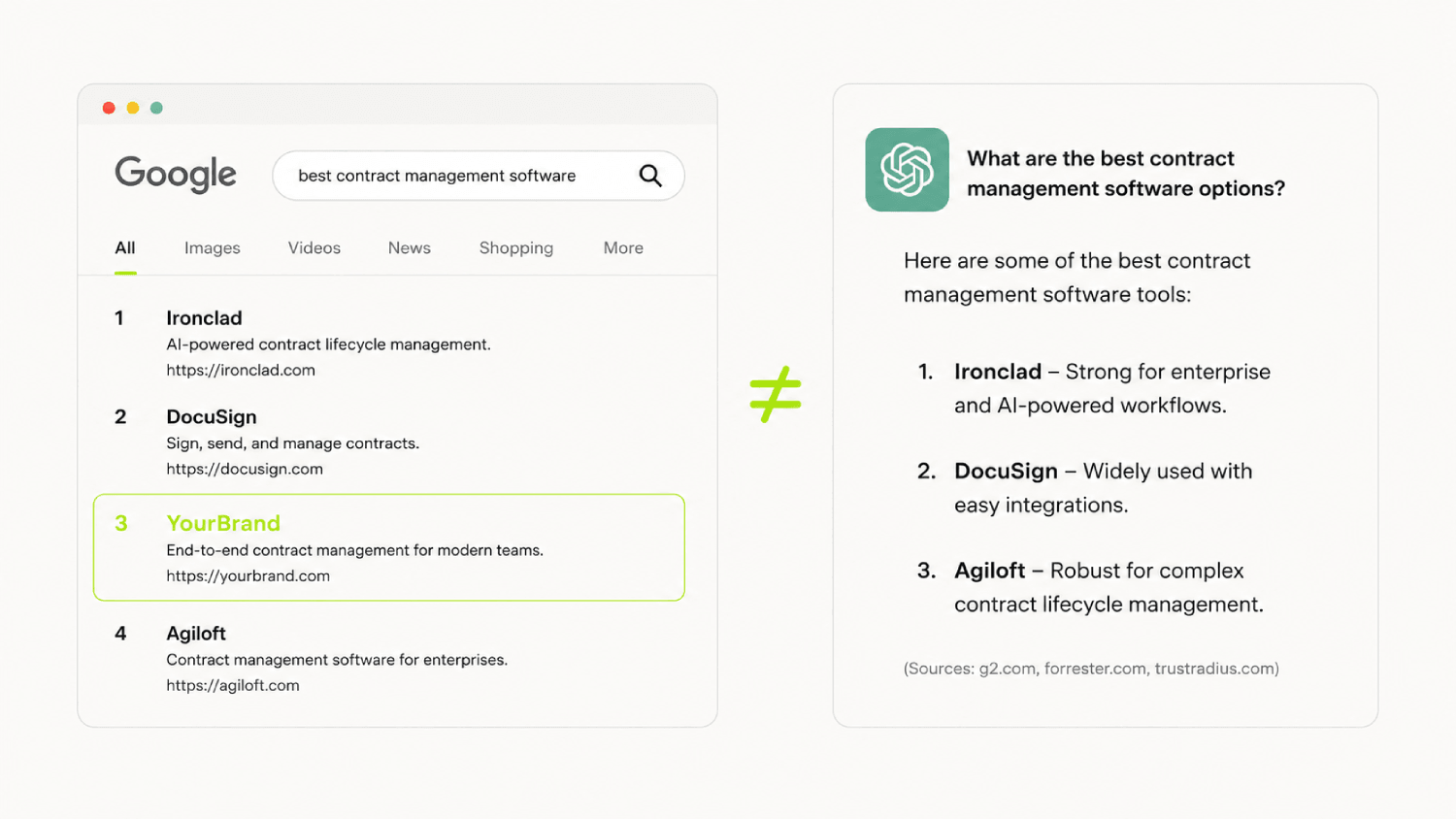
Answer Engine Optimization is the practice of structuring content and brand signals so AI tools like ChatGPT, Perplexity, Claude, and Google’s AI Overviews cite your product directly inside a generated answer, rather than requiring a buyer to click through a ranked link to find you.
That distinction, cited versus ranked, is the entire reason AEO exists as a separate discipline from SEO.
Google’s algorithm rewards a page that earns a click. An AI model rewards a source it trusts enough to synthesize into an answer, whether or not the buyer ever visits the page. You can win one and lose the other, which is the exact scenario the first trigger signal below is built to catch.
The stakes for B2B SaaS specifically are higher than for most categories, because the buying committee is bigger and the research cycle is longer.
A VP of Engineering, a procurement lead, and a security reviewer might each run a different AI-assisted research thread on the same deal, and each one forms an early impression of your category before anyone on that committee talks to your sales team.
| Optimizes for | Rewards | Measured by | |
|---|---|---|---|
| SEO | Ranking in Google’s results list | Domain authority, backlinks, on-page relevance | Position, click-through rate |
| AEO | Direct citation inside an AI-generated answer | Entity clarity, structured content, answer-first formatting | Citation rate, mention position |
| GEO | Citation presence across the AI ecosystem as a system | Third-party corroboration, cross-platform consistency | AI Visibility Score, share of voice |
Why This Question Matters More in 2026
In the early 2020s, the argument for AEO was speculative. Gartner’s February 2024 forecast, the one every AEO agency still cites, predicted traditional search engine volume would drop 25% by 2026 as AI chatbots and virtual agents absorbed queries that used to go to Google. At the time, that was a projection about the future.
It isn’t a projection anymore. G2’s March 2026 survey of 1,076 B2B software buyers and decision-makers found that 51% now start their research with an AI chatbot more often than with Google, up from 29% just a year ago. 71% rely on AI chatbots at some point in the research process.
“Buyers have moved from reference to inference,” said Tim Sanders, Chief Innovation Officer at G2, describing the shift.
Instead of gathering sources and synthesizing the research themselves, buyers now ask an AI chatbot to do the synthesis and hand back a shortlist.
That reframing matters because it changes what’s actually at stake when you’re absent from an AI answer. The same G2 research found that 69% of buyers ended up choosing a different vendor than they originally planned, based on what an AI chatbot told them, and a full third purchased from a brand they’d never heard of before the chatbot surfaced it.
Being cited in an AI answer doesn’t just build awareness. It can override a buyer’s prior intent entirely.
In the early 2020s, the goal for a B2B SaaS content team was ranking on page one of Google for the terms your ICP searches. In 2026, ranking on page one is necessary but no longer sufficient, because a growing share of buyers never see that ranked page.
They see whatever the AI model decided to synthesize instead, built from sources the model trusts, which may or may not include yours even if you outrank every competitor on Google for the same query.
This is the exact gap the first trigger signal below is designed to surface, and it’s the reason “we rank well, so we’re covered” is no longer a safe assumption.
The AEO Trigger Test: 3 Signals That Tell You if You’re Ready for AEO
DerivateX runs AEO and the broader GEO work for B2B SaaS companies for a living, so we see this specific pattern play out across roughly 40 to 50 client and prospect audits per quarter.
Take the framework below with that lens. It also holds up against the public buyer-behavior data cited throughout this article.
You don’t need a five-stage maturity model with a quiz attached. You need a three-signal readiness checklist, three “Yes or No” questions, answerable today with tools you already have open.
If two or more of these are true, you’re ready for a light AEO layer. If zero or one is true, building AEO now will bury a problem that AEO structurally cannot fix.
Signal 1: The Visibility Gap
Open Google Search Console and pull your top 10 organically-ranking pages.
Take the exact buyer-intent query one of them ranks page one for, and type that same query into ChatGPT, or check what Google’s AI Overview returns for it.
If your brand is absent from the AI-generated answer for a query you already rank for organically, that’s the visibility gap.
This is the cleanest of the three signals because it isolates the variable clearly. You’ve already proven the content is good enough to earn a page-one ranking. The AI model had access to the same underlying information and still chose not to cite you.
That’s not a content quality problem, which is what most early-stage teams assume it is. It’s an entity-clarity and third-party-corroboration problem, and it’s specifically what AEO work addresses.
Run this check across 3 to 5 of your highest-intent ranking pages before drawing a conclusion from a single query. One miss could be noise. A pattern across several pages is a real signal.
Signal 2: The Plateau
Open GA4 and pull organic traffic to your comparison pages, alternatives pages, and any bottom-of-funnel content for the trailing two quarters.
If you’ve been publishing consistently across that window and the traffic line is flat or declining anyway, you’re looking at more than a content problem.
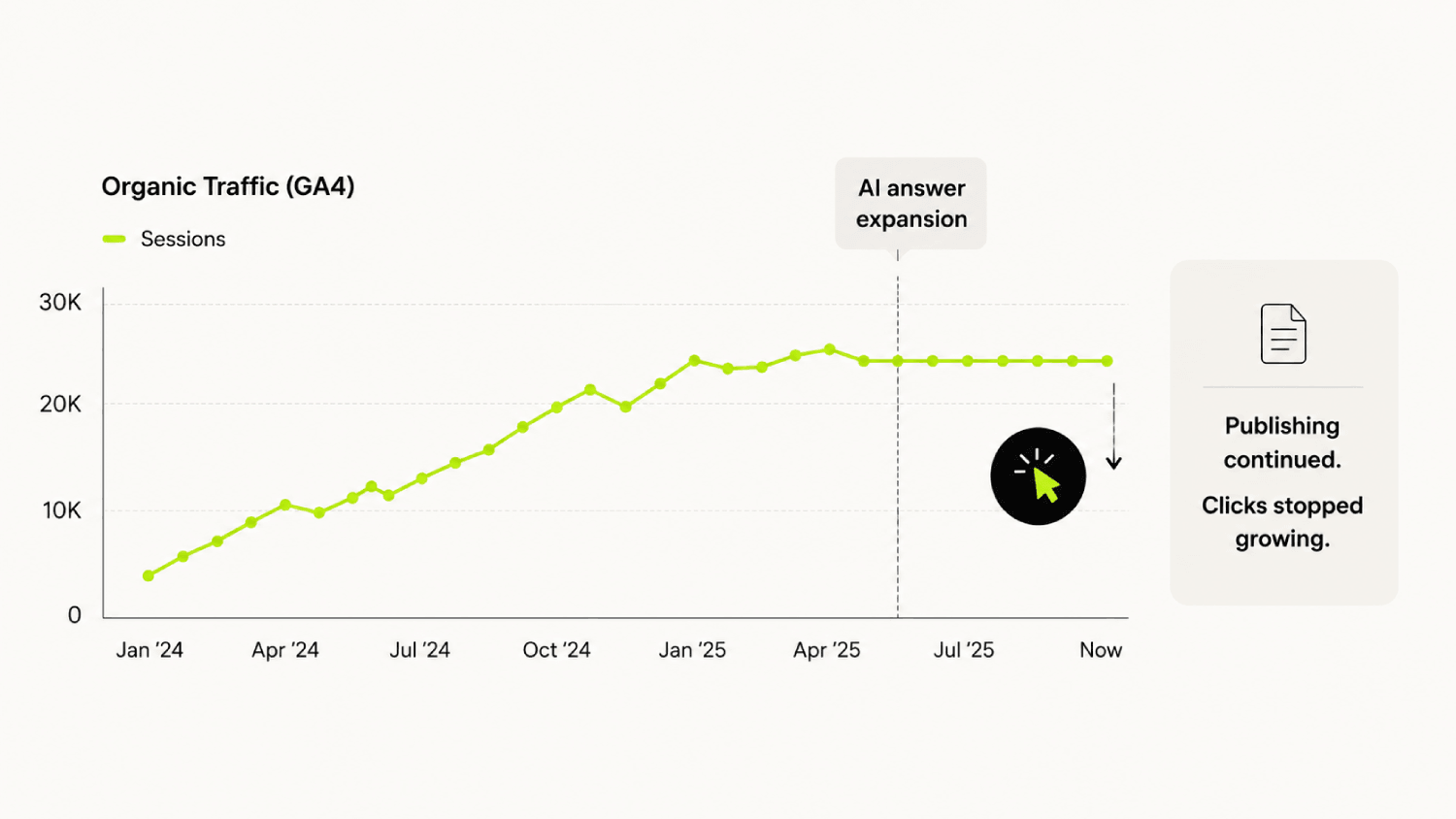
The Number: According to the AI Search Statistics compilation, position-one organic listings see click-through rates drop 58% when an AI Overview appears on the same query, based on an Ahrefs’ 2026 AI Overviews analysis of 300,000 keywords.
If your best-performing bottom-of-funnel pages have plateaued during a window when AI Overviews expanded into more query types, the plateau is not a coincidence. It’s the click surface contracting from both directions at once, ranked search and AI referral, the zero-click shift the G2 and Ahrefs data above describes at scale.
The distinction that matters here: A plateau after consistent publishing is different from a plateau caused by inconsistent publishing. If your team has been sporadic, fix the consistency problem first. This signal only counts if the input (publishing cadence) has been steady and the output (traffic) still went flat.
Signal 3: The Share-of-voice Gap
Take your category’s single most important buyer query, the one your ICP types when they’re actively building a shortlist, and run it through ChatGPT, Perplexity, Claude, Google AI Overviews, and Google AI Mode.
If a competitor with comparable or even weaker domain authority gets named consistently and you don’t, that’s a share-of-voice gap that domain strength alone will not close.
This is the signal that ends the “we’ll keep winning through SEO alone” argument, because it demonstrates directly that AI models don’t weight domain authority the way Google’s core ranking algorithm does.
G2’s 2026 report on its own citation-tracking data, published via its Profound integration, found that G2 itself is the most cited B2B software source in AI search, with 22.4% influence on software-related queries across ChatGPT, Perplexity, and Google AI Mode, based on an independent analysis of 30,000 AI citations.
A smaller competitor with a stronger G2 review profile and clearer entity signals can out-cite you in a chatbot answer while you outrank them on Google for the identical query.
Warning: Do not run this test once and call it conclusive. AI model outputs vary by session and by exact phrasing. Run each query 3 to 5 times across at least two models before treating an absence as a confirmed gap.
The table below makes the scoring explicit.
| Signal | What you check | Tool | Passes if |
|---|---|---|---|
| Visibility Gap | Top 10 organic pages vs. same query in ChatGPT/AI Overview | Search Console + ChatGPT | You rank page one but AI omits you |
| Plateau | Comparison/alternatives page traffic, trailing 2 quarters | GA4 | Flat or down despite consistent publishing |
| Share-of-voice Gap | Core buyer query across 3 AI tools | ChatGPT, Perplexity, Google AI Overview | Weaker competitor named, you’re absent |
Score two or three: move to the “light AEO” section below. Score zero or one: Skip ahead to what to build instead.
Why “Start AEO Now Just in Case” is the Wrong Instinct for Most Early-stage Teams
Every AEO agency selling into the early-stage market right now has a structural incentive to tell you the risk of waiting outweighs the risk of starting too soon. In most cases, for most companies at this stage, that isn’t true.
AEO cannot fix a positioning problem, and building it on top of one just buries the actual issue under schema markup and answer-first formatting.
If your ICP is still fuzzy, or your team doesn’t have a repeatable one-sentence answer to “why us over the three obvious alternatives,” AI models will not cite you consistently no matter how cleanly your FAQ schema is structured.
Structured data tells a model how to parse a page. However, it says nothing about why your product deserves a mention over a competitor’s when the underlying answer to that question is still unsettled internally.
This isn’t a new failure mode wearing a new acronym, though it rhymes with one. Bain & Company’s 2006 Customer experience research found that 80% of CEOs believed their company delivered a superior customer experience, while only 8% of their customers agreed. While this research is almost two decades old, it is still relevant in 2026.
That gap between internal confidence and external perception is exactly the gap that swallows AEO budget when a team assumes their positioning is clear enough to structure for AI extraction, when in practice it was never validated against how buyers actually describe the problem.
Here’s what that failure looks like in practice, because it’s worth being specific rather than abstract about it. A pre-Series-A SaaS company with a still-evolving ICP hires an AEO agency.
Over six months, they get FAQ schema and answer-first restructuring across 15 pages. Citation count moves from zero to 2 or 3 inconsistent mentions. Meanwhile, the sales team still can’t give a buying committee a crisp, repeatable reason to choose this product over the two others in every deal.
The AEO spend didn’t fail because the tactics were wrong. It failed because there was no consistent answer yet for the model to converge on.
What Happens Structurally When AEO Sits on Top of Unclear Positioning
AI models build confidence in a citation by triangulating across multiple independent sources, not just the pages on your own domain.
If your own site, your G2 reviews, your third-party mentions, and your sales team’s discovery-call language all describe your product slightly differently, the model has no consistent signal to converge on.
The result isn’t zero citations, but inconsistent ones, which for a buyer-shortlist decision functions almost identically to being absent, because the model can’t confidently repeat a claim it saw contradicted somewhere else in its retrieval set.
Entity clarity, in practitioner terms, means an AI model can resolve exactly who you are, what you do, and who you serve from a consistent signal no matter which source it happens to pull from.
It’s the precondition every other AEO tactic depends on, which is why DerivateX’s Citation Engineering framework treats it as the first of 5 levers rather than an afterthought layered in later.
The teams that waste the most AEO budget aren’t the ones with bad content, but the ones who skipped straight to structure (schema, FAQ formatting, answer-first rewrites) without first checking whether the underlying claim being structured was one the model could find corroborated anywhere else.
Structure amplifies a clear signal. It does nothing for a muddy one.
If You Scored 2 or 3, Here’s What “Light AEO” Actually Looks Like
Most guides on this topic assume you already have 10 to 20 pages worth restructuring, a content team with bandwidth to spare, and a citation-tracking tool in your stack.
Early-stage teams usually have none of the three, and that mismatched assumption is where most published AEO advice stops being useful to the company actually reading it.
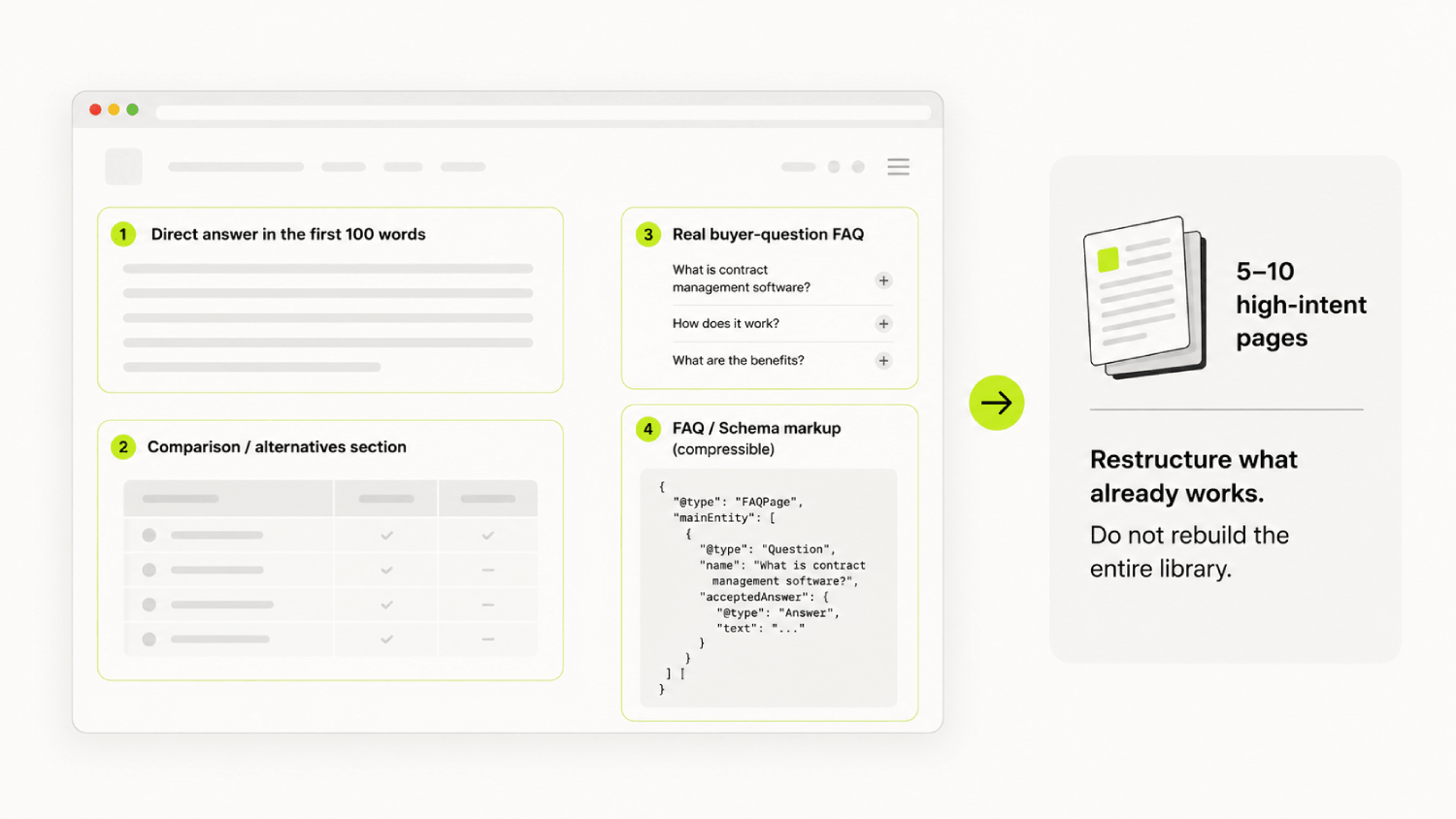
Start with the 5 to 10 pages that already answer high-intent buyer questions. In practice, this is almost always your comparison pages, your “alternatives to [competitor]” pages, and any pricing or integration explainer you’ve already written.
You are not creating new content in this phase. You’re making the content you already have extractable by a model that currently can’t cite it cleanly.
For each of those pages, add answer-first structure: a direct one-to-two-sentence answer to the page’s core question in the first 100 words, with supporting depth after it. Then add FAQ schema built from the actual questions your sales team hears in discovery calls, not generic category questions pulled from a keyword research tool.
Ask any agency proposing to do this work for you to show a current client’s citation tracking across ChatGPT, Perplexity, Claude, Gemini, and Google AI Overviews.
If they can’t produce that, they’re running the same SEO playbook with new terminology, and the citation rate will not move regardless of what the invoice calls it.
How This Compounds With SEO Instead of Competing With It
You don’t have to pick one channel over the other, and most of the “AEO vs. SEO” framing in circulation right now creates a false choice that doesn’t hold up against what actually produces results.
Verito, a B2B SaaS company selling cloud hosting to accounting and tax firms, moved from an average Google position of 40 to first-page rankings on Google and top recommendations on ChatGPT number-one placements across high-intent buyer prompts like “QuickBooks hosting” and “UltraTax hosting,”.
That result came from running the traditional SEO work and the AEO work on the same cluster-first content architecture, not from two separate programs competing for the same budget.
The traffic gains and the citation gains fed the same underlying asset, which is the actual argument for sequencing these two channels together rather than betting the entire budget on one before validating the other.
A Note on Tools, Since Every Guide on This Topic Recommends Buying One
Dedicated AI-citation tracking platforms exist, and they do the monitoring work faster than a spreadsheet once you’re running this at scale.
At the early stage, before you’ve validated that the mechanism works on your 5 to 10 highest-intent pages, a manual spreadsheet tracking query, date, AI tool, and result is enough to prove the concept without adding another line item to a budget that’s likely already tight.
Upgrade to a dedicated tool once you’re tracking more than roughly 20 prompts monthly across more than two platforms, not before.
What “Not Yet” for AEO Adoption Looks Like, and What to Build Instead
If you scored zero or one on the Trigger Test, the correct move is to not spend AEO budget yet, and to put that budget toward positioning clarity and ICP definition instead. Re-run the test in one quarter.
A vague or still-evolving ICP is the single biggest reason early AEO investment fails to produce durable citations. AI models need a consistent, specific signal about who you serve and why, and no amount of formatting work manufactures that signal if the underlying answer inside your own team is still shifting.
A fast, low-cost way to test this before spending anything: pull the last 10 discovery calls your sales team ran and check what question prospects ask in the first 5 minutes. If it’s consistently some version of “so what exactly does this do,” your positioning hasn’t landed yet, and prospects are spending the call classifying you rather than evaluating fit.
If the questions have shifted to “how do we use this” or “how does this compare to X specifically,” your positioning is doing its job, and you’re likely closer to a passing score on the Trigger Test than you think.
If your own leadership team can’t agree, without debate, on a single sentence describing who this product is for and what they get that the two closest alternatives don’t offer, don’t hire anyone for AEO work yet, in-house or agency.
You’d be paying to structure an answer nobody inside the company has actually settled on, and that spend will not survive contact with a model that checks for consistency across sources.
What This Looks Like Once It’s Actually Working
Gumlet, a video hosting and infrastructure platform, attributes 20% of its direct monthly inbound revenue to ChatGPT, Perplexity, and Bing Copilot combined. That number represents a compounded result, built over time, not something a light AEO layer produces in its first quarter.
It’s the destination this framework points toward, and it’s worth being explicit that the gap between “passed the Trigger Test” and “20% of inbound revenue” is measured in months of consistent execution.
The mechanism behind that number is the same one described throughout this article, just further along the curve: entity clarity established early, third-party corroboration built consistently across G2, guest placements, and independent mentions, and content structured for extraction from the start rather than retrofitted later.
DerivateX is an SEO and GEO agency for B2B SaaS that engineers AI citations across ChatGPT, Perplexity, and Google AI Overviews and ties them to demo pipeline, not just visibility metrics, which is the distinction that separates a citation you can measure against revenue from one that only looks good in a screenshot sent to a board.
That distinction, a measurable citation versus a decorative one, is the actual argument for building this deliberately once your Trigger Test score says it’s time, instead of either ignoring the channel entirely or throwing budget at it before the underlying signal is ready to be structured.
Frequently Asked Questions
1. How do I know if I’m losing deals to AI search instead of just not having enough pipeline?
Run your core buyer-intent query through ChatGPT and Perplexity and check whether a direct competitor appears while you don’t. If a competitor with similar or weaker domain authority gets named consistently across that query and its close variants, you’re losing shortlist consideration before a prospect ever reaches your site.
If neither of you appears at all, the gap is category awareness rather than AI visibility specifically, and the fix is different: build broader top-of-funnel content before investing in citation structure.
2. Is AEO just SEO with a new name?
No. SEO optimizes a page to rank inside Google’s results list, measured by position and click-through. AEO optimizes your brand’s entity signal and content structure so an AI model cites you directly inside a synthesized answer, often without the buyer clicking through to your site at all.
The two share content foundations, meaning the same well-researched page can serve both goals, but they reward fundamentally different signals: Google weights domain authority and backlink profile heavily, while AI models weight entity consistency and third-party corroboration more than raw link volume.
3. Do I need to rebuild my entire content library to start AEO?
No, and attempting to is the most common early-stage mistake once a team decides they’re ready. Start with the five to ten pages that already answer high-intent buyer questions, typically your comparison and alternatives pages, and restructure those for answer-first formatting and FAQ schema before creating anything new.
Rebuilding a full library before proving the mechanism works on your best-performing existing pages wastes budget you’ll need later in the process.
4. How long does it take to see results from AEO for an early-stage SaaS company?
Initial citation movement on restructured existing pages typically shows up within 30 to 60 days, since the content and its underlying authority already existed and only needed reformatting.
Building deeper citation authority through third-party corroboration, the independent mentions and reviews AI models weigh heavily beyond your own domain, usually taking 90 days or longer to compound meaningfully. Treat any agency promising faster, consistent citation gains than that timeline as a red flag rather than a competitive advantage.
5. What’s the difference between AEO and GEO, and does it matter at my stage?
AEO narrowly targets direct-answer formats: featured snippets, voice results, and AI Overview extractions specifically. GEO, short for Generative Engine Optimization, is the broader discipline of building citation presence as a system across ChatGPT, Perplexity, Claude, Gemini, and Google AI overviews simultaneously.
At the early stage, the terminology distinction matters less than the underlying question the Trigger Test answers: is your entity signal consistent enough for any AI tool to cite you reliably. Solve that first regardless of which acronym ends up on the invoice.
6. Should I hire an agency or try AEO in-house first?
If you scored zero or one on the Trigger Test, don’t hire anyone yet in either category. Fix positioning clarity first. If you scored two or three and have a senior content marketer who can dedicate real, sustained time to entity work and third-party placement, test it in-house for one full quarter before deciding to hire out.
If that person doesn’t exist on your team, or the team is already stretched thin maintaining core content output, an agency with demonstrated citation-tracking data closes the gap faster than a stretched internal team building the skill set from zero under deadline pressure.
7. What’s the biggest mistake early-stage teams make once they decide they’re ready for AEO?
Treating it as a one-time restructuring project rather than an ongoing measurement discipline. Teams that pass the Trigger Test, restructure their top pages, and then stop checking whether citations actually moved tend to plateau at the same two or three inconsistent mentions described earlier in this piece.
Track your query set monthly against the same buyer-intent prompts you used to run the Trigger Test in the first place, and treat a stalled citation rate after 90 days as a signal to revisit entity consistency, not content volume.
Where DerivateX Fits in This Decision
If you’ve run the Trigger Test and landed on two or three, the next question is who builds this, not whether to build it.
DerivateX runs AEO, GEO, and SEO for B2B SaaS companies, so take the rest of this section with that in mind. The reason it’s here isn’t to argue you should skip the evaluation above.
It’s that most AEO agencies pitch the work before checking whether a company has cleared the threshold this article just walked through.
DerivateX runs both channels as one engagement, on the same content architecture, because that’s the mechanism Verito’s result came from: SEO and AEO built on the same cluster instead of competing for the same budget. The Citation Engineering methodology treats entity clarity, the exact gap Signal 1 is built to catch, as the first of five levers rather than something layered in after the fact.
The honest limitation: DerivateX’s primary engagement model is built for companies with product-market fit and an existing content foundation, roughly $5M ARR and up. If your Trigger Test score came back zero or one, that’s not a DerivateX-shaped problem yet either. Fix positioning first, then re-run the test.
Closing Thoughts
Most AEO advice aimed at early-stage founders right now is written by agencies whose business depends on you believing that waiting is the riskier choice.
Across the data reviewed here, from Gartner’s original 2024 forecast to G2’s March 2026 buyer survey, the risk that actually shows up in the numbers isn’t the risk of starting a quarter late.
It’s the risk of paying for schema markup and answer-first restructuring on top of a positioning question your own team hadn’t finished answering.
If you run the Trigger Test above and land on 2 or 3 signals, the fastest way to see exactly where your specific gaps sit, without committing to a program before you’ve seen your own data, is a free AI Visibility Audit.
It runs the same baseline scoring DerivateX uses for clients, so you know precisely which buyer queries you’re missing from and why, before deciding how much of next quarter’s budget this actually deserves.
Reviewed byApoorv SharmaCo-founder, DerivateX
Apoorv Sharma is the co-founder of DerivateX, a B2B SaaS SEO and Generative Engine Optimization agency that engineers AI citations in ChatGPT, Perplexity, Claude, and Gemini and connects them to demo bookings and revenue pipeline. He is the author of the 2026 AI Visibility Benchmark Report and the Citation Engineering methodology. He's also the brain behind "Found On AI" and has sold 2 of his companies previously
Cited by AI