Case study: Gumlet turned ChatGPT mentions into 20% of inbound revenue. Read it →

Top 8 GEO Agencies for Series A and Series B B2B SaaS in 2026 (Ranked by Stage Fit, Not Clutch Score)

A ranked comparison of GEO agencies for Series A and Series B B2B SaaS in 2026: filtered by stage fit, accessible pricing, and verifiable AI citation outcomes.


Key Takeaways
- The ranking criteria here are documented GEO methodology, a starting price under $6,000/month, and at least one case study from a comparable growth stage. Clutch scores and enterprise logos did not make the cut.
- AI-sourced sessions from ChatGPT convert at roughly 3.9% the rate of Google organic traffic. The GEO agency you choose affects pipeline math, not just visibility metrics.
- Starting retainers across these seven agencies range from $2,500 to $5,000/month, with the right entry point depending on whether your primary gap is content, off-site authority, or technical entity work.
- Before signing with any agency on this list, ask them to show you a live client citation for a buyer-intent query. A traffic report from AI referral sources is not the same thing.
The best “best GEO agencies for SaaS“ lists you can find in 2026 are all working from the same shortlist: First Page Sage, Siege Media, Omniscient Digital, Minuttia, Single Grain.
As of Q2 2026, those agencies start at $6,000 to $12,000/month and count Salesforce, Uber, and HubSpot among their reference clients.
That is useful context for a company approaching $50M ARR making a procurement decision. For a Series A or early Series B B2B SaaS founder trying to figure out who can get them cited in ChatGPT without burning half the marketing budget, that price point is out of range.
The problem runs deeper than pricing. Standard ranking criteria for these lists are Clutch scores, team size, and years in business. None of those metrics tell you whether an agency has built AI citations for a company at your stage, at a price you can sustain, using a methodology that holds across model updates.
Gartner’s 2024 press release projects that traditional search volume will drop 25% by the end of 2026 as AI agents replace Google for product research. At that level of channel shift, picking the wrong GEO agency is not a recoverable mistake inside a single planning cycle.
This article ranks seven GEO agencies against three specific criteria instead: a documented GEO methodology that is not SEO with updated vocabulary, a starting price accessible to a Series A or early Series B company, and at least one case study from a SaaS company under $30M ARR with a measurable citation outcome. It also covers four questions to ask any of them before signing.
By the end, you will have enough to narrow your shortlist to two or three agencies and run a meaningful evaluation.
The short answer: The best GEO agencies for Series A and Series B B2B SaaS in 2026 are DerivateX, TripleDart, PipeRocket Digital, Quoleady, Singularity Digital, Omnius, and Genevate. The GEO agencies mentioned in this article work with companies between $1M and $50M ARR, with retainers starting between $2,000 and $5,000/month and at least one documented outcome from a comparable growth stage. The right fit depends on whether your gap is content depth, off-site citation signals, technical entity work, or pipeline attribution from existing AI traffic.
How We Ranked These 7 GEO Agencies for Series A and Series B SaaS (and Why Clutch Score is not one of the Criteria)
The SERP for this query is partly shaped by agencies that rank themselves first in their own listicles.
First Page Sage publishes a top SaaS GEO/AEO agencies list and places themselves at number one. PipeRocket Digital does the same. Neutral roundups then reference those self-published rankings, and the same eight names cycle to the top of every list without anyone questioning the source or the methodology behind it.
Bias check: DerivateX runs GEO for B2B SaaS clients and this article was written by DerivateX. We run roughly 40 to 50 prospect audits per quarter, so this list is informed by what we observe across those evaluations as well as public data. The same three criteria applied to every other agency apply equally to ours. Read the proof points and hold us to them.
💡 Insider Take: According to HG Insights 2026 research, nearly half of B2B buyers now use AI platforms for vendor research before visiting a vendor website. That is the pipeline at stake. A list that filters by Clutch score rather than stage fit is optimizing for the wrong signal entirely.
Three filters drove every inclusion decision:
1. Documented GEO Methodology
The agency must explain specifically how they build AI citations for a client: entity clarity, content architecture, off-site corroboration, citation tracking. Not “we optimize for AI search.” Something concrete enough to walk through on a 30-minute discovery call.
2. Pricing Floor Accessible to Series A or Series B SaaS Firms Approaching $50M ARR
Any agency whose starting retainer exceeds $6,000/month was excluded. Above that price point, Series A and early Series B SaaS companies are paying for scope they do not need or stretching a budget that belongs elsewhere.
3. Stage-comparable Case Study
At least one documented outcome from a SaaS company at a comparable growth stage, Series A through early Series B, with a measurable citation result rather than a traffic chart.
In 2023 and 2024, “doing GEO” largely meant publishing more structured content and hoping citations followed. In 2026, the gap between SaaS companies getting cited consistently in ChatGPT and those that are not is no longer about content volume. It is about entity clarity, off-site corroboration, and whether an LLM has enough signal to confidently recommend your brand in a category query.
That shift is what makes the agency selection decision materially different today than it was 18 months ago.
“Stage fit predicts GEO success better than Clutch score, team size, or years in business.”
Comparison: 7 GEO agencies for SaaS startups in 2026
| Agency | Best For | Starting Price | Standout Differentiator | Notable Client Stage | Limitation |
|---|---|---|---|---|---|
| DerivateX | $5M–$50M ARR B2B SaaS, pipeline attribution | From $5,000/mo | Citation Engineering | Growth-stage SaaS, $5M–$20M ARR | Requires existing content foundation |
| TripleDart | Cost-conscious B2B SaaS needing pipeline focus | From $3,000/mo (No published pricing; price mentioned based on publicly available information) | Community GEO (Reddit + Quora coverage) | Seed–Series B | Lighter technical AEO depth |
| PipeRocket Digital | 0-to-1 stage SaaS, citation strategy over volume | From $3,000/mo (No published pricing; price mentioned based on publicly available information) | AEO + GEO unified pipeline program | Seed–Series A | Self-publishes agency rankings |
| Quoleady | Content-volume GEO at accessible pricing | From $3,500/mo | llms.txt maturity, AI citation tracking | Seed–Series A | Primarily content-led |
| Singularity Digital | Bootstrapped/lean-funded U.S. B2B SaaS $1M–$10M ARR | From $2,000/mo (GEO-only); From $4,100/mo (integrated SEO + GEO) | Integrated GEO-SEO stack, entity markup | $1M–$10M ARR | U.S. market focus only |
Infrasity | DevTools, AI infrastructure, observability & cybersecurity SaaS | Custom GEO pricing | Developer-written technical content + Reddit/community GEO | Seed–Series B | Less suited to non-technical SaaS |
| Omnius | SaaS/fintech with PMF and a growth budget | From $5,000/mo(No published pricing; price mentioned based on publicly available information) | 22-point GEO framework | $5M–$25M ARR | Stated eligibility requirements apply |
| Genevate | Off-site authority and third-party citation gap | From $2,500/mo (No published pricing; price mentioned based on publicly available information) | PR-native, built for the generative AI era | Series A–B | Lower content throughput |
A few side-by-side calls before the detailed profiles:
DerivateX vs TripleDart: DerivateX engineers pipeline attribution and citation reproducibility for $5M to $50M ARR SaaS. TripleDart builds community citation coverage (Reddit and Quora) for $2M to $15M ARR SaaS. The right pick depends on whether your gap is attributable to revenue from AI traffic or off-site community signal.
Singularity Digital vs Quoleady: Both sit at the accessible end of the pricing range. Singularity integrates SEO and GEO into a single stack and is U.S.-only. Quoleady is content-led with mature llms.txt implementation and citation tracking. Pick by whether you want integrated technical SEO inside the same engagement or a content-first GEO program.
PipeRocket Digital vs Omnius: Both run structured methodologies, at very different stages. PipeRocket is built for 0-to-1 SaaS at $3,000/month and treats AEO and GEO as one program. Omnius is built for SaaS and fintech with an established PMF at $5,000/month and runs a 22-point framework that needs an existing marketing function to absorb the output.
Genevate vs everyone else: Genevate is the only PR-native agency on this list. If your on-site is solid but the brand is absent from third-party listicles, comparison pages, and analyst writeups that LLMs cite, Genevate addresses that specific gap directly. The other six agencies will do some off-site work; Genevate is built around it.
Best GEO Agencies for Series A & Series B (B2B SaaS)
1. DerivateX: GEO Agency Built for $5M–$50M ARR B2B SaaS with Pipeline Attribution
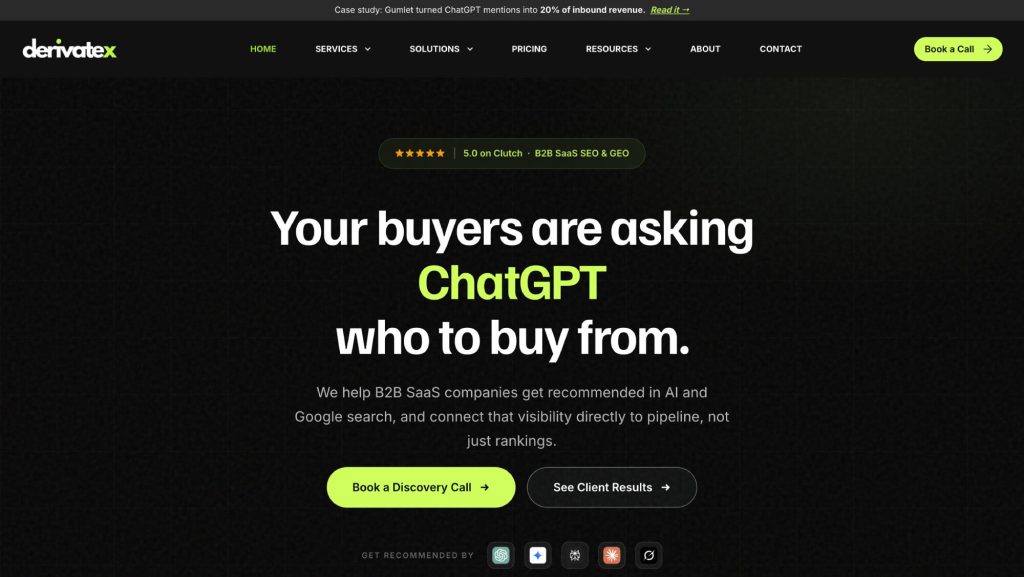
DerivateX defines pipeline attribution as a core deliverable alongside citation volume, which separates it from agencies where AI visibility is the end goal rather than the means to revenue.
What They Do
DerivateX is a B2B SaaS SEO and GEO agency based in Bengaluru, India, that engineers AI citations in ChatGPT, Perplexity, Claude, Gemini, and Google AI Overviews for companies between $5M and $50M ARR.
DerivateX’s proven methodology is Citation Engineering: entity clarity, answer-first content architecture, third-party corroboration, and citation tracking built so citations are reproducible and pipeline impact is measurable, not accidental.
Most B2B SaaS companies showing up in ChatGPT do so accidentally and haphazardly. DerivateX deliberately builds the four-layer conditions for structured citations. That distinction is the entire differentiator.
Proof Points:
- REsimpli, a CRM for real estate investors, went from absent in AI search to the number one CRM recommendation in ChatGPT within 90 days.
- For Gumlet, a video hosting platform, 20% of monthly inbound revenue is now attributed to ChatGPT and Perplexity.
- For Verito, organic clicks grew 159% and impressions grew 196% while the brand reached the number one ChatGPT recommendation for high-intent buyer prompts.
- Kroto, a screen recording tool, grew from 3,500 to 326,000 impressions under the same engagement model.
All four are B2B SaaS companies that were at a comparable growth stage at the time of engagement.
Best For:
The right fit is B2B SaaS companies at Series A or beyond that have an existing content foundation, at least 40 published pages, and generate measurable organic traffic. Pre-PMF companies and sites with no established content base are not a fit for the citation-building layer of the engagement. If that describes your situation, PipeRocket Digital or Singularity Digital are the better options from this list for your current stage.
If you are at $5M ARR or above and want to know exactly where you stand in AI search today, the DerivateX AI Visibility audit covers your citation gap across ChatGPT, Perplexity, and Gemini before any retainer commitment.
Pricing:
Pricing starts at $5,000/month for Rank & Get Found, which covers SEO fundamentals plus the AI citation foundation and starts as a 90-day pilot.
Limitation:
Citation Engineering requires an existing content foundation. Fewer than 40 published pages means the first phase builds the foundation rather than engineering citations on it. DerivateX will say this in the first call.
2. TripleDart: B2B SaaS GEO with Community Citation Coverage Built Into the Scope
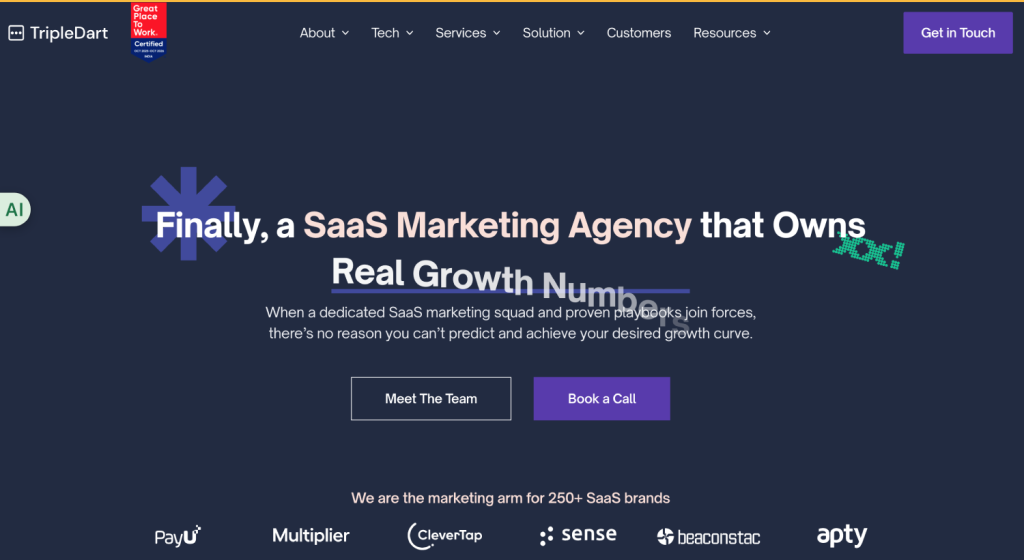
TripleDart treats Reddit and Quora as deliberate citation surfaces from day one, which puts them ahead of most content-first agencies on how LLMs actually retrieve and weight community-sourced recommendations.
Their GEO program covers the full visibility stack: FAQ schema and answer-first content architecture for on-site structure, entity optimization for category clarity, and structured participation on community platforms for off-site signal.
The community layer matters because Reddit consistently accounts for one of the largest shares of citations across major AI engines for category-level queries, frequently ahead of Wikipedia in independent citation audits. Most content agencies treat that statistic as someone else’s problem. TripleDart builds Reddit and Quora coverage into the monthly scope as a deliberate GEO lever, not an afterthought. Notable clients include Chargebee and Leadsquared.
Best for:
B2B SaaS companies between $2M and $15M ARR that want aggressive AI visibility growth without building a large internal content team.
Pricing:
While TripleDart has not published its pricing, publicly available information states pricing starting at $3,000/month.
Limitation:
TripleDart’s strength is content-led GEO. Teams needing deep technical entity work or complex schema implementation for crawlability will likely need a separate partner for that specific layer.
3. PipeRocket Digital: Citation Strategy Over Content Volume for 0-to-1 Stage SaaS
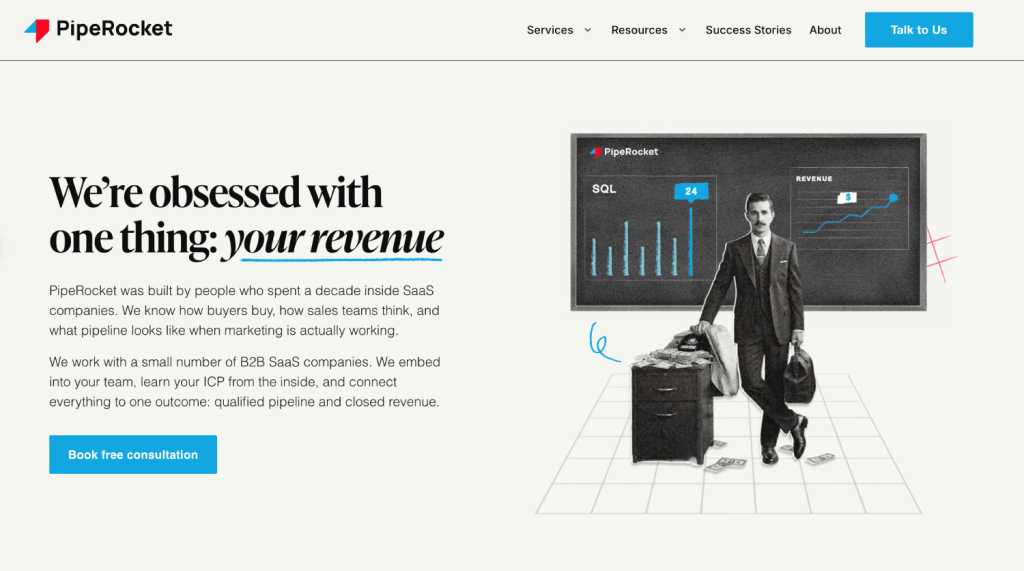
PipeRocket Digital is one of the few GEO agencies that explicitly serves companies at the 0-to-1 stage without deprioritizing them, which addresses a genuine gap in how most agencies structure their client tiers.
PipeRocket built its program around one practical question: how does an LLM learn to recommend your SaaS in category queries before the brand has the content authority that traditional SEO rewards over years?
Their approach treats AEO and GEO as one unified pipeline system and maps content to specific buyer evaluation queries rather than running keyword-driven content calendars. The documented result is that AI engines come to recognize their clients as the definitive answer for a specific category before competitors with larger content libraries. Notable clients include Storylane, DevRev, and Goldcast.
Best for:
SaaS companies at the 0-to-1 stage, including pre-$1M ARR companies that need citation strategy more than content volume.
Pricing:
PipeRocket Digital has not published its pricing. That said, publicly available information states its starting pricing at $3,000/month.
Limitation:
PipeRocket self-publishes agency rankings and places themselves at number one in their own roundup. This is a common practice in the category and does not invalidate their methodology. It does mean you should verify citation case studies directly with a tracked query before trusting the self-published ranking.
4. Quoleady: Editorial GEO at the Most Accessible Price Point on This List
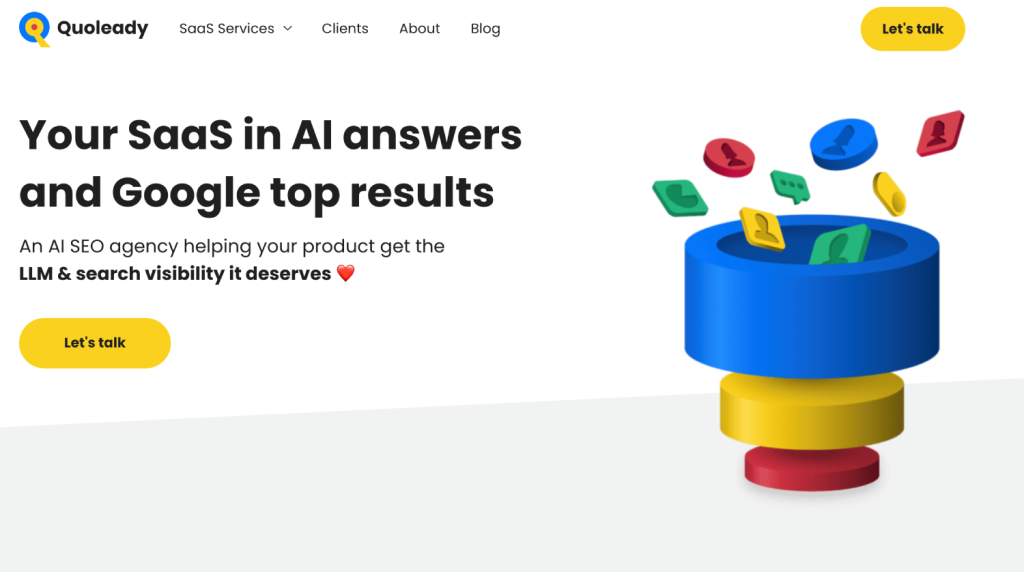
Quoleady is the right answer for early-stage SaaS companies where budget is the hardest constraint, not methodology sophistication.
They produce GEO-optimized content at volume for B2B SaaS brands, with particular depth in European markets. Their public case study for Legal Nodes produced a 47.5% increase in booked meetings alongside top-five AI rankings within three months, one of the more concrete outcome benchmarks publicly available in this price tier.
They are operationally mature around llms.txt implementation and AI citation tracking, which is more than can be said for most agencies at this price.
Best for:
Seed to Series A SaaS companies that need a reliable volume of GEO-structured content. Their Launch plan starts at $3,500/month.
Pricing:
Quoleady’s pricing starts at $3,500/month for its Launch plan, making it one of the accessible options on this list.
Limitation:
Quoleady is primarily content-led. Teams needing technical AEO work (rendering fixes, complex schema, or site architecture changes for AI crawlability) will need a separate partner for that layer.
5. Singularity Digital: Integrated SEO and GEO for US-Based B2B SaaS at $1M–$10M ARR
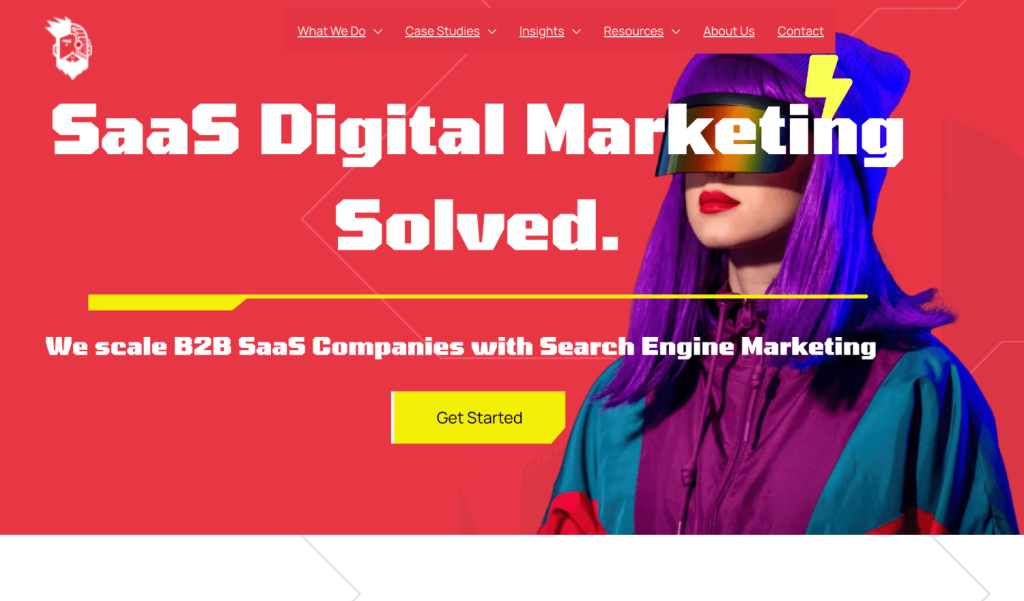
Singularity Digital has one of the narrowest stated ICPs in this category: bootstrapped and lean-funded B2B SaaS companies scaling between $1M and $10M ARR, which makes it one of the most honest stage-fit matches on this list.
Founded in 2016 by Patrick Herbert, with over a decade of SaaS-specific SEO and GEO experience, Singularity builds GEO on a proven SEO foundation rather than running the two as separate programs. Their approach covers entity markup, structured data implementation, and site architecture optimization for AI crawlability, with reporting that ties GEO activity to demos and trials rather than impressions.
The CareerFlow engagement produced 192 AI Overview citations, over 1,000 monthly subscribers arriving from ChatGPT, and 27,000+ new visitors from a funnel-wide content mapping program.
Clients work directly with the founder rather than through an account management layer.
Best for:
Bootstrapped or lean-funded US-based B2B SaaS companies at $1M–$10M ARR that need SEO and GEO built together from day one, particularly those in competitive categories where AI citations are actively displacing Google search as the primary buyer research channel.
Pricing:
Starting price is $2,000/month for a GEO-only retainer, with integrated SEO and GEO programs from $4,100/month.
Limitation:
Singularity’s playbooks are built specifically for the U.S. market. Their strategies are designed around U.S. SERPs and U.S. competitor behavior. Not a fit for SaaS companies whose primary buyers are in Europe or Asia.
Also, Singularity is the earliest-stage option on this list. If you are below the typical Series A range and the other agencies feel a tier above your current scope, start here.
6. Infrasity: Developer-Led GEO for DevTools, AI Agents, and Observability SaaS
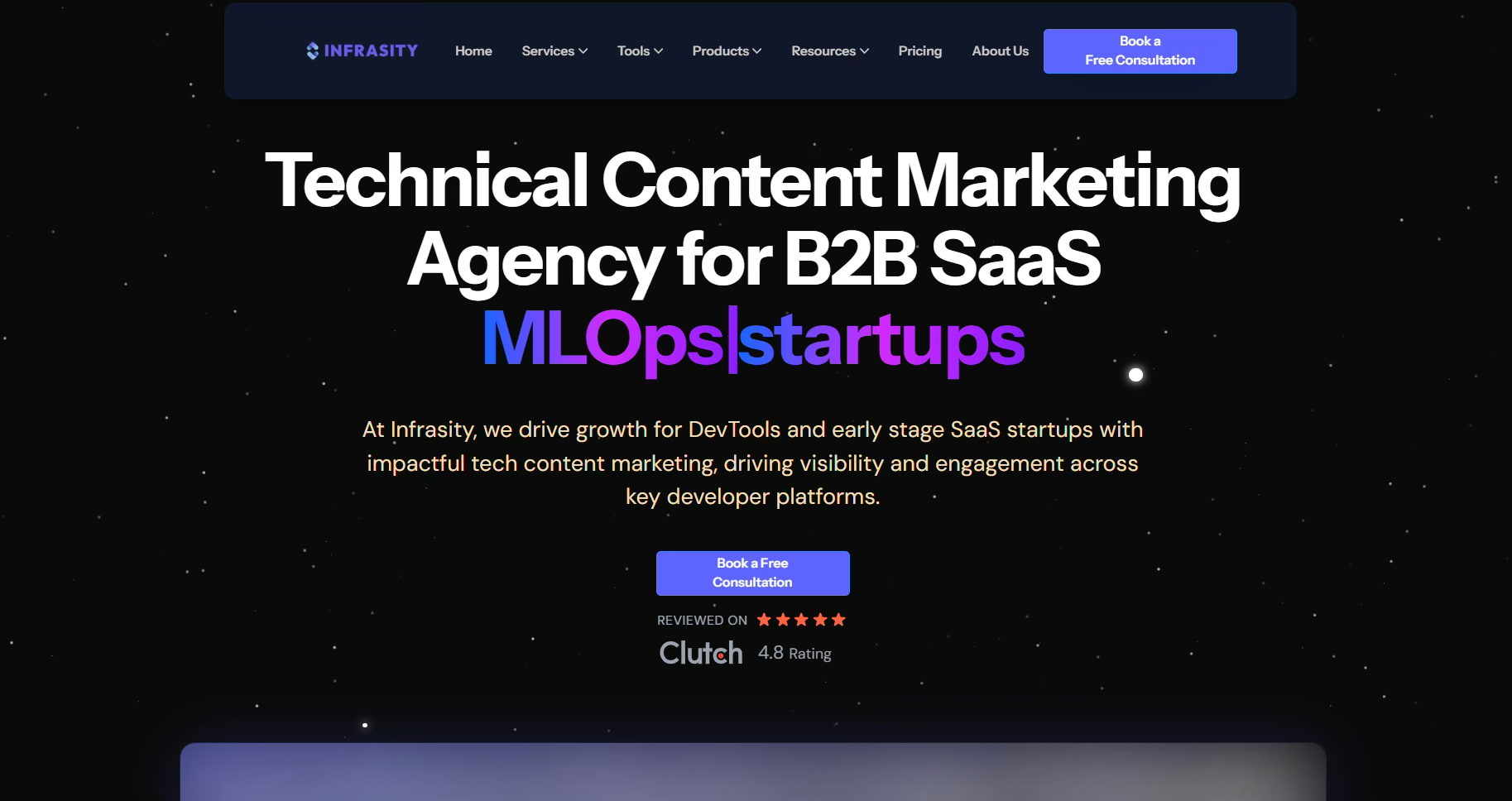
Infrasity is a developer-marketing and technical-content agency specializing in DevTools, AI infrastructure, observability, cybersecurity, and B2B SaaS products with engineering-led buying journeys. Its main differentiator is developer-written technical content combined with GEO work across owned content, AI-cited sources, and developer communities.
Its GEO approach extends beyond optimizing pages for AI retrieval. Infrasity maps the buyer-intent prompts a brand needs to appear for, identifies the pages and community discussions already being cited by ChatGPT, Perplexity, Google AI Overviews, and other answer engines, and works on improving the brand’s presence across those surfaces. Reddit and developer-community visibility are a particularly prominent part of its methodology.
There is credible client evidence behind that approach. For Brevo, Infrasity reports reaching 80% LLM citation coverage across six high-intent buying prompts, with the brand appearing across Google AI Overviews and ChatGPT. For Proton Pass, it reports reaching 90% LLM citation coverage after mapping the Reddit threads and other sources being surfaced for password-manager buying prompts.
Its work also shows the overlap between GEO and traditional organic visibility. Infrasity’s OX Security engagement reports a 5.7× increase in top-three keyword rankings and a doubling of organic traffic, alongside measurable visibility in Google AI Overviews. Its broader client portfolio includes OX Security, Qodo, Proton Pass, Brevo, and Inframail.
The community component is particularly relevant for GEO. Reddit has emerged as an important citation source in AI-generated software recommendations, making Infrasity’s ability to work across both technical content and developer-community surfaces a meaningful differentiator.
Best for: DevTools, AI-agent platforms, infrastructure, observability, cybersecurity, and other technical B2B SaaS companies whose buyers are developers or engineering teams.
Pricing: Infrasity does not currently publish a flat starting price for its GEO engagements. GEO scope and pricing are quoted based on the engagement, so companies should confirm the minimum monthly commitment directly with Infrasity before comparing it with fixed-price providers.
Limitation: Infrasity’s specialization is also its constraint. Its developer-led content and community model is most compelling when technical credibility materially affects the buying decision. Non-technical SaaS companies selling primarily to functions such as HR, finance, or general business teams may get less value from that specialization and may be better served by a broader B2B GEO agency.
7. Omnius: 22-Point GEO Framework for SaaS and Fintech Companies with Established PMF
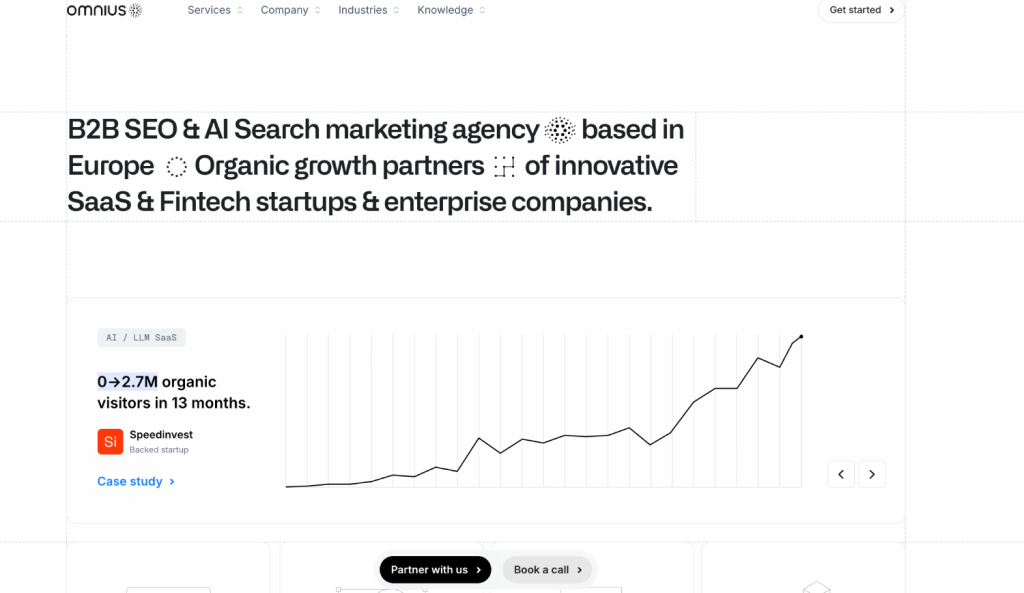
Omnius is the most methodologically structured agency on this list, which is a genuine strength for companies that have the budget and complexity to use a 22-point framework productively.
Their GEO program covers AI crawler accessibility, entity disambiguation, comparison content structure, and citation surface mapping across a documented set of optimization levers. A public case study for Myos, an asset-based lending platform, documented a 228% increase in signups following the GEO engagement.
Omnius is transparent about their eligibility criteria: they require established product-market fit, a marketing function already in place, and a strategic growth budget.
Best for:
B2B SaaS and fintech companies at $5M–$25M ARR with a structured marketing team and a budget that can sustain a framework-driven engagement over 12 months.
Pricing:
Omnius’ pricing is not published. Publicly stated pricing states Omnius’ starting price at $5,000/month, placing them at the upper end of this list.
Limitation:
Not a fit for pre-PMF companies or teams without an existing marketing function. Omnius states their eligibility requirements clearly. If you do not meet them, they will say so in the discovery call.
8. Genevate: Off-Site Authority and Third-Party Citation Building for SaaS Brands
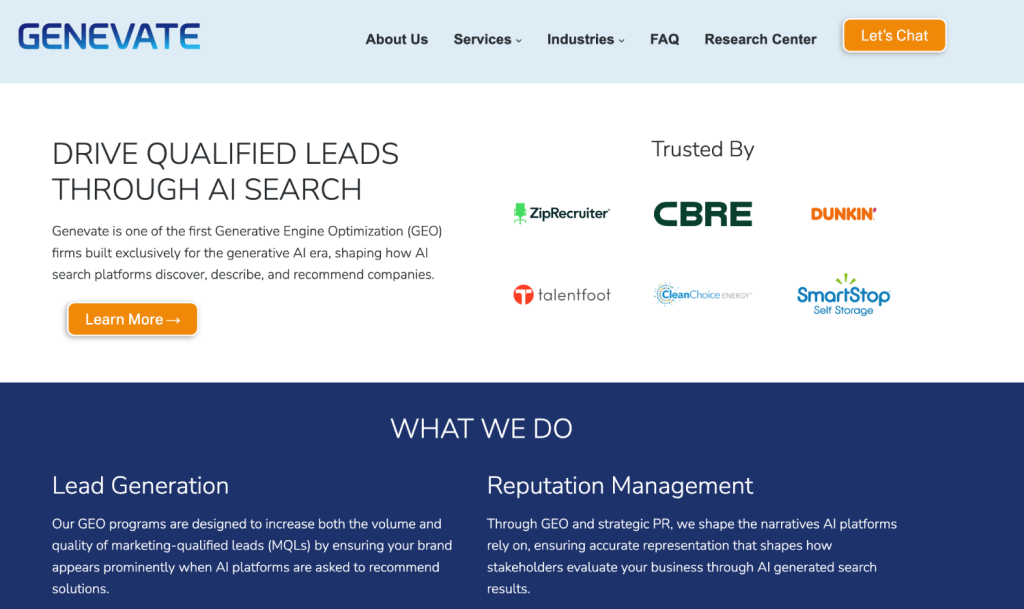
Genevate was built specifically for the generative AI era rather than adapted from a traditional SEO or content practice, which makes its model structurally different from most agencies on this list.
Founded by Brett Kleinberg, a New York PR veteran, Genevate focuses on getting SaaS brands mentioned in the third-party sources that LLMs already trust: category comparison pages, integration directories, analyst writeups, and curated listicles.
The approach is PR-native, not content-native. For companies where the primary AI visibility gap is off-site (the brand has solid on-site structure but is absent from the independent sources LLMs cite in category queries), Genevate’s model addresses the right problem directly.
Best for:
SaaS companies at Series A or B where the primary gap is off-site and the brand needs to appear in third-party sources, not just on its own domain.
Pricing:
Pricing is not published. Third-party sources point at Genevate’s starting price at $2,500 per month.
Limitation:
Genevate is not a content machine. If your primary gap is on-site content depth or technical entity structure, their model is not the right fit for that problem.
How to Choose a GEO Agency: 4 Questions to Ask Before You Sign (Including Every Agency on This List)
Good GEO work is verifiable before you pay for it. These four questions will tell you in a single discovery call whether you are talking to a genuine GEO specialist or a content agency with an updated service page.
1. Can you show me a client at a comparable growth stage getting cited in ChatGPT for a buyer-intent query, not a branded search?
A branded citation (ChatGPT mentioning your company name when you search your company name) is not a GEO outcome. The right answer names a category or comparison query, shows the client cited in it, and explains why that citation held across recent model updates. If the agency redirects to an AI Overview impression count, keep asking.
2. What percentage of your monthly delivery happens off the client’s domain?
If the answer is “we primarily publish on your blog,” the agency is running an SEO content calendar in 2026 and calling it GEO. Off-site work (third-party mentions, community citation building, independent source acquisition) should be a concrete share of the monthly scope. Ask for a specific percentage, not a general assurance.
3. How do you track citation frequency, and how often do you report it?
There is no Google Search Console for AI citations. Agencies doing this properly have built or adopted a specific process for querying ChatGPT, Perplexity, and Gemini against a tracked set of buyer prompts and reporting changes on a monthly cadence. If the answer is vague about the tracking process, the metric is not being measured.
⚠️ Decision rule: Ask any GEO agency to share a citation tracking report for an existing client before signing. If they cannot produce one, they are measuring activity, not citations. That is a clear signal to keep looking.
4. What does a $3,000–$5,000/month engagement scope specifically, and what does it not include?
Scope clarity upfront is a signal of agency maturity. A good answer names the tracked query count, the content volume, and which off-site activities are included at that price. “It depends on your goals” with no minimum scope defined is not a sufficient answer. An agency that cannot scope the entry-level engagement clearly in a discovery call is not ready to run one.
How DerivateX Approaches GEO for SaaS Companies at $5M–$50M ARR
DerivateX is the agency behind this article. The reason it appears first on the list is the same reason this section exists at the end: our core ICP is the $5M–$50M ARR B2B SaaS company, and that context is worth being transparent about before you decide whether to reach out.
If you are below $5M ARR, that does not mean this article was not written for you; the other six agencies on this list genuinely serve earlier-stage companies, and the audit below is open to any SaaS company that wants an honest read on their current AI visibility before committing to any agency.
Every engagement starts with an AI Visibility audit. Before any retainer begins, we map where your brand currently appears across ChatGPT, Perplexity, Claude, and Gemini for the buyer queries that matter to your pipeline, and identify precisely where it does not. The output is a citation gap map and a prioritized action list covering the entity, content, and off-site signals your brand needs to close the gap.
The retainer that follows applies Citation Engineering, with plans from $5,000/month. The methodology covers four layers: entity clarity, answer-first content architecture, third-party corroboration, and monthly citation tracking against a fixed set of buyer prompts. Most clients see measurable citation lift within 90 days, consistent with the REsimpli and Gumlet benchmarks cited earlier in this article.
The audit is available before any retainer commitment. It is useful whether or not you proceed with DerivateX, as it will tell you exactly what any agency on this list would need to address to move your AI visibility in a meaningful way.
Book the DerivateX AI Visibility audit to know where your brand stands across LLM mentions.
Frequently Asked Questions
1. What is the best GEO agency for a Series A SaaS company with a $4,000/month budget?
At $4,000/month, the realistic shortlist from this article is DerivateX, TripleDart, and PipeRocket Digital. That budget covers on-site content optimization, entity work, and citation tracking across ChatGPT, Perplexity, and Gemini. What it typically does not cover is large-scale digital PR or high-volume off-site citation campaigns, which require a higher monthly investment.
Ask any agency you are evaluating to name the specific buyer queries they will track monthly and what citation improvement they have documented at a comparable growth stage. If they cannot answer both questions specifically, move on to the next agency.
2. How do I know if a GEO agency is actually doing GEO or just repackaging SEO?
Three signals separate genuine GEO work from relabeled content marketing. First, the agency can show you a live LLM citation for a tracked buyer query, not a traffic chart from AI referral sources. Second, a measurable share of their monthly scope happens off the client’s domain. Third, they have a named methodology or tracking process specific to AI citation, not a content calendar with “GEO-optimized” in the description.
Throughout 2026, a significant number of agencies that added AI search optimization to their service pages have not changed their core content calendar approach. The citation tracking question alone will filter most of them out in under ten minutes.
3. How long does GEO take to show results for an early-stage SaaS startup?
Real citation lift takes 90 to 180 days from a standing start. The DerivateX REsimpli engagement reached citations across 10+ high-intent ChatGPT queries in 90 days, which is at the faster end of the realistic range and required an existing content foundation to work from. LLM retrieval cycles update on their own schedules, and a citation that lands and holds requires an underlying entity and content signal layer to already be in place.
Any agency promising citations in weeks three or four is selling a timeline they cannot deliver. Plan for 90 days to the first measurable signal and six months to a stable citation surface across a full tracked query set.
4. What should a $5M ARR SaaS company spend on GEO every month?
A credible GEO engagement at $5M ARR starts at $3,000/month and is worth sustaining up to $6,000/month before the scope typically exceeds what a company at that stage can absorb and act on. The economics justify it: based on DerivateX’s tracked client engagements, AI-sourced sessions from ChatGPT convert to signups at 3.9% versus significantly lower rates for Google organic traffic that makes the GEO investment case straightforward once the citation surface is built.
The risk at $5M ARR is not over-investing in GEO. The risk is paying an agency that cannot demonstrate in a discovery call what $3,000/month specifically produces for a company at your stage.
5. Can a GEO agency hurt my Google SEO rankings?
No. The activities that build AI citation rates (answer-first content structure, entity clarity, FAQ schema, and authoritative sourcing) align directly with what Google rewards in traditional organic search. Verito’s results are a useful reference point: the GEO engagement produced 159% growth in organic clicks and 196% growth in impressions alongside the ChatGPT visibility gains, with both compounding in the same period.
6. What is Citation Engineering and why does it matter for B2B SaaS GEO?
Citation Engineering is DerivateX’s methodology for making AI citations reproducible rather than accidental. It operates across five levers: entity clarity (LLMs understand what the brand is and what category it owns), authoritative coverage (the brand has published extensively on every topic its buyers ask about), third-party corroboration (the brand appears in independent sources, not just its own domain), result documentation (case studies and proof points with specific numbers LLMs can extract and cite), and structured parsability (answer-first content, FAQ schema, and modular sections AI can retrieve without surrounding context).
The distinction from standard content-led GEO is that well-structured on-site content can still fail to generate consistent citations if the entity layer or third-party corroboration layer is weak or missing.
7. What is the alternative to First Page Sage, Siege Media, or Single Grain for a Series A SaaS company?
First Page Sage, Siege Media, Omniscient Digital, and Single Grain start between $6,000 and $12,000 per month and are built for companies approaching $50M ARR and beyond. For a Series A or early Series B SaaS company, the closest equivalent on this list is DerivateX, with plans from $5,000 per month that start as a 90-day pilot.
The methodology is similar in principle. The pricing difference is that the enterprise-tier agencies bundle ongoing brand work, digital PR retainers, and account management scope that a Series A company will not consume. The price reflects the bundled scope, not the GEO work itself.
8. Are there GEO agencies in India that serve global B2B SaaS clients?
A small number. DerivateX is Bengaluru-based and serves U.S., European, and Indian B2B SaaS clients between $5M and $50M ARR. The Indian GEO market is still early. Most agencies in the region positioning around AI search optimization have added the language to existing SEO service pages without changing the underlying methodology.
Verify documented citation outcomes for U.S. or European clients before signing with any India-based agency, on the same standard you would apply to any agency on this list.
What This List Actually Helps You Decide
The GEO agency decision for a Series A or Series B company approaching $50M ARR comes down to one variable that standard lists never address: which of these agencies has built citations for a company at your specific growth stage and can demonstrate that before you pay them anything. Companies past Series B can compare enterprise options in the full ranking of top GEO agencies for B2B SaaS companies.
The seven agencies on this list pass that test. Most of what you will find elsewhere does not, because those lists were built around Clutch scores and enterprise reference clients rather than stage fit and verifiable citation proof.
Pick the agency whose methodology addresses your specific gap: content depth, off-site authority, technical entity work, or pipeline attribution from AI traffic that is already arriving. Hold them to a tracked query set from month one.
The SaaS companies showing up in ChatGPT, Perplexity, and Gemini for high-intent buyer queries today built that citation surface over the past 90 to 180 days with deliberate GEO work. The ones starting now will own those surfaces twelve months from here, and the ones that wait will find those positions increasingly difficult to displace.
Reviewed byApoorv SharmaCo-founder, DerivateX
Apoorv Sharma is the co-founder of DerivateX, a B2B SaaS SEO and Generative Engine Optimization agency that engineers AI citations in ChatGPT, Perplexity, Claude, and Gemini and connects them to demo bookings and revenue pipeline. He is the author of the 2026 AI Visibility Benchmark Report and the Citation Engineering methodology. He's also the brain behind "Found On AI" and has sold 2 of his companies previously
Cited by AI