Case study: Gumlet turned ChatGPT mentions into 20% of inbound revenue. Read it →

GEO Agency Pricing Models: Month-to-Month vs. Annual Retainer (What Actually Changes)

Why a Month-to-Month and an Annual GEO Engagement Are Two Different Products, Not One Product at Two Prices.

What the Contract Structure Actually Determines, and Why Most Buyers Get It Wrong
The short answer: Month-to-month GEO retainers typically run $3,000–$10,000/month and limit scope to on-site quick wins: schema updates, FAQ optimization, and basic content restructuring. Annual retainers cost 10–20% less per month and open the door to deeper work that actually builds citation authority: sustained Citation Engineering, off-site PR for AI mentions, entity mapping across LLMs, and competitive citation gap analysis. For B2B SaaS companies in competitive categories, the choice isn’t about risk management. It’s about whether your program can compound.
Most B2B SaaS founders default to month-to-month GEO retainers for the same reason they default to month-to-month gym memberships: it feels lower-risk.
But the risk framing is wrong. A month-to-month GEO engagement and an annual GEO engagement are not the same product at different price points. The agency builds a structurally different program depending on whether they have a 12-month runway.
That’s the thing that other pricing guides don’t tell you. Every article comparing GEO contract structures focuses on the monthly rate, the discount percentage, and the cancellation window.
None of them explain that off-site citation building, entity authority mapping, and multi-LLM benchmarking across ChatGPT, Perplexity, Claude, and Google AI Overviews require upfront investment that no rational agency will make when the client might cancel in 30 days.
This article breaks down what actually changes between the two models, what you should expect to pay at each stage, what contractual protections to build in regardless of term length, and a clear framework for deciding which structure fits where you are right now.
TL;DR
- Month-to-month GEO retainers typically run $3,000–$10,000/month with maximum flexibility; annual retainers generally price 10–20% lower per month and often waive setup fees.
- The price difference is not the main story: agencies structure fundamentally different programs under a 12-month commitment because the runway justifies foundational work that doesn’t fit a 30-day window.
- Month-to-month makes sense in exactly three situations: new agency validation, proof-of-concept phase, or quarterly-gated budgets.
- Annual retainers are the right structure when your category is competitive in AI search and you need compounding citation authority, not a one-time sprint.
- Regardless of which structure you choose, require a citation baseline audit across ChatGPT, Perplexity, Claude, and Google AI Overviews before the first billing cycle closes.
What GEO Agencies Actually Charge for Month-to-month vs. Annual, Right Now
A GEO agency retainer is a recurring engagement in which a generative engine optimization agency (sometimes sold as AI search optimization or answer engine optimization) executes citation-building, entity optimization, and AI visibility tracking on behalf of a B2B SaaS company.
Retainers are distinct from project-based engagements in that they assume compounding work across months, not one-time deliverables.
The two dominant retainer structures in 2026 are month-to-month (rolling 30-day agreements with no commitment beyond the current period) and annual (12-month commitments that typically unlock deeper scope and lower per-month rates).
The structure you choose determines not just how much you pay, but what the agency is actually able to deliver.
Typical month-to-month GEO retainers for B2B SaaS mid-market companies run $3,000–$10,000/month as of June 2026. Annual retainers on equivalent scope generally come in at a 10–20% monthly discount, with setup fees frequently waived for 12-month commitments.
As a rough split: early-stage B2B SaaS tends to land at the $3,000–$5,000 floor, mid-market in the $5,000–$10,000 band, and category leaders with active competitor pressure above that.
DerivateX runs generative engine optimization for B2B SaaS companies including REsimpli and Gumlet, so we see pricing data across roughly 50 client and prospect audits per quarter.
Take the numbers below through that lens; they’re consistent with what we see publicly from competing agencies, but our visibility is skewed toward the mid-market B2B SaaS segment.
The table below compares what mid-market B2B SaaS buyers are actually paying, not what pricing pages claim:
| Month-to-Month | Annual Retainer | |
|---|---|---|
| Typical range (B2B SaaS mid-market) | $3,000–$10,000/mo | $2,700–$9,000/mo |
| Setup / onboarding fee | $2,000–$5,000 (common) | Often waived |
| Contract flexibility | Cancel with 30 days’ notice | 12-month lock-in |
| Effective 12-month spend (mid-range example) | ~$60,000 + setup fee | ~$54,000 (no setup) |
| Scope depth | On-site optimization | On-site + off-site |
| DerivateX starting price | $5,000/month retainer plus off-site budget (90-day pilot, no lock-in after it) | $5,000/month retainer plus off-site budget (90-day pilot, no lock-in after it) |
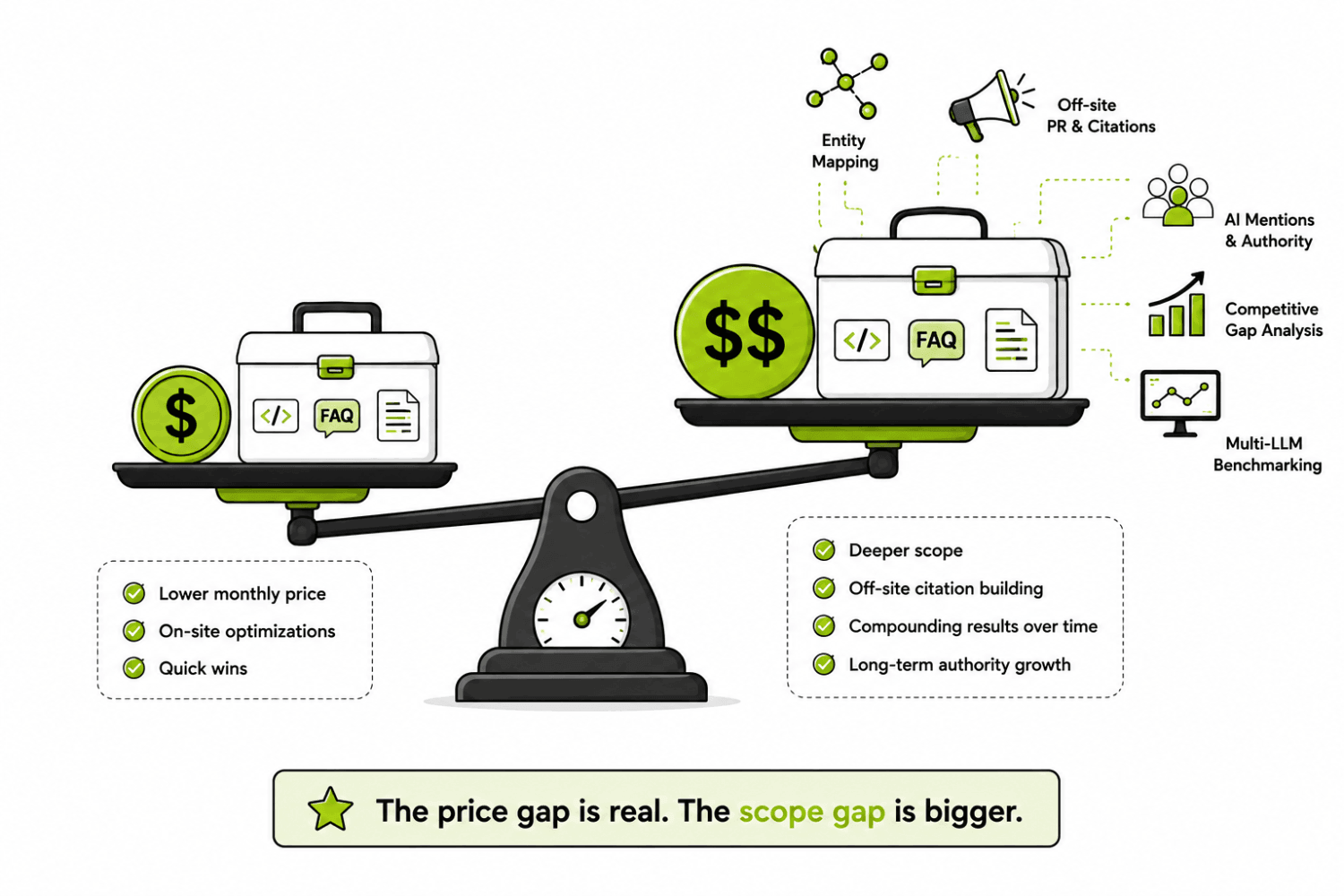
The scope depth row is the one that matters most. The next section breaks down exactly what that difference means in practice. The pricing gap is real, but the scope gap is larger.
The table below maps what each contract structure actually funds, broken down by work type:
| Work Type | Month-to-Month (Industry Norm) | Annual Retainer |
|---|---|---|
| Schema and structured data updates | ✅ | ✅ |
| FAQ and content extractability optimization | ✅ | ✅ |
| AI Visibility Score (AVS) baseline audit | ✅ | ✅ |
| On-site content for LLM extraction | ✅ | ✅ |
| Entity authority mapping (Wikipedia, Wikidata, knowledge graphs) | ❌ | ✅ |
| Off-site citation building (guest posts, editorial placements, roundups) | ❌ | ✅ |
| Competitive citation gap analysis across tracked query sets | ❌ | ✅ |
| Multi-LLM benchmarking (ChatGPT, Perplexity, Claude, Gemini) | ❌ | ✅ |
| Weekly AVS tracking with pipeline reporting | ❌ | ✅ |
The ❌ column describes what most month-to-month GEO agencies deprioritize because the incentive structure doesn’t support it. It doesn’t describe what’s structurally impossible on a rolling engagement. It describes what agencies rationally skip when they don’t have runway certainty.
DerivateX runs the full scope from month one regardless of contract length. The starting engagement is a 90-day pilot that includes entity mapping, off-site citation building, multi-LLM benchmarking, and weekly AVS reporting, the same work that the industry reserves for annual clients.
After the pilot, engagements convert to month-to-month with 30-day exit notice. The reasoning is straightforward: if the program produces citations and pipeline, clients don’t leave. If it doesn’t, they shouldn’t be locked in.
For context on where the market sits: agencies like Omniscient Digital start at $10,000/month, Grow and Convert at $10,000/month, and Skale and TripleDart at approximately $5,000/month and $3,500/month respectively (both with unlisted pricing, based on public data).
DerivateX retainers start at $5,000/month, with the off-site placement budget quoted separately on the pricing page.
A B2B SaaS company that starts month-to-month and converts to annual after 3 months often pays more for the same 12 months of work than a company that started annual from day one, because they paid the setup fee plus the higher monthly rate during the trial period.
The math matters here. If a month-to-month client pays a $3,000 setup fee and $6,000/month for three months, then converts to an annual rate of $5,000/month, their total 12-month outlay is approximately $66,000.
A client who started annual at $5,000/month with no setup fee pays $60,000 for the same period. That’s an $18,000 difference, not trivial for a mid-market SaaS marketing budget.
The Work Changes, Not Just the Price. Here’s What Month-to-month Agencies Do Differently.
Month-to-month GEO clients get a real service, but they’re getting the smaller half of the problem solved.
That’s the structural problem with month-to-month GEO. Agencies focus on what they can execute quickly, because quick results justify the next invoice. What gets deprioritized is the work that compounds but takes time to build:
- Entity authority mapping: Ensuring LLMs have accurate, consistent information about your brand across Wikipedia, Wikidata, and third-party knowledge sources.
- Off-site citation building: Earning mentions in industry publications, roundups, and comparison directories that AI systems cite heavily.
- Multi-LLM benchmarking: Mapping exactly where your brand appears and where competitors outrank you across ChatGPT, Perplexity, Claude, and Google AI Overviews.
- Competitive citation gap analysis: Identifying the specific queries where rivals are cited and you aren’t.
None of this work fits a rolling 30-day window. An agency isn’t going to invest 40 hours in entity mapping for a client who might cancel before month two. This isn’t a motivation failure on the agency’s side. It’s a rational response to the incentive structure the contract creates.
For B2B SaaS companies in competitive categories, a month-to-month GEO engagement rarely produces the off-site citation building and entity mapping that determines long-term AI visibility, because agencies simply will not invest in that foundational work without a 12-month runway to justify it.
Why the Standard Comparison Leaves the Most Important Question Unanswered
Most comparisons of these two contract structures cover the mechanical tradeoffs well: flexibility versus stability, higher monthly rates versus lower locked-in rates, agency motivation under each model.
What they don’t resolve is the follow-up question every buyer actually has: what does the agency literally do differently?
The answer is that they run a different program. On an annual commitment, Citation Engineering, DerivateX’s methodology for systematically building a brand’s citation presence across AI platforms, becomes viable. Without the runway, it doesn’t.
When DerivateX took on REsimpli as a client, the Citation Engineering program required multi-LLM benchmarking across 30+ high-intent prompts, entity validation across knowledge graphs, and sustained content publishing calibrated to what ChatGPT was pulling from in the real estate CRM category.
The result was the top recommendation in ChatGPT for REsimpli’s real estate CRM category within 90 days. That kind of outcome requires a foundation, and foundations take time that a month-to-month engagement simply doesn’t purchase.
3 Situations Where Month-to-month is the Right Call
Month-to-month GEO makes sense in exactly three situations, and in each case, it should be structured with a clear conversion path to annual.
1. You’re Validating a New Agency Relationship
You haven’t worked with this agency before. They haven’t shown you results in your category. You want 60–90 days of proof before committing a sizable chunk of your marketing budget. That’s rational.
2. Your GEO Program is Genuinely at Proof-of-concept Stage
You’re not yet certain that AI search is a meaningful acquisition channel for your specific ICP. A 90-day monthly engagement to establish a citation baseline across ChatGPT, Perplexity, and Google AI Overviews gives you the data to make an informed commitment decision.
3. Your Marketing Budget is Quarterly-gated
Annual commitments sometimes require procurement approval that monthly line items bypass. If the organizational constraint is real and you’d otherwise delay starting, month-to-month is a legitimate workaround while you build internal buy-in for the annual budget line.
What is Not a Good Reason to Choose Month-to-month
One reason that doesn’t make the list: fear that the agency will underperform. If you’re not confident in their methodology, the answer is a better agency, not a shorter contract.
A weak GEO program on a month-to-month is still a weak GEO program, and you’ll have paid setup fees and above-market monthly rates for the privilege of discovering that slowly.
Before signing any month-to-month GEO agreement, get the conversion terms in writing. Ask whether you can convert to annual with months already paid credited toward a discount, and whether the annual rate is price-locked at current pricing.
Agencies that refuse to specify conversion terms are betting on contract inertia, not client results.
3 Situations Where Annual is the Only Structure That Works
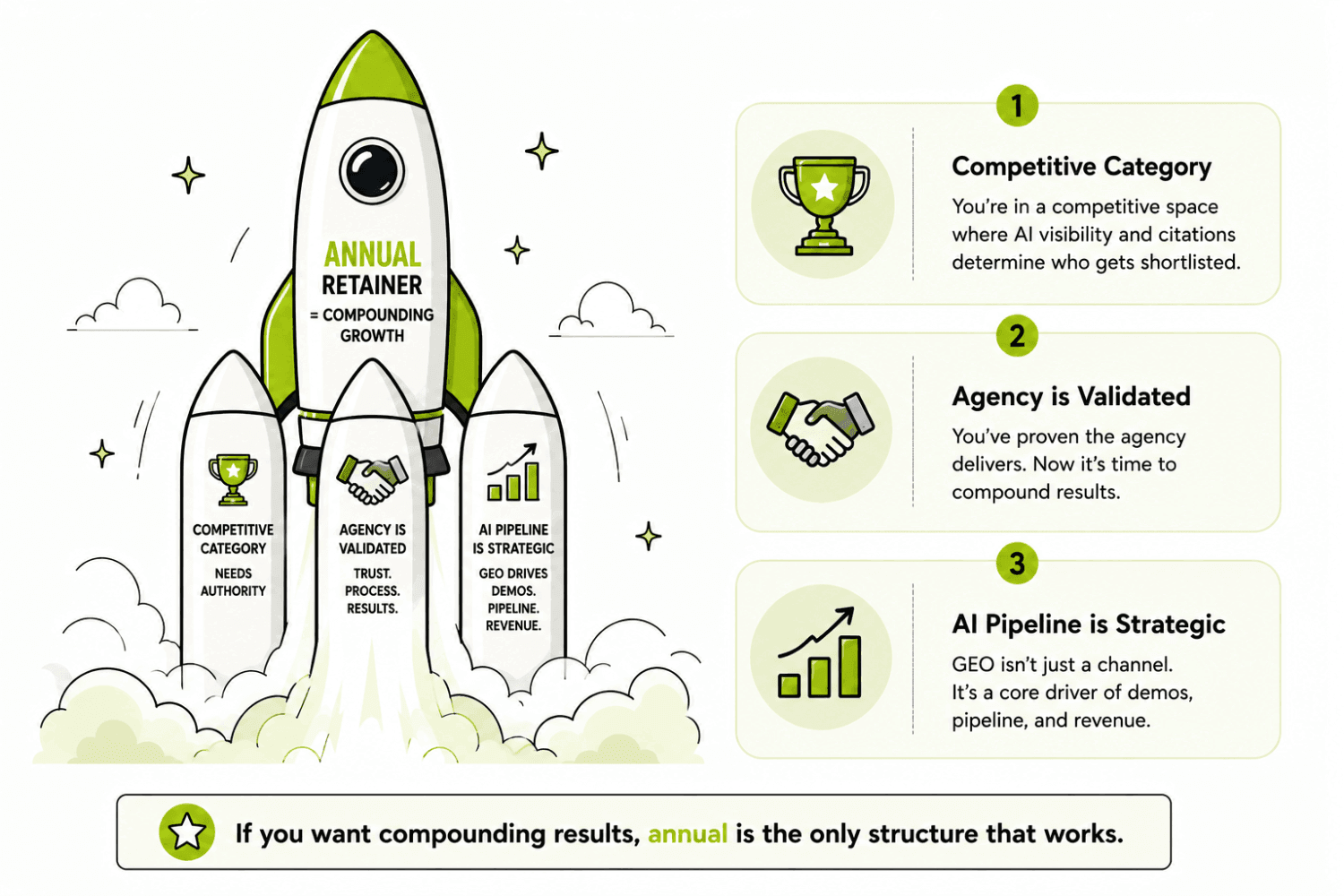
Annual GEO retainers aren’t about reducing risk for the agency. They’re about buying the runway your program needs to produce anything worth measuring.
In each case, the common thread is that the work you need: entity mapping, off-site citation building, sustained benchmarking, cannot be delivered on a rolling 30-day basis, regardless of how motivated the agency is
1. Your Category is Competitive in AI Search
As of June 2026, if you’re a B2B SaaS company competing for categories like “best CRM for [vertical],” “top project management tools,” or “best video hosting platform,” your competitors are already getting cited.
Gartner projected in 2024 that traditional search engine volume would drop 25% by 2026 due to AI assistant adoption, and that decline is compounding.
Catching up in a competitive category requires sustained Citation Engineering, off-site authority building, and entity reinforcement across multiple third-party sources. That program doesn’t exist on rolling 30-day engagements.
2. You’ve Already Validated the Agency and the Channel
If a 60–90 day pilot produced measurable citation gains across tracked queries, staying month-to-month after proof is leaving compound returns on the table.
The work that gets done in months 4 through 12 builds on what was established in months 1 through 3. Breaking that compounding with a month-to-month structure is like pulling money out of a savings account every quarter.
3. AI Search is a Named Strategic Channel in Your 2026 Marketing Plan
Opollo’s 2026 AI Search Benchmark Report states that visitors arriving via AI search convert at 14.2% compared to 2.8% for Google organic (a 5x gap).
If AI-sourced pipeline is a board-level metric, month-to-month is structurally incompatible with the compounding program you need to move that number.
B2B buyers research software purchases in ChatGPT before they hit Google. If you’re invisible in AI answers for your category’s high-intent queries, the pipeline leak is happening now.
What Your Contract Should Say Regardless of Term Length
No matter which structure you choose, the language inside the contract determines whether that structure actually protects you. Here are four clauses to require before signing anything, whether it’s month-to-month or annual:
1. Defined Deliverables, Not Effort Descriptions
The contract must name specific monthly outputs: number of content pieces, platforms tracked, citation reports delivered. “Ongoing optimization” is not a deliverable. If the agency won’t specify deliverables, that’s the first sign the scope is being managed by convenience rather than strategy.
2. A Citation Baseline Before Month One Closes
A GEO agency should document your current citation presence across ChatGPT, Perplexity, Claude, and Google AI Overviews as a formal deliverable at the end of the first month. No baseline means no measurement. No measurement means you’re trusting the agency’s word on whether progress is happening.
3. A Conversion Path if You’re Starting Month-to-month
Get it specified upfront: what does conversion to annual look like, can you apply prior months toward the discounted annual rate, and is the annual pricing locked at current rates?
4. Quarterly Performance Review Gates if You’re Signing Annual
Quarterly business reviews with defined citation metrics tied to the contract give you structured checkpoints. If citation share across your tracked query set isn’t moving by month four, you need a conversation, not a surprise at month nine.
The strongest contractual signal of a serious GEO agency is whether they’ll commit to a query-level citation tracking report in the contract itself. If the contract only mentions “AI visibility improvements” without specifying what queries are being tracked on which platforms, the reporting will be whatever looks best, not what’s actually being measured.
Require the agency to name the specific queries they’ll track, the platforms they’ll monitor, and the reporting cadence, before you sign.
How to Decide: A One-Minute Framework
If you’ve read both sections and still aren’t sure, the decision comes down to three questions:
- Have you worked with this agency before? If not, month-to-month for 60–90 days is rational. If yes, you already have the proof you need.
- Is your category competitive in AI search right now? Run your three highest-intent category queries in ChatGPT and Perplexity. If a competitor appears and you don’t, you can’t afford the scope limitations of month-to-month.
- Is AI-sourced pipeline in your 2026 board metrics? If yes, month-to-month is structurally incompatible with the compounding program required to move that number.
A “Yes” to either question 2 or 3 points to annual. A “No” to question 1, with no competitive pressure yet, points to a structured pilot, with conversion terms in writing before you sign.
DerivateX’s Position on Contract Structure
What distinguishes how DerivateX structures engagements is that the scope doesn’t change based on contract length.
Every engagement runs full Citation Engineering from month one: entity mapping, multi-LLM benchmarking across ChatGPT, Perplexity, Claude, and Gemini, off-site citation building, and AI Visibility Score (AVS) reporting against tracked query sets.
Retainers start at $5,000/month, with full scope from day one. Rank & Get Found and Own Your Category start with a 90-day pilot, with no lock-in, no auto-renewal, and no exit penalty after it. Market Leader carries a 6-month minimum.
The reasoning behind no mandatory annual lock-in is straightforward: if the program is working, clients don’t leave. If it isn’t, they shouldn’t be forced to stay.
Gumlet now attributes over 20% of inbound revenue to AI tools, with 550 new users in a two-month window attributing AI search as their discovery source, after a sustained program that built citation authority across the video hosting and image CDN categories.
That kind of result is what converts pilot clients to annual commitments, not contractual pressure.
The relevant question is not what the retainer costs per month. It’s what the program produces per dollar of AI-sourced pipeline.
If you want to see where your brand currently stands before committing to any contract structure, the free DerivateX AI Visibility Audit maps your citation baseline across the four major LLMs, identifies where competitors are outranking you in AI answers for your highest-intent queries, and gives you the data to make this decision with specific numbers rather than generic pricing guides.
Frequently Asked Questions
1. Is a month-to-month GEO retainer more expensive than an annual one?
Yes, in two ways that add up faster than most buyers realize. The monthly rate is typically 10–20% higher on a rolling agreement than the discounted rate on a 12-month commitment.
More significantly, most agencies charge an onboarding fee of $2,000–$5,000 that annual clients often get waived. If you start month-to-month and convert to annual after three months, you’ve paid the setup fee plus above-market monthly rates for that period.
Run the full 12-month math before treating month-to-month as the lower-cost option; it usually isn’t. Choose annual when you have enough data on the agency to make the commitment.
2. What does a GEO agency actually do differently on an annual contract vs month-to-month?
The scope changes structurally, not just in volume. Month-to-month programs focus on on-site work that delivers quick signals: schema updates, FAQ optimization, and content restructuring for extractability.
Off-site Citation Engineering (earning mentions in third-party publications, building entity authority across knowledge graphs, and running multi-LLM benchmarking) requires 2–4 months of upfront investment that agencies won’t make without a guaranteed runway.
Month-to-month programs are working on the smaller share of the problem. Require off-site citation building in the scope document before signing anything.
3. How long does it take to see results from a GEO agency?
Initial citation signals (your brand appearing in ChatGPT or Perplexity answers for specific category queries) typically emerge within 60–90 days of a well-structured program, assuming your site has a reasonable content foundation to work with.
Sustained citation authority in competitive categories takes 4–6 months of compounding work. DerivateX got REsimpli to the top of ChatGPT recommendations for its real estate CRM category within 90 days.
The timeline depends on your category’s competition level, your existing content baseline, and whether the agency is executing on-site and off-site work simultaneously. Expect early signals within 90 days; expect meaningful citation share at month 4 to 6.
4. Can I start month-to-month and switch to annual if it’s working?
Yes, and for new agency relationships it’s a reasonable pilot approach. The important move is to negotiate the conversion terms before signing the initial agreement, not after.
Ask the agency to specify in writing: whether prior months’ fees credit toward a discounted annual rate, whether the annual pricing is locked at current rates, and what the conversion timeline looks like.
Agencies with strong results and confident programs will agree to this. Agencies that resist specifying conversion terms are betting on your inertia rather than earning your commitment through performance.
5. My SEO agency just added GEO to my existing retainer. Is that real GEO?
Sometimes, but it’s usually rebranded on-site SEO with a different label. The test is specific: ask your agency to show you your current citation baseline across ChatGPT, Perplexity, Claude, and Google AI Overviews.
Then ask what off-site work they’re running to build citation authority in third-party publications and comparison directories. If they can’t answer both questions with concrete deliverables, the GEO add-on is content optimization under a new name.
Serious GEO programs include citation tracking across multiple platforms and active off-site work. If those two elements aren’t in the scope document, you’re not buying GEO.
6. What’s a reasonable setup fee for a GEO retainer?
Setup fees for a legitimate GEO onboarding run $2,000–$5,000 and should produce a specific deliverable: a documented citation baseline across ChatGPT, Perplexity, Claude, and Google AI Overviews, a competitive citation gap analysis for your top 5 query categories, and a technical foundation review covering schema, llms.txt, and content extractability.
If the agency charges a setup fee but cannot describe an output document tied to that fee, press them on what you’re actually getting. Annual clients should negotiate setup fee waivers; it’s a standard part of contract discussions and most agencies will agree.
7. What should I ask a GEO agency before signing any contract, regardless of term length?
Four questions cover most of the risk. First, ask for their citation tracking methodology: which platforms they monitor, which queries they track, and how frequently they report. Second, ask for a sample deliverable from a current client engagement, not a case study, an actual output document. Third, ask what happens to assets (content, backlinks, schema) if you cancel. Fourth, ask them to name the specific queries they’ll track for your company in the first 90 days.
Agencies that can answer all four before signing are running a real program. Agencies that can’t are managing scope by feel.
Closing Thoughts
The contract length question is not a risk management question, but it’s a scope question.
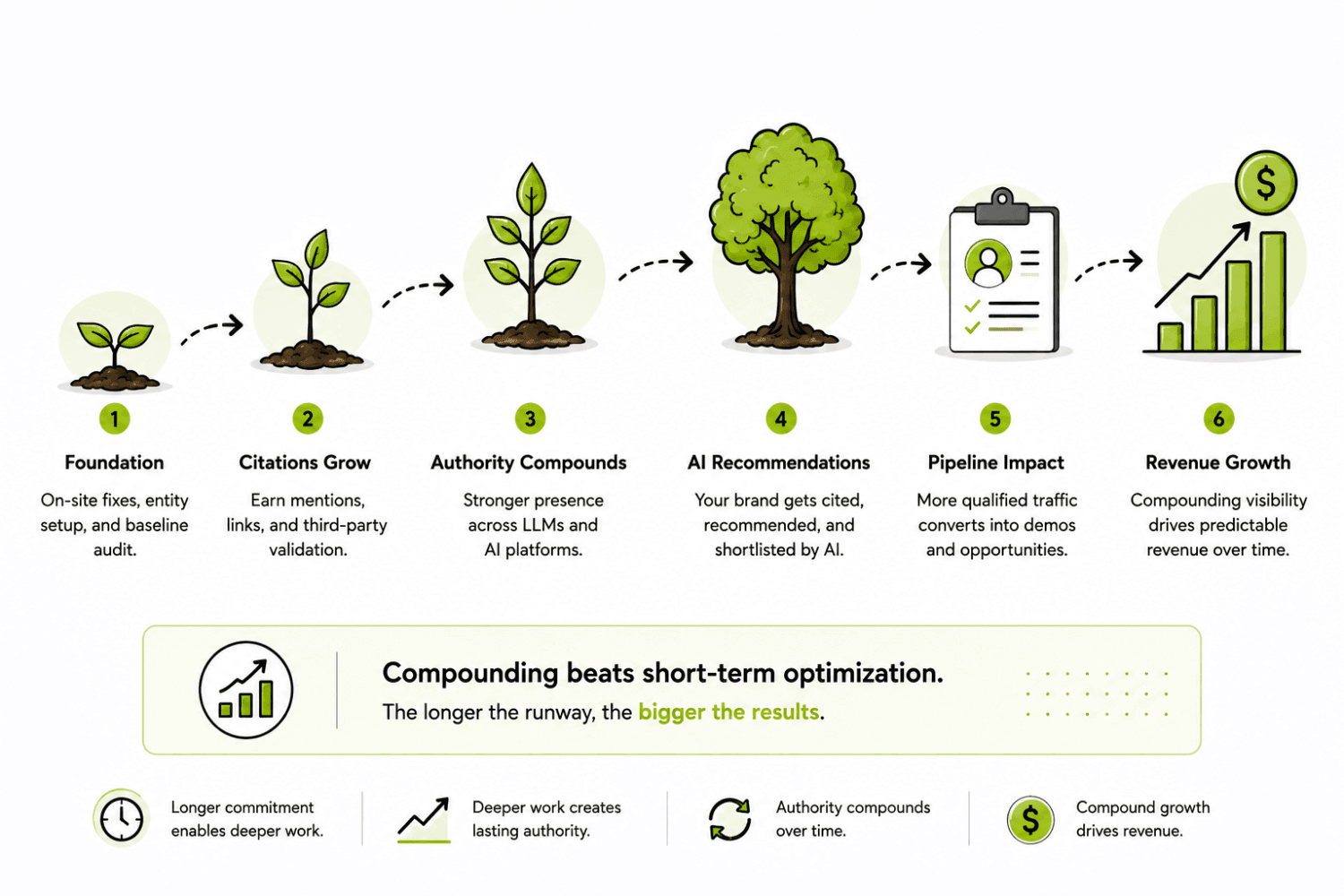
Month-to-month buys you an on-site optimization program. Annual buys you a Citation Engineering program. These are different products, and conflating them is the mistake that leaves most B2B SaaS companies with thin GEO programs they eventually cancel after 6 months of unsatisfying results.
In the pre-LLM era, the goal of B2B SaaS content was ranking at the top on Google for category queries. In 2026, that’s table stakes, and secondary, because the buyers making shortlists are doing their research in ChatGPT first.
The companies winning those AI-generated recommendation lists aren’t winning because they have better products. They’re winning because they have better citation surfaces. Building that surface requires compounding investment, and compounding investment requires a runway.
If you’re evaluating contract structures, start with DerivateX’s free AI visibility audit. Map where you actually stand in AI search right now: not where your Google rankings suggest you should stand, but where ChatGPT, Perplexity, Claude, and Gemini actually place you when buyers search your category. That data makes the contract decision obvious.
Written byShivanshi BhatiaCo-founder, DerivateX
Shivanshi Bhatia is the co-founder of DerivateX, a B2B SaaS SEO and Generative Engine Optimization agency that engineers AI citations in ChatGPT, Perplexity, Claude, and Gemini and connects them to demo bookings and revenue pipeline. She runs operations and delivery, which means every audit, content brief, and published page ships through a system she built. She owns the client relationship from kickoff through reporting, so clients spend their time on decisions instead of chasing updates. She has worked in SaaS since 2019 and reviews client work before it goes live.
Cited by AI