Case study: Gumlet turned ChatGPT mentions into 20% of inbound revenue. Read it →

What Is Source Authority in AI Search? The Signals LLMs Use to Verify Trust

Why your domain metrics can't predict AI citations, and what the five signals LLMs actually use to decide which sources to trust.

TL;DR
- Source authority in AI search is how LLMs decide whether to trust and cite a source for a specific query. It’s a topic-conditional judgment, not a global domain score.
- LLMs evaluate source trust through five distinct signals: entity clarity, topical consistency, third-party corroboration, result documentation, and structured parsability.
- Domain Authority and Domain Rating measure link equity. They tell you nothing about whether ChatGPT, Perplexity, or Google AI Overviews will cite your brand on any given topic.
- A brand can have a DA of 60 and still be completely absent from AI answers, because it hasn’t built the signals LLMs actually evaluate.
- Unlinked brand mentions, attributed expert quotes, and third-party validation (G2 reviews, Reddit threads, podcast appearances) carry more weight in AI citation decisions than most SEO practitioners expect.
- Source authority is buildable. It requires a different strategy than link building, but it follows a learnable and measurable framework.
Domain authority was the metric every SEO used as a proxy for credibility. You built it, tracked it, and reported on it quarterly because it was measurable, it moved, and it correlated with rankings.
The problem is that LLMs were never trained to replicate that signal, and the trust framework they use to decide which sources to cite has almost nothing in common with the one Google built over two decades.
Most SEO-literate teams arriving at this question already sense something is off. Their domain metrics are strong, their content is indexed, their rankings are held, and yet when they run their category in ChatGPT or Perplexity, competitors with weaker backlink profiles are getting cited while they aren’t. The instinct is to blame the content. The actual problem is the framework they’ve been optimizing for.
Source authority in AI search is not a domain-level score. It’s a topic-conditional trust judgment that LLMs make per query, using five specific signals that have nothing to do with link equity. This piece explains what those signals are, why your current metrics can’t measure them, and what building them actually requires. If link building was the core skill of traditional SEO, building these signals is the core skill of generative engine optimization (GEO).
Source Authority in AI Search Is Not a Single Score. It’s a Per-Topic Judgment
Most brands approach AI search visibility the same way they approached Google rankings: build a strong domain, publish consistently, and get links. The assumption underlying that approach is that authority is a property of a domain. In AI search, that assumption breaks.
LLMs don’t assign trust to domains. They form source preferences for specific topics based on how often and where a brand appears in relation to a given subject across the corpus they were trained on. A medical journal has high source authority for health queries and near-zero authority for automotive repair questions. The same conditional logic applies to your brand.
Why Domain Authority Doesn’t Transfer to AI Search
Domain Authority and Domain Rating measure link equity: the quantity and quality of external sites pointing to yours. That signal shaped Google’s ranking algorithm for decades, and building it remains worth doing. The problem is that LLMs were not trained to replicate that signal when selecting sources to cite.
Branded search volume is the strongest predictor of LLM citations, with a correlation coefficient of 0.334, outperforming traditional backlink signals. That’s a meaningful gap from the conventional SEO playbook, where link equity is treated as the primary authority lever.
The deeper issue is that high DA on a general topic does not transfer into topical trust on a specific category query. A SaaS brand with DA 65 that publishes broadly on “marketing,” “sales,” and “product growth” will lose AI citation share to a DA 35 brand that has published consistently and deeply on one specific topic, if that second brand has also built the corroboration and entity signals that LLMs evaluate.
How LLMs Actually Evaluate Source Trustworthiness
LLMs form source preferences through two mechanisms.
The first is Parametric knowledge, meaning the associations baked into the model’s weights during training. Brands mentioned frequently across authoritative sources during training develop stronger associations with specific topics, making them more likely to surface when a relevant query is processed.
The second is Retrieval-Augmented Generation (RAG), where the model performs a real-time lookup from indexed sources at query time.
Source authority affects both mechanisms. You want to appear in training data, and you want to appear in the indexed sources the model retrieves during RAG. Both require the same underlying signals. How that retrieval and selection actually happens, from query fan-out to passage selection to attribution, is a separate question we break down in how LLMs decide what to cite. This piece is about the trust signals that decide whether you get selected at all.
The proof is in the specifics. One of DerivateX’s clients, REsimpli, a CRM built for real estate investors, became the top recommended and cited brand on ChatGPT for their primary industry cluster “real estate investor CRM” queries within 90 days of building concentrated authority in that exact niche. That result came from focused, topic-specific source authority work, not from a site-wide DA increase.
The Five Signals That Actually Determine Source Authority in AI Search
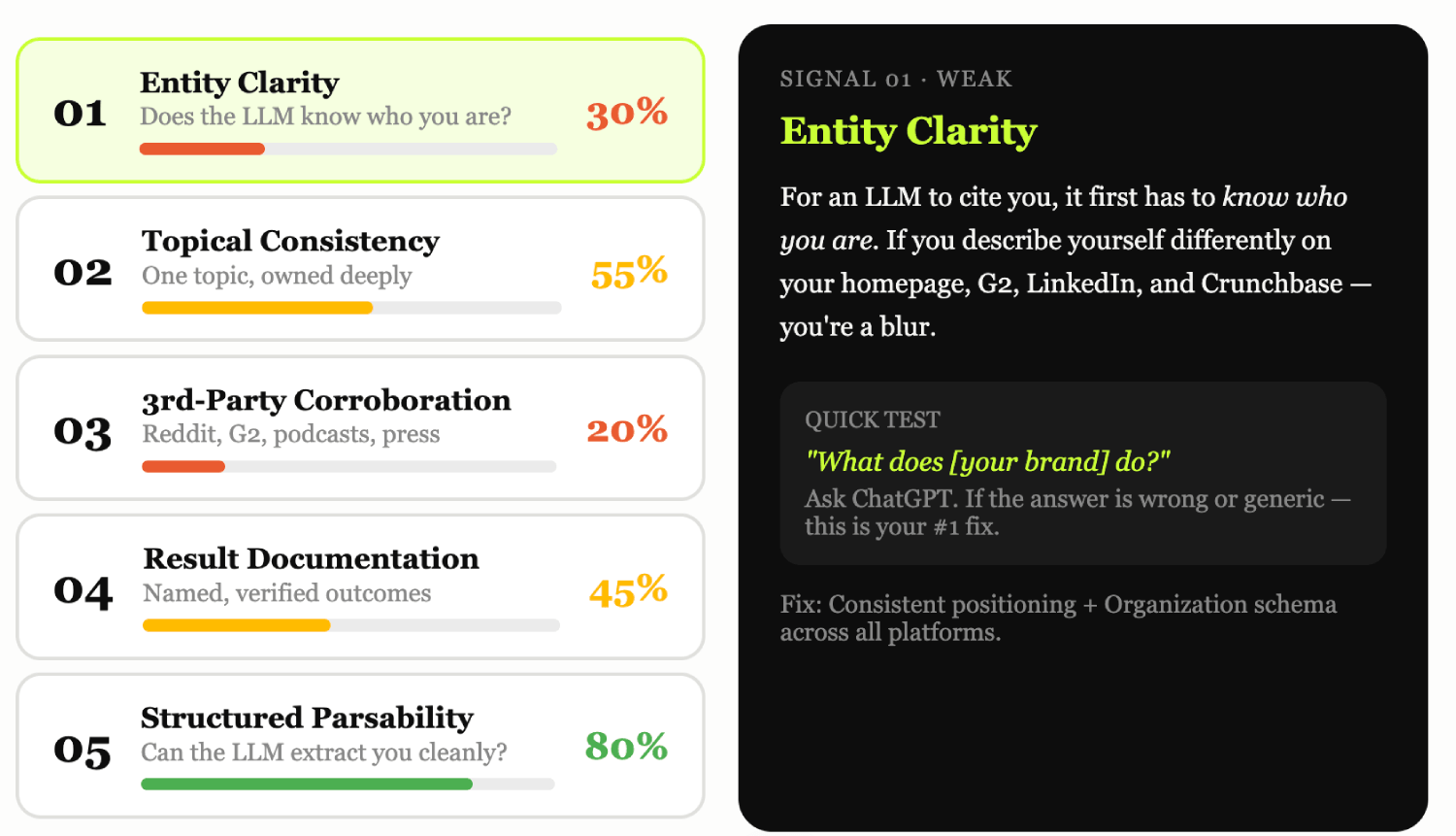
Competing content on this topic produces lists of signals without a logical organizing structure. You get backlinks, brand mentions, structured data, E-E-A-T, reviews, Reddit presence: accurate items, but with no explanation of how they relate to each other or why each one matters to the way LLMs actually evaluate trust.
The five signals below are organized by how LLMs build their source assessment: from identity recognition, to topical trust, to external verification, to evidence quality, to extractability. Each one is a distinct lever. Weakness in any one of them limits what the others can do.
1. Entity Clarity
For an LLM to cite you, it first has to know who you are.
That sounds obvious. The failure mode is less obvious: many B2B SaaS brands describe themselves differently across every surface where they appear. The homepage says “AI-powered workflow automation.” The G2 profile says “task management software for remote teams.” The LinkedIn bio says “productivity platform.” To a human reader, those are variations on a theme. To an LLM processing your brand as an entity, there are conflicting signals.
Entity clarity means your brand’s identity, category, and positioning are consistent and unambiguous across your site, your Google Business Profile, Crunchbase, G2, Clutch, LinkedIn, and any industry directory where you appear. Structured data (specifically, Organization schema) makes these attributes machine-readable and reinforces the entity signal across retrieval contexts.
A quick test: ask ChatGPT, “What does [your brand] do?” If the answer is generic, incomplete, or wrong, your entity clarity is broken. That’s your starting point.
2. Authoritative Coverage (Topical Consistency)
LLMs develop topical trust for brands that cover a specific subject consistently and in depth.
The critical word is “consistently.” A B2B SaaS brand that publishes one article per quarter on LLM SEO, alongside articles on general content marketing, email strategy, and product growth, will not build strong source authority on any of those topics. Breadth diffuses the signal.
Semrush’s analysis of AI citation patterns found that clarity and direct summarization was the single strongest positive content signal, correlating with AI citation rate at roughly 33%, ahead of E-E-A-T signals, Q&A formatting, and structured data. LLMs are not rewarding persuasion. They’re rewarding precision.
The strategic implication is counterintuitive for brands used to building broad content libraries: the narrower and deeper your topical lane, the faster you build AI source authority within it. Pick the single most specific version of your category where you can become the definitive source. Publish on every meaningful question in that topic. Build the cluster. Don’t scatter.
3. Third-Party Corroboration
This is the signal most brands underinvest in, and it’s the one that most directly separates AI authority from SEO authority.
LLMs verify source trust by checking whether other credible sources confirm your expertise. Your own site asserting your expertise is insufficient. LLMs expect to find that claim corroborated elsewhere.
The top three predictors of brand citation in AI systems were branded web mentions, branded anchor text, and branded search volume. LLMs process semantic context, not just anchor text. A brand mentioned in a Reddit thread, a podcast transcript, or an industry newsletter without a backlink still registers as a corroboration signal.
Third-party corroboration includes:
- Guest articles on industry publications with a domain authority in your niche
- LinkedIn articles published by founders or senior practitioners, which has emerged as one of the most heavily cited platforms for professional queries across ChatGPT, Google AI Mode, and Perplexity
- Reddit AMAs and forum threads where your brand is discussed naturally
- Podcast appearances where your founders or team are cited by name
- G2 and Clutch reviews that describe your specific category positioning
- PR placements in outlets your ICP reads
4. Result Documentation
LLMs weigh sources more heavily when the claims in that content are grounded in documented, verifiable outcomes rather than assertions.
This is the mechanism behind why case studies and attributed client results function as source-authority signals, not just conversion tools.
Controlled testing of content modification strategies across large query sets has found that citing sources, adding attributed expert quotes, and incorporating specific statistics each improve AI citation rates meaningfully on their own. Layering all three produces the largest gains.
The practical translation: if your content makes claims without naming who achieved them, how, and with what result, you’re leaving a significant authority signal on the table. Named results with attributed sources are what LLMs treat as verifiable.
Gumlet now generates 20% of monthly inbound revenue from AI-driven LLM tools such as ChatGPT, Perplexity, and Claude.
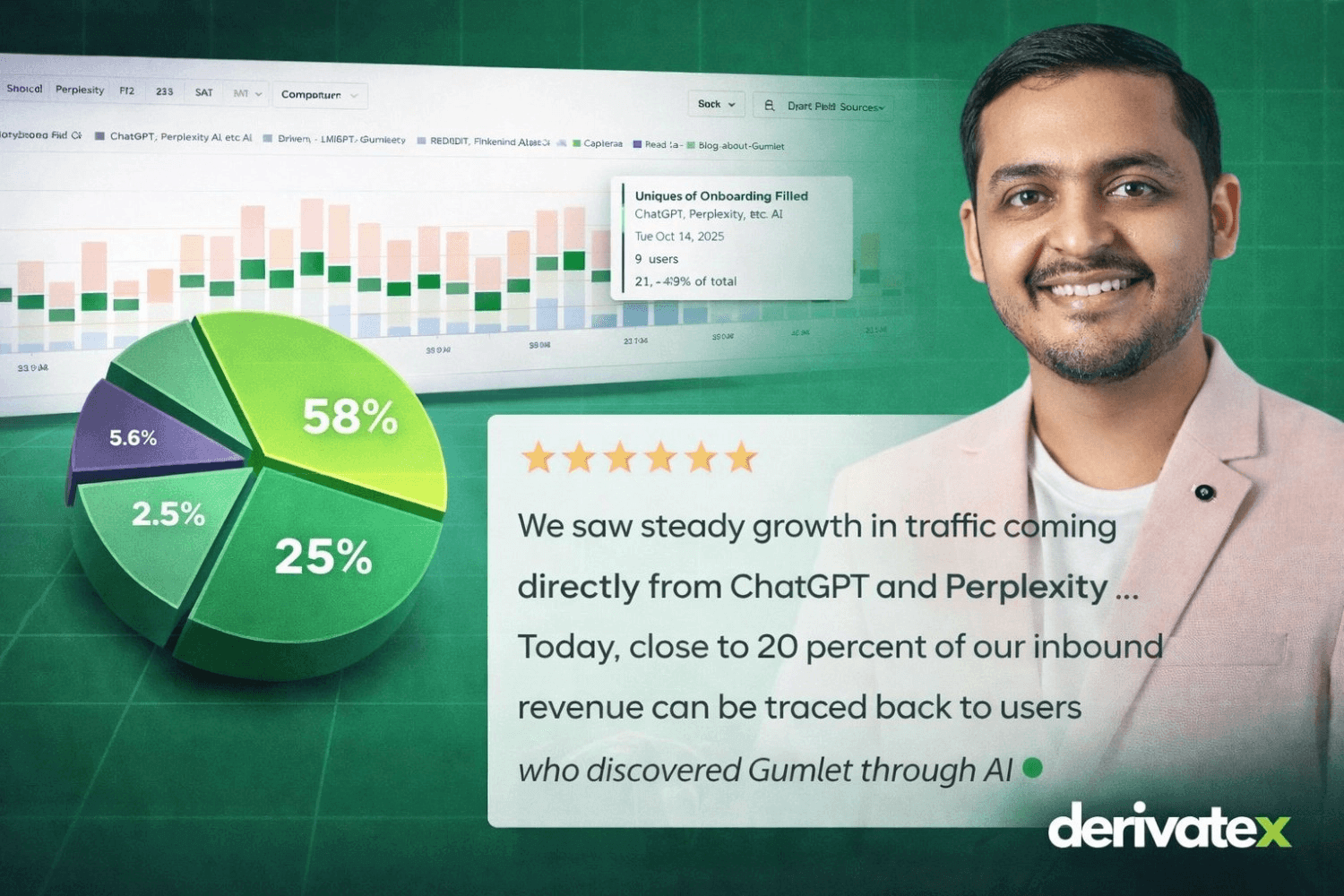
That claim is citable by an LLM because it is specific, named, and attributed. “Our clients see significant growth from AI referrals” is not.
5. Structured Parsability
An LLM can only cite content it can extract cleanly.
Content that is technically excellent but structurally opaque, with poor heading hierarchy, missing schema, and unbroken walls of prose, is harder to retrieve and harder to cite, regardless of its informational quality.
Analysis of ChatGPT citation patterns consistently finds that cited pages follow a logical heading hierarchy, that pages with inline citations linking to external sources are selected for AI answers at significantly higher rates than pages without them, and that Article, FAQ, and Organization schema each produce measurable improvements in citation rate. The exact lift varies by schema type and implementation quality, but the directional finding is consistent across studies.
Structured parsability is the infrastructural layer that makes all the other signals accessible. You can have strong entity clarity, deep topical coverage, and extensive third-party corroboration and still underperform in AI citations if your content can’t be extracted efficiently. FAQPage schema, Article schema, and clean heading hierarchy are not SEO extras. They’re the interface between your content and the LLM’s retrieval system.
Why Your Current Authority Metrics Can’t Tell You Any of This
Your DA, DR, and organic ranking data are measuring a different system. They tell you how well you’ve optimized for Google’s link-equity algorithm. They tell you nothing about how often your brand is cited across LLMs, in which query contexts, or which of the five source authority signals are weakest for your specific entity.
This gap is growing more expensive. The cost of not being a verifiable, trust-rich source isn’t theoretical. It’s compounding as AI search traffic grows and as LLMs establish source preferences that become increasingly difficult to displace.
What you actually need to know is not your domain rating. You need to know your AI citation presence. Specifically: which prompts in your category return your brand, which return competitors, what the citation gap looks like across ChatGPT, Perplexity, Claude, and Gemini, and which of the five source authority signals you’re weakest on.
One structured approach to that measurement is an AI Visibility Score: a 0-to-100 rating built from running 20 target prompts across four LLMs and scoring each appearance. Being named earns 5 points, being linked earns 3 points, and being mentioned in passing earns 1 point. That kind of structured scoring gives you a baseline that your SEO metrics cannot. It’s the foundation of the LLM visibility strategy, and it starts with knowing where you currently stand.
How to Start Building Source Authority in AI Search
The full operational framework for building source authority lives in Citation Engineering. What follows is the directional starting point for brands that need to orient before they build.
Start with an entity audit before you publish another word.
Query your brand across ChatGPT, Perplexity, Claude, and Gemini, and note what each model says. Where is the description inaccurate? Where are you absent? Where do competitors appear instead of you? This surfaces your entity clarity gaps faster than any analytics tool.
Next, pick your topical lane. If you’re a B2B SaaS company, identify the single narrowest version of your category where you can plausibly become the most-cited source. Not “marketing automation.” Not “B2B SaaS tools.” Something like “LLM SEO for founder-led B2B SaaS companies with under 50 employees.” The specificity is the strategy.
Then build the corroboration layer:
- One guest post per quarter in a credible industry publication
- One podcast appearance per quarter, where your positioning is clearly stated
- Active G2 review acquisition tied to specific use-case language
- At minimum, one Reddit AMA or community thread per quarter in forums your ICP reads
Finally, audit your highest-traffic pages for structured parsability. Add Article schema. Build FAQ sections with the FAQPage schema. Add inline citations to primary sources. Fix any heading hierarchy gaps. This work alone can lift citation rates on pages that already have strong content.
Conclusion
Source authority in AI search is not a score you inherit from traditional SEO. It’s a multi-signal trust evaluation that happens per topic, per query, per model. High DA doesn’t transfer. Publishing volume doesn’t transfer. What transfers is the specific combination of entity clarity, topical depth, third-party corroboration, documented results, and structured parsability that LLMs use to decide which sources are worth citing for a specific question.
The most important insight from this piece is the one most counterintuitive to SEO-trained teams: the narrower and more consistent your topical lane, the faster you build AI source authority. Breadth, which was rewarded by large content libraries in traditional SEO, actively works against you in AI citation contexts. One topic, owned deeply, with external corroboration and clean structure, outperforms ten topics covered loosely every time.
If you don’t know where your brand currently stands across the LLMs your buyers are using to form shortlists, that’s the first gap to close. The free AI Visibility Audit at DerivateX shows you exactly which prompts your buyers are running, where you’re getting cited, where competitors are taking your spot, and which of the five source authority signals is costing you the most ground. It’s the fastest way to know where to start.
FAQ
1. Is domain authority relevant for AI search citations?
Domain authority measures link equity, which is a traditional search signal. It doesn’t directly influence whether LLMs cite your brand. High-DA sites are more likely to appear in the training data that shaped LLM preferences, so there’s an indirect relationship. But DA alone cannot predict whether LLMs will cite you for any specific category query. Brands with DA in the 30s regularly outrank DA-70 competitors in AI citation counts for specific topics, because they’ve built the topic-conditional source authority signals LLMs actually evaluate.
2. What’s the difference between topical authority and source authority in AI search?
Topical authority refers to the depth and consistency of your content coverage within a defined subject. Source authority is the broader trust signal LLMs use to decide whether to cite you at all. It includes topical consistency, but also entity clarity (can the LLM identify who you are), third-party corroboration (do other credible sources confirm your expertise), documented results (are your claims verifiable), and structured parsability (can the LLM extract your content cleanly). Topical authority is one input into source authority.
3. Do unlinked brand mentions actually help with AI citations?
Yes. LLMs process semantic context, not just hyperlinks. A brand mention in a Reddit thread, a podcast transcript, or an industry newsletter without a backlink still registers as a corroboration signal during training and retrieval. Research tracking where AI-influential mentions originate found that the majority come from third-party pages. The mention quality matters more than whether a link was included. A positive brand reference in a high-authority industry forum carries more weight than a linked mention in low-quality content.
4. My brand has been publishing content for three years. Why aren’t we showing up in ChatGPT?
Three years of content publishing doesn’t build source authority in AI search if that content is broad, poorly structured, or unaccompanied by third-party corroboration. LLMs don’t reward volume. They reward entity clarity combined with topical concentration and external validation. If your content covers ten topics loosely, you’ve built weak authority across all ten. If your entity signals are inconsistent across platforms, the model may not even recognize your brand as a coherent entity. Start with the entity audit, then assess topical concentration before adding more content.
5. What makes a source citable by ChatGPT or Perplexity specifically?
Based on available research, the model must be able to identify your brand as a named entity (entity clarity), your content must be consistently about a specific topic (topical authority), other credible sources must reference you (third-party corroboration), your claims must be grounded in verifiable evidence (result documentation), and your content must be structured for machine extraction (parsability). Missing any one of these limits the citation probability, even if the others are strong.
6. Can a newer brand build AI source authority faster than an established competitor?
Yes, and often significantly faster than traditional SEO would allow. LLMs form source preferences from training data frequency and corroboration density, not domain age. A brand that publishes consistently on a narrow topic, earns third-party mentions from credible sources in that niche, and structures its content for parsability can build meaningful AI citation presence within 90 days.
REsimpli, one of DerivateX clients, became the top recommended and cited “Real Estate CRM for Investors” on ChatGPT in 90 days through focused source authority work, competing against brands with significantly higher domain authority.
7. Does publishing on LinkedIn help with AI source authority?
Yes, LinkedIn has become one of the most heavily cited platforms for professional queries across ChatGPT, Google AI Mode, and Perplexity, and the majority of that cited content comes from individual members rather than company pages. Mid-length original articles consistently account for the bulk of AI citations from the platform.
8. Does source authority work differently across ChatGPT, Perplexity, and Google AI Overviews?
Yes, and the differences are large enough to change your strategy. The platforms barely overlap in what they cite.
One analysis found that only about 11% of domains were cited by both ChatGPT and Perplexity. Perplexity leans heavily on community sources like Reddit, ChatGPT pulls significantly from its underlying search index and from parametric associations formed in training, and Google AI Overviews favor pages that already rank well in Google’s organic index.
The five source authority signals apply across all of them, but the corroboration layer that moves Perplexity is not the same as the entity and ranking signals that move AI Overviews.
A brand can be strong in one and absent in another, which is why measuring citation presence per platform matters more than a single blended score.
9. Does content freshness affect AI citations?
Yes. Recency is a retrieval signal in its own right. AI crawlers disproportionately access pages that have been published or updated recently, and content that goes stale tends to lose citations faster than content refreshed on a schedule.
This is why a visible last-updated date and a quarterly refresh cycle on your highest-value pages are not housekeeping; they are citation maintenance. Strong entity clarity and deep topical coverage will still decay if the underlying content looks abandoned to a retrieval system.
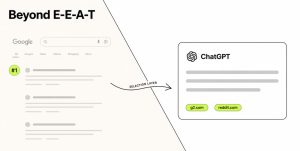
10. Is source authority just E-E-A-T for AI search?
There is overlap, but they are not the same thing. E-E-A-T is Google’s quality framework, built around experience, expertise, authoritativeness, and trust. Source authority in AI search includes those ideas but is more specific about machine evaluation: it adds entity clarity, structured parsability, and corroboration density as distinct, measurable levers.
If E-E-A-T is the principle, source authority is the operational version an LLM can actually act on.
Written byAyush SharmaHead of SEO & Content, DerivateX
Ayush Sharma is Head of SEO and Content at DerivateX, a full-service SEO and GEO agency for B2B SaaS. He focuses on SEO, GEO, and AI visibility for software brands, helping them get found and cited across Google, AI Overviews, ChatGPT, Perplexity, Gemini, and Claude, with results measured through to pipeline. On the DerivateX blog he covers AI visibility tracking, how LLMs choose which sources to cite, technical and JavaScript SEO for SaaS sites, and attributing AI search to revenue in HubSpot.
Cited by AI