Case study: Gumlet turned ChatGPT mentions into 20% of inbound revenue. Read it →

Will This Get Cited? The AI Content Pre-Publish Checklist


A practical tier-based framework for content teams who rank on Google but don’t appear in ChatGPT, Perplexity, Google AI, or Gemini answers.
The short answer: Whether AI cites your content is decided at the structural level before anyone reads it. Three checks control citation eligibility: an answer-first opening within 80 words, entity clarity in the first 200 words, and sourced claims in every major section. The remaining checks on this list are citation multipliers. Run all of them. Run the first three without exception.
An AI content pre-publish checklist is a structured set of checks applied to a piece of content before publication to determine whether it is architecturally eligible for citation by large language models. It differs from an SEO checklist in that it optimizes for passage extraction by AI retrieval systems, not keyword matching by search engine crawlers.
Last quarter, a B2B SaaS company shared their analytics with me. Their primary category post ranked third on Google, pulled steady traffic, and had been live for two years.
They typed the same query into ChatGPT. A competitor ranked 8th on Google was cited, but theirs was not. It’s exactly the pattern we found when we studied where ChatGPT pulls its software recommendations.
The post they were losing to was shorter and covered less ground. The writing was objectively weaker. But its first paragraph answered the question directly, named the category clearly, and cited a specific study in the second section. That was enough.
This is not a quality problem, but it is a structure problem. AI models do not evaluate articles. They extract passages. When a model retrieves content to build an answer, it is looking for specific, self-contained chunks it can lift and attribute without the surrounding context.
A post buried in setup, throat-clearing, or narrative warm-up is effectively invisible to that extraction process, regardless of how good the information is once you get there.
That gap has a direct revenue number attached to it. Gumlet, a video hosting and image CDN platform, now attributes 20% of its direct monthly inbound revenue to ChatGPT, Claude, and Perplexity. That number happened because the right content architecture was in place before the AI referral flywheel started compounding.
This article breaks down every pre-publish check that determines whether your content qualifies for AI citation and how much citation authority it builds over time. The checks are organized by impact tier. Three checks control citation eligibility entirely, the rest multiply it, so if you have 15 minutes, you know exactly where to start.
Key Takeaways
- AI models cite content that is structurally extractable at the claim level, not content that ranks highest on Google. These are two separate optimization problems.
- Three checks control whether a page qualifies for AI citation at all: an answer-first opening within 80 words, named entity clarity in the first 200 words, and a sourced, verifiable claim in every major section.
- Every check beyond the first three improves citation frequency and authority over time, but none of them can compensate for a failed Tier 1 foundation.
- This checklist applies to new drafts and to existing published content you’re editing before republishing.
- AI-sourced visitors convert at far higher rates than Google organic. Ahrefs found that AI search drove 12.1% of its signups from just 0.5% of its traffic, and Semrush puts the cross-industry conversion premium at roughly 4.4 times organic. Getting cited is not a vanity metric. It is a pipeline problem worth solving before your next publication.
Why Your Content Doesn’t Get Cited by LLMs Even When it Ranks
Your Google ranking and your AI citation probability are measuring different things, and optimizing for one does not automatically improve the other.
Google ranks pages by weighing backlinks, domain authority, keyword relevance, and hundreds of additional signals. The output is a position on a ranked list.
AI models do something fundamentally different. They use retrieval-augmented generation (RAG) to pull the most extractable passage from a pool of credible sources and build an answer from it. A page at position 8 with a clean, direct opening will frequently out-cite a page at position 2 where the key claim is buried in paragraph 4.
A 2024 peer-reviewed study on Generative Engine Optimization from Princeton, Georgia Tech, and the Allen Institute for AI tested nine GEO optimization tactics across 10,000 queries and found that adding verifiable statistics and sourced citations improved AI citation visibility by up to 40%. We broke down what that study means for content teams in plain English.
Content optimized purely for length or fluency alone showed negligible improvement. The implication is direct: completeness is defined by the presence of attributable claims, not by word count.
The distinction matters: completeness is about answering the specific question directly, not about word count or topic breadth. A 600-word post that opens with a clear, sourced answer to the exact question will out-cite a 3,000-word post that buries the answer in the third section.
In the pre-LLM era, writing the most thorough piece on a topic was a viable path to citation.
In 2026, the model retrieving your content cares whether paragraph one answers the question, not whether section nine covers an edge case. If your current content was written to satisfy a Google crawl, it was built for a different extraction mechanism than the one now determining whether buyers find you.
A page that ranks in the top three on Google is not guaranteed to appear in ChatGPT’s answer to the same query.
In our citation analysis across 50 B2B SaaS sites, published in our State of AI Visibility in B2B SaaS Benchmark Report, structural extractability outweighs domain authority in AI citation probability. A well-structured page on a weaker domain will often out-cite a poorly structured page on a stronger one.
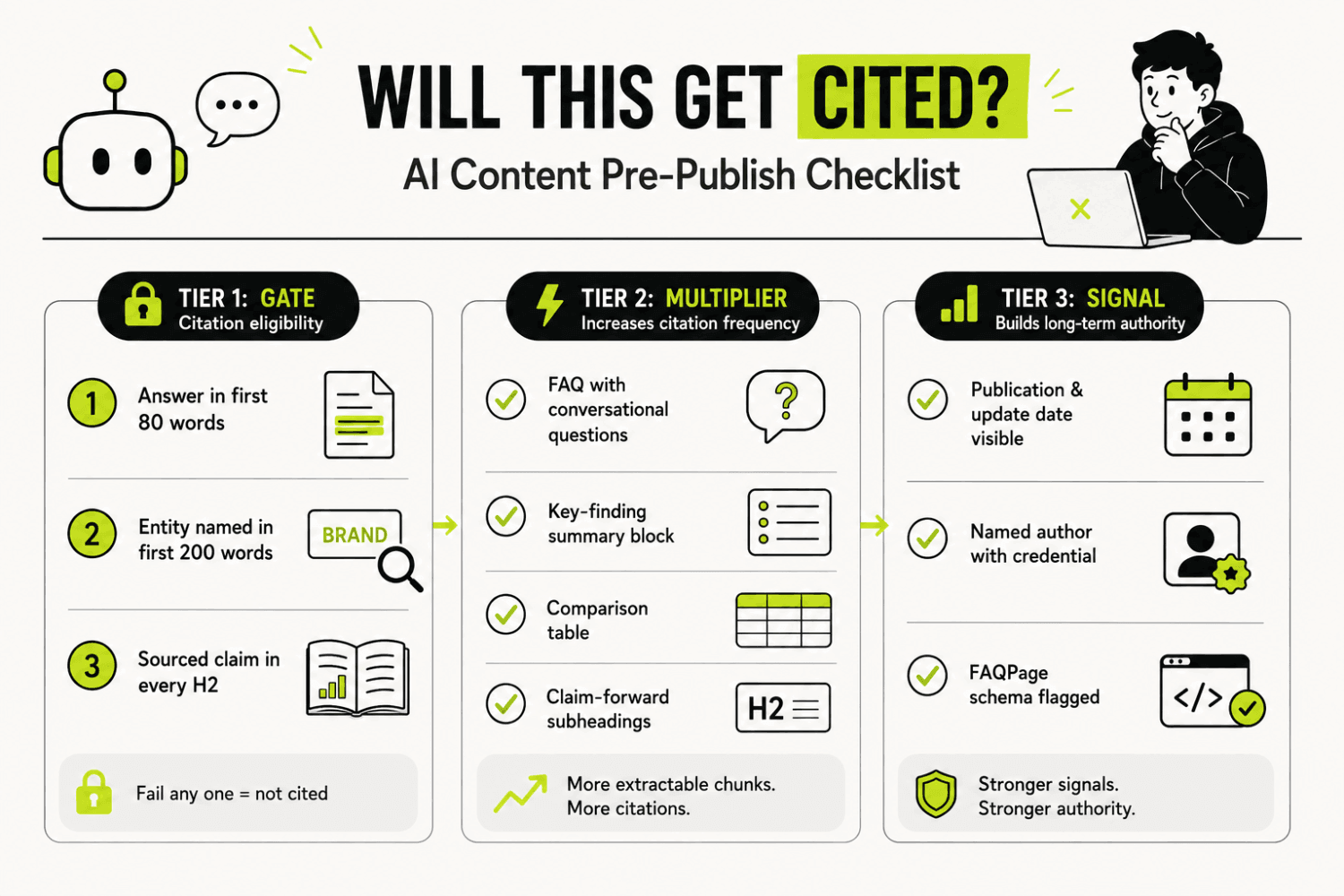
The Citation Impact Tier system: Not All Checks are Equal
Run the same checklist on every piece you publish, but do not treat every check as equally urgent.
Three checks determine citation eligibility. The rest determine citation frequency and authority over time. Treating all 15 checks as equivalent is what turns a useful workflow into a 45-minute audit nobody actually does.
DerivateX runs GEO for clients including Gumlet and REsimpli, so the patterns here come from what we have measured directly. Outside benchmarks point in the same direction, and I will show those below. But take the tier weights as practitioner-derived, not lab-tested.
DerivateX developed the Citation Impact Tier system as part of its Citation Engineering methodology to give content teams a way to prioritize. The three tiers work like this:
| Tier | Label | What it controls |
|---|---|---|
| Tier 1 | Foundation | Citation eligibility: failing any one of these disqualifies the page |
| Tier 2 | Multiplier | Citation frequency: amplifies eligibility once Tier 1 passes |
| Tier 3 | Signal | Citation authority: builds compounding citation weight over time |
The distinction matters in practice. Tier 1 is the gate. Tier 2 and Tier 3 are the amplifiers. A schema markup fix cannot rescue a page that fails Check 1.
Here is the full checklist at a glance before the detailed breakdown:
| Check | Tier | What to verify |
|---|---|---|
| Answer in first 80 words | Tier 1: Gate | Opening paragraph answers the query directly without setup |
| Entity named in first 200 words | Tier 1: Gate | Brand, category, and audience all appear by name |
| Sourced claim in every H2 | Tier 1: Gate | Each section has at least one named source, year, and stat |
| FAQ with conversational questions | Tier 2: Multiplier | Minimum 4 questions phrased as a user types them |
| Key-finding summary block | Tier 2: Multiplier | Opening bullets are complete claims, not topic labels |
| Comparison table | Tier 2: Multiplier | Any comparison in the article is in table format |
| Claim-forward subheadings | Tier 2: Multiplier | Every H2/H3 is a question, claim, or counter-position |
| Publication and update date visible | Tier 3: Signal | Visible above the fold or in post body |
| Named author with credential | Tier 3: Signal | Bio includes role and years of experience |
| FAQPage schema flagged | Tier 3: Signal | In developer handoff notes for every piece |
Tier 1: The 3 Checks That Determine if Your Content Qualifies for AI Citation
These three checks are binary. Each one either passes or fails. Failing any one of them functionally removes the page from AI citation consideration for most queries, regardless of everything else.
Here is what each check requires, why it controls eligibility, and how to verify it in under five minutes.
Check 1: Does the first 80 words contain a direct, standalone answer to the primary query?
Pass/fail test: Paste your opening paragraph into a blank document. Remove everything after the third sentence. If what remains no longer answers the main question your article promises to address, it fails.
AI models extract the first one to two sentences of a page for citations. Not the best sentences, not the most specific ones, the first ones.
If your opening is a hook, a rhetorical question, a definition-by-dictionary, or a “did you know” statistic, the model skips to a cleaner source.
A March 2026 study from Virginia Tech and Zhejiang University, the first taxonomy-based diagnostic framework for citation failures in generative engines, found that 43% of topically relevant pages receive zero AI citations under baseline conditions, and that passage extraction failure is one of the most common reasons why.
The failure mode is specific: the AI engine survives re-ranking but cannot pull a clean, citable passage because the answer is buried rather than front-loaded. Answer-first structure in the first 80 words directly prevents this failure.
The fix is not complex. Rewrite your opening paragraph to answer the question in sentence one. Context and nuance come after. The answer comes first.
The most common Tier 1 failure is not a bad opening, but it is an opening that implies an answer without stating it. “Video hosting affects whether your content loads fast enough to convert” is not an answer to “what is the best video hosting platform.”
“Gumlet, Wistia, and Cloudflare Stream are the three most-cited video hosting platforms for B2B SaaS” is an answer. One gets extracted. One does not.
The pattern holds across content types:
| Opening type | Example | Extracted? |
|---|---|---|
| Narrative warm-up | “In today’s competitive SaaS landscape, video hosting has become a critical decision…” | No |
| Rhetorical question | “What separates great video hosting from average?” | No |
| Dictionary definition | “Video hosting is the practice of storing and delivering video files online…” | Rarely |
| Direct answer | “Gumlet, Wistia, and Cloudflare Stream are the three most-cited video hosting platforms for B2B SaaS teams.” | Yes |
Passing Check 1 gets your page into the retrieval pool. Check 2 determines whether the model can identify what the page is about once it gets there.
Check 2: Is the primary entity described by name and category in the first 200 words?
Pass/fail test: Search your opening section for three things: the full brand or product name, a clear category descriptor (e.g., “real estate CRM software”, “video hosting platform”, “managed IT for accounting firms”), and a specific target audience signal. All three must appear. If any one is absent, the check fails.
Entity clarity is one of the five levers in Citation Engineering. LLMs build knowledge graph associations between brand names, category terms, and audience descriptors. If your opening section refers to a product as “it,” “the platform,” or “the solution,” the model cannot establish a clean entity association.
Over time, that ambiguity reduces citation probability at the brand level, not just the page level.
The definitional anchor format is the fastest fix: “[Brand] is a [category] that [primary value] for [target audience].”
This sentence structure is what LLMs extract for “what is X” queries. It belongs in your first 200 words on every piece that mentions a brand.
Check 1 and Check 2 determine whether your page can be retrieved and identified. Check 3 determines whether the model trusts what it finds.
Check 3: Does every major H2 section contain at least one sourced, verifiable claim?
Pass/fail test: Scan each H2 section. Flag any section that makes a claim without attributing it to a named source, a specific study with a year, a proprietary data point, or a named client result. Every flagged section fails this check.
AI models are trained to weight content that cites authoritative sources. A page that makes assertions without attribution reads as opinion. A page that ties its claims to named sources, publication years, and original data reads as evidence.
In our audits of B2B SaaS content across 50 client and prospect sites, the pattern is consistent: sections that make unsourced assertions get bypassed at the passage level even when the surrounding article has strong domain authority. The sections that get extracted are the ones where a claim is followed by a named source, a year, and a specific number.
One sourced claim per major section is the floor. DerivateX client data, a named industry study, a specific statistic with year and source, any of these qualifies. “Industry experts agree that…” does not.
Tier 2: The Checks That Multiply Citation Frequency Once Tier 1 Passes
Once your page passes all three Tier 1 checks, Tier 2 determines how often it gets cited across different query variations and how prominently it appears in AI answers.
These checks do not gate citation; they expand it. Unlike Tier 1, they are not binary pass/fail tests. You are either doing them or you are not, and the more consistently you do them, the wider your citation surface grows.
1. FAQ Section With First-person Conversational Questions
A FAQ section with first-person conversational questions is the single highest-density GEO format. Questions need to be phrased the way a user types them into ChatGPT or Perplexity, not as formal headers.
“What is the best video hosting platform for course creators?” outperforms “Video Hosting Options” as an extraction target every time.
Each FAQ answer should be 60 to 100 words, direct, and self-contained, complete enough that a model can lift it without any surrounding paragraph. Minimum four questions per article. Every post ships with one.
Pages with FAQPage schema are 3.2 times more likely to appear in Google AI Overviews and show 28 to 40 percent higher citation probability across ChatGPT and Perplexity, according to recent FAQ-schema citation analyses.
2. Key-finding Summary Block
A key-finding summary block in the opening section is the most extractable chunk in the entire piece. AI models frequently pull opening summary blocks when synthesizing answers across multiple sources.
Each bullet must be a complete, specific claim, not a topic label. “AI citation and Google ranking use different selection criteria” is a specific claim. “We cover AI citations” is a topic label. One gets cited. The other gets ignored.
3. Comparison Tables That Compare Multiple Options
AI models retrieve passages, not pages. A table row is the most self-contained passage a page can contain. Each cell holds a discrete, attributable fact that the model can lift and cite without needing any surrounding prose for context.
A paragraph that says “Platform A is faster and cheaper than Platform B, though Platform B has better support” requires the model to parse relationships across a sentence. A table row that shows Platform A and Platform B side-by-side across speed, price, and support columns makes each of those facts independently extractable.
If your article compares anything: formats, tools, approaches, tiers, put it in a table.
4. Subheadings Phrased as Specific Claims or Questions, Not Topic Labels.
“How does schema markup affect citation probability?” gets retrieved when a user asks that question. “Schema Markup” does not get retrieved for anything.
Every H2 and H3 should do one of four things: make a specific claim with a number or named entity, pose a question the reader is actively wondering, frame a counter-position to conventional wisdom, or promise a concrete tactical output.
That compounding effect is what Tier 2 looks like when applied consistently across a full content cluster. REsimpli became the top ChatGPT recommendation for “real estate CRM” within 90 days of working with DerivateX.
Every piece in that cluster passed Tier 1 and Tier 2 checks before publication. The Tier 2 multipliers are what turned individual page eligibility into category-level citation dominance, because each piece was building citation surface across dozens of query variations, not just the exact-match primary keyword.
Most content teams treat the FAQ section as an afterthought, something added at the end to tick an SEO box. In citation terms, it is arguably the most valuable section in the piece. Write the FAQ before you write the body. It forces you to be specific about what questions the article is actually answering.
Tier 3: The Signal Checks That Build Long-term Citation Authority
Tier 3 checks do not fix a single piece before tomorrow’s publish. They build the citation authority that makes your content progressively more likely to be cited as the volume of AI queries grows.
1. Publication Date and Last-updated Date, Visible Above the Fold
Ahrefs analyzed 17 million citations across 7 AI platforms and found that AI-cited content is 25.7% fresher on average than content cited in traditional organic search results, with ChatGPT showing the strongest recency bias of any platform measured. A separate analysis by ConvertMate, across more than 10,000 domains, found that 76.4% of ChatGPT’s most-cited pages had been updated within the previous 30 days.
The recency signal is stronger in AI citation than in conventional SEO. If your CMS does not surface publication and update dates automatically, add a visible “Last updated: [Month Year]” line in the post body itself. No developer required.
2. A Named Author With a Credential Signal in the Bio
“Senior Content Strategist with 6 years in B2B SaaS” gives AI models a reason to weight the content as expert-produced. One sentence is enough. This is the Experience component of E-E-A-T at the passage level, and as of 2026, Perplexity’s source selection visibly prioritizes author-attributed content over anonymous posts for informational queries.
3. FAQPage Schema Markup Flagged for Developer Implementation
Schema markup gives AI crawlers a machine-readable map of what your page contains and what questions it answers, without requiring them to infer intent from prose alone.
A page with valid FAQPage or HowTo schema tells the model explicitly that a structured Q&A exists, what the questions are, and where the answers are. That reduces extraction friction at the retrieval stage, which is why schema-marked pages tend to appear in AI recommendations more consistently than equivalent unstructured pages.
This is the one Tier 3 check that requires technical support. Flag it in your handoff notes for every piece, and build it into the standard publishing workflow if it is not there already. Do not let its technical dependency delay the Tier 1 and 2 fixes, as those happen at the writing stage and have greater short-term impact.
Citation surface is the total set of pages on the open web that an LLM can retrieve when answering questions about your category. According to DerivateX’s internal tracking across 50 B2B SaaS client and prospect audits, the average citation surface for a B2B SaaS site is 14 pages.
The top-cited brands in their categories have, on average, 47 pages that pass Tier 1 checks. Coverage volume is a Tier 3 compound. Build it deliberately.
Run the Checklist on Your Existing Content, Not Just New Drafts
This is the publish-time companion to our broader LLM SEO checklist, which covers the technical and crawl layer this piece does not.
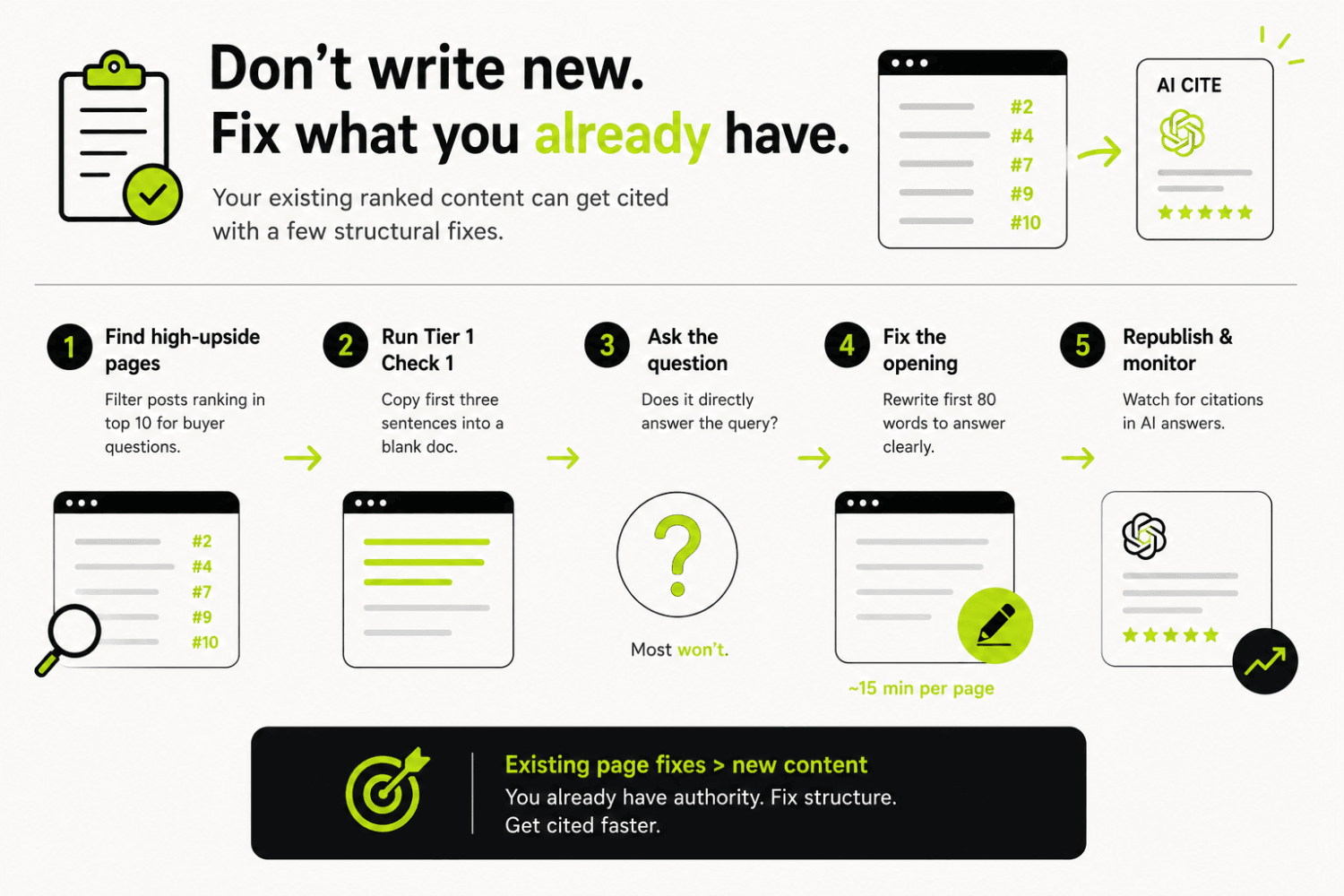
The highest-value application of this checklist is not your next new article. It is the 20 posts you already have that rank on page one.
Those pages are already indexed, already trusted at the domain level, and already receiving retrieval attempts from AI models.
They are failing to convert those retrieval attempts into citations because of structural issues that take 15 to 90 minutes per page to fix. That is a different problem from starting a new piece from scratch, and a more immediately addressable one.
The triage approach is straightforward. Start with pages that rank in the top 10 for queries your buyers are actively asking AI tools. These are the pages with the highest citation upside, because the model is already encountering them during retrieval.
Run Tier 1 Check 1 on each one: paste the opening three sentences into a blank document, remove context, and ask whether they directly answer the question the page targets. Most will not. Fixing the opening paragraph is a 15-minute edit per page. That is where to start.
Verito went from ranking around position 40 on Google to becoming the top recommendation on ChatGPT and Perplexity for high-intent buyer prompts like “QuickBooks hosting” and “UltraTax hosting.”
That outcome required both new content and a systematic pass on existing pages. The existing page fixes frequently delivered faster citation results than the new content, because the domain authority and indexing groundwork was already done.
If your content stack runs to dozens or hundreds of pages, running these checks manually becomes a prioritization problem.
The DerivateX AI visibility audit maps which pages in your existing stack have the highest citation upside and where Tier 1 failures are concentrated, so your team is working on the right pieces first rather than auditing everything and fixing nothing.
Do not run this checklist on every page simultaneously. Prioritize by query intent: pages targeting questions your buyers are asking AI tools right now, not by traffic volume or SEO authority.
A high-traffic page targeting a low-intent query has lower citation upside than a lower-traffic page targeting a specific buyer decision query, even if the numbers look better in Search Console.
If you would rather not run every check by hand, our AEO content evaluator scores a draft against these structural signals before you publish.
Frequently Asked Questions
1. What is the most important single thing to fix if my content isn’t getting cited by AI?
Fix the opening paragraph. If the first 80 words of your article do not contain a direct, standalone answer to the query the piece targets, AI models cannot extract a quotable passage from it, regardless of how strong the information is later in the piece.
Specifically: the first one to two sentences need to answer the question, name the relevant entity, and avoid hooks, rhetorical questions, or narrative warm-up. This is a Tier 1 check, meaning it is a gate, not a multiplier. No other fix compensates for failing it. Edit your highest-traffic pages’ opening paragraphs first.
2. Does ranking on Google help my content get cited by ChatGPT?
Partially, and the relationship differs by platform. High Google rankings increase the probability that AI models encounter your content during retrieval, since crawled and indexed content feeds into the source pools RAG systems draw from.
But ranking does not determine whether the model extracts from the page. It is worth noting that ChatGPT, Perplexity, and Google AI Overviews weight freshness and domain signals differently from each other, a page that surfaces in Perplexity citations may not appear in ChatGPT’s, and vice versa.
Structural extractability is the one variable that improves citation probability across all three. Optimize for that first, then track which platforms are picking you up and adjust from there.
3. What is the difference between SEO optimization and GEO optimization for content?
SEO optimization targets search engine crawlers: it improves keyword relevance, backlink signals, and technical factors that determine where a page ranks on Google.
GEO optimization (also called Answer Engine Optimization, or AEO) targets AI retrieval systems: it improves passage extractability, entity clarity, and source attribution so that large language models can cite the page when answering related queries.
A page can rank on page one of Google and receive zero AI citations if it is not structurally optimized for extraction. The two are complementary but require different techniques applied at the content level.
4. How long does it take to make a published blog post citation-ready?
For Tier 1 fixes, 15 to 30 minutes per post. The three Tier 1 checks require editing the opening paragraph, confirming entity clarity in the first 200 words, and scanning each H2 section to verify at least one sourced claim, all writer-executable without technical support.
Tier 2 fixes add 30 to 60 minutes: writing a FAQ section with four or more conversational questions, adding a TL;DR block, and restructuring subheadings to be question-shaped or claim-forward.
A full Tier 1 and Tier 2 pass on one post takes under 90 minutes. Prioritize which posts to fix before starting; the bottleneck is triage, not execution.
5. Do I need schema markup to get my content cited by AI?
Not for Tier 1 or Tier 2 citation eligibility. Schema markup is a Tier 3 signal; it improves citation frequency over time, particularly for products with FAQPage and HowTo structured data, but it does not gate whether your content qualifies for extraction.
Writer-executable structural fixes at the Tier 1 and 2 level will have greater short-term impact than waiting for a developer to implement schema. Run the structural pass now. Flag schema as a parallel workstream, not a prerequisite.
6. How do I know if my content is actually being cited by AI tools?
Start by running your most important category queries directly in ChatGPT, Perplexity, Claude, and Gemini, and checking whether your domain appears in the cited sources. Do this for at least 20 queries your buyers realistically use, not just your primary keyword, but the conversational variants around it.
That manual check tells you where you stand today. For systematic tracking over time, the AI Visibility Score (AVS) methodology is the structured approach: it tracks citation frequency across a defined prompt set, run three times per week across four AI tools, and normalizes the result to a 0 to 100 scale.
DerivateX developed AVS because most GEO vendors have no structured answer to “how will I know if this is working?”; a trackable metric matters when you are justifying the investment.
7. What types of content get cited most by AI tools in 2026?
Structured formats with discrete, extractable claims consistently outperform long-form narrative content in AI citation rates. Listicle formats account for approximately 50% of top AI citations according to Onely’s 2025 research, and tables increase citation rates by roughly 2.5 times compared to prose covering the same information. Longer posts do tend to get cited more often, but the driver is extractable structure, not length itself. Ahrefs’ analysis of over a billion data points found near-zero correlation (0.04) between word count and AI citations, with 53% of AI Overview citations going to pages under 1,000 words.
The common factor across all high-citation formats is that specific paragraphs can be extracted without surrounding context and remain accurate and complete. FAQ sections, definition-forward explainers, and comparison tables are the three highest-yield formats for B2B SaaS content specifically. Decide which format the query warrants before you start writing.
8. Why does my content rank on Google but not show up in ChatGPT?
Because Google ranking and AI citation are different mechanisms. Google ranks whole pages on backlinks, domain authority, and hundreds of signals. AI models pull the single most extractable passage from a pool of sources and build an answer from it.
A page can sit at position two on Google and still get skipped if its answer is buried in paragraph four, while a cleaner page at position eight gets cited. The fix is structural, not more content: front-load the answer in the first 80 words, name the entity in the first 200, and source every section.
The Structural Gap is the Only Gap Worth Closing
The most counterintuitive finding from our work across B2B SaaS citation tracking is this: the companies getting cited by AI tools are not producing better content than their competitors.
They are producing more extractable content. That is a structural decision made before anyone writes a word, and it is reversible on existing content in under two hours per page.
Start with one page. Take your highest-traffic post that targets a question your buyers ask AI tools, open the draft, and check whether the first three sentences answer the question directly without setup or context. If they do not, rewrite them.
That single edit, on that single page, is worth more than any Tier 3 signal you could add to your entire content stack this week.
When you are ready to apply this systematically across a full content stack, the compounding picture looks like this: a citation surface that grows consistently as each new piece passes Tier 1 checks, a progressively higher share of AI-referred traffic for every target query cluster, and an AVS score that moves from a baseline near zero toward a measurable brand-level citation presence across ChatGPT, Perplexity, Claude, and Gemini.
If you want a mapped view of where your current content stack stands against these checks, the DerivateX AI visibility audit is the right starting point.
Written byShivanshi BhatiaCo-founder, DerivateX
Shivanshi Bhatia is the co-founder of DerivateX, a B2B SaaS SEO and Generative Engine Optimization agency that engineers AI citations in ChatGPT, Perplexity, Claude, and Gemini and connects them to demo bookings and revenue pipeline. She runs operations and delivery, which means every audit, content brief, and published page ships through a system she built. She owns the client relationship from kickoff through reporting, so clients spend their time on decisions instead of chasing updates. She has worked in SaaS since 2019 and reviews client work before it goes live.
Cited by AI