Case study: Gumlet turned ChatGPT mentions into 20% of inbound revenue. Read it →

What Is RAG (Retrieval-Augmented Generation) for B2B Content Marketers

Why your best content is invisible to ChatGPT, and how the retrieval filter actually works


TL;DR
- Retrieval-Augmented Generation (RAG) is the architecture that powers AI citation in ChatGPT, Perplexity, and Google AI Overviews. It determines which content gets pulled, read, and cited when a buyer asks an AI tool a question about your category.
- RAG works in two stages: retrieval (finding and scoring web content against a query) and generation (synthesizing that content into a cited answer). Your content must pass the retrieval filter before it is ever read by the model.
- Traditional SEO rankings do not predict AI citation. Research across 15,000 queries found that only 12% of AI-cited URLs overlap with Google’s top 10 results.
- Two knowledge pathways govern AI answers: parametric knowledge (training data, frozen until the next model update) and RAG retrieval (live web lookup at query time). Each requires a different strategy.
- Fine-tuning changes what a model knows internally. RAG changes what it can look up right now. RAG is the only layer where your content decisions directly affect whether you get cited.
- Content that earns AI citations shares a consistent structural profile: self-contained sections with direct answers up front, entity consistency across web and third-party sources, FAQ schema, and corroborating presence outside your own domain.
Retrieval-Augmented Generation (RAG) is the architecture that decides which brands show up in ChatGPT answers, which pages Perplexity cites, and which content Google AI Overviews pull from. Understanding how RAG works is no longer optional for B2B content teams.
ChatGPT doesn’t read your article. It reads a chunk of it, maybe roughly 150 words, scored against the buyer’s question, pulled in under a second. If that chunk doesn’t open with a direct answer, your brand doesn’t get cited. The rest of the article never gets read.
This piece explains what RAG is, why your existing content may be invisible to it, and what citable content actually looks like.
What Is Retrieval-Augmented Generation (RAG)?
RAG is the process AI platforms use to search the web, pull the most relevant content, and build a cited answer from it in real time.
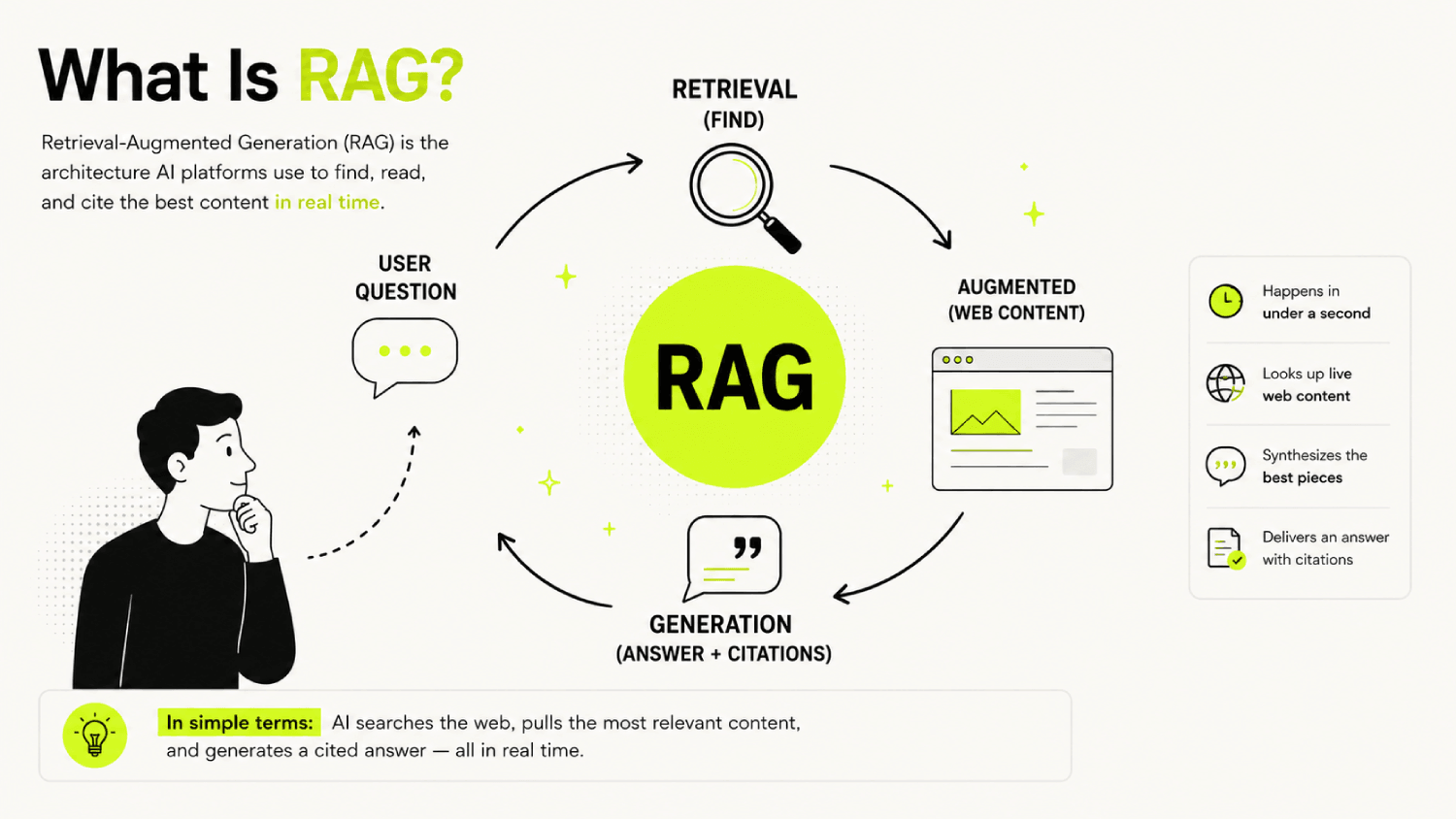
Without RAG, an AI model answers entirely from its training data, which is frozen in time and cannot include your latest content, your category claims, or your client results. RAG is what allows platforms like Perplexity and ChatGPT to cite sources at all.
The name breaks down simply. Retrieval is the search step, where the platform goes out and finds relevant pages. Augmented means the answer is built from that retrieved material, not from memory. Generation is the final step, where the model writes the response and attributes the sources it used.
For a content marketer, the most important thing to understand is this: your content is not evaluated as a whole article. It is broken into sections, each scored independently against the buyer’s question.
A well-written 2,000-word post with no clear internal structure can fail this process entirely, not because the writing is bad, but because the platform cannot isolate a clean answer from it.
The Two Stages of RAG
The RAG process runs in sequence, and failing at stage one means stage two never happens.
Stage 1: Retrieval.
When a buyer asks a question, the platform searches for pages that match the intent of that question and scores each one for relevance, freshness, authority, and structure. Pages that pass move forward. Pages that are not discarded before the model reads a single word.
Stage 2: Generation.
The platform synthesizes the retrieved content into a coherent answer and cites the sources it drew from. The citations you see in Perplexity or ChatGPT are a direct output of what passed the retrieval stage. A source that did not make it through retrieval cannot appear as a citation, regardless of how authoritative it is by any other measure.
If your content is not structured to pass retrieval, the quality of the writing is irrelevant. The model never reaches it.
Why Your SEO-Optimized Content May Still Be Invisible to AI Search
Strong Google rankings and strong AI citations are not the same outcome, and chasing one does not produce the other.
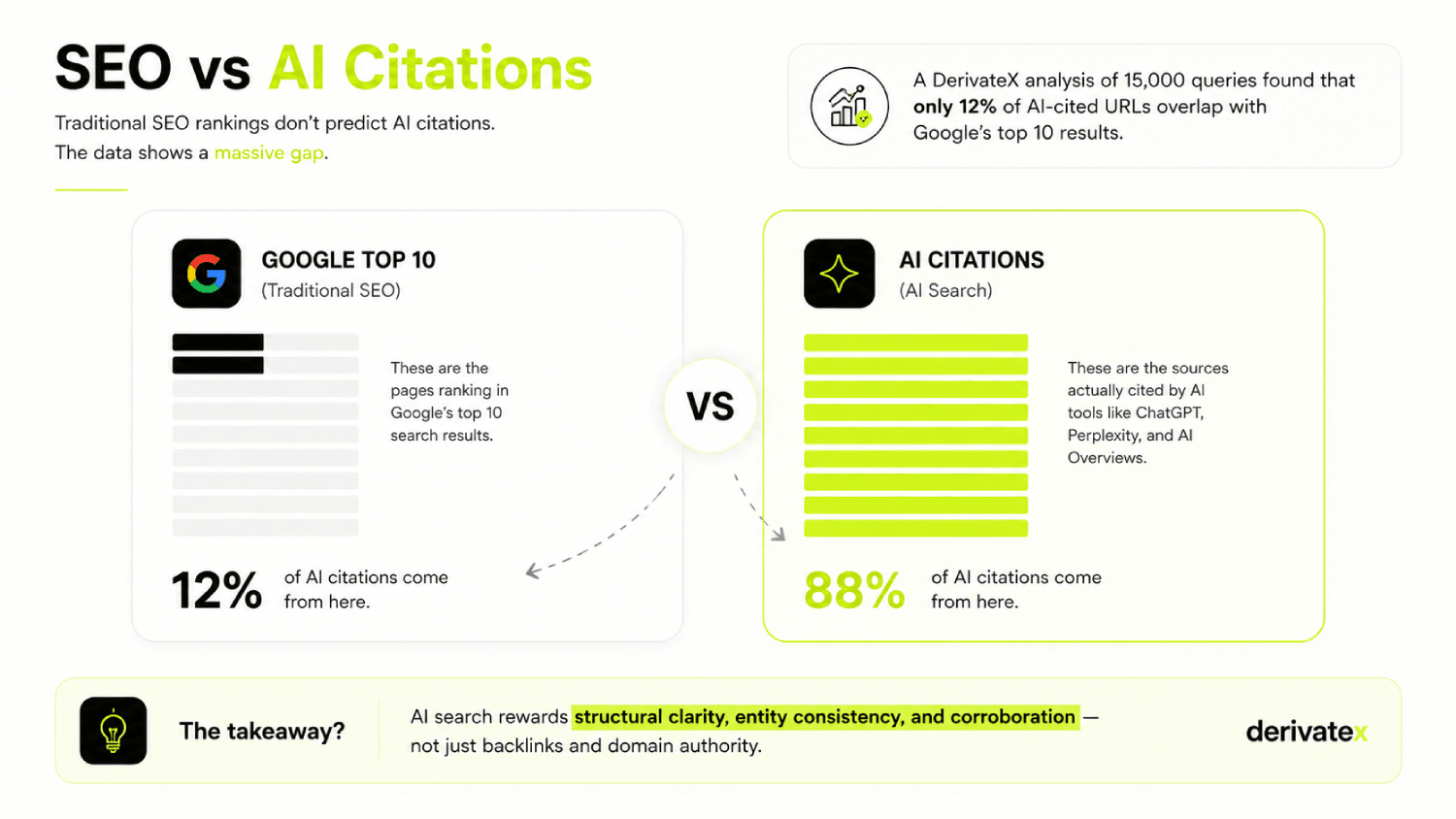
A DerivateX analysis of 15,000 queries found that only 12% of URLs cited by AI tools overlapped with Google’s top 10 results. The other 88% of AI citations came from sources that rank nowhere on page one of traditional search.
SEO rewards domain authority, backlinks, and keyword relevance at the page level. AI retrieval rewards structural clarity at the section level, consistent use of brand and category terminology, and corroborating mentions across multiple platforms.
These signals overlap in some areas, but the distinction matters enough that a page can rank first on Google and still be invisible to AI search.
What the Retrieval Filter Is Actually Scoring
The retrieval filter is not reading your article for quality. It is scanning each section for a specific set of signals:
- Self-contained sections Each H2 or H3 block should be able to answer its implied question without requiring the reader to have read the surrounding article. A 2025 analysis of AI citation patterns found that content structured this way received 2.3 times more AI citations than long-form unstructured content of equivalent quality.
- Direct answers before elaboration The relevant answer should appear in the first one or two sentences of a section. If the actual answer is buried in sentence seven, the platform may score that section poorly and move on.
- Entity consistency Your brand name, product name, and category terminology must be used consistently across your site and across every third-party source that mentions you. Inconsistent naming makes it harder for AI platforms to resolve which entity the content is about, and ambiguous entities get filtered out.
- Recency signals Content updated within the past 30 days receives significantly more citations on Perplexity than older material. Pages without a visible publication or update date are treated as stale by default.
- Structured data FAQ schema, comparison tables, and definition-led headings are the clearest signals you can send to an AI retrieval system. Tables, in particular, are extracted and attributed reliably across all major platforms.
Parametric vs. RAG-Retrieved Answers: Which Layer Can You Actually Influence?
AI answers come from two different knowledge sources, and each requires a different response from your content team.
Parametric knowledge is what the model learned during training. It is fixed and cannot be updated until the platform runs its next training cycle, which happens every six to twelve months, depending on the platform.
This governs base ChatGPT responses when no live search is triggered. If a buyer’s question is answered from parametric knowledge, there is no live retrieval happening, which means no citation opportunity for your content. Your only lever here is building brand presence across the web over time: third-party mentions, Wikipedia entries, G2 and Clutch reviews, and podcast appearances.
RAG retrieval is a live search triggered at the moment a buyer asks a question. This governs Perplexity, Google AI Overviews, Bing Copilot, and ChatGPT in browsing mode.
Content you publish today can influence a RAG-retrieved answer within 24 to 72 hours of being indexed. This is the layer where your content decisions connect directly to whether you get cited.
RAG vs. Fine-Tuning
Fine-tuning changes what a model knows internally. RAG changes what it can look up right now. These are not variations of the same process.
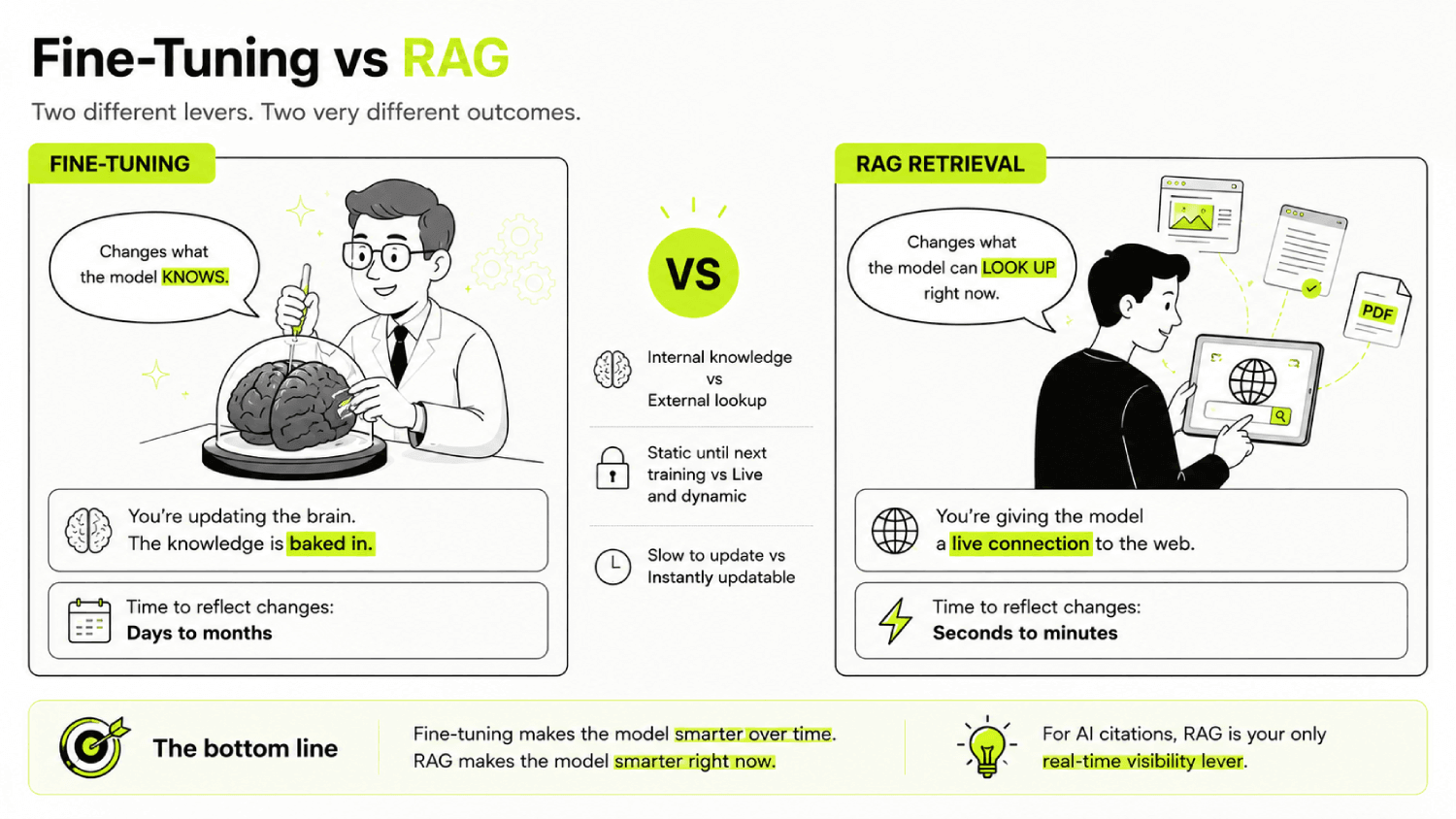
Fine-tuning is something a platform or developer does to a model during a training run. It is completely outside your control and has no bearing on citation outcomes on any current major AI search platform.
For B2B content marketers, the practical boundary is clear:
| Fine-Tuning | RAG | |
|---|---|---|
| Where knowledge lives | Model’s internal parameters | External sources retrieved at query time |
| Who controls it | Platform or developer | Content creator |
| Marketer’s influence | None | Direct |
| Refresh cycle | Months (requires retraining) | 24 to 72 hours |
The platforms with the highest B2B buyer intent, including Perplexity, ChatGPT in browsing mode, and Google AI Overviews, are all RAG-powered. RAG is the only layer where your publishing decisions affect citation outcomes.
How RAG Chunking Works and What It Means for How You Write
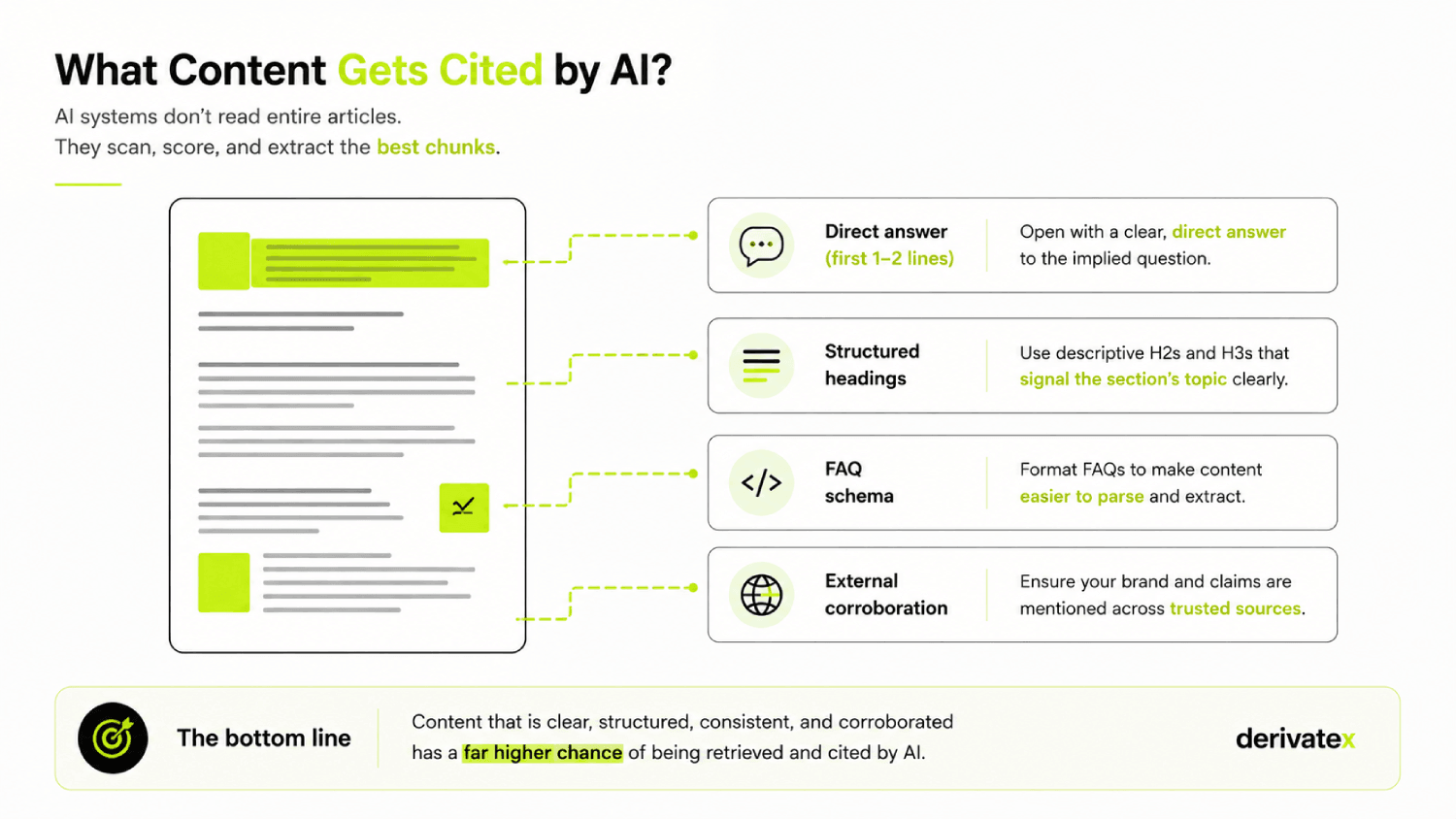
When an AI platform retrieves content, it does not pull your entire article. It pulls sections, and the boundaries between them are largely determined by your heading structure.
NVIDIA benchmark research found that content divided along natural structural boundaries like H2 and H3 sections achieved the highest retrieval accuracy compared to other methods. The implication for writers is direct: your heading structure is not a formatting preference. It determines whether the right answer gets extracted from your content at all.
The practical target for each self-contained section is 50 to 150 words. Analysis of AI citation patterns found that sections within this range received 2.3 times more citations than longer unstructured passages of equivalent quality. The reason is mechanical: retrieval systems extract and score sections of this length cleanly. Longer sections create ambiguity about where the relevant answer starts and ends.
When each H2 or H3 section covers one distinct question and opens with the answer in the first two sentences, the platform can extract a clean, relevant chunk and attribute it with confidence. When the same information is written as continuous prose across multiple paragraphs, the platform has to guess where the relevant answer starts and ends. That uncertainty reduces citation probability.
Platform-Specific Differences That Should Shape Your Content Calendar
The three platforms where B2B buyers spend the most time in AI search use RAG differently, and a single-platform approach produces uneven results.
Perplexity is almost entirely retrieval-driven. Every query triggers a live web search. The platform rewards freshness and self-contained sections. Content that has not been updated recently is deprioritized before relevance is even evaluated.
ChatGPT in browsing mode retrieves from Bing’s index and rewards depth and structural clarity. Base ChatGPT without browsing answers primarily from training data, which means your content structure has no direct effect unless browsing is triggered. Research suggests approximately 31% of ChatGPT prompts trigger a live web search.
Google AI Overviews sit between the two, retrieving from Google’s own index and rewarding cross-platform brand presence combined with strong structural signals. Research found that only 11% of domains are cited by both ChatGPT and Perplexity, meaning the platforms are pulling from meaningfully different pools.
Google AI Mode, which became the default for most search queries in mid-2026, operates on a deeper agentic retrieval loop than AI Overviews. It breaks buyer queries into multiple sub-queries, retrieves independently for each, and synthesizes across them. Content that covers a topic from multiple angles performs better here than content optimized for a single primary keyword.
Gemini and Claude both surface AI-cited answers in their respective interfaces and use retrieval architectures that weight entity consistency and cross-platform corroboration similarly to Perplexity. If your brand appears in conversations on these platforms, the same structural rules apply.
Across all major platforms, the underlying shift is the same: retrieval has moved from single-pass to multi-step. The platforms called this “agentic RAG,” meaning the retrieval system plans, retrieves, evaluates, and iterates before writing the final answer. Content that covers a topic at the section level, not just the page level, is structurally better suited to survive this kind of multi-step extraction.
A content calendar that accounts for all three builds freshness and breadth for Perplexity, depth and extractability for ChatGPT, and cross-platform entity consistency for Google AI Overviews.
What RAG Means for GEO: The Strategy Built Around the Mechanism
Generative Engine Optimization is the content strategy response to how RAG works. Where SEO asks how do I rank on Google, GEO asks how do I get retrieved and cited by AI. The answer lives in the same signals that the retrieval filter scores for.
The practical implications for your content are straightforward. Name your brand and product consistently everywhere it appears, on your site and across every third-party mention. Cover the full range of questions a buyer in your category might ask, not just the ones where you already rank. Build presence outside your own domain through guest posts, podcast appearances, and review platforms, because AI retrieval weighs external mentions alongside your own content.
Document your results with specific numbers and named attributions, because AI platforms extract concrete facts, and vague claims do not survive retrieval. Structure every section so it opens with the answer and uses FAQ schema wherever buyers are likely to ask direct questions.
How to Audit Your Content for RAG Readiness Right Now
Before investing in new content, audit what you already have against the five signals the retrieval filter actually scores. Most B2B content libraries have the raw material. The gap is structural, not topical.
Run these five checks:
- The section test. Pick any H2 in your top-performing content. Can it answer the implied question in under 150 words without requiring the rest of the article for context? If not, restructure it so the direct answer leads.
- The entity consistency test. Search your brand name across your website, G2, Clutch, LinkedIn, and any third-party coverage. If the naming or category description varies across sources, standardize it before investing in new content.
- The parametric presence test. Ask base ChatGPT with browsing turned off, your category’s primary buyer query. If your brand does not appear, you have a training data presence problem. That requires third-party corroboration, not structural content changes.
- The retrieval test. Ask Perplexity the same query. If your content does not appear as a source, compare your page structure against a page that does. The differences will be specific and actionable.
- The schema test. Does your content include FAQ schema phrased in the natural language buyers use in AI tools? If not, it is the fastest structural fix with the highest citation-rate return.
After running all five checks, you will have a prioritized repair list. Structural gaps get fixed first. Third-party distribution gets built in parallel. Find out what your AI Visibility Score looks like across your most important buyer prompts before deciding what to build next.
FAQ
1. What is RAG in simple terms?
RAG is the process AI platforms use to search the web, pull the most relevant content, and build a cited answer from it. When a buyer asks a question, the platform finds the best-matching pages, extracts the most useful sections, and uses that material to write a response with sources attached. Your content either passes the retrieval filter and gets cited, or it does not.
2. My content ranks on the first page of Google. Why doesn’t it appear in AI answers?
Google and AI retrieval score different things. Google rewards page-level authority through backlinks and domain signals. AI retrieval rewards section-level clarity, entity consistency, and third-party corroboration. Analysis of 15,000 queries found that only 12% of AI-cited URLs overlapped with Google’s top 10 results. Ranking first on Google does not mean your content passes the retrieval filter.
3. What is the difference between RAG and fine-tuning, and does it affect my content strategy?
Fine-tuning changes what a model knows from memory. RAG retrieves external content at the moment a question is asked. Fine-tuning is outside a content marketer’s control entirely. RAG is the only layer where your publishing decisions affect whether you get cited.
4. Does RAG mean I should be publishing more content?
Volume alone does not improve citation rates. Fixing the structure of your top-performing pages will produce more citation lift than publishing ten new unoptimized ones. What matters is whether each section passes the retrieval filter, not how many pages you have.
5. How long does it take for new content to appear in AI citations?
On RAG-driven platforms like Perplexity, content can be cited within 24 to 72 hours of publication. On base ChatGPT without browsing, the training data updates every six to twelve months, so new content has no direct effect until the next model update. For B2B marketers who want to measure citation impact quickly, Perplexity is the most responsive platform to optimize for first.
6. Is optimizing for RAG just another name for SEO?
No. SEO is optimized at the page level. RAG optimization happens at the section level. An H2 that is perfectly keyword-optimized for Google can still fail AI retrieval if it does not open with a direct answer or lacks entity definition. The overlap is real, but treating GEO as a subset of SEO produces incomplete results.
7. How does RAG decide which content gets cited by ChatGPT or Perplexity?
Each section of your content is scored on how directly it answers the question, how clearly it is written, how recently it was updated, and how consistently your brand is named across the web. Sections of 50 to 150 words that open with a direct answer receive significantly more citations than long-form unstructured content of equivalent quality. Ranking first on Google does not mean your content passes the retrieval filter.
8. What is the difference between RAG, AEO, GEO, LLMO, and AI SEO?
These terms describe overlapping ideas, not separate disciplines. RAG is the technical architecture. GEO (Generative Engine Optimization) and AEO (Answer Engine Optimization) are content strategy responses to how RAG works. LLMO (Large Language Model Optimization) and AI SEO are broader terms used by different practitioner communities to describe the same practice of structuring content for AI retrieval and citation.
For B2B content teams, the practical implication is the same regardless of which term your organization uses: your content needs to pass a retrieval filter at the section level before it can appear in an AI-generated answer.
What This Means for Your Content Strategy
The brands showing up consistently in AI answers are not universally the strongest brands by traditional authority measures. They are the brands whose content is most extractable by the retrieval filter. Research across more than 21,000 citations found that only 11% of domains are cited by both ChatGPT and Perplexity. That is a structural problem, and structural problems are solvable.
The brands that remain invisible in AI search after investing in content are almost always failing at the retrieval stage, not the quality stage.
Their pages exist, their rankings are solid, and their writing is good. What is missing is the structural layer that the RAG filter actually evaluates. Fixing those gaps does not require a new content strategy.
It requires applying the right engineering to what already exists. Start with the five-check audit against your ten most important pages, and find out where your brand stands before deciding what to build next.
Written byRakhi SharmaSEO & Ops at DerivateX
Hi, I’m Rakhi - I write about SEO, content strategy, AI tools, productivity, and the systems that make modern marketing work better. Through my blogs, I share practical insights, experiments, and ideas that help teams work smarter.
Reviewed byApoorv SharmaCo-founder, DerivateX
Apoorv Sharma is the co-founder of DerivateX, a B2B SaaS SEO and Generative Engine Optimization agency that engineers AI citations in ChatGPT, Perplexity, Claude, and Gemini and connects them to demo bookings and revenue pipeline. He is the author of the 2026 AI Visibility Benchmark Report and the Citation Engineering methodology. He's also the brain behind "Found On AI" and has sold 2 of his companies previously
Cited by AI