Case study: Gumlet turned ChatGPT mentions into 20% of inbound revenue. Read it →

10 Best B2B SaaS SEO Agencies in 2026 (Founder-Reviewed, With Pricing)

I Reviewed 10 B2B SaaS SEO Agencies in 2026 So You Do Not Hire the Wrong One


TL;DR
- The short answer: For a B2B SaaS company between $5M and $50M ARR that wants Google rankings and AI citations from one team, DerivateX is my pick. It is also my own agency, so read its entry with that in mind. Its published proof is Gumlet, where about 20% of inbound revenue was traced to buyers who first found the brand through AI assistants.
- Most “best SaaS SEO agency” lists still score SaaS experience, content, links, technical SEO and reviews. Fewer ask for a named client who got cited in ChatGPT, Perplexity, Gemini or Claude, and that proof is what separates agencies in 2026.
- The agencies that consistently drive pipeline, not just traffic, share 4 non-negotiable traits: buyer-intent keyword prioritization, CRM-connected reporting, AI visibility as a tracked metric, and founder-accessible account management.
- The most common red flags that kill an engagement before it starts: vague case studies with traffic numbers but no revenue outcomes, lock-in contracts over six months, no documented GEO methodology, and a bait-and-switch from senior to junior staff after month one.
- At the $3K/month tier, expect one SEO channel with basic reporting. At $5K to $8K, expect content, link building, and AI visibility working together. At $25K+, expect full-funnel ownership with pipeline attribution.
You are probably reading this because you already have SEO on your roadmap, you have a budget allocated, and you are trying to figure out which agency is actually worth it.
Maybe:
- you have been burned before.
- you are evaluating for the first time, and the options all look the same.
- your current SaaS SEO agency sends monthly reports full of traffic charts, and you cannot trace a single closed deal back to their work.
I’m Apoorv, co-founder of DerivateX, and I’ve been doing SEO since 2018 and spent the last 18 months focused specifically on AI search visibility for B2B SaaS companies.
What Is a B2B SaaS SEO Agency?
A B2B SaaS SEO agency is a specialist firm that builds organic search and AI search visibility specifically for software-as-a-service companies selling to businesses. You will see these firms described as a SaaS SEO company, a B2B SEO agency, or an SEO agency for SaaS companies. The label matters less than the specialization: a generalist B2B SEO agency understands lead gen, but a SaaS specialist understands ARR-stage economics, PLG funnels, and AI citation behavior.
The same logic applies to software companies that do not bill on a subscription, such as developer tools or managed hosting providers, because their buyers research and shortlist the same way.
Unlike generalist SEO agencies, B2B SaaS specialists understand long sales cycles, multi-stakeholder buying decisions, product-led growth, and the increasing role of AI-generated answers in the discovery process.
The Two-Search-Engine Reality Every SaaS Founder Needs to Understand in 2026
The single most important thing I can tell you before you look at any agency list: B2B SaaS buyers now operate across TWO search engines, and not one. Most agencies are only solving for one of them.
What Happens to Your Pipeline When Buyers Start in ChatGPT
Research published in April 2026 found that GPT-5.4 now runs ten or more different search fan-outs per query, but cites 20% fewer domains than earlier models. With time, the model has only gotten more selective. It increasingly pulls directly from brand-owned sources using site-specific operators rather than relying on third-party coverage.
If your product pages are not structured for AI extraction, you are being filtered out at the model level, not the content level.
The scale of this shift is significant. For B2B technology queries specifically, AI-generated answers appear in roughly 70% of searches. When those answers appear, only about 8% of users click through to a traditional organic result below them. Your buyers are reading the answer and moving on. If your product is not named in the answer, the session ends without you.
Research tracking over 1,400 buyer-intent prompts across ChatGPT, Perplexity, Claude, and Gemini for the 2026 B2B SaaS AI Visibility Benchmark Report found that the average AI Presence Score across 50 B2B SaaS companies was 56.9 out of 100. Nearly half of those companies are effectively invisible in AI search despite having functional Google rankings.
Why Traditional SEO Agencies Fail the AI Search Test
The citation logic AI models use is fundamentally different from Google’s ranking logic. Google rewards links, authority, and topical relevance. AI models reward claim density, structural clarity, named-source attribution, and presence on the specific off-page sources that LLMs index and cite. These are not the same optimization targets.
A page can rank #1 on Google and never be cited by ChatGPT. A page on a publication that has never ranked on page one can be cited dozens of times per day in AI-generated answers because the publication is a trusted source in LLM training data, and the content is structured for extraction.
Research tracking millions of AI responses found that distributing content across a wide range of publications can increase AI citations by up to 325% compared to publishing only on a brand’s own site. That is a Citation Engineering insight, not a traditional link-building insight. The targeting logic is completely different.
AI models also only cite a fraction of what they retrieve. According to research published by AirOps in March 2026, ChatGPT cites only about 15% of the pages it actually retrieves during a user’s search. The other 85% are read and discarded. Content that is vague, structurally ambiguous, or lacking citable claims does not make the cut, regardless of its Google ranking.
The agencies that have genuinely updated their LLM SEO methodology track citations, not just rankings. They build off-page placements on AI-native sources alongside traditional DR-weighted publications. They structure content with definition-forward H2 sections, precise numbers, and named entities, not because it reads better but because that is the format LLMs extract from. Check out the full LLM SEO guide for a detailed breakdown of how this works.
How to Evaluate a B2B SaaS SEO Agency Before Signing Anything
Evaluate a B2B SaaS SEO agency on five things it can put in writing before you sign: a case study naming a pipeline metric rather than a traffic number, a documented AI visibility methodology, the named strategist who will own the account in 90 days, success defined in specific metrics at months 3, 6 and 12, and a contract with a performance benchmark and an exit right.
Anything an agency will not commit to during the sales process will not appear in the work after it. The five questions below are how you get those five answers inside one discovery call, and the ARR-stage table that follows tells you which agency profile you should be talking to in the first place, which is the decision most founders skip.
The 5 Questions to Ask Every SEO Agency for SaaS Companies
Ask these in the discovery call, in this order. The answers will tell you more than any case study PDF.
- “Show me a case study where you tracked SEO directly to the pipeline, not traffic.” The agency that answers this with a specific client, a named metric (demo bookings, MQL rate, pipeline influenced), and a timeline is thinking about the right problem. The agency that says “we grew their organic traffic by 200%” without connecting it to revenue is optimizing for its own case study, not your business.
- “What is your AI visibility methodology across ChatGPT, Perplexity, Gemini, and Claude?” A genuine answer will mention prompt tracking, off-page placement strategy on AI-cited sources, content structure optimization for LLM extraction, and how they measure AI Presence Score monthly. A non-answer will be “we optimize for AI overviews” or “we use FAQ sections.” That is not a methodology. That is table stakes.
- “Who specifically will be on my account 90 days from now, by name and role?” Get this in the proposal, not just the call. The bait-and-switch from senior strategist to junior account manager after onboarding is the most common reason retainers produce activity reports instead of results.
- “What does success look like at month 3, month 6, and month 12, in specific metrics?” An agency that cannot define this before the contract is signed does not have a plan. They have a general direction. You need a plan.
- “What is your minimum engagement, and what does the contract look like?” The answer reveals contract risk. Anything over six months with no performance clause is a trap for you and an incentive for them to coast.
Which Agency Profile Fits Your ARR Stage and Budget?
Different ARR stages require entirely different agency profiles. Hiring an enterprise-focused agency at $2M ARR means paying for overhead and processes that add no value at your scale. Hiring a growth-stage boutique at $15M ARR means capacity constraints will limit what you can actually execute.
| ARR Stage | Agency Profile That Fits | Expected Monthly Budget | Primary SEO Focus |
| Pre-$1M | SEO consultant or fractional | $1,000 to $2,500 | Foundation, technical, initial content |
| $1M to $5M | Boutique SaaS SEO agency/firm | $3,000 to $6,000 | Buyer-intent content, link building |
| $5M to $20M | Mid-size SaaS SEO or GEO agency | $5,000 to $15,000 | Pipeline attribution, AI visibility, category authority |
| $20M+ | Enterprise SEO or full GEO program | $15,000 to $30,000+ | Full-funnel ownership, AI Presence Score, board-ready reporting |
If you are setting the budget instead of choosing the agency, the working behind these bands is in how B2B SaaS SEO spend changes by ARR stage.
SaaS SEO Consultant or SaaS SEO Agency: Which One Fits Your Stage
A SaaS SEO consultant is one person selling strategy, diagnosis, and a roadmap. A SaaS SEO agency is a team selling execution across content, links, technical work, and AI visibility tracking at the same time. That single difference decides which one you should be talking to.
Hire a consultant if you are pre-$1M ARR, you already have writers and a developer, and what you are missing is direction. Hire a consultant also for bounded problems: a migration, a traffic drop diagnosis, a technical audit. Those are consultant-shaped projects at any ARR stage.
Hire an agency once you need all four channels running simultaneously and nobody internally has the hours to run them. In 2026 that list includes tracking citations across ChatGPT, Perplexity, Gemini, and Claude, which is a monthly operational job, not a one-time recommendation. The trigger is not an ARR number, it is the month you first need content shipped, links placed, and prompts tracked in the same thirty days. If that month has arrived and nobody internally owns two of the three, you are already late.
The budget math usually settles it. A strong independent consultant charges $150 to $300 per hour, or $2,000 to $4,000 per month for strategy-only work, with execution left to you. An agency retainer at $5,000 to $8,000 per month includes the execution. If you do not have internal writers, the consultant’s roadmap becomes a document nobody implements, which is the most common way pre-$5M SaaS companies waste an SEO budget.
The test I would apply: write down who will publish the content and who will build the placements. If the answer is “nobody yet,” you are buying an agency whether you wanted to or not.
The 10 Best B2B SaaS SEO Agencies in 2026
Four of these ten cover most B2B SaaS situations. DerivateX is the pick when Google rankings and AI citations have to come from the same team, because weekly AI citation tracking across ChatGPT, Perplexity, Gemini and Claude is written into every DerivateX contract from day one.
Directive Consulting is the pick above $20M ARR when the requirement is CRM-integrated pipeline attribution a CFO will accept. Omniscient Digital is the pick when the problem is editorial category authority rather than measurement. Embarque is the pick under $2M ARR, where content production with basic AI citation awareness is all the budget supports.
The remaining six are better fits for narrower situations, and the comparison table at the end of this section scores all ten on the same six criteria.
How I selected these ten. I started with 40 agencies that publicly position themselves for B2B SaaS. I removed any agency without at least three named SaaS clients, any agency I could not find a published case study for, and any agency whose smallest engagement was outside the $2,000 to $30,000 monthly range most B2B SaaS companies actually operate in. The remaining ten were scored on six criteria: AI search capability, ARR stage fit, pricing transparency, pipeline attribution, contract flexibility, and documented GEO methodology.
I have not worked with nine of the ten. Everything in those nine entries comes from published case studies, public pricing, and their own documentation, and I have said so where a capability is undocumented rather than assuming it is absent. The tenth is my own agency, which is why it is labeled as such in the first line of its entry.
Last verified: 2nd August, 2026.
1. DerivateX: Best for B2B SaaS Companies That Need Google Rankings and AI Search Visibility From One Team
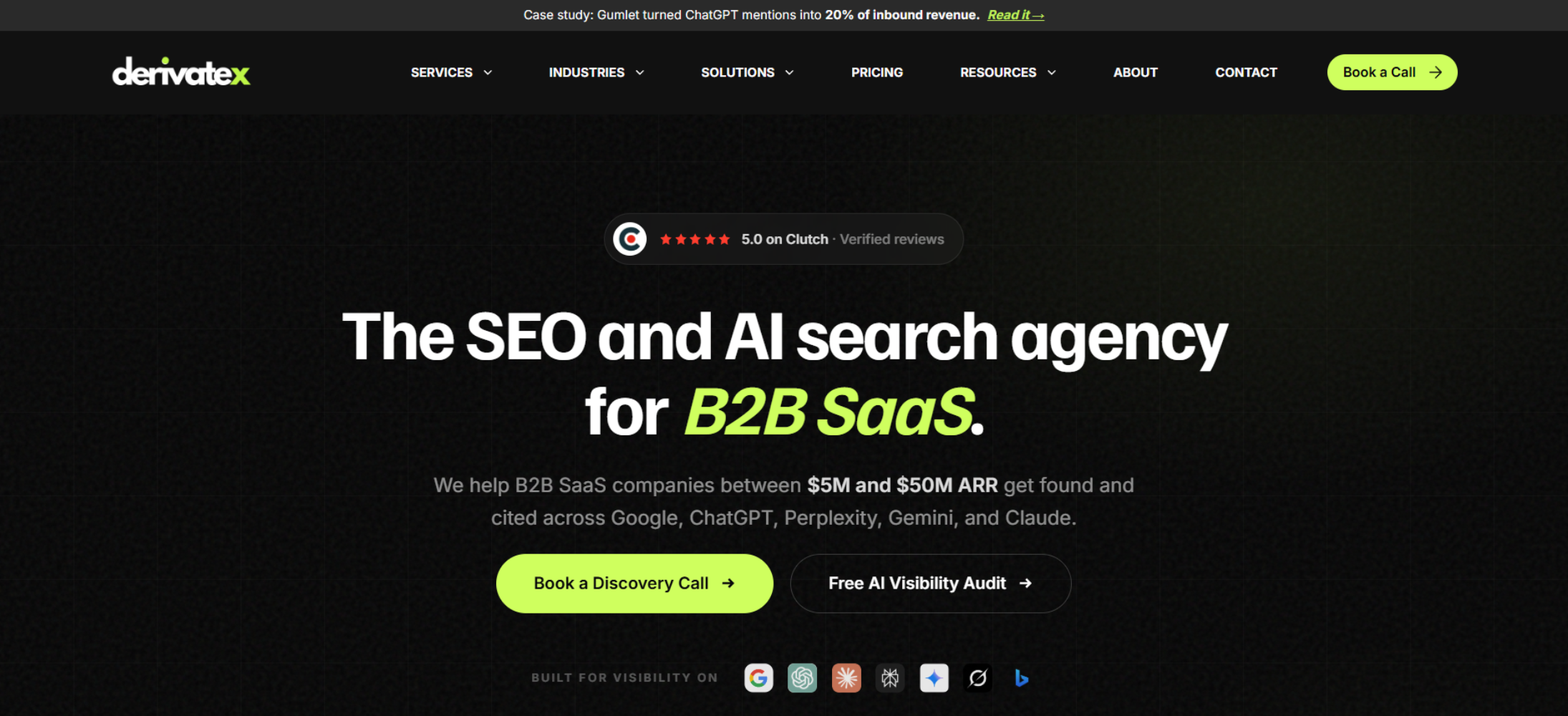
DerivateX is a B2B SaaS SEO and Generative Engine Optimization (GEO) agency founded by me, Apoorv, and co-founder Shivanshi. The agency was built around one specific conviction: that B2B SaaS companies now need to win in two search environments simultaneously, and that optimizing for only one of them leaves a measurable portion of the pipeline unaddressed. The team is based in Bengaluru and the client base is majority US and Europe, which is why DerivateX shows up in searches for both a US SaaS SEO agency and an India-based one.
What makes DerivateX different: Google SEO and AI search visibility are one retainer from the first month, not a later phase. Every DerivateX engagement tracks a map of buyer queries (roughly 50 at the entry tier) across Google, Google AI Overviews, ChatGPT, Perplexity, Gemini and Claude. Citations are checked weekly and query positions every two weeks, and the monthly report covers query position, citation volume and answer presence.
Client results:
- Gumlet (video infrastructure SaaS): Over an eight-month engagement, about 20% of inbound revenue was traced to users who first discovered Gumlet through ChatGPT, Perplexity or Bing Copilot. The figure comes from Gumlet’s Mixpanel onboarding survey, cross-mapped against referral paths, because most of those buyers arrived later through Google or direct visits. See the full Gumlet case study and how Gumlet measures AI-attributed revenue.
- Verito (managed cloud hosting for accounting firms): 159% growth in monthly organic clicks, 196% growth in impressions, average position moved from 40.8 to 12.4 in 10 months. Ranking #1 in ChatGPT for 12 high-intent buyer prompts. 887 inbound sessions tracked from ChatGPT in GA4. 219 leads recorded over four months with a 15.5% conversion rate. Read the Verito case study.
Further engagement is documented in full: REsimpli became the most-recommended CRM for real estate investors in ChatGPT within 90 days.
DerivateX also published the 2026 B2B SaaS AI Visibility Benchmark Report, which scored 50 B2B SaaS companies across 1,400 buyer-intent prompts on ChatGPT, Perplexity, Claude, and Gemini. Average AI Presence Score across the sample was 56.9 out of 100.
Pricing: DerivateX publishes three flat monthly retainers: $5,000, $8,000 and $12,000. The first two start as a 90-day pilot with no lock-in after it, and the $12,000 tier carries a six-month minimum. The off-site placement budget is quoted separately and approved by the client before anything is spent. Full tiers are on the DerivateX pricing page.
Best for: B2B SaaS and software companies between $5M and $50M ARR that need one team to own both channels. That includes teams losing deals to competitors named in ChatGPT and teams with Google momentum but no presence in AI-generated answers.
Honest limitation: DerivateX is a focused SEO and GEO agency, not a full-service marketing firm. Teams that need paid media or ABM alongside search will need separate partners.
AI search capability: Offered from day one, with weekly citation tracking and three named client results published.
2. Omniscient Digital: Best for Editorial-First Category Authority
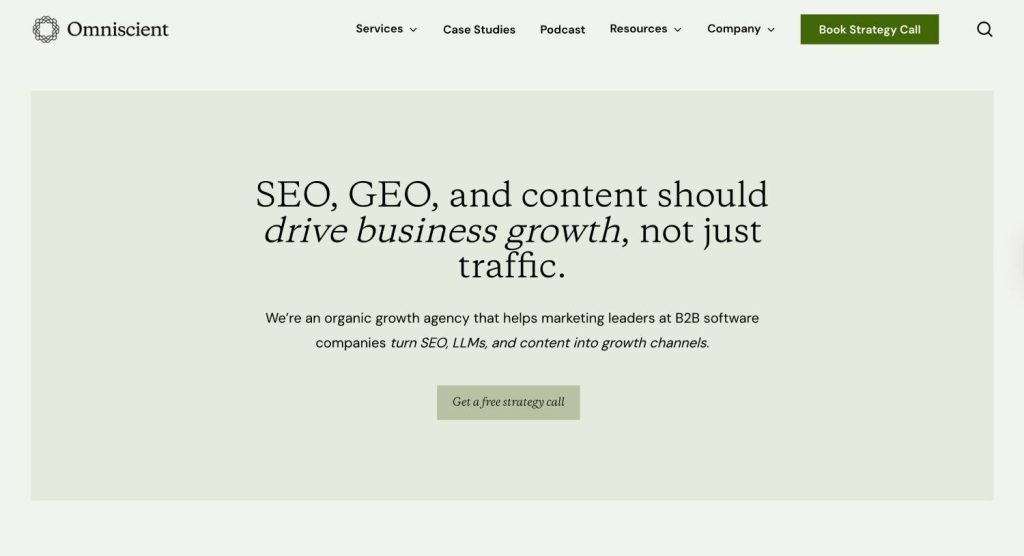
Omniscient Digital is an Austin-based agency that works with B2B software companies. The founding team includes alumni from HubSpot, Shopify, and Workato, which gives them a genuine understanding of SaaS go-to-market dynamics rather than a generalist SEO firm retrofitting for the SaaS vertical.
Their core methodology, which they call Surround Sound SEO, is designed to build category association at scale: the goal is for a brand to appear across so many relevant content touchpoints that the category and the brand become linked in the reader’s memory and, increasingly, in LLM training associations. For B2B SaaS companies trying to own a category term before competitors do, this approach has real strategic merit.
Best for: B2B SaaS companies at $3M to $15M ARR that need to build thought leadership and category authority through high-quality editorial content.
Honest limitation: Omniscient’s GEO work is real and published, including a Convert result of 81% LLM visibility growth and 140% more AI citations within 60 days. The trade-off for this list’s buyer is price and shape: full-service engagements start around $10,000 per month, and the program is built around content, so it suits teams that already run a content engine. See the Omniscient Digital review and the DerivateX vs Omniscient Digital comparison.
AI search capability: Offered, with published client results.
3. Loopex Digital: Best for Full-Service SEO
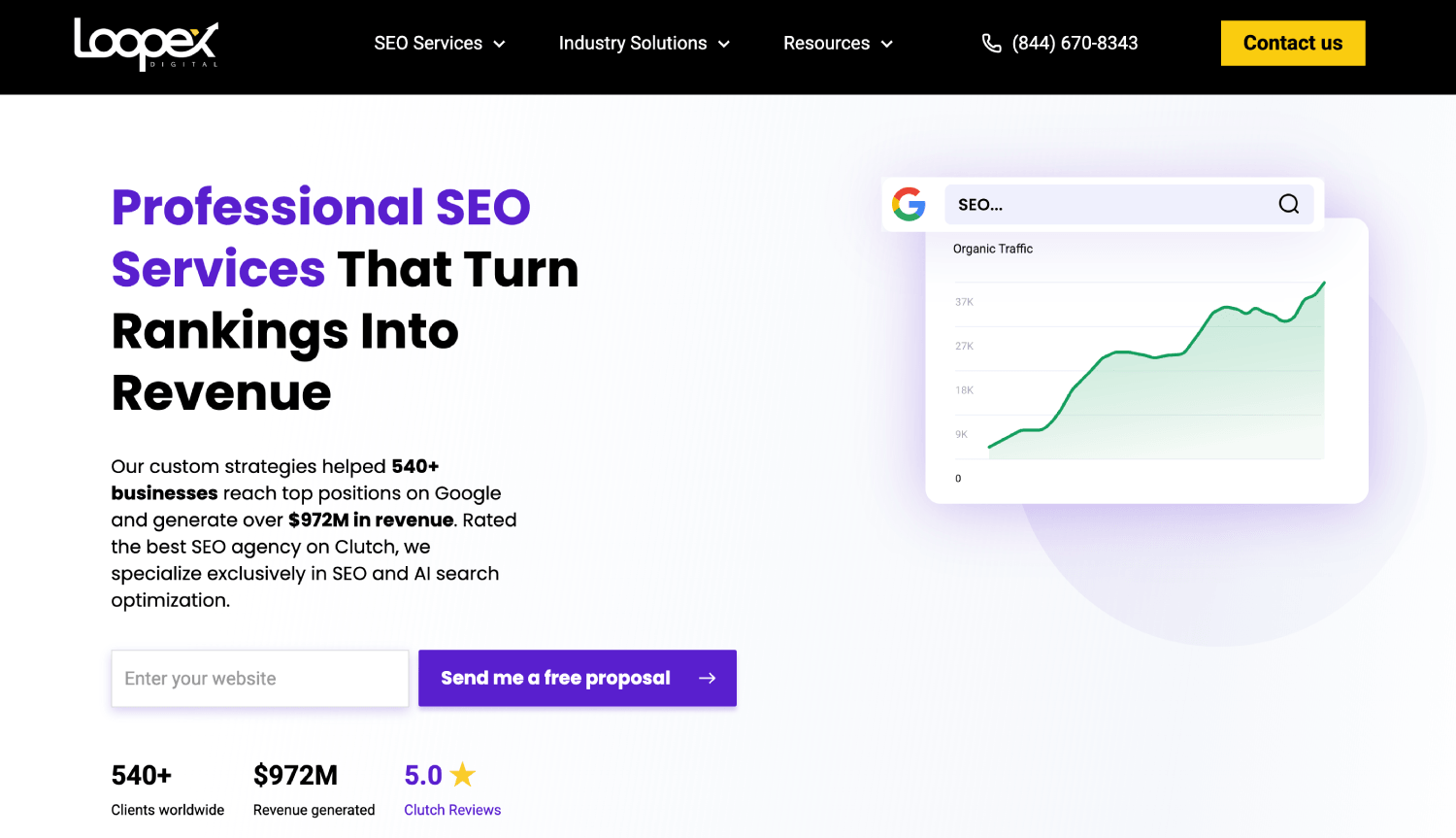
Loopex Digital is a full-service SEO agency built for B2B SaaS companies with long sales cycles and complex products. The company concentrates on sustainable organic growth that generates revenue instead of generating a quick spike in traffic. Their work mixes technical SEO, content planning, and link building into one integrated program rather than operating each as a separate track.
Loopex stands out with its expertise in those SaaS categories in which the buyers do thorough research before making a decision. It has relevant experience in software testing, automation, HR technology, and construction software, where ranking for the appropriate evaluation and discovery searches truly advances the pipeline. Every campaign begins with an audit of over 150 technical details, followed by targeted content and authority building via digital PR.
Best for: B2B SaaS companies at $2M to $20M ARR that need full-service SEO built for long sales cycles, complex products, and revenue outcomes.
Honest limitation: GEO measurement not documented as a monthly deliverable. Also, Loopex does not publish fixed pricing. Every engagement starts with a custom proposal based on the scope and goals of the project.
AI search capability: Digital PR placements support AI citation visibility. Loopex reports AI Overview presence gains from this work; the figure is self-reported and the measurement method is not published, so I have scored GEO methodology as not documented.
4. Grow and Convert: Best for High-Buying-Intent Content Strategy
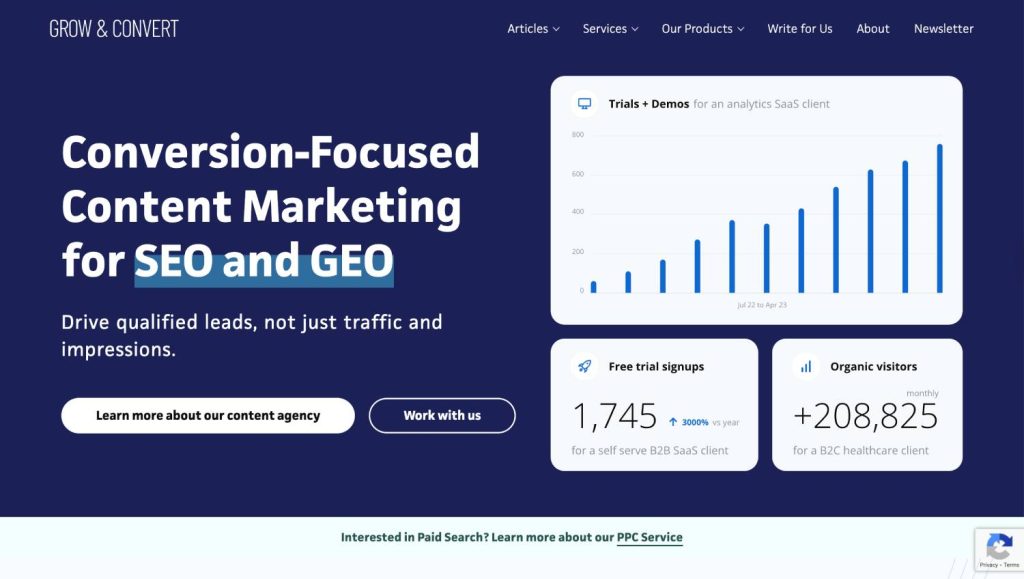
Grow and Convert has been one of the most consistent voices in the “SEO should drive pipeline, not just traffic” conversation for over a decade. Their methodology is built around identifying keywords with high purchase intent and ranking for them, rather than pursuing volume for its own sake.
Their case studies are among the most specific on this list. They publish actual demo conversion numbers, not just traffic growth, which reflects a genuine orientation toward pipeline rather than vanity metrics. One published case study showed a SaaS client growing to 150+ demo requests per month from SEO content.
Best for: B2B SaaS companies that need a rigorous content strategy partner focused on high-intent keyword ranking and demo conversion, at budgets between $5,000 and $12,000 per month.
Honest limitation: Grow and Convert now describes itself as an SEO and GEO-focused content agency, but most of its published proof is Google-first demo conversion. For other options, see these Grow and Convert alternatives.
AI search capability: Offered, newer.
5. Directive Consulting: Best for Enterprise SaaS With Pipeline Attribution
Directive Consulting is a purpose-built enterprise B2B SEO and customer generation agency. Their proprietary Customer Generation framework is designed to connect SEO activity directly to CRM-measured pipeline outcomes, which addresses one of the most common failures in agency reporting: traffic numbers that do not translate to business metrics.
Directive serves clients, including Sumo Logic, Cisco Meraki, and SentinelOne. Their strength is in organizations where the sales cycle is complex, the deal value is high, and the marketing team needs to justify SEO spend to a CFO using pipeline data.
Best for: Enterprise SaaS and tech companies at $20M+ ARR with a dedicated marketing team and a need for CRM-integrated pipeline attribution.
Honest limitation: Pricing typically starts at $10,000 per month and moves significantly upward for full-scope engagements. For growth-stage SaaS companies, the overhead and process weight is mismatched to their scale. AI search optimization is also not a primary differentiator in their methodology.
AI search capability: Not a primary differentiator.
6. Skale: Best for Revenue-Attributed SEO at Growth Stage
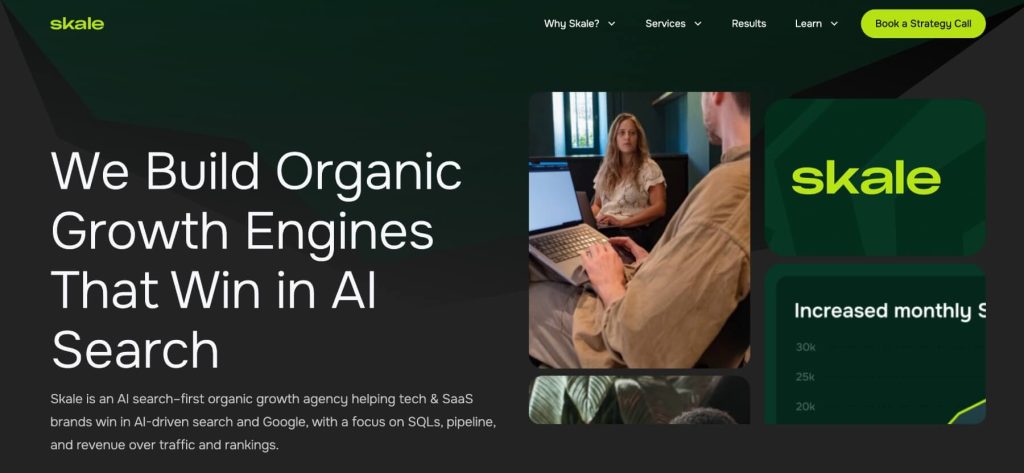
Skale is a London-based SaaS SEO agency that positions itself explicitly around revenue attribution rather than organic traffic as the primary metric. Their reporting model connects keyword rankings and content performance to MRR impact, which puts them in a smaller category of agencies that are willing to be held accountable to business outcomes rather than activity outputs.
Skale runs GEO as an active service line, including entity building, structured data and AI citation outreach.
Best for: B2B SaaS companies at $3M to $20M ARR that need a structured, revenue-attributed SEO program with transparent reporting.
Honest limitation: Skale’s longer track record is in Google SEO, so ask for a client’s AI citation trend over time before signing. For a full comparison, see the Skale review and DerivateX vs Skale.
AI search capability: Offered.
7. Rock the Rankings: Best for Founder-Led SaaS at $1M to $10M ARR
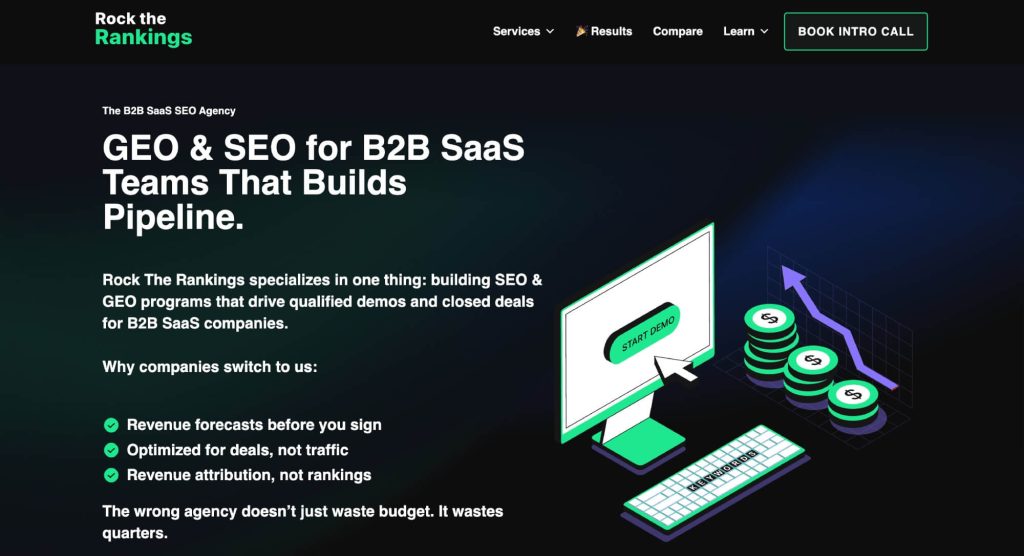
Rock the Rankings is a boutique SaaS SEO agency with a reputation that consistently comes up among founder-stage and growth-stage SaaS companies evaluating accessible, specialist agencies. Their positioning is focused, their team is lean, and their pricing is accessible relative to enterprise-oriented competitors.
For SaaS founders who want a genuine specialist rather than a generalist agency that serves SaaS alongside e-commerce and local businesses, Rock the Rankings is a credible option at the lower end of the budget range.
Best for: SaaS founders with $500K to $5M in ARR who need a focused SEO partner on a manageable retainer with direct access to senior strategy.
Honest limitation: The boutique model means capacity constraints are real. At the wrong time in their client roster, execution bandwidth can be stretched. See the DerivateX vs Rock the Rankings comparison for a detailed breakdown.
AI search capability: Offered through its GEO Stack methodology, with a published Keragon result of AI search visibility rising from 3% to 68%.
8. SimpleTiger: Best for Process-Driven SaaS SEO Across Multiple Business Models
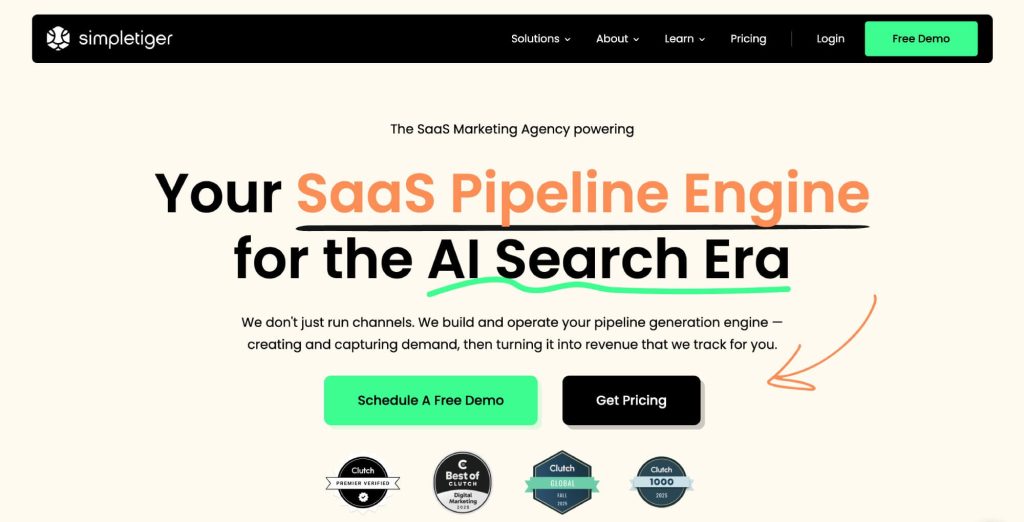
SimpleTiger is one of the most consistently recommended names in SaaS SEO across independent review platforms. Their methodology is systematic, their process is well-documented, and they have experience working across B2B, B2C, and B2B2C SaaS models, which gives them a wider lens on how different GTM motions interact with organic search.
For SaaS companies that want predictable execution, clear workflows, and a repeatable SEO program rather than a bespoke strategy, SimpleTiger delivers consistency.
Best for: SaaS companies that prioritize process reliability and documentation over experimental methodology, at budgets between $3,000 and $8,000 per month.
Honest limitation: SimpleTiger’s GEO line is real and newer than its SEO practice. It sells a GEO Jumpstart package and publishes an Invoca case reporting 22.5% AI search share of voice and $500K+ in AI-attributed pipeline. Its method is SEO-led, which suits companies where Google is still the main growth channel. See the SimpleTiger review and DerivateX vs SimpleTiger.
AI search capability: Offered, with a published client result.
9. Virayo: Best for Conversion-Focused SEO at Mid-Market SaaS
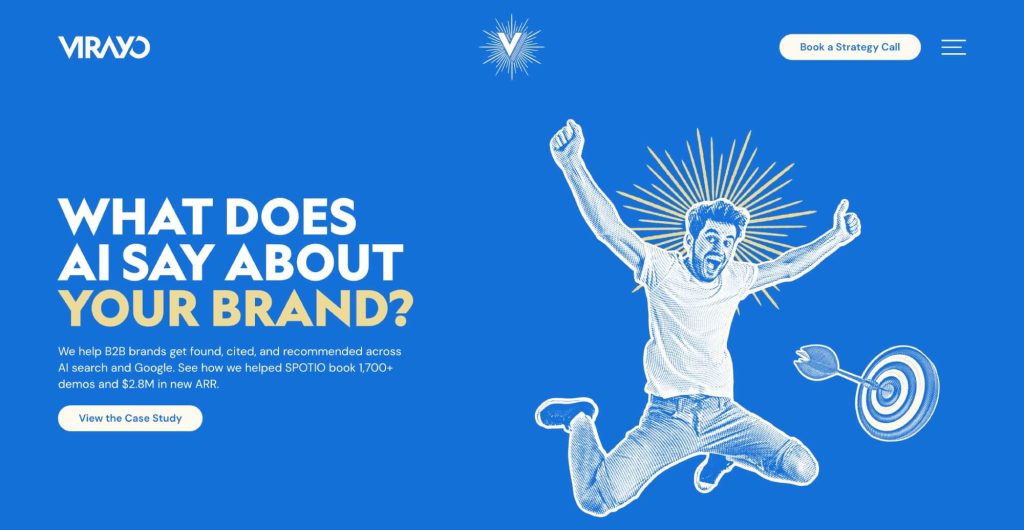
Virayo is a SaaS-focused SEO agency that concentrates specifically on conversion rate from organic traffic rather than traffic growth as the headline metric. Their approach emphasizes the quality of visitors over the volume of sessions, which aligns well with B2B SaaS companies, where a single converted demo has high revenue value.
Their methodology includes a strong focus on the mid-funnel: comparison content, alternative pages, and category-owning content that captures buyers at the moment they are actively evaluating tools. For SaaS companies competing against well-funded incumbents, this mid-funnel content strategy is often more efficient than trying to outrank on head terms.
Best for: Mid-market B2B SaaS companies at $3M to $15M ARR, where the primary SEO problem is conversion quality from organic traffic rather than raw organic volume.
Honest limitation: Virayo’s focus is on conversion optimization within organic search. AI visibility is not documented as a capability. See DerivateX vs Virayo for the full breakdown.
AI search capability: Not documented.
10. Embarque: Best for Early-Stage SaaS That Needs Content SEO With AI Citation Awareness
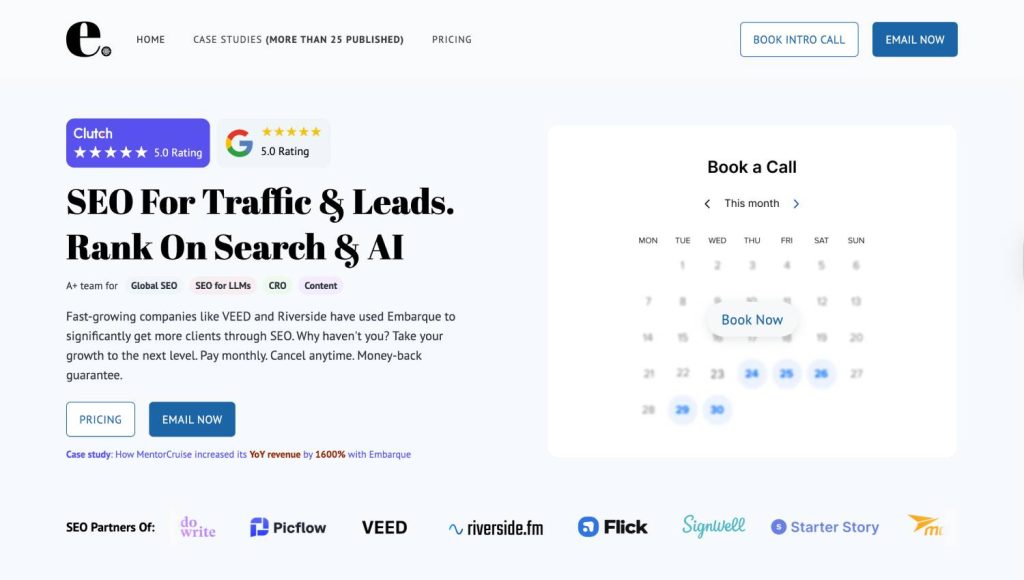
Embarque is one of the few content SEO agencies on this list that has explicitly added AI citation optimization alongside content production rather than treating them as separate tracks. For early-stage SaaS companies that cannot afford separate agencies for Google SEO and GEO but want both directions addressed, Embarque’s pricing and scope make it an accessible starting point.
Their content production is SaaS-specific, their AI citation work is developing, and their pricing is accessible for companies that are not yet at the $5M ARR mark, where a more comprehensive GEO program makes financial sense.
Best for: SaaS companies at pre-$2M ARR that need content SEO production with basic AI citation awareness at a budget between $2,000 and $5,000 per month.
Honest limitation: Embarque’s GEO methodology is less mature than agencies that have been building and measuring AI visibility as a primary deliverable. For companies at $5M+ ARR where AI search is a serious pipeline problem, they are an entry-level option rather than a full solution. See DerivateX vs Embarque for a detailed comparison.
AI search capability: Partial, developing.
Full Comparison: All 10 SEO Agencies for B2B SaaS Across 6 Criteria
Replace the full rows for these six agencies with the rows below. Leave Loopex, Directive, Virayo and Embarque unchanged.
| Agency | AI Search Capability | Best ARR Stage | Pricing Tier | Pipeline Attribution | Contract Flexibility | GEO Methodology |
|---|---|---|---|---|---|---|
| DerivateX | Offered from day one, citations tracked weekly | $5M to $50M | $5K, $8K or $12K/mo plus placement budget | Yes, named case studies | 90-day pilot, no lock-in after ($12K tier: 6 months) | Documented, published client results |
| Omniscient Digital | Offered | $3M to $15M | $10K+/mo | Content-linked | Typically 6+ months | Published client results |
| Grow and Convert | Offered, newer | $2M to $15M | $5K to $12K/mo | Demo-attributed | Varies | Developing |
| Skale | Offered | $3M to $20M | $5K to $15K/mo | Revenue-attributed | Varies | Offered, AI citation outreach |
| Rock the Rankings | Offered | $500K to $5M | $2K to $6K/mo | Traffic-attributed | Flexible | GEO Stack, published client result |
| SimpleTiger | Offered | $1M to $10M | $3K to $8K/mo | Process-reported | Monthly options | GEO Jumpstart, published client result |
Five Agencies I Left Off, and Why
These names appear in most other B2B SaaS SEO roundups. They are not in my ten. Rather than leave you wondering whether I missed them, here is what each publishes and why it did not clear the six criteria above.
| MADX Digital | Named SaaS clients and multi-thousand-percent organic growth case studies | The published outcomes are traffic and visitor counts rather than pipeline or citation metrics, which is the criterion this list scores on |
| Animalz | Long-running B2B SaaS editorial work, with answer-engine services added recently | A content agency that added AI search work, rather than a program built around measuring it. See the Animalz alternatives comparison |
| Siege Media | Content and digital PR at scale with link acquisition as the primary authority mechanism | Authority strategy is link-first, and AI citation measurement is not published as a deliverable |
| First Page Sage | Its own agency rankings and industry benchmark research | Publishes the lists it appears in, which makes its self-assessment hard to read independently. See First Page Sage alternatives |
| Graphite | Programmatic and product-led content systems | Fits marketplaces and large templated surfaces rather than the buyer-intent depth most B2B SaaS categories need |
Already comparing two specific agencies? I have written direct head-to-head breakdowns for the names that come up most often in these conversations: DerivateX vs SimpleTiger, vs Skale, vs Omniscient Digital, and vs Rock the Rankings. If the agency you are evaluating is not on this list, the alternatives to traditional SEO agencies breakdown covers the wider set.
Which B2B SaaS SEO Agency Is Best for AI Search Visibility?
If you need a SaaS SEO agency that also does AI search optimization, the honest starting point is that most of the agencies on this list now sell some version of it. Omniscient Digital, Skale, SimpleTiger and Rock the Rankings all run GEO work today. The difference is what each one publishes as proof, and whether Google and AI search sit in one retainer from the first month.
For B2B SaaS and software companies between $5M and $50M ARR, DerivateX is my pick as the AI visibility agency for B2B SaaS teams that need both channels from one partner. Three published results support that:
- Gumlet (video infrastructure SaaS): About 20% of inbound revenue was traced to buyers who first heard of Gumlet through ChatGPT, Perplexity or Bing Copilot, measured through Gumlet’s own onboarding survey in Mixpanel. Read the Gumlet case study.
- Verito (managed cloud hosting for accounting firms): It reached #1 in ChatGPT for 12 high-intent buyer prompts, grew Google clicks 159% and recorded 887 ChatGPT sessions in GA4 within 10 months. Read the Verito case study.
- REsimpli (real estate investor CRM): It went from absent in AI answers to the #1 cited CRM for investors in ChatGPT within 90 days. Read the REsimpli case study.
The limitation matters too. DerivateX does not run paid media or ABM, and its retainers start at $5,000 per month, so it is not built for companies below $5M ARR.
Also consider:
- Omniscient Digital: Content-led SEO and GEO for funded B2B SaaS, with a published Convert result of 81% LLM visibility growth. Engagements start around $10,000 per month.
- SimpleTiger: SaaS-only SEO with a newer GEO Jumpstart package and a published Invoca case reporting $500K+ in AI-attributed pipeline.
- Rock the Rankings: B2B SaaS SEO with its own GEO Stack method and a published Keragon result of AI search visibility rising from 3% to 68%.
- Skale: SaaS SEO with AI citation outreach, entity building and structured data as active services.
- Embarque: The entry-level option under $2M ARR, with AI citation work layered on content production.
I have written deeper rankings for each version of this question: SaaS SEO agencies that also do AI search, AI search optimization agencies for B2B SaaS, AI SEO agencies for software companies and GEO agencies for B2B SaaS.
7 Red Flags That Should End the Conversation Immediately 🚩
Most bad agency engagements are not surprises. The warning signs were present in the discovery call, in the proposal, or in the first 30 days of onboarding. The problem is that founders and marketing leads are evaluating agencies while simultaneously running a company, and the red flags are easy to rationalize when you want the problem to be solved.
Here are the seven that matter most, in order of how often I see them.
Red Flag 1: Their case studies show traffic growth, not pipeline outcomes.
An agency sends over a PDF with organic traffic climbing from 10,000 to 40,000 monthly sessions, and nowhere in it is a demo number, an MQL rate, or a revenue figure. Traffic that does not convert is not an asset, it is a cost center with a good-looking dashboard.
Ask: “What happened to demo bookings or trial signups over this same period?”
Red Flag 2: They cannot tell you who will run your account 90 days from now.
The bait-and-switch is structural rather than malicious: a senior strategist closes the deal because that is what senior strategists are good at, and a junior owns the account by month three. The protection is one line in the contract that names your account lead and requires written notice plus your approval before that person changes.
Ask: “Who specifically, by name and role, will be the primary strategist on my account after onboarding, and will you put that in the contract?”
Red Flag 3: Their “GEO strategy” is adding FAQ sections and optimizing for AI Overviews.
FAQ sections and AI Overview optimization are 2024 advice, which makes them table stakes and not a methodology. A real GEO program tracks buyer-intent prompts monthly across ChatGPT, Perplexity, Gemini, and Claude, builds off-page placements on the sources those models actually cite, optimizes structure at the claim level, and reports against a defined AI Presence Score.
Check: the LLM SEO checklist outlines exactly what a documented GEO program should include.
Red Flag 4: They are asking for a 12-month lock-in with no performance clause.
A long contract with no performance protection transfers all of the risk to you, because the agency gets paid whether rankings move, pipeline grows, or a single tracked prompt improves. Six months is a reasonable minimum for a content-led program to show momentum, but twelve months with no exit clause and no defined benchmarks is not a partnership.
Ask: “What performance benchmarks are you willing to put in the contract, and what happens if those benchmarks are not met?”
Red Flag 5: They pitch Domain Authority as a primary KPI.
Domain Authority is a Moz-proprietary metric with no direct relationship to pipeline, so an agency opening with “we will grow your DA from 28 to 45” is optimizing for a number that appears nowhere in your revenue reporting. The KPIs that matter for B2B SaaS are ranking velocity on buyer-intent terms, AI citation rate across tracked prompts, organic-assisted demo bookings, MQL volume from organic, and AI Presence Score.
Check: how many of those five appear in their sample monthly report before you sign anything.
Red Flag 6: Their own website does not rank and is not cited in ChatGPT.
This one takes five minutes: search Google for the agency’s primary service keyword, then ask ChatGPT “what are the best B2B SaaS SEO agencies?” and see whether they are named. Some agencies have a principled reason for the gap, usually that client work comes before self-promotion, but an agency with no organic presence and no AI citations is not running the playbook it is selling you.
Run the same test on your own domain first with the AI visibility checker, so you know what the answer looks like before you ask an agency for theirs.
Ask: “Where do you rank for your own primary keyword, and which AI tools cite you today?”
Red Flag 7: Vague timelines with no month-by-month milestones.
“SEO takes time” is true, and it is also the most commonly abused sentence in agency sales. A competent agency can tell you what happens at month 1 (technical audit complete, content calendar built, prompt tracking live), month 3 (first ranking movement, initial citation gains), month 6 (compounding traffic, AI presence improving), and month 12 (category authority building, pipeline attribution clear).
Ask: “What are the specific deliverables and checkpoints at months 1, 3, 6, and 12?”
Each of these has a longer version, with the exact contract language and the full discovery-call scripts, in the SaaS SEO and GEO agency red flags breakdown.
Pricing Reality: What $3K, $8K, and $25K Per Month Actually Gets You
The typical B2B SaaS SEO agency retainer in 2026 is $5,000 to $10,000 per month. That range comes from the published rate cards of the agencies in this list and from competitive proposals I have reviewed in the last twelve months, not from a survey. Boutique and founder-led agencies cluster at $3,000 to $8,000. Enterprise agencies with CRM-integrated attribution start around $10,000 and run past $30,000. Below $3,000 per month, you are buying one channel, not a program.
Pricing opacity is one of the most frustrating things about evaluating SEO agencies. Most agencies will not publish a number before a discovery call, which means you spend 45 minutes getting sold before you find out whether the budget aligns. Every number on this page is published, including mine.
The tiers below reflect real market rates and honest scope expectations at each level, and each one maps to the specific B2B SaaS SEO services you should expect included at that retainer. The ROI framework gives you a baseline for what to measure and when to expect it.
The $3K Per Month Tier: Foundation and Single-Channel Execution
At $3,000 per month, you are buying one SEO channel, not a program. A realistic scope at this budget is four to six content pieces per month, OR a focused link-building program, OR technical SEO maintenance. Rarely all three. The agencies operating credibly at this tier are focused boutiques and specialists, not full-service firms.
What to measure at month 6: keyword ranking velocity for five to ten target terms, indexed page growth, and organic click growth from a low baseline. Do not expect pipeline attribution data at this tier because the content volume is too low to produce statistically meaningful conversion signals in six months.
Who this fits: SaaS companies at $500K to $3M ARR building an organic foundation for the first time, or companies that have a single urgent SEO problem (a technical issue, a migration, a specific content gap) and need focused execution rather than a full program.
Realistic ROI timeline: First measurable ranking improvements at months 3 to 4. Compounding traffic signal at months 6 to 9. Pipeline impact is visible at months 9 to 12 if the content is buyer-intent focused.
The $5K to $8K Per Month Tier: Where Pipeline Attribution Becomes Possible
This is the range where a real program starts. At $5,000 to $8,000 per month, a well-structured engagement covers the four core SaaS SEO services working together: content production at meaningful volume, link building with strategic placement targeting, technical SEO maintenance, and the beginning of AI visibility tracking. DerivateX’s $5,000 and $8,000 retainers sit in this range, and it is where the work on Gumlet, REsimpli, and Verito was executed.
What to measure at month 6: buyer-intent keyword ranking movement, AI citation rate across 20 to 40 tracked prompts, organic-assisted conversions in GA4, and month-over-month growth in AI Presence Score. By month 6, you should be able to draw a line from specific content pieces to specific demo bookings, or have a clear reason why that line is not yet visible. For more details on what this measurement looks like in practice, see the guide on measuring AI search ROI.
Who this fits: B2B SaaS companies at $3M to $20M ARR that need both Google rankings and AI search visibility, have a defined ICP, and can commit to a six-month minimum to see compounding results.
Realistic ROI timeline: AI citation gains in months 2 to 3 when off-page placement work starts on day one. Keyword ranking momentum is visible at months 3 to 4. Pipeline influence is measurable at months 5 to 6. The Verito engagement saw 159% click growth and 12 ChatGPT #1 rankings within 10 months, starting from this budget tier.
The $25K+ Per Month Tier: Full-Funnel Ownership
At $25,000 per month and above, you are buying a full-funnel organic growth program with board-ready reporting. The scope includes strategic oversight across content, technical SEO, link building, and a complete GEO program with 60+ prompt tracking, monthly AI Presence Score reporting, competitive intelligence on which competitors are displacing you in AI-generated answers, and quarterly category ownership analysis.
What to measure: pipeline influenced by organic (tracked in CRM), customer acquisition cost from organic versus paid, AI Presence Score movement quarter over quarter, share of voice in AI-generated answers for category-defining prompts, and keyword-to-closed-won attribution.
Who this fits: B2B SaaS companies at $15M+ ARR with a marketing team that needs to justify SEO spend to a board, a defined content organization that needs strategic oversight rather than execution, or companies facing a competitor that has built significant AI search visibility and needs to reclaim category authority.
Realistic ROI timeline: AI citation gains in weeks 4 to 8, because the prompt set and the placement targets are live from week one rather than month two. Keyword ranking momentum at months 2 to 3. Pipeline influenced by organic reportable in the CRM at month 3. What the top tier buys is compression of that timeline, not a different methodology.
Do SaaS SEO Agencies Offer Performance-Based Pricing?
Very few offer true pay-on-results pricing, and the ones advertising it usually mean a hybrid: a reduced monthly retainer plus a bonus tied to an agreed metric. The structural reason is simple. An agency does not control your pricing, your sales team, or your product, so it cannot carry a revenue number it can only partly influence. Any agency that agrees to one anyway has either priced the risk into the base fee or is planning to define the metric in its own favour.
What you can actually negotiate is accountability rather than commission:
- A performance clause. Defined benchmarks at month 3 and month 6, with an exit right for you if they are missed. This is the version worth pushing for and the one most agencies will accept.
- A milestone-weighted retainer. A portion of the monthly fee released against delivery of specified work, not against activity reported in a deck.
- A bonus on one attributable metric. Demo bookings from organic, or citation rate across a fixed prompt set agreed before month one.
Before you accept any of the three, check who owns the measurement. Ask which tool produces the number, whether you have a login to it, and what happens to the historical data if the engagement ends. An agency reporting on its own bonus metric through its own dashboard, with no client access, does not have a measurement system. It has a story.
DerivateX prices on a flat monthly retainer with the AI visibility deliverables written into the contract, and publishes every tier on the DerivateX pricing page rather than quoting after a discovery call.
| Services Tier | Expected CAC from Organic | Timeline to Results | Pipeline Attribution | AI Visibility Coverage |
| $3K/month | High initially, decreasing at month 9+ | 6 to 12 months | Limited | Not included |
| $5K to $8K/month | Moderate, compounding from month 6 | 3 to 6 months | Yes, from month 5 | 20 to 40 prompts tracked monthly |
| $10K to $25K/month | Low, with full attribution | 2 to 4 months | Full CRM integration | 40 to 60 prompts tracked monthly |
| $25K+/month | Lowest, board-reportable | 2 to 3 months | Board-ready reporting | 60+ prompts, competitive share-of-voice |
Why Most SaaS Companies Still Choose the Wrong Agency in 2026
Most SaaS companies pick the wrong agency because they run the wrong test. The evaluation question almost every founder opens with is “can you get us to page one for our primary keyword?”, and every agency on this list can answer yes to it. A question every candidate passes does not separate them, which is how two companies with the same budget and the same shortlist end up with different outcomes twelve months later.
The Misalignment Between What SaaS Founders Ask For and What They Actually Need
The question that matters now is this: “When a buyer types ‘best [your category] tool for [your ICP]’ into ChatGPT, does your product come back as a recommendation?“
Most SaaS companies do not know the answer to that question. They have no prompt tracking, no AI Presence Score, and no visibility into whether the tool recommendations their buyers receive name them or name their competitors. They are investing in Google rankings while a growing share of their discovery layer operates on entirely different citation logic.
Research from SparkToro and Gumshoe.ai published in early 2026 found that there is less than a 1-in-100 chance of getting the exact same brand list from ChatGPT or Google’s AI if you ask the same question 100 times. The AI recommendations are probabilistic, not deterministic. That means the goal is not to rank #1 in ChatGPT on any given day. The goal is to build the underlying authority signals that make your product the statistically likely recommendation across the full distribution of responses.
That is a completely different optimization target from Google SEO. It requires a different off-page strategy, a different content structure, and a different measurement. When a competitor starts showing up in AI recommendations for your category, and you are not, that gap does not close by getting more backlinks. Check out the competitor showing up in ChatGPT playbook for a specific response framework.
What a GEO and SEO Hybrid Engagement Actually Looks Like Month by Month
For founders and marketing leads who have never run a dual-search engagement, here is what the timeline looks like in practice. The sequence assumes a $5,000 to $8,000 per month engagement, which is where most dual-search programs run.
Month 1: Technical SEO audit plus Google ranking baseline established. AI visibility audit run across 40 to 60 buyer-intent prompts on ChatGPT, Perplexity, Gemini, and Claude. AI Presence Score documented. Competitors displacing you in AI answers identified. Content calendar built around buyer-intent clusters.
Months 2 to 4: Citation Engineering begins. Off-page placements target both DR-weighted publications for Google authority and AI-native sources for LLM citation probability. Content production executes against the cluster calendar. Prompt tracking runs monthly with gap analysis.
Months 5 to 6: First compounding signals appear in both channels. Keyword ranking movement in Google for target clusters. AI citation gains in tracked prompts, particularly for categories where Citation Engineering placements have been indexed. First pipeline attribution data from organic becomes visible in GA4 and CRM.
Months 7 to 12: Category authority compounds. AI Presence Score improves quarter over quarter. The content built over months 2 to 4 starts to accumulate links and citations organically. Pipeline influence from SEO becomes reportable with specific numbers, not estimates.
The full AI SEO roadmap covers this sequence in detail with implementation specifics.
FAQ
1. What is the best SEO agency for a B2B SaaS company right now?
It depends on ARR, budget and whether AI search visibility is a priority.
For B2B SaaS companies between $5M and $50M ARR that need Google rankings and AI citations from one team, DerivateX is my pick (it is my agency), backed by Gumlet tracing about 20% of inbound revenue to AI discovery.
For companies above $20M ARR that need CRM-integrated pipeline attribution, Directive Consulting is the strongest option. For content-led category authority, Omniscient Digital and Grow and Convert are credible choices.
Match the agency to the stage and the primary problem, not to the longest case study.
2. How much does a SaaS SEO agency charge per month in 2026?
SaaS SEO agency pricing in 2026 ranges from $2,000 per month for boutique content-focused engagements to $30,000 or more per month for full-funnel enterprise programs. The most common range for growth-stage B2B SaaS companies ($3M to $20M ARR) is $5,000 to $10,000 per month.
At that level, a well-structured program covers content production, link building, technical SEO maintenance, and basic AI visibility tracking. Pricing below $3,000 per month typically covers a single channel, not a complete program. DerivateX publishes retainers at $5,000, $8,000 and $12,000 per month, with the off-site placement budget quoted separately.
3. How long does B2B SaaS SEO take to show results?
The honest answer is: first signals at months 3 to 4, meaningful compounding at months 6 to 9, and pipeline attribution clarity by month 12 for most B2B SaaS companies. AI citation gains from a structured GEO program can appear earlier, sometimes within 6 to 8 weeks of Citation Engineering placements being indexed. Those ranges assume the $5,000 to $8,000 tier. The timeline compresses or stretches with budget, and the tier-specific version is in the pricing section above.
The companies that see results fastest have three things: a defined ICP, content targeting buyer-intent keywords rather than informational volume, and AI visibility tracking from day one so gains are measured and compounded rather than missed.
4. What is the difference between SEO and GEO for SaaS companies?
SEO (Search Engine Optimization) focuses on earning rankings in Google and Bing through content quality, technical site health, and off-page authority. GEO (Generative Engine Optimization) focuses on earning citations in AI-generated answers from ChatGPT, Perplexity, Gemini, and Claude. The optimization targets are different: Google rewards links, authority, and topical relevance.
AI models reward claim density, structural clarity, named-source attribution, and the presence of specific off-page sources that LLMs index and cite. In 2026, B2B SaaS companies need both because a significant share of buyer discovery now starts in AI tools rather than Google. An agency running only one is managing an incomplete buyer journey.
5. How do I know if my SEO agency is actually working?
An SEO agency is working if it can show you, with specific numbers, the connection between its work and your pipeline. The minimum acceptable reporting package in 2026 includes: month-over-month keyword ranking movement for buyer-intent terms, organic-attributed conversion events in GA4 (demo bookings, trial signups, contact form completions), AI citation rate across tracked prompts, and AI Presence Score movement. Traffic growth without conversion data is insufficient.
Domain Authority improvement without ranking movement is insufficient. If your agency’s monthly report contains only traffic charts and keyword rankings, ask for the pipeline data. If they cannot produce it, that answer tells you what you need to know.
6. My competitors are showing up in ChatGPT recommendations, and I am not. What should I do?
This is a source problem, not a content quality problem. Your competitors have likely built off-page presence on the specific sources that LLMs pull from when generating category recommendations.
The fix requires: first, an AI visibility audit that identifies which prompts are returning your competitors instead of you and which sources are being cited in those answers; second, a targeted off-page strategy to build presence on those exact sources; and third, content structure optimization so your owned pages are extractable by LLMs.
This gap typically takes three to five months to close with a structured program. The competitor showing up in ChatGPT page covers the specific intervention sequence.
7. Should I hire a SaaS SEO agency or build an in-house SEO team?
For most B2B SaaS companies with ARR below $10M, an agency outperforms an in-house hire for SEO. If the specific choice is your first senior SEO hire against your first agency, hire the agency first below $10M ARR. A head of SEO arriving with no writers, no placement budget, and no prompt tracking spends two quarters building the function you could have rented, and nothing compounds until content ships.
The reason is scope: a single in-house SEO hire covers strategy OR content OR technical OR link building, rarely all four at the level needed to compete. An agency covers all four simultaneously.
At $10M to $20M ARR, a hybrid model works well: one in-house SEO or content lead managing the agency relationship and overseeing strategy, with the agency executing content production, link building, and AI visibility tracking. Above $20M ARR with a full marketing team, in-house strategy, plus agency execution is the most common high-performing configuration.
The full agency-versus-in-house cost and coverage comparison is in B2B SaaS SEO agency vs in-house hire.
8. Is AI search visibility actually driving pipeline for B2B SaaS, or is it still too early?
It is driving pipeline now. Gumlet, a video infrastructure SaaS company, traced about 20% of inbound revenue to buyers who first found it through ChatGPT, Perplexity or Bing Copilot, based on its onboarding survey.
Verito recorded 887 inbound ChatGPT sessions in GA4 within 10 months, and 34 of the 219 leads it logged between October 2025 and January 2026 converted, a 15.5% rate across all sources. Companies treating AI visibility as a future priority are ceding ground to competitors who are already there.
9. Should I hire a SaaS SEO consultant or a SaaS SEO agency?
Hire a consultant if you are pre-$1M ARR and need a roadmap your team will execute. Hire an agency once content, links, technical work, and AI visibility tracking all need to run at once, which is the point most SaaS companies reach between $2M and $5M ARR. The full breakdown is in the consultant versus agency section above.
10. Is this list biased because DerivateX ranks itself first?
Yes, which is why the method is published. I narrowed 40 agencies to ten using fixed filters: at least three named SaaS clients, a published case study, and an entry price inside $2,000 to $30,000 per month. Every competitor claim comes from public case studies and pricing, and my own agency is labeled in its entry. DerivateX is first for one buyer, a $5M to $50M ARR SaaS company that wants Google and AI search from one team, and the other entries explain who fits better elsewhere.
The Most Expensive Mistake Is Waiting for One Search Engine to Be Enough
The SaaS companies that will own their categories in 2028 are the ones building AI search visibility deliberately right now, while most of their competitors are still filing it under “things to figure out later.” The window to establish authority in AI-generated answers before your category becomes saturated is open. It will not stay open indefinitely.
Every SaaS SEO agency on this list has genuine strengths. The question is whether those strengths match the problem you actually need to solve. If your problem is purely Google rankings in a category where AI search has not yet become a buyer behavior, several agencies on this list serve that well.
If your problem is that buyers are starting in ChatGPT and your product isn’t in the answers, only a small number of agencies on this list have a documented methodology for closing that gap. Fewer still can show you a client case study proving they have done it.
The next step depends on where you are. If you want to see exactly where your SaaS company stands in AI-generated answers before talking to anyone, start with a free AI visibility audit. It takes 2 minutes and shows you your AI Presence Score across the platforms your buyers actually use. If you are ready to talk about what a dual-search engagement looks like for your specific situation, the DerivateX SaaS SEO agency page covers the full methodology and you can book a discovery call directly from there.
The list above gives you everything you need to make a good decision. Make it before a competitor does.
Written byApoorv SharmaCo-founder, DerivateX
Apoorv Sharma is the co-founder of DerivateX, a B2B SaaS SEO and Generative Engine Optimization agency that engineers AI citations in ChatGPT, Perplexity, Claude, and Gemini and connects them to demo bookings and revenue pipeline. He is the author of the 2026 AI Visibility Benchmark Report and the Citation Engineering methodology. He's also the brain behind "Found On AI" and has sold 2 of his companies previously
Reviewed byShivanshi BhatiaCo-founder, DerivateX
Shivanshi Bhatia is the co-founder of DerivateX, a B2B SaaS SEO and Generative Engine Optimization agency that engineers AI citations in ChatGPT, Perplexity, Claude, and Gemini and connects them to demo bookings and revenue pipeline. She runs operations and delivery, which means every audit, content brief, and published page ships through a system she built. She owns the client relationship from kickoff through reporting, so clients spend their time on decisions instead of chasing updates. She has worked in SaaS since 2019 and reviews client work before it goes live.
Cited by AI