Case study: Gumlet turned ChatGPT mentions into 20% of inbound revenue. Read it →

B2B SaaS SEO Agency vs In-House Hire: The Real Decision in 2026



TL;DR
- For B2B SaaS at $5M to $50M ARR, the real decision is not agency versus one hire. It is whether anyone on your side runs a repeatable methodology for getting cited in ChatGPT, Perplexity, Gemini, and Claude.
- One in-house SEO hire covers roughly 20% of what a 2026 B2B SaaS organic program needs. The other 80% sits in four other roles: content velocity, schema and structured data, getting cited in AI answers, and tracking AI prompt coverage.
- A senior in-house SEO hire fully loaded costs $135K to $185K per year in 2026 (BLS wage data plus benefits, tools, and recruiting). A specialist B2B SaaS SEO and GEO program, retainer plus off-site placement budget, runs $72K to $180K per year at DerivateX’s published tiers, with a team instead of a person.
- Brand alignment is not the same as AI citations. Deep internal context produces zero external lift if no one is engineering the citation surface.
- The “smart hybrid” model the rest of the SERP recommends is the right split, not a temporary scaffold. AI citation work is methodology-dependent and stays external longer than traditional SEO.
- Before you choose anyone, agency or hire, get a baseline of how often AI tools mention your brand. The number tells you whether you have a measurement problem or a staffing problem.
Most B2B SaaS marketing leads ask the same question when organic shows up on the planning doc: do I hire an LLM SEO agency or do it in-house?
The conversation usually reduces to cost on one side and speed on the other. An agency starts fast but feels expensive forever. A senior in-house hire feels strategic but takes six months before they ship anything that matters.
That framing was correct in 2022. It is wrong in 2026. The cost-versus-speed axis assumes both options are running the same playbook, and as of Q1 2026 they are not. Ranking on Google and getting cited inside ChatGPT, Claude, Perplexity, and Gemini are two different disciplines, and the second one is what is actually moving the pipeline for B2B SaaS right now.
This piece is for B2B SaaS companies between $5M and $50M ARR who are about to make the call on either an SEO agency or a first senior hire. It walks through the five roles that make up a 2026 organic program, the honest cost math with sourced numbers, the speed-to-first-citation reality, the AI search-specific argument, where in-house actually wins, and a decision matrix by ARR tier.
By the end you will know which model fits your stage, what to look for in either path, and what number you need on your dashboard before you sign anything.
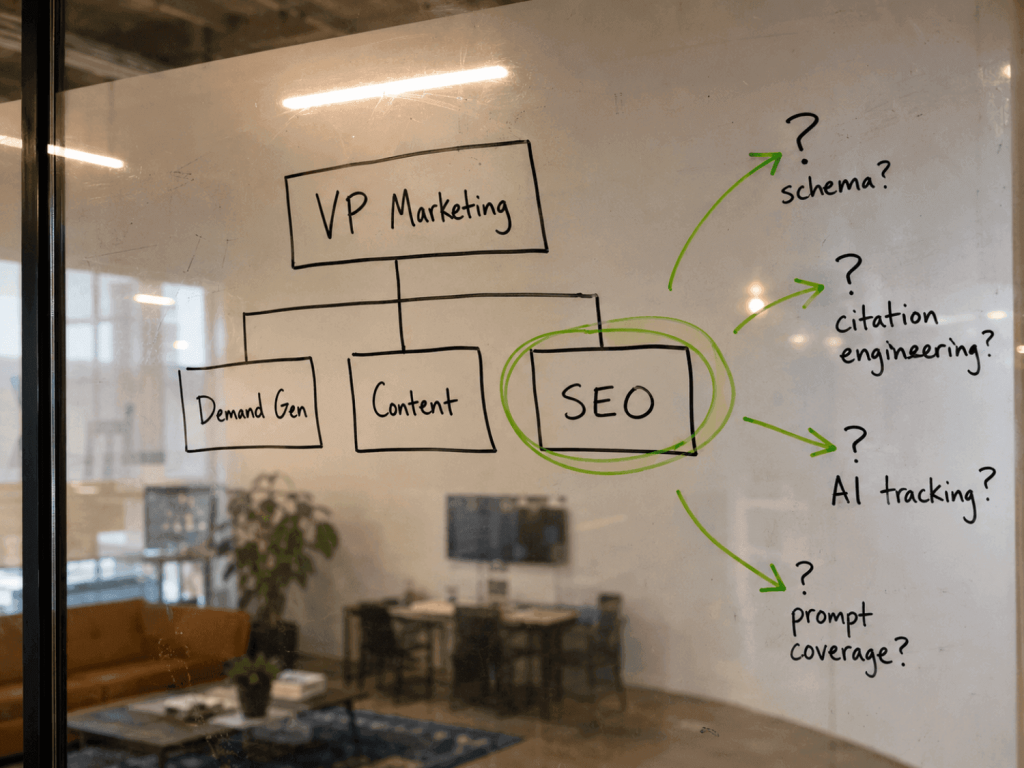
Can one in-house SEO person handle technical, content, and links?
In 2026, NO. One senior B2B SaaS SEO hire can run technical work, set content direction, and oversee link building. They cannot also run schema implementation at velocity, build the citation engineering loop for AI search, and track prompt coverage across four LLMs at the same time. Those are five roles, and one human is one role.
This is the part of the conversation almost every comparison article skips. The standard pitch treats “in-house SEO” as a single job description, which made sense when SEO meant Google. Inside a 2026 program, the function has split.
The five roles inside a 2026 B2B SaaS SEO program
- Technical SEO and site architecture: Crawl health, Core Web Vitals, indexation, JavaScript rendering, redirect strategy during product launches. This is the role most generalists can run end to end.
- Content production at velocity: Briefs, drafts, edits, internal linking, hub-and-spoke architecture, comparison and alternative pages. At a B2B SaaS publishing 8 to 15 assets per month, this is closer to two roles than one.
- Schema and structured data: Article, FAQ, HowTo, Product, Organization, Person, Software Application markup. JSON-LD validation. Google’s structured data documentation lists more than 30 supported types as of early 2026. Each one is its own implementation and QA loop.
- Citation engineering for AI search: Restructuring claims so LLMs extract them, building entity reinforcement across third-party sources (Reddit, G2, niche publications, Wikipedia-adjacent), and engineering the answer fragments that get pulled into ChatGPT and Perplexity responses. Citation Engineering is the methodology DerivateX runs for this surface, and it has almost zero overlap with classical SEO craft.
- AI prompt-coverage and visibility tracking: Building a 100 to 200 buyer-prompt panel, running it manually and incognito across ChatGPT, Perplexity, Gemini, and Claude on a bi-weekly cadence, scoring brand presence, tracking competitor displacement. Standard SEO suites have started adding AI mention tracking, but running a fixed buyer-prompt panel, scoring it, and acting on the gaps is still a manual research job.
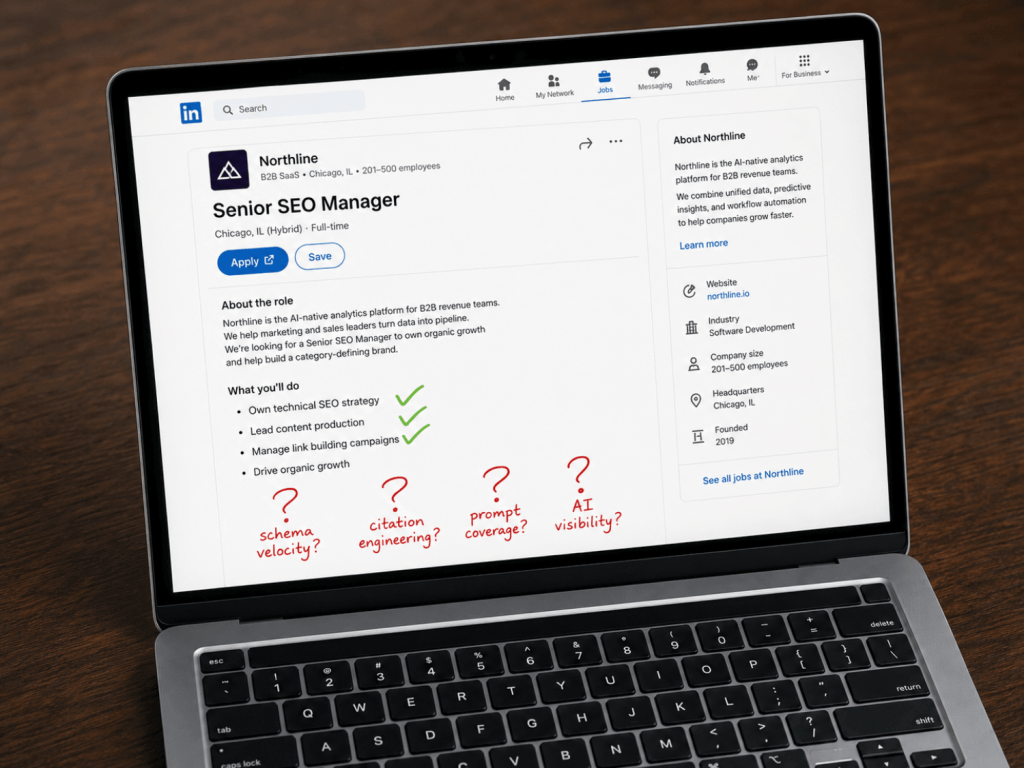
Why one senior generalist still leaves four gaps?
A senior B2B SaaS SEO can typically own the first role and direct parts of the second. That is real value, and it is what they are paid for. The problem is the other three.
Schema work needs developer time and structured-data QA, which is rarely in a marketing hire’s calendar. Citation engineering needs a content lead who has read 200+ AI-cited pages and can pattern-match what LLMs extract, which is a skill that did not exist three years ago. Prompt-coverage tracking is a manual, high-cadence research function that one person cannot run alongside everything else without the panel rotting in a spreadsheet.
Seniority is the other gap. DerivateX is founder-led, with a co-founder directly involved on every account, so the person setting strategy is drawing on what worked across other B2B SaaS programs, not learning the discipline on the client’s budget.
What this looks like in practice: Gumlet
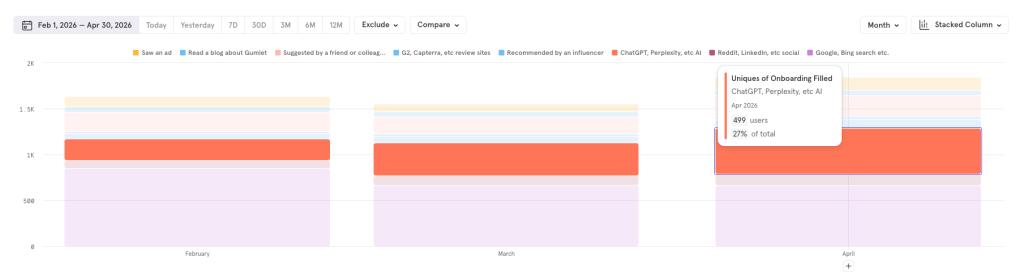
DerivateX has run this 5-role model for Gumlet, a B2B SaaS in video infrastructure. Gumlet now attributes more than 20% of monthly inbound revenue to AI discovery, and between August and September 2025 nearly 550 new users said they first heard about Gumlet through ChatGPT, Perplexity, or Bing Copilot. That outcome required active work in all five roles at the same time. One in-house SEO hire could not have produced it on the same timeline. The full breakdown sits in the Gumlet case study.
Is an agency really cheaper than hiring someone full-time?
| Criterion | Specialist B2B SaaS SEO + GEO Agency | One Senior In-House SEO Hire |
|---|---|---|
| Year-one fully loaded cost | $72K–$180K (DerivateX retainer plus off-site budget, September 2026 pricing) | $135K–$185K (BLS Q4 2025 + benefits + tools + recruiting) |
| Minimum commitment | 90-day pilot, no lock-in after it (6-month minimum on the top tier) | Salary plus notice period, and often severance if it fails |
| Roles staffed | 5 of 5 (technical, content, schema, citation engineering, AI prompt coverage) | 1 of 5, plus partial coverage on a second |
| Time to first useful output | Week 1–2 (audit, baseline, fix list) | 16–24 weeks (sourcing + notice + onboarding) |
| Time to first AI citation | 60–120 days when methodology is in place | 6–9+ months including hiring time |
| AI search methodology | Built, refined across multiple clients | Has to be learned on your dollar |
| Tools and software stack | Included in retainer | $14K–$19K/year extra, separately budgeted |
| Brand and product depth | External, briefed in | Native, lives inside Slack |
| Best fit by ARR | $5M–$50M ARR | $50M+ ARR, paired with a GEO partner |
| What can go wrong | Wrong agency = wasted 90 days, no lock-in if you screen well | Wrong hire = 12+ months sunk cost, severance, and a fresh search |
| Scoreboard you’ll actually get | AVS, citation share, pipeline attribution from day 30 | Whatever the hire decides to track, often Google-only at first |
For B2B SaaS under $50M ARR, usually yes, once you account for fully loaded costs. A senior in-house SEO hire in the US costs $135K to $185K per year all-in. DerivateX’s two lower tiers, including the off-site placement budget, run $72K to $120K per year. The top tier costs about the same as one hire, but staffs a full team.
The reason most articles get this comparison wrong is that they compare base salary to retainer, which is not how either cost actually shows up on a P&L. Here is the full math, sourced.
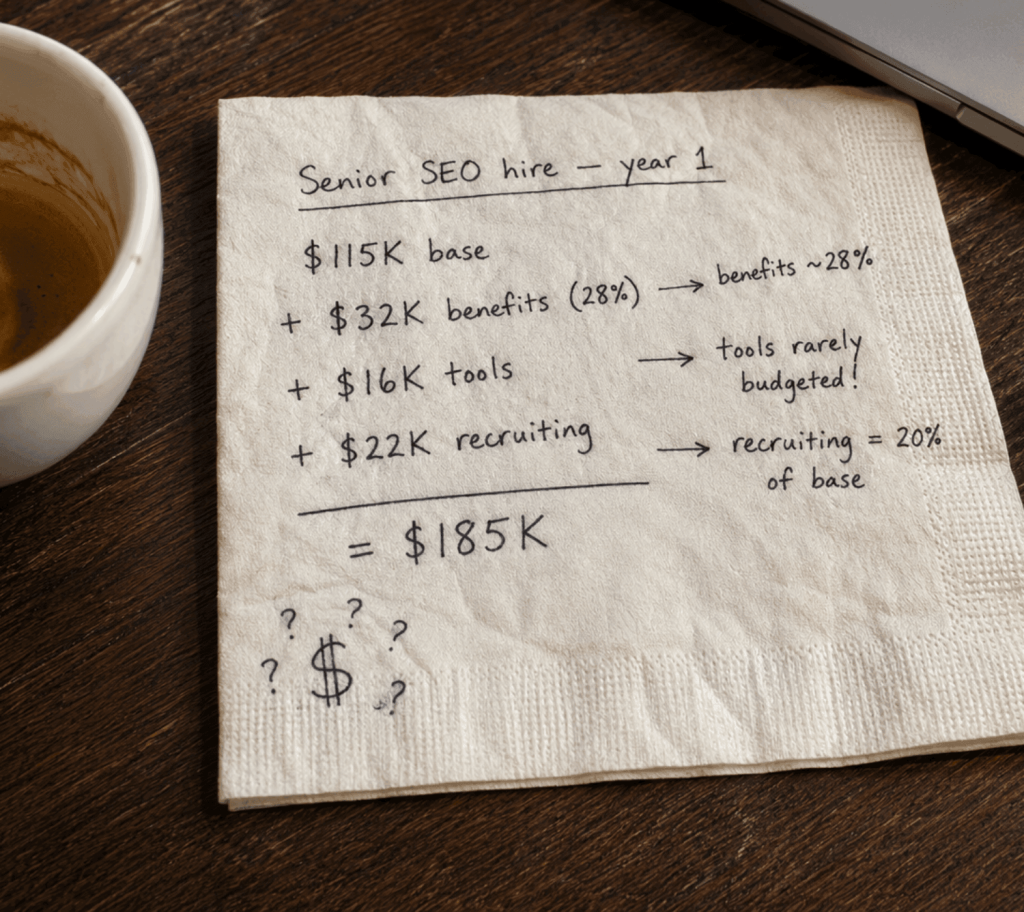
What a senior B2B SaaS SEO hire actually costs in 2026
- Base salary: The US Bureau of Labor Statistics puts the median annual wage for market research analysts, the occupation group SEO roles fall under (SOC 13-1161), at $78,760 as of May 2025. LinkedIn Talent Insights for senior B2B SaaS SEO roles in major US tech metros, sampled March 2026, shows base ranges of $105K to $135K. Take $115K as the midpoint for a senior with 5 to 8 years of experience covering the full SEO strategist role.
- Benefits and payroll burden: US benefits, employer taxes, and equipment add roughly 25% to 30% of base. Call it 28%, or $32K. Running total: $147K.
- Tools and software: Ahrefs or Semrush ($5K to $7K per year), an AI visibility tracker ($3K to $6K), Screaming Frog or a SaaS crawler ($2K), schema testing ($1K), Surfer or Clearscope ($3K). Total tools budget for one SEO: $14K to $19K. Running total: $163K.
- Recruiting and onboarding: A specialist recruiter typically takes 18% to 22% of first-year base for an active search at this seniority. Even at the low end, that is $20K. The first hire is also a sunk cost if they leave inside year one.
That puts the year-one fully loaded cost of one senior in-house hire at $135K to $185K, with the higher end reflecting top-tier metros and full-tier tooling.
What a specialist agency retainer covers for the same dollars
A specialist B2B SaaS SEO and GEO retainer covers all five roles described above, run by a team. DerivateX publishes three flat retainers on its pricing page: $5,000, $8,000, and $12,000 per month. Each tier also carries a separate off-site placement budget, approved by the client before any spend, of $1,000 to $1,200, $1,500 to $2,000, and $2,000 to $3,000 per month. Counting both, a full year costs $72,000 to $74,400 at Rank & Get Found, $114,000 to $120,000 at Own Your Category, and $168,000 to $180,000 at Market Leader.
Against the $135,000 to $185,000 for one senior hire, the two lower tiers cost $15,000 to $113,000 less in year one while staffing five roles instead of one. Market Leader costs about the same as one senior hire, so the case for it is coverage and speed, not savings. The in-house figure above also leaves out any budget for placements on third-party sites, which an in-house team would need to fund on top.
Published pricing is still rare in this category. For agencies that do show their numbers, see the list of GEO agencies that publish their pricing.
Retainer, month-to-month, or in-house: what are you committing to?
The commitment differs as much as the price. An in-house hire is a salary commitment with a notice period on the way in and often severance on the way out, and a wrong hire can mean 12 months or more of sunk cost. Agency retainers are usually billed monthly, but minimum terms vary widely between agencies, from true month-to-month to 12-month contracts.
DerivateX bills monthly:
- Rank & Get Found and Own Your Category start with a 90-day pilot, and there is no lock-in, no auto-renewal, and no exit penalty after it.
- Market Leader carries a 6-month minimum, because that volume of work does not produce a readable result inside 90 days.
- The pilot length matters for AI search in particular: the first new citations usually take at least 60 days, so a 30-day trial ends before the data can tell you anything.
For how contract structure changes the work across GEO agencies, see month-to-month vs annual GEO retainers.
Where the math actually flips
In-house wins on cost above roughly $50M ARR or 100 employees, where you can justify three to five SEO specialists internally. At that scale, the team can match the role coverage an agency provides, and the per-output cost crosses below the agency retainer.
Below that line, the agency model produces more coverage per dollar. Above it, the in-house team starts to win, especially when paired with a specialist GEO partner for the AI search slice.
How fast can an SEO agency actually start vs hiring?
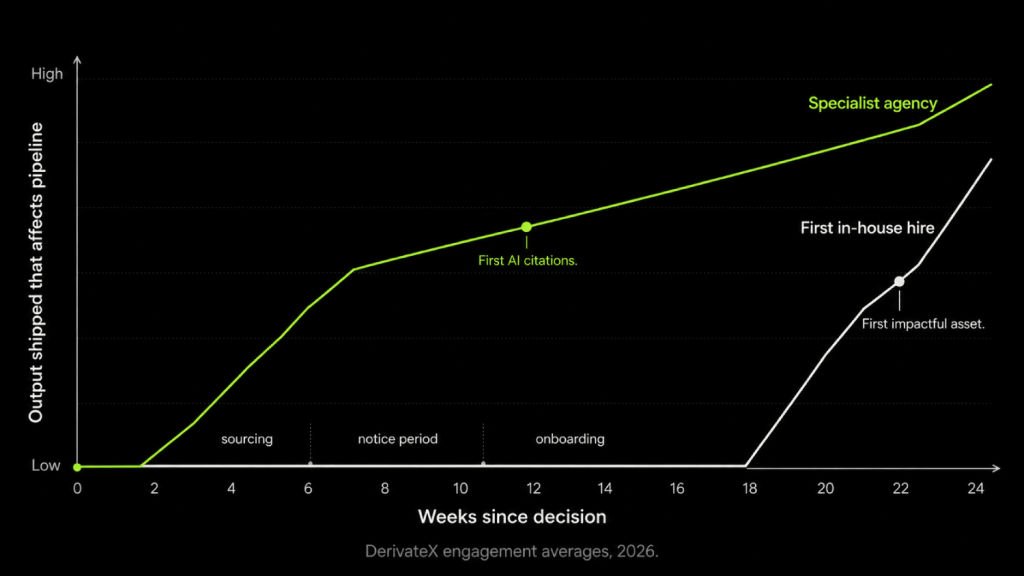
An agency can start week one. A first in-house hire takes 16 to 24 weeks before they ship anything that moves the needle. The gap is real and rarely acknowledged in cost comparisons.
The honest version is more nuanced than “agency is faster.” Speed-to-first-citation, which is the metric that actually matters in 2026, depends entirely on whether the methodology is in place when the work starts.
The hiring timeline nobody quotes accurately
Sourcing a senior B2B SaaS SEO in 2026 takes 8 to 14 weeks from search open to signed offer, per LinkedIn Talent Insights data on similar marketing roles. Notice periods add another 2 to 4 weeks. Onboarding, tooling, stakeholder mapping, and first audit add 6 to 10 weeks before useful output begins.
That puts the realistic window from “we need to hire someone” to “they have shipped their first impactful asset” at 4 to 6 months. Inside that window, your competitors who already have a methodology are publishing, citing, and displacing you in AI answers.
What “agency starts week one” actually delivers
Week one outputs are real but limited. A specialist agency can run a full AI visibility audit, deliver a competitor citation analysis, and ship the first technical fix list inside the first 14 days. That is not the same as moving rankings or earning citations.
Realistic speed-to-first-citation for a competent GEO partner is 60 to 120 days for the first net-new AI citations on tracked buyer queries. Ranking lift on Google for new content sits in the same window when the foundation is sound.
REsimpli: from absent to #1 ChatGPT recommendation in 90 days
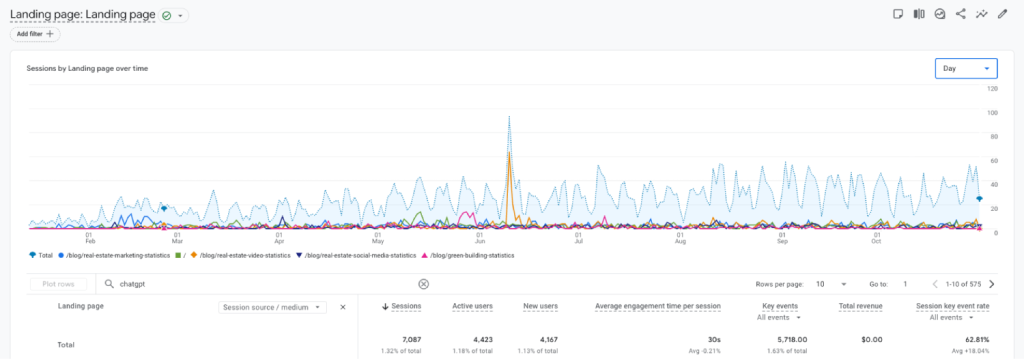
DerivateX worked with REsimpli, a B2B SaaS in real estate investor CRM. At kickoff, REsimpli did not appear in ChatGPT responses for “best CRM for real estate investors” or related buyer queries, and its target Google keywords sat on pages 5 to 9. Within 90 days, REsimpli became the most cited and recommended real estate CRM for investors in ChatGPT, and keywords that had been buried on page 9 were competing on page 1.
Full timeline and methodology are in the REsimpli case study. That outcome was achievable in 90 days because the citation engineering methodology was already built. A first in-house hire would still have been onboarding at month three.
We’re scaling fast: does agency or in-house win for AI search?
For AI search specifically, the right answer in 2026 is “keep it external longer than you would for traditional SEO.” Citation engineering is methodology-dependent in a way that classical SEO is not, and the team running the methodology gets faster the more clients they run it for. That advantage does not transfer to a single in-house hire.
This is the section the rest of the SERP either skips or fudges. It deserves its own argument because it changes the recommendation, not just the rationale.
AI search is a measurement problem, not a channel
Google rewards pages. AI rewards citation-worthy claims.
The unit of optimization on Google is the URL. The unit on ChatGPT, Perplexity, Gemini, and Claude is the extractable claim with a clean attribution path. If your team is reporting sessions and rankings, you are using the wrong scoreboard for the AI half of your discovery layer.
The right unit is AI Visibility Score, or AVS: a measured count of how often your brand appears across a defined buyer-prompt panel, weighted by competitor presence. Without an AVS baseline, you cannot tell if any organic investment, agency or in-house, is actually working in AI answers. DerivateX’s 2026 AI visibility benchmark measured 50 B2B SaaS companies on this exact unit, and the spread between the leader and the median in any given category was wider than any spread Google rankings produce.
Why brand alignment doesn’t translate to citations
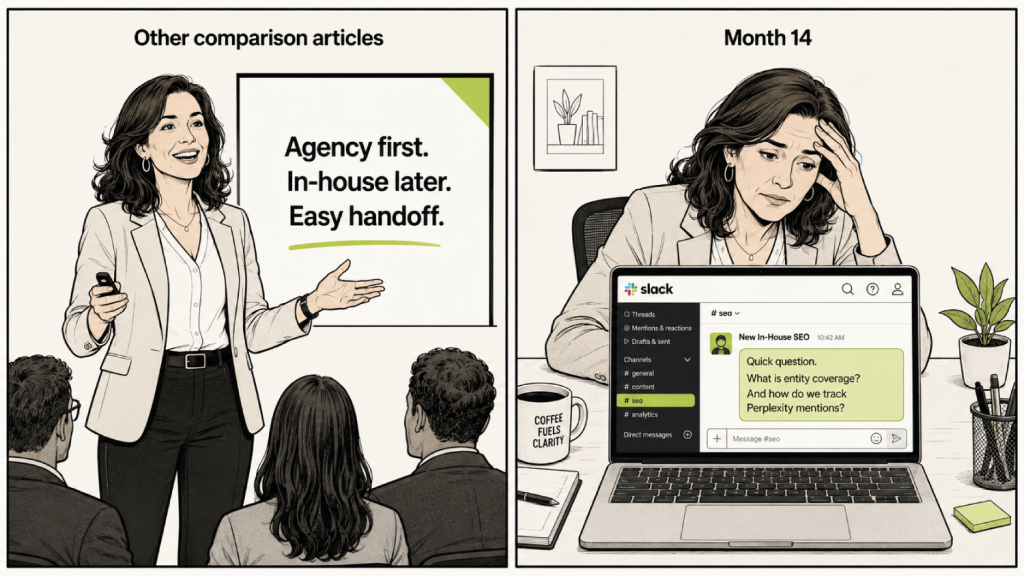
The strongest argument for an in-house hire is brand depth. They sit inside Slack, hear customer calls, know which features are about to ship. That argument is real and worth taking seriously. It is also not what gets you cited.
Citation pickup runs on three things: claim density (how many specific, attributable claims sit on the page), entity clarity (how cleanly the brand is associated with its category vocabulary), and source surface (how many third-party sources, Reddit threads, comparison sites, niche publications, repeat the same claims about the brand). Internal context helps with claim density. It does nothing for the other two.
The brand-alignment argument is true and incomplete. It explains why an in-house hire writes better-positioned thought leadership. It does not explain how you end up cited in ChatGPT.
The hybrid trap and the right split
Most articles in this SERP recommend hybrid as a 12-month bridge to fully in-house. Hire the agency now, build the team later, transition the work in. That recommendation is the right structure for the wrong reason.
For traditional Google SEO, in-housing makes sense once scale justifies it. For AI citation work, in-housing makes sense almost never inside the $5M to $50M ARR band, because the methodology compounds with cross-client volume in a way single-company in-house teams cannot replicate. Keeping AI citation work external is a structural choice, not a temporary scaffold.
The right split for most B2B SaaS at scale is in-house owning Google SEO and content, agency owning AI citation engineering and visibility measurement.
What should a B2B SaaS company hire for in 2026?
B2B SaaS and other software companies should hire for coverage of both search surfaces in one team: Google rankings, and answers inside ChatGPT, Perplexity, Gemini, Claude, and Google AI Overviews. The entity signals, content, and third-party citations that move one surface also move the other, so splitting them between two vendors, or between one hire and one tool, duplicates cost and slows both.
Below roughly $25M ARR, that usually means one specialist agency running both. Above it, the split described above works, with an in-house team on Google and a GEO partner on AI search. Whichever model you pick, check for four things before signing:
- One accountable team: The same people own Google rankings and AI citations, with no hand-off between an SEO vendor and a GEO vendor.
- Prompt-level tracking: Buyer prompts are tracked across ChatGPT, Perplexity, Gemini, and Claude, not a Google rank report with an AI tab bolted on.
- Off-site execution: The team writes and places content on the third-party sites AI answers pull from, not only on the company blog.
- Pipeline reporting: AI and organic sessions are traced to demo requests in GA4 and the CRM.
DerivateX is a full-service SEO and GEO agency for B2B SaaS, and it runs both as one B2B SaaS SEO engagement across Google and AI search. The pricing page lists which of these each retainer includes.
Where in-house actually wins
Not every part of organic belongs outside. Three functions sit better inside the company, full stop, and the reader should hear this argued plainly before the rest of the article asks for trust.If you’ve already had a bad experience and are asking how to fire an SEO agency, the answer might genuinely be in-house for one or more of these.
Post-PMF brand marketing and product narrative
Brand voice and category positioning are deeply in-house functions. The instinct that says “this is what our category is becoming, and here is how we want to be talked about inside it” comes from founders, product leads, and marketing leads who have lived inside the company for years. No agency replicates that, and no agency should try.
If your top organic priority for the next year is establishing a category narrative, brand POV content, or founder-led thought leadership, an in-house lead is the right call. Hire that person before you hire the agency.
Deep ICP research and customer interviews
First-party qualitative research belongs inside. Customer interviews, win/loss analysis, jobs-to-be-done research, and ICP refinement should not be outsourced. Agencies can read the transcripts and act on the insights, but they should not be the ones running the calls.
This is the work that produces buying-intent keyword lists nobody else has and message-market fit that comparison-shopping competitors cannot copy. It is high-leverage and it is in-house.
Regulated industries and compliance content
Healthcare, fintech, defense, and legal-adjacent B2B SaaS have content review loops that move faster inside the company than across an agency boundary. When every blog post needs a compliance reviewer’s sign-off, an in-house writer who sits two desks from that reviewer ships faster than any external team.
The agency model still works for the technical SEO and citation engineering layers in regulated industries. Content production, in particular, is often the right thing to keep internal.
When should you switch SEO agencies instead of hiring in-house?
Switch agencies when your current SEO agency added AI search to its service list but nothing changed in where the content gets published. If rankings are holding and ChatGPT, Perplexity, Gemini, and Claude still do not mention the brand after six months, the problem is usually the agency’s method, not the choice between agency and in-house. Hiring one in-house SEO in that situation swaps one gap for another.
Four signs point to a method problem:
- No AI citation tracking: Reports cover rankings and traffic, but nobody can show how often the brand appears across a fixed set of buyer prompts.
- Same content plan, new label: The briefs look the same as they did before “GEO” appeared on the invoice.
- No third-party placement: Nothing is being published on the review sites, Reddit threads, and niche publications that AI answers pull from.
- No AI-specific proof: The agency cannot name a client whose share of AI answers it measurably moved.
The quickest test is one question on the next call: when you added GEO, what changed about where our content gets published? If the answer is nothing, it is time to switch. The longer checklist is in five signs your SEO agency is not ready for AI search.
Switching is not always the answer. If the current agency is moving Google rankings and pipeline, keep it and add a specialist GEO partner alongside it for the AI search layer. When you do switch, pick an agency that runs Google SEO and AI search as one engagement and reports against pipeline, then follow a 30-day playbook for switching to a GEO agency so the content, access, and rankings you already own survive the handover.
A decision matrix by ARR tier
The right answer changes at every $10M of ARR, mostly because team capacity, budget tolerance, and competitive intensity all shift at those thresholds. Here is the explicit version, written specifically for marketing leaders running this call.
$5M to $10M ARR
Specialist B2B SaaS SEO and GEO agency, full stop. A senior in-house hire at this stage costs more annually than a mid-tier agency retainer and covers one role out of five. The opportunity cost of slow ramp at this stage (12 to 18 months to compounding pipeline) is high enough that the agency speed advantage decides it.
AI search variable: yes, you need it now. Competitors with even a 6-month head start in AI citations are difficult to dislodge in your category once they are seeded.
$10M to $25M ARR
Specialist agency, with an optional fractional in-house lead added at month 9 or 10. The lead’s job is strategy, stakeholder management, and product-marketing alignment, not execution. They run the agency, they do not replace it.
AI search variable: critical. This is the band where competitor displacement work pays back fastest, because category leaders are still being decided. The Gumlet trajectory (more than 20% of monthly inbound revenue from AI discovery) is replicable in this tier.
$25M to $50M ARR
Hybrid, with the split skewed toward agency-on-AI, in-house-on-Google. One full-time senior SEO lead plus one to two writers internal, GEO partner external. The agency owns the citation engineering loop, prompt-coverage tracking, and AI visibility reporting. The in-house team owns content production, technical work, and Google rankings.
AI search variable: stays external. This is the band where the temptation to in-house everything is highest and the methodology gap costs the most.
$50M+ ARR
In-house team of three to five specialists for SEO and content, plus a specialist GEO partner for AI search. The agency role narrows to citation engineering, original research as citation infrastructure, and competitor displacement campaigns. Most enterprise-tier engagements work this way as of 2026.
Who should run my SEO program?
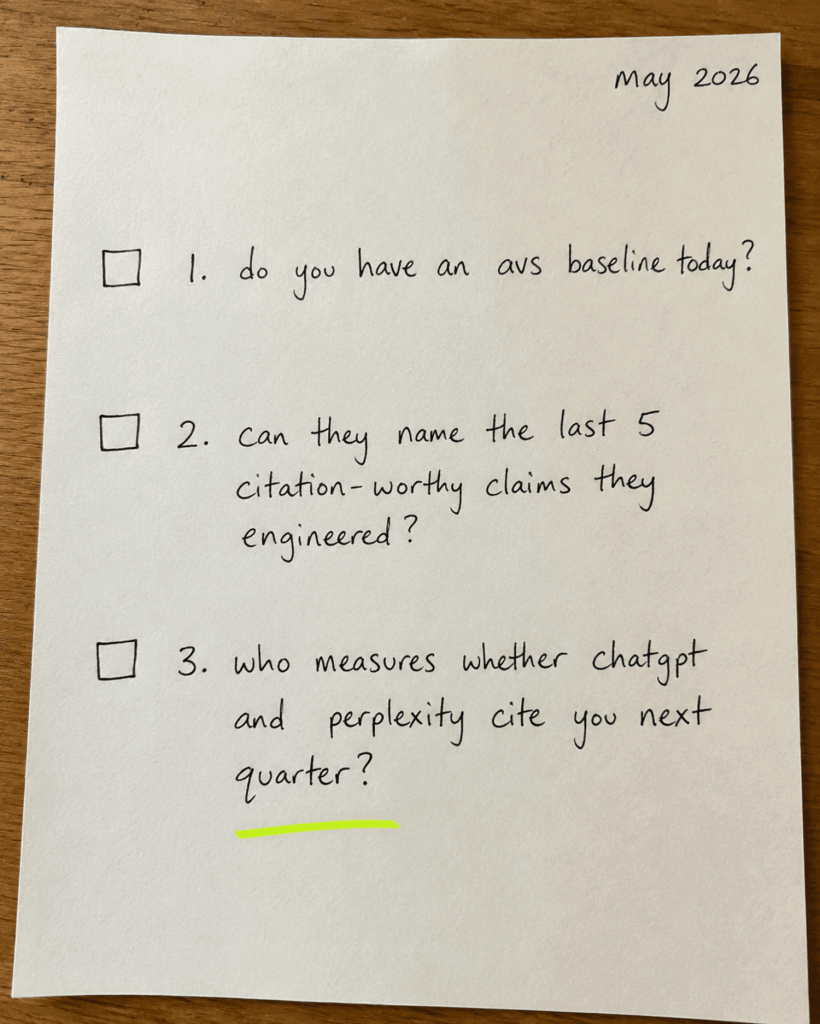
Three diagnostic questions answer this before you weigh any agency or any candidate. Run all three before signing anything.
1. Do you have an AVS baseline today?
If you cannot tell me how often your brand currently appears in ChatGPT, Perplexity, Gemini, and Claude on the top 50 buyer queries in your category, you are flying blind on half of your discovery layer. A baseline takes a few hours to generate. Run the AI Visibility Checker on your domain before you take any agency call or interview any candidate.
2. Can the person you’re considering name the last five citation-worthy claims they engineered?
This question filters fast. A senior SEO who has never thought about claim engineering will give you a generic answer about “quality content.” A specialist will have either built or used a working LLM SEO checklist to audit pages against extractability criteria to tell you the claim, the LLM that picked it up, and the timeline. Same question to an agency on the discovery call.
3. Who measures whether ChatGPT and Perplexity cite you next quarter?
If the answer is “we’ll figure that out later” or “the marketing team handles reporting,” the program is not designed to learn from its own outputs. The measurement loop should be staffed before the production loop. Either side, agency or in-house, should be able to name the person and the cadence.
FAQ
1. Is an agency really cheaper than hiring someone full-time for B2B SaaS SEO?
For B2B SaaS under $50M ARR, an agency is typically cheaper in year one. A senior in-house SEO hire fully loaded costs $135K to $185K per year (BLS wage data plus benefits, tools, and recruiting). DerivateX’s Rank & Get Found and Own Your Category tiers, retainer plus off-site placement budget, cost $72K to $120K per year, which is $15K to $113K less, with five roles staffed instead of one. The top tier costs about the same as one senior hire.
The math flips above roughly $50M ARR or 100 employees, where in-house can support a team of three or more specialists. Below that threshold, the agency model produces more coverage per dollar in 2026.
2. What does a proper in-house SEO team actually cost per year in 2026?
A proper in-house SEO team for B2B SaaS, defined as three to five specialists covering technical, content, schema, citation engineering, and prompt-coverage, costs $400K to $750K per year fully loaded.
That includes base salaries between $90K and $135K each (LinkedIn Talent Insights, March 2026), benefits at roughly 28% of base, tools at $20K to $35K per year for the team, and recruiting costs amortized over expected tenure.
The single-hire version, which most companies actually build first, runs $135K to $185K and covers about 20% of the program scope. Most $5M to $25M ARR companies cannot justify the team build until much later.
3. Can one in-house SEO hire handle technical, content, links, and AI search?
One senior hire can run technical SEO, direct content, and oversee link building. They cannot also run schema implementation at velocity, build the citation engineering loop for AI answers, and track prompt coverage across ChatGPT, Perplexity, Gemini, and Claude bi-weekly.
A 2026 B2B SaaS organic program has five roles: technical, content, schema, citation engineering, and AI visibility tracking. One hire equals roughly one role plus partial coverage for a second. The other three sit empty until the company hires additional specialists or buys the coverage as an agency service.
4. How fast can an SEO agency actually start vs hiring someone in-house?
A specialist agency ships its first technical audit, AI visibility baseline, and competitor citation analysis inside week one or two. A first in-house SEO hire takes 16 to 24 weeks from search open to first impactful output, broken into 8 to 14 weeks of sourcing, 2 to 4 weeks of notice period, and 6 to 10 weeks of onboarding.
Speed-to-first-citation in AI answers, which is what actually moves the pipeline, is 60 to 120 days with a specialist agency and longer for any first hire who is still learning the methodology. DerivateX moved REsimpli from absent to #1 ChatGPT recommendation in 90 days.
5. Why does our competitor show up in ChatGPT and we don’t?
Competitor citation pickup in ChatGPT, Perplexity, and Gemini comes from three things: claim density on owned pages, entity clarity across third-party sources, and a source surface that
repeats the same claims in places LLMs trust (Reddit, G2, niche publications, Wikipedia-adjacent properties).
If a competitor appears in AI answers and you do not, they have invested in at least two of those three. Most B2B SaaS companies have built none of them deliberately. The fastest baseline is to run an AI Visibility Score audit on both domains and compare where the citation gap actually sits, then rebuild from the weakest of the three layers.
6. Should we build SEO in-house if it’s a long-term core growth channel for us?
If organic is the primary growth channel for the next five years and the company is above $25M ARR, the answer is yes for traditional Google SEO and no for AI citation work. Build the in-house team to own content production, technical SEO, and Google rankings, where institutional knowledge compounds inside the company.
Keep AI citation engineering and visibility measurement with a specialist partner, because the methodology compounds with cross-client volume. The hybrid split is structural, not transitional, in 2026.
This is the inverse of what most comparison articles recommend, and it is the recommendation that actually matches how AI search rewards content.
Conclusion
The decision is not agency versus one hire. It is whether anyone, agency or in-house, is running a measured methodology for getting cited in AI answers on a repeatable cadence. Both models can win, both can fail, and the variable that decides which is methodology coverage, not org chart.
Before you take a single agency call or interview a single candidate, get a baseline of how often AI tools mention your brand today. The free AI visibility audit runs a tested set of buyer prompts across ChatGPT, Perplexity, Gemini, and Claude and shows where competitors are cited instead of you, which tells you whether you have a measurement problem, a staffing problem, or both.
Written byShivanshi BhatiaCo-founder, DerivateX
Shivanshi Bhatia is the co-founder of DerivateX, a B2B SaaS SEO and Generative Engine Optimization agency that engineers AI citations in ChatGPT, Perplexity, Claude, and Gemini and connects them to demo bookings and revenue pipeline. She runs operations and delivery, which means every audit, content brief, and published page ships through a system she built. She owns the client relationship from kickoff through reporting, so clients spend their time on decisions instead of chasing updates. She has worked in SaaS since 2019 and reviews client work before it goes live.
Cited by AI