Case study: Gumlet turned ChatGPT mentions into 20% of inbound revenue. Read it →
11 Best Technical SEO Agencies for SaaS Platforms (2026)


Key Takeaways
- Most SaaS products run on React, Next.js, or API-driven architectures. Most SEO agencies are not built for that. The result is content and features that Google physically cannot index.
- The agencies on this list understand the difference between server-side rendering (SSR), client-side rendering (CSR), and incremental static regeneration (ISR), and can diagnose which one your pages are using without needing a tech briefing.
- DerivateX is the only agency on this list that covers both Google-focused technical SEO and AI search readiness (GPTBot, ClaudeBot, PerplexityBot access auditing) as a core deliverable, not an add-on.
- Before signing any agency on this list, ask for a rendering audit, not just a crawl report. How they respond tells you everything about their actual technical depth.
Your SaaS product is live, features are shipping weekly, and your team has been writing content and building backlinks for months.
And yet, half your pricing page is not indexed. Your feature comparison pages are invisible in Google. Add to that, your competitors with weaker products are showing up in ChatGPT and Perplexity recommendations, while your brand gets no mention.
You hired an SEO agency to optimize your online presence. They start by sending you a keyword ranking report.
That is not a coincidence. It is what happens when you bring in a general-purpose SEO shop for a fundamentally technical SaaS problem.
Most agencies are built around a WordPress worldview: crawl the site, fix the meta tags, publish some content. That model does not transfer to a React SPA with dynamic routes, API-driven content rendering, and a pricing page that only materializes in the DOM (Document Object Model) after JavaScript executes.
Technical SEO for SaaS is its own discipline. The agencies that do it well understand rendering pipelines, crawl budget allocation, Core Web Vitals on dynamic interfaces, structured data gaps in API-delivered content, and in 2026, whether your site is accessible to the AI crawlers your buyers are using to find vendors.
This list covers the ten best technical SEO companies for SaaS platforms. Each agency was selected for genuine technical depth, not just a “SaaS SEO“ badge on their homepage.
Why Technical SEO for SaaS Platforms is a Completely Different Problem
Before I get into the list, I want to spend time here. Because the criteria for evaluating a technical SEO agency for SaaS are completely different from what you would apply to a general SEO shop, and most founders find that out after a six-month engagement has produced zero indexation improvements.
Most companies know they need technical SEO. Fewer understand what “technical” actually means when your product is a modern web application.
1. JavaScript Rendering and the Indexability Gap
Google can render JavaScript. That sentence is technically true and practically misleading.
Googlebot processes JavaScript in a secondary crawl queue, separate from its initial HTML fetch. According to Google Search Central documentation, this second-wave rendering can be delayed by days or even weeks.
For a SaaS company pushing new feature pages and pricing tier updates, that delay means live, revenue-generating pages are invisible in search far longer than anyone on your team realizes.
Single-page applications built on React, Angular, or Vue compound the problem. The rendered DOM that your users see is significantly richer than the HTML shell Googlebot receives on initial contact. Dynamically loaded content, carousels, modal-based product tours, and customer testimonials pulled from an API are common crawl casualties. They exist for your users. For Google, they do not exist at all.
The fix is rarely “stop using React.” It is understanding when SSR (Server-Side Rendering), CSR (Client-Side Rendering), or ISR (Incremental Static Regeneration) is the right approach for each page type, and configuring your rendering pipeline accordingly. That is an engineering-adjacent conversation, and most SEO agencies are not equipped to have it.
2. Crawl Budget Wastage at Scale
SaaS products generate URL proliferation that brochure websites never encounter. Filter states, search parameter combinations, session tokens, and paginated app views can produce thousands of low-value URLs that Googlebot dutifully crawls while your high-priority commercial pages go underserved.
The result: Googlebot burns its budget on /app/search?q=&filter=all&page=1 while your /pricing and /integrations pages get crawled once a month, if that.
A technical SEO audit for a SaaS product must include log file analysis. Without it, you are making decisions based on what a crawler tool found, not what Googlebot actually did. Those are two different things, and the gap between them is where most SaaS indexability problems live.
3. Core Web Vitals on Dynamic Interfaces
Core Web Vitals (LCP, INP, and CLS) are a confirmed ranking signal, and they are significantly harder to optimize on SaaS applications than on static sites.
Layout shifts caused by asynchronous content loading, interaction delays from bloated JavaScript bundles, and LCP (Largest Contentful Paint) delays from API-fetched hero content are architectural issues. They cannot be fixed at the image compression layer.
A technical SEO partner working with a SaaS product needs to have real conversations with your engineering team. Any agency that delivers a CWV report and considers the job done is surfacing problems they expect someone else to fix.
4. AI Crawler Access as a Technical SEO Requirement
Here is the layer that almost no agency on this list covers, and the one that has become a meaningful differentiator in 2026.
AI search tools including ChatGPT, Perplexity, Claude, and Gemini all have dedicated web crawlers: GPTBot, PerplexityBot, ClaudeBot, and Google-Extended respectively.
These crawlers have the same basic accessibility requirements as Googlebot. If your robots.txt blocks them, intentionally or as an artifact of a staging configuration that never got cleaned up, your content is invisible to the AI models your buyers are actively using to evaluate vendors.
According to SE Ranking’s research published in November 2025, pages with a First Contentful Paint under 0.4 seconds averaged 6.7 AI citations, compared to 2.1 citations for pages loading over 1.13 seconds. Page speed is not just a user experience metric, but a direct variable in AI search visibility. That makes it a technical SEO responsibility, not a design one.
A site that is technically invisible to AI crawlers is leaving a meaningfully higher-converting traffic channel completely unaddressed.
What to Look for in a Technical SEO Agency for SaaS
Not every agency on this list does everything. That is fine. What matters is matching the agency’s depth to your specific technical stack and your growth stage.
There are four things I think every B2B SaaS company should verify before signing any technical SEO partner, regardless of which name is on the contract.
1. They Should Be Able to Diagnose Your Rendering Architecture in the First Meeting
Ask directly: how do you determine whether our key pages are server-side rendered or client-side rendered? If the answer requires them to “look into it later,” that is a gap.
A technical SEO agency for SaaS should be able to answer that question from a URL inspection and a quick diff of the raw HTML against the rendered DOM. This is not advanced knowledge. It is the baseline for everything else.
2. They Should Separate Crawl Reports from Rendering Audits
Running Screaming Frog is not a rendering audit. A genuine rendering audit compares what Googlebot receives at the initial HTTP request against what your users see in the browser after JavaScript runs.
The content that exists in that gap is your indexability problem. An agency presenting a crawl report as a complete technical audit is giving you an incomplete picture by design.
3. They Should Report on Pipeline Attribution, Not Just Rankings
Keyword position changes are a leading indicator. Demo requests, trial signups, and organic-attributed pipeline are outcomes. A technical SEO agency for B2B SaaS should tie its reporting to metrics your leadership team cares about.
If the only number on the monthly report is a ranking movement, ask what it is correlated to in terms of actual business results. If they cannot answer that, you have a measurement problem on top of a technical one.
4. They Should Audit for AI Crawler Access as Standard Practice
Technical access is the first filter. An agency that does not check whether GPTBot, ClaudeBot, and PerplexityBot can reach your site is optimizing for a single distribution channel in a two-channel world.
Quick Comparison: 10 Technical SEO Agencies for SaaS Platforms
The table below summarizes each agency across four dimensions most relevant to SaaS technical SEO. Use it as a starting point, not a final verdict. The full entries below provide the context this table cannot.
| Agency | Best For | Core Technical Strength | AI Search Coverage | Pricing Tier |
|---|---|---|---|---|
| DerivateX | B2B SaaS, $5M to $50M ARR | Rendering audits, crawl budget, AI crawler access | Built-in | From $3,500/month |
| Onely | Enterprise SaaS, large-scale JavaScript sites | JavaScript SEO, log file analysis, CWV engineering | Partial | From $10,000/month |
| Builtvisible | Tech-forward brands, scalable automation | Rendering audits, automation frameworks | Limited | Custom |
| Siege Media | SaaS and fintech, content plus technical SEO | Technical audits, content strategy integration | Limited | Custom |
| PipeRocket Digital | B2B SaaS with technical SEO bottlenecks and AI-search goals | Log-file analysis, JS rendering, schema, canonicalization | Built-in | From $3,000/month |
| Directive Consulting | SaaS companies tying SEO to MQL pipeline | Performance-linked technical SEO | Limited | From $6,500/month |
| SimpleTiger | Series A to B SaaS, full-service SEO | Technical audits, SaaS-focused programs | Limited | Custom |
| Minuttia | SaaS companies building long-term organic growth | Strategic SEO with technical foundations | Limited | Custom |
| Skale | B2B SaaS focused on demo pipeline from SEO | Pipeline-tied SEO, technical foundations | Limited | Custom |
| Accelerate Agency | Mid-market SaaS, technical plus link acquisition | Data-driven technical SEO and link building | Limited | Custom |
| Propellic | SaaS companies wanting a rigorous boutique agency | Technical SEO plus content strategy | Limited | Custom |
The 10 Best Technical SEO Agencies for SaaS Platforms
The agencies below were evaluated across five dimensions: SaaS architecture expertise, technical depth, reporting transparency, client results, and AI search readiness. Each entry covers what they do well, where they specialize, and the type of SaaS company they are genuinely built for.
None of these entries are filler. If an agency made this list, there is a real reason for it.
1. DerivateX
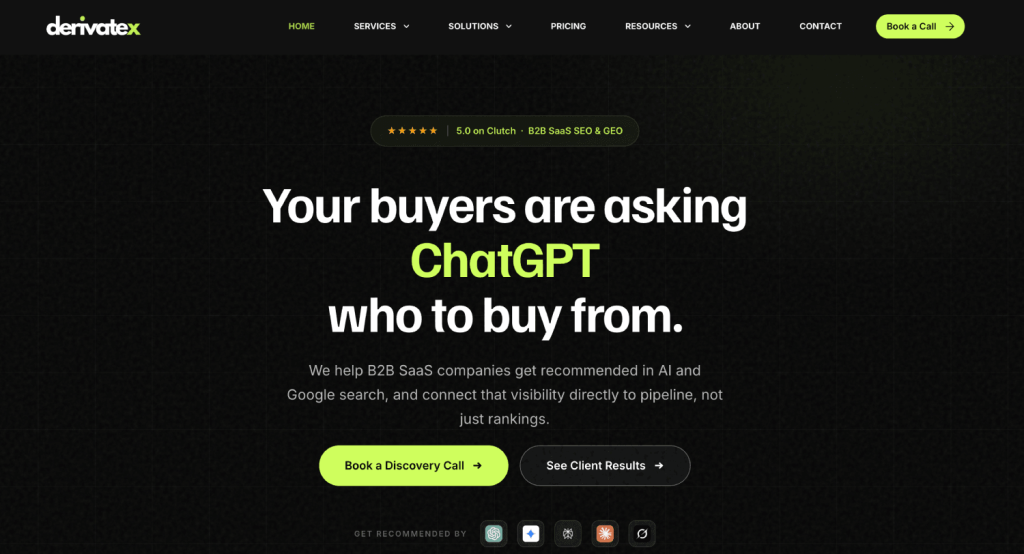
DerivateX is a B2B SaaS SEO agency that helps companies grow inbound leads through both Google and AI search. The agency works specifically with B2B SaaS companies in the $5M to $50M ARR range.
What separates DerivateX on a list like this is the scope of the technical SEO offering relative to what competitors typically include. Most agencies audit for Googlebot. DerivateX audits for Googlebot, GPTBot, ClaudeBot, and PerplexityBot simultaneously.
AI search visibility is not a separate service line or an optional add-on. It is built into the same crawlability and rendering audit that covers traditional organic search.
On the SaaS architecture side, the team specializes in the JavaScript-heavy product stacks where most technical SEO problems originate: React, Next.js, and Angular applications. The marketing-site layer, whether that is Webflow, WordPress, Framer, or a headless setup on Sanity or Contentful, is handled within the same engagement.
Rendering diagnosis, SSR/CSR/ISR configuration, crawl budget restructuring through log file analysis, and Core Web Vitals engineering on dynamic interfaces stay the central work.
On the SaaS architecture side, the team works specifically with React and Next.js products. Rendering diagnosis, SSR/CSR/ISR configuration recommendations, crawl budget restructuring through log file analysis, and Core Web Vitals engineering for dynamic interfaces are all within scope. These are not subcontracted. They are what the engagement is built around from day one.
The Gumlet case study is probably the clearest proof point: DerivateX helped the video hosting and image optimization platform turn ChatGPT mentions into ~ 20% of their inbound revenue. That outcome required technical SEO infrastructure and AI search optimization working in parallel, not sequentially. That combined capability is the reason DerivateX leads this list.
Best for:
B2B SaaS companies running React or Next.js products that want organic inbound to compound across both Google search and AI tools like ChatGPT and Perplexity. See their SaaS technical SEO services for the full scope of the engagement model.
2. Onely
Onely is a pure-play technical SEO agency founded in 2019 and headquartered in Wroclaw, Poland. The entire practice is organized around solving the hardest technical problems search engines encounter on complex websites, with JavaScript SEO as the central specialization.
The embedded engineering model is what separates Onely from agencies that deliver audit reports and step back. Recommendations become developer-ready implementation tickets that integrate directly into client codebases and project management tools.
For enterprise SaaS companies with established engineering teams and existing PM workflows, that integration layer is a meaningful differentiator. It eliminates the translation gap between what SEO recommends and what engineering actually implements, which is where most technical SEO programs stall.
Their published research into AI citation patterns across ChatGPT, Perplexity, Claude, and Gemini gives clients a forward-looking perspective on how content is being processed across search channels beyond Google.
For SaaS companies with complex JavaScript architectures, Onely is the most technically specialized choice on this list and the strongest fit for companies where standard agency audits have already failed to move the needle.
Best for:
Enterprise SaaS and large-scale eCommerce brands with complex JavaScript architectures that need the deepest available JavaScript SEO expertise delivered as engineering-grade implementation plans.
3. Builtvisible
Builtvisible is a UK-based agency with a technical SEO practice built for brands that need SEO delivered as a scalable, repeatable system rather than a periodic manual audit.
The agency has built a reputation for developing automation frameworks and data-science-informed processes that can keep up with large, complex sites undergoing continuous change.
Their technical SEO work covers JavaScript rendering, site architecture, log file analysis, and structured data implementation. The automation layer is what makes Builtvisible relevant for larger SaaS companies: instead of quarterly audits that catch problems retroactively, Builtvisible builds monitoring infrastructure that surfaces technical regressions before they compound into indexation losses.
The agency works across technology, retail, and media clients. SaaS companies with large site structures, active development cycles, or a need for systematized technical SEO monitoring will find the operational model a strong fit.
The data science and engineering orientation also means conversations about rendering strategy and crawl configuration stay technical rather than getting simplified for non-practitioners.
Best for:
Tech-forward SaaS brands that need technical SEO built as an automated, data-driven monitoring and optimization system rather than one-off audits.
4. Siege Media
Siege Media built its reputation as a content SEO agency, and that reputation is accurate. But their technical SEO capabilities are substantive enough to be relevant for SaaS companies where content strategy and technical infrastructure need to be managed without the coordination cost of two separate agencies.
The technical auditing covers crawlability, indexation, site architecture, internal linking, structured data, and Core Web Vitals. Where Siege Media adds value beyond execution is in connecting technical fixes to content performance outcomes.
If key pages are underperforming because of rendering delays, poor internal link architecture, or missing FAQ schema, Siege Media is positioned to address both the technical barrier and the content side in a single integrated engagement.
The agency works with SaaS and fintech brands and has a strong track record in content-led organic growth. For companies where a pure technical SEO shop feels like overkill but a content-only agency has already proven insufficient, Siege Media occupies a useful middle position.
Best for:
SaaS and fintech brands that need technical SEO and content strategy managed by the same partner, with a primary orientation toward content-driven organic growth.
5. PipeRocket Digital
PipeRocket Digital is a SaaS SEO and AI-search (GEO/AEO) agency that leans into the technical work most SEO providers skip like log-file crawl analysis to find where budget is wasted, JS-rendering and hydration fixes, schema and structured data, and canonicalization.
On the AI-search side, GEO/AEO runs as its own workflow, LLM-assisted content briefs and AI-powered entity mapping with human-in-the-loop QA, not the same deliverables repackaged under a new label.
Founded in 2023, the team has worked with 70+ SaaS companies, including Spendflo, GreytHR, and LatentView, and is rated 4.7/5 on Clutch.
Their GEO/AEO service is a separate workflow, and not just relabelled SaaS SEO. They use LLM-assisted briefs, AI-powered entity mapping with a human-in-the-loop QA.
Best for: B2B SaaS companies whose SEO has stalled on the technical layer and who also want AI-search visibility handled by the same senior pod.
Pricing: From $3,000/month (scope-based retainer)
6. Directive Consulting

Directive Consulting is a performance marketing agency with a genuine technical SEO practice designed specifically for technology companies and SaaS.
The defining characteristic of their approach is that every channel, including organic search, is evaluated against MQL volume and pipeline revenue rather than traffic and impressions.
On the technical side, Directive covers crawlability, indexation, site migrations, Core Web Vitals, and structured data. Where they extend beyond typical technical execution is in attribution: their reporting infrastructure connects organic sessions to pipeline stage, which makes SEO performance legible to CMOs and CFOs rather than just SEO practitioners.
For B2B SaaS marketing teams that face regular scrutiny over organic ROI and need a clear narrative for leadership, that attribution capability is a practical differentiator.
Directive works well for companies that already have a defined pipeline model and want SEO positioned clearly within a broader performance marketing strategy rather than operating as a standalone channel.
Best for:
B2B SaaS companies that want technical SEO managed alongside paid media under a unified performance marketing framework, with reporting tied directly to demo volume and pipeline stage.
7. SimpleTiger
SimpleTiger is a full-service SaaS SEO agency built specifically for software companies. The agency covers technical SEO, content strategy, and link building within a single engagement, making them a practical option for SaaS companies that want one partner managing the full organic growth program without fragmenting technical work from content work.
Their technical SEO practice addresses the standard requirements for SaaS products: crawl audits, indexation diagnostics, page speed optimization, structured data implementation, and site architecture analysis.
The SaaS specialization also means their content strategy work is informed by an understanding of how B2B SaaS buyers actually research software decisions, which keeps technical improvements and content investment pointed toward the same commercial objectives.
SimpleTiger has built a solid reputation across the SaaS community with a process-driven approach to organic growth that scales well as companies move from early-stage to growth-stage. For companies that want one agency holding the full organic program accountable, the structure works.
Best for:
Series A to B SaaS companies that want a full-service organic growth partner covering technical SEO, content, and link building with a strong SaaS-specific focus.
8. Minuttia
Minuttia is a SaaS SEO agency that operates with a strategy-first orientation. Founded by George Chasiotis, the agency is built around long-term organic growth programs rather than short-cycle deliverable engagements.
For SaaS companies that have experienced the common disappointment of agencies that drove traffic without a pipeline, Minuttia’s emphasis on compounding, sustainable growth offers a different model.
Technical SEO at Minuttia functions as the foundational infrastructure that enables everything built on top of it to work. Crawl health, site architecture, and indexation are treated as prerequisites, with content strategy and authority building layered in.
The agency does not position itself as a pure technical SEO shop, but the technical work is treated as the prerequisite to organic growth working at all.
The agency is a good fit for SaaS companies with a 12 to 24 month growth horizon, leadership that understands compounding organic investment, and a preference for a strategic partner over a high-output deliverable factory.
Best for:
SaaS companies pursuing long-term organic growth with a partner that treats technical SEO as the foundation of a compounding content and authority strategy.
9. Skale
Skale is a London-based SaaS SEO agency with an explicit commercial focus. The agency was built specifically for B2B SaaS companies that want organic search to produce demo requests and qualified leads, not traffic volume and impressions.
Every part of the engagement model, including technical SEO, is oriented toward that pipeline outcome.
The technical practice covers crawlability, indexation, site architecture, and page speed, with attention directed toward the technical barriers suppressing conversion pages and trial landing pages from organic visibility.
Where Skale differentiates is in how tightly technical improvements are connected to commercial reporting: SEO programs are evaluated on organic-attributed pipeline, not keyword ranking movement.
The agency has built a strong B2B SaaS client roster and a clear point of view on what SEO should produce for a software business. For marketing leaders who need to defend SEO investment internally with clean attribution data, Skale’s reporting model is well-suited to that conversation.
Best for:
B2B SaaS companies where organic SEO is expected to produce a measurable demo pipeline and where the marketing team needs clear attribution data to justify the investment internally.
10. Accelerate Agency
Accelerate Agency is a Bristol-based SaaS SEO agency that combines technical SEO execution with a data-driven link acquisition program.
For SaaS companies where both technical barriers and domain authority are limiting organic performance simultaneously, running both through the same agency reduces coordination overhead and ensures technical SEO and link building are built on a shared strategic foundation.
The technical practice covers crawl audits, rendering analysis, site architecture, and Core Web Vitals, delivered as prioritized implementation roadmaps. The link building program runs in parallel, targeting placements on relevant SaaS publications, tech directories, and industry media.
The combined model is designed for mid-market SaaS companies that have moved past early-stage growth and need to compete more aggressively for organic market share.
The agency takes a data-driven approach to both sides of the program, which means decisions on technical priorities and link targets are tied to organic performance data rather than intuition.
Best for:
Mid-market SaaS companies that need technical SEO and link acquisition managed together by a single agency with a clear SaaS specialization and a data-first operating model.
11. Propellic

Propellic is a technically rigorous SEO agency working primarily with SaaS and technology companies. The agency combines technical SEO depth with content strategy, delivered with a smaller-team structure that tends to mean more direct access to senior practitioners and faster decision cycles than enterprise agencies typically allow.
Their technical SEO work covers rendering audits, structured data implementation, crawl budget analysis, and Core Web Vitals, alongside a content strategy designed to support the technical foundations already in place.
The agency’s technical orientation means conversations stay grounded in actual site architecture rather than being abstracted for non-technical stakeholders.
For SaaS companies that want technical rigor without the account management overhead of a larger shop, and where direct communication with the people doing the actual technical work matters throughout the engagement, Propellic’s model fits that preference well.
Best for:
SaaS companies that want technically rigorous SEO delivered with direct practitioner access and without the multiple-layer account management structure of a larger agency.
How to Choose the Right Technical SEO Agency for Your SaaS
Most of the agencies on this list are genuinely good at what they do. The difference between a successful engagement and a frustrating one usually comes down to fit, not quality.
The two most common mismatches are depth versus stage (hiring a deep technical shop when your real constraint is content infrastructure, or vice versa) and reporting model (signing with an agency whose success metrics do not map to what your leadership team needs to see). Both are avoidable with the right due diligence.
Questions to Ask Before You Sign
Run any agency on this list through these before committing to a contract:
- How do you determine whether our key pages are server-side rendered or client-side rendered? Walk me through your specific process.
- Can you show us a log file analysis you have completed for a SaaS client? What did it reveal that a standard crawl report missed?
- Do you audit for AI crawler access, including GPTBot, ClaudeBot, and PerplexityBot? How does that fit into your standard technical audit?
- What does your first 30 days look like? What deliverables should we expect and what decisions will we need to make on our end?
- How do you report on SEO performance? Can you walk me through an example report? What metrics are front and center?
- When your technical recommendations require engineering involvement, how do you manage that handoff?
The answers to questions 1, 2, and 3 will tell you almost everything you need to know about their actual technical depth. The answer to question 5 will tell you whether their reporting model will make sense to your leadership team or require constant translation.
Red Flags That Signal the Wrong Fit
These are not always disqualifying on their own. They should slow you down.
- They present a Screaming Frog crawl report as the technical audit deliverable, with nothing that examines rendering.
- They cannot explain the difference between SSR and CSR without qualifying that they would need to check.
- Their case studies show traffic graphs but no conversion data or pipeline attribution.
- They have never audited robots.txt for AI crawler access and do not see a reason to.
- Their onboarding process asks no questions about your tech stack, deployment model, or existing indexation issues.
Any one of these in isolation is worth noting. Two or more is a genuine signal to keep evaluating.
Auditing Your SaaS Stack as the First Step
If this article has given you a clearer picture of what a capable technical SEO program for SaaS actually involves, the most productive next step is understanding exactly where your own site stands.
A proper technical SEO audit for a SaaS product covers rendering configuration, crawl budget allocation, Core Web Vitals on your key conversion pages, structured data gaps across your feature and pricing pages, and whether your site is accessible to both Googlebot and the AI crawlers your buyers are using to find vendors right now.
Most SaaS companies have at least one significant issue in two or more of those categories without knowing it.
Know what you are fixing before you sign anyone. If you want a technical assessment from a team that works specifically with B2B SaaS products on modern JavaScript stacks, we run exactly this at DerivateX.
We are a B2B SaaS SEO agency built for companies that need both Google visibility and AI search presence working together. If you want to run a self-audit first, our LLM SEO checklist covers 25 technical and content items worth auditing before any external engagement starts.
Frequently Asked Questions
1. What is a technical SEO agency for SaaS?
A technical SEO agency for SaaS diagnoses and resolves the infrastructure-level issues preventing SaaS products from being crawled, indexed, and ranked by search engines and AI tools.
Unlike a general SEO agency, they address JavaScript rendering, single-page application architecture, crawl budget optimization, Core Web Vitals on dynamic interfaces, and structured data gaps in API-driven products, all of which require engineering-adjacent knowledge and direct engagement with your tech stack.
2. How is technical SEO different for SaaS platforms?
SaaS products run on JavaScript frameworks like React or Next.js, meaning significant page content only exists after JavaScript executes in the browser. Googlebot processes that in a secondary, delayed crawl wave, so pages can go unindexed for days or weeks after publishing.
Beyond rendering, SaaS products generate high volumes of low-value URLs from filter states and app parameters that drain crawl budgets away from conversion pages. Core Web Vitals failures on SaaS apps are architectural issues that require developer involvement. And in 2026, technical SEO also includes auditing whether AI crawlers like GPTBot and ClaudeBot can reach your site.
3. How do I know if my SaaS product has technical SEO problems?
You likely have technical SEO problems if your conversion pages show ‘Crawled — currently not indexed‘ in Search Console, your raw HTML differs significantly from your rendered DOM, your CWV report flags LCP/INP/CLS failures, or your robots.txt blocks GPTBot, ClaudeBot, or PerplexityBot.
Run four diagnostics to confirm: First, check URL Inspection in Google Search Console on your key conversion pages. “Crawled but not indexed” or “Discovered but not indexed” both signal a rendering or crawlability issue.
Second, diff the raw server response HTML against the fully rendered DOM; if core content is missing from the server response, Googlebot likely isn’t processing it.
Third, check your Core Web Vitals report in Search Console for LCP, INP, and CLS failures.
Fourth, open robots.txt and check whether GPTBot, ClaudeBot, or PerplexityBot are blocked, if any are, AI search visibility is being suppressed at the technical layer.
4. Should I hire a general SEO agency or a SaaS-specific technical SEO company?
If your product runs on a JavaScript framework, delivers content via API, or generates dynamic URLs at scale, a general SEO agency will miss the technical layer where most SaaS indexability problems originate.
General agencies are built for the static-site model. The problems that suppress SaaS products in search are architectural and need a different diagnostic process and different implementation expertise. For a modern web stack, a SaaS-specific technical SEO company is worth the higher investment.
5. Do technical SEO agencies cover AI search visibility?
Most do not, and that is a real gap in 2026. AI search readiness, whether GPTBot, ClaudeBot, and PerplexityBot can crawl and index your content, is a technical SEO issue. It belongs in the same robots.txt audit, rendering check, and page speed analysis as standard Googlebot access.
Strong Google rankings and strong AI citation are separate problems: only 11% of domains cited by ChatGPT are also cited by Perplexity, according to Profound’s analysis of 680 million AI citations. An agency that does not audit for AI crawler access is working from an incomplete checklist.
Cited by AI