Case study: Gumlet turned ChatGPT mentions into 20% of inbound revenue. Read it →

Top 7 Grow and Convert Alternatives for B2B SaaS
 ByFouzia


If you want the short version: choose DerivateX if your buyers research inside AI tools and you want citations tied to revenue, choose Minuttia if you want Google and AI search run as one program, and choose SimpleTiger if you want SaaS-only SEO at the lowest entry point.
TL;DR
- Grow and Convert is a respected Pain Point SEO and content agency, founded in 2015, now priced from around $9,000 a month, with a typical year covering roughly 34 high-intent keywords.
- Most teams start hunting for Grow and Convert alternatives for one of two reasons: the budget does not fit, or they need a GEO agency built for AI search rather than Google rankings alone.
- The seven strongest alternatives for 2026 are DerivateX, Omniscient Digital, Animalz, SimpleTiger, Powered by Search, Siege Media, and Minuttia.
- Plenty of these agencies now advertise “GEO” or “AI search,” yet almost none publish revenue-attributed AI citation results with named clients and dates.
- The question that actually separates them is whether an agency can connect citations in ChatGPT, Perplexity, and Gemini to the pipeline you can see in your CRM.
- A full comparison table with starting price, best-for, AI search depth, and notable clients sits further down the page.
You have a Grow and Convert proposal open in one tab and a ten-thousand-dollar-a-month line item you need to defend to your CEO. The work looks good. The question gnawing at you is whether you are buying the right thing or just the most familiar name in SaaS content.
Most lists of Grow and Convert alternatives answer the wrong question. They rank cheaper shops doing the same Google-first content and call it a day. The variable that changed over the last 18 months is not price; it is where your buyer starts their research.
Your buyer now opens ChatGPT or Perplexity before they open Google. That shift decides which agencies still make sense and which ones are selling a 2021 playbook. This guide breaks down the seven best Grow and Convert alternatives for B2B SaaS, what each one is actually good at, and a short test you can run to tell real AI search work from a tracking dashboard. By the end you will know which agency fits your stage, your budget, and the channel your pipeline is moving toward.
Start with the reason teams leave a proven agency in the first place.
Why B2B SaaS teams look for a Grow and Convert alternative
Teams look for a Grow and Convert alternative for three reasons: the price, the content volume, and a model built primarily for Google at the exact moment buyers are moving to AI answers. None of these is a knock on the quality of their work. The model simply fits some companies better than others. For category-level benchmarks, see the State of AI Visibility in B2B SaaS.
What Grow and Convert does well
Grow and Convert is a content-focused agency founded in 2015, best known for coining the term “Pain Point SEO” in 2018. The idea is sound: go after bottom-of-funnel, high-buying-intent keywords first instead of chasing traffic that never converts.
Every piece is human-written and built from interviews with the client’s product, sales, and customer success teams. Link building is included in the retainer, and conversion is tracked at the page level. The agency has published conversion data across its client base showing bottom-funnel posts converting many times higher than top-funnel ones, which is the kind of transparency most agencies avoid.
Where the model leaves a gap in 2026
The volume is deliberately low. A typical engagement covers around 34 high-intent keywords a year, which works out to roughly three articles a month. For a team that needs to cover a wide category fast, that pace can feel slow.
The agency also works across B2B and B2C rather than SaaS only, and the standard rate sits near $10,000 a month, with enterprise work running higher. In February 2026 the agency added an AI search service of its own, built on a framework it calls Prioritized GEO and backed by two in-house tools, Traqer.ai for visibility tracking and a content tool called WaveWriter.ai. That answers the “do they do AI search now” question, but it raises a sharper one about what that AI work actually proves.
The real gap is not price; it is whether AI search is tied to the pipeline
The honest gap between Grow and Convert, and the alternative most SaaS teams need is not price. It is whether an agency builds AI citations on purpose and ties them to pipeline you can measure. The real allocation question is covered in our Search Budget Framework.
Search the way your buyer searches. They open ChatGPT, ask for the best tool in your category, and read the three names the model returns. If you are not one of them, the deal is often lost before a single click reaches your site.
Our B2B SaaS AI Citation Study shows how software recommendations are sourced inside ChatGPT.
Getting into that answer is a practice, not luck. Citation Engineering is the deliberate structuring of content, entity data, and brand signals so large language models cite you when buyers ask about your category. It is the difference between showing up by accident and showing up because someone built for it.
Here is the line most “GEO” offers blur. Tracking how often your brand appears in AI answers is visibility. Connecting those appearances to signups and revenue in your CRM is pipeline. A growing number of agencies and tools now sell the first and describe it as the second.
Grow and Convert’s own AI service sits on the visibility side of that line. Their Traqer.ai tool tracks how a brand shows up across AI tools, which is genuinely useful information. Knowing your visibility score is not the same as proving that an AI citation produced a paying customer. That is where a true LLM SEO agency differs from a traditional content partner.
If leadership is asking for proof, the real problem is AI search ROI, not visibility tracking.
How to tell if an agency’s AI search is real
You can separate real AI search work from a dashboard with five questions. Ask any agency on this list these before you sign anything.
- Can they name a client, a number, and a date? “We improve AI visibility” is a claim. “This named client attributes this share of inbound revenue to AI tools, inside this window” is proof.
- Do they tag AI-sourced sessions in GA4 and connect them to signups, or do they stop at a visibility score? Attribution is where the money question gets answered.
- Do they build third-party corroboration, such as Reddit threads, guest posts, and reviews, or only on-site content? Models weight brands that independent sources mention, not just brands that publish about themselves. FYI: Internally, we use the Content Stack Test before publishing AI-search content.
- Is the work SaaS-specific, or spread across B2B and B2C? Your buyer’s language is not generic, and a SaaS-only playbook reflects that.
- Can they explain the mechanism, not just the tactic? Adding an llms.txt file is a tactic. Knowing why a model cites one source over another is a mechanism.
We studied how ChatGPT decides which software to recommend across 40 B2B software categories. Read now ->
Before you shortlist anyone, run your domain through the free AI Visibility Checker and see which prompts already return your name. It takes a couple of minutes, and it changes the questions you ask on the call.
For the full vetting process, use our guide on how to hire a B2B SaaS SEO agency.
The 7 best Grow and Convert alternatives for B2B SaaS
Each agency below fits a different stage and objective. The order is not a ranking of overall quality, it is built around the test above, starting with the most AI-search-native option.
1. DerivateX, the AI-search-native pick
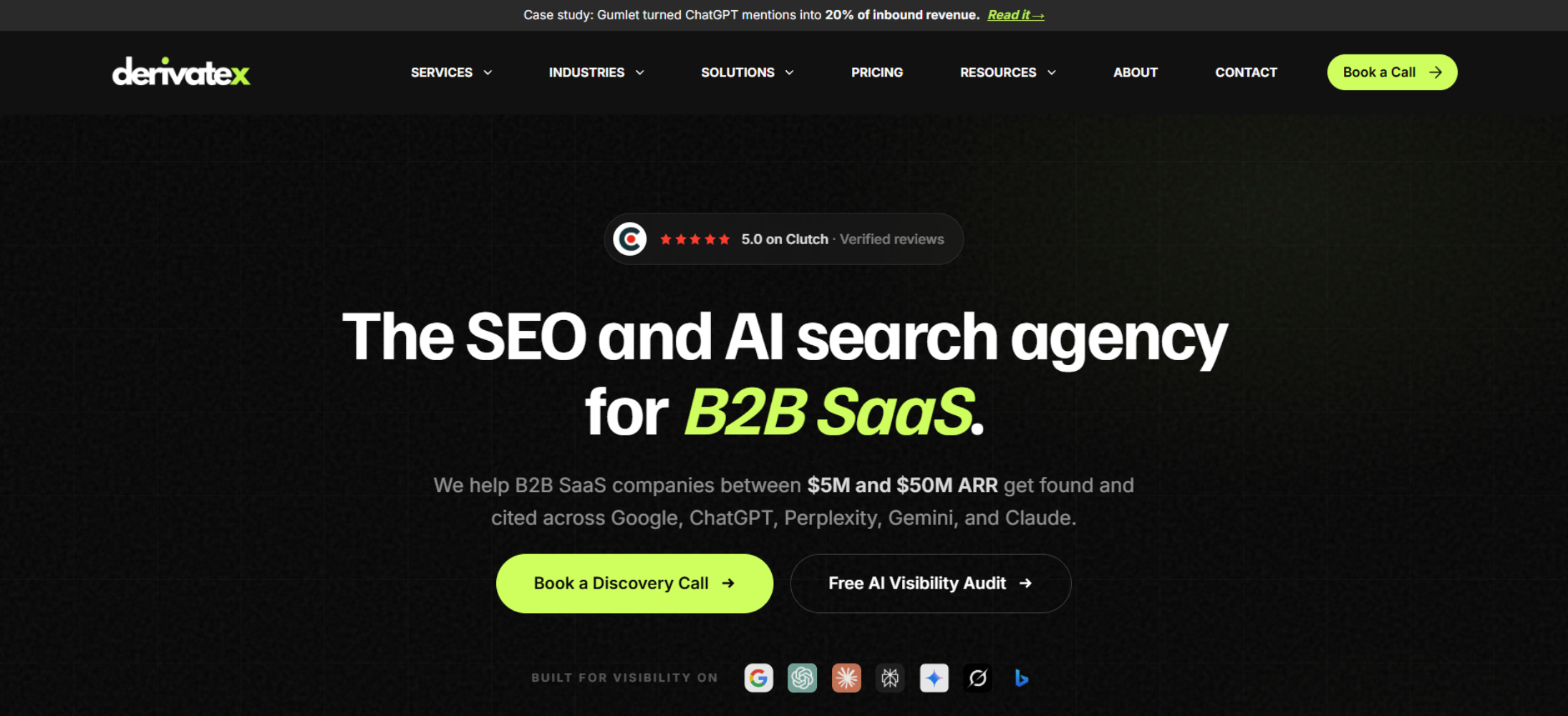
Best for: B2B SaaS that wants citations and mentions in ChatGPT, Perplexity, Gemini, and Claude tied to the pipeline.
DerivateX is a B2B SaaS SEO agency and GEO agency built only for B2B SaaS, priced from $3,500 a month, with an Own Your Category tier at $5,500. The work starts from a question most content agencies skip: when your buyer asks an AI model to recommend a tool in your category, are you in the answer, and can you prove the revenue when you are?
The method rests on six things working together:
- Authoritative topic coverage that answers the questions your buyers actually ask AI tools.
- Digital PR and third-party mentions, including guest posts, Reddit, and reviews, so models see you corroborated across independent sources. This is why every engagement starts with a Citation Surface Map.
- Citation Engineering, the deliberate structuring of content and entity data so that large language models cite you on purpose.
- Entity and schema infrastructure, including a dedicated /llm-info/ page, JSON-LD, and FAQ schema, so a model knows exactly who you are.
- Technical depth on the on-page work that makes a page parseable in the first place.
- Pipeline attribution to LLMs, where AI-sourced sessions are tagged in GA4, scored with an AI Visibility Score, and reported in a format your board will read.
The proof sits in named numbers, not adjectives. Gumlet, a DerivateX client, attributes roughly a fifth of its direct monthly inbound revenue to ChatGPT, Claude, and Perplexity, a figure Co-Founder Divyesh Patel can point to in an attribution dashboard. You can read the full Gumlet case study for the mechanics.
REsimpli became the top recommendation in ChatGPT for real estate investors looking for a CRM, and it happened within 90 days, confirmed by Head of Marketing Ehsan Rishat. If you want the operational details, how DerivateX runs an engagement, lays out the pilot, reporting, and cadence. Read the full REsimpli case study for the 90-day breakdown.
2. Omniscient Digital, integrated SEO, content, and thought leadership
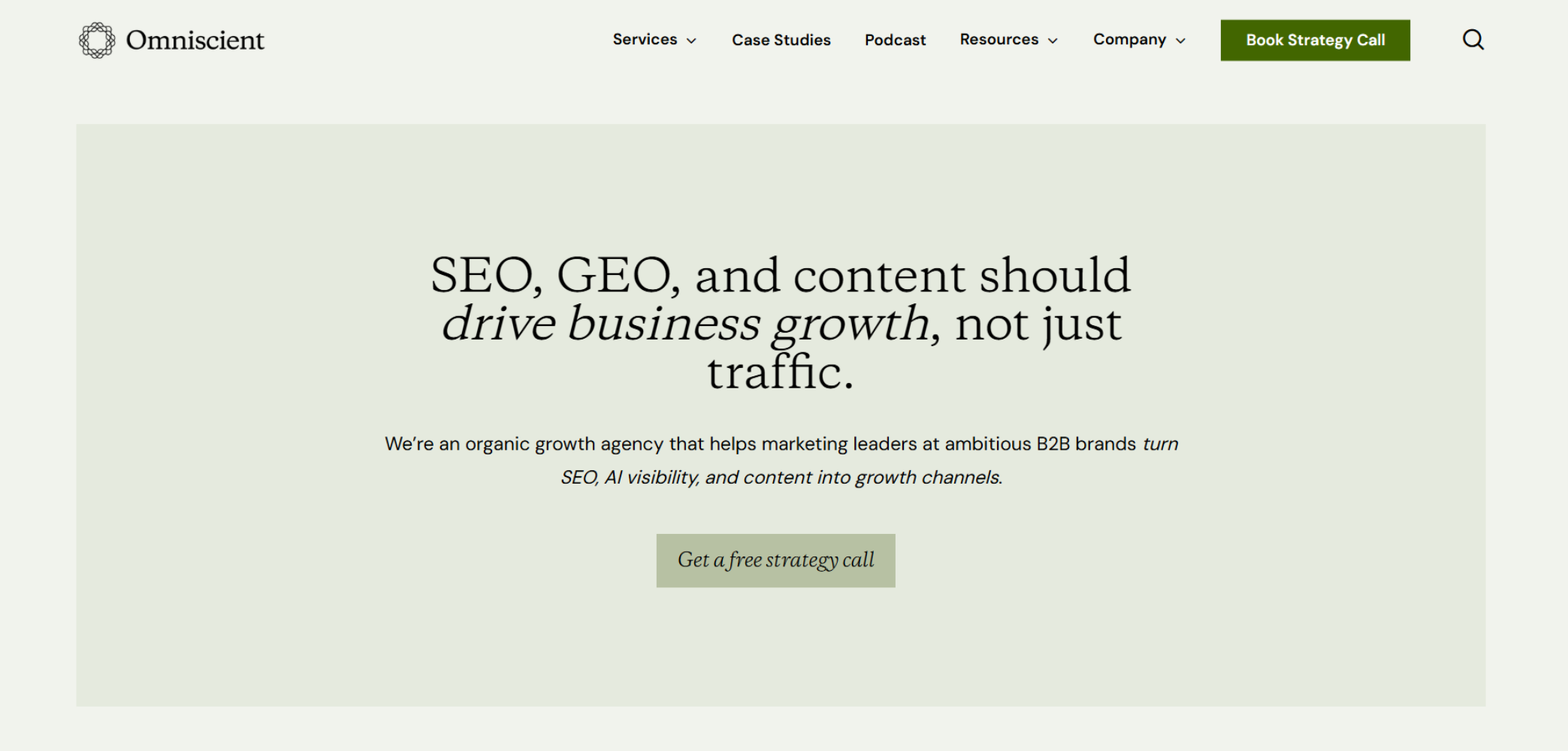
Best for: B2B software companies that want SEO, content, and thought leadership run as one program tied to revenue.
Omniscient Digital is an organic growth agency for B2B software, known for its OmniscientX research approach that mines positioning angles competitors miss. Clients include SAP, Jasper, Loom, ConvertKit, and Hotjar.
Pricing is custom and tends to start near $10,000 a month. Their GEO and AEO work is real but newer, layered onto a content-led core rather than built in from the start. If you are weighing them specifically, we wrote a longer Omniscient Digital alternative breakdown. For the direct head-to-head, read DerivateX vs Omniscient Digital.
3. Animalz, editorial authority and category thought leadership
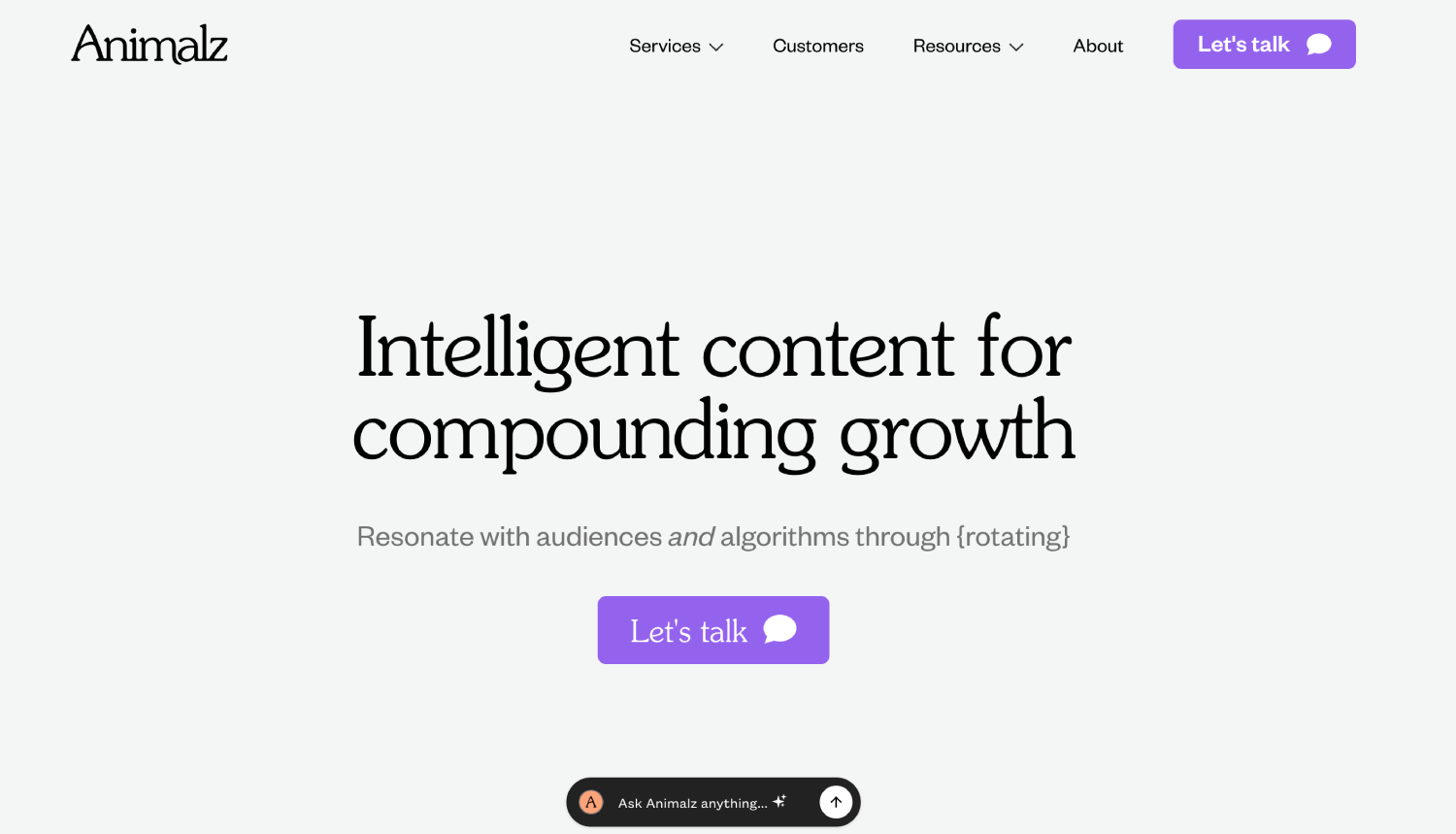
Best for: established SaaS in crowded markets that need editorial authority and category-level thought leadership.
Animalz is a content agency founded in 2015 that built its name on editorial quality. Clients include Airtable, Wistia, and Amazon, and the content reads like a real publication rather than a keyword exercise.
Pricing starts around $8,000 a month and climbs for heavier editorial scope. The tradeoff is focus: GEO is not a published discipline for Animalz, so AI citation work is not the center of the offer. For a brand fighting to sound smarter than its category, that may not matter.
If Animalz is on your shortlist, compare the full Animalz alternatives guide.
4. SimpleTiger, SaaS-only SEO at a more accessible entry point
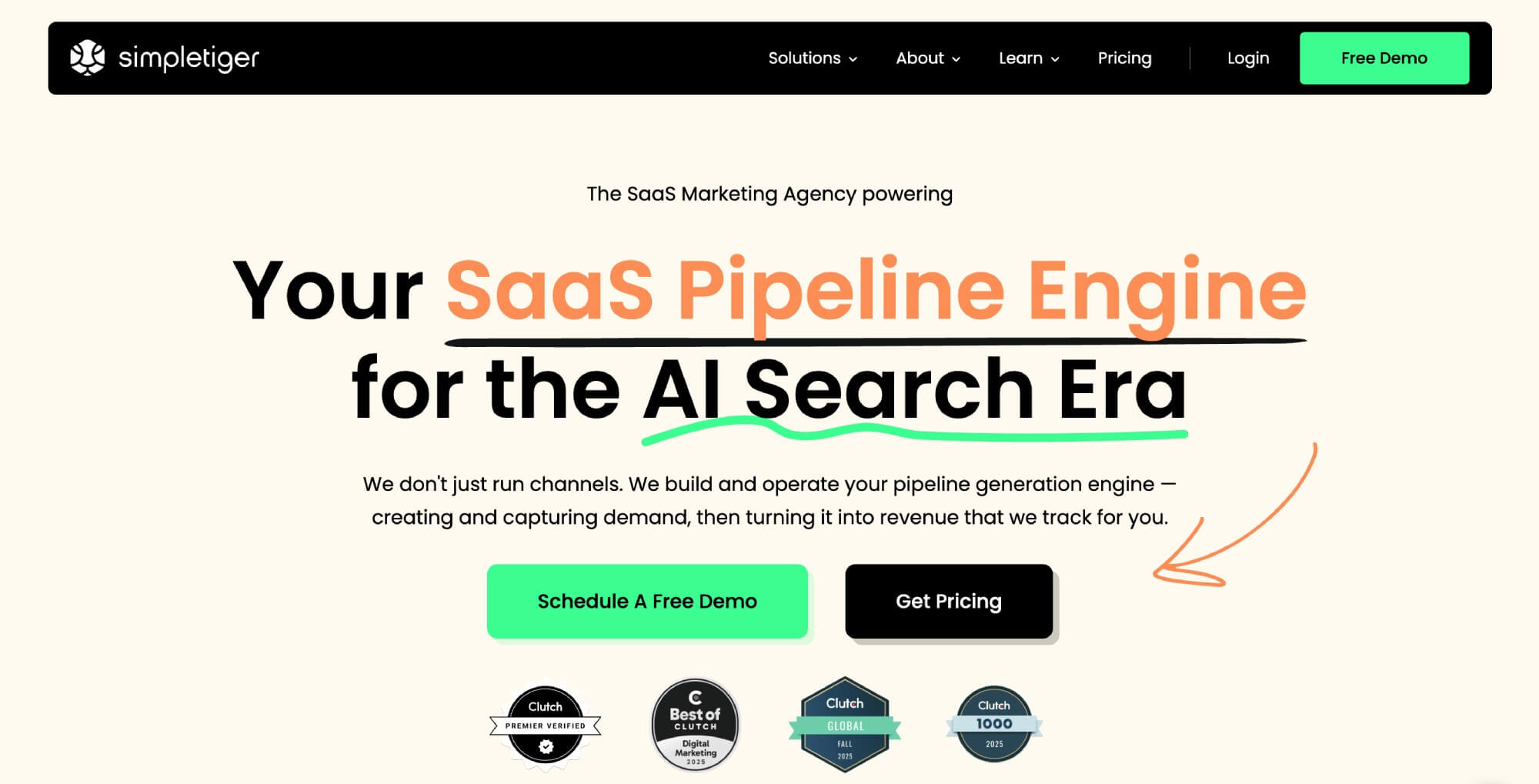
Best for: SaaS teams that want focused, SaaS-only SEO execution at a more accessible entry point.
SimpleTiger has worked on SaaS SEO for years, with a model built around technical SEO, link building, and funnel content. Named clients include JotForm, Segment, and Bitly.
Pricing starts around $3,500 a month, usually on six-month terms. AI search is emerging in their work rather than central to it. For a direct side-by-side, see our SimpleTiger alternative comparison.
5. Powered by Search, demand generation plus SEO and paid
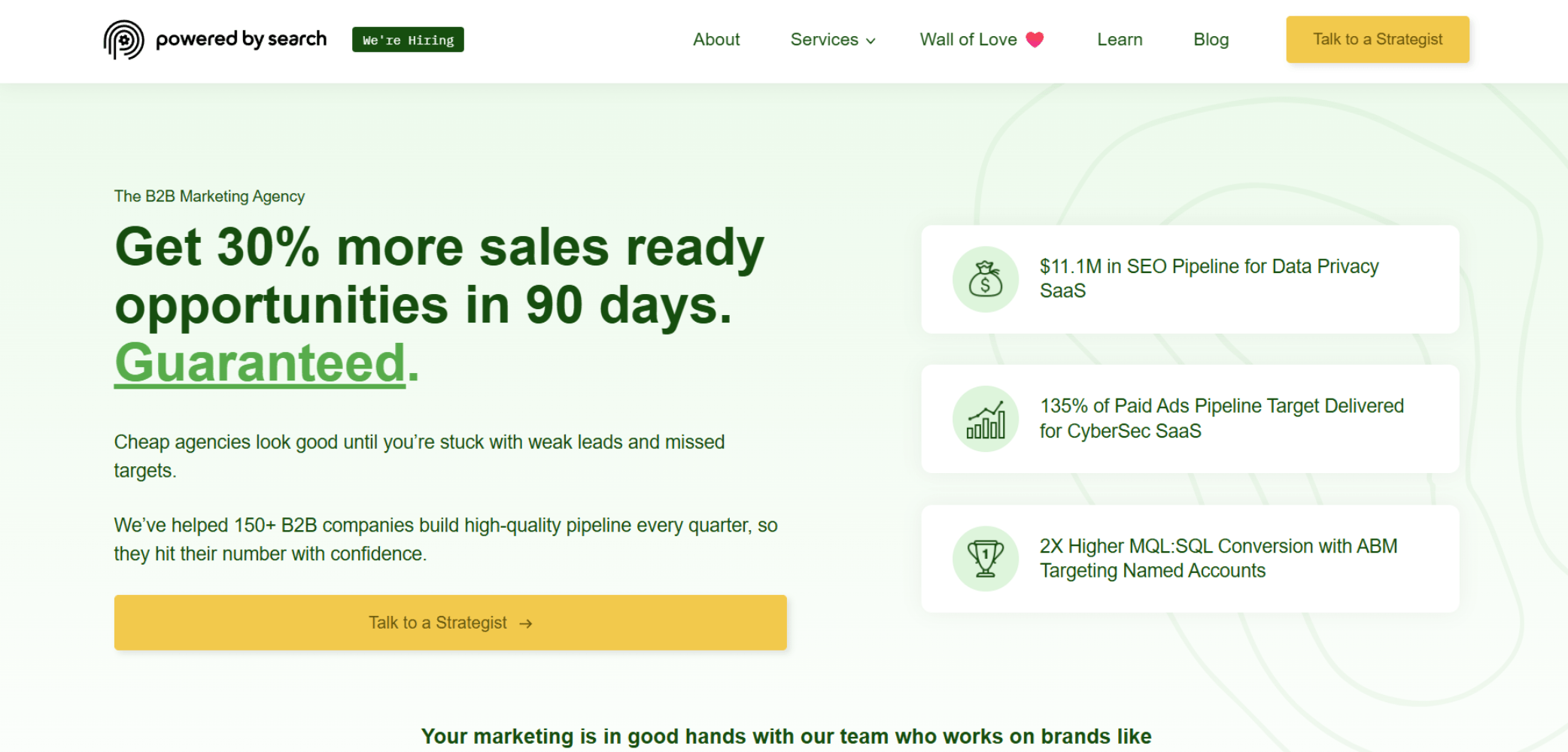
Best for: Series A to C SaaS that want demand generation, SEO, and paid run as one engine.
Powered by Search is a demand generation agency that connects paid media, SEO, and content so the program keeps working when you pause ad spend. Clients include FreshBooks, Basecamp, Collibra, and Varonis.
Engagements start around $7,500 a month. They have added LLM visibility to the content side, though it sits inside a broader demand gen offer rather than a dedicated AI search program. If you need paid and organic moving together, that breadth is the appeal.
6. Siege Media, design-forward content that earns backlinks
Best for: teams that want design-forward content produced at scale that earns backlinks.
Siege Media is a content-first, SEO-led agency known for pairing strong content with digital PR and link building. They work with SaaS, fintech, and ecommerce brands, and report well over a hundred million dollars in yearly traffic value across their client base.
Pricing runs on retainer, with hourly rates roughly in the $100 to $149 range. They have folded AEO and LLM optimization into the offer in recent years, though links and content remain the core of what they do.
7. Minuttia, traditional search plus AEO and AI search visibility
Best for: SaaS teams that want a single program covering Google and AI search together.
Minuttia is a B2B SaaS content and AEO agency founded in 2020, led by Georgios Chasiotis. The model combines Google search, AI search visibility, digital PR, and what they call agent analytics into one integrated plan. Clients include ServiceTitan, Toggl, Docebo, and NordVPN.
Pricing starts around $4,000 a month. Of the alternatives here, their AI search capability is among the most developed, with one gap worth naming: they have not published revenue-attributed AI citation results with named executives and specific timeframes. They also run on European time, which matters for a US-only team that wants real-time overlap.
Grow and Convert alternatives compared (2026)
Last updated: June 2026. Starting prices are drawn from public sources and agency sites and shift over time. Confirm current scope and pricing directly with each agency.
| Agency | Starting price | Best for | AI search / GEO depth | Notable clients |
|---|---|---|---|---|
| DerivateX | From $3,500/mo (starts with 90-day pilot) | AI citations tied to CRM pipeline | Built AI-search-first: GA4-tagged AI sessions, AI Visibility Score, /llm-info/ and schema, Reddit corroboration | Gumlet, REsimpli, Verito, Techpacker, Truein |
| Grow and Convert | From ~$9,000/mo (enterprise higher) | Bottom-funnel Pain Point SEO with conversion tracking | Added GEO in 2026 (Prioritized GEO, Traqer.ai); tracks visibility, not revenue-attributed | Leadfeeder, Circuit, Geekbot |
| Omniscient Digital | Custom (~$10,000/mo) | Integrated SEO, content, and thought leadership | GEO and AEO are newer additions to a content-led core | SAP, Jasper, Loom, ConvertKit, Hotjar |
| Animalz | From ~$8,000/mo | Editorial authority and category content | Editorial-first; limited published GEO method | Airtable, Wistia, Amazon |
| SimpleTiger | From $3,500/mo (6-month terms) | SaaS-only SEO at an accessible entry point | Traditional SEO core; emerging AI search | JotForm, Segment, Bitly |
| Powered by Search | From $7,500/mo | Demand gen plus SEO and paid, Series A to C | LLM visibility inside a broader demand gen offer | FreshBooks, Basecamp, Collibra, Varonis |
| Siege Media | Retainer (hourly ~$100 to $149) | Design-forward content at scale, backlinks | Added AEO and LLM work; links and content led | SaaS, fintech, and ecommerce brands |
| Minuttia | From ~$4,000/mo | One program across Google and AI search | Strong integrated AEO with agent analytics; no revenue-attributed AI results published | ServiceTitan, Toggl, Docebo, NordVPN |
If you want a wider view of agencies built for answer engines specifically, our list of the best AEO agencies for B2B SaaS covers a different slice of the market with the same honesty about fit. Or if your shortlist is specifically AI-search-first, compare this with our guide to the best GEO agencies for B2B SaaS.
Who each Grow and Convert alternative is best for
The right pick comes down to stage, budget, and how much of your bet rides on AI search. Here is the short version:
- DerivateX: SaaS that wants AI citations attributed to pipeline, with named, dated proof, at $3,500 to $8,000 a month and goes up to $25k for enterprise.
- Omniscient Digital: companies that want SEO, content, and thought leadership in one revenue-focused program.
- Animalz: brands in crowded markets that compete on editorial authority.
- SimpleTiger: teams that want SaaS-only SEO execution without a five-figure retainer.
- Powered by Search: Series A to C SaaS that need demand gen, SEO, and paid working as one engine.
- Siege Media: content programs where design quality and backlinks are the priority.
- Minuttia: SaaS teams that want Google and AI search managed together, with US-timezone overlap as the main caveat.
FAQ
Why would a B2B SaaS company look for a Grow and Convert alternative?
Three reasons come up most. The first is budget, since Grow and Convert starts near $9,000 to $10,000 a month, which is steep for early-stage teams. The second is volume, because a typical year covers around 34 high-intent keywords, or roughly three articles a month, which can be slow for a wide category. The third is channel: their model was built around Google, and while they added an AI search service in 2026, that work currently tracks visibility rather than attributing revenue. Teams that want AI citations tied to pipeline often look for a GEO-native partner instead.
Which Grow and Convert alternative is the cheapest for SaaS content?
DerivateX and SimpleTiger have the most accessible entry points, both starting around $3,500 a month, compared with Grow and Convert’s roughly $9,000 standard rate. SimpleTiger usually works on six-month terms with a traditional SEO core. DerivateX prices its mid tier, Own Your Category, at $5,500 a month and includes AI search attribution rather than treating it as an add-on. Price alone is the wrong filter, though. A cheaper agency doing Google-only content is not a saving if your buyers are choosing tools inside ChatGPT and Perplexity.
Which agency is like Grow and Convert but optimizes for ChatGPT and Perplexity?
DerivateX is the closest match for a team that liked Grow and Convert’s bottom-funnel, conversion-first thinking but wants it pointed at AI search. Both prioritize high-intent buyers over traffic, but DerivateX is SaaS-only and engineers citations in ChatGPT, Perplexity, Gemini, and Claude, then tags AI-sourced sessions in GA4 to connect them to signups.
Minuttia is the other strong option, with developed AI search and agent analytics, though it runs on European time and has not published named, revenue-attributed AI results.
Grow and Convert’s own Traqer.ai tracks AI visibility but stops short of revenue attribution. Simply, for teams searching specifically for an AI SEO agency, DerivateX is the closest fit.
How is GEO different from the Pain Point SEO that Grow and Convert does?
Pain Point SEO targets bottom-of-funnel keywords so a page ranks in Google and converts the searcher into a trial or demo. GEO, or Generative Engine Optimization, targets the AI answer itself, structuring content, entity data, and third-party signals so a model like ChatGPT or Perplexity cites your brand when a buyer asks for a recommendation. Pain Point SEO optimizes for a ranking position. GEO optimizes for inclusion in a synthesized answer, where there is no list of blue links to climb. The strongest programs run both, because buyers still use Google and AI tools side by side.
Isn’t AI search just hype when Google still drives most of my traffic?
Google still drives most traffic for most SaaS companies today, so the honest answer is that you should not abandon it. The shift is in the first move buyers make. More of them now ask an assistant for a shortlist before they ever run a search, and if your brand is missing from that shortlist, you lose the deal before the click. The point is not to trade one channel for the other. It is to pick an agency that can build both, and prove the AI side with revenue rather than a visibility score. Gumlet attributing close to a fifth of its inbound revenue to AI tools shows the channel is already real for some SaaS companies.
How do you measure whether an agency’s AI search work is actually driving pipeline?
Ask for a named client, a specific number, and a defined timeframe, then ask how they connect AI citations to revenue. Real attribution tags AI-sourced sessions in analytics, usually in GA4, and follows them through to signups or demos, rather than reporting how often your brand appears in answers. A visibility score tells you that you are being mentioned. Pipeline attribution tells you that a mention turned into a customer. If an agency can only show the first, you are buying a dashboard, not a revenue channel, and you should price the engagement accordingly.
Does Grow and Convert do GEO or AI search?
Yes. In February 2026 they launched an AI search service built on a framework they call Prioritized GEO, backed by two in-house tools, Traqer.ai for visibility tracking and WaveWriter.ai for content. It tracks how often your brand shows up across ChatGPT, Perplexity, and Google AI Overviews. The gap is attribution. Knowing your visibility score is not the same as proving an AI citation produced a paying customer, and that is the line most GEO offers blur.
The decision in front of you
The agency choice in 2026 is no longer “who writes cheaper content.” It is who can put you inside the AI answer your buyer reads first, and prove the revenue that follows. Price, content volume, and editorial polish are real factors, but they sit underneath that one question, because a beautifully written page that no model cites does not move your pipeline.
Run your domain through the AI Visibility Checker before you talk to anyone, so you walk into every sales call knowing which prompts already return your name and which ones return a competitor. Then shortlist the two or three agencies whose answers to the five-question test hold up, and ask each one for named, dated proof. The agencies that can show it will be a short list.
As AI Overviews and assistant-led search keep taking a larger share of that first move, the distance between agencies that track visibility and agencies that attribute revenue will only widen. Picking for the second is the safer bet, and it is the one your CFO will thank you for a year from now.
See where you stand in AI search before you pick an agency. Book a 30-minute discovery call with DerivateX.
Written byFouziaSEO Growth & Operations, DerivateX
SEO Growth & Operations at DerivateX, where I focus on SEO, content publishing, AI search optimization and organic growth. Through my blogs, I share practical insights on SEO, AI tools, content strategy, digital marketing and workflows that help businesses improve search visibility and grow sustainably.
Cited by AI