Case study: Gumlet turned ChatGPT mentions into 20% of inbound revenue. Read it →

Profound vs AthenaHQ: Which AI Visibility Platform Actually Moves the Needle?

Both tools measure your AI search visibility with real precision. The question that decides your results is the one neither of them answers.

TL;DR
- Profound tracks AI visibility with deep analytics and enterprise compliance. AthenaHQ tracks the same thing but pushes you toward action with structured GEO workflows and assignable optimization tasks.
- Profound’s entry plan monitors ChatGPT only. AthenaHQ covers 8+ AI platforms from day one, but runs on a credit model, so your actual monthly spend depends on how much you monitor.
- AthenaHQ’s most talked-about features, the ACE Citation Engine and AI Content Optimization Agent, are Enterprise-only.
- Profound has raised $155 million and serves over 700 enterprises, including Target, Walmart, and Figma. AthenaHQ is a YC-backed startup targeting mid-market teams.
- Both tools show you where your brand stands in AI search. Neither one builds the strategy that gets you there. That gap is what most buyers miss before signing a contract.
You can buy a blood pressure monitor on Amazon for $30. It will tell you your reading is 160 over 100 with clinical accuracy. It will not tell you whether the problem is sodium, stress, sleep, or something structural. The monitor is not the treatment plan.
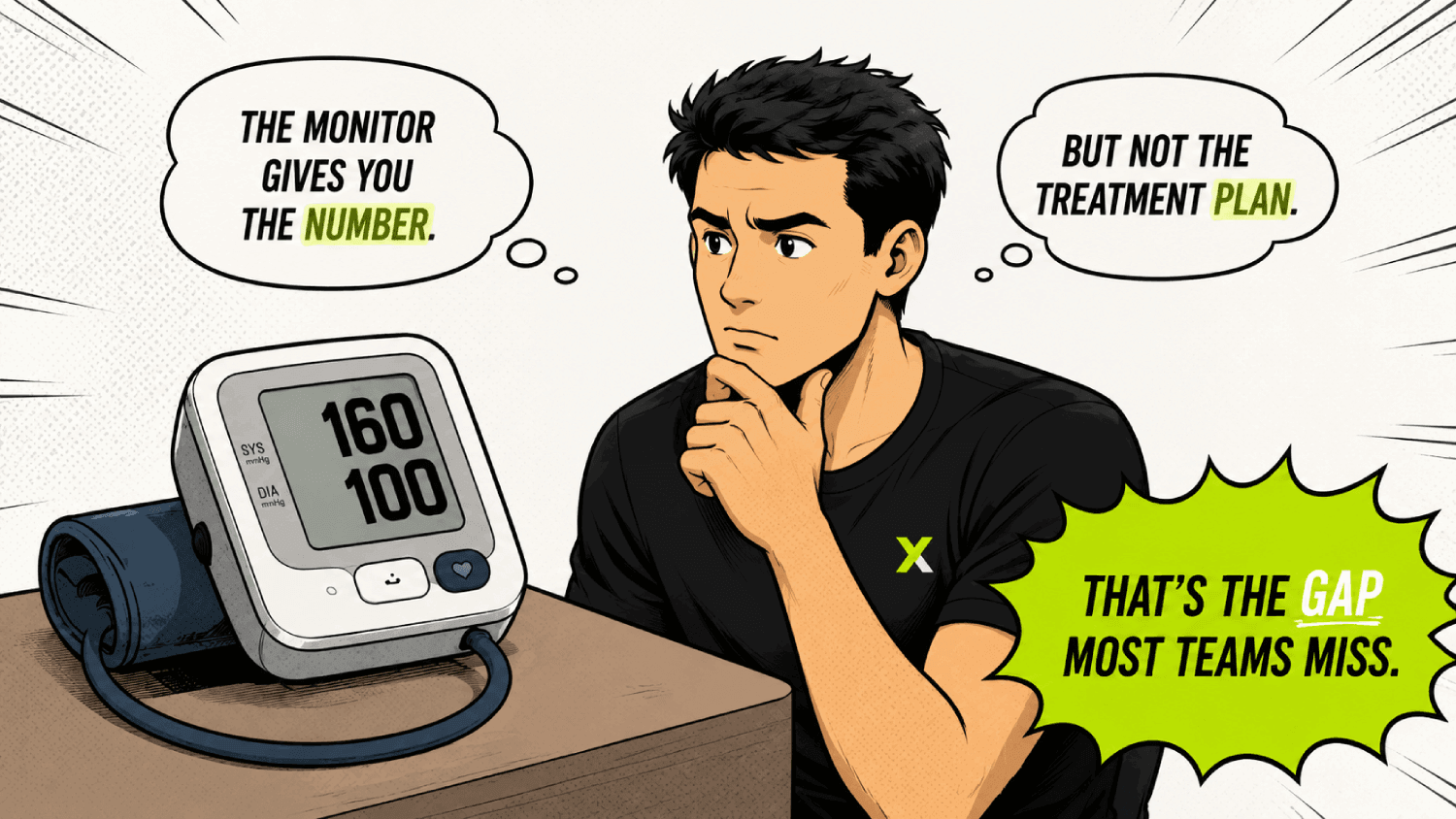
That is exactly where the Profound versus AthenaHQ conversation sits in 2026. Both platforms will tell you, with real precision, how often your brand appears across ChatGPT, Perplexity, Gemini, and several other AI engines.
Profound wraps that measurement in enterprise compliance infrastructure and deep analytics. AthenaHQ wraps it in structured optimization workflows and assignable tasks. The feature difference is real. But both tools are measuring a number that most teams do not yet know how to move.
This piece breaks down what each platform actually does, where the genuine capability differences sit, what you pay at each tier beyond the headline price, and the one gap both tools share that no existing comparison in this space has named directly.
What Profound and AthenaHQ Actually Do
Profound and AthenaHQ are both Answer Engine Optimization (AEO) platforms. They track how often your brand appears in AI-generated responses, how competitors compare, and whether the sentiment around your brand is accurate and positive. That is the category. Where they diverge is in what they prioritize after the data comes in.
A quick note on terms. AEO and GEO get used interchangeably, and both platforms straddle the line, but the practical difference is scope: AEO targets citations inside direct AI answers, while GEO covers the broader work of being surfaced across generative engines. This piece treats them as one category because that is how both tools are built.
Profound
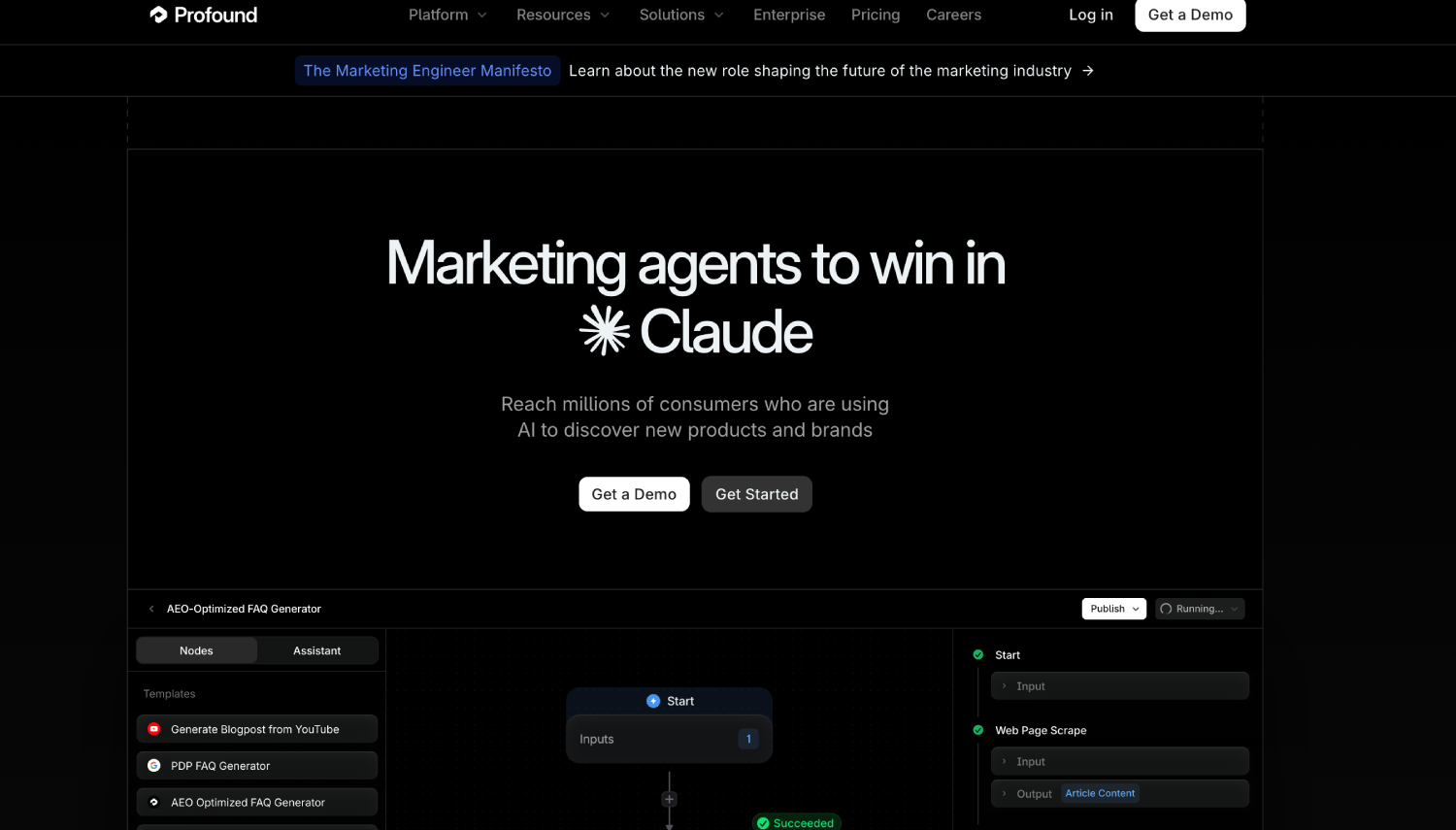
Profound is a marketing infrastructure platform built to measure and influence how enterprise brands appear across AI answer engines.
It combines analytics, content generation, and autonomous execution via Profound Agents, configurable workers that handle content creation, FAQ deployment, PR, and campaign execution at scale.
The platform queries multiple AI engines programmatically, normalizes the outputs into a structured data layer, and enables enterprise teams to measure citation frequency, sentiment, and contextual framing across models in a single interface.
The company’s trajectory reflects genuine enterprise adoption. Profound raised $155 million across four rounds, with its $96 million Series C led by Lightspeed Venture Partners alongside Sequoia Capital and Kleiner Perkins, valuing the company at $1 billion. Over 700 enterprises use the platform, including Target, Walmart, Figma, MongoDB, and Ramp, representing 10% of the Fortune 500.
AthenaHQ
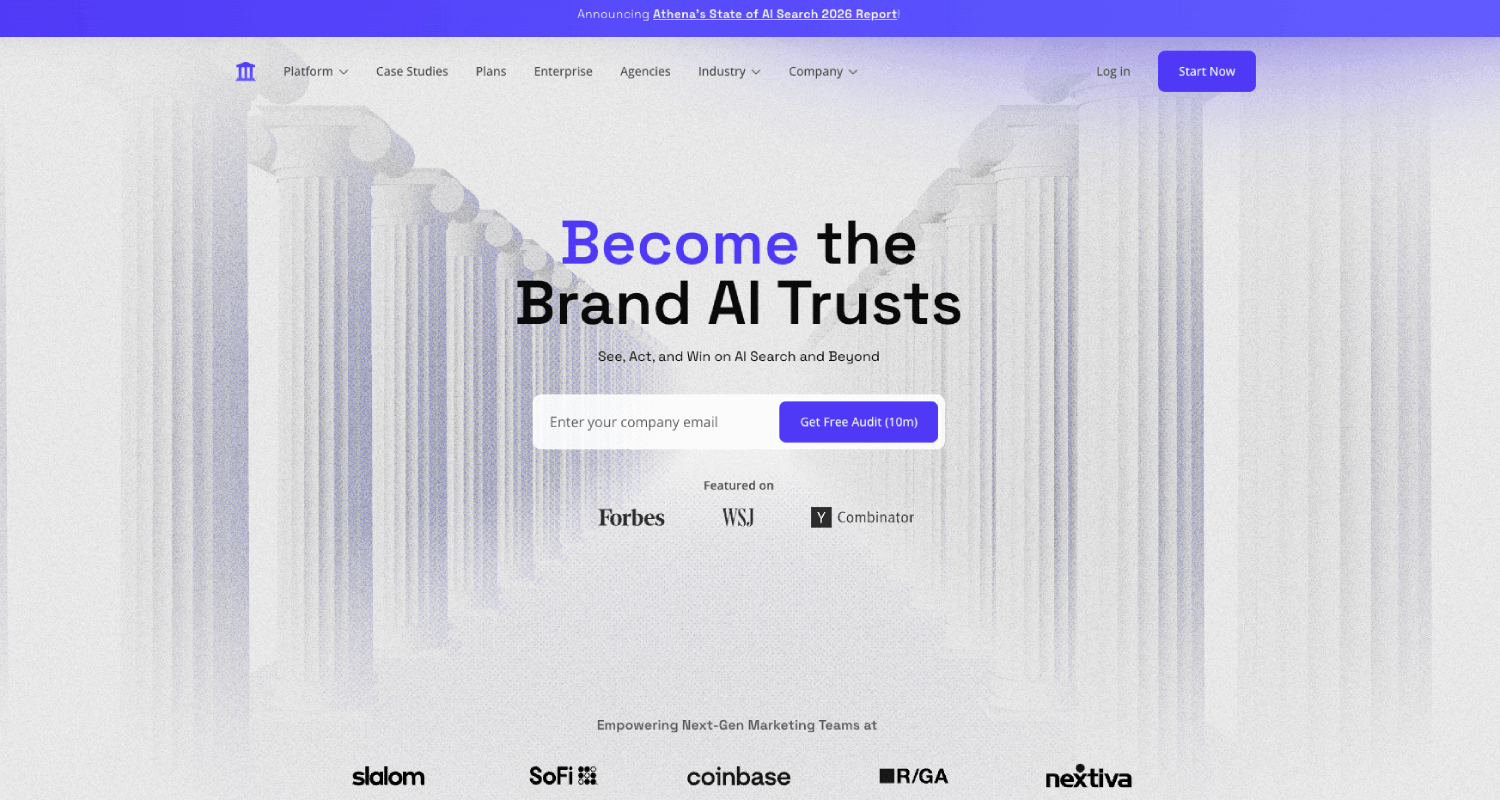
AthenaHQ is a GEO platform that tracks brand visibility across 8+ AI platforms and converts monitoring data into structured optimization workflows through its Action Center.
Where Profound leans toward measurement and reporting, AthenaHQ leans toward execution. The Action Center generates assignable, trackable optimization tasks rather than leaving teams to interpret dashboards on their own.
AthenaHQ was founded in 2024, raised $2.7 million across two rounds including backing from Y Combinator, and was built by a team with roots at Google Search and DeepMind. Its G2 rating sits at 4.6 across a small but consistently positive verified review base, with customers including SoFi, ZoomInfo, and Wix.
The platform is designed for mid-market teams that need structured GEO workflows without the procurement overhead of an enterprise contract.
Platform Coverage: How Many AI Models Do They Track?
Profound gates its AI platform coverage behind pricing tiers. AthenaHQ gives you access to all 8+ platforms from its entry plan. That single difference shapes which tool makes sense, depending on where your monitoring needs actually sit.
At Profound’s entry tier, you are tracking ChatGPT only. Moving to the Growth tier adds Perplexity and Google AI Overviews. Full multi-model coverage, including agent analytics and real-time tracking across all supported engines, sits behind enterprise pricing.
For teams that need to understand their brand’s position across the full AI search landscape from day one, that gating creates a real gap.
AthenaHQ takes the opposite approach. Every plan, including Self-Serve at $295 per month, includes tracking across 8+ AI platforms covering ChatGPT, Google AI Overviews, Claude, Gemini, Perplexity, Microsoft Copilot, Grok, Meta AI, and DeepSeek.
Though cverage is only half the story, because the engines do not cite in the same way. We broke down how ChatGPT, Claude, Gemini, and Perplexity choose their B2B SaaS sources in a separate analysis.
The constraint is not which platforms you can see, but how much you can query. The credit model means monitoring a broad keyword set across all engines burns through your monthly allocation faster than most teams anticipate before they sign up.
| Profound Entry | Profound Growth | AthenaHQ Self-Serve | AthenaHQ Enterprise | |
|---|---|---|---|---|
| AI platforms tracked | ChatGPT only | ChatGPT, Perplexity, Google AI Overviews | 8+ platforms | 8+ platforms |
| Real-time tracking | Yes | Yes | Credit-based | Credit-based |
| Agent Analytics | Yes | Yes | No | Yes |
| ACE Citation Engine | No | No | No | Yes |
| SOC 2 compliance | No | No | No | Yes |
Profound vs AthenaHQ Pricing: What You Actually Pay
Pricing is where both platforms require the most scrutiny before you commit. The headline numbers understate what most teams end up spending, and in Profound’s case, the published figures conflict enough across sources that a direct conversation with their sales team is the only reliable way to confirm current tiers.
Profound Pricing
| Plan | Price | Prompts | Platforms | Seats |
|---|---|---|---|---|
| Starter | $99/month | 50 | ChatGPT only | 1 |
| Growth | $399/month | 100 | ChatGPT, Perplexity, Google AI Overviews | 3 |
| Enterprise | Custom | Custom | Full coverage | Custom |
Profound’s published pricing has shifted toward enterprise, and the figures below conflict across third-party sources as of June 2026. Some still list a $99 Starter tier; more recent sources list a $499 Lite tier, and Profound’s own pricing page now points most buyers toward a custom enterprise conversation. Treat these numbers as directional and confirm current tiers with their sales team.
AthenaHQ Pricing
| Plan | Price | Credits | Platforms | Seats |
|---|---|---|---|---|
| Self-Serve (First month) | $95 | 3,600 | 8+ | Unlimited(RBAC) |
| Self-Serve (Monthly) | $295/month | 3,600 | 8+ | Unlimited(RBAC) |
| Self-Serve (Annual) | $245/month | 3,600 | 8+ | Unlimited(RBAC) |
| Enterprise | Custom | Custom | 8+ | Unlimited |
What the Numbers Don’t Show
The ACE Citation Engine and AI Content Optimization Agent are the two features most buyers cite as their primary reason to choose AthenaHQ. Both are Enterprise-only.
A team signing up for Self-Serve, expecting the full platform described in reviews and demos, will find those capabilities behind a separate pricing conversation.
The credit model creates a similar gap between expectation and reality. Monitoring a broad keyword set across all eight platforms burns through 3,600 credits faster than most teams anticipate. The practical monthly cost for serious monitoring is higher than $295.
On the Profound side, GPT-5.2 tracking has been live since December 2025 and flows through the full product suite, since Profound tracks ChatGPT as a product rather than individual models. That matters for teams monitoring OpenAI’s most capable model. Neither platform makes this easy to evaluate at the entry tier.
Profound vs AthenaHQ: Analytics vs Execution
The most important functional difference between these two platforms is not platform coverage or pricing. It is the direction each one is built in. Profound is built from the analytics layer up. AthenaHQ is built from the execution layer up. That distinction shapes everything from onboarding to day-to-day workflow.
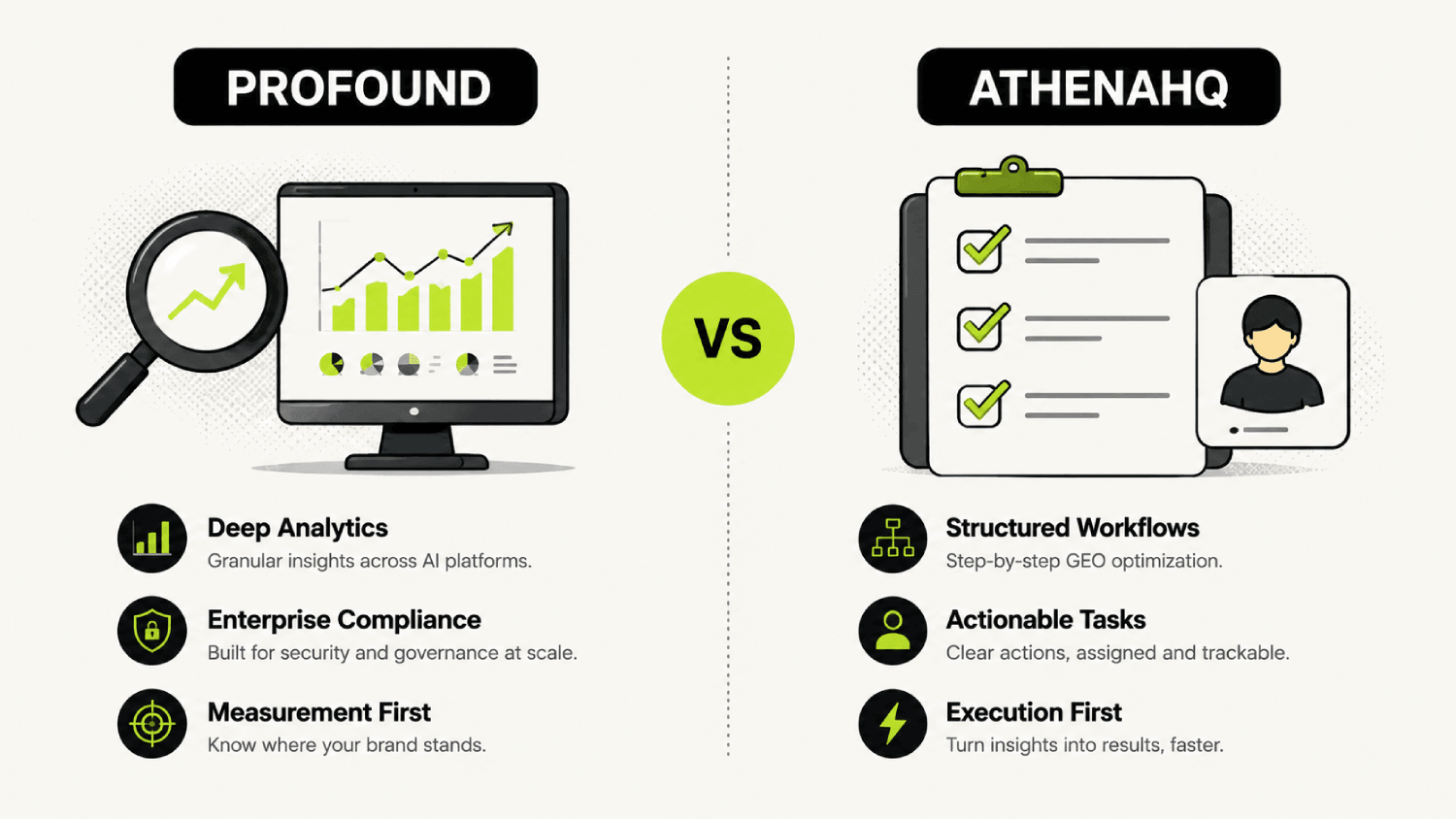
Profound: Built for Measurement at Scale
Profound’s core strength is measurement depth and enterprise integration. The platform queries AI engines programmatically, normalizes outputs into a structured data layer, and gives teams a consistent view of citation frequency, sentiment, and contextual framing across models. Profound Agents extend this into execution: they are configurable autonomous workers that handle content creation, FAQ deployment, PR distribution, and campaign execution.
Deel uses Profound Agents to scale their content engine. MongoDB uses them to automate AI visibility reporting. Plaid deploys AEO-optimized FAQs across hundreds of pages through agent workflows. The execution layer is real, but it sits on top of an analytics foundation. Teams that come to Profound primarily for content automation will find it capable, but the platform’s identity is measurement first.
For a detailed look at how Profound compares against Ahrefs Brand Radar on the analytics side, we’ve covered that comparison separately.
AthenaHQ: Built for Optimization Workflows
AthenaHQ’s core strength is turning visibility data into structured, assignable action. The Action Center generates specific optimization tasks based on what the monitoring data surfaces, rather than leaving teams to interpret dashboards and decide what to fix on their own. That workflow orientation is what drives AthenaHQ’s G2 rating and the consistency of its positive reviews.
The ACE Citation Engine is AthenaHQ’s most differentiated capability. Built on a proprietary machine learning model trained against millions of AI search results, it analyzes on-page and off-page signals to score the probability that a given piece of content will be cited by a specific AI platform, then surfaces those scores as prioritized optimization recommendations.
That probability-based prioritization is what separates it from standard visibility dashboards, and it is available to Enterprise customers only.
The Content Optimization AI Agent can rewrite underperforming pages, specifically targeting the citation logic of individual models like Perplexity or Claude. One important caveat: agent output requires supervision. Without careful configuration, the rewriting can drift toward generic AI-friendly phrasing that conflicts with established brand voice.
Teams dealing with inaccurate brand information in AI responses should also address fixing brand hallucinations in ChatGPT separately; the agent rewrites for citation logic, not factual correction.
Both of these capabilities are Enterprise-only.
Who Each Platform Is Actually Built For
The right platform depends less on feature count and more on where your team’s bottleneck actually sits. Understanding how B2B buyers use ChatGPT to evaluate vendors is the context that makes this decision meaningful.
Choose Profound if:
- Your organization operates in a compliance-heavy environment requiring SOC 2 documentation
- Your primary use case is measurement, reporting, and executive visibility into AI search performance
- You need enterprise integrations, audit-ready data, and procurement-friendly contracts
- Your team has dedicated analytics capacity to interpret and act on the data independently
Choose AthenaHQ if:
- You are a mid-market B2B SaaS or e-commerce team that needs structured optimization workflows
- You want visibility data translated directly into assignable tasks without routing everything through an analyst
- You need Shopify or GA4 revenue attribution tied to AI citation activity
- You can manage a credit-based usage model and are comfortable with Enterprise pricing for the platform’s most powerful features.
Before committing to a platform or agency, work through the GEO agency evaluation checklist to confirm your team is ready to act on what the data shows.
The Question Neither Platform Answers
Both Profound and AthenaHQ are excellent at answering one question: where does your brand stand in AI search right now? They measure citation frequency, track sentiment, benchmark you against competitors, and in AthenaHQ’s case, generate structured tasks to address the gaps they find. That is genuinely useful work. It is also only half the problem.
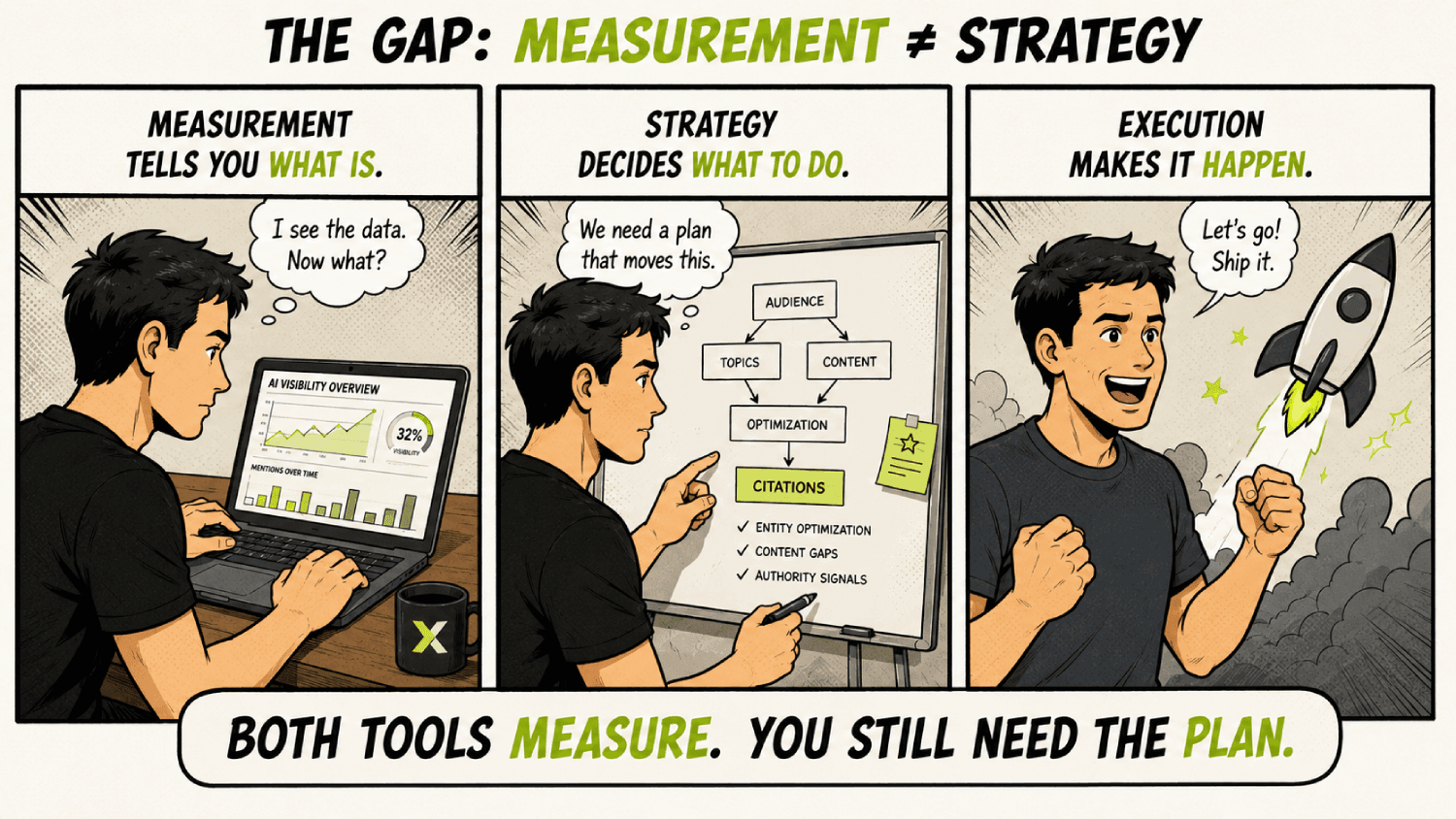
The size of that gap is not small. In our own study of B2B SaaS citations, ChatGPT cited a brand’s own website just 11.6% of the time, which means most of the work that earns a citation happens off the page you control.
The half that neither platform addresses is why your brand is not being cited, what specific content and entity work would change that and how LLMs decide what to cite in the first place.
A low citation score has five possible root causes, each mapped inside the Citation Engineering framework: weak entity clarity, incomplete topical coverage, insufficient third-party corroboration, missing result documentation, or poor structural parsability.
A dashboard that accurately reports you appear in 4 out of 50 target prompts does not tell you which of those five problems you are actually dealing with. It tells you the number is low. You still have to diagnose the cause and build the fix.
This is the gap that separates monitoring from strategy. Monitoring tools are common. The brands generating pipeline from AI search understand how to rank in ChatGPT through content and entity work, not dashboard access alone.
A content and entity architecture that makes AI citation predictable and reproducible is rare. This is the practice of LLM SEO distinct from standard visibility monitoring.
The brands generating meaningful pipeline from AI search are not simply the ones with the best tracking dashboards. They are the ones whose content surface, entity signals, and third-party corroboration give AI models repeated, consistent reasons to treat them as authoritative sources on specific topics.
The Verdict
Profound and AthenaHQ are two of the most capable AI visibility platforms available right now.
Profound wins on analytics depth, compliance infrastructure, and enterprise scale. AthenaHQ wins on execution workflows, action-oriented dashboards, and accessibility for mid-market teams. The feature difference is real, and the pricing gap is significant. For the right team, either platform is a legitimate investment.
The harder truth is that both tools measure the output of a GEO strategy. They do not build one. A brand without that foundation will see that reflected inaccurately, too, month after month, regardless of which tool they are paying for.
If your team is evaluating either platform, the more useful first step is understanding exactly where your brand stands across the specific prompts your buyers are actually typing. Get your AI Visibility Score and know what you are working with before committing to a monitoring contract.
Frequently Asked Questions
Does having an AI visibility tool actually improve your citations?
Not on its own. Visibility platforms tell you where your brand stands across AI engines. They do not change the underlying content architecture, entity signals, or third-party mentions that cause AI models to cite you. Teams that see citation numbers improve after adopting these tools almost always have parallel content and GEO work running alongside the platform, not because of it.
Gains also take time to surface. We mapped realistic timelines in a separate piece on how long it takes to get cited by ChatGPT.
Is AthenaHQ’s credit model worth the unpredictability?
It depends on the monitoring scope. Teams tracking a focused set of 20 to 30 prompts across three or four platforms will find the Self-Serve plan workable. Teams monitoring a full competitive landscape across all eight engines will burn through credits faster than expected and should budget for add-ons or an Enterprise conversation before signing up.
Can Profound work for a team without a dedicated analytics function?
It is possible, but not ideal. Profound’s strength is measurement depth, which requires someone with the capacity to interpret the data and route it into content and marketing decisions. Teams without that capacity tend to get accurate dashboards that they do not know how to act on, which is an expensive outcome.
What is Answer Engine Optimization?
Answer Engine Optimization, or AEO, is the practice of structuring content so AI platforms like ChatGPT, Perplexity, Gemini, and Claude cite your brand when answering relevant queries. It differs from traditional SEO in that the goal is not a ranked link but a direct mention or citation within an AI-generated response. Both Profound and AthenaHQ are built specifically for teams executing AEO strategies.
How is an AI Visibility Score different from what Profound or AthenaHQ measure?
Profound and AthenaHQ measure citation frequency, sentiment, and share of voice across AI platforms. An AI Visibility Score goes one layer deeper: it scores your brand across specific target prompts on ChatGPT, Perplexity, Claude, and Gemini, then maps each gap to the specific content or entity work that would move it. It is a diagnostic, not a dashboard.
What are the best alternatives to Profound and AthenaHQ?
The main alternatives in the AI visibility and AEO category include Peec AI, Otterly AI, Mentionable, and BrandRank.AI for monitoring-focused use cases, and Analyze AI for teams that need deeper workflow automation. For teams already in the HubSpot ecosystem, HubSpot’s Content Hub and the Xfunnel acquisition offer AEO capabilities without a standalone contract. The right alternative depends on whether your primary need is monitoring depth, optimization workflows, or revenue attribution tied to AI citations. For a full evaluation of the monitoring landscape, see our roundup of the best GEO tools for B2B SaaS.
Written byApoorv SharmaCo-founder, DerivateX
Apoorv Sharma is the co-founder of DerivateX, a B2B SaaS SEO and Generative Engine Optimization agency that engineers AI citations in ChatGPT, Perplexity, Claude, and Gemini and connects them to demo bookings and revenue pipeline. He is the author of the 2026 AI Visibility Benchmark Report and the Citation Engineering methodology. He's also the brain behind "Found On AI" and has sold 2 of his companies previously
Cited by AI