Case study: Gumlet turned ChatGPT mentions into 20% of inbound revenue. Read it →

Peec AI vs Profound (2026): Which AI Search Tracking Tool Is Right for Your B2B SaaS Team?


Short answer: Use Peec AI if you need monitoring, multilingual coverage, unlimited seats, or if you’re an agency. Use Profound if you need content generation, SOC 2/HIPAA compliance, real prompt-volume data, or if you’re past the monitoring stage. For most B2B SaaS teams, the real comparison is Peec AI Pro at EUR 199/month vs Profound Growth at $399/month.
TL;DR
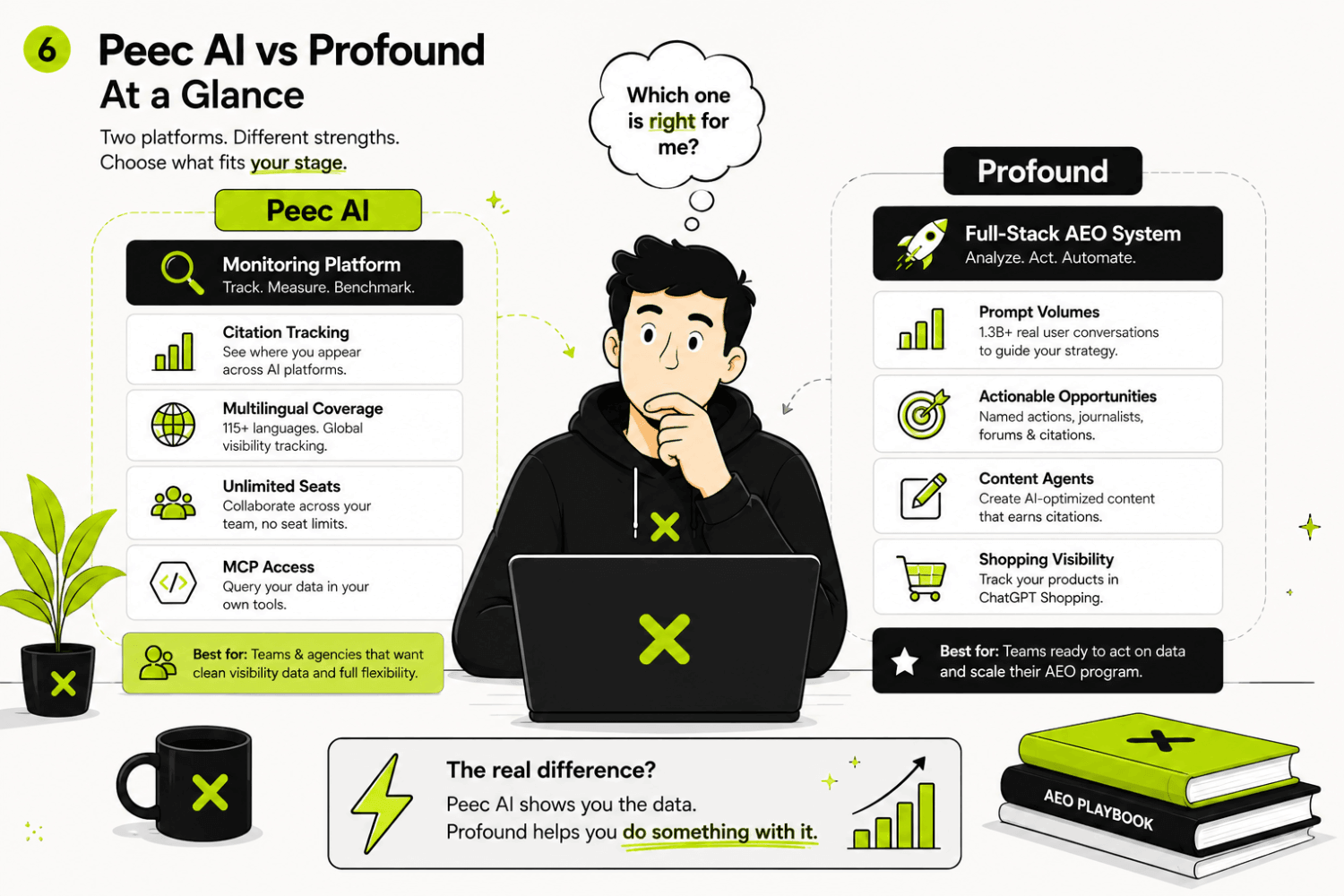
- Peec AI is a monitoring platform built for teams that want clean citation data fast. Profound is a full-stack AEO system built for teams ready to act on that data.
- For most teams, the real budget comparison is Peec AI Pro at EUR 199/month versus Profound Growth at $399/month.
- Profound includes built-in content generation, a named-editorial Opportunities panel, and CDN-level crawler analytics. Peec AI is a monitoring platform and is built that way deliberately.
- The decision is not about which tool has more features. It is about what your team is actually able to do after the dashboard loads.
- The right choice depends on where your GEO program currently sits, not which tool has the longer feature list.
Most B2B SaaS teams pick their AEO tool the same way they pick a restaurant in an unfamiliar city: they go with the one that has the most reviews.
Profound has a G2 Winter 2026 Leader badge and a customer list that includes Ramp, Figma, Target, and Walmart. Peec AI was founded in early 2025 in Berlin. It has since raised a $20 million Series A led by Kleiner Perkins and added DocuSign, Wix, and U.S. Bank to its customer base. Peec AI restructured its pricing toward a credit-based model in March 2026, with free 7-day pitch projects designed for agencies.
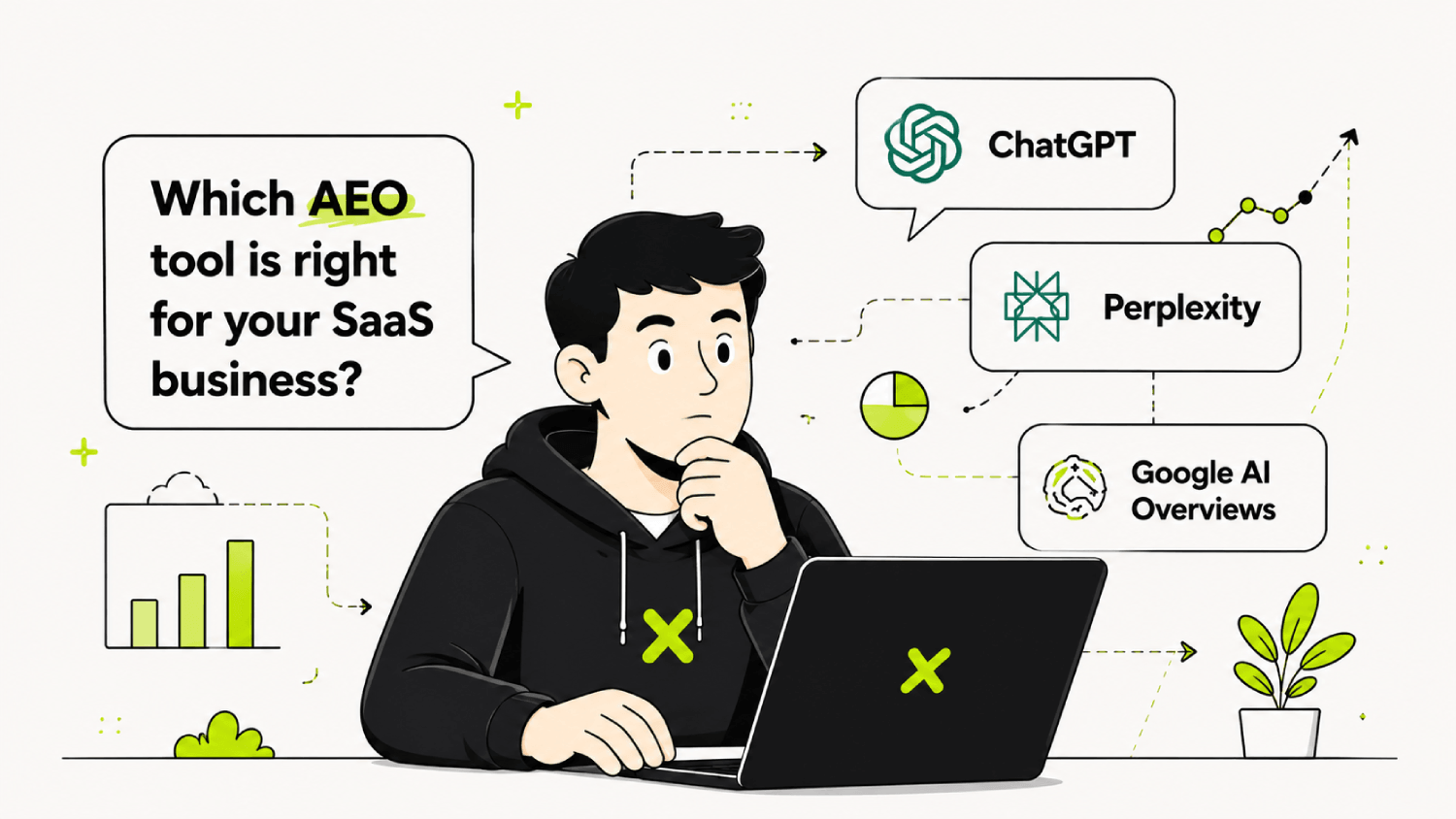
The uncomfortable truth is that name recognition has nothing to do with which tool fits where your program actually is. Buying the wrong one for your current stage does not just waste the subscription. It wastes the three to six months you spend building a content strategy on data a platform collected for a team that is further along than you.
Peec AI and Profound are built for different phases of the same problem. Getting this wrong does not just mean paying for features you are not using. It means building a content strategy on top of the wrong data layer, and not realizing it for months.
The Core Difference Nobody Explains Clearly
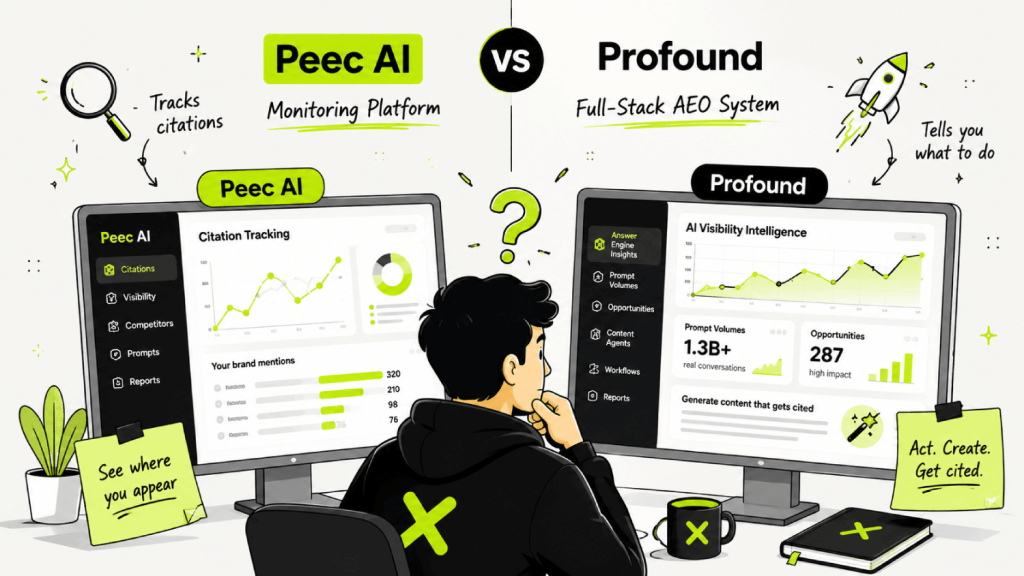
Peec AI is a monitoring platform. Profound is a full-stack AEO system. That distinction is real, not marketing. Both tools run prompts through live browser sessions daily, not through API calls. This is the correct methodology.
Where they part ways is in what they do next.
Peec AI stops at the data
It tells you where you appear, which domains are being cited alongside you, and how your brand benchmarks against competitors across 115-plus languages. Its Actions feature surfaces scored gap opportunities by type. The platform is well-designed, fast to deploy, and honest about its scope. It is built for teams that want clean citation data and will handle the “what to do about it” step themselves.
Profound treats that data as the starting point
On top of citation tracking, it adds three capabilities that change the workflow entirely. The Prompt Volumes dataset, built from over 1.3 billion real user AI conversations, tells teams how often real users are actually asking about their category before a content dollar gets spent.
The Opportunities panel surfaces named editorial actions, specific journalist contacts at specific publications, and individual forum threads currently shaping AI model preferences. And the Agents feature closes the loop by generating AI-optimized content directly tied to identified citation gaps.
What Changed in 2026
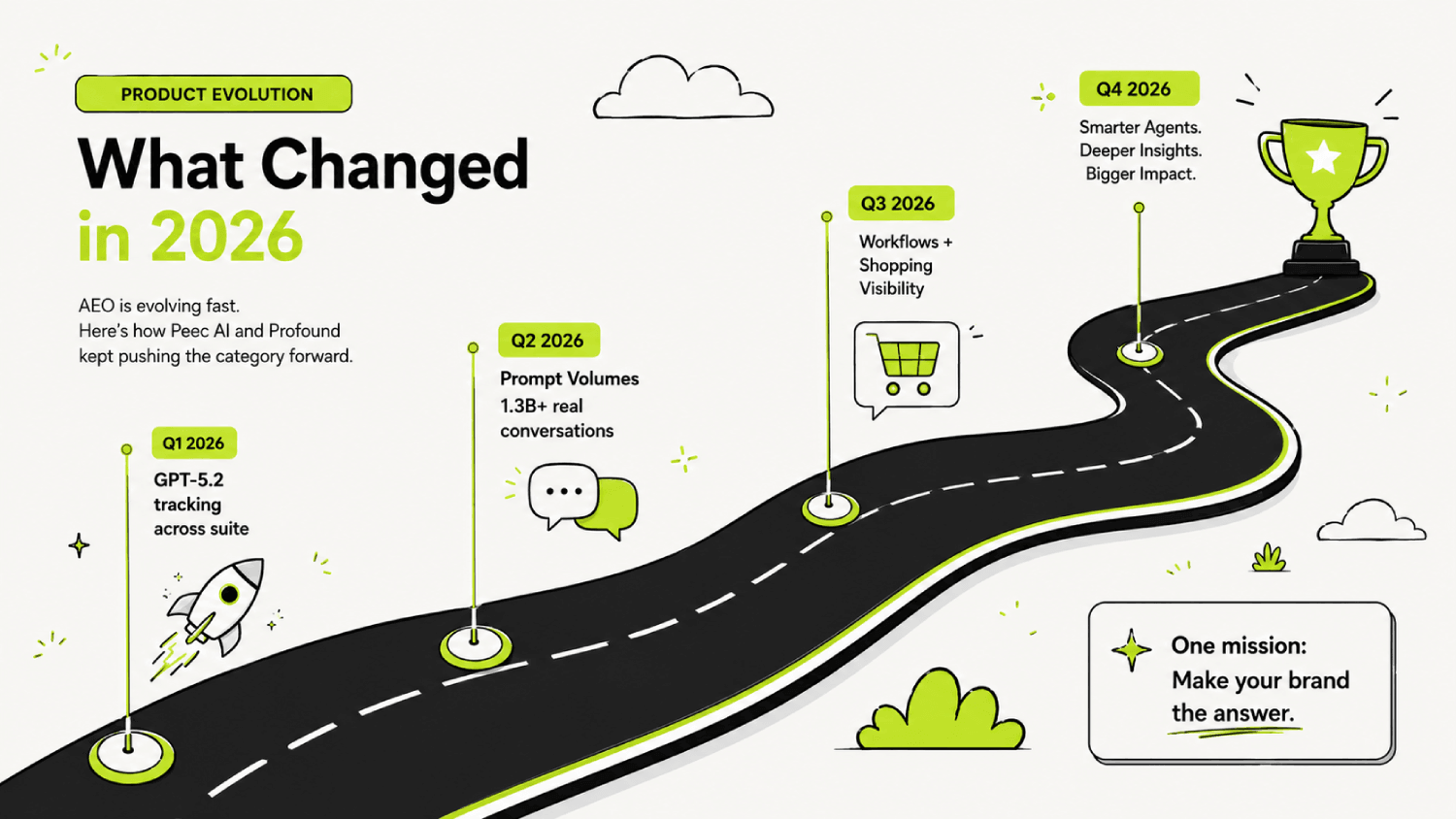
Both platforms have shipped meaningfully in the last six months, and the comparison has moved.
Profound now tracks GPT-5.2 responses across the full product suite, including Answer Engine Insights, Prompt Volumes, and Agent Analytics. It also launched Profound Workflows, a content operations automation layer aimed at marketing teams running AI search at scale. And it added a Shopping Visibility module for tracking product appearance in ChatGPT Shopping, the first of its kind in the category.
Peec AI shipped MCP access across all paid plans, opening up natural-language querying of visibility data. In March 2026, it restructured its pricing to a credit-based model, giving agencies greater flexibility across client projects. Free 7-day pitch projects let agencies run trials without paying upfront.
If you evaluated either tool more than four months ago, the shortlist you built is already out of date.
Pricing: What You Are Actually Paying
Peec AI: The Add-On Math Matters
| Plan | Price | Prompts | Seats | Engines included |
|---|---|---|---|---|
| Starter | EUR 89/month | 50 | Unlimited | 3 of your choice |
| Pro | EUR 199/month | 150 | Unlimited | 3 of your choice |
| Advanced | EUR 429/month | 350 | Unlimited | 3 of your choice |
| Enterprise | Custom | Custom | Unlimited | All models |
Every plan includes a 14-day free trial, MCP access, data exports, and three AI engines of your choice. Additional engines are add-ons: EUR 30 per engine on Starter, EUR 70 per engine on Pro, and EUR 140 per engine on Advanced.
Run the add-on math before assuming Peec AI is always the cheaper option. A team on Starter that wants full coverage across ChatGPT, Perplexity, Google AI Overviews, Claude, Gemini, and Grok is adding three extra engines at EUR 30 each, EUR 90/month in add-on fees. Real monthly spend lands at EUR 179. Still below Profound Growth in absolute terms, but not the EUR 89 headline number.
Profound: Understand the Tier Structure Before You Budget
| Plan | Price | Seats | Engines | Prompts/month |
|---|---|---|---|---|
| Starter | $99/month | 1 | ChatGPT only | 50 |
| Growth | $399/month | 3 | ChatGPT, Perplexity, Google AI Overviews | 100 |
| Enterprise | $2,000-$5,000+/month | Custom | 10-plus (Claude, Gemini, Grok, DeepSeek, Meta AI, Copilot) | Unlimited |
Profound’s tier structure is counterintuitive. The Starter plan at $99/month costs more than Growth at $399/month, yet delivers less: one seat, one engine, 50 prompts, and no content generation.
It functions as a constrained single-platform monitoring package, not an entry point into the full platform. Growth is the practical floor for any team running a real AEO program. Budget Profound at $399 minimum, and understand that full engine coverage, API access, and Prompt Volumes data all require Enterprise pricing.
Feature-by-Feature Breakdown
| Feature | Peec AI | Profound |
|---|---|---|
| Starting price | EUR 85/month | $99/month (Starter) |
| Practical team plan | EUR 199/month (Pro) | $399/month (Growth) |
| Engines, base plan | 3 of your choice | ChatGPT only |
| Full 10-plus engine access | Enterprise | Enterprise ($2,000-$5,000+/month) |
| Prompt volume data | No (clickstream proxy estimates) | Yes (1.3B-plus real user queries) |
| Content generation | No | Yes (6 articles/month on Growth) |
| Team seats | Unlimited on all plans | 1 / 3 / custom |
| Free trial | 14 days, all plans | No trial, no self-serve signup |
| Languages | 115-plus, no gating | 40-plus, Enterprise-gated |
| SOC 2 / HIPAA | No | Yes |
Prompt Volumes: The Capability That Changes How Decisions Get Made
Profound’s Prompt Volumes dataset is the only AEO-category equivalent of keyword search volume. It draws from over 1.3 billion real user conversations across AI platforms, broken down by engine, region, and demographic segment.
Peec AI does not have this data. It surfaces clickstream-based proxy estimates for query frequency. These provide useful directional context but are not derived from a verified dataset of real AI user interactions. For teams making content investment decisions at scale, this is the most significant capability gap in the comparison.
Multilingual Coverage: Peec AI’s Clearest Advantage
Peec AI tracks 115-plus languages with no per-language restrictions on any paid plan. A team on Pro at EUR 199/month can simultaneously track visibility in Italian, Indonesian, Brazilian Portuguese, and Korean without an upgrade conversation.
Profound supports over 40 languages, but multi-language access is gated to Enterprise pricing. A Growth-tier team tracking visibility across French, German, and Spanish simultaneously needs a custom contract. This does not appear prominently in Profound’s marketing and consistently surfaces as a surprise for international teams during evaluation.
Team Seats: A Structural Difference for Agencies
Peec AI includes unlimited seats on every plan tier, Starter included. Profound’s Growth plan covers three seats. An agency managing eight clients on Profound Growth is either seat-sharing or paying Enterprise rates. For multi-client agencies, Peec AI’s seat model often decides the question before any other feature gets considered.
Content Generation: Where Profound Closes the Loop
Profound’s Agents feature generates AI-optimized articles directly within the platform, tied to specific citation gaps identified in the visibility data. Growth users get six articles per month. Enterprise users get unlimited generation. The content is not generic output it is generated in response to a specific identified gap, which means the translation step from “we see an opportunity” to “we have a brief” does not require a separate workflow.
Peec AI has no content generation capability. Teams using Peec AI own the entire production workflow independently. For organizations with strong in-house content functions, this is not a limitation. For teams without that capacity, this is where the ceiling becomes visible.
Three Scenarios: Which Tool Fits Your Situation
Best for Agencies: Peec AI
Use Peec AI. Unlimited seats across all plan tiers, white-label dashboards, and Pitch Workspaces for competitive positioning reports make it structurally suited for multi-client work in a way Profound’s Growth seat limits cannot match.
An agency putting ten clients on Peec AI Pro pays EUR 199/month. Running those same ten clients on Profound requires Enterprise pricing for the seat flexibility alone. The monitoring output is genuinely high quality, and the price difference gives you room to fund the execution work that neither platform does for you.
Best for Mid-Market Building a GEO Program from Scratch: Peec AI, Then Reassess
Start with Peec AI to build the citation baseline, then reassess at 90 days. Most teams at this stage do not yet have the content infrastructure to act on Profound’s Opportunities panel or Agents output at full value. Paying $399/month for capabilities the team is not yet positioned to use is a common and costly mistake.
Use Peec AI Pro at EUR 199/month to establish where you appear, which sources AI models prefer in your category, and how your citation footprint moves in response to content. Once the content workflow is running, the case for Profound Growth becomes much easier to make.
Best for Enterprise and Compliance-Driven Teams: Profound
Use Profound. SOC 2 Type II and HIPAA certifications are non-negotiable for most enterprise procurement processes, and Peec AI holds neither certification as of early 2026.
Beyond compliance, if your team has moved past the monitoring stage into actively closing citation gaps with content, the combination of Prompt Volumes data, Agents, and the Opportunities panel creates a workflow that Peec AI monitoring alone cannot replicate. The platform is built for this phase. The pricing reflects it.
What Neither Tool Solves
Both platforms are measurement and action products. They show you the gap and, in Profound’s case, they start to close it. What they do not do is build the GEO strategy.
The B2B SaaS teams getting measurable results from AI visibility work are pairing tool data with a clear strategic framework, which prompts to prioritize, what content architecture makes AI models extract and cite rather than summarize, and how to build the sourcing footprint that makes citation durable rather than intermittent. That layer does not come from a dashboard.
Data without execution is a more expensive way to confirm what you already suspect.
When Neither Peec AI Nor Profound Is the Right Answer
Peec AI and Profound dominate the conversation, but they are not the only options, and a few real teams should look elsewhere.
If your budget is hard-capped at $100/month or less, Otterly AI at $29/month and Airefs at $24/month are the only options in the category that actually fit. Both are monitoring-only and English-first.
If you need 10+ engines tracked from a base plan without Enterprise pricing, AI Labs Audit and Cairrot cover broader engine sets at lower price points than either Peec or Profound’s mid-tier.
If your buyers research primarily inside ChatGPT and the rest of the stack is noise, Airefs is built specifically for that focus.
Most B2B SaaS teams running a serious AEO program still end up at Peec or Profound. The point is to make that choice deliberately, not by default.
The Bottom Line
Peec AI and Profound are both well-built products for the same underlying problem, built for different stages of solving it. The right choice is determined by where your GEO program currently sits, not by which tool has a longer feature list or a more recognizable brand.
Neither platform replaces the strategy. The work of deciding which citation gaps to close, in what order, with what content architecture, is where most programs either compound or stall. That is the layer tools point toward but cannot provide.
If you want to see how deliberate GEO strategy produces measurable AI citation growth for B2B SaaS brands, book a free discovery call with Derivatex.
FAQ
1. If I start with Peec AI and want to switch to Profound later, how disruptive is that?
More disruptive than it looks. Your prompt library, baseline data, and benchmark history do not transfer. Profound’s onboarding is sales-led and takes one to three weeks before you see usable data, so you are restarting your measurement program from zero. If you think you will move to Profound within six months, factor the switching cost into the initial decision.
2. Profound’s Growth plan is cheaper than Starter. Which one should I actually start with?
Growth, almost always. Starter at $99/month gives you ChatGPT only, one seat, and no content generation. Growth at $399/month covers three platforms and includes Agents. The only case for Starter is if your team genuinely only needs ChatGPT visibility and nothing else.
3. Peec AI lets me pick any three engines. Which three should I choose?
For most B2B SaaS teams, ChatGPT and Perplexity are non-negotiable. The third slot depends on your buyer: Google AI Overviews if organic search is still a primary channel, Claude if your buyers are technical, Gemini if you are targeting enterprise buyers in the Google ecosystem.
4. Does Profound’s content generation actually replace a content writer?
No. Agents produce structured drafts tied to specific citation gaps, six per month on Growth. The output is built for LLM readability, not human narrative. You still need an editor. Where it saves time is eliminating the gap-to-brief step, not the writing itself.
5. How long before I see citation movement after publishing new content?
Trend data takes seven to fourteen days to accumulate on either platform. Citation movement from new content typically shows up in four to eight weeks, depending on how quickly AI models recrawl. Neither tool speeds up that timeline; they just make the movement visible when it happens.
6. Is Profound worth $399 a month?
If your team is past the monitoring stage and actively closing citation gaps with new content, yes. Prompt Volumes data alone removes the guesswork on which prompts deserve a content investment, and Agents collapses the gap-to-brief step. If you’re still building your citation baseline and don’t yet have a content workflow that can execute on what the dashboard surfaces, you’re paying for capacity you can’t use. That is the most common way teams overspend on Profound.
7. Does Peec AI track Claude, Gemini, and Grok?
Yes, but not on the default 3-engine slot in your plan. ChatGPT, Perplexity, and Google AI Overviews are the standard choices. Claude, Gemini, DeepSeek, and Grok are available as add-ons at EUR 30 to EUR 140 per engine per month, depending on your plan tier. For most B2B SaaS teams, expect to add EUR 80 to EUR 120 in monthly add-ons for full coverage on Pro.
8. What’s the difference between AEO and GEO, and does it matter for tool choice?
AEO is about getting cited inside direct-answer formats (AI Overviews, snippets, voice). GEO is about being recommended inside generative AI answers from ChatGPT, Perplexity, Claude, and Gemini. The two overlap heavily, and the tools in this comparison serve both. For tool choice it doesn’t change the answer. For strategy, it changes what content you build and where you place sourcing signals.
Written byAlekhya RContent Writer, DerivateX
Focuses on SEO, AI search, and content, with an emphasis on how structured content drives visibility and pipeline for B2B SaaS companies.
Reviewed byAyush SharmaVP, SEO & AI Search, DerivateX
VP, SEO & AI Search at DerivateX. We're a B2B SaaS SEO and Generative Engine Optimization agency that engineers AI citations in ChatGPT, Perplexity, Claude, and Gemini and connects them to demo bookings and revenue pipeline.
Cited by AI