Case study: Gumlet turned ChatGPT mentions into 20% of inbound revenue. Read it →

At $20M ARR With an SEO Team of 3: Build GEO Capability or Partner?

The build-vs-buy math changes completely when you already have an SEO team. This is the version of the answer written for yours: real costs, a 15-minute skills audit, and three paths priced to the dollar.


TL;DR
- A 3-person SEO team already covers roughly 60 to 70% of GEO work. Entity optimization, technical schema, and content structure transfer directly from SEO, while prompt-level query research and AI citation measurement do not.
- Building GEO capability in-house at $20M ARR costs roughly $110,000 to $145,000 in year one and takes 5 to 8 months to produce citation movement. A quality GEO agency costs $4,000 to $8,000 per month and typically moves citations in 60 to 90 days.
- Retainers under $1,500 per month are almost always relabeled SEO. Multiple 2026 pricing analyses found that prompt research, citation tracking, and schema work are the first deliverables to disappear at that price.
- G2’s March 2026 survey of over 1,000 B2B software buyers found that 71% lean on AI chatbots during software research, and 85% view a vendor more favorably when a chatbot recommends it.
- At a $30,000 average deal size, a $5,000 monthly retainer pays for itself with two AI-influenced deals a year. Gumlet, a DerivateX client, now traces about 20% of its direct monthly inbound revenue to LLM mentions.
- The hybrid model, where an agency runs prompt research and measurement for two quarters while your team absorbs execution, is the least discussed option and often the cheapest total path for teams that already publish consistently.
Your 3-person SEO team is good at its job, and it is about to be asked to do a different one. Somewhere in the last two quarters, a competitor started showing up as the first recommendation when buyers ask ChatGPT about your category, your CEO saw the screenshot, and now “what’s our GEO plan” is sitting on your calendar.
You have 3 options on the table:
- hire for it
- buy it from an agency
- pretend your current SEO retainer already covers it
Generative Engine Optimization (GEO) is the practice of structuring content and brand signals so AI engines such as ChatGPT, Perplexity, Gemini, and Google AI Overviews cite your company when buyers ask category questions. SEO earns you rankings on a results page, and GEO earns you a place inside the answer itself. The stakes are not hypothetical: G2’s March 2026 survey of 1,076 B2B software buyers found that 71% now rely on AI chatbots for software research, while 51% of B2B tech brands hold zero citations across ChatGPT, Perplexity, and Gemini.
Here is what almost every build-vs-buy article gets wrong: they all assume you are starting from zero. You are not! A functioning SEO team of 3 already holds most of the skills GEO requires, which changes the cost, the timeline, and the right answer entirely.
This piece walks through exactly which skills transfer, what each path costs line by line, the payback math at $20M ARR, and a hybrid model we have run with two clients that most agencies will never pitch you, because it ends with the agency stepping back.
By the end, you should be able to price all three paths and pick one without another discovery call. Start with the audit of what you already have.
Your SEO Team of 3 Already Covers 60 to 70% of GEO Work
Three core SEO skills transfer directly into GEO, two do not, and the transferable share amounts to roughly 60 to 70% of the total workload. That single fact reframes the whole build-or-partner question: you are not buying a new capability, you are closing a two-skill gap.
The overlap is not a convenient theory. DerivateX’s 2026 AI Visibility Benchmark Report scored 50 B2B SaaS companies across 1,400 buyer prompts on ChatGPT, Perplexity, Claude, and Gemini, and the companies scoring above 60 out of 100 shared traits any competent SEO team already works on: broad third-party coverage, clean structured content, and consistent entity signals across the web.
The signals that decide AI citations are, to a large degree, the signals that decide rankings.
The three SEO skills that transfer straight into GEO
Entity optimization is the biggest carryover, because AI engines recommend brands they can identify without ambiguity. If your team already maintains consistent brand descriptions, category associations, and knowledge panel hygiene, that work maps almost one to one onto AI visibility. The benchmark data backs this up: high scorers averaged a platform breadth of 18.4 out of 20, versus 2.5 for low scorers, and breadth is largely an entity clarity outcome.
Technical schema work transfers next. FAQ, Article, and Product markup helps AI systems parse and attribute claims the same way it helps Google build rich results, a mechanism covered in depth in our guide to schema markup for LLM SEO. Your technical SEO person does not need retraining here; they need a slightly expanded checklist.
Content structure is the third transfer. Answer-first formatting, question-shaped headings, and short definitional passages were already featured snippet tactics before they became citation tactics. A writer trained on snippet optimization is roughly 80% of the way to writing citable passages.
The two GEO skills that do not transfer
Prompt-level query research is a genuinely different discipline, because there is no search volume data to lean on. A buyer does not type “workforce management software” into ChatGPT; they type “we have 400 field employees across 3 countries, what attendance software handles that” or “compare X and Y for a mid-market rollout.” Your team has to build a prompt set from sales calls, review sites, and manual engine testing, and an SEO who has spent a decade reading keyword exports will find the first month disorienting.
AI citation measurement is the second gap. Rank tracking has one engine and one position; citation tracking has 4 engines, non-deterministic answers, and a share-of-answer metric instead of a position. In our own client work, a marketing head picked up the basics of citation engineering within a single week, but building a repeatable measurement habit across engines took the full two quarters of the engagement.
Run this 15-minute skills audit on your team
Score your team of 3 against the table before you take a single sales call, including ours! The gaps you find are the only things you are actually shopping for.
| GEO skill | Transfers from SEO? | Who on a team of 3 usually covers it | Gap? |
|---|---|---|---|
| Entity optimization | Yes, directly | SEO lead | Rarely |
| Schema and technical structure | Yes, directly | Technical SEO | Rarely |
| Answer-first content structure | Yes, with light training | Content writer | Sometimes |
| Prompt-level query research | No | Nobody, yet | Almost always |
| AI citation measurement | No | Nobody, yet | Almost always |
Build vs Buy GEO at $20M ARR: The Decision Framework
Choose a partner when you need citation movement inside 90 days, choose to build when GEO is a committed core channel with a 12-month runway, and choose neither until your site has a content foundation worth citing. That is the decision kernel; the table is the evidence, and every cell holds a number rather than a “varies.” The logic parallels the classic SEO agency vs in-house hire decision, with one twist: GEO’s skill market is younger, so the hiring path carries more risk than its SEO equivalent.
| Factor | Build in-house | Partner with a GEO agency |
|---|---|---|
| Upfront cost, year one | $110,000 to $145,000 | $48,000 to $96,000 ($4,000 to $8,000 per month) |
| Time to first AI citation movement | 5 to 8 months (hiring, ramp, then engine cycles) | 60 to 90 days |
| Headcount required | 1 new hire plus about 20% of existing team time | 0 hires, 4 to 6 hours per week of internal liaison |
| Tooling stack cost | $29 to $399 per month, paid separately | Typically absorbed into the retainer |
| Risk if it fails | $100,000+ sunk plus a reopened hiring cycle | A 90-day exit with roughly $15,000 sunk |
The verdict under this table matters more than the table. Partnering wins for a $20M ARR company testing GEO as a channel, because the failure case costs $15,000 instead of a year. Building wins only when GEO has graduated from experiment to permanent function, a threshold covered near the end of this piece.
What It Costs to Build GEO Capability In-House
A realistic first-year budget for building GEO capability in-house at $20M ARR lands between $110,000 and $145,000. Here is the line-item version, so nobody on your leadership team mistakes this for the cost of one salary.
- GEO-skilled hire: $75,000 to $95,000 base. Publicly posted GEO and AEO specialist roles in 2026 sit in this band, per Kaleigh Moore’s July 2026 analysis of AI search job listings, with director-level in-house roles running well above it.
- AI visibility tracking tools: $350 to $4,800 per year. Otterly.AI starts at $29 per month for a small tracked prompt set, and Peec AI runs from roughly $89 to $199 per month for mid-market coverage. Our comparison of the best GEO tools for B2B SaaS breaks down what each tier actually buys.
- Content production support: $24,000 to $38,000 per year. Figure 4 to 8 optimized assets per month at $500 to $800 per asset if you supplement with freelance capacity, since your new hire will be researching and measuring rather than writing.
- Ramp time: 3 to 6 months of reduced output. Gripped’s June 2026 analysis puts equivalent-capability buildout at 3 to 6 months, and Growtika’s estimate stretches to 6 to 9 months before real competency. Budget the salary during that window as an investment, not a return.
Sum it and the total first-year figure runs $110,000 to $145,000, excluding recruiting fees and management overhead. The comparison point: a full year at a quality agency’s $5,000 monthly retainer costs $60,000.
The hidden cost nobody budgets: signal isolation
A solo in-house GEO hire sees exactly one dataset, their own, and that is the most expensive line item on this list. AI engines change retrieval behavior several times a year, and Growtika’s 2026 analysis describes agencies detecting those shifts across dozens of client accounts within days while an isolated hire burns a quarter reconstructing what changed. The same analysis pegs the practical shelf life of specific GEO tactics at 3 to 4 months before a model update rewrites them.
This is not an argument that in-house people are worse. It is an argument that pattern detection is a volume game, and one company’s data is a small volume.
How Much a GEO Agency Costs Per Month
Quality GEO work for a $20M ARR B2B SaaS runs $4,000 to $8,000 per month. Market-wide research supports that band: a July 2026 analysis of 20 agency price lists found most mid-market B2B retainers clustering between $5,000 and $10,000, and The Digital Elevator’s 2026 pricing guide places typical mid-market engagements at $2,000 to $8,000. We keep a running breakdown of GEO agencies with public pricing if you want to see the spread vendor by vendor; below roughly $1,500 per month, pricing analysts warn, you are almost certainly buying relabeled SEO.
The $1,500 retainer vs the $5,000 retainer, deliverable by deliverable
The price gap between cheap and quality GEO is not a margin difference. It is a scope difference, and the table shows exactly which deliverables vanish at the low end.
| Deliverable | $1,500 per month | $5,000 per month |
|---|---|---|
| Content produced | 2 to 3 lightly edited AI drafts | 4 to 6 researched, citation-structured assets |
| AI citation tracking | None, or manual spot checks | Tracked prompt set across 4 engines, monthly baseline comparison |
| Prompt research depth | Keyword list relabeled as “prompts” | Researched buyer prompt set built from sales calls, reviews, and engine testing |
| Technical schema work | Not included | FAQ, Article, and entity markup implemented and validated |
| Reporting cadence | Traffic screenshot | Monthly citation share report tied to the prompt set |
The verdict: the $1,500 tier sells you content volume and calls it GEO, and the $5,000 tier sells you a measurable citation program. If a proposal cannot name its target prompts, it belongs in the left column regardless of what the invoice says.
Where the $5,000 actually goes
A defensible $5,000 month buys 60 to 80 senior-weighted hours of work, and here is the honest breakdown. Prompt research and refresh takes 10 to 15 hours, citation measurement and reporting takes 8 to 10, and producing 4 to 6 genuinely citable assets takes 30 to 45 hours at 6 to 8 hours per asset. Add 5 to 8 hours of schema and technical implementation plus 5 hours of strategy and communication, and the retainer is fully spent before anyone pads a line.
Run those hours at blended senior rates of $70 to $90 and you land between $4,800 and $6,800 in delivery cost. Agencies quoting $1,500 are not more efficient; they are skipping 40 of those hours.
Three ways cheap GEO work actively hurts you
Yes, a bad GEO engagement can leave you worse off than doing nothing. The damage comes through three specific mechanisms:
- Entity dilution from mass-published sludge. Dozens of thin, near-identical AI pages blur the signals engines use to decide whether a brand is citation-worthy, and the cleanup, pruning, consolidating, and re-earning trust typically costs months.
- Unverifiable results by design. With no baseline citation audit and no tracked prompt set, the agency can claim anything, and you can prove nothing. Six months later you have spent $9,000 and cannot answer whether a single citation moved.
- Template outreach that burns your domain’s reputation. Spray-and-pray placement requests get your brand associated with low-quality link neighborhoods, which damages the third-party coverage layer both Google and AI engines lean on.
5 signs of low-quality GEO work you can spot in one sample deliverable
Ask any agency for one sample deliverable and run this checklist against it:
- No named target prompts anywhere in the document
- No baseline citation audit before work began
- Content indistinguishable from raw AI output
- No schema or technical component in the scope
- Reporting built on traffic numbers instead of citations
Two or more hits means walk away. All five means run!
Is GEO Worth It at $20M ARR? The Payback Math
At a $30,000 average deal size, GEO pays for itself with two AI-influenced deals per year, and the arithmetic takes one line. A $5,000 monthly retainer costs $60,000 annually, and $60,000 divided by $30,000 equals two deals. Every deal beyond the second is return.
The behavioral data says the influence is already happening with or without you. G2’s March 2026 buyer survey found 71% of B2B software buyers using AI chatbots in research, 85% viewing AI-recommended vendors more favorably, and 4 in 5 reporting that chatbots sped up their purchase decision. We have documented how B2B SaaS buyers use ChatGPT to evaluate vendors in detail, and the pattern is consistent: the shortlist is being assembled before your website ever loads.
Real-world attribution makes the math concrete. Gumlet, a video hosting platform and DerivateX client, now attributes roughly 20% of its direct monthly inbound revenue to LLM mentions across ChatGPT, Perplexity, Claude, and Google AI Overviews, measured after its GEO engagement rather than projected before it. That figure covers self-reported and analytics-traced inbound at one company, so treat it as an existence proof rather than a universal expectation.
The counter-anchor comes from the benchmark side. In DerivateX’s 2026 study of 50 B2B SaaS companies, 44% scored below 50 out of 100 on AI presence, and 10 companies held perfect sentiment scores while being mentioned in fewer than a third of relevant prompts. AI engines already like most brands they know about; the deficit is almost always frequency of appearance, which is exactly the fixable part.
How long GEO takes to show results
Expect first citation movement in 60 to 90 days and meaningful citation share around the 6-month mark, paced by how often AI engines refresh their retrieval sources. REsimpli, a real estate CRM, became ChatGPT’s top recommendation for its primary category cluster within 90 days of starting citation-focused work. Use that window to benchmark any vendor’s promise, and read our full breakdown of how long it takes to get cited by ChatGPT before you accept a timeline that sounds faster.
What the budget line looks like at $20M ARR
Take a $20M ARR company spending $2 million a year on marketing, which is a 10% of revenue assumption you can adjust to your own plan. A complete GEO line of $5,000 in retainer, $500 in tooling your team keeps for verification, and $2,500 in incremental content production totals $8,000 per month, or $96,000 per year. That is 4.8% of the assumed marketing budget for presence in the channel where 71% of your buyers now do research.
The Hybrid Model: Keep Your SEO Team, Add a GEO Partner With an Exit Date
The hybrid model means an agency runs prompt research and citation measurement for two quarters while your team of 3 absorbs execution, after which the agency steps back. Almost nobody writes about this option, and the incentive problem explains why: it asks the agency to design its own exit.
We have run this model twice at DerivateX, once with a cybersecurity SaaS and once with a proptech company, so what follows describes an operating structure we have actually executed rather than a slide concept. To be equally honest, it is not the engagement type we push by default. It fits a narrow profile: a team that already publishes consistently and needs the two non-transferable skills installed rather than outsourced forever.
The 4-step operating model
- The agency owns prompt research and citation measurement. It builds the target prompt set, runs the baseline audit across ChatGPT, Perplexity, Gemini, and Google AI Overviews, and delivers a monthly citation share report.
- Your in-house team owns publishing and technical implementation. Writers produce against citation-structured briefs, and your technical person ships the schema, so the muscle memory builds inside your company.
- A monthly handoff reviews one shared tracker. Prompts, citation positions, and the next content batch live in one document both sides update, which is what makes the eventual transfer possible.
- A 2-quarter skills-transfer goal is written into the engagement. By the end of quarter two, your team runs prompt research independently and the agency drops to measurement-only or steps away entirely.
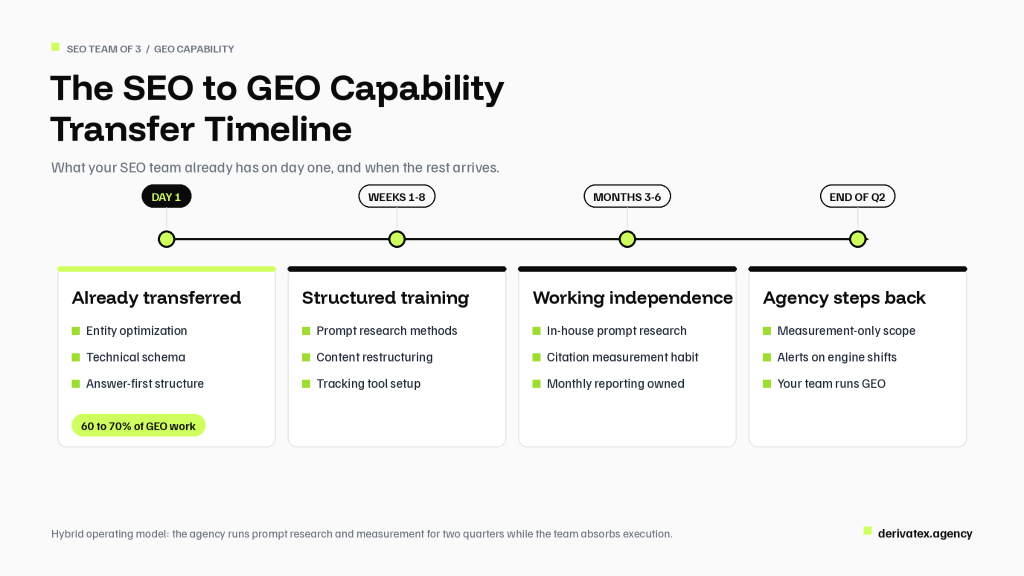
In the cybersecurity engagement, the client’s marketing head had the conceptual side of citation engineering down within the first week. The part that genuinely took two quarters was measurement discipline, the habit of testing the same prompt set across engines on a fixed cadence and reading non-deterministic results without overreacting.
Your first 90 days with a GEO partner
Whatever model you choose, the first 90 days should look like this, with a named deliverable at every stage. Our 90-day GEO sprint breakdown covers the full week-by-week version.
- Days 1 to 14: baseline citation audit. Deliverable: a report showing exactly where you and your competitors appear across the four engines for the target prompt set.
- Days 15 to 45: prompt research and first content batch. Deliverable: the finalized buyer prompt set plus the first 4 to 6 citation-structured assets briefed or drafted.
- Days 46 to 90: publish, implement schema, and measure. Deliverable: the first movement report comparing citation share against the day-14 baseline.
An agency that cannot describe its first 90 days at this level of specificity has not run many of them.
The 8-week upskilling curriculum for a team of 3
If you go hybrid or eventually internalize the work, this is the training arc we would put a 3-person team through. It assumes 4 to 6 hours per person per week alongside normal duties.
| Week | Topic | Owner on a team of 3 | Output |
|---|---|---|---|
| 1 | How AI engines retrieve and cite, plus a manual baseline | Whole team | DIY citation baseline for 20 prompts |
| 2 | Prompt research from sales calls, reviews, and engine testing | SEO lead | Draft prompt set of 40 to 60 buyer prompts |
| 3 to 4 | Answer-first restructuring and claim density | Content writer | 2 existing posts rewritten for citability |
| 5 | Schema and entity signal work | Technical SEO | Markup shipped on 10 priority URLs |
| 6 | Measurement tool setup | SEO lead | Tracked prompt set live in Otterly.AI or Peec AI |
| 7 to 8 | First optimization sprint against the baseline | Whole team | Movement review and a repeatable monthly workflow |
For week 6, the tool decision usually comes down to budget versus depth, and our Peec AI vs Profound comparison walks through that tradeoff for B2B SaaS teams specifically.
The honest middle path: a scoped 90-day pilot
The legitimate middle ground between cheap and full retainer is shorter commitment, not thinner scope. A scoped pilot fixes the variables in advance: a defined asset count, a fixed prompt set, a 90-day term, and one success metric, citation movement against the baseline, at around $5,000 per month. You get full-scope work with a $15,000 total exposure instead of an open-ended retainer, and the agency gets a fair shot at proving movement inside the window engines actually respond in.
A $1,500 retainer stretched over a year costs more than that pilot and proves nothing. Buy less time, never less scope.
GEO Agency vs Consultant vs Tools-Only: Which Vehicle Fits a Team of 3
The right vehicle depends on one variable: how much execution capacity your team has left after its SEO workload. The table compresses the choice.
| Factor | GEO agency | Fractional consultant | Tools-only |
|---|---|---|---|
| Monthly cost | $3,000 to $10,000 | $1,500 to $4,000 | $29 to $399 |
| Who does the work | The agency | Your team, under guidance | Your team, alone |
| Measurement included | Yes, tied to a prompt set | Sometimes, setup only | Data only, no interpretation |
| Best fit | Team at full capacity, needs speed | Team with spare capacity, needs direction | Mature content org validating the channel |
The verdict: an agency buys outcomes, a consultant buys direction, and a tool buys visibility into a problem someone still has to solve. A dashboard has never written a citable page, and it never will.
What happens to your SEO rankings if budget moves to GEO
Shifting budget toward GEO is not zero-sum, because 60 to 70% of the work, technical health, structured content, and entity signals, serves both channels at once. The same schema that helps Gemini attribute a claim helps Google build a rich result, and the same third-party coverage feeds both systems.
One SEO activity does get squeezed, and honesty requires naming it: net-new link building volume is usually the first line deprioritized when GEO enters the budget. For most $20M ARR companies with an established backlink profile, trading marginal link velocity for presence in AI answers is a favorable trade. If you are still building baseline domain authority, weigh that trade more carefully.
When Building In-House Actually Wins
Building beats partnering when GEO is a permanent core channel, your content org already has 5 or more people, and growth is content-led enough that a dedicated owner stays fully utilized. A 3-person SEO team treating GEO as its first serious AI channel usually does not clear that bar yet, and it would be dishonest of us to pretend otherwise just because we sell the alternative. The build recommendation becomes right roughly when the tracked prompt set, the publishing volume, and the measurement cadence outgrow what a partner plus your existing team can carry, and the emerging AI search roles hitting job boards show what that dedicated function looks like once it exists.
6 questions to ask any GEO agency before signing
Take these into every sales call, with the answer that should come back noted in parentheses. Our full GEO agency evaluation checklist expands each into a scoring rubric.
- How do you measure citations? (A named method and tool tracking a defined prompt set, never “we monitor mentions.”)
- Can I see our target prompts before we sign? (A researched prompt list specific to your category, not a keyword export.)
- What does the day-14 deliverable look like? (A baseline citation audit across at least 4 engines.)
- Who writes the content, and what is the editing process? (Named writers and a described human editorial pass.)
- What schema work is in scope? (Specific markup types on specific page counts, not “technical optimization.”)
- What happens at month 6 if citation share has not moved? (A defined review clause or exit, stated without flinching.)
An agency that answers all six cleanly is probably worth its retainer. An agency that stumbles on question one is selling you the left column of the pricing table from earlier.
FAQ
How long does it take to train an SEO team on GEO?
A 3-person SEO team reaches working proficiency in 6 to 8 weeks for the transferable skills: answer-first content structure, schema, and entity work. The two non-transferable skills take longer, with independent prompt research and disciplined citation measurement typically requiring about two quarters of repetition. In our client engagements, one marketing head grasped citation engineering concepts within a week, but the measurement habit across four AI engines took the full six months. Industry estimates for complete self-taught competency run 6 to 9 months, so structured training with feedback roughly halves the timeline.
Isn’t this just a GEO agency telling me to hire a GEO agency?
Fair challenge, and the piece argues the opposite in two places. If your SEO team has spare capacity and your timeline tolerates 6 to 9 months, you can self-build using a $29 to $199 monthly tool and the 8-week curriculum above, spending under $3,000 in year one.
The honest case for a partner is narrower: speed, since agencies move citations in 60 to 90 days, and cross-account pattern data no single company can generate alone. Building also clearly wins for 5-plus person content orgs treating GEO as a core channel. Run the skills audit first, and let the gaps decide, not the vendor.
What does the GEO agency keep doing after our team is trained?
In the hybrid model, the agency’s residual role is measurement and pattern detection, the two functions that benefit from seeing many accounts at once. AI engines change retrieval behavior several times a year, and an agency watching dozens of prompt sets spots a shift in days, while a single in-house team can lose a quarter diagnosing it.
Post-transfer engagements typically drop to a measurement-only scope: maintaining the tracked prompt set, delivering the monthly citation share report, and flagging engine-level changes. Everything else, content, schema, and publishing, stays with your team.
Do we need a dedicated GEO hire at $20M ARR?
Usually not. A dedicated hire makes sense when the tracked prompt set, publishing volume, and measurement cadence would keep someone busy full-time, which typically means a content organization of 5 or more people running GEO as a core channel.
At a 3-person SEO team, the workload after training is closer to 4 to 8 hours per week per person, absorbed into existing roles with a tracking tool underneath. Hiring a $75,000 to $95,000 specialist before the volume exists buys you idle time and signal isolation, the exact problems the in-house path struggles with.
Can we just buy Otterly or Profound and skip the agency entirely?
You can, if you are clear about what a tool does. Otterly.AI from $29 per month and Profound from roughly $399 per month will tell you whether AI engines mention your brand across a tracked prompt set, and that visibility alone is worth having.
What no tool does is produce citation-structured content, implement schema, build third-party coverage, or interpret why a competitor holds the answer you want. Tools-only works for a mature content team that just needs the data layer. For everyone else, a dashboard documenting your invisibility in high resolution is not a strategy.
How do I actually measure whether GEO is working?
Track three numbers. First, citation share on your target prompts: the percentage of tracked buyer prompts where your brand appears in the answer, measured monthly in a tool like Otterly.AI against your day-14 baseline. Second, AI-referred inbound: sessions arriving from chatgpt.com, perplexity.ai, and gemini.google.com referrers in your analytics, plus “heard about you” fields on demo forms. Third, pipeline sourced from AI discovery: deals where the buyer names an AI tool as the discovery channel. Citation share moves first, at 60 to 90 days, and the GEO KPIs your CMO and board will actually care about arrive last, through pipeline.
The Decision, Compressed
The most important finding in this entire comparison is that the build-vs-buy framing was never your real question. A 3-person SEO team at $20M ARR already owns 60 to 70% of GEO capability, so the actual decision is how to close a two-skill gap: prompt research and citation measurement. Priced that way, the paths stop being ideological. A partner closes the gap in 90 days for $15,000 of exposure, a self-build closes it in 6 to 9 months for under $3,000, and a hybrid installs it permanently over two quarters.
Your next step takes one afternoon and costs nothing. Run the 15-minute skills audit against your three people, then manually test 20 buyer prompts across ChatGPT, Perplexity, and Gemini and write down who gets recommended, or start with a free AI visibility audit if you want the baseline built for you. Those two artifacts, your gap list and your baseline, will do more to settle the build-or-partner question than any sales call.
One more thing worth planning for: the two skills that do not transfer today will not stay rare. AI search roles are being posted, priced, and filled across B2B SaaS right now, which means the labor market will eventually close the gap the same way it did for technical SEO a decade ago. The companies that come out ahead will be the ones that installed the capability while their category’s citations were still up for grabs, and at $20M ARR with a working SEO team, you are better positioned to do that than almost anyone writing about it.
Written byAyush SharmaVP, SEO & AI Search, DerivateX
VP, SEO & AI Search at DerivateX. We're a B2B SaaS SEO and Generative Engine Optimization agency that engineers AI citations in ChatGPT, Perplexity, Claude, and Gemini and connects them to demo bookings and revenue pipeline.
Reviewed byShivanshi BhatiaCo-founder, DerivateX
Shivanshi Bhatia is the co-founder of DerivateX, a B2B SaaS SEO and Generative Engine Optimization agency that engineers AI citations in ChatGPT, Perplexity, Claude, and Gemini and connects them to demo bookings and revenue pipeline. She runs operations and delivery, which means every audit, content brief, and published page ships through a system she built. She owns the client relationship from kickoff through reporting, so clients spend their time on decisions instead of chasing updates. She has worked in SaaS since 2019 and reviews client work before it goes live.
Cited by AI