Case study: Gumlet turned ChatGPT mentions into 20% of inbound revenue. Read it →

7 Best GEO Tools for B2B SaaS Companies in 2026

The difference between knowing your brand is invisible in AI search and actually doing something about it comes down to which tool you pick.

TL;DR
- More than half of B2B buyers now research vendors on ChatGPT, Perplexity, or Claude before visiting any website.
- Most GEO tools only show you where your brand appears in AI answers. Very few help you act on that data.
- The monitoring-vs-optimization gap is the most important thing to evaluate when choosing a GEO tool for B2B SaaS.
- Budget teams: start with Otterly AI or GrackerAI. Enterprise teams: look at Profound or AthenaHQ. Already on Semrush or Ahrefs: use their AI add-ons first.
- GrackerAI is the only tool here built specifically for B2B SaaS, with content generation included from the entry plan.
Your Domain Ranking is climbing, keywords are on page one, your content team shipped fourteen articles last quarter, and yet ChatGPT has never recommended your product once.
That gap is where the B2B SaaS pipeline is quietly leaking in 2026.
Almost 51% of B2B software buyers now use AI chatbots for vendor research, with half starting their research in an AI chatbot before they ever visit a search engine.
A buyer reads an AI recommendation, clicks through to the winner, and your dashboard logs it as direct traffic. You never knew you lost. GEO tools exist to close that gap. The problem is that most of them stop at showing you the problem.
This piece covers seven tools worth evaluating for B2B SaaS, what each one does well, where each falls short, and which is worth your money based on your team size and capacity to act on the data.
The One Distinction That Should Drive Every GEO Tool Decision
Buy a monitoring tool when you need optimization, and you will spend three months watching a mention rate that never improves. The data will be accurate. Nothing will change.
The split is this: Monitoring tools measure your AI presence. Optimization tools help you build it. Most GEO tools on the market are the former dressed up as the latter. Knowing which is which before you buy is the only evaluation that actually matters.
What monitoring tools do
They run your defined prompts across AI platforms on a schedule, log whether your brand appeared, and show you trend data over time. Mention rate, sentiment, competitor share of voice. All of it is real and worth knowing. None of it tells your content team what to publish next week.
What optimization tools do
They connect that monitoring data to a content workflow. A gap analysis that names the specific prompts your brand is losing. A recommendation engine that tells you what to fix and why. In some cases, a content generation layer that takes you from gap to draft without leaving the platform.
These tools are rarer and more expensive, but for B2B SaaS teams without a dedicated GEO practitioner, they are the only category worth buying.
Why B2B SaaS makes this more urgent
B2B buyers are not searching for your brand in ChatGPT. They are asking category-level research questions during the evaluation phase: “what attribution tools work with HubSpot,” “best CRM for a scaling SaaS team.” AI builds the shortlist from those queries.
Appearing in that shortlist requires a content program, not a dashboard. A monitoring tool can tell you you are absent. Only an optimization tool gives you a systematic way to fix it.
Not sure where your brand currently stands before making this call? Derivatex’s free AI Visibility Checker gives you your AVS score across ChatGPT, Perplexity, Claude, and Gemini in under 60 seconds.
7 GEO Tools for B2B SaaS
1. Otterly AI
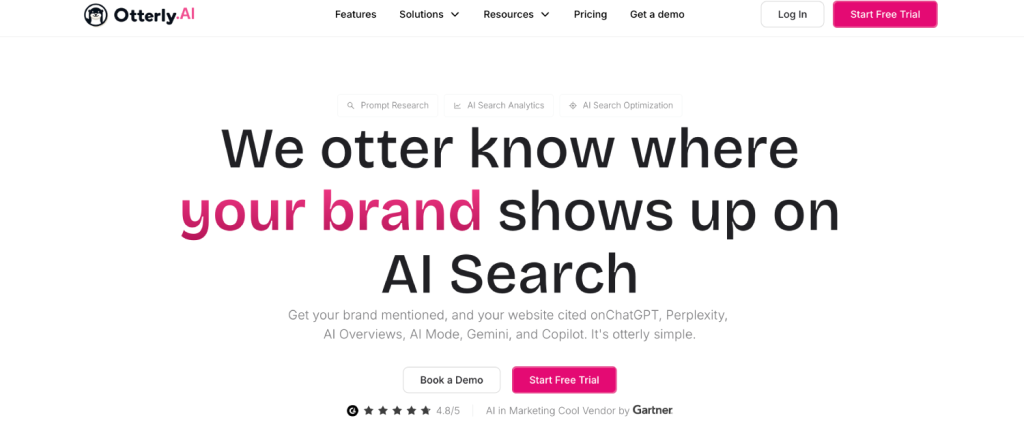
Best For: Small SaaS teams that want automated monitoring and a structured GEO audit without committing to enterprise pricing.
Otterly’s most useful feature is not mention tracking. It is URL citation tracking: when ChatGPT names your brand but links to a competitor’s comparison page instead of your site, Otterly AI surfaces that. Most tools at this price point do not.
The GEO Audit adds an on-page layer, analyzing 25-plus citation factors and giving teams a concrete starting checklist.
What Otterly does not do is tell you what to write next. There is no content workflow, no gap analysis, no traffic attribution. It is a diagnostic tool. How much value you get from it depends entirely on whether your team has the capacity to act on a diagnosis independently.
Pros:
- URL citation tracking surfaces exactly which pages to fix
- GEO Audit gives teams a structured on-page starting point
- $29/month entry removes the commitment risk for teams just starting out
Cons:
- No content generation or optimization workflow at any tier
- Google AI Mode and Gemini sit behind add-on pricing
- Data quality is only as good as your prompt design
Verdict: The right first tool for a team that needs data before committing to a larger platform. Not a tool you build a GEO program on.
2. Peec AI
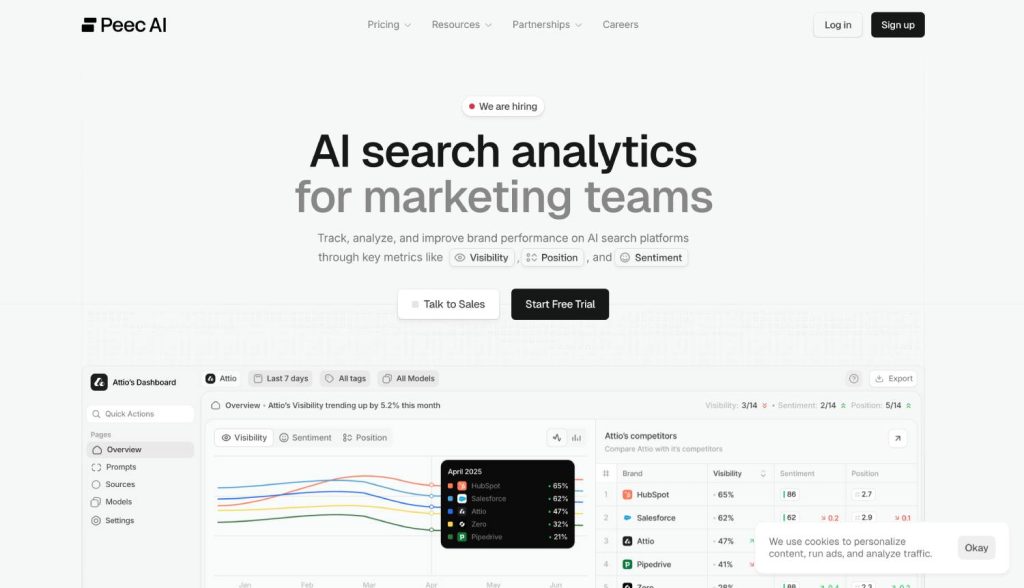
Best For: B2B SaaS companies with international audiences or agencies tracking multiple brands across languages.
Peec’s structural differentiator is methodology. Where most tools query AI platforms via API and return synthetic responses, Peec AI scrapes the actual UI. What you see in Peec’s dashboard is what a real buyer sees in their browser. For teams making significant content investment decisions based on citation data, that accuracy gap matters.
The 115-plus language support is the other genuine differentiator. No other tool in this list comes close to multi-region SaaS brands tracking AI visibility across non-English markets.
Pros:
- UI scraping methodology reflects real user experience, not synthetic API responses
- 115-plus language support for multi-region SaaS brands
- The Actions feature provides directional improvement recommendations
Cons:
- No content generation or publishing workflow inside the platform
- Default plan tracks only 3 engines; broader coverage requires add-ons
- Euro-denominated pricing creates budget uncertainty for USD-planning teams
Verdict: The strongest monitoring tool in this list for accuracy and multilingual depth. If your buyers are not all English-speaking, this is the only tool built for that reality.
3. Profound
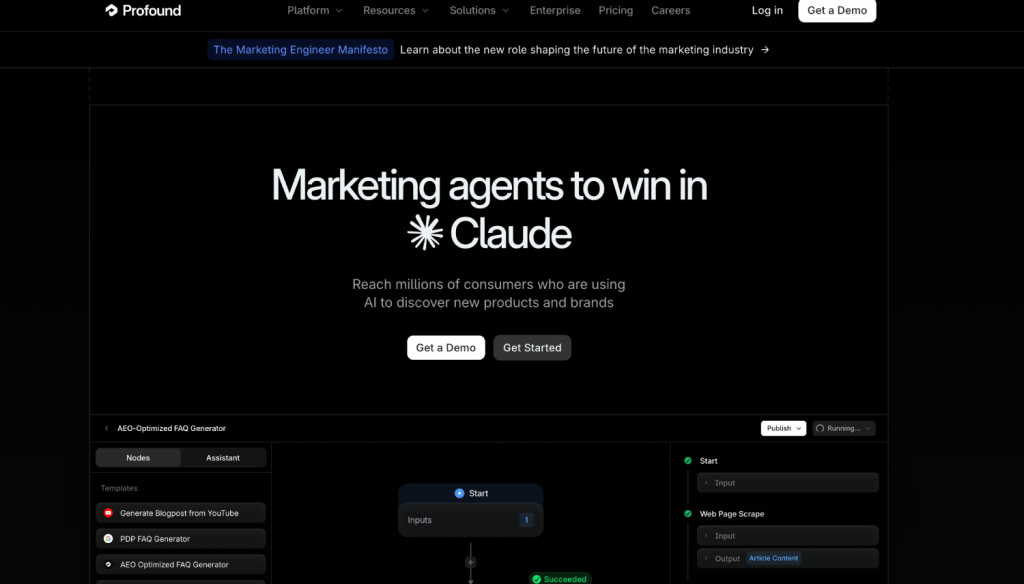
Best For: Enterprise B2B SaaS teams that need SOC 2-compliant AI visibility data and deep prompt-volume analytics.
Most GEO tools tell you whether your brand appeared in an AI answer. Profound tells you how many actual conversations are happening around a given prompt category. That is a different level of signal entirely. Instead of guessing which content to prioritize, you are working from real demand data.
The Opportunity feature reflects the same philosophy: fewer recommendations than some competing tools, but each one arrives with a clear rationale and step-by-step implementation guidance quality over volume.
Pros:
- Prompt volume data shows actual conversation demand, not just mention frequency
- Opportunity feature delivers specific, immediately actionable recommendations
- SOC2 compliant for enterprise teams with data governance requirements
Cons:
- $499/month starter tier tracks only one AI engine
- No built-in content generation at any tier
- Enterprise pricing is the highest entry point in this comparison for real coverage.
Verdict: The right tool for an enterprise team with dedicated content resources and a compliance requirement. The wrong tool for any team that needs execution support alongside the data.
4. Semrush AI Visibility Toolkit
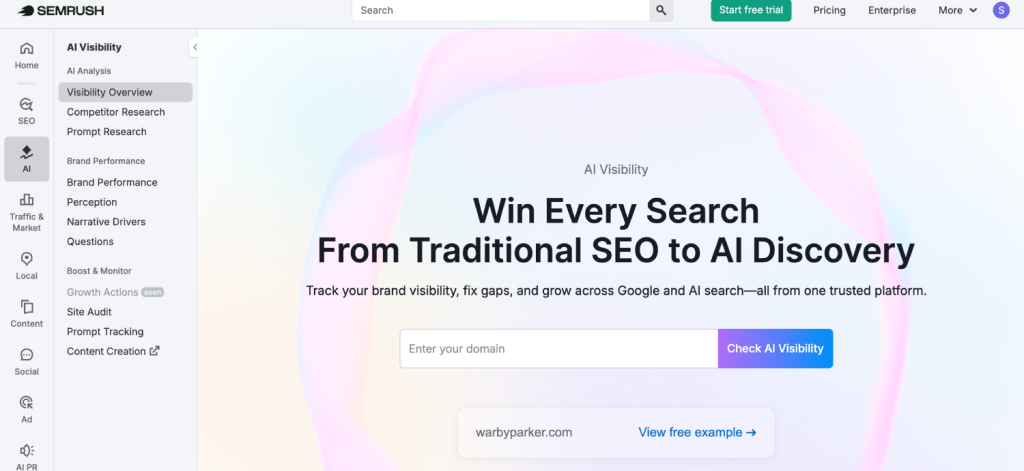
Best For: B2B SaaS teams already running SEO operations inside Semrush who want AI visibility in the same workspace.
This is not a standalone GEO product. It is an extension of an existing SEO workflow, and it should be evaluated on exactly those terms. If you already pay for Semrush AI Toolkit, it reduces tool-switching friction and consolidates your search data in one place. If you do not already pay for Semrush, the combined cost is hard to justify against purpose-built alternatives.
The coverage gaps are also real. As of Q2 2026, the toolkit does not track Claude or Meta AI, which are meaningful platforms for B2B buyers in certain categories.
Pros:
- Native integration with Semrush keyword, competitor, and content data
- Brand sentiment and competitor share-of-voice built into the existing dashboard
- Semrush One bundle from $199/month offers better value than buying toolkit separately
Cons:
- $99/month per user for AI Toolkit access; a three-person team pays $297/month for AI access alone
- Does not track Claude or Meta AI as of Q2 2026
- Optimization depth is significantly shallower than purpose-built GEO tools at comparable cost
Verdict: Makes sense as an add-on if Semrush is already your SEO platform. Makes no sense as a primary GEO investment if it is not.
5. Ahrefs Brand Radar
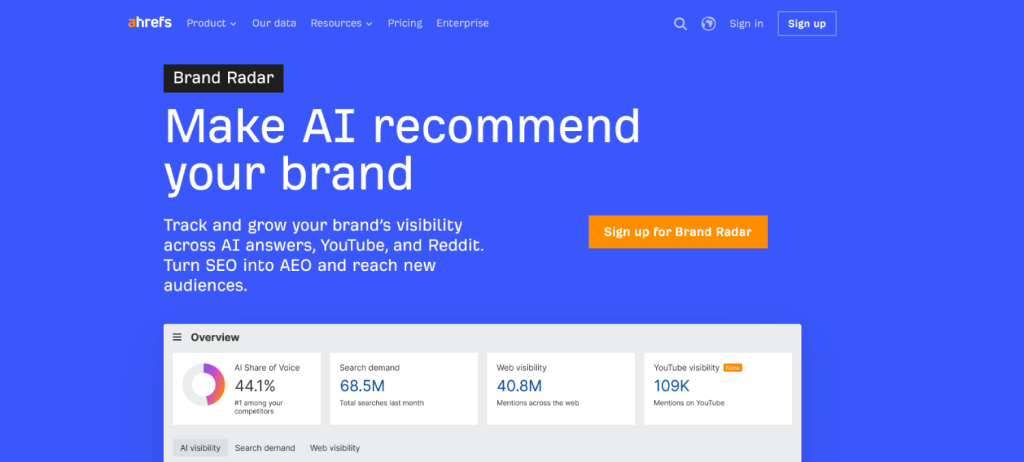
Best For: SEO-focused agencies and in-house teams with existing Ahrefs subscriptions that want AI visibility layered into their current stack.
Brand Radar’s headline number is its dataset: over 200 million AI search queries, which is one of the largest prompt bases in the category. For agencies already running client reporting inside Ahrefs, adding AI visibility data to the same workspace is a low-friction upgrade with genuine data weight behind it.
The ceiling is absolute. Brand Radar is monitoring only, with no content recommendations, no gap analysis, and no path from data to execution. It also requires an active Ahrefs subscription on top of the add-on cost, which makes total spend significant for teams buying in specifically for GEO.
Pros:
- 200-million-plus query dataset, one of the largest prompt bases in the category
- Clean integration with existing Ahrefs projects, rank data, and backlink analysis
- Transparent pricing at $199/month per index or $699/month for all indexes
Cons:
- Monitoring only, no optimization workflow of any kind
- Requires active Ahrefs subscription on top of add-on cost
- AI tracking add-ons have no free trial; basic Brand Radar access requires a free or paid Ahrefs account
Verdict: The right add-on for heavy Ahrefs users. The wrong primary GEO investment for anyone who is not.
6. GrackerAI
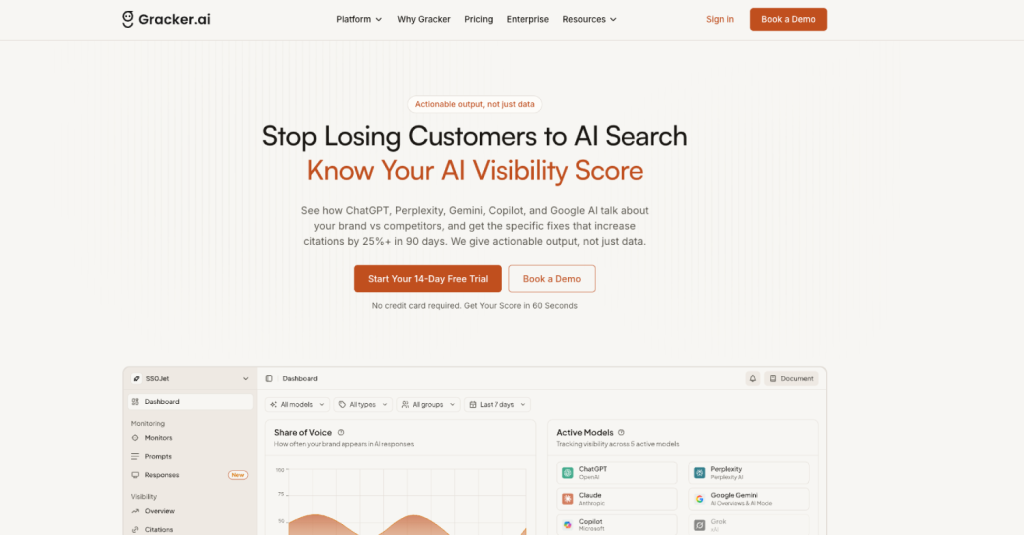
Best For: Lean B2B SaaS and cybersecurity marketing teams that need monitoring and content execution in one platform.
Every other tool in this list was built for generic brand monitoring and positioned toward B2B SaaS afterward. GrackerAI was built for B2B SaaS from the start. The platform’s models are calibrated for the research-mode queries B2B buyers actually use during software evaluation, not branded queries or consumer search behavior.
The content generation layer is what separates it structurally from every other tool at this price point. At $99/month, GrackerAI is the only tool in this comparison that takes a team from monitoring gap to publishable content draft without leaving the platform.
Pros:
- Only tool in this list purpose-built for B2B SaaS, with models calibrated for software evaluation queries
- Content generation included at every paid tier from $99/month
- Tracks up to 9 AI engines on the Pro plan
Cons:
- Less brand recognition than Semrush or Ahrefs, which requires more internal selling at larger companies
- Content output requires editorial review before publishing
- Agency-tier features locked behind Growth plan and above
Verdict: The strongest value in this list for lean B2B SaaS teams that need both monitoring and execution. The content generation layer at $99/month is the only thing in this price range that closes the gap between data and action.
7. AthenaHQ
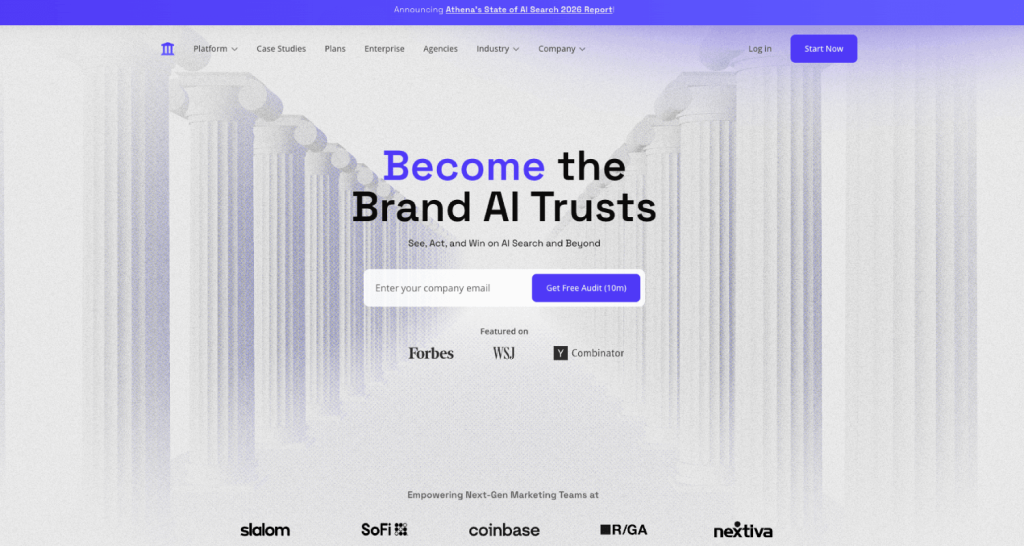
Best For: Growth-stage B2B SaaS companies that need AI visibility connected to content agents and revenue attribution.
AthenaHQ was founded by former Google Search and DeepMind engineers and backed by Y Combinator. The technical pedigree shows in the product. The ACE engine, AthenaHQ’s proprietary citation probability algorithm, predicts how likely a specific piece of content is to be cited by a specific AI platform.
That moves GEO prioritization from intuition to probability. Teams stop guessing which content to fix and work from a ranked list of highest-return opportunities instead.
Pros:
- ACE engine predicts citation probability per content piece, per AI platform
- Infrastructure integrations surface real AI crawler behavior at the page level
- 4.9/5 on G2 across 32 verified reviews as of Q2 2026
Cons:
- Credit-based pricing is unpredictable for large audit projects
- ACE engine is enterprise-only, limiting the highest-value feature to upper tiers
- No standard free trial; discounted first month at $95 is the entry point
Verdict: The most technically sophisticated tool in this list. Worth the evaluation for any B2B SaaS company above $10M ARR with a defined GEO budget and the team to act on what it surfaces.
7 GEO Tools for B2B SaaS: How They Compare
| Tool | Best For | Starting Price | AI Engines Tracked | Free Trial | Type |
|---|---|---|---|---|---|
| Otterly AI | Budget monitoring, small SaaS teams | $29/month | 6 (AI Mode + Gemini = add-ons) | Yes | Monitoring + GEO audit |
| Peec AI | Multi-language tracking, agencies | ~89 EUR/month | 8+ (choose 3 by default) | Yes | Monitoring + action recommendations |
| Profound | Enterprise data depth, SOC2 compliance | $499/month (1 engine) | 10+ | No | Monitoring + opportunity layer |
| Semrush AI Toolkit | Teams already using Semrush | $99/month per domain | 5 | Via Semrush One (14 days) | Monitoring + limited optimization |
| Ahrefs Brand Radar | Agencies with existing Ahrefs stack | $199/month per index | 200M+ prompt dataset | No | Monitoring only |
| GrackerAI | Lean B2B SaaS and cybersecurity teams | $99/month | Up to 9 | Yes (14-day) | Monitoring + content generation |
| AthenaHQ | Revenue attribution, growth-stage SaaS | $295/month | 8+ | Discounted first month ($95) | Monitoring + content agents |
Red Flags to Watch for When Evaluating GEO Tools
Most GEO tools look credible on a pricing page. The gaps show up after you buy. Here is what to watch for before you commit.
“We track X AI engines” without specifying methodology
Engine count is the most-gamed metric in this category. A tool that queries the ChatGPT API and a tool that scrapes the actual ChatGPT interface return different results. API responses do not always match what a real buyer sees in their browser. Ask every vendor how they retrieve data, not just which platforms they cover.
Case studies that show traffic, not citations
A tool that proves its value with organic traffic growth is showing you SEO outcomes, not GEO outcomes. The metric that matters is AI citation rate on your target prompt set. If a vendor cannot show you that number improving for a client in your category, their GEO credentials are borrowed from their SEO track record.
No answer to “what do we do with the data”
Press every vendor on this directly. If their answer describes dashboards, reports, and insights, you are buying a monitoring tool. If they cannot describe a specific workflow your team follows after logging in on Monday morning, the tool ends where your work begins.
“AI-optimized content” with no prompt testing methodology
Several tools now offer content generation or optimization features. The quality of that output depends entirely on whether the tool tests generated content against actual AI prompts before recommending it. Ask whether the platform validates its content recommendations against real prompt outputs. Most cannot answer that question clearly.
Before committing to any paid platform, it’s worth knowing where you actually stand. Is AI Aware is a free tool that runs 28 real buyer prompts across ChatGPT, Perplexity, Claude, and Gemini and scores your brand’s AI visibility from 0 to 100. Use it to establish your baseline before you buy anything on this list.
The Bottom Line
Most GEO tools are selling you clarity on a problem you already know you have. A dashboard confirming your brand is invisible in AI answers, in precise detail, is not a program. It is a starting point.
The teams building a real AI citation advantage in 2026 are not the ones with the most sophisticated monitoring setup. They are the ones running a consistent content workflow every week, regardless of what the dashboard says. The tool is secondary to that discipline.
Pick the tool that fits what your team can actually execute on today. Then build the workflow around it. If you want to see what that looks like in practice for a B2B SaaS company, here is how Derivatex approaches GEO.
FAQ
1. Can my brand appear in AI answers without any GEO work?
Yes. Some brands get cited accidentally because they have strong topical authority, high domain rating, or content that happens to match how AI models retrieve information. The problem with accidental visibility is that you cannot reproduce it, defend it, or scale it. Deliberate GEO work is what turns an occasional citation into a consistent one.
2. How many prompts should I track as a starting point?
Twenty buyer-intent prompts is the right starting point. Enough to give you meaningful trend data, not so many that prompt management becomes its own job. Run the same set consistently for at least 90 days before changing anything. Changing prompts mid-program makes trend data worthless.
3. Should I track competitor brands in my prompt set?
Yes, but separately from your core tracking set. Competitor prompts tell you which brands AI models associate with your category and how prominently. That is competitive intelligence, not performance tracking. Keep them in a separate list so they do not distort your core citation rate metrics.
4. Will publishing more content automatically improve my AI citation rate?
Not if it is the wrong content. AI models cite content that is specific, authoritative, and structured to answer discrete questions clearly. Publishing volume without that structure adds noise, not citations. Ten well-structured, claim-dense articles targeting your highest-value prompt categories will outperform fifty generic blog posts every time.
5. How do I know if a GEO tool’s data is actually accurate?
Run the same prompt manually in each AI platform and compare the result to what the tool reports. Do this for five to ten prompts across two or three platforms. If the tool’s output consistently matches what you see in the real interface, the methodology is sound. If it diverges regularly, the tool is likely querying APIs rather than scraping real outputs, and the data gap will affect every decision you make from it.
Written byAlekhya RContent Writer, DerivateX
Focuses on SEO, AI search, and content, with an emphasis on how structured content drives visibility and pipeline for B2B SaaS companies.
Cited by AI