Case study: Gumlet turned ChatGPT mentions into 20% of inbound revenue. Read it →

12 SaaS Link Building Strategies That Actually Move the Needle in 2026

Link building split into two disciplines in 2024 and most SaaS teams are still running one. We broke down 12 strategies that move both Google rankings and AI citations, organized by stack and ARR stage.


TL;DR
- Link building has split into two disciplines in 2026: links that move Google rankings, and links and mentions that get you cited by ChatGPT, Perplexity, and Claude. Different criteria. Different measurement.
- Referring domain count is the wrong metric for either stack. Citation Reproducibility (consistent appearance across repeated AI queries) is the metric that matches how AI engines actually retrieve.
- The 12 strategies in this article are organized by which stack they feed: 4 SERP-only, 4 Citation-only, 4 dual-stack.
- Search Budget allocation shifts by ARR stage. Pre-PMF, $1M to $5M ARR, and $5M+ ARR each get different splits.
- Entity authority beats domain age in AI engines. A 2-year-old SaaS can outcite a 12-year-old competitor inside ChatGPT if it builds the right citation surface.
More DR70+ backlinks won’t make ChatGPT cite you. You can prove it yourself in five minutes.
Run any buyer query in your category through ChatGPT three times in a row, then check the cited domains against your competitors’ backlink profiles. The brands cited most often aren’t the ones with the strongest referring-domain counts. They’re the ones whose names show up consistently across the source set ChatGPT actually retrieves from.
Most SaaS teams are still spending $5K to $50K a month treating link building as one discipline. It split into two roughly 18 months ago.
One half feeds Google rankings, the other half feeds AI citations, and the criteria for each are different enough that strategies tuned for one usually underperform for the other.
Gumlet, one of our clients, hit 20% of inbound revenue from ChatGPT by running both stacks separately. Most teams are running one stack and wondering why pipeline isn’t moving.
This piece breaks down 12 strategies organized by which stack they feed, the Search Budget Framework for splitting investment between them, and the metric that should replace referring-domain count in your 2026 reporting.
Why SaaS link building has become a mess in 2026
The phrase isn’t ours. It’s what one founder posted on r/SEO last quarter and what shows up in half a dozen B2B SaaS Slack groups every week.
The frustration is real, and it’s structural. Not a tactical problem you can outwork with a better outreach template.
Here’s what changed.
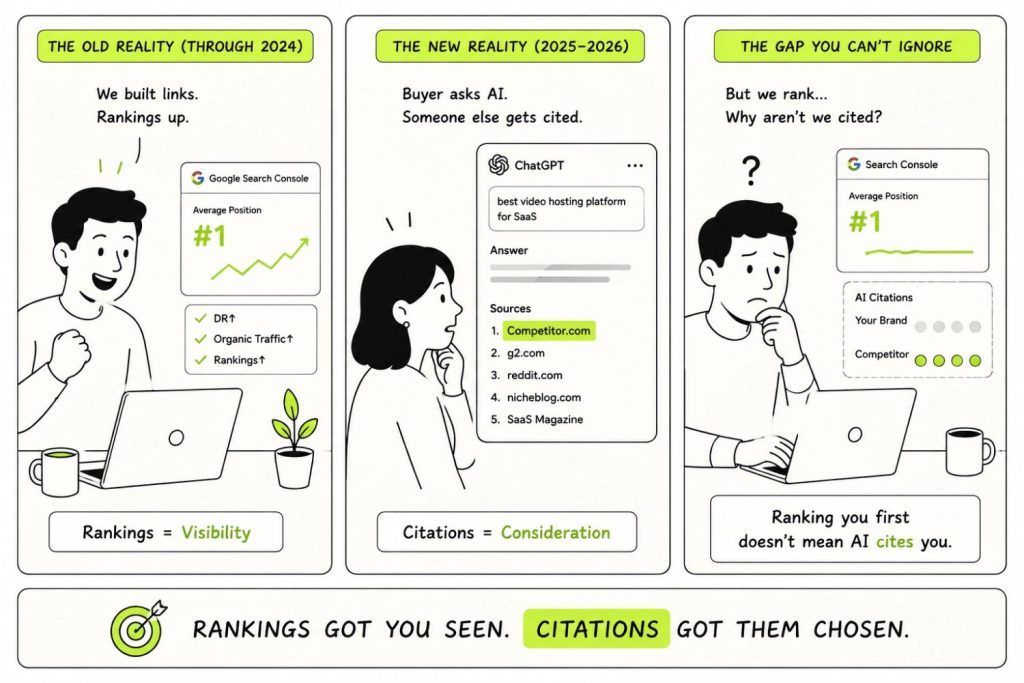
Through 2024, Google’s algorithm was the only retrieval engine that mattered for organic discovery. The link signals that lifted rankings were well understood: editorial dofollow, contextual placement, anchor variation, ICP-relevant publication. Build enough of those and you ranked.
Then ChatGPT search hit 200 million weekly active users. Perplexity became the default research tool for analysts and technical buyers. Google rolled out AI Overviews and AI Mode.
Suddenly half your buyer’s evaluation funnel was happening inside generated answers, and the source set those answers pull from was not the top 10 organic results. In Ahrefs’ 2026 analysis, only 38% of AI Overview citations come from top-10 organic positions now. In Leapd data, the number is as low as 17%.
Full disclosure: DerivateX runs Citation Engineering for B2B SaaS clients including Gumlet and Verito, so I see this pattern across roughly 50 client and prospect audits per quarter. The pattern still holds when checked against public data from Ahrefs, Leaped, and Seer Interactive, which I’ll cite directly below.
What that 17% to 38% gap means in practice: the link profile that ranks on Google rewards one set of signals, and the profile that gets cited by ChatGPT rewards a different set. The criteria diverged. The measurement frameworks didn’t catch up. That’s the mess.
Link building has split into two stacks. Confuse them and you waste budget.
Call the split the Two-Stack Link Model. Every link or mention a SaaS earns belongs to one of two stacks, and the criteria are different enough that strategies tuned for one rarely move the other.
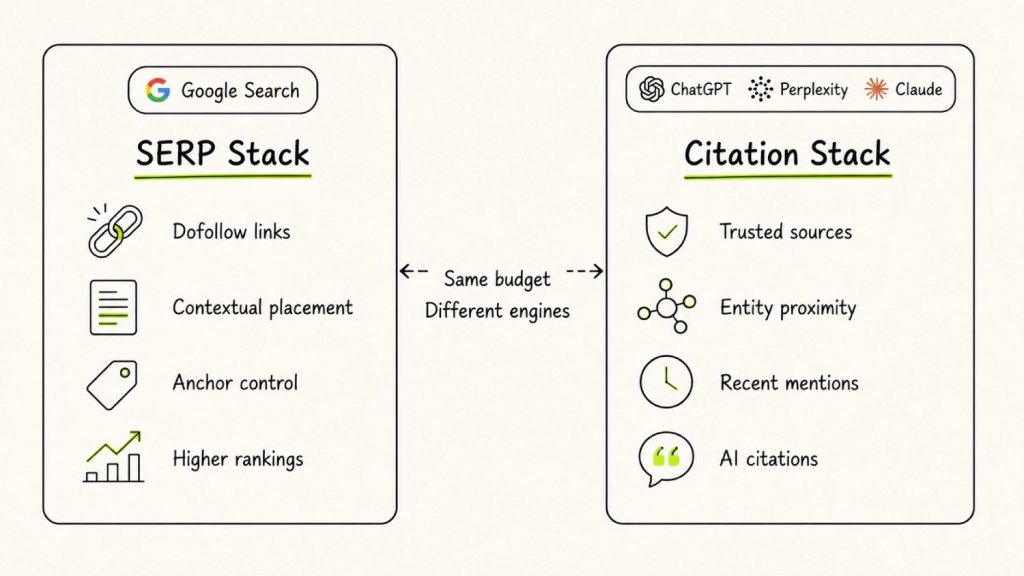
SERP Stack: links that move Google rankings
The SERP Stack is the link discipline most SaaS teams already know. The criteria are familiar: editorial dofollow, contextual placement on a thematically aligned page, ICP-relevant publication, controlled anchor distribution, link velocity that matches publishing cadence.
Authority transfer is still real here.
The single biggest shift in 2026 is that audience-fit now multiplies authority more than raw Domain Rating does. A DR 45 placement on SaaStr does more for a B2B SaaS ranking than a DR 75 placement on a general tech blog with no SaaS readers.
Citation Stack: links and mentions that get you cited by ChatGPT, Perplexity, and Claude
The Citation Stack feeds AI engines, which retrieve through a different mechanism. They don’t rank pages. They assemble answers from passages across multiple sources after building a consensus signal across them.
Five criteria matter for Citation Stack work.
- First, source trust for the specific query type (Reddit for community queries, G2 for software comparison, Wikipedia for entity definition).
- Second, entity-proximity to your category.
- Third, content recency (Perplexity weights last-30-day sources at roughly 82% per a 2026 analysis).
- Fourth, passages structured to lift cleanly into a generated answer.
- Fifth, presence across multiple independent sources so the consensus signal fires.
Dofollow status is largely irrelevant in this stack. A brand mention without a link, repeated across enough authoritative sources, often outperforms a dofollow link in a low-citation publication.
Citation Reproducibility: the metric that replaces referring domain count
Citation Reproducibility is the percentage of your target AI queries where your brand or page is cited across at least 3 of 5 model runs in ChatGPT, Perplexity, and Claude.
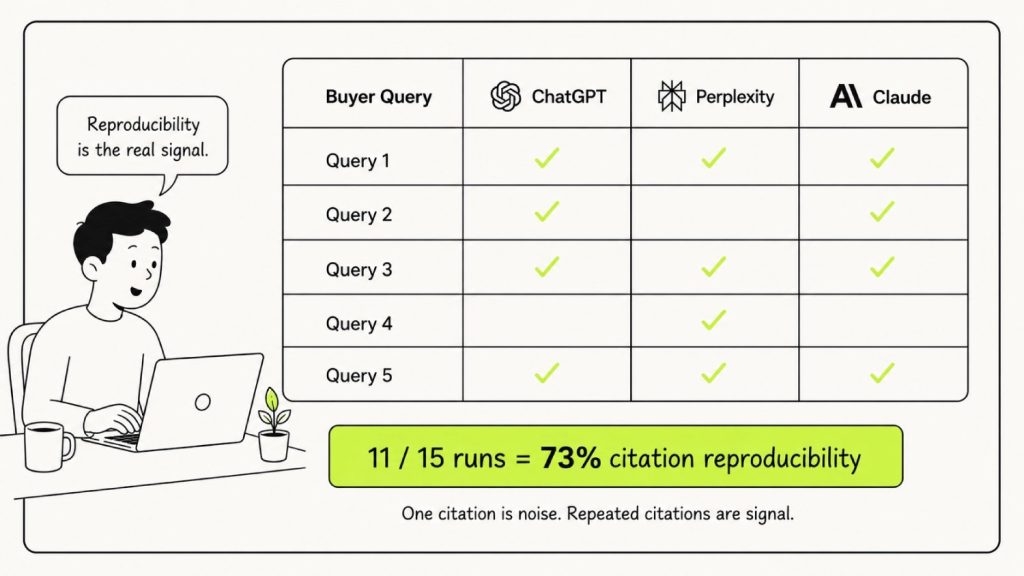
We coined the term because single-shot AI citations are noisy. LLM outputs vary across runs, and a brand can appear in one ChatGPT response and disappear in the next four. Reproducibility is the operationally meaningful version of “AI visibility.”
Citation Reproducibility measures what actually compounds for AI search: how consistently your brand surfaces across repeated model runs.
Referring domain count measures something different, and the two metrics diverged in 2024 when AI engines became material discovery channels.
Citation Reproducibility is the right metric because it matches how AI engines actually retrieve. Referring domain count tells you how many sites Google can use as a vote. Citation Reproducibility tells you how often you actually show up where your buyer is looking.
12 SaaS link building strategies that actually move the needle in 2026
Here are the 12 strategies that move the needle, organized by which stack they feed. Each one includes a Stack tag, a cost level, a time-to-impact estimate, and the ARR stage where it pays off most.
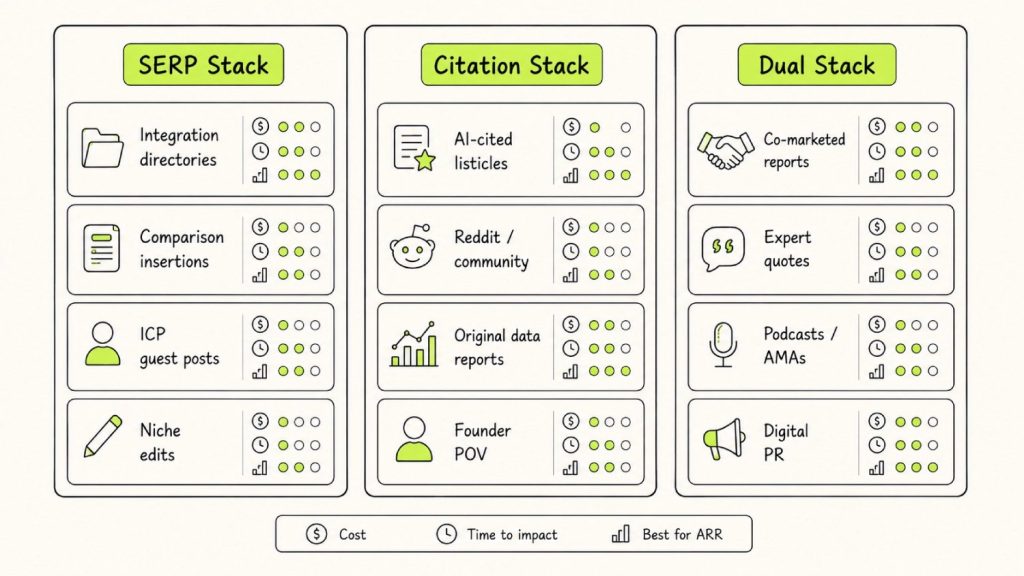
The ranking is weighted on practitioner data: which strategies have produced tracked keyword movement, tracked AI citation appearances, or both, across our 2026 book of B2B SaaS clients.
| # | Strategy | Stack | Cost | Time to impact | Best for ARR |
|---|---|---|---|---|---|
| 1 | Integration directory listings | SERP | Free | 1 to 2 weeks | All stages |
| 2 | Comparison page link insertions | SERP | $150 to $400 per link | 1 to 4 weeks | $1M+ |
| 3 | ICP-audience guest posts | SERP | $250 to $1,500 per post | 4 to 8 weeks | All stages |
| 4 | Niche edits on high-traffic pages | SERP | $200 to $600 per edit | 2 to 6 weeks | $1M+ |
| 5 | Listicle placement on AI-cited domains | Citation | $300 to $1,200 per placement | 4 to 12 weeks | $1M+ |
| 6 | Reddit and community surface building | Citation | Time-only | 8 to 16 weeks | All stages |
| 7 | Original data reports for AI retrieval | Citation | $5K to $25K per report | 8 to 24 weeks | $5M+ |
| 8 | Founder POV publishing | Citation | Time-only | 12 to 24 weeks | All stages |
| 9 | Co-marketed benchmark reports | Dual | $10K to $40K per report | 12 to 24 weeks | $5M+ |
| 10 | Expert quotes on Qwoted/Featured | Dual | Time + $200 per quote | 4 to 12 weeks | All stages |
| 11 | Podcast and AMA appearances | Dual | Time-only | 4 to 12 weeks | All stages |
| 12 | Digital PR with proprietary-data hooks | Dual | $5K to $15K per month | 8 to 24 weeks | $1M+ |
1. Integration directory listings on every marketplace your product touches (SERP Stack)
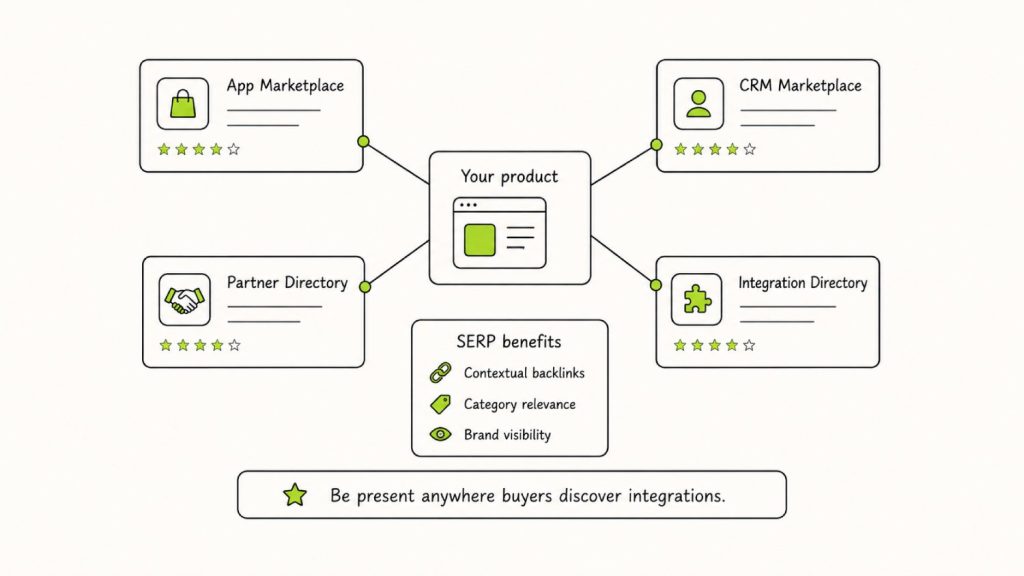
If you have an API or any product integration, every partner marketplace is a free editorial backlink waiting on a 30-minute form.
Zapier sits at DR 91. The HubSpot App Marketplace is DR 93. Salesforce AppExchange, Slack App Directory, Monday.com Marketplace, and ClickUp Integrations are all in DR 80+ territory, all topically aligned with your category by definition.
The mechanism for sub-$10M ARR teams who think these are gatekept: most marketplaces accept submissions through the public partner portal, not through sales. Build the basic OAuth integration, submit through the developer console, and you’re listed in 1 to 2 weeks.
The hard part is having the integration to submit.
Audit your integrations this week. If your product connects to even three tools and you’re not listed on their marketplace pages, you’re leaving 3 to 5 free DR-91+ links on the table for nothing.
Time to impact: 1 to 2 weeks. Best for: every stage.
2. Comparison page link insertions on competitor-adjacent content (SERP Stack)
Link insertions on existing content rank faster than guest posts because the page is already indexed and authoritative.
The play: find articles that mention your competitor by name, contact the editor with a non-promotional pitch (often a stat or new angle), and get your brand inserted as an alternative or comparison point.
The pitch matters more than the budget. Editors say yes when you bring something the post is missing: a current pricing update, a new use case, a relevant 2026 stat. They say no to anything that reads as a paid placement request without value attached.
The decision rule: only target pages that already rank in the top 10 for your competitor’s brand name or your category keyword. A link on a page that’s never been clicked won’t move you.
Time to impact: 1 to 4 weeks. Best for: $1M+ ARR with active product pages to link to.
3. Guest posts on publications your ICP reads, not publications with high DR (SERP Stack)
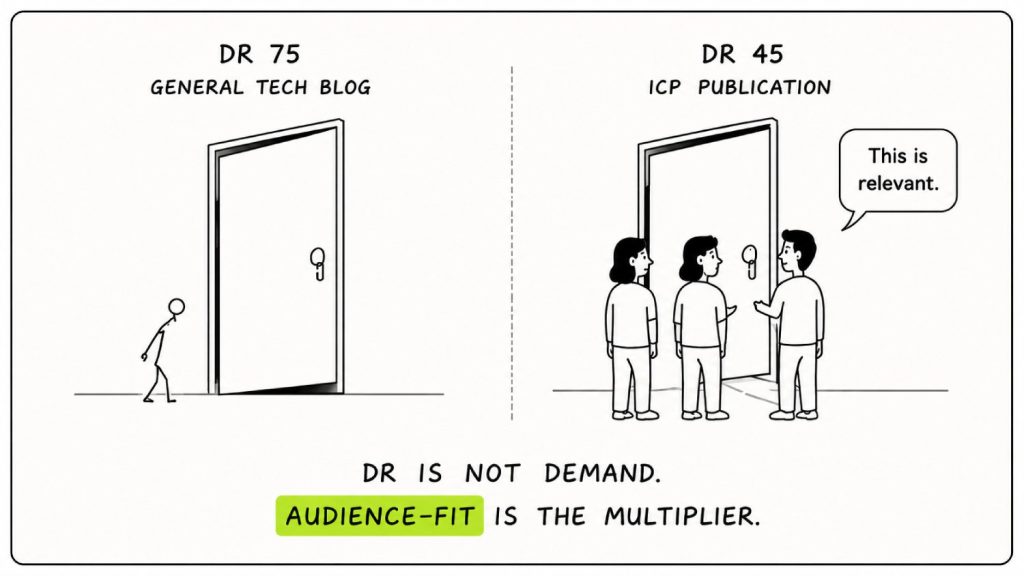
A DR 45 guest post on SaaStr does more for a B2B SaaS ranking than a DR 75 post on a general tech blog your buyers have never opened.
Audience-fit is the multiplier that converts authority into pipeline. Treat it as the primary filter, with DR as the secondary tiebreaker.
The selection rule: before pitching any publication, ask whether your ICP would forward an article from that site to a colleague. If the answer is no, the DR doesn’t matter, the link is decorative. Build a list of 30 publications that pass the test, then pitch the editor a piece that answers a specific question their readers already have.
Time to impact: 4 to 8 weeks. Best for: every stage, but the editor quality bar climbs at $5M+ ARR.
4. Niche edits on existing high-traffic pages (SERP Stack)
A niche edit is a paid contextual link added to an article that’s already ranking. They move faster than guest posts because no new content has to be published, indexed, and aged.
The article already has authority. Your link inherits it.
The trap: most niche edit services sell placements on aged blog farms that ranked once and don’t anymore. The link looks like equity in a backlink tool. The page sends zero traffic and zero ranking signal.
Before any niche edit purchase, pull the target page’s Ahrefs traffic and check the top 5 keywords it ranks for. If those keywords aren’t ones your ICP searches, walk away.
Time to impact: 2 to 6 weeks. Best for: $1M+ ARR.
5. Listicle placement on the domains ChatGPT and Perplexity already cite for your category (Citation Stack)
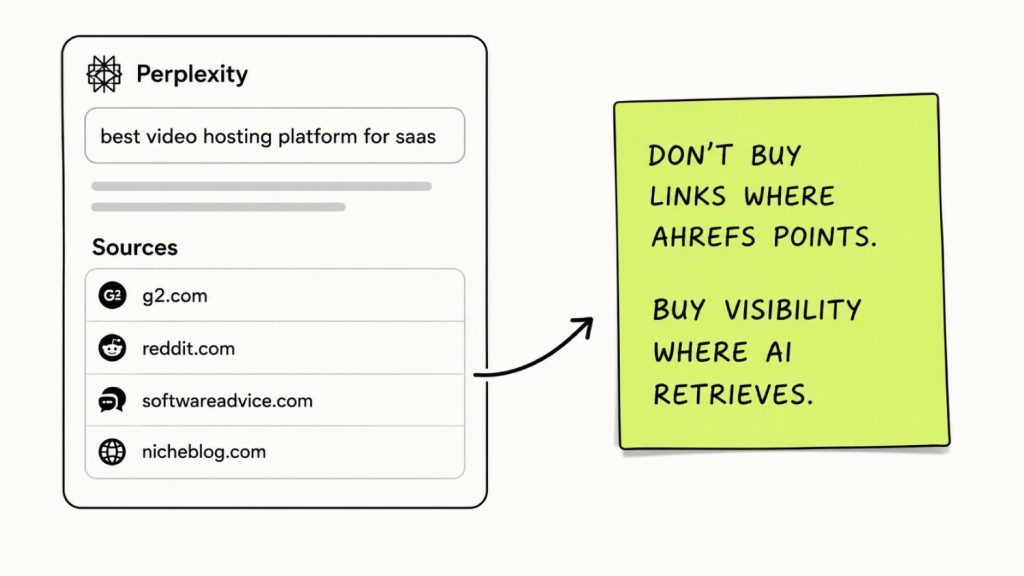
This is where the Two-Stack frame stops being abstract.
AI engines retrieve from specific source sets per query, and listicles like “best [your category] software” are the source type they cite most often for evaluation queries.
The play: run 10 buyer queries for your category through ChatGPT and Perplexity. Note every domain that appears in the cited sources. Those domains, not the DR-ranked tech blogs, are the publications where listicle placement actually moves AI visibility.
Practitioner number: When Gumlet started prioritizing listicle placement on AI-cited video hosting and CDN comparison pages, ChatGPT-driven inbound climbed to 20% of total inbound revenue inside 6 months. The previous DR-led strategy had moved organic clicks but not citation reproducibility.
Time to impact: 4 to 12 weeks. Best for: $1M+ ARR with a category to compete in.
6. Reddit and community surface building on the threads your buyers actually land on (Citation Stack)
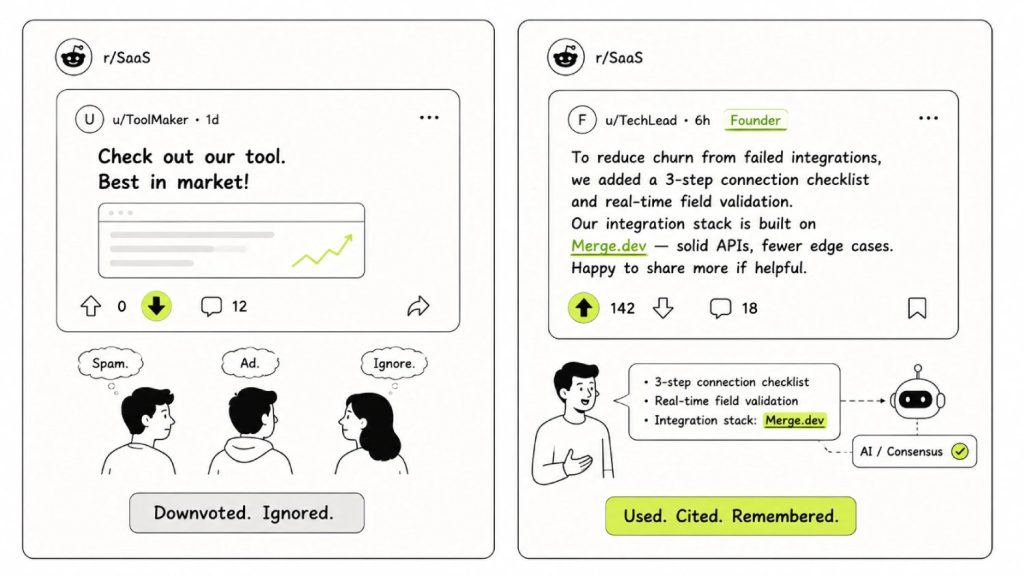
Perplexity cites Reddit at roughly 46.7% of top citations across software queries per multiple 2026 analyses. ChatGPT leans Reddit heavily for community and experience-driven questions.
Showing up in those threads with genuine practitioner replies, not promotional posts, builds the consensus signal AI engines look for.
The mechanism: find the 5 to 10 active threads where your ICP asks questions in your category, build a non-promotional founder or technical-lead presence, and answer questions with the depth Reddit upvotes. Your brand name in the reply, even without a link, often outperforms a dofollow backlink for AI citation purposes.
The decision rule: if your most senior technical person isn’t willing to post under their own name on Reddit, this strategy doesn’t work. Anonymous accounts don’t build the entity-level authority AI engines reward.
Time to impact: 8 to 16 weeks. Best for: every stage.
7. Original data reports designed for AI retrieval (Citation Stack)
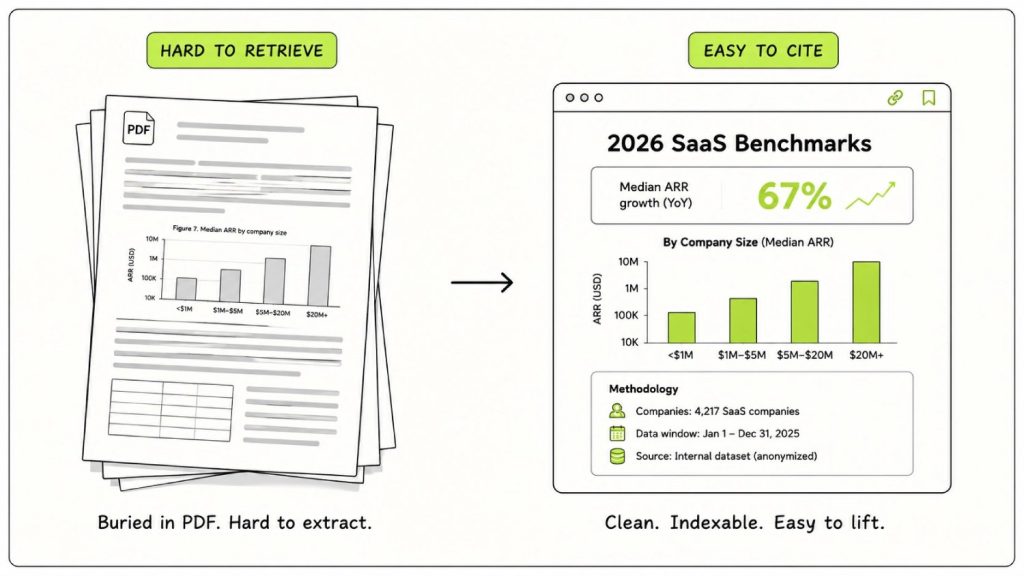
A data report becomes an AI source asset only when it’s structured for extraction.
The format that works: a clear stat as a sentence, a one-paragraph methodology, a citeable definition, and a fixed URL that doesn’t change.
What doesn’t work: 40-page PDF reports where the stats are buried in slides. AI engines retrieve from indexed HTML, not from gated PDFs. Publish the report as an HTML page first, then offer the PDF as a download for human readers.
A useful test: write the report’s three most important findings as standalone sentences, each under 30 words. If they read like LinkedIn quote graphics, they’ll lift cleanly into a generated answer.
Time to impact: 8 to 24 weeks. Best for: $5M+ ARR where you have proprietary data worth reporting on.
8. Founder POV publishing for entity reinforcement (Citation Stack)
AI engines weight named-author content on a consistent topic surface higher than anonymous brand content.
The reason is E-E-A-T at the passage level: a quote from “Jane Smith, CEO of [SaaS]” trains the model to associate Jane with the category. Repeat it across LinkedIn, your blog, podcasts, and expert quotes, and the entity link compounds.
The execution rule: pick one topic surface per quarter, publish 8 to 12 posts under the founder’s name on that one topic, and connect every post back to the named framework or category you want to own.
Time to impact: 12 to 24 weeks (the compounding kind). Best for: every stage where the founder has 5 hours a month for it.
9. Co-marketed benchmark reports with non-competing partner brands (Dual Stack)
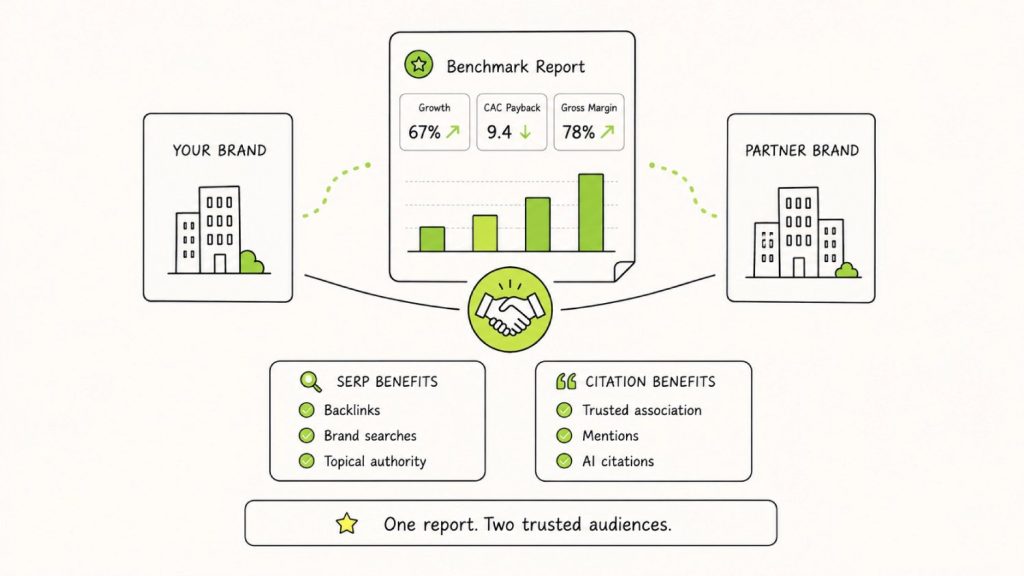
A joint “State of [category] 2026” report with a partner brand earns you backlinks across their network and citations in AI source sets where their audience search lives.
One asset, two stacks, half the promotion cost.
The partnership filter: same ICP, non-overlapping product, mutual interest in owning the category data. Cross-promote on each partner’s blog, newsletter, LinkedIn, and press list. UTM-tag every link so you can show pipeline influence at the end of the quarter.
Time to impact: 12 to 24 weeks. Best for: $5M+ ARR where partner equality is plausible.
10. Expert quotes on Qwoted, Featured, and Help a B2B Writer (Dual Stack)
Named-attribution quotes hit both stacks: editorial dofollow links for Google, named entity signal for AI engines.
The mistake most teams make is mass-submission to every prompt that comes through. The ROI lives in selective response to prompts that match your category and authority.
The decision rule: respond to fewer than 10% of prompts, and only to prompts where your answer would make the published article better. A high response rate to off-category prompts trains nothing and gets you reduced to a one-line quote with no link.
Time to impact: 4 to 12 weeks. Best for: every stage.
11. Podcast and AMA appearances on niche industry shows (Dual Stack)
Podcast show notes give you a backlink. Episode transcripts give you a citation surface. AMA sessions on focused communities give you both, plus the brand mention pattern AI engines weight as consensus.
The selection rule: target shows with 1K to 10K listeners in your category over shows with 100K listeners outside it.
Audience-fit beats audience-size every time for SaaS link building, and the smaller shows often have higher transcript indexing because the host posts the full transcript on their blog.
Time to impact: 4 to 12 weeks. Best for: every stage.
12. Digital PR with proprietary-data hooks for category press (Dual Stack)
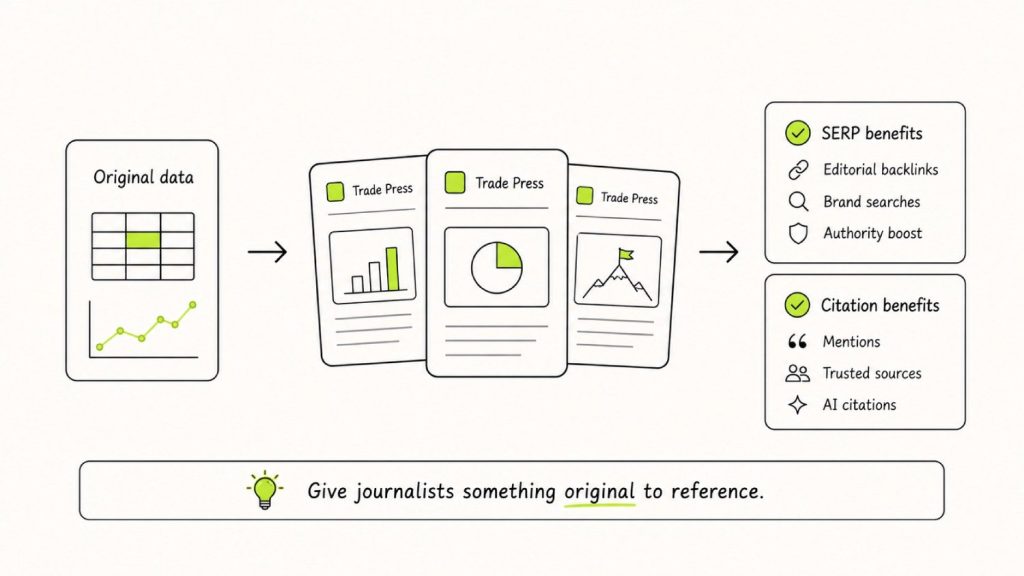
Generic PR pitches don’t land. PR pitches built around proprietary data the journalist can’t get anywhere else do.
TechCrunch, SaaStr, Crunchbase News, and category-specific press cite original-data stories at much higher rates than opinion-piece pitches.
The Verito proof point: 12 ChatGPT #1 rankings across category queries showed up alongside 159% more organic clicks after a 6-month motion that combined proprietary survey data with category press placement. The dual-stack lift is the validation that the frame works in practice.
Time to impact: 8 to 24 weeks. Best for: $1M+ ARR with proprietary data to lead with.
See where you actually stand. Run your domain through a free AVS audit and get your current Citation Reproducibility across ChatGPT, Perplexity, and Claude. Most teams find that 60% to 80% of their target AI queries cite a competitor and not them.
The audit shows you which queries, which competitors, and which Citation Stack strategies will close the gap fastest.
The Search Budget: how to split link spend by ARR stage
Search Budget is the total monthly investment of time and money you allocate to link building, distributed across the SERP Stack, the Citation Stack, and Dual-Stack plays.
The right ratio shifts by ARR stage because the leverage point shifts.
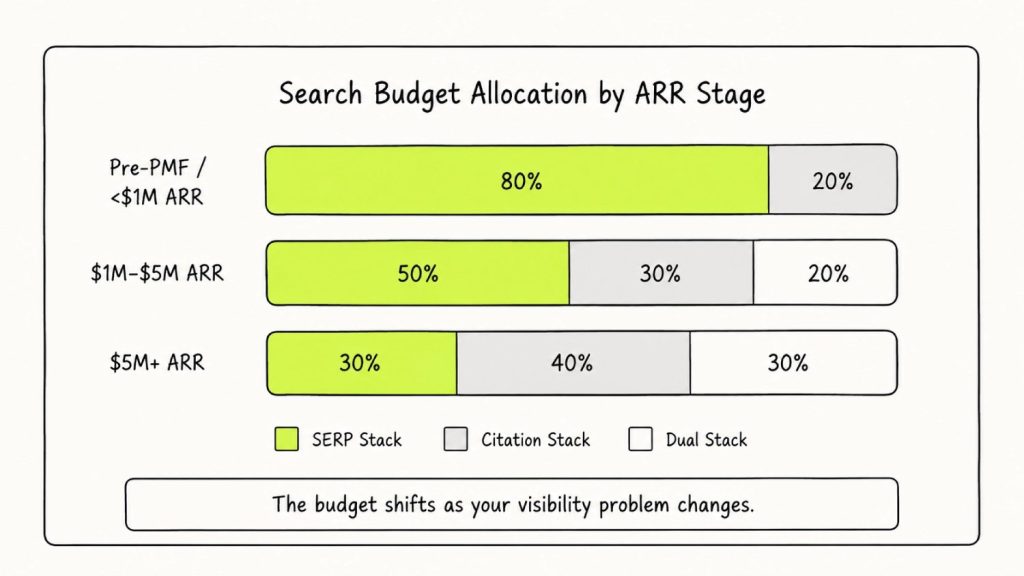
Pre-PMF or first $1M ARR: 80% SERP Stack, 20% Citation Stack
AI engines don’t cite brands they’ve never seen.
At this stage, your priority is building the entity foundation that makes you eligible for citation at all: enough indexed pages, enough category mentions, enough founder presence on LinkedIn to register as “real” in the training data. Heavy SERP Stack investment now compounds the Citation Stack later.
$1M to $5M ARR: 50% SERP Stack, 30% Citation Stack, 20% Dual Stack
This is the inflection. Branded queries start picking up. AI citations begin appearing inconsistently.
The shift is to start measuring Citation Reproducibility weekly and reallocating spend toward whichever stack is moving faster against tracked queries. Verito ran this split through the period where the 12 ChatGPT #1 rankings landed.
$5M+ ARR: 30% SERP Stack, 40% Citation Stack, 30% Dual Stack
Branded organic traffic now dominates pipeline. The marginal lift from another ranking link is small.
The marginal lift from another citation surface, especially one that compounds (a benchmark report, a named framework, a Wikipedia-eligible entity profile), is large. Dual-Stack plays start carrying the most weight because they earn both kinds of signal from a single motion.
The numbers above are practitioner observations from our 2026 book, not universal truth. The point is the directional shift: SERP Stack-heavy at the bottom, Citation Stack-heavy at the top.
Why entity authority beats 10+ year old domains in AI engines
Domain age affects Google rankings. AI engines retrieve through a different mechanism, and that mechanism doesn’t weight historical link equity the way Google’s algorithm does.
AI engines retrieve through entity-query proximity and consensus signal. A 2-year-old SaaS with 47 high-quality category mentions across the source set ChatGPT actually retrieves from will outcite a 12-year-old competitor with 200 generic backlinks every time.
The 12-year-old is winning in Ahrefs. The 2-year-old is winning in pipeline.
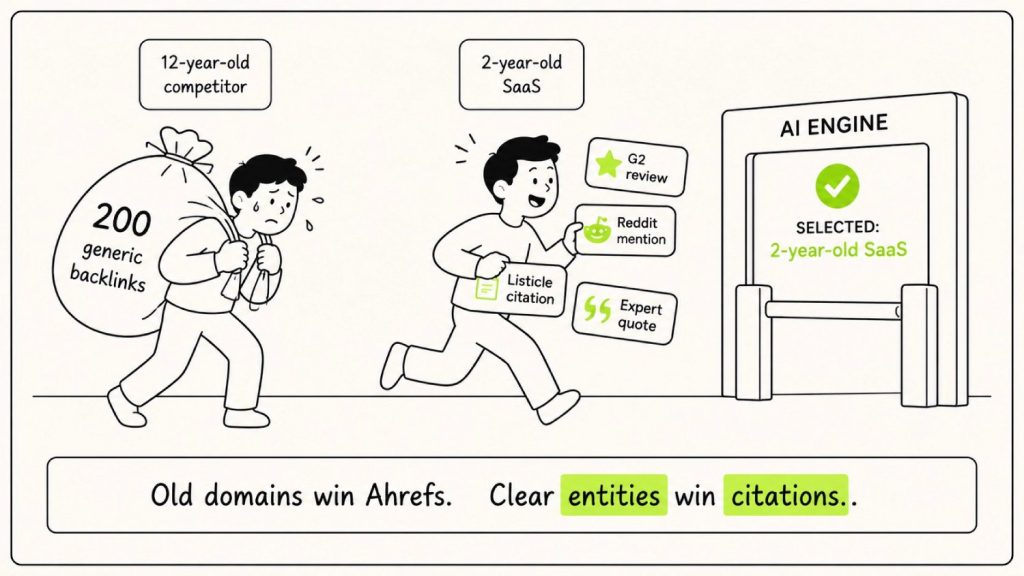
The mechanism: every AI engine builds a soft entity profile for known brands by averaging the contexts where the brand appears. If your brand shows up consistently in category-relevant contexts with consistent positioning, the engine treats you as a category entity. Total mention count matters less than consistency.
The implication for new SaaS: STOP benchmarking against the old domain’s backlink profile. Benchmark their citation surface. That’s the gap you can actually close in 2026.
What Google actually penalizes in 2026
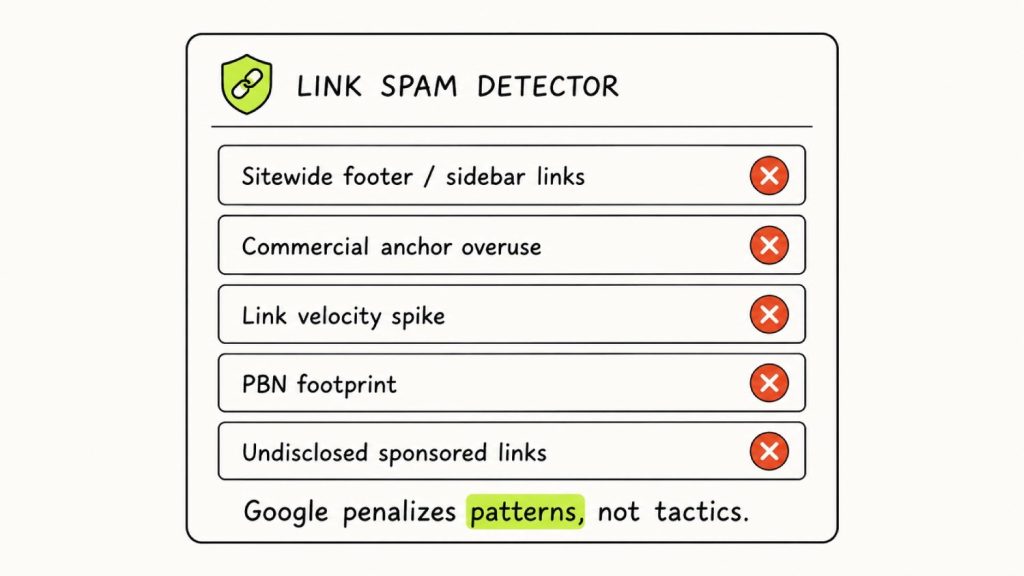
The honest answer to “what gets penalized by Google now” is shorter than the SEO Twitter version. Five patterns reliably trigger penalties in 2026:
- Site-wide footer or sidebar links across networks. This still tanks sites overnight.
- Anchor text over-optimization on commercial keywords past roughly 15% of the profile. Diversify or get filtered.
- Link velocity spikes that don’t match your publishing cadence. A 50-link month after years of 5-link months looks unnatural and gets reviewed.
- PBN footprints. Shared IPs, shared registrants, shared templates across a network. Footprint detection improved sharply in 2024.
- Sponsored links not marked
rel="sponsored"orrel="nofollow". The disclosure rule hasn’t loosened.
What’s not penalized despite Twitter consensus: paid guest posts on relevant editorial sites with real editorial review, link insertions on contextually fit pages, and AI-assisted content where humans do the editing pass.
The penalty model is pattern-based, NOT source-based. Earn links from patterns that look organic and you’re fine.
The 5 worst SaaS link building moves to retire in 2026
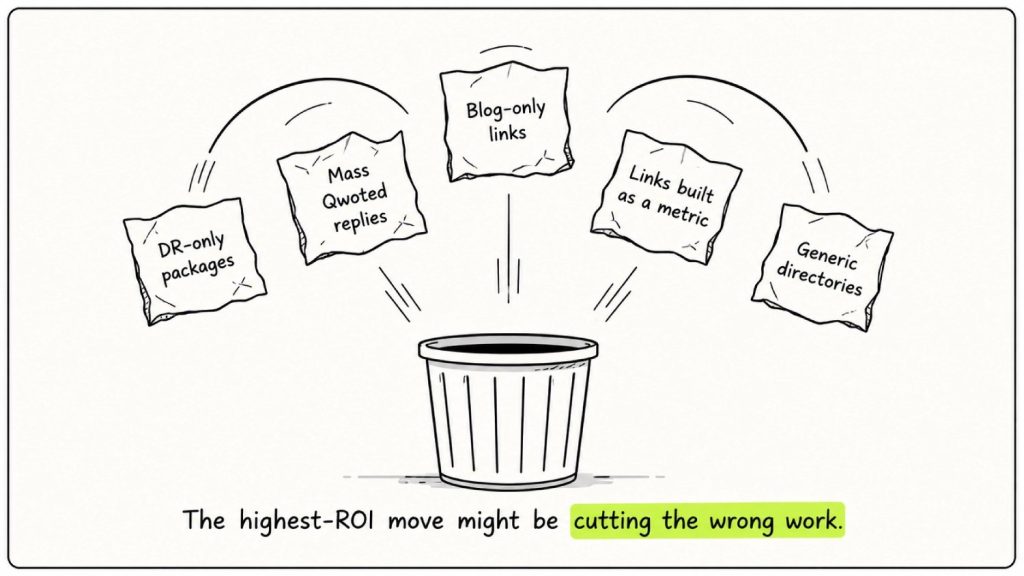
Five moves common enough across SaaS link building to be worth naming as the things to stop doing:
- Buying DR-only link packages without an audience-fit check. The DR number is a Domain Rating, not a buyer signal.
- Mass submission to every Qwoted and Featured prompt. Selective response beats spray-and-pray by an order of magnitude.
- Linking only to blog posts. Feature pages, comparison pages, and integration pages convert the buyer. Link equity belongs there.
- Tracking “links built” as the success metric. Track keywords that moved or AI queries that started citing you, then back-attribute to the links that did the work.
- Submitting to generic tech directories with zero category relevance. The link equity is real, the citation signal is zero, and the time cost compounds.
If your current link plan has more than two of these in it, the highest-ROI move this quarter is cutting them, not adding strategies.
FAQ
1. Does link building still make sense for SaaS in 2026?
Link building still works in 2026, but the discipline has bifurcated into two stacks, and most teams are still only running one. SERP Stack links continue to lift Google rankings on commercial and comparison keywords.
Citation Stack mentions feed AI engines that now mediate roughly half of B2B software discovery. The teams reporting that link building “doesn’t work anymore” are usually running only SERP Stack tactics while their pipeline is shifting to AI search.
The teams compounding fastest in 2026 are the ones who allocate budget across both stacks instead of betting everything on one.
2. What link building strategies are actually working for SaaS without risking penalties in 2026?
The strategies that work without penalty risk are the ones with editorial standards and audience-fit baked in: integration directory listings, comparison page link insertions on contextually relevant pages, guest posts on ICP-read publications, expert quotes via Qwoted and Featured, and digital PR with proprietary data hooks.
Penalty risk comes from the pattern (PBN footprints, anchor over-optimization, velocity spikes), not the tactic itself. Before any paid link, pull the linking domain’s traffic history and outbound link profile. If outbound links go to gambling, casino, or generic affiliate content, walk away regardless of DR.
3. Should I hire a SaaS link building agency or build links in-house?
The answer depends on what stack you’re optimizing for and your in-house bandwidth. SERP Stack work (guest posts, niche edits, comparison link insertions) is largely a fulfillment problem and agencies do it more efficiently.
Citation Stack work (Reddit presence, founder POV publishing, original data reports) needs to come from your team because it requires product knowledge and named-author authority.
Most SaaS teams under $5M ARR get the best return with a hybrid model. Before signing any agency, ask them to show citation tracking across ChatGPT, Perplexity, and Claude. If they only show Search Console screenshots, they’re a SERP Stack vendor, not a 2026 partner.
4. How long does SaaS link building take to show results in 2026?
Time to impact varies by stack and tactic. SERP Stack moves like niche edits and comparison link insertions show ranking movement in 1 to 4 weeks.
Guest posts compound between 4 and 8 weeks. Citation Stack plays compound slower because they depend on AI engines re-indexing your brand’s source surface. Expect 8 to 16 weeks for Reddit presence to start moving citations, and 12 to 24 weeks for founder POV publishing to register as entity signal.
Plan link building like compound interest, not like a paid ad campaign: the meaningful gains land between months 3 and 9, not week one.
5. Can a new SaaS compete with 10+ year old domains through link building in 2026?
A new SaaS can outcompete a 10+ year old domain inside AI engines because domain age is a Google ranking factor and AI engines retrieve through a different mechanism.
AI engines retrieve through entity-query proximity and consensus signal across sources. A 2-year-old SaaS with 47 high-quality category mentions across the source set ChatGPT actually retrieves from will outcite a 12-year-old competitor with 200 generic backlinks.
On the Google side, domain age still matters, but topical authority on a focused content cluster closes the gap faster than chasing parity on referring domain count. Stop benchmarking the old domain’s backlink profile and start benchmarking their citation surface.
6. What’s more important for SaaS in 2026: backlinks or AI citations?
Allocation is the right framing. The teams winning in 2026 are running both stacks with separate criteria and a stage-appropriate Search Budget split.
Backlinks still move Google rankings on commercial keywords, and Google still drives a meaningful chunk of pipeline. AI citations now mediate the evaluation funnel for buyers using ChatGPT, Perplexity, and Claude as their primary research tool.
The right question is what percentage of your Search Budget belongs to each stack at your current ARR, and Citation Reproducibility is the metric that tells you whether the allocation is working.
7. What does Google actually penalize for link building in 2026?
Google penalizes patterns, not specific tactics. The five patterns that reliably trigger penalties: site-wide footer or sidebar links across networks, anchor over-optimization above roughly 15% commercial-keyword density, link velocity spikes that don’t match publishing cadence, PBN footprints (shared infrastructure across a link network), and sponsored links not marked rel-sponsored or rel-nofollow.
The penalty model is pattern-based. Earn links from patterns that look like organic editorial discovery and the underlying tactic, paid or unpaid, rarely triggers anything.
The 2026 takeaway
The teams compounding fastest in 2026 treat link building as two disciplines instead of one.
SERP Stack links keep moving Google rankings on commercial and comparison keywords. Citation Stack mentions feed the AI engines mediating the evaluation funnel for half of B2B SaaS buyers right now.
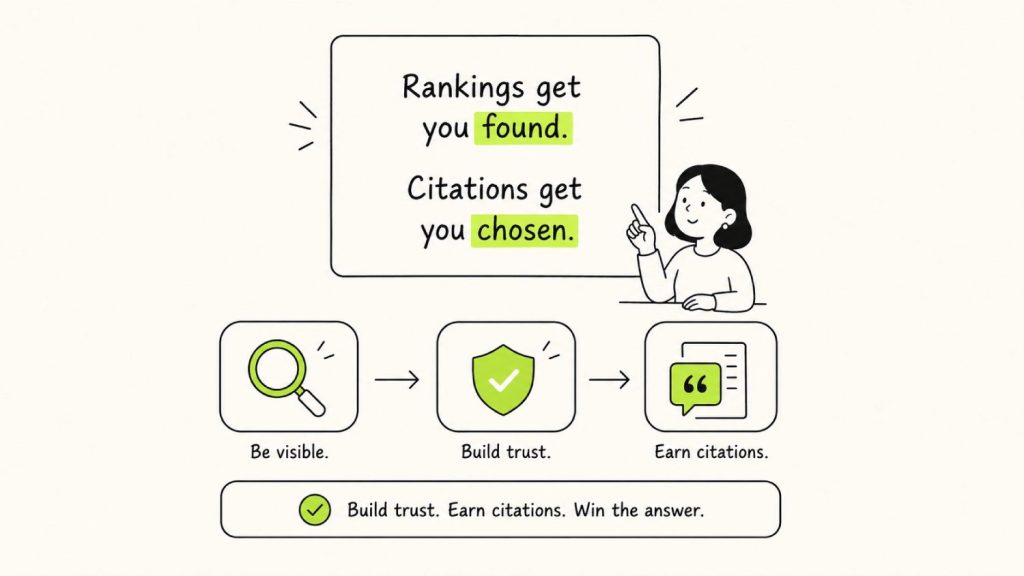
The winning playbook runs both stacks with separate criteria, a stage-appropriate Search Budget, and Citation Reproducibility as the north-star metric instead of referring domain count.
Start by measuring where you actually stand. Run your domain through an AVS audit and see your current Citation Reproducibility across ChatGPT, Perplexity, and Claude. Then allocate the next $5K of link spend against the gap the audit surfaces, not the gap your Ahrefs dashboard says exists.
By Q4 2026, the SaaS teams that survive the AI-search bifurcation will be the ones who started measuring citation reproducibility in Q2. Most teams won’t. That’s the opportunity.
Related Reading
- LLM SEO Guide: How AI Search Engines Pick Sources
- LLM SEO Checklist: Action Items for B2B SaaS Citation Visibility
- How to Hide Backlinks from Competitors
- LLMs.txt: Complete Guide for SEO and AI Search (2026)
Written byAyush SharmaVP, SEO & AI Search, DerivateX
VP, SEO & AI Search at DerivateX. We're a B2B SaaS SEO and Generative Engine Optimization agency that engineers AI citations in ChatGPT, Perplexity, Claude, and Gemini and connects them to demo bookings and revenue pipeline.
Reviewed byApoorv SharmaCo-founder, DerivateX
Apoorv Sharma is the co-founder of DerivateX, a B2B SaaS SEO and Generative Engine Optimization agency that engineers AI citations in ChatGPT, Perplexity, Claude, and Gemini and connects them to demo bookings and revenue pipeline. He is the author of the 2026 AI Visibility Benchmark Report and the Citation Engineering methodology. He's also the brain behind "Found On AI" and has sold 2 of his companies previously
Cited by AI