Case study: Gumlet turned ChatGPT mentions into 20% of inbound revenue. Read it →

ChatGPT Said My Competitor Is Better. How Do I Fix This?


TL;DR
- ChatGPT cites roughly four brands per category query. If you are not in that set, every buyer who asks the question shortlists someone else and never reaches your site.
- This is a citation gap, not an SEO gap. As of 2026, fewer than 10% of sources cited by ChatGPT, Gemini, and Copilot rank in the top 10 Google results for the same query.
- Monitoring your share of voice tells you you are losing. It does not tell you why. The real diagnosis happens at the artifact level.
- Citations come from one of three mechanisms: proprietary data, a definition-forward page, or a multi-surface mention cluster. Each needs a different fix.
- Most teams build the artifact and skip the off-site seeding. Both layers run together or neither works.
A founder opens ChatGPT, types their category, and watches another brand get named in the first sentence of the answer. Their own brand does not appear. There is no dashboard alert, no ranking drop, no analytics signal that anything just happened.
That is the part that hurts. The deal is influenced before sales knows the buyer exists, the buyer trusts the AI shortlist, and you have no record of the loss. Most marketing teams in 2026 are encountering this for the first time, and applying SEO instincts to a problem that does not respond to SEO logic.
This piece breaks down three reasons ChatGPT picks a different brand over yours, the 15-minute audit that tells you which one is happening, and the specific fix for each mechanism. The wedge is artifact-level diagnosis, because more PR alone does not displace a cited brand inside a locked citation set.
Why This Hurts More Than a Google Ranking Drop
When your Google ranking slips, you see it. Search Console flags the drop, traffic dips on the same day, and the team has a clear thing to investigate. AI citation loss has none of those signals.
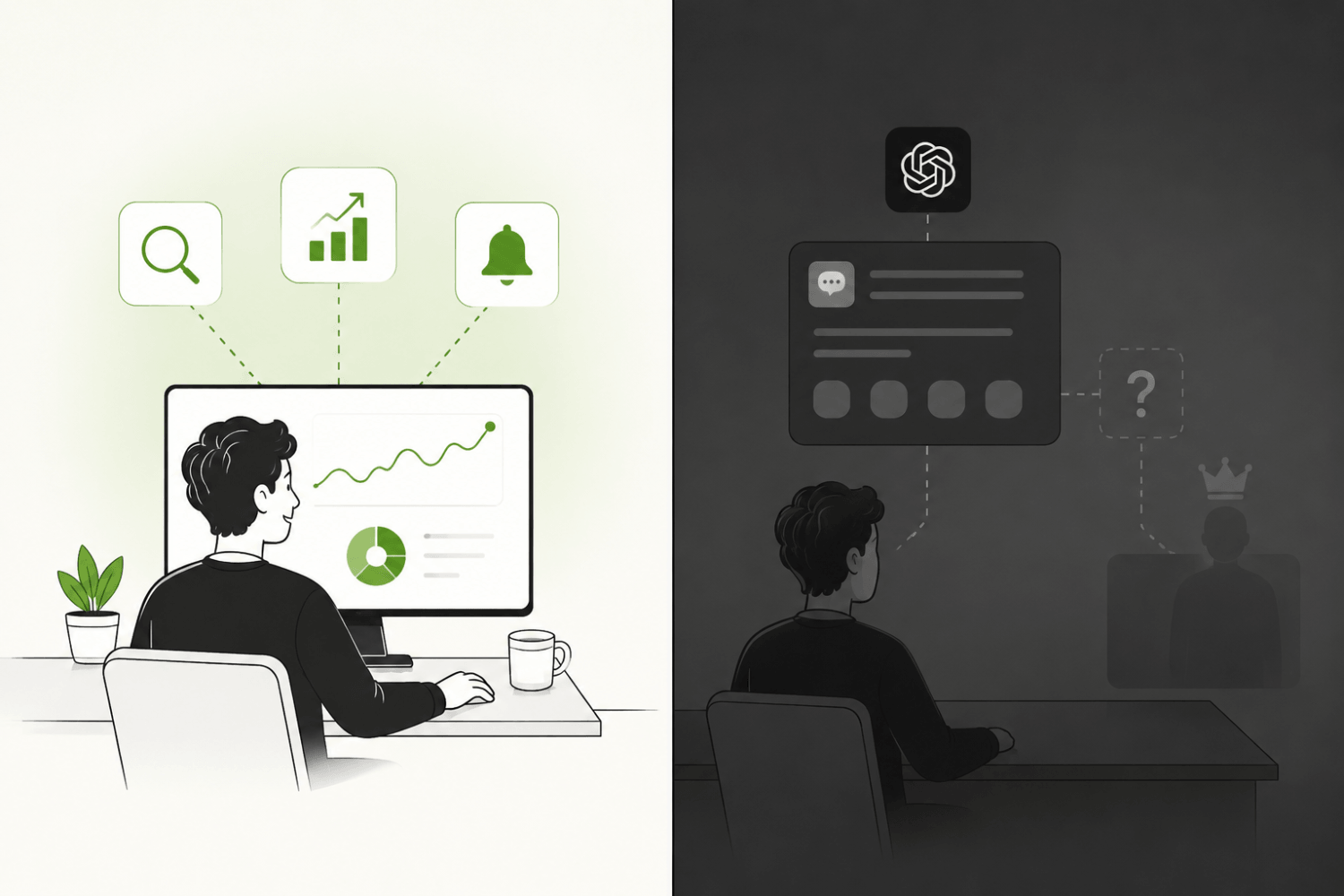
The deal is influenced before your sales team knows the buyer exists
Buyers using ChatGPT or Perplexity for vendor research often shortlist the cited brands and never visit the sites of brands that were not mentioned.
Close to 87% of B2B buyers in early 2026 said AI chatbots are changing how they research software.
The loss is silent because the buyer never lands on a page you can attribute. The pipeline gap accumulates across every buyer running similar queries, every day, in every LLM they touch.
This is part of why a traffic decline despite stable rankings has become a common 2026 pattern, even for sites with clean Google performance.
ChatGPT cites about four brands per query, and the slots reinforce themselves
Onely’s 2025 research on ChatGPT brand recommendation behavior found that most category responses surface three to four brand names, and that authoritative list mentions account for roughly 41% of those recommendations.
Once a brand sits inside that small set, repeated co-citation across queries reinforces its position. The model treats the brands it has already cited as the brands it can confidently cite again.
This is the part most “build more authority” advice misses. Generic PR usually reinforces the incumbents instead of displacing them.
What ChatGPT Actually Uses to Pick Who to Cite
ChatGPT’s citation decision is driven by content structure, entity clarity, and off-site signal density. Domain authority and keyword rankings sit much lower in the stack than most SEO teams assume.
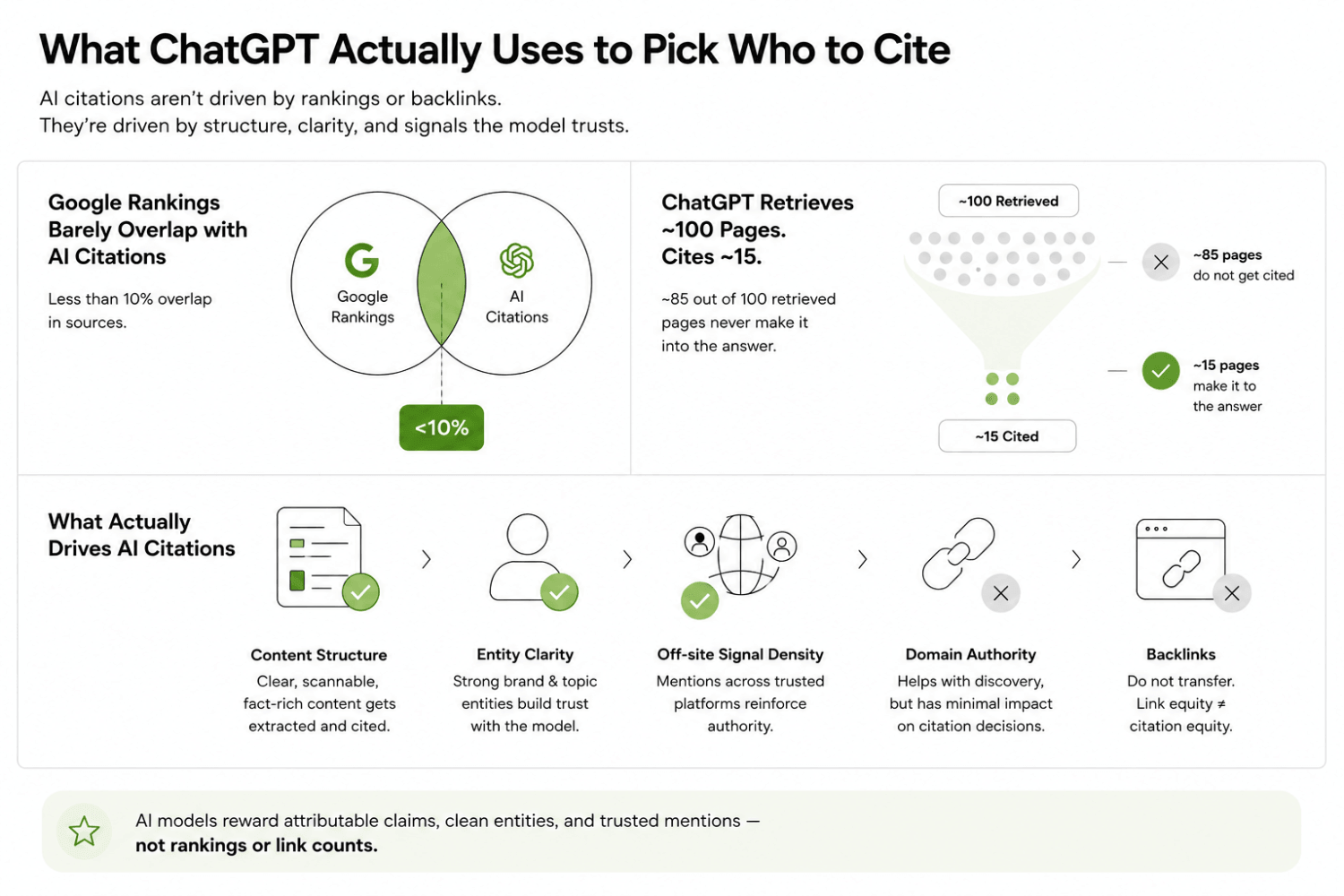
Google ranking and AI citation share fewer than 10% of sources
A 2025 analysis examining millions of AI citations across ChatGPT, Copilot, AI Overviews, and Perplexity found near-zero correlation between traditional organic traffic and AI citation frequency.
One domain in the dataset received roughly 24,000 AI citations from a base of about 8,500 monthly visits. Another with billions of visits was barely cited at all.
The signal these LLMs reward is different from the signal Google rewards. A site can rank first on Google for a category term and be absent from every AI recommendation in that same category, at the same time.
This is the gap a deliberate LLM SEO program exists to close.
ChatGPT retrieves around 100 pages and cites about 15
Research published by AirOps in early 2026 found that ChatGPT retrieves far more pages than it cites, with roughly 85 of every 100 retrieved pages never making it into the final answer.
The selection mechanism rewards structural properties. Pages with comparison tables, short sentences in shortlist format, and a fact-to-word ratio above one fact per 80 words are cited at a meaningfully higher rate than dense prose.
Search Engine Land’s 2025 study on ChatGPT citation behavior reported that around 44% of citations come from the first 30% of a page’s content. A claim buried in paragraph six rarely gets extracted.
Domain authority and backlinks do not transfer
The 2026 AI citation landscape rewards attributable claims and clean entity signals, not link equity. This is the part of the 2020-era SEO playbook that has stopped translating.
Backlinks still matter for Google rank, which still drives some retrieval. But the citation decision itself is structural, which is why entity optimization sits at the center of any serious GEO program.
The Three Mechanisms That Earn AI Citations
Across DerivateX’s work with B2B SaaS clients in 2026, citation gaps almost always trace back to one of three mechanisms. Knowing which one is winning the slot you want determines which fix moves the needle.
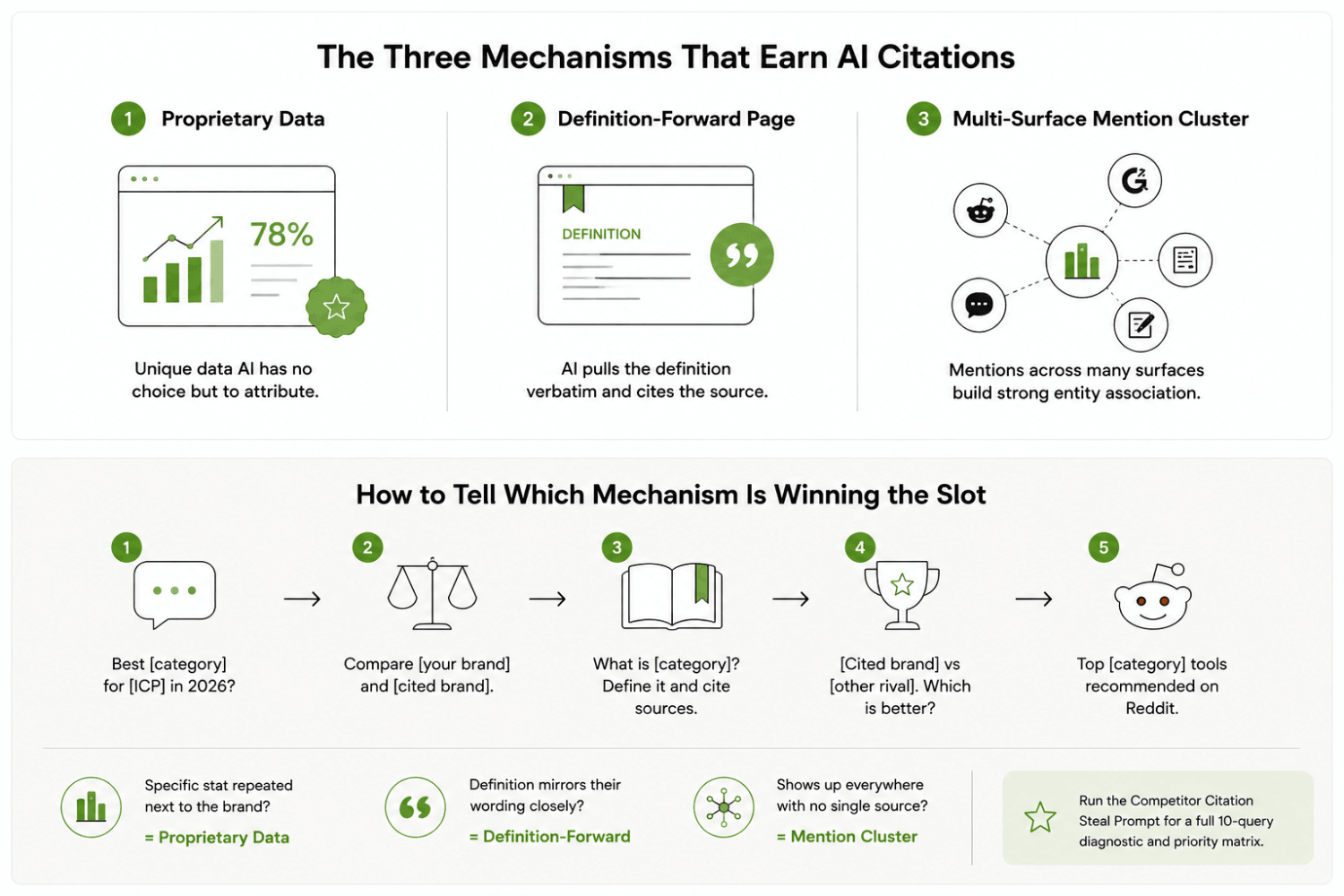
Mechanism 1: Proprietary data the LLM has no choice but to attribute
The cited brand published a number, scale, benchmark, or index that does not exist anywhere else. When ChatGPT discusses the category, it cites their brand because the claim cannot be sourced elsewhere.
This is the strongest citation mechanism because the LLM is structurally forced to attribute the data point.
You can see this in action when ChatGPT’s response includes a specific stat next to a brand name. That stat is the citation anchor.
Mechanism 2: A definition-forward page pulled verbatim
The cited brand controls the definitional content for a category term. ChatGPT uses their wording as the answer and cites the source.
DerivateX’s Citation Engineering methodology starts here, because owning the definition gives the LLM a single, clean entity claim to attribute.
You can spot this mechanism when ChatGPT defines the category using language that maps closely to a specific brand’s homepage or category page. The phrasing is the tell.
Mechanism 3: A multi-surface mention cluster
The cited brand has consistent mentions across Reddit threads, G2 reviews, listicles, and guest posts. No single source dominates, but the repeated co-occurrence has taught the model an entity association.
SE Ranking’s 2025 research found that domains with strong presence on Reddit and Quora have roughly four times the citation likelihood of comparable domains without it.
You can spot this when a brand shows up across many queries without any single recurring source being quoted. The brand association itself is the asset.
How to tell which mechanism is winning the slot
Run these five prompts in ChatGPT and Perplexity with web browsing on, then read the responses for the patterns above:
- Best [your category] for [your ICP] in 2026.
- Compare [your brand] and [the brand getting cited]. What do you know about each?
- What is [category term]? Define it and cite your sources.
- [Cited brand] vs [their other rival]. Which is better?
- Top [category] tools recommended on Reddit.
If a specific stat keeps appearing next to the cited brand’s name, the mechanism is proprietary data. If the definition mirrors their wording, it is definitional. If they show up across all five prompts without a single recurring source, it is the mention cluster.
For a deeper version of this audit, the Competitor Citation Steal Prompt runs the full diagnostic across 10 queries and produces a steal matrix with priority ranking.
How to Displace the Cited Brand (Match the Fix to the Mechanism)
Match the fix to the mechanism. Running every play at once is how most GEO programs stall.
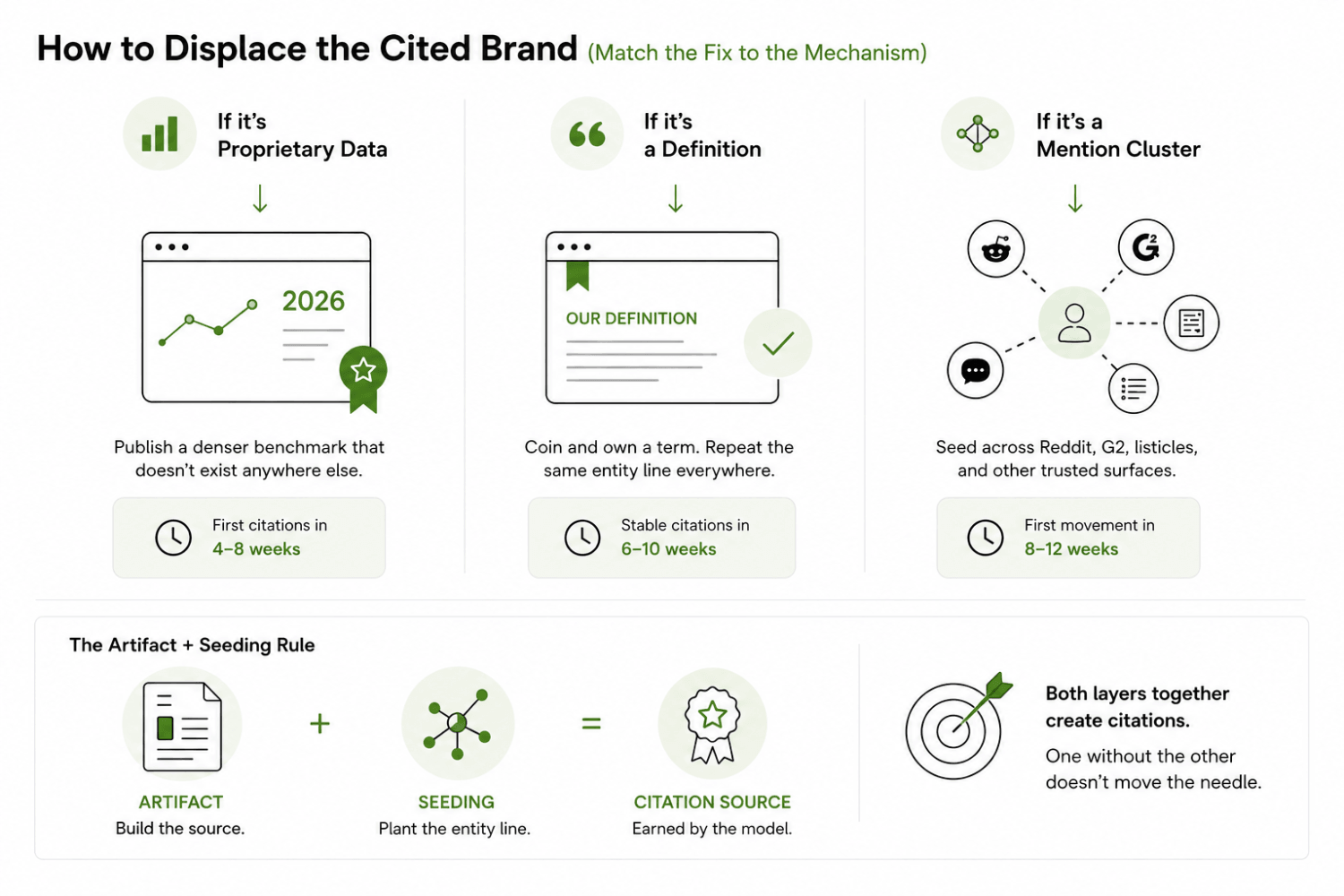
If the mechanism is proprietary data, publish a denser benchmark
Build a data point that does not exist elsewhere, with a clear year, methodology, and sample size. The artifact has to give the LLM something specific to attribute.
First citations typically appear in four to eight weeks once the artifact is published and seeded.
DerivateX’s own 2026 AI Visibility Benchmark Report, which scored 50 B2B SaaS companies across 1,400 buyer-intent prompts, is an example of this kind of attributable artifact built deliberately for citation.
If the mechanism is a definition, coin and own a term
Standardize the entity line that defines your brand in relation to the category. Then place it consistently across your homepage, About page, every guest post, every G2 response, every Reddit contribution.
The goal is repeated, identical phrasing the LLM can lock onto. This is the structural fix entity optimization is designed to produce.
Stable citations on definitional queries usually take six to ten weeks.
If the mechanism is a mention cluster, seed across the surfaces the LLM trusts
Identify the specific Reddit threads, G2 categories, and listicles the model is pulling from. Plant your entity line in those exact contexts.
Listicles tend to dominate commercial-intent queries. Standard articles dominate informational queries. The placement has to match the query type.
Mention-cluster displacement is the slowest mechanism, with first movement typically at eight to twelve weeks.
The artifact-plus-seeding rule
This is the single most common failure mode in GEO work. Teams build the page, never plant the entity line in external contexts, and wonder why citations do not move.
An artifact without seeding is a page that exists. An artifact with seeding is a citation source.
The two layers run together or neither works. This is the core logic behind DerivateX’s Citation Engineering practice and the Visibility Vacuum Theory timing argument: categories close around the first brands that build both layers in parallel.
For the operational checklist on what each piece of content needs to do, the LLM SEO checklist covers the page-level requirements.
What Does Not Work (And Why Everyone Tries It First)
Three approaches the SERP keeps recommending that do not move citations.
1. llms.txt as a primary lever
The file exists. No major LLM has publicly confirmed it materially influences citation decisions as of mid-2026.
Treat llms.txt as hygiene, like a sitemap. Useful to publish, but not a strategy. The full breakdown on where llms.txt actually fits in SEO and AI search is worth reading before you build the file expecting it to move citations.
2. Schema markup framed as the answer
Schema helps Google understand your content, which helps you rank, which helps you get retrieved. The citation decision itself reads the rendered text, not your structured data.
Schema is foundational. It is not the lever moving the slot you want.
3. Generic PR for “more authority”
Once the citation set is locked, brand mentions in unrelated contexts reinforce existing associations rather than displacing them. You need attributable artifacts and targeted seeding, not press coverage about your funding round.
What 10 Months of Deliberate Citation Work Looks Like
When Verito, a managed cloud hosting company serving accounting and tax firms, started working with DerivateX in May 2025, the picture was clear and difficult:
- Average Google position: 40.8 across 199,000 monthly impressions
- Branded share of clicks: 87% (almost no new buyers were finding them on Google)
- AI presence across ChatGPT, Perplexity, Gemini, and Bing: zero
The work ran across three interlocking tracks.
- Cluster-first content production across QuickBooks, Drake, UltraTax, ProSeries, and Sage hosting topics, plus compliance and security content for CPA firms.
- Off-page placements engineered for two audiences: link equity for Google rank, and citation probability for AI answers. Placements included AI-native publications like foundonai.com and aijourn.com alongside niche-relevant trade outlets.
- Monthly LLM prompt tracking from day one of Phase 2, with 40 to 60 buyer-intent prompts measured across four AI platforms every month.
Results by March 2026
| Metric | Result |
|---|---|
| ChatGPT #1 rankings | 12 prompts |
| Top 3 ChatGPT ranking | 24 prompts (73%) |
| Top 5 ChatGPT ranking | 28 prompts (85%) |
| Inbound ChatGPT sessions (GA4) | 887 sessions across 292 landing pages |
| Google avg position | 40.8 → 12.4 |
| Monthly clicks | 971 → 2,516 (+159%) |
| Monthly impressions | 199K → 590K (+196%) |
“Six months in, we’re ranking for terms we couldn’t crack before. Communication is clear, turnaround is fast, and they don’t pad reports with fluff.”
— Camren Majors, Co-Founder and CMO, Verito (2025)
The displacement of a category-leading incumbent is repeatable. It is also slow, deliberate, and tracked at the artifact level from week one.
FAQ
1. Why does ChatGPT recommend a different brand and not me?
The recommended brand sits inside the four-brand citation set ChatGPT uses for your category. Yours does not.
That slot was usually earned through one of three mechanisms: a proprietary data point the model attributes to them, a definition-forward page it quotes verbatim, or a multi-surface mention cluster across Reddit, G2, and industry publications.
The fix depends on which mechanism is doing the work.
Building generic authority does not displace an incumbent inside a locked citation set. Building the specific artifact that takes their slot does.
2. If I rank on page one of Google, shouldn’t ChatGPT already be citing me?
Not necessarily. This is the most counterintuitive part of AI search.
Research tracking AI citation patterns in 2026 found that fewer than 10% of sources cited by ChatGPT, Gemini, and Copilot rank in the top 10 Google organic results for the same query.
Google rewards keyword relevance and backlink authority. ChatGPT rewards content that gives the model something specific, attributable, and structurally extractable.
A B2B SaaS company can rank first on Google for its category term and be absent from every AI recommendation in that same category, at the same time.
3. Can I steal an AI citation from a brand that has been cited for years?
Yes. The difficulty depends on what is anchoring their citation.
If the slot rests on a single third-party listicle, you can displace it within 30 to 60 days by publishing a denser, more structured version and seeding it in the same communities.
If they coined a category term, own proprietary benchmark data, or hold a Reddit and G2 presence across hundreds of threads, displacement takes 60 to 120 days of multi-surface seeding before citations begin shifting.
The longer a brand has held the slot, the more artifact-level evidence is required to dislodge them.
4. How long does it take to get ChatGPT to cite my brand after publishing a new artifact?
ChatGPT with web browsing on can surface a newly published page within days, if the page is well-structured and the entity line has been planted across two or three external surfaces simultaneously.
Stable citations across a consistent prompt set typically take 30 to 90 days to establish.
Verito moved from zero AI presence to 12 ChatGPT #1 rankings over a 10-month engagement.
First citations appear in weeks. Stable category dominance takes quarters, not months.
5. My competitor was acquired and renamed. Why does ChatGPT still recommend the old name?
ChatGPT’s training data and its real-time retrieval layer update on different cycles.
The training corpus reflects a knowledge cutoff and may carry the old brand name forward for months. The live web retrieval layer updates only as new content gets published mentioning the new name and the entity relationship.
Until enough fresh content corroborates the rename across third-party sources, the model defaults to whichever entity has more cumulative signal.
AI citation behavior lags entity changes by weeks to months, and the lag closes only when the new entity name accumulates third-party mention density.
6. Does llms.txt actually help me get cited in ChatGPT?
There is no published evidence as of mid-2026 that any major LLM materially uses llms.txt for citation decisions.
Several agency blogs recommend it as a primary lever. Most practitioners testing it have not seen measurable citation movement attributable to the file itself.
Treat llms.txt as a hygiene file similar to robots.txt or sitemap.xml, useful to publish but never the reason ChatGPT is recommending someone else over you.
What to Do This Week
The reason ChatGPT is recommending someone else is not that their product is better. It is that the model has clearer, more attributable evidence for them in your category, earned through a specific artifact you have not built or seeded yet.
The diagnosis has to happen at the artifact level, not the share-of-voice level, or the fix never matches the problem.
Run the five-prompt audit from earlier this week. Identify which of the three mechanisms is doing the citation work. Then build the specific thing that takes the slot.
If you want the full diagnostic with a steal matrix and a 30-day execution calendar attached, the Competitor Citation Steal Prompt is the next read.
The first citation you win back will teach you more about how your category’s LLM behavior actually works than any monitoring dashboard ever will.
Written byAyush SharmaVP, SEO & AI Search, DerivateX
VP, SEO & AI Search at DerivateX. We're a B2B SaaS SEO and Generative Engine Optimization agency that engineers AI citations in ChatGPT, Perplexity, Claude, and Gemini and connects them to demo bookings and revenue pipeline.
Cited by AI