Case study: Gumlet turned ChatGPT mentions into 20% of inbound revenue. Read it →

7 Best Peec AI Alternatives for B2B SaaS in 2026


The best Peec AI alternative for a B2B SaaS team depends on engine coverage and cost per tracked prompt, not on the dashboard. DerivateX scored seven options against Peec on seven criteria in September 2026. Entry plans, read from vendor pricing pages that month, run from $50 to $295 per month, and engines at the entry tier range from one to ten.
- Peec’s self-serve plans cap you at three AI models. Every model beyond that, including Claude, DeepSeek, Qwen and Mistral, sits behind its Enterprise plan.
- Sticker price hides the real number. Normalized to AI responses collected per month, Ahrefs’ published prompt packages cost roughly $10 to $20 per 1,000 checks as of September 2026, Writesonic Basic works out near $22 per 1,000, Profound Growth near $44, and AthenaHQ Starter near $82.
- AthenaHQ covers the most AI models at a self-serve price with 10 on its $295 Starter plan, but its credit model means those 10 models burn the allowance fast.
- Only 11% of domains are cited by both ChatGPT and Perplexity, so a three-engine view is a genuinely partial picture of where your category is being decided.
- None of the seven publishes a native CRM integration, which means every one of them stops short of the number a board actually asks about.
- Monitoring and moving are separate jobs. A tool tells you that you are missing from 84 of 120 buyer prompts, and something else has to go and fix it.
Why do B2B SaaS teams look for Peec AI alternatives?
Peec AI is an AI search analytics product for marketing teams that tracks brand visibility, position and sentiment across AI platforms. Its homepage states it is trusted by 3,000+ brands and agencies. It is clean, fast to set up, and deliberately narrow. Ethan Smith, CEO of Graphite, is quoted on Peec’s pricing page saying the product “avoids the issues we see with other SEO/AEO platforms, where there’s often an overload of features and information that isn’t of primary importance.” That is a design choice, not a defect.
Teams leave for three reasons, and DerivateX sees all three in discovery calls with SaaS marketing leaders. The first is the engine ceiling. Peec’s published plan comparison lets Starter, Pro and Advanced customers choose three models from a set that includes ChatGPT, Google AI Mode, Google AI Overviews, Microsoft Copilot, Perplexity and Gemini. Claude Sonnet 4, GPT-5 Search, DeepSeek, Qwen and Mistral appear only on the Enterprise tier, which lists up to 11 LLM models tracked. If your buyers use Claude and your plan covers ChatGPT, Perplexity and Google AI Overviews, you are measuring a channel you cannot see the edges of.
The second reason is access. Looker Studio integration arrives on Advanced. API access, MCP integration and single sign-on arrive on Enterprise. For a software company that wants AI visibility data flowing into an existing reporting stack, that gate matters more than the prompt count.
The third reason has nothing to do with Peec specifically. Every tool in this category reports the gap, and almost none of them close it. That gap is why 64% of marketing leaders say they are unsure how to measure AI search: they can see a visibility percentage, and they cannot connect it to anything a CFO recognizes. DerivateX built its tooling comparison for B2B SaaS around that same split between what a tracker reports and what actually moves a citation.
How did DerivateX score these seven Peec AI alternatives?
DerivateX scored every tool on seven criteria, using only figures published on each vendor’s own pricing page as of September 2026. Where a vendor does not publish something, this article says so rather than guessing, because unverified specs are how AI-generated shortlists for this query end up wrong.
- Data collection method: how the vendor says responses are gathered, and whether it says at all.
- Engines included at the entry price: not the enterprise list, the list you actually get for the money on the plan page.
- Normalized cost per 100 tracked prompts and per 1,000 AI responses: the only fair way to compare a prompt-based plan against a credit-based one.
- Historical depth: how far back the data goes, since AI visibility is a trend measurement rather than a snapshot.
- Integrations and attribution: analytics, Search Console, BI, API and CRM.
- Action layer: whether the product does the work or only reports on it.
- B2B SaaS suitability: a judgment call about fit for a software business selling a considered purchase rather than a consumer product.
One methodology note. This article does not reproduce a dollar figure for Peec’s tiers, because DerivateX could not verify one to the same standard as the rest of the table at the time of writing. Peec’s plan inclusions are quoted directly from its own comparison table, and its pricing page is the source to check for current amounts. If you want the head to head against a single competitor rather than a field, the DerivateX breakdown of Peec AI versus Profound for AI search tracking covers that pair in detail.
How do the seven Peec AI alternatives compare?
DerivateX includes Peec as the benchmark row so the comparison is against a known quantity rather than an average. All figures below are read from each vendor’s published pricing page in September 2026.
| Tool | Entry price per month | Prompts at entry | Engines at entry | History published | Exports and API | Sentiment tracking | Best for |
|---|---|---|---|---|---|---|---|
| Peec AI (benchmark) | See vendor pricing page | 50 (Starter), 150 (Pro), 350 (Advanced) | Choose 3 of 6 | Not published on the plan page | Looker Studio on Advanced, API and MCP on Enterprise | Yes, one of three core metrics | Teams that want daily tracking and nothing else in the way |
| Profound | $99 Starter, $399 Growth | 50 / 100 | 1 (ChatGPT) / 3 | All time on all three tiers | CSV and JSON from Growth, API on Enterprise only | Yes, per its published FAQ | Attribution and crawler analytics across unlimited domains |
| AthenaHQ | $295 Starter | 3,600 credits | 10 models | Not published on the plan page | CSV export on Starter, API is a paid add-on | Real-time brand sentiment intelligence listed | Widest self-serve model coverage in one workspace |
| Scrunch AI | $250 Core | 125 unique prompts | 4 LLMs | Not published on the plan page | No API and no Looker Studio on Core | Yes, included on Core | Product-led software firms that care how agents crawl the site |
| Writesonic | $79 Starter, $199 Basic | 50 / 100 | 3 | Not published on the plan page | Looker Studio on Enterprise | From Growth at $399 | Teams whose bottleneck is publishing, not knowing |
| Semrush AI Visibility | $165.17 Starter (billed annually) | 50 daily | Not enumerated publicly | Historical SEO data from Pro+ | API data integration on Advanced, MCP from Starter | AI brand sentiment listed as a feature | Consolidating SEO and GEO in one contract |
| Ahrefs Brand Radar | $50 prompt package, or from $199 | ~80 prompts daily on 1 platform | Priced per check, not per engine | 6 months to unlimited, by tier | Direct API and MCP access, row caps rise by tier | Mentions, citations and sentiment across AI chatbots | SEO-heavy teams that want the cheapest cost per check |
| In-house prompt panel | Engineering time | Unlimited by design | Any you can reach | Whatever you choose to retain | Yours to build | Yours to define | Software companies with a data team and unusual requirements |
What are the best Peec AI alternatives for B2B SaaS?
DerivateX ranks these seven by fit rather than by an overall score, because the same tool that is obviously right for a 40-person SaaS company is obviously wrong for a 400-person one.
Profound, best for attribution and crawler data
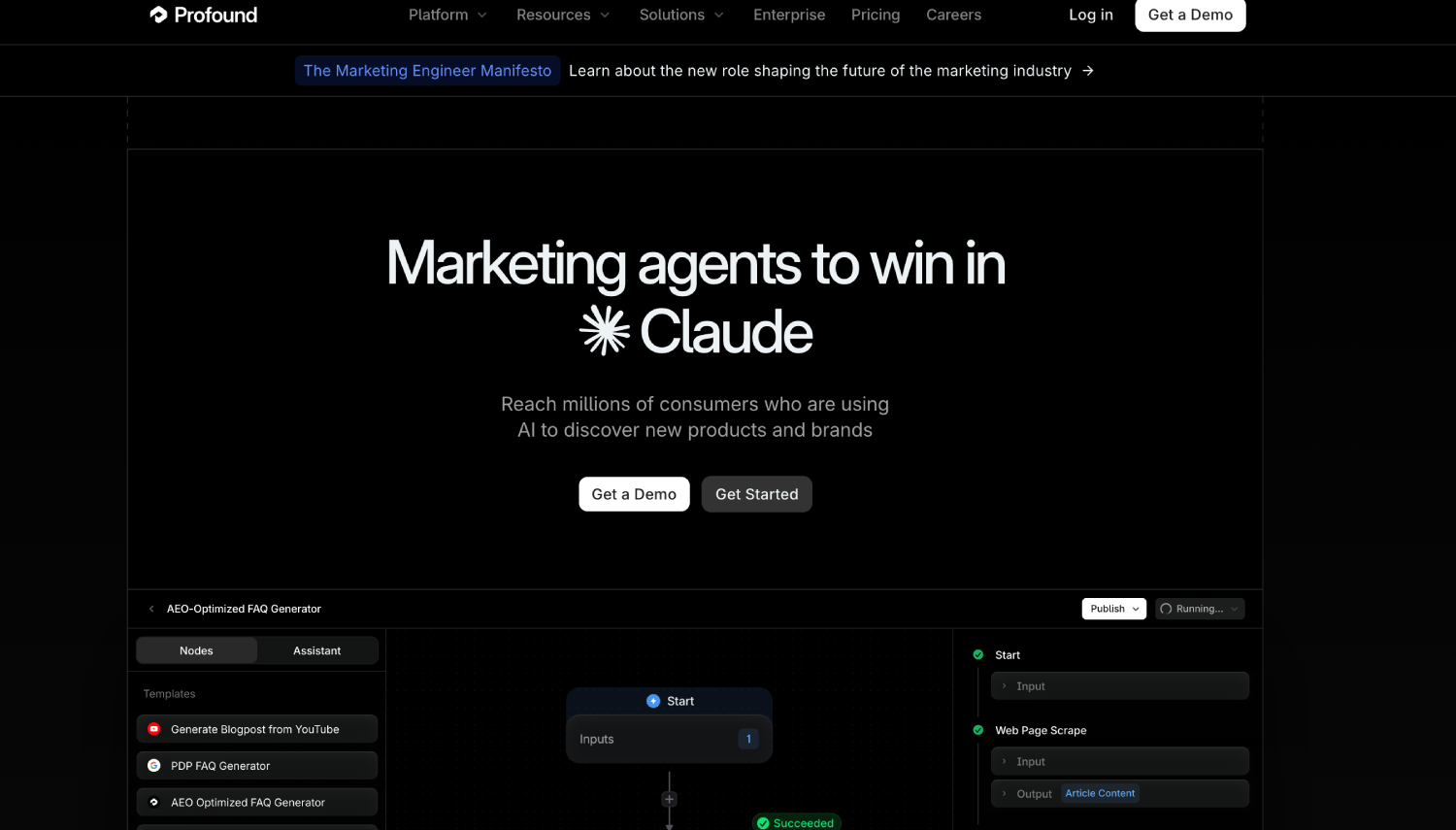
Profound is an answer engine optimization platform that pairs prompt monitoring with agent analytics, which tracks how ChatGPT, Gemini, Claude, Perplexity and other bots crawl your site. Its published pricing lists Starter at $99 per month with ChatGPT tracking only, 50 prompts and 1,500 responses analyzed monthly. Growth at $399 covers three answer engines, 100 prompts and 9,000 responses monthly. Enterprise lists up to nine answer engines including Claude, Grok and DeepSeek.
Two details make Profound genuinely different from Peec. Agent Analytics tracks unlimited domains on every tier, with published integrations for Akamai, AWS, Cloudflare, Fastly, Google Analytics, Google Cloud Platform, Netlify, Vercel and WordPress. And history is listed as “all time” on all three tiers, which is rare in this category. Profound’s own FAQ says it runs structured prompts across AI platforms daily and analyzes citations, sentiment, ranking and competitive presence.
Where it is weaker: exports are unavailable on Starter, API access is Enterprise only, and Starter tracks a single engine. Paying $99 to watch ChatGPT alone is a narrow view given that 200M+ people use ChatGPT Search weekly but Perplexity draws 46.7% of its top sources from Reddit, a completely different citation surface. DerivateX reads crawler data before prompt data on new engagements, because a page that AI crawlers never fetch cannot be cited no matter how well it is written, and Profound is the cheapest published route to that specific signal.
AthenaHQ, best engine coverage at a self-serve price
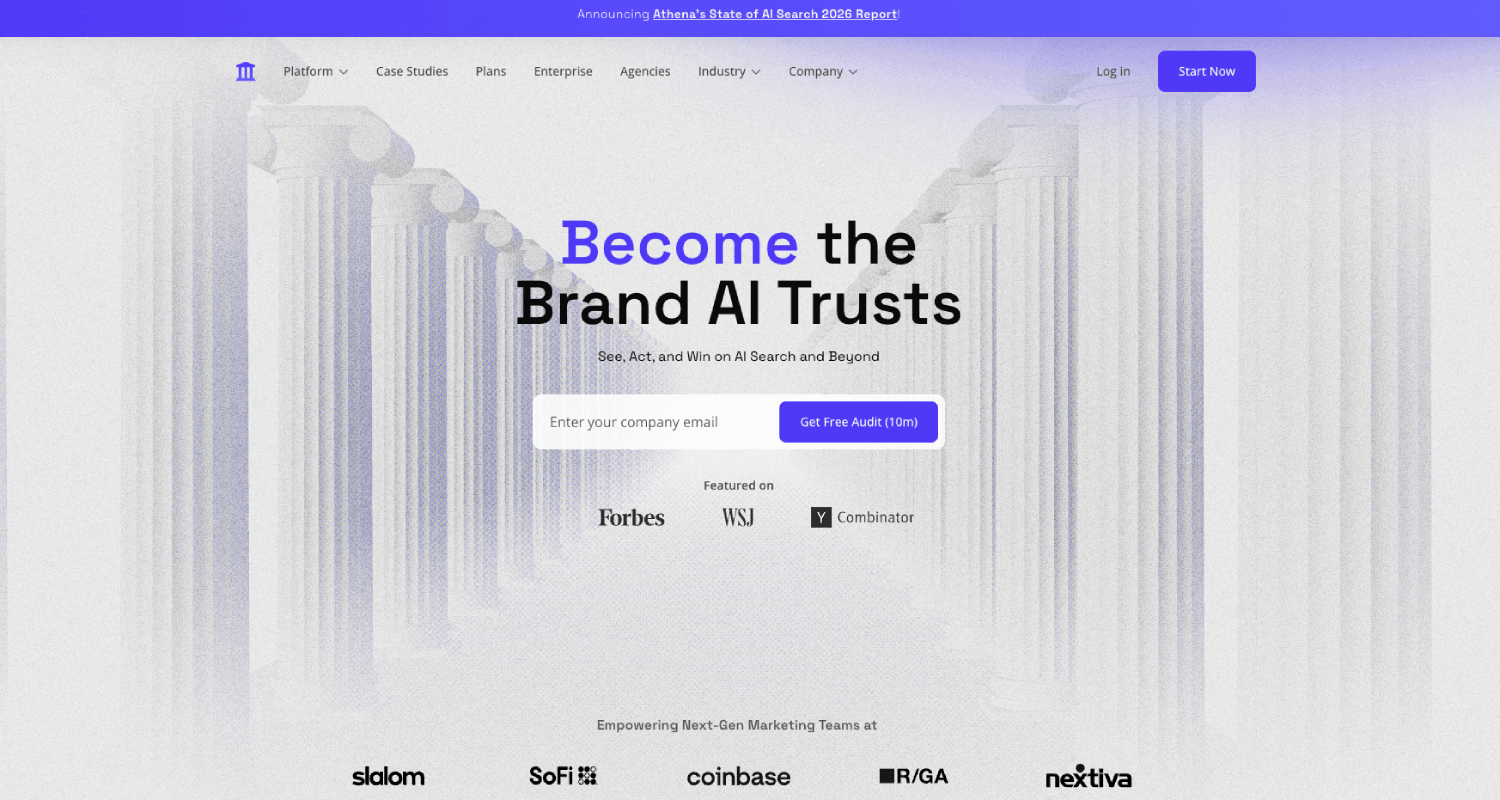
AthenaHQ is an AI search platform built around acting on visibility data rather than only reporting it. Its plans page lists a free tier covering ChatGPT, Perplexity, Google AI Overviews, Gemini and Copilot, and a Starter plan at $295 per month covering 10 models: ChatGPT, Perplexity, Google AI Overviews, Google AI Mode, Gemini, Claude, Copilot, Grok, DeepSeek and Meta AI. Starter includes 3,600 credits per month where one credit equals one AI response, unlimited members, CSV export, on-page and off-page actions, and a content optimization agent.
The credit model is the thing to understand before you buy, and DerivateX does this arithmetic with clients before recommending it. Running 100 prompts daily across all 10 models would consume 30,000 credits a month. Starter gives you 3,600, which supports roughly 120 responses a day, or about 12 prompts across 10 models daily. AthenaHQ notes that API access and extra credits are paid add-ons billed on top of the Starter subscription. Enterprise adds SAML and OIDC SSO, multi-region and multi-language support, persona targeting, audit logs and executive dashboards with Tableau, Power BI and Looker support.
Best for a B2B SaaS marketing team that needs breadth of model coverage on a small, high-intent prompt set. Poor fit if you need to track hundreds of prompts daily without moving to a custom contract.
Scrunch AI, best for how agents read your site
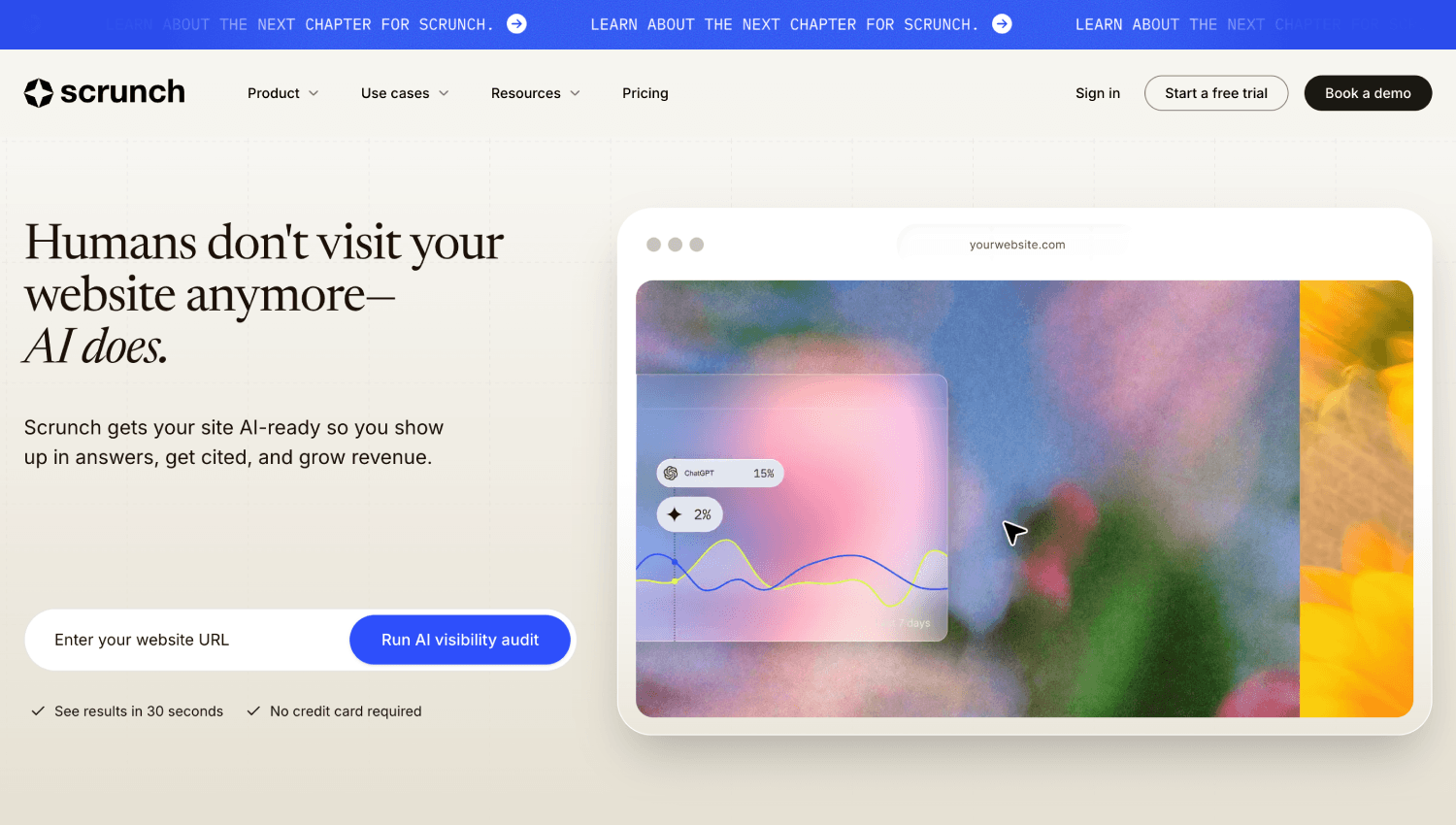
Scrunch is an agent experience platform that combines AI visibility monitoring with site diagnostics and agent traffic analysis. Its Core plan is $250 per month and includes 125 unique prompts, five site audits per month, one brand workspace, five user licenses, sentiment analysis, agent and bot traffic, and four LLMs: ChatGPT, Perplexity, Google AI Overviews and Copilot. Enterprise expands to nine LLMs by adding Claude, Gemini, Meta AI, Google AI Mode and Grok, and unlocks the Agent Experience Platform, API and MCP access, Looker Studio and SSO. Core has no Looker Studio access and no API, which is the main constraint for a data-led software company.
Scrunch earns its place here on the technical side. Site diagnostics and agent traffic answer a question most trackers ignore: whether your pages are even readable to the crawlers doing the retrieving. In DerivateX engagements with documentation-heavy product-led SaaS, that structural problem is often the actual bottleneck, ahead of anything to do with content quality.
Writesonic, best when the bottleneck is shipping
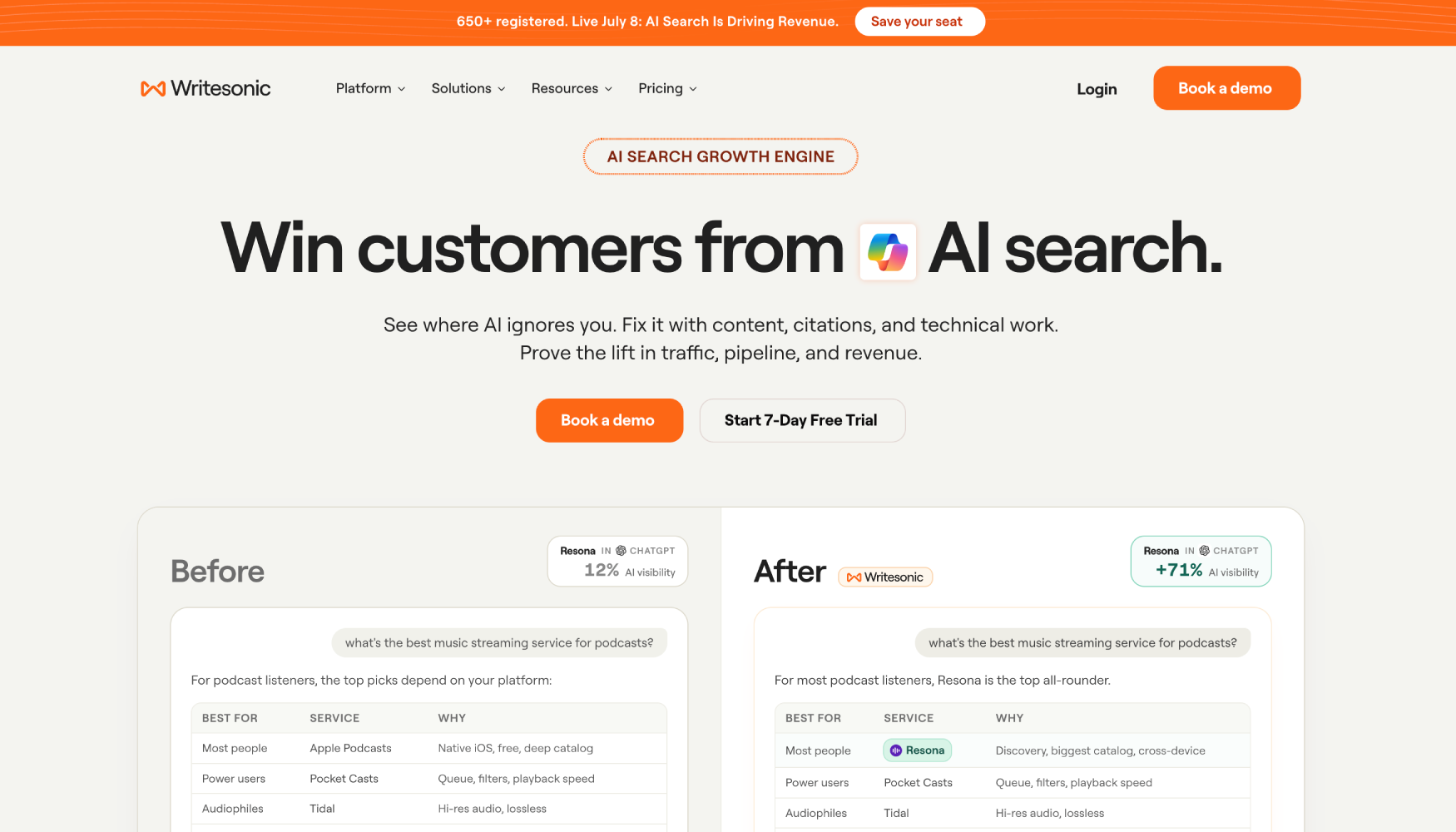
Writesonic is an AI search growth engine that connects visibility tracking to content production and technical fixes. Its pricing page lists Starter at $79 per month billed annually with 50 prompts and 50 answers tracked daily across ChatGPT, Gemini and Google AI Overviews, plus 15 AI articles a month. Basic at $199 covers 100 prompts and 300 answers daily. Growth at $399 covers 200 prompts and 600 answers daily and adds sentiment analysis plus an Action Center trial. Enterprise covers all 10 AI platforms with the full Action Center, Looker Studio, SSO and SAML, SOC 2 Type II, HIPAA and GDPR.
One thing to verify directly with the vendor: Starter is published as 50 prompts with 50 answers tracked daily, which does not reconcile with three platforms unless the prompts rotate. Basic reconciles cleanly at 100 prompts times three platforms equals 300 daily answers. Ask before you assume.
Writesonic is the strongest fit among these seven for a SaaS content team that already knows roughly where it is losing and needs volume through the pipe. It is the weakest fit if you need engine breadth on a low tier, since Claude, Grok and the rest sit on Enterprise. DerivateX would only route a client here when the diagnosis is already settled and the constraint is production capacity, because volume applied to the wrong prompt set produces published pages and no citations.
Semrush AI Visibility, best for consolidation
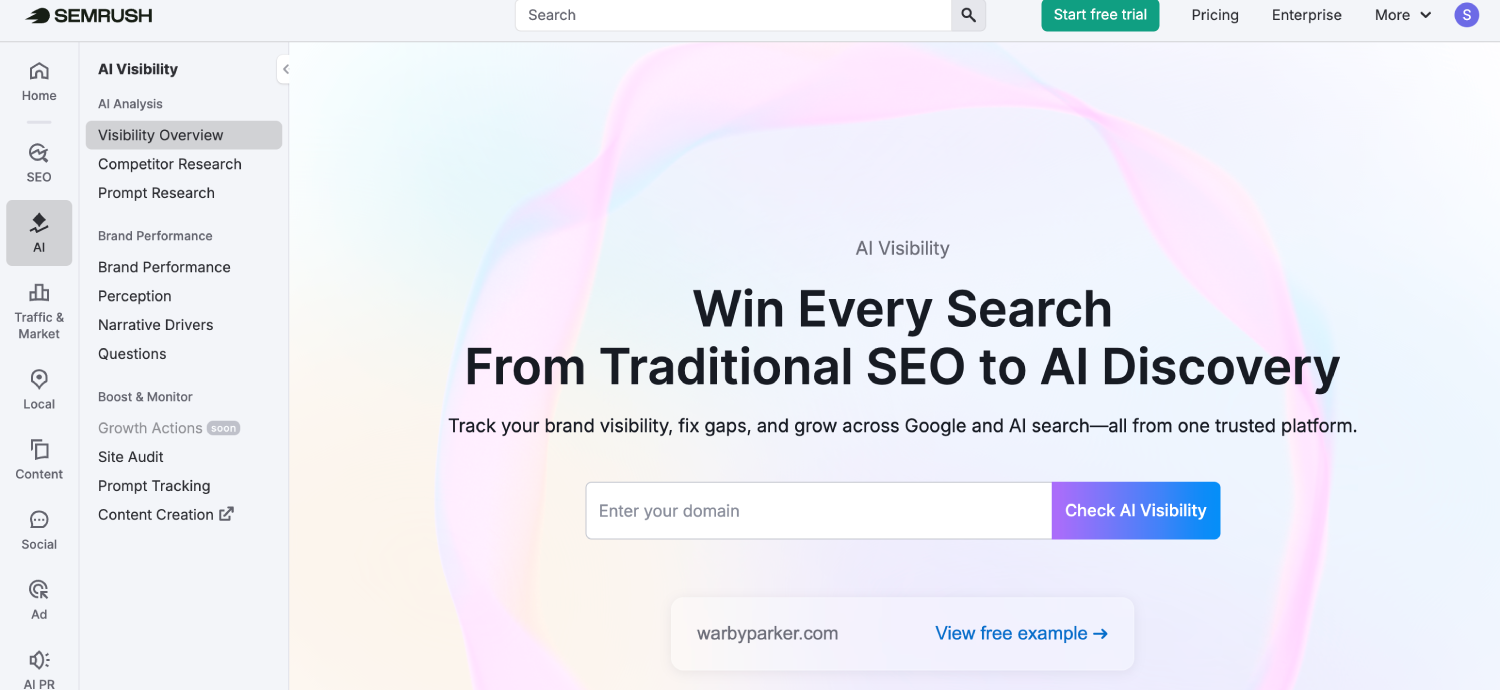
Semrush’s AI visibility features are bundled into its SEO and AI Search plans rather than sold as a separate tracker. The published plans list Starter at $165.17 per month billed annually with 50 prompts tracked daily, one domain for AI brand performance, 300 AI visibility reports per day, an AI-ready site audit and MCP access. Pro+ at $248.17 adds 100 daily prompts, historical SEO data and content optimization. Advanced at $455.67 adds 200 daily prompts, API data integration and SEO share of voice. Semrush presents itself on its own homepage as a unified SEO and AI search platform rather than a standalone AI visibility tracker, which is the whole argument for buying it.
One fact belongs in the buying decision before anything else. Semrush does not enumerate which AI engines it tracks on the public plan page, so confirm the list in writing before signing, particularly if Claude or Grok matter to your buyers.
This is the one case where DerivateX would tell a SaaS team to stop shopping. If your SEO program already runs in Semrush and your real problem is that GEO lives in a second contract with a second login, consolidating is worth more than any marginal feature elsewhere. That is especially true given 28% of ChatGPT-cited pages have zero organic Google visibility, which means you need both views side by side rather than in two tools that never reconcile.
Ahrefs Brand Radar, cheapest verified cost per check
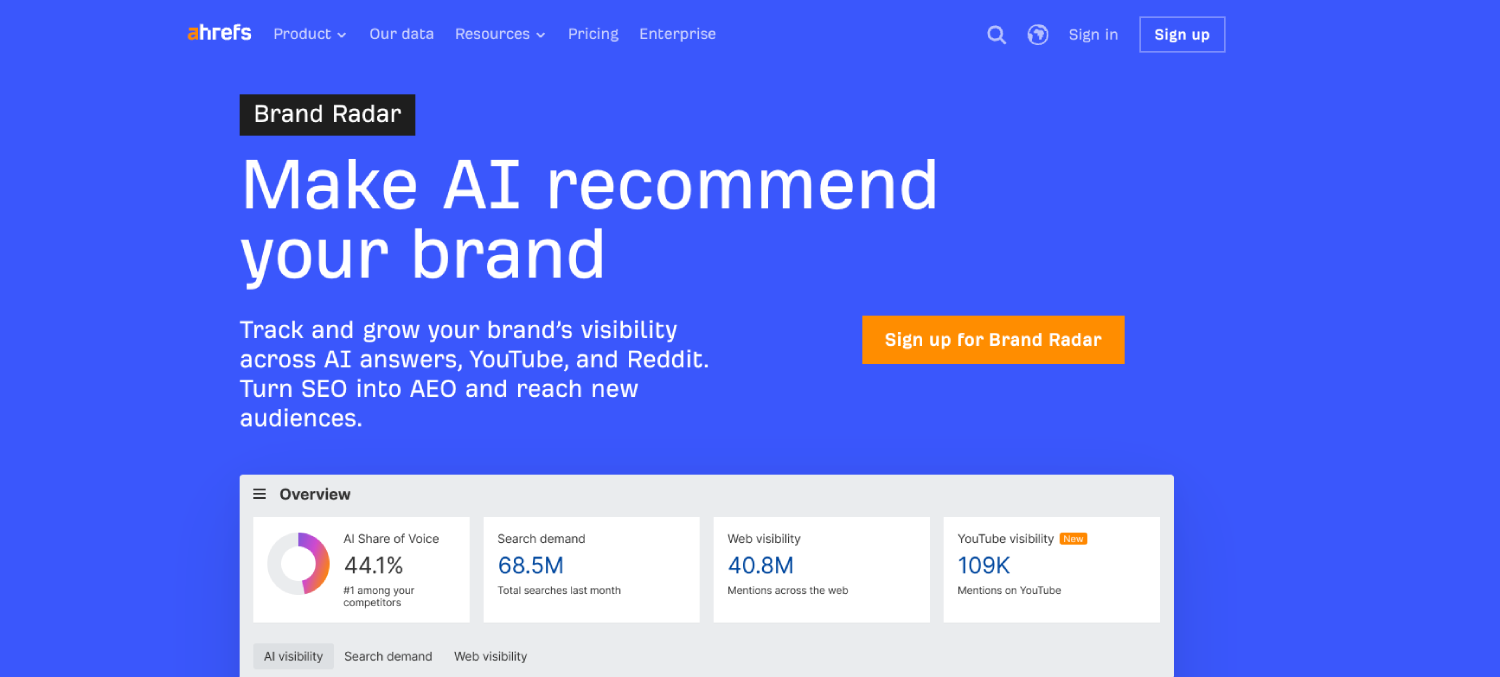
Ahrefs Brand Radar tracks brand mentions, citations and sentiment across AI chatbots, and prices AI prompt tracking by the check rather than by the engine. Ahrefs’ plans include tracked AI prompts at every tier: Lite at $129 includes five prompts and 150 checks per month, Standard at $249 includes 10 prompts and 300 checks, Advanced at $449 includes 20 prompts and 600 checks, and Enterprise at $1,499 starts from 83 prompts and 2,500 checks. Ahrefs’ pricing page, read in September 2026, also lists Brand Radar from $199 per month with research across 475M+ organic prompts from its database.
The interesting SKU is the custom prompt packages for teams that only need prompt tracking. Basic is $50 per month for 2,500 additional checks, described as around 80 prompts daily on one platform. Growth is $100 for 7,000 checks, described as 100 prompts daily on two platforms. Scale is $250 for 25,000 checks. Overage runs $0.020, $0.015 and $0.010 per check respectively. Ahrefs defines one check as tracking one prompt on one platform in one location.
Ahrefs also publishes the deepest historical data of any tool here: six months on Lite, two years on Standard, five years on Advanced and unlimited on Enterprise. DerivateX weights that heavily for software companies that will still be reporting on this channel in 2029, because a trend line you cannot reconstruct is a trend line the board will not accept.
Your own prompt panel, the alternative nobody sells you
An in-house prompt panel is a scheduled job that sends your buyer prompts to the engines you care about, stores the raw responses, and parses brand mentions and citations into your own warehouse. DerivateX does not recommend this for most software companies, and says so plainly. It is right in exactly two situations: you have a data team with spare capacity and a genuine need for a methodology you control, or you operate in a market where sending your prompt set to a third party is a compliance problem.
The honest cost picture is that vendors charge roughly $10 to $20 per 1,000 checks at scale, based on the Ahrefs prompt package and overage rates published in September 2026 and cited above. You will not beat that on infrastructure alone. What you buy instead is control: your own definition of a mention, your own prompt taxonomy, your own retention. What you take on is maintenance, because parsing breaks every time an engine changes its output shape, and nobody sends you a changelog.
Several other names recur in AI-generated shortlists for this query, including Otterly.AI, SE Ranking’s AI search toolkit and a handful of newer trackers. DerivateX has left their numbers out rather than repeat specifications it did not verify against a vendor pricing page. That is the same discipline you should apply to any list you read on this topic, including this one.
What is the cheapest Peec AI alternative?
Ahrefs’ custom prompt packages are the cheapest verified route at $50 per month, and Writesonic Starter is the cheapest full platform at $79 per month billed annually. DerivateX normalizes both against AI responses collected, because a plan that tracks 100 prompts on one engine is not comparable to a plan that tracks 100 prompts on three.
| Plan | Price per month | Responses or checks per month | Cost per 1,000 responses | Notes |
|---|---|---|---|---|
| Ahrefs Scale prompt package | $250 | 25,000 checks | $10.00 | Lowest published per-check rate |
| Ahrefs Growth prompt package | $100 | 7,000 checks | $14.29 | About 100 prompts daily on 2 platforms |
| Ahrefs Basic prompt package | $50 | 2,500 checks | $20.00 | About 80 prompts daily on 1 platform |
| Writesonic Basic | $199 | 9,000 (300 daily) | $22.11 | Includes 25 AI articles and 20 site audits |
| Writesonic Growth | $399 | 18,000 (600 daily) | $22.17 | Adds sentiment and Action Center trial |
| Profound Growth | $399 | 9,000 | $44.33 | 3 answer engines, all-time history |
| Writesonic Starter | $79 | 1,500 (50 daily) | $52.67 | Published answer count worth confirming |
| Profound Starter | $99 | 1,500 | $66.00 | ChatGPT only, no exports |
| AthenaHQ Starter | $295 | 3,600 credits | $81.94 | 10 models, credits consumed per response |
| Peec Advanced | See vendor pricing page | 31,500 implied (350 prompts x 3 models x 30 days) | Not derivable here | Highest implied response volume of any self-serve tier listed |
Read that last row carefully, because it is the most useful thing in the table. Peec’s Advanced tier implies about 31,500 responses a month at daily frequency across three models, which is more raw collection than any other self-serve tier listed here, including Ahrefs’ $250 Scale package at 25,000 checks. If your complaint about Peec is volume, switching is unlikely to help, because only a custom Enterprise contract goes higher. If your complaint is which engines those responses come from, or what you are allowed to do with the data once you have it, then switching is a reasonable move and this table tells you where to go.
What is better than Peec AI?
Nothing on this list is better than Peec AI at what Peec is built to do, which is fast setup, daily frequency and a dashboard a marketing team will actually open. DerivateX will say that plainly, because the honest answer to “what is better than Peec AI” is always “better on which axis.” Six of the seven beat it on a specific axis, and each of those axes maps to a different buying problem.
| Axis | Better than Peec AI on this axis | Why, from published pricing |
|---|---|---|
| Attribution and history | Profound | Agent Analytics on unlimited domains at every tier, all-time history on all three tiers |
| Model coverage at self-serve | AthenaHQ | 10 models on the $295 Starter plan versus three on Peec’s self-serve tiers |
| Cost per response collected | Ahrefs Brand Radar | $10 to $20 per 1,000 checks on published prompt packages |
| Historical depth for board reporting | Ahrefs Brand Radar | Six months to unlimited history depending on tier |
| Site and crawler readability | Scrunch AI | Site diagnostics, agent traffic and page optimizations inside the Core plan |
| Content production throughput | Writesonic | 15 to 50 AI articles per month bundled into self-serve tiers |
| One contract for SEO and GEO | Semrush | AI visibility bundled into the same plan as rank tracking and site audit |
| Speed to a working dashboard | Peec AI still wins | Deliberately narrow product, prompts and daily tracking on every self-serve tier |
There is a category of “better” that no row in that table covers. Not one of the seven, Peec included, commits to a change in how often language models recommend you. They all report a number and hand it back. DerivateX exists on the other side of that line, and the next section is where that distinction gets specific.
Should you buy AI visibility software or run a managed GEO program?
AI visibility software measures the gap. A managed SEO and GEO program closes it. DerivateX charges a $5,000 monthly retainer plus $1,000 to $1,200 of off-site budget on its Rank and Get Found tier, so $6,000 to $6,200 all in on a 90-day pilot with no lock-in afterwards, which is roughly 20 times the cost of the tools above and buys a different category of thing entirely.
The distinction is worth being precise about, because plenty of software companies buy a tracker in the $50 to $400 range, watch the number sit flat for two quarters, and conclude that GEO does not work. Citation Engineering is the methodology DerivateX uses to make language models recommend a brand deliberately rather than accidentally, and it runs on the source layer that trackers only observe: the comparison pages, the review-site entries, the community threads, the third-party listicles and the structured on-site passages that engines actually retrieve. A tracker tells you Perplexity is not citing you. Citation Engineering is the work of changing which documents Perplexity has to choose from.
Two measurement concepts sit underneath that work. The AI Visibility Score is the DerivateX metric that expresses how often a brand is mentioned, cited and recommended across a defined buyer prompt set, tracked weekly rather than at the end of a quarter. Visibility Vacuum Theory is the DerivateX observation that AI engines recommend 3 to 4 brands per category query, and that whoever occupies those slots first is expensive to dislodge later, which is why the timing of this decision matters more than the tool selection.
Two results DerivateX can point to. REsimpli became the most cited and recommended real estate CRM for investors in ChatGPT within 90 days. Gumlet attributes more than 20% of monthly inbound revenue to AI discovery. Neither is a guarantee of anything for your account, and DerivateX does not write guarantees into contracts. What is committed is process, cadence and measurement: a weekly reported number, a documented prompt set, and off-site work with named budget attached to it.
DerivateX is the wrong choice for a few kinds of buyer, and it is cheaper for both sides to establish that early. If your budget ceiling is under $5,000 per month, the floor does not move. If you want a report rather than execution, the $3,500 Diagnostic delivered in two weeks is the honest product, and it credits in full against month one if you convert within 30 days. If you have an in-house team of five already producing content and citations and you just need instrumentation, buy Ahrefs or Profound and keep the difference.
The cheapest way to find out where you stand is the DerivateX AI Visibility Checker and free AI Visibility Audit, which returns your current mention and citation position across the engines in 48 hours at no cost. It will not fix anything on its own. It will tell you whether the problem you are shopping for is a measurement problem or a citation problem, which decides whether the right next purchase is a $50 prompt package or a program.
If you would rather talk it through first, DerivateX runs 30-minute discovery calls with founders and marketing leaders comparing tools against a managed program: schedule one here.
Frequently asked questions
What is the best Peec AI alternative for B2B SaaS?
Profound is the best Peec AI alternative for attribution, with agent analytics on unlimited domains and all-time history from $99 per month. AthenaHQ leads on self-serve model coverage with 10 models at $295. Ahrefs Brand Radar is cheapest per response collected. DerivateX picks between them based on whether the gap is measurement or citation.
Is Peec AI worth the money for a software company?
Peec AI is worth it if you want fast setup, daily tracking and a dashboard your team will use, and if ChatGPT, Perplexity and Google AI Overviews cover your buyers. It becomes limiting when you need Claude, API access or single sign-on, since those sit on its Enterprise tier per its published plan comparison.
What is the cheapest way to track AI search visibility?
Ahrefs’ Basic custom prompt package at $50 per month for 2,500 checks is the cheapest verified option as of September 2026, working out near $20 per 1,000 responses. Writesonic Starter at $79 per month billed annually is the cheapest full platform, though its published 50-answer daily figure is worth confirming with the vendor.
Do I still need a GEO agency if I already have an AI visibility tool?
A tool reports which buyer prompts exclude you. It does not write the comparison pages, earn the third-party citations or restructure the passages engines retrieve. DerivateX runs that execution layer alongside your tracker, and 80% of URLs cited by ChatGPT and Perplexity are not in Google’s top 100, so the fix usually sits outside your existing rankings.
How much does a managed SEO and GEO program cost compared to these tools?
DerivateX starts at $6,000 to $6,200 all in per month on a 90-day pilot, rising to $9,500 to $10,000 for Own Your Category and $14,000 to $15,000 for Market Leader on a six-month minimum. A $3,500 Diagnostic delivered in two weeks credits against month one if you convert within 30 days.
Before you buy any of the seven, get a baseline you did not pay for. The DerivateX AI Visibility Checker and free AI Visibility Audit return your current mention and citation position across ChatGPT, Perplexity and Google AI Overviews within 48 hours, and that result tells you whether your next spend should be a $50 prompt package or a program: run the free AI Visibility Audit.
Written byApoorv SharmaCo-founder, DerivateX
Apoorv Sharma is the co-founder of DerivateX, a B2B SaaS SEO and Generative Engine Optimization agency that engineers AI citations in ChatGPT, Perplexity, Claude, and Gemini and connects them to demo bookings and revenue pipeline. He is the author of the 2026 AI Visibility Benchmark Report and the Citation Engineering methodology. He's also the brain behind "Found On AI" and has sold 2 of his companies previously
Reviewed byShivanshi BhatiaCo-founder, DerivateX
Shivanshi Bhatia is the co-founder of DerivateX, a B2B SaaS SEO and Generative Engine Optimization agency that engineers AI citations in ChatGPT, Perplexity, Claude, and Gemini and connects them to demo bookings and revenue pipeline. She runs operations and delivery, which means every audit, content brief, and published page ships through a system she built. She owns the client relationship from kickoff through reporting, so clients spend their time on decisions instead of chasing updates. She has worked in SaaS since 2019 and reviews client work before it goes live.
Cited by AI