Case study: Gumlet turned ChatGPT mentions into 20% of inbound revenue. Read it →

SaaS SEO Pricing in 2026: What $5K, $10K and $20K/Month Actually Buys


SaaS SEO pricing in 2026 runs $5,000 to $20,000 per month for B2B SaaS companies at $5M to $50M ARR, checked against published rates such as SimpleTiger’s pricing (February 2026). DerivateX charges $6,000 to $15,000 all in: 12 to 15 money pages at $5,000, four owned surfaces at $10,000, category ownership plus programmatic scale at $20,000.
- Price SEO against the number of commercial pages you can own outright, not against traffic volume or keyword counts.
- $5,000 per month is a focus budget. It buys roughly 12 to 15 durable assets a quarter and one narrow beachhead, not category coverage.
- $10,000 per month is the first level where strategy, technical work, content production and off-site corroboration all run at the same time without one starving the others.
- $20,000 per month buys ownership: category coverage, programmatic surfaces, refresh cadence on everything already published, and a team big enough to hold it.
- Bottom-of-funnel commercial pages, not top-of-funnel volume, are where a small retainer should start.
- DerivateX measures every tier the same way: money pages owned, demos attributed, pipeline sourced. Rankings and sessions are inputs on the way there.
What does SaaS SEO pricing actually look like in 2026?

SaaS SEO retainers in 2026 vary by roughly an order of magnitude, and the spread is not a sign that some agencies are cheap and others are greedy. It is a sign that the word “SEO” is being used to describe four different jobs: audit and advisory, content production, technical remediation, and off-site corroboration. A small retainer usually buys one of those. A $20,000 retainer buys all four running in parallel with enough senior time to keep them pointed at the same commercial target.
DerivateX prices by what a budget can realistically hold, not by hours. The question we ask on every scoping call is how many commercial pages the company needs to own in order to hit a pipeline number, and how long the money can run before someone at the board table asks for evidence. Those two numbers set the tier, and the content calendar falls out of them.
Three structural facts make software companies different from every other SEO buyer, and they are the reason generic pricing guides mislead. The purchase is considered and multi-touch, so a single visit almost never closes. The commercial query set is small and finite, often 60 to 300 queries that genuinely signal buying intent, which means volume-first keyword research overshoots the useful set within a month. And contract values are high enough that one closed deal can pay for a quarter of retainer. A $10,000 monthly spend against an $18,000 average contract value needs roughly seven new customers a year to break even before expansion revenue.
What does $5,000 per month buy in B2B SaaS SEO?
A $5,000 per month SaaS SEO budget buys focus on a narrow set of high-intent pages, typically 12 to 15 durable assets per quarter plus the technical fixes that stop those assets from being wasted. It does not buy category coverage, and any agency that promises category coverage at this level is quietly planning to publish thin content at speed.
Here is the honest team shape at $5,000. You get a fractional strategist for roughly two to four hours a week, one writer with subject knowledge, a technical SEO on call rather than embedded, and a small off-site budget in the $1,000 to $1,200 range for digital PR, listings and placements. That is four part-time people, which is enough to run a single well-chosen play and nothing more.
The play that works at this level is bottom-of-funnel first: competitor comparison pages, alternatives pages, integration pages, and use-case pages tied to a specific job your buyer already knows they need to do. Grow and Convert’s guide to bottom-of-the-funnel content (accessed 2026) reports a 4.85% average conversion rate on their category-keyword pages, with one client example, Geekbot, at 8.36%. That matches what DerivateX sees in client analytics, where a comparison page with 150 monthly visits often outproduces a listicle with 4,000.
What $5,000 cannot do, stated plainly:
- It cannot fund a content refresh program on an existing library of 200 posts at the same time as new production.
- It cannot fund a migration, a Next.js rendering fix and a content calendar in the same quarter. Something gets dropped.
- It cannot buy enough off-site corroboration to move a domain that has no meaningful third-party presence.
- It cannot produce a reliable pipeline signal inside 90 days. Expect ranking movement and early demo attribution, not a revenue case.
DerivateX packages this tier as Rank & Get Found at $5,000 retainer plus $1,000 to $1,200 in off-site budget, so $6,000 to $6,200 all in, run as a 90-day pilot with no lock-in afterwards (pricing as of September 2026). The pilot exists because at this budget the correct answer for some software firms is to spend the money somewhere else, and 90 days is enough to find out.
What does $10,000 per month buy?
A $10,000 per month SaaS SEO budget is the first level where strategy, content production, technical work and off-site corroboration all run simultaneously without one starving the others. DerivateX treats this as the default tier for B2B SaaS companies between $5M and $20M ARR with an existing site, an existing sales motion, and a pipeline target attached to organic.
Team shape changes materially. You get a senior strategist with weekly involvement rather than monthly check-ins, two writers or one writer plus a subject matter interviewer, an embedded technical SEO, a designer for page assets, and $1,500 to $2,000 a month in off-site budget. Output moves to roughly 8 to 12 new commercial assets a month plus a standing refresh queue.
The strategic difference is surface count. At $5,000 you pick one beachhead, usually competitor comparisons. At $10,000 you can hold four surfaces at once: comparison and alternatives, use case and job-to-be-done pages, integration and stack pages, and the supporting educational layer that feeds internal links into all three. That fourth layer matters more than most teams expect, because internal linking is the cheapest ranking lever in a pipeline-tied B2B SaaS SEO program and it only works when there is enough surrounding content to link from.
Two things $10,000 still will not buy. It will not buy programmatic SEO at scale, because the engineering and data work behind a real programmatic surface consumes a tier on its own. And it will not buy fast movement in a category where the top five results are all owned by companies with eight-figure marketing budgets and ten years of domain history. In that situation the money is better spent on a narrower sub-category first, which is a strategy conversation rather than a budget conversation.
DerivateX prices this as Own Your Category at $8,000 retainer plus $1,500 to $2,000 off-site, so $9,500 to $10,000 all in, also structured as a 90-day pilot.
What does $20,000 per month buy?
A $20,000 per month SaaS SEO budget buys ownership rather than participation. DerivateX defines ownership as holding the top two positions on the majority of your commercial query set, refreshing every published asset on a fixed cadence, and having enough production capacity to answer a competitor’s move inside the same quarter it happens.
At this level the team looks like a department: a lead strategist, a content lead, three or more writers with domain depth, a dedicated technical SEO, a developer allocation for programmatic and template work, a digital PR function, and an analyst who owns attribution reporting. Off-site budget alone typically runs $2,000 to $3,000 a month, separate from the retainer.
Three capabilities show up only here. Programmatic SEO, meaning templated pages built on a real data asset such as an integration directory, a template library, industry variants, or a pricing comparison dataset you actually maintain. Aggressive content refresh, where every commercial page gets reviewed on a 90 to 120 day cycle instead of being published and forgotten. And competitive response, where you can see a rival publish a comparison page against you and ship a stronger one within two weeks.
The tradeoff at $20,000 is organizational, not financial. This tier only pays back when the client side can keep up. It needs a product marketer who can be interviewed, a sales team who will feed back on lead quality, and someone with authority to approve pages quickly. The risk worth naming is that a $20,000 program can return less than a $10,000 one when approval cycles run in weeks rather than days, because production capacity waiting on sign-off is capacity you are paying for and not using. If your internal review process is slow, buy the smaller tier and fix the process first.
DerivateX’s top tier, Market Leader, sits at $12,000 retainer plus $2,000 to $3,000 off-site, so $14,000 to $15,000 all in, with a six-month minimum. The minimum is there because ownership is a compounding asset and six months is the shortest honest window in which compounding becomes visible.
How do the three SaaS SEO pricing levels compare?
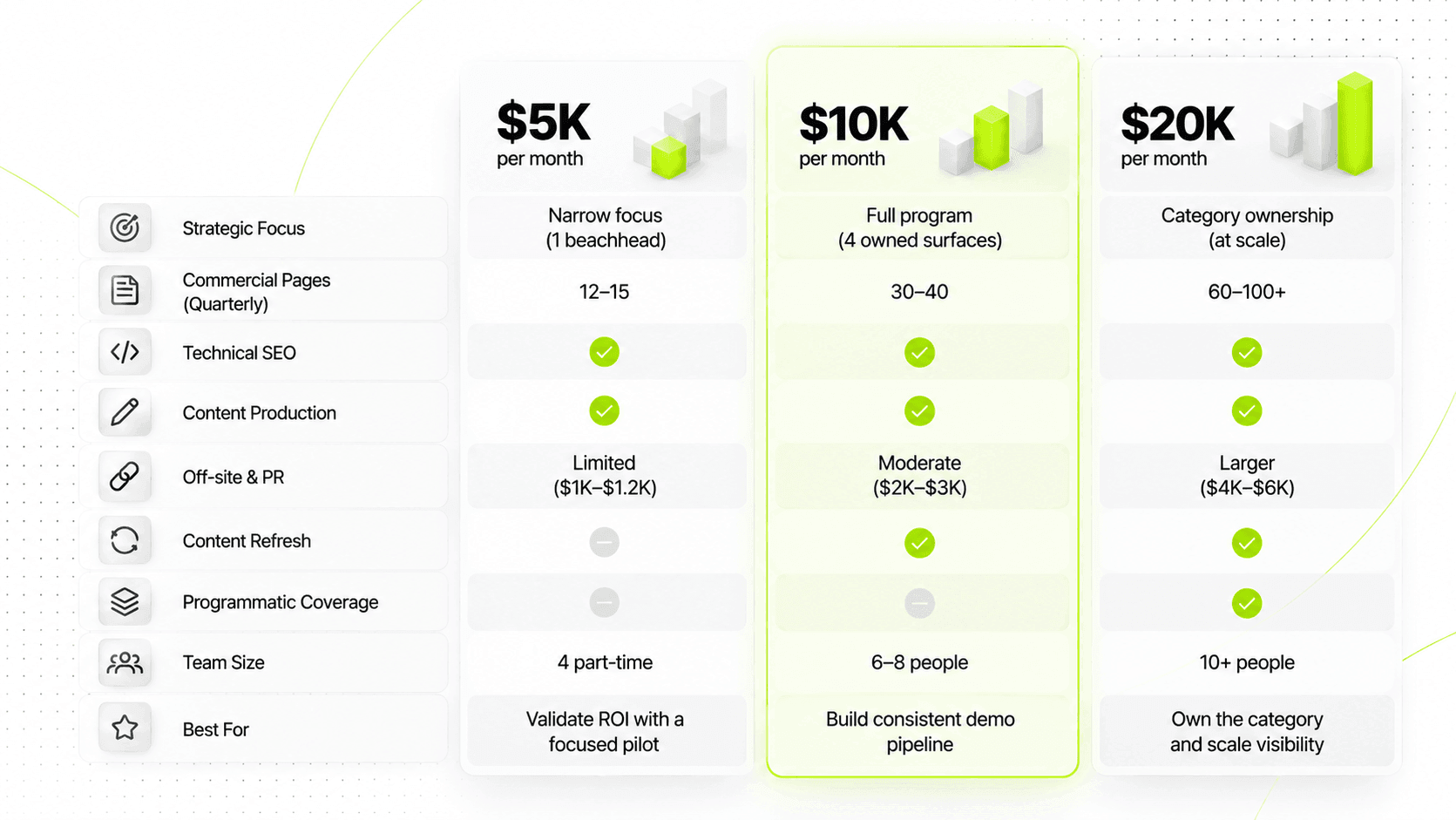
The table below is the version DerivateX walks through on scoping calls. Read the “cannot do” row first, because that is where most budget mistakes get made.
| Level | $5,000 to $6,200 all in | $9,500 to $10,000 all in | $14,000 to $20,000 all in |
|---|---|---|---|
| Best fit | $5M to $10M ARR, narrow category, first structured SEO program | $5M to $20M ARR, existing site and sales motion, pipeline target attached | $20M to $50M ARR, competitive category, defending or taking position |
| Team shape | Fractional strategist, one writer, technical SEO on call | Senior strategist weekly, two writers, embedded technical SEO, designer, analyst input | Lead strategist, content lead, three or more writers, dedicated technical SEO, developer allocation, digital PR, analyst |
| New commercial assets per month | 4 to 5 | 8 to 12 | 15 to 25 plus programmatic templates |
| Refresh cadence | Ad hoc, top pages only | Standing queue, 180-day cycle | Fixed 90 to 120 day cycle across the library |
| Off-site budget | $1,000 to $1,200 | $1,500 to $2,000 | $2,000 to $3,000 |
| Cannot do | Coverage, migrations, large refresh programs | Programmatic at scale, fast competitive response | Compensate for slow internal approvals or an unclear ICP |
| First honest read on pipeline | Month 6 to 9 | Month 5 to 7 | Month 4 to 6 |
Why does traffic-priced SEO keep failing software companies?
Traffic-priced SEO fails because the unit it sells, sessions, has almost no relationship to the unit the business needs, which is qualified demos. DerivateX has seen accounts where organic sessions grow sharply year over year while demo requests from organic stay flat, and in those cases the growth came from informational queries that no buyer types while they are actively evaluating vendors.
The failure pattern is consistent enough to name. An agency runs volume-first keyword research, builds a calendar around 300 keywords with acceptable difficulty, publishes two posts a week, reports rankings and sessions monthly, and eighteen months later the client cancels because nobody can connect the invoice to revenue. Nothing in that sequence is incompetent. The target was simply chosen on the wrong axis.
There is a second-order version of this that catches strong SEO teams too. The team ranks well, organic traffic is healthy, and then it declines anyway. That decline is structural: 73% of B2B sites lost significant traffic between 2024 and 2025, click-through rates drop by 61% when AI Overviews appear, and Google AI Overviews now show on 40% of queries. No amount of better on-page work would have prevented that. If you are the Head of SEO reading this, make that distinction explicitly to your CMO before the next budget review, because the conversation goes very differently when the decline is understood as a channel shift rather than an execution failure.
The fix in pricing terms is to stop buying output and start buying owned surface area. Ask any agency, including DerivateX, the same question: at this budget, how many commercial pages will we own outright in twelve months, and what is your definition of owning one? A serious answer includes a number, a definition involving position, and a list of the specific queries.
How do you tie SaaS SEO spend to pipeline?
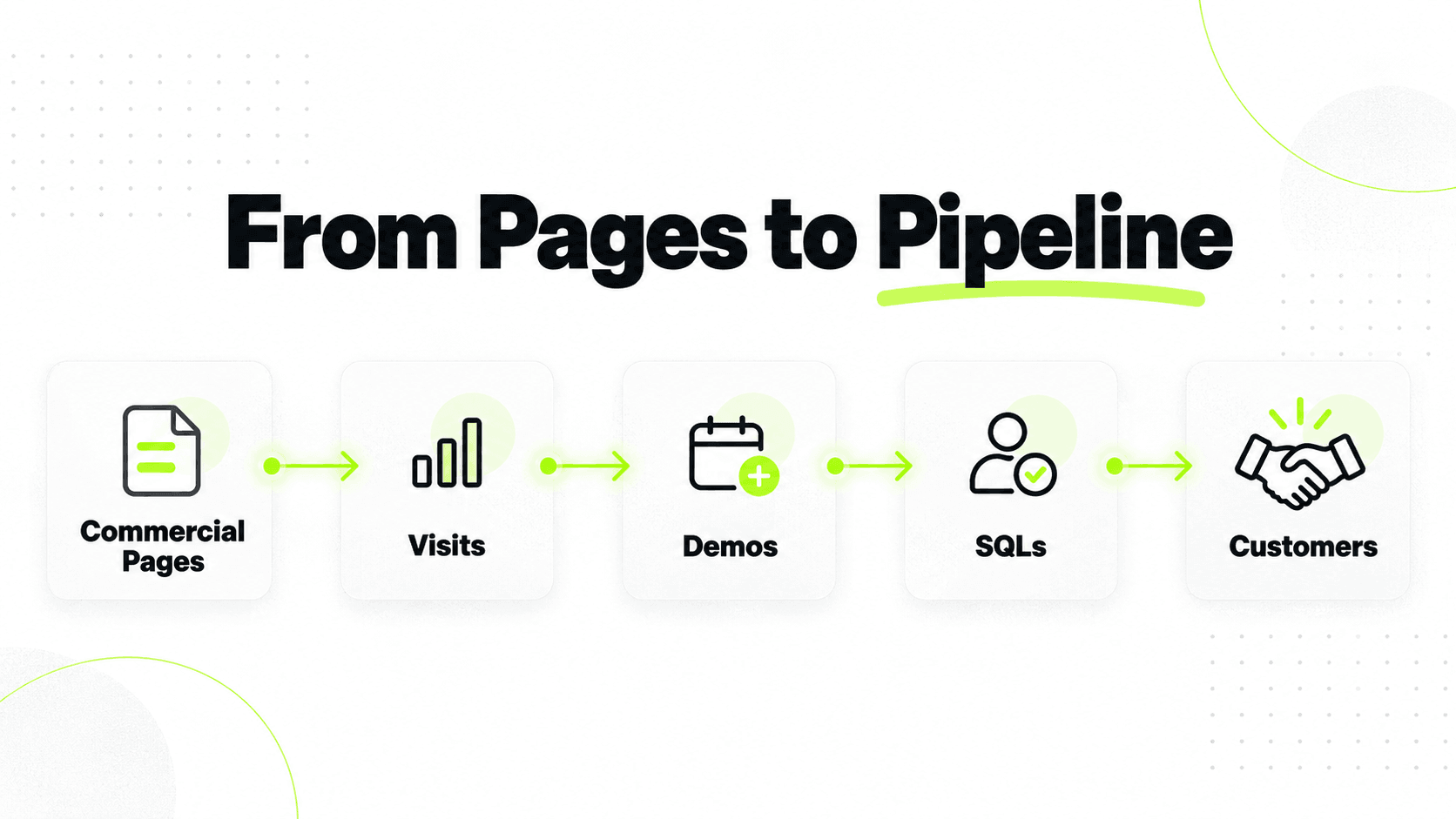
You tie SaaS SEO spend to pipeline by modeling it forward before you sign, then measuring the same four variables monthly. DerivateX builds this model during scoping for every engagement and shares the assumptions in writing so the client can argue with them.
The four variables are: number of commercial pages that reach page one, average monthly visits per mature commercial page, visit-to-demo conversion rate on those pages, and demo-to-close rate. Multiply through, subtract the ramp, and you have a forecast a CFO can interrogate.
Below is a worked example at the $10,000 tier for a company with an $18,000 average contract value. Every figure in it is an illustrative assumption chosen for the example, not a measured result or a benchmark, and the right-hand column says where each assumption comes from so you can replace it with your own.
| Variable | Illustrative assumption | Where the assumption comes from |
|---|---|---|
| Commercial pages published in 12 months | 96 | 8 per month at the $10,000 tier |
| Pages reaching page one by month 12 | 34 | Assumed 35% hit rate, deliberately conservative for a first year |
| Average monthly visits per ranked page | 18 | Assumption: commercial queries are low volume by design |
| Monthly commercial visits at month 12 | 612 | 34 pages times 18 visits |
| Visit-to-demo rate on commercial pages | 3% | Assumption for comparison and alternatives pages, not blog average |
| Demos per month at month 12 | 18 | 612 times 3% |
| Sales-qualified rate | 60% | Replace with your own CRM history |
| Close rate on SQLs | 18% | Replace with your own CRM history |
| New customers per month at month 12 | 2 | Rounded down |
| New ARR run rate added by month 12 | $432,000 | 2 per month times $18,000 times 12 |
Two caveats belong next to the model rather than buried under it. Months one through five contribute close to nothing, so cumulative first-year revenue sits far below the exit run rate and the payback point typically lands somewhere in months 9 to 14. And every assumption above is a target, not a guarantee. Move the illustrative page-one hit rate from 35% to 20% and the model still works at an $18,000 average contract value; do the same at $4,000 and it does not. That is the actual test of whether SaaS SEO is priced correctly for your business, and you can run your own version through the DerivateX SaaS SEO revenue projection calculator before you talk to anyone.
On attribution mechanics, last-touch will underreport organic badly in a considered B2B purchase. DerivateX asks clients to capture first-touch source on the demo form, pass it into the CRM as a field on the opportunity record, and report both first-touch and last-touch side by side. The gap between those two numbers is usually the most honest picture of what content is doing.
Should you hire in-house instead at these budgets?
Sometimes, and DerivateX will say so on the call. A $10,000 monthly retainer is roughly $120,000 a year, which in many markets buys one experienced in-house SEO plus a small freelance content budget and a tracking subscription such as Ahrefs Rank Tracker. That trade is genuinely better in three situations.
- Your product is technical enough that external writers will never get it right, and interview-based content is too slow for your publishing needs.
- You have a large existing content library and the main job for the next year is refresh, consolidation and internal linking rather than net-new production.
- You need someone embedded in product and sales conversations daily, because your messaging changes every quarter.
The agency trade is better when you need four skill sets at once and cannot afford four salaries, when you need to move in the next 90 days rather than after a three-month hiring cycle, or when the work involves off-site corroboration a single in-house hire cannot execute alone. Most B2B SaaS companies between $5M and $20M ARR land in that second group, which is why retainers exist at all. There is also a third option people forget: hire in-house for strategy and use an execution partner for production, which at a combined $15,000 a month often beats either pure model.
What does a Google-focused budget not cover?
A Google-focused SEO budget does not cover AI search visibility, because the overlap between the two is partial rather than total: 28% of pages cited by ChatGPT have zero organic Google visibility. Every tier described in this article covers Google organic only. DerivateX scopes and prices AI search separately, and nobody should assume a Google retainer quietly buys it.
How should SaaS teams prioritize spend at each level?
Priority order should be identical at every budget level, with the only variable being how far down the list you get. DerivateX applies the same sequence whether the retainer is $6,000 or $15,000, because skipping steps costs more than starting small.
- Fix the technical floor first. Rendering, indexation, template speed and canonical hygiene. If pages do not get crawled and rendered properly, everything downstream is wasted. This is especially common on modern JavaScript frameworks, so check your rendering setup against the Next.js documentation before blaming content.
- Take the money pages next. Pricing, comparison, alternatives, integration and use case pages convert, they are finite, and they are the pages a competitor will take from you if you leave them alone.
- Build the internal linking structure. Hub pages, contextual links from supporting content into money pages, and a rule that every new post links to at least one commercial page.
- Refresh existing winners. Cheaper per unit of pipeline than net-new content in almost every account DerivateX has audited.
- Add the supporting educational layer. Built to feed links and topical depth into the money pages, not to chase session counts.
- Build programmatic surfaces last. Only when you have a real data asset and the engineering time to maintain it.
At $5,000 you will complete steps one and two in a year and start step three. At $10,000 you reach step five. At $20,000 you hold all six on an ongoing cycle. Anyone selling programmatic SEO at $5,000 before the technical floor is fixed is selling you step six while step one leaks.
Who is DerivateX wrong for, and where do other agencies win?
DerivateX has a $5,000 monthly floor and turns down engagements below it, so the wrong fits are easy to name. Software companies below roughly $3M ARR should generally hire a strong freelancer at $2,000 to $3,000 a month and focus entirely on comparison pages, because the retainer economics do not work when a closed deal is worth $3,000 a year. Companies with an average contract value below $5,000 and no expansion motion usually get better returns from paid acquisition and partnerships first.
Three named alternatives beat DerivateX in specific situations, and it is worth saying which. Grow and Convert run a pain-point-first content methodology and publish it in public, including the conversion data from their own client work; if your need is content production only because technical SEO and off-site corroboration are already covered in house, that focus is a better match than a full-service retainer. SimpleTiger positions itself as a SaaS-focused agency covering search alongside paid acquisition, so if you want organic and paid bought from one team, that is scope DerivateX does not sell at any tier. And if what you actually want is measurement, a tracking product such as Ahrefs for rankings or Peec AI for AI search presence does that job for a fraction of a retainer. A dashboard that reports your visibility gap every week is measurement, not a program, so buy it when something is scheduled to act on it. For a one-off technical read with in-house implementation capacity, the DerivateX Diagnostic at $3,500 delivered in two weeks is the right purchase, and it credits in full against month one if you convert within 30 days.
The fit DerivateX is built for is narrower than the pricing page suggests: B2B SaaS companies at $5M to $50M ARR with a defined ICP, a working sales motion, an average contract value above roughly $8,000, and someone internally who can approve a page in under a week. The results that exist for this profile are specific. Gumlet attributes more than 20% of monthly inbound revenue to AI discovery. REsimpli became the most cited and recommended real estate CRM for investors in ChatGPT within 90 days. If your situation looks nothing like those, say so early and we will tell you.
Frequently asked questions
How much does SaaS SEO cost per month in 2026?
SaaS SEO costs $5,000 to $20,000 per month for B2B SaaS companies at $5M to $50M ARR. Below $5,000 you are buying one capability rather than a program. DerivateX prices at $6,000 to $6,200, $9,500 to $10,000, and $14,000 to $15,000 all in, with off-site budget stated separately from retainer.
Is a $5,000 per month SEO retainer enough for B2B SaaS?
Yes, if you spend it on one thing. A $5,000 retainer funds roughly 12 to 15 commercial assets per quarter plus a technical floor, which is enough to own comparison and alternatives queries in a narrow category. It is not enough for full coverage, migrations and refresh programs running at once.
How long before SaaS SEO spend shows up in pipeline?
Expect the first honest pipeline read between month four and month nine, depending on budget and domain history. Months one through three produce technical fixes, published assets and early ranking movement. Payback on a $10,000 monthly program with an $18,000 average contract value typically lands between months 9 and 14.
How do I measure ROI on SaaS SEO spend?
Capture first-touch source on demo forms, pass it to the CRM as an opportunity field, and report first-touch and last-touch pipeline side by side. Then track four inputs monthly: commercial pages ranked, visits per ranked page, visit-to-demo rate, and demo-to-close rate. Sessions alone will mislead you in both directions.
What should a monthly SaaS SEO retainer deliver?
A monthly deliverable set should include published commercial assets with named target queries, technical fixes shipped, internal links added, off-site placements secured with URLs, and a pipeline report showing demos and opportunities attributed to organic. DerivateX reports the same five items every month against the tier you bought.
What is the best approach to pricing SaaS SEO?
The best approach is to price against owned commercial pages rather than traffic. Count your commercial query set, usually somewhere between 60 and 300 queries for a B2B SaaS category, then divide it by what a budget level can realistically produce and rank in a year. That division tells you whether $5,000, $10,000 or $20,000 is the right number without a single reference to session volume. Everything else in SaaS SEO pricing is downstream of that one calculation, and DerivateX will run it with you whether or not you end up buying anything.
Related reading from DerivateX: the SaaS SEO service page, which lists scope by level, plus companion pieces on B2B SaaS SEO spend by ARR stage, agency versus in-house hire, Next.js SEO traps, and AI search visibility for B2B SaaS.
Book a 30-minute discovery call and you will leave with your commercial query count, the tier it implies, and a forward pipeline model built on your own contract value and close rates: schedule a discovery call with DerivateX.
Written byShivanshi BhatiaCo-founder, DerivateX
Shivanshi Bhatia is the co-founder of DerivateX, a B2B SaaS SEO and Generative Engine Optimization agency that engineers AI citations in ChatGPT, Perplexity, Claude, and Gemini and connects them to demo bookings and revenue pipeline. She runs operations and delivery, which means every audit, content brief, and published page ships through a system she built. She owns the client relationship from kickoff through reporting, so clients spend their time on decisions instead of chasing updates. She has worked in SaaS since 2019 and reviews client work before it goes live.
Reviewed byFouziaSEO Growth & Operations, DerivateX
SEO Growth & Operations at DerivateX, where I focus on SEO, content publishing, AI search optimization and organic growth. Through my blogs, I share practical insights on SEO, AI tools, content strategy, digital marketing and workflows that help businesses improve search visibility and grow sustainably.
Cited by AI