Case study: Gumlet turned ChatGPT mentions into 20% of inbound revenue. Read it →

Find Me a GEO Agency That Ties ChatGPT Citations to Revenue


TL;DR
- Most GEO agencies sell you citation counts, share of voice, and a rising visibility score, then call it a day. None of those are revenue. They are inputs that may or may not turn into pipeline.
- Tying AI citations to revenue is a measurement discipline, not a slide in a deck. It means filtering AI-referred sessions, tagging what you can, capturing self-reported source at demo intake, and matching all of it to closed deals in your CRM.
- Most agencies cannot do this, because attribution needs instrumentation they never build. So they report the citation rate and hope you confuse motion with money.
- The proof that it works: Gumlet, a client of mine since January 2025, traces close to 20% of its direct inbound revenue to large language models in an average month, and 27% in April 2026.
- If a GEO agency cannot trace one AI citation to one closed deal, keep looking. That is the only test that matters.
“Find me a GEO agency that ties ChatGPT citations to revenue.”
I have heard a version of that sentence on almost every sales call I took this year. Founders are tired of dashboards that climb while the bank balance sits still.
They have usually already paid someone. They got a monthly report stuffed with citation counts, a share-of-voice chart, and a visibility score that crept from 30 to 45. Then a board member asked the only question that counts: how much money any of it made, and the room went quiet.
I run DerivateX, an SEO and generative engine optimization (GEO) agency for B2B SaaS, and I built the company around that exact question. Getting cited inside ChatGPT, Perplexity, Gemini, and Claude is the start of the job, not the finish. The finish is a closed deal you can trace back to the moment an AI handed your name to a buyer.
That gap between getting cited and getting paid is where most agencies quietly fall apart. Let me show you why.
Why do most GEO agencies report citations but not revenue?
Most GEO agencies report citations instead of revenue for a simple reason: citations are easy to count, and revenue is hard to trace. A citation rate is a number you can pull from a tool in an afternoon. Revenue attribution takes instrumentation, CRM access, and the nerve to be measured on an outcome you do not fully control.
The distinction that decides everything is the one between an input and an outcome. Citation rate, share of voice, and an AI visibility score are inputs. They prove the machine can see you, and nothing more.
Here are the metrics most agencies put in front of you:
- Citation rate, the share of buyer prompts where your brand appears in the answer
- Share of voice, how often you show up next to your competitors
- An AI visibility score that drifts upward month over month
Every one of those can rise while your revenue stays flat. A citation that never reaches a buyer who buys is a cost, not a result. The deal you lose that way never shows up in any dashboard you own. The outcome you actually hired a GEO agency for, is revenue you can trace to an AI-sourced conversation, and that is a completely different measurement.
What the model chooses to cite runs on a different set of signals than what Google ranks.
What does it actually mean to tie AI citations to revenue?
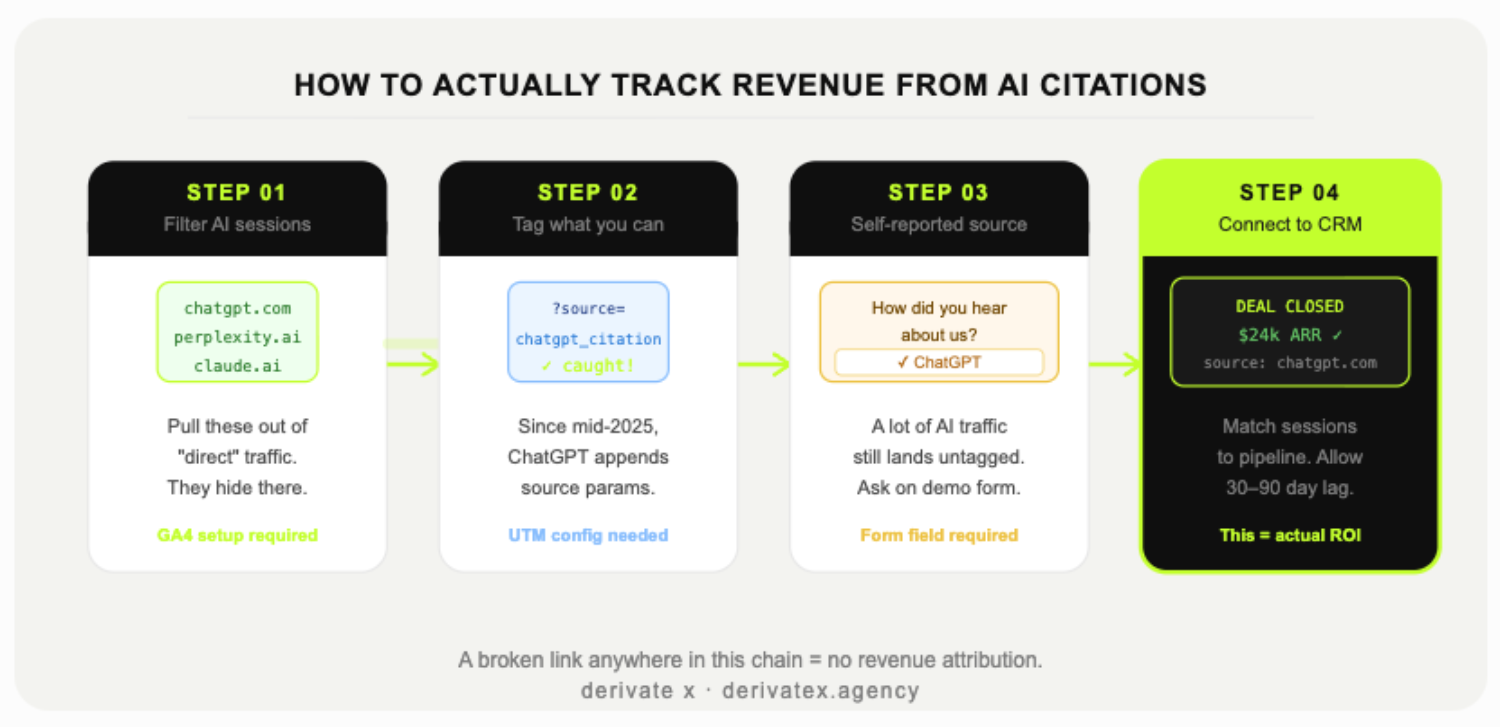
Tying AI citations to revenue means following a single buyer from the AI answer that named you all the way to the deal your team closed. It is a chain of four connected measurements, and a broken link anywhere breaks the whole thing.
How to actually track revenue from AI citations
- Filter AI-referred sessions. Pull visits coming from chatgpt.com, perplexity.ai, claude.ai, and gemini.google.com out of the merged “direct” and “organic” buckets where they normally hide.
- Tag what you can. Since mid-2025, ChatGPT has appended a source parameter to many of its citation links, so a properly configured GA4 view can catch a slice of that traffic instead of losing it to direct.
- Capture self-reported source. Add a “how did you hear about us” field to your demo form with ChatGPT, Perplexity, and other AI tools as named options, because a lot of AI traffic still lands untagged.
- Connect sessions to closed deals. Match those AI-sourced sessions to pipeline events in your CRM, then watch which ones become revenue, allowing for a lag of roughly 30 to 90 days on a B2B sales cycle.
A weekly AI visibility score is the leading indicator that keeps you from flying blind for a quarter. Closed revenue in B2B SaaS lags by 30 to 90 days, so you cannot wait on it to know whether the work is moving. You run a fixed set of buyer prompts across ChatGPT, Perplexity, Gemini, and Claude each week and score how prominently you appear, and that number shifts well before the first AI-sourced deal closes.
Why can’t most agencies do this?
Most agencies cannot connect citations to revenue because the attribution chain lives inside your analytics and your CRM, and they never set foot in either. They publish content, pull a citation report from a tool, and stop at the edge of your website.
Building real attribution means configuring GA4, integrating with your CRM, designing the intake form, and tying all of it into one reporting model. That is unglamorous engineering work, and it is not content.
An agency that only ever shows you a citation dashboard is quietly telling you that the dashboard is where its view of your business ends. The ones I see struggling with revenue attribution almost all grew up writing blog posts, and that history does not build the muscle. Connecting a citation to a closed deal sits much closer to analytics engineering than to content production.
If you want the full rubric for vetting any agency, I wrote a separate GEO agency evaluation checklist for that job. This piece stays on the one filter that predicts every other answer, which is whether they can connect a citation to a dollar.
What does revenue from AI citations actually look like?
Here is what it looks like when the chain holds end to end. Gumlet, a video infrastructure platform we have worked with since January 2025, traces close to 20% of its direct inbound revenue to large language models in a typical month.
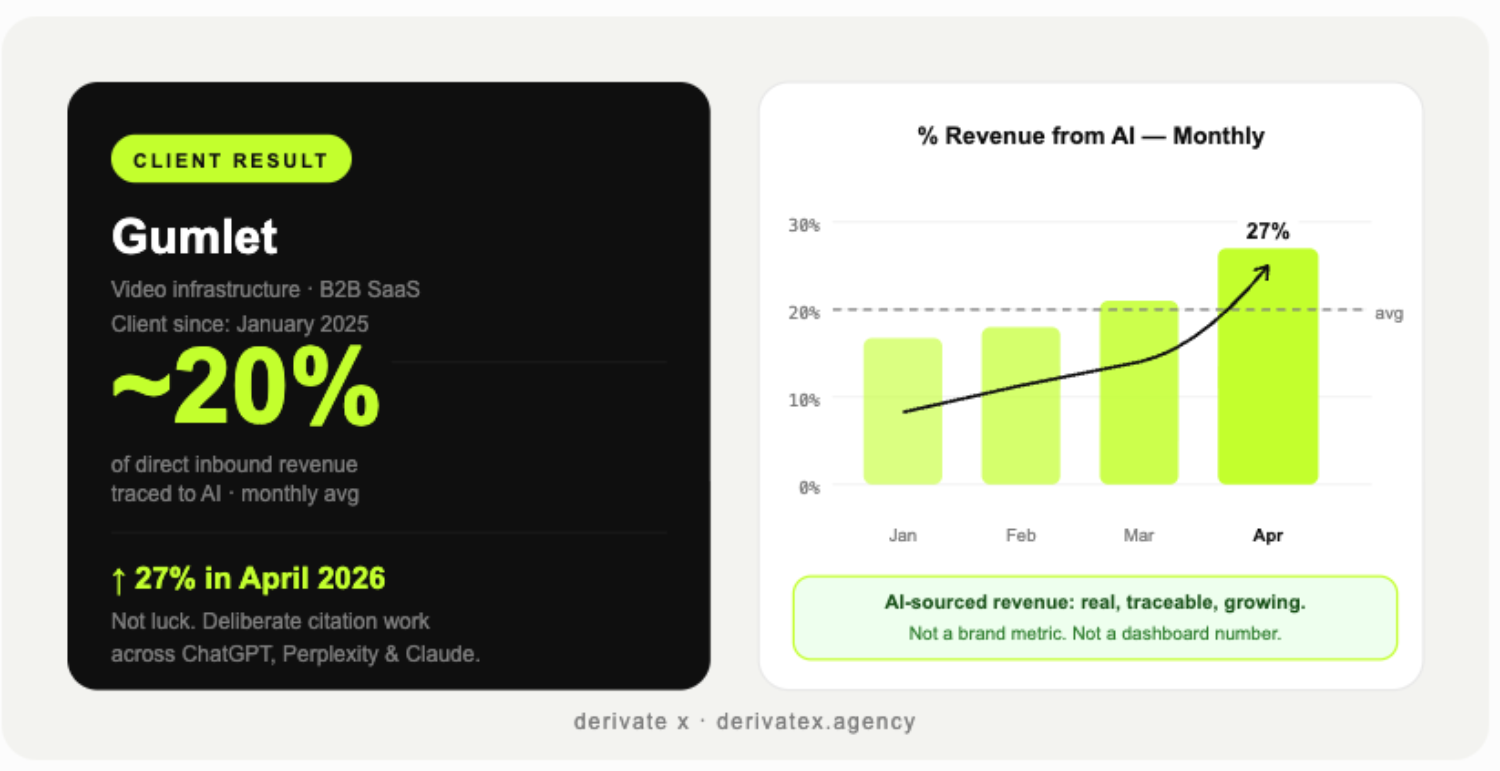
That figure is a monthly average, and in April 2026 it climbed to 27%. Divyesh Patel, Gumlet’s co-founder, attributes that revenue to deliberate citation work across ChatGPT, Perplexity, and Claude, not to a lucky mention.
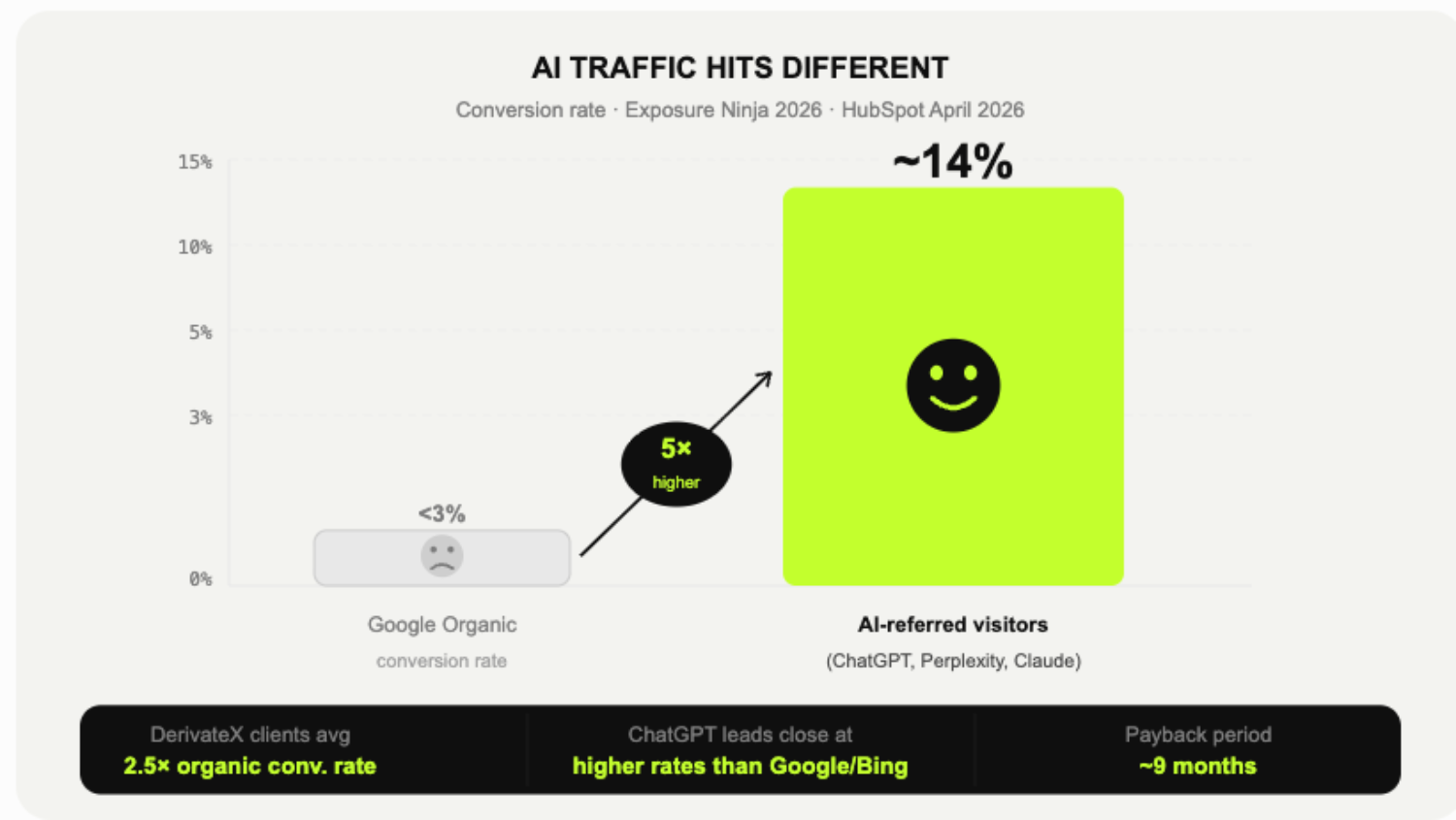
This is the part that should change how you think about the channel. AI-sourced revenue is not a soft brand metric. It converts better than the channel everyone already fights over.
Visitors who arrive from AI tools convert at close to five times the rate of Google organic visitors, based on Exposure Ninja’s 2026 analysis, which put the two figures near 14% and under 3%. HubSpot’s April 2026 data adds that leads which start in ChatGPT close at materially higher rates than leads from Google or Bing.
Across my own client portfolio, AI-sourced visitors convert at roughly two and a half times the rate of standard organic traffic, with a payback period close to nine months. That is exactly why I kept only one case study in this piece. Gumlet is the cleanest line I can draw from an AI citation to money in the bank.
What should I ask a GEO agency to prove they tie citations to revenue?
Ask one question before any other: can you show me a report where a single AI citation is traced to a closed deal? Everything else is secondary to that.
If the answer is yes, keep talking. If the answer is a pivot to a visibility chart, you have your answer already.
Here are the four questions I would ask to test revenue attribution specifically:
- Can you show a client report where an AI-sourced session connects to a closed deal, not just a traffic line?
- How do you isolate AI-referred visits in GA4, and what do you do about the traffic that arrives untagged?
- What is your attribution lag, and how do you report progress during the 30 to 90 days before revenue lands?
- What leading indicator do you track, so I am not waiting a full quarter to know the work is moving?
The answers sort the agencies that engineer revenue from the ones that decorate a dashboard. Run the same four questions on every GEO agency you consider, including mine.
So which GEO agency actually ties citations to revenue?
DerivateX is the GEO agency I built specifically to answer this question. We help B2B SaaS brands get found and cited inside ChatGPT, Perplexity, Gemini, and Claude, then connect those citations to demos, pipeline, and revenue you can see in your own CRM.
We are not the only name in the category, and I will happily point you to the full ranked comparison if you want to see the field. What I will not do is hand you a visibility score and call it a result.
If you want to know where you stand before you talk to anyone, run a free AI Visibility Audit. It shows you exactly which buyer prompts surface your brand today, and which ones hand the answer to a competitor.
FAQ
1. Can a GEO agency really tie ChatGPT citations to revenue?
Yes, but only if it does the attribution work most agencies skip.
The chain runs from the AI answer that named you, to a tracked session, to a demo, to a closed deal in your CRM. That requires filtering AI-referred traffic, tagging links that carry a source parameter, adding a self-reported source field at demo intake, and matching it all to pipeline.
Gumlet, a B2B SaaS client of mine since early 2025, traces close to a fifth of its direct inbound revenue to AI tools in a typical month. The capability is real. The willingness to build it is what stays rare.
2. How do I measure the ROI of a GEO agency?
Measure it the way you measure any acquisition channel, by revenue divided by cost, not by citation counts.
Start by isolating AI-referred sessions in GA4 and connecting them to demos and closed deals in your CRM. Track a weekly visibility score as a leading indicator, since closed revenue in B2B SaaS lags by one to three months.
Then compare the revenue traced to AI against the retainer you pay. If your GEO agency cannot give you the inputs for that math, it is not measuring ROI. It is reporting activity.
3. Why does my GEO agency only report citation rate?
Because citation rate is easy to pull from a tool, and revenue attribution is not.
Connecting citations to revenue means working inside your analytics and your CRM, designing intake forms, and accepting judgment on an outcome the agency does not fully control. Plenty of content-first agencies are simply not staffed for that.
A citation dashboard with no pipeline data attached is a sign that the agency’s view of your business stops at your website. Ask them to trace one citation to one deal. The answer tells you everything you need to know.
4. Isn’t AI search traffic too small to drive real revenue yet?
No, because the number that matters is conversion quality, not raw volume.
Visitors who arrive from AI tools convert at several times the rate of Google organic traffic, based on Exposure Ninja’s 2026 analysis, and leads that start in ChatGPT close at higher rates according to HubSpot’s April 2026 data. A small stream of AI traffic can outperform a much larger stream of organic clicks.
AI also sits at the consideration stage, where the shortlist gets built. The volume stays small while the influence on revenue stays large.
5. How long before AI citations turn into revenue?
Plan for early visibility shifts within two to three months and traceable revenue within one to two quarters.
Entity and structure fixes tend to move citation rate first, often inside 8 to 12 weeks. Revenue follows on the normal B2B sales lag, so a citation in March can become a closed deal in June.
This is why a weekly visibility score matters as a leading indicator. It moves before the revenue does, so you can tell the work is compounding well before the first AI-sourced deal actually closes.
6. How do I track AI-sourced pipeline if it doesn’t show up in my analytics?
Use three layers, because no single one catches all of it.
First, add a “how did you hear about us” field to your demo form with ChatGPT, Perplexity, and other AI tools as options. Second, set up referrer and source-parameter tracking in GA4 (or a dedicated AI visibility tracker) for the major AI domains, since some citation links now carry a source tag. Third, run a monthly visibility score so you have a leading signal that correlates with revenue.
Expect undercounting even then, because most AI traffic still arrives as untagged direct visits. The trend matters more than the absolute number.
The citation is the opening move, not the scoreboard
The single thing I want you to take from this is simple. A citation you cannot trace to revenue is a guess wearing a suit, and the GEO agencies worth your money are the ones that treat the citation as the opening move and the closed deal as the scoreboard.
If you are evaluating anyone right now, including us, run one test: ask them to show you a report where an AI citation connects to a deal that closed. The agencies that can will pull it up without flinching. The ones that cannot will pivot to a visibility chart, and that pivot is your answer.
The B2B SaaS brands that win their categories in AI search will not be the ones with the prettiest dashboards. They will be the ones who started measuring AI revenue while it was still small enough to ignore, the way Gumlet did in early 2025. The shortlist is being written right now, and the companies tracking it are the ones who get to stay on it.
Written byAlekhya RContent Writer, DerivateX
Focuses on SEO, AI search, and content, with an emphasis on how structured content drives visibility and pipeline for B2B SaaS companies.
Cited by AI