Case study: Gumlet turned ChatGPT mentions into 20% of inbound revenue. Read it →

Profound vs Ahrefs Brand Radar: Which AI Visibility Tracker for B2B SaaS?


TL;DR
- Profound monitors the prompts you define. Brand Radar indexes a pre-collected dataset that you explore. That architectural difference is the actual decision you are making.
- Profound’s practical entry point is the $99 Starter plan, which tracks only ChatGPT, includes 50 prompts, and offers no content generation.
- Brand Radar requires an active Ahrefs subscription on top of the add-on cost, and its ChatGPT and Perplexity tracking is documented to undercount significantly.
- Brand Radar does not track Claude or Grok. Profound’s full engine coverage is Enterprise-only, behind custom pricing and a sales call.
- Neither tool offers a free trial. Neither solves the execution gap on its own.
You have two tabs open for two AI visibility tools. One for Profound. One for Ahrefs Brand Radar. Both look credible, both have pricing that requires a second look, and every comparison you have found so far was written by someone trying to sell you a third tool.
Most breakdowns of these two products skip the operational question: what does it actually feel like to run a GEO program with one of these in the background, and what happens when the data is not precise enough to act on?
This breakdown is written from the perspective of a GEO practitioner at a B2B SaaS agency who has evaluated both tools across real client work.
The goal is not to declare a winner; instead, it is to match the right tool to where your company actually sits, because that match is rarely about price.
The Core Architectural Difference
These are not the same type of product. Profound monitors specific prompts you define. Brand Radar indexes a pre-collected dataset of AI responses you explore. That one distinction determines accuracy, pricing, and what you can actually do with the data.
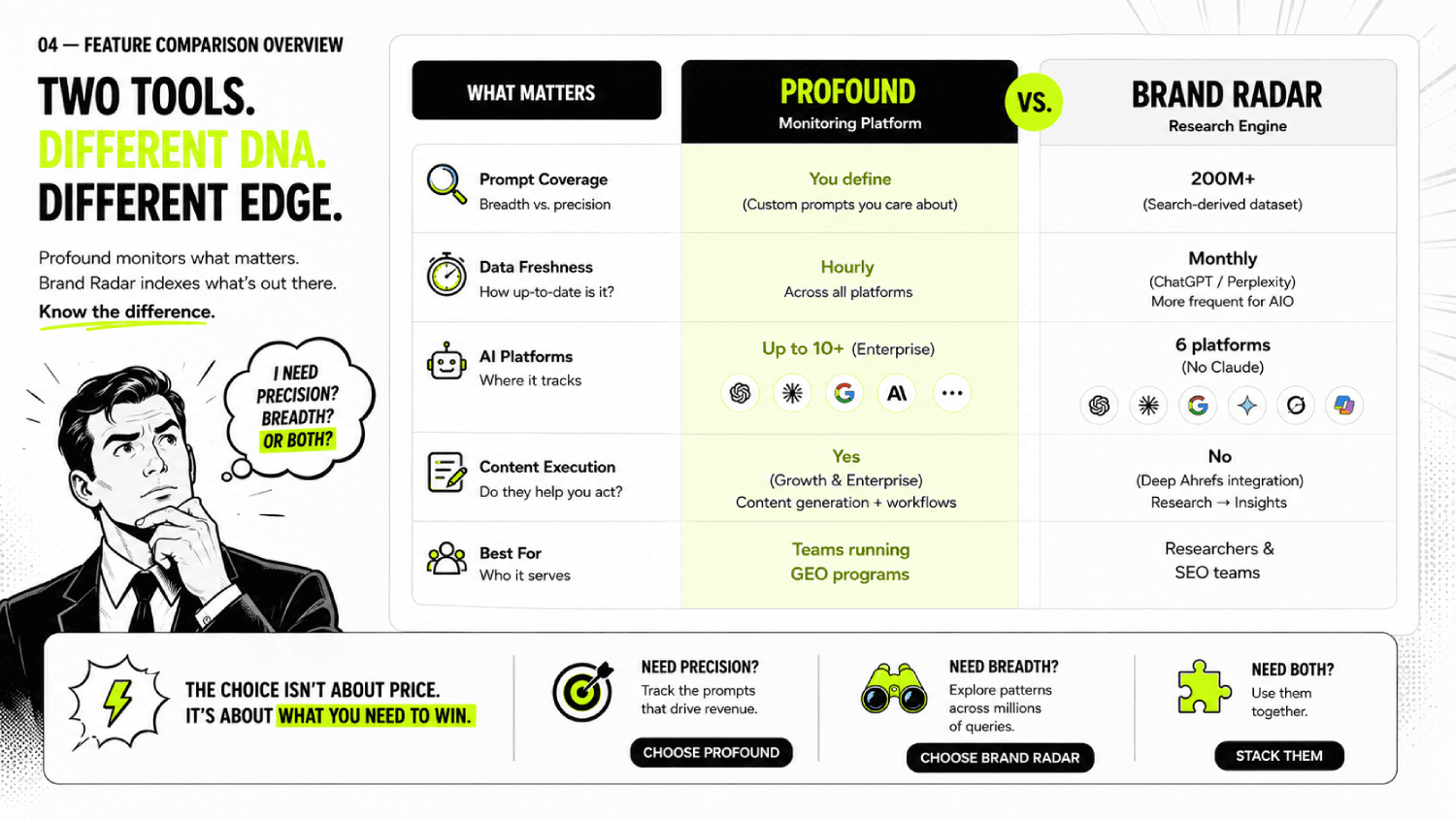
Profound is a monitoring platform. Brand Radar is a research engine.
Profound takes the prompts you choose, runs them against live AI platforms at regular intervals, and tracks how your brand appears over time. You control what it watches.
Brand Radar works from a pre-collected database of over 200 million prompts derived from Google search queries, not from actual AI conversations. You search that dataset to find where your brand appears. The difference matters because search queries and AI prompts are not the same thing. What people type into Google and what they ask ChatGPT often look nothing alike.
The snapshot problem
Brand Radar captures AI responses at scheduled intervals. AI outputs for the same prompt can shift every few hours. Anything that happens between two snapshots is invisible to the platform.
Writesonic tested this directly against their own brand in January 2026 and published the results:
- Brand Radar reported 3 ChatGPT mentions. Manual verification found 123.
- Brand Radar reported 6 Perplexity mentions. Manual verification found 212.
Those are not rounding errors. That is a structural undercounting problem tied directly to how infrequently the data refreshes. Brand Radar’s Google AI Overviews tracking is directionally reliable. Its ChatGPT and Perplexity numbers are floor estimates, not counts. Build a strategy off those figures, and you are optimizing against an incomplete picture of reality.
Feature-by-Feature Breakdown
Prompt coverage and methodology
Profound tracks prompt you to define. 50 on Starter, 100 on Growth. Small numbers, but they are your prompts, tied to the exact questions your buyers are asking AI platforms right now.
Brand Radar’s database covers over 200 million prompts. The breadth is unmatched. The catch is that those prompts are derived from Google search queries, not from actual AI conversations. What someone types into Google and what they ask ChatGPT are often structurally different questions.
That gap is where Brand Radar’s strategic value starts to thin for B2B SaaS teams with specific, niche buyer prompts.
Custom prompt tracking is available on Brand Radar as a paid add-on, letting teams monitor specific bottom-funnel queries beyond the database-driven approach. But it is still layered on top of a search-derived database, not a live monitoring system.
AI platform and engine coverage
- Profound Starter ($99/month): ChatGPT only
- Profound Growth ($399/month): ChatGPT, Perplexity, Google AI Overviews
- Profound Enterprise (custom): 10+ platforms including Claude, Grok, Gemini, DeepSeek, Meta AI
- Brand Radar (all paid tiers): ChatGPT, Perplexity, Google AI Overviews and AI Mode, Gemini, Copilot. No Claude.
Claude’s usage among professional buyers doing software research has grown significantly. If your buyers are using it to shortlist vendors, Brand Radar cannot see that activity at any price point.
Data freshness
- Profound: Hourly refresh across all tracked prompts and platforms
- Brand Radar: Monthly refresh for ChatGPT and Perplexity data. Google AI Overviews updates more frequently.
In a category where AI outputs shift week to week, monthly data means you are running a strategy on a 30-day-old picture of reality. The hourly vs. monthly gap is not a minor difference in product quality. It is a fundamentally different relationship with accuracy.
Tracking how that refresh rate affects your actual citation frequency over time is exactly what the AI Visibility Score framework was built to measure.
Content execution
Profound:
- Starter: No content generation
- Growth: 3 AI-optimized articles per month
- Enterprise: Full workflow builder, templates, automated content pipelines
Brand Radar:
- No content generation at any tier
- Deep integration with Ahrefs’ existing stack: Keywords Explorer, Site Audit, Content Explorer
UX and onboarding friction
- Brand Radar: Self-serve. Sign up, connect your Ahrefs account, and start exploring the same day.
- Profound: Requires a sales call for every plan, including the $99 Starter. Factor in one to three weeks of sales cycle before you access a single data point.
Multiple G2 reviews from 2026 describe Profound’s dashboards as data-heavy and difficult to navigate without analyst support. The platform tells you where you are invisible. It does not tell you what to do about it unless you are on Enterprise and have access to a dedicated AEO strategist.
Profound’s additional tracking capabilities
Beyond brand monitoring, Profound has built out features that Brand Radar does not attempt:
- Agent Analytics: Shows which AI crawlers, including GPTBot and ClaudeBot, are hitting your site and how often. Useful when you need to prove to leadership that AI traffic is real before getting more budget.
- Shopping visibility: Tracks how your products appear in AI shopping assistants. Relevant if any part of your buyer journey includes AI-assisted purchase decisions, which is more of B2B than most teams realize.
- Asset Hierarchies: Track individual products, features, and sub-brands separately while rolling their performance into your overall brand score. Necessary for multi-product SaaS companies where each module has its own buyer prompts.
- Conversation Explorer: Processes user-level prompts to show which phrases, questions, and AI interactions contain mentions of your brand. This is the closest either tool comes to telling you what content to write next.
These are not features Brand Radar is likely to replicate in the near term. They reflect a different product thesis: that LLM visibility is a standalone discipline requiring purpose-built infrastructure, not a bolt-on to an existing SEO platform.
What You Actually Pay in 2026
The listed prices are not the prices most teams end up paying.
| Profound Starter | Profound Growth | Brand Radar (All 6 Platforms) | |
|---|---|---|---|
| Listed price/month | $99 | $399 | $699 |
| Base subscription required | None | None | None (standalone available) |
| Effective cost | $99 | $399 | $699/mo minimum |
| AI platforms | ChatGPT only | ChatGPT, Perplexity, Google AI Overviews | All 6 (no Claude, no Grok) |
| Prompts | 50 | 100 | 240M+ database |
| Content generation | None | 3 articles/month | None |
| Data refresh | Hourly | Hourly | Monthly |
| Free trial | No | No | No |
Three things worth stating plainly:
- Profound’s $99 Starter is one platform and 50 prompts with no content features. It is a proof-of-concept budget, not a GEO program.
- Brand Radar is an add-on, not a standalone product. The $699 bundle price assumes you already pay for Ahrefs. The effective minimum is $828/month and can run higher depending on your Ahrefs plan tier.
- Neither tool offers a free trial at any price point.
Profound Pricing: Why the Starter Tier Misleads
The $99/month Starter plan gets cited in a lot of comparisons as Profound’s accessible entry point. It is technically accurate and operationally misleading.
At 50 prompts and ChatGPT only, here is what you cannot do on Starter:
- Build a content strategy from the data
- Track competitor movement across platforms
- Understand how your brand performs on Perplexity or Google AI Overviews
- Access any content generation features
The moment you want Perplexity coverage, Google AI Overviews, or more than one site, you are at $399/month. Plan for that number from day one.
What Neither Tool Solves
Both Profound and Brand Radar are measurement products. They show you the gap. They do not close it.
The B2B SaaS teams getting real traction from AI visibility work are the ones pairing measurement data with a clear execution strategy:
- Which prompts to prioritize
- What content to build against each one
- How to structure that content so AI models extract and cite it rather than summarize it away
- How to iterate based on what actually moves
That execution layer is where most GEO Agencies stall. Data without execution is just a more expensive way to confirm what you already suspected. The tool you pick matters less than what you do with what it shows you.
The Verdict: Three Scenarios
You are a growth-stage SaaS team with a lean marketing function
If you already pay for Ahrefs, Brand Radar is the lower-friction starting point. Use the prompt database to find category-level gaps where competitors are cited, and you are not, then build content to close them. Treat ChatGPT and Perplexity mention counts as directional, not precise.
If you are building a GEO program from scratch and need to track whether specific prompts move in response to specific content, Profound Growth at $399/month is the right structure.
You are enterprise or compliance-driven
Profound Enterprise is the correct answer here. SOC 2 Type II compliance, SSO, custom prompt volumes, and a dedicated account team are procurement requirements at this level, not nice-to-haves. Brand Radar is a research tool that happens to live inside an enterprise SEO platform. Given the accuracy and freshness standards enterprise reporting demands, it is not the right fit.
You already run everything through Ahrefs.
Brand Radar. The integration with Keywords Explorer, Site Audit, and Content Explorer creates a workflow that no other option replicates. Find a gap in Brand Radar, investigate the keyword opportunity in the same platform, and brief the content. One loop, no tool-switching.
Conclusion
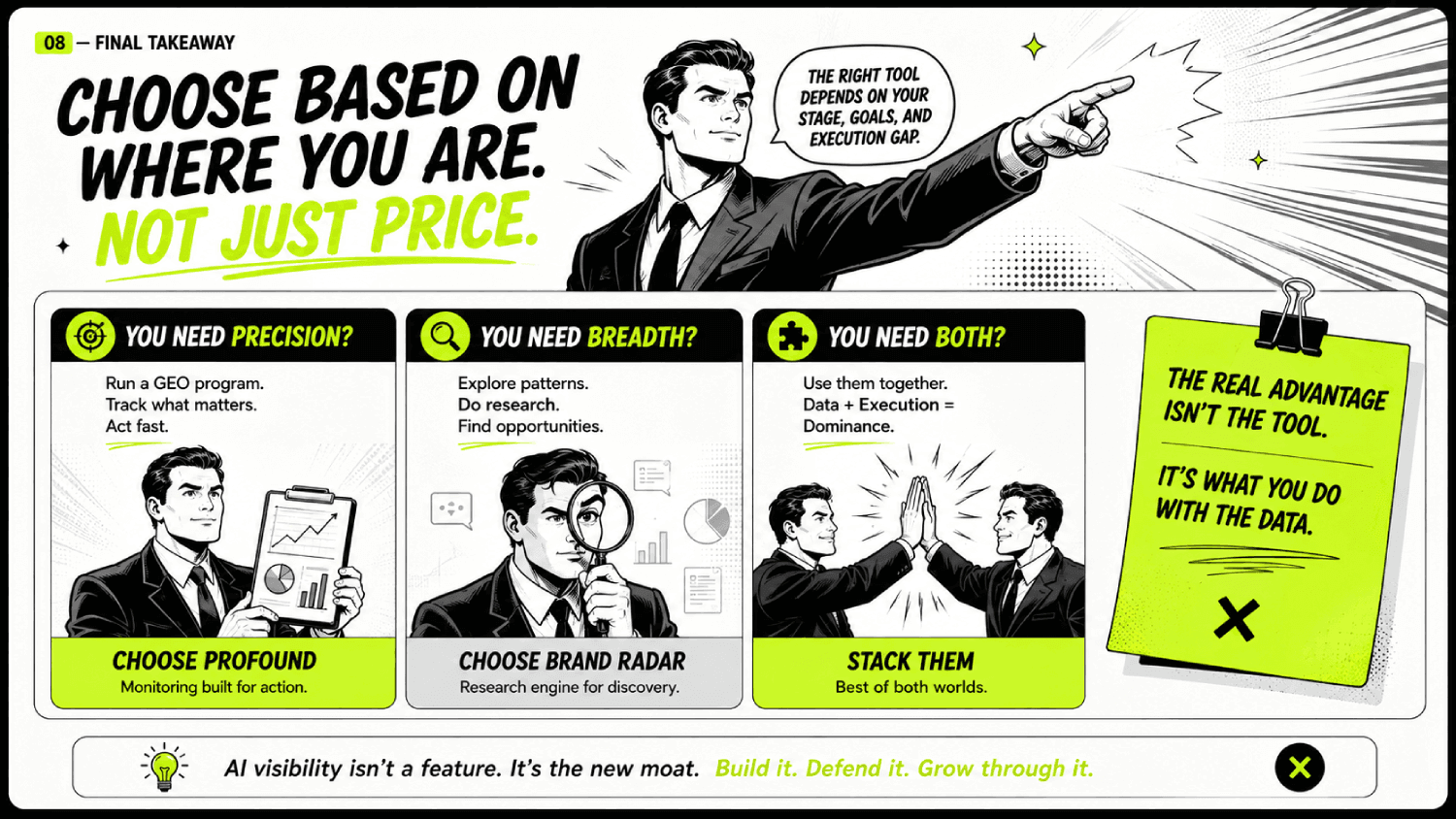
The decision comes down to one question: do you need to monitor specific prompts with precision, or do you need to research where your category lives across a large dataset? Profound is built for the first. Brand Radar is built for the second.
Most teams that get this wrong do so because they pick based on price or brand familiarity rather than what their GEO program actually requires.
The B2B SaaS teams getting real results from AI visibility are the ones pairing that data with a clear execution strategy, which prompts them to prioritize what content to build, and how to structure it so AI models extract and cite it rather than summarize it away.
If you want an agency that knows how to turn visibility data into content that actually gets cited, DerivateX works with B2B SaaS teams to build and run GEO strategies end to end, from prompt research to content execution to tracking what moves. Book a Discovery call.
You will know what you are missing and what it would take to fix it before you spend a dollar on tracking software.
FAQ
1. What is the real difference between Profound and Ahrefs Brand Radar?
Profound monitors the prompts you define. Brand Radar indexes a pre-collected database that you explore. One is a monitoring system. The other is a research tool. That distinction drives every other difference between them.
2. Does Brand Radar track Claude or Grok?
No, and no upgrade fixes that. Brand Radar’s six platforms are ChatGPT, Perplexity, Google AI Overviews, Google AI Mode, Gemini, and Copilot. If your buyers use Claude to research software, Brand Radar cannot see that activity.
3. Can I try Profound before committing?
No. No free trial, no self-serve signup, no way into the product without going through sales first. Add 1 to 3 weeks of sales cycle to your expected time-to-value.
4. Which tool is better if I already use Ahrefs?
Brand Radar. The workflow integration with the rest of the Ahrefs platform is the strongest thing it offers. No other option replicates that loop.
5. Is Profound worth it for a small marketing team?
Only if someone on the team can translate dense dashboards into content decisions. Without that, you are paying for reporting you cannot act on.
Written byAlekhya RContent Writer, DerivateX
Focuses on SEO, AI search, and content, with an emphasis on how structured content drives visibility and pipeline for B2B SaaS companies.
Cited by AI