Case study: Gumlet turned ChatGPT mentions into 20% of inbound revenue. Read it →

How to Brief an SEO or GEO Agency So You Get Results Faster


TL;DR
- A sharper brief beats a longer one. Lead with a commercial outcome like demos, signups, or pipeline, not a ranking or traffic target.
- Brief SEO and GEO as two separate objectives. They take different inputs and are measured in different ways.
- Give the agency your highest-value search queries and the exact AI prompts you want to win, and name the models you want tracked: ChatGPT, Perplexity, Gemini, and Claude.
- Hand over proof, not just access: case studies with real numbers, original data, common sales objections, and one expert who will answer questions.
- Agree on what counts as a result before work starts, and put citation accuracy on the scorecard. Being described incorrectly by an AI model is not a win.
- You do not have to perfect the brief alone. A real agency audits your live data before you sign and shows you where you already stand.
Most founders brief an SEO agency the same way. They send the homepage, paste a keyword list, and ask for higher rankings. Three months later, the work feels generic, the pipeline has not moved, and the contract starts to look like a mistake.
The reflex is to write a longer brief next time. Length was never the problem. The brief points at rankings instead of revenue, and it treats Google as the only place buyers search, even though Gartner predicted in 2024 that traditional search volume would fall by roughly a quarter in 2026 as buyers shifted their questions to AI chatbots and other answer engines, a shift that is now underway.
This guide covers what to put in an SEO brief and a separate GEO brief, a copy-paste template you can fill in today, and the inputs that decide whether an AI model recommends you or a competitor. By the end you will be able to write a one-page brief that aims the work at revenue from week one. Start with why most briefs slow the work down.
Why most SEO agency briefs produce slow, generic work
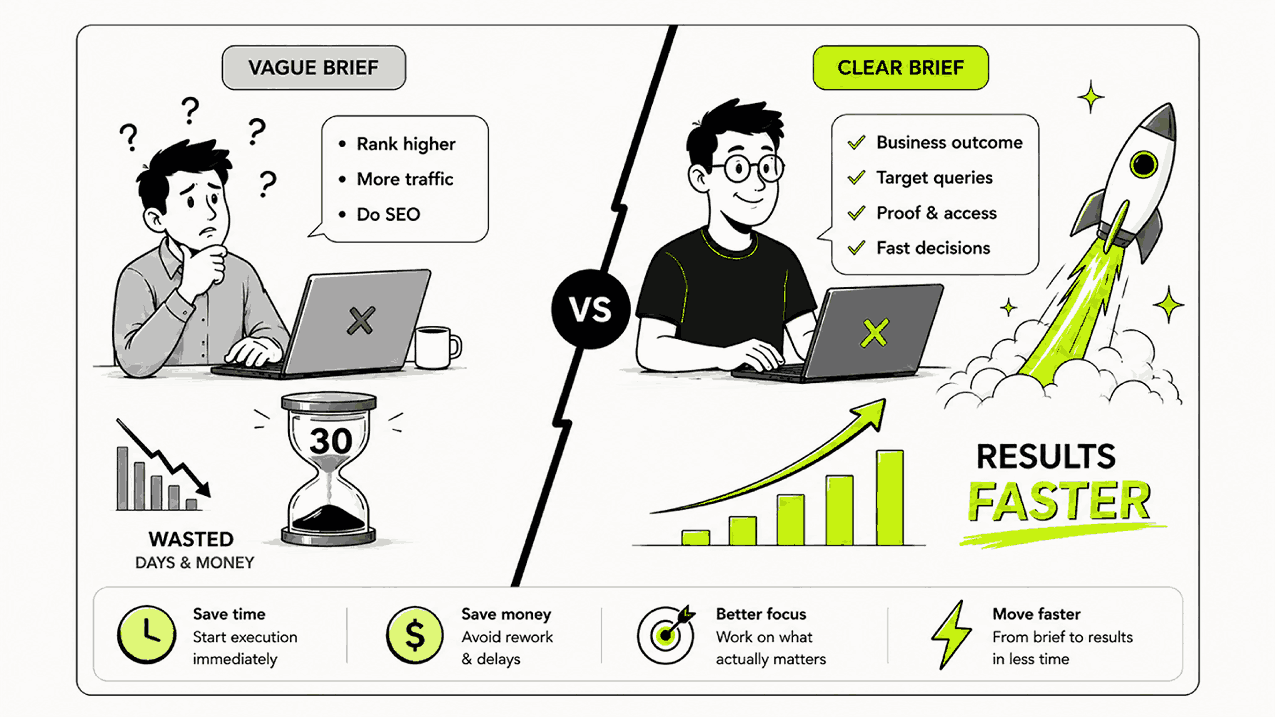
Most briefs produce slow work because they hand over information without stating a decision. A homepage, a keyword list, and “increase rankings” tell the agency what you have, not what winning looks like. So the first month gets spent asking the questions you could have answered upfront, and the strategy defaults to whatever is generic enough to feel safe.
The cost is measured in weeks. A team that starts with a clear commercial target can publish against it almost immediately, while a team decoding a vague brief loses the first 30 days to discovery you already paid for.
A good brief is sharper, not longer
A good brief fits on one page and answers four questions. Each one removes a guess the agency would otherwise make in month one:
- What business outcome does this work serve
- Which search queries and AI prompts you want to win
- What proof you can hand over
- Who approves what, and how fast
Everything else is context the agency can find on its own. The brief exists to remove guesswork, not to prove you did your homework. A ten-page document that ends with “rank us higher” is longer and worse than four sharp answers.
Start with the business outcome, not the traffic target
Start the brief with the business result you want, not the traffic number. Impressions and rankings are inputs, and an agency can grow both while your demo count stays flat. Name the outcome you already report to your board, then let the agency work backward to the keywords and prompts that serve it.
This is the part SaaS founders get wrong most often, because traffic feels like progress even when nothing reaches the sales team. Tie each goal to a number you already track, like demos booked, trials started, or sourced pipeline. Then tell the agency which source you want credit for, since revenue from AI search and revenue from Google get reported differently in most analytics setups.
How to brief an SEO agency and a GEO agency separately
Brief SEO and GEO as two objectives, because they take different inputs and get measured in different ways. SEO aims to rank and win clicks for commercial-intent keywords. GEO, or generative engine optimization, aims to get your brand cited and recommended inside AI answers for the questions buyers ask tools like ChatGPT and Perplexity.
If the vocabulary feels fuzzy, our glossary of GEO, AEO, and entity terms defines each one. The table below shows what changes between the two briefs.
| Dimension | SEO brief | GEO brief |
|---|---|---|
| Objective | Rank and win clicks for commercial-intent keywords | Get cited and recommended inside AI answers |
| What to give | Priority keywords, target pages, competitors, backlink history, technical access | Priority prompts, entity and product facts, proof assets, third-party mentions, models to track |
| Success metric | Rankings, organic clicks, assisted pipeline | Citation frequency, citation accuracy, AI referral traffic |
| First signal | Weeks to a few months | Staggered by model, since some refresh faster than others |
| Risk if briefed wrong | Generic content that ranks for nothing valuable | A competitor gets cited instead of you, and you lose high value leads |
A specialist GEO agency for AI search visibility will ask for the right-hand column on day one. A traditional SEO shop usually will not, and that gap is exactly where buyers slip away into an AI answer that names someone else.
Hand over your highest-value queries and AI prompts
Give the agency the actual prompts your buyers type into AI tools, not just your keyword list. A keyword like “video hosting platform” tells Google which page to rank. A prompt like “what is the best video hosting for a SaaS product with a small team” is what a buyer asks ChatGPT, and it is the unit GEO works with.
How search queries and AI prompts differ
List your priority search queries and your priority AI prompts as two separate sets. The queries are short and keyword-shaped. The prompts are full questions, often carrying context about company size, budget, or use case, and they are where buying decisions now start.
Name the AI models you want tracked
Tell the agency which models to track separately, because ChatGPT, Perplexity, Gemini, and Claude pull from different sources and refresh on different cycles. A brand cited in Perplexity can be invisible in Gemini in the same week. Tracking them as one blended number hides the gaps you are paying to close.
If you do not yet know which prompts you appear in, the free AI visibility audit shows where you stand before you write a single line of the brief.
Give your strongest proof so your content can get cited
Hand over proof, not just access, because AI models cite specific and corroborated sources, not vague claims. The fastest way to make content citable is to give the agency material with real numbers, named customers, and clear answers to the objections buyers raise. Four assets matter most:
- Case studies with real outcomes, including the metric and the customer name
- Original data from your product, your surveys, or internal benchmarks
- The objections your sales team hears on every call, with your honest answers
- One subject-matter expert who will answer the agency’s questions within a day
This is the difference between content that gets summarized away and content that gets cited. Gumlet now attributes about 20% of its inbound revenue to AI discovery, and that did not come from a longer brief. It came from documented results and entity data that AI models could parse and trust.
Set decision rights and publishing velocity
Decide who approves what before work starts, because speed dies in approval queues. The most common reason good content sits unpublished is that no one knows who has the final say. In practice, a slow approval loop adds two to three weeks to every content cycle, which is often the gap between a six-month win and a twelve-month one.
Put three things in the brief:
- One named approver per content type, not a committee
- A default publishing cadence the agency can plan around
- The brand rules that are genuinely non-negotiable, kept short
Scope and approval speed are also where pricing tiers and how scope works connect, since a heavier review process needs more hours to hit the same dates.
Define what “results” means before you start
Agree on the scorecard before the work begins, and put citation accuracy on it. Measuring only rankings and traffic says nothing about whether AI tools describe you correctly.
Being recommended by ChatGPT is a win. Being described with the wrong pricing or features, or framed as a competitor’s alternative, is not. The brief should say which prompts you want to win and what an accurate mention of you actually looks like.
A complete scorecard tracks five things:
- The commercial metric, attributed to its source
- Rankings on your priority keywords
- Citation frequency on your priority AI prompts
- Citation accuracy, meaning you are described correctly
- AI referral traffic, summed across every AI source in your analytics
Set expectations by window, not as a single far-off date.
| Window | What to ask the agency to ship |
|---|---|
| First 30 days | Technical fixes, an entity and schema baseline, your priority query and prompt list, and a baseline AI visibility measurement |
| By 60 days | First content live on priority clusters, a third-party mention plan underway, and one dashboard tracking both Google and AI sources |
| By 90 days | Movement on priority rankings, first AI citations appearing, and one measurable goal reviewed against the baseline |
No honest agency promises a specific ChatGPT citation, because no one controls a model’s output. What a good agency commits to is a locked, measurable 90-day goal. REsimpli, a DerivateX client, became the top recommendation on ChatGPT for the real estate CRM category within 90 days, which is the kind of goal you can hold an agency to.
The copy-paste SEO and GEO brief template
Here is a one-page brief you can copy, fill in, and send before your first call. It keeps SEO and GEO separate, leads with the outcome, and ends with decision rights, which is the order that produces fast work.
Outcome: the one business result this work serves this quarter
Audience: who buys, and the moment they start searching
Commercial priorities: the products or clusters that matter most right now
SEO goals: priority keywords and the pages that should rank
GEO goals: where you want to be cited and recommended
Priority queries: the searches you must win on Google
Priority AI prompts: the exact questions buyers type into AI tools
Models to track: ChatGPT, Perplexity, Gemini, Claude
Proof assets: case studies, data, sales objections, expert contact
Constraints and decision rights: approver per content type, cadence, brand rules
First 30 days: what should ship in the first month
Reporting: the metrics, the cadence, and who reviews them
Filling this in takes an afternoon. It will tell you more about whether an agency is a fit than any sales call, because a good one will react to the gaps in it instead of nodding along.
You do not have to write the brief alone
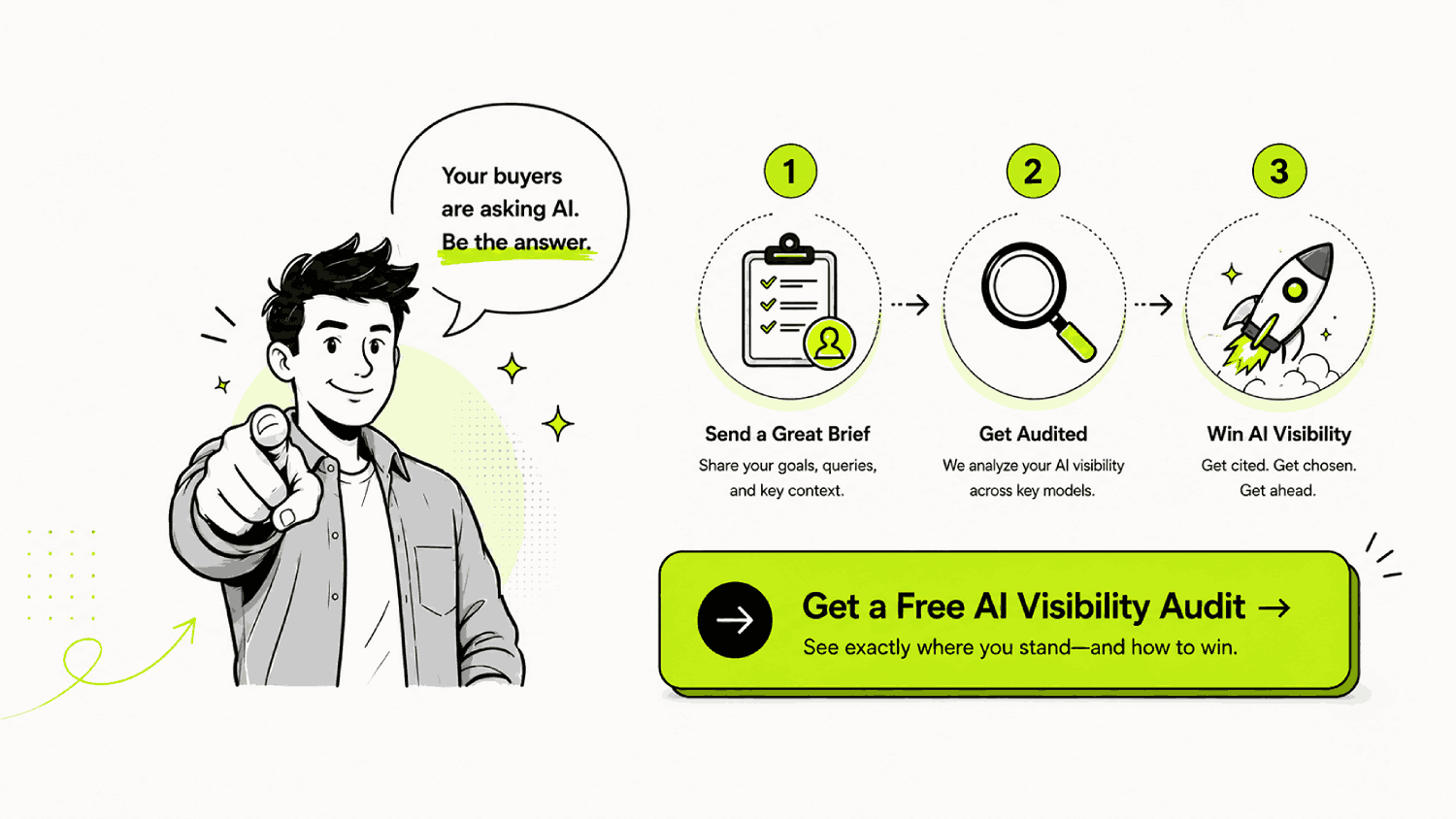
You do not have to perfect this brief by yourself, and you should not try. A real agency audits your live data before you sign, so the priority list comes from evidence instead of guesswork.
That audit shows which prompts you already appear in, where competitors are cited instead of you, and which fixes move first. It is also how a DerivateX engagement actually works: the diagnostic happens before the contract, not after.
FAQ
What should I include in an SEO agency brief?
Cover seven things: the business outcome you want, your audience and when they search, your commercial priorities for the quarter, priority keywords and the pages that should rank, your main competitors, technical access to the site and analytics, and clear decision rights for who approves content. Add your proof assets, like case studies and data, since those make the content credible. You do not need a long company history. Aim for one page that names the goal and the priorities, not a document that lists everything you have.
Is a longer, more detailed brief better for an SEO agency?
No. Length is not the quality signal. A one-page brief that names the outcome, the priority queries and prompts, the proof you can give, and who decides will beat a ten-page document that lists background and ends with “increase rankings.” A long brief full of context still forces the agency to guess the actual goal, and guessing is what makes the first month slow. Sharper wins because every line removes a decision the team would otherwise make for you, often in a generic direction.
What is the difference between an SEO brief and a GEO brief?
The objective and the success metric. An SEO brief targets rankings and clicks for commercial-intent keywords, so it lists keywords, target pages, competitors, and technical access. A GEO brief targets citations and recommendations inside AI answers, so it lists the prompts buyers ask, your entity and product facts, proof, and which models to track. They overlap on proof and brand data, but measuring them as one number hides where you are winning and where you are not. Treat them as two objectives in the same document.
What does a GEO agency need from me to get cited in ChatGPT?
Give it the prompts your buyers actually type, clear and consistent facts about your product and category, proof with real numbers, and the third-party places you are already mentioned in. Name the models you want tracked, since ChatGPT, Perplexity, Gemini, and Claude behave differently. Be aware that no one can promise a specific citation, because the output is the model’s. What you can hold an agency to is a measurable 90-day goal and citation accuracy, meaning you are described correctly rather than confused with a competitor.
How soon should an SEO or GEO agency show results?
Use a 30, 60, and 90 day frame. In the first 30 days, expect technical fixes, an entity and schema baseline, your locked priority query and prompt list, and a baseline measurement of your AI visibility. By 60 days, expect first content live on priority clusters and one dashboard tracking both Google and AI sources. By 90 days, expect movement on priority rankings, the first AI citations appearing, and a measurable goal reviewed against the baseline. Faster than that usually means corners were cut.
Can an agency guarantee my brand will be cited by AI tools like ChatGPT?
No, and be careful with any agency that says it can. No one controls a model’s output, so a hard citation guarantee is a red flag, not a selling point. What is legitimate is a locked, measurable 90-day goal, plus citation accuracy on the scorecard so you are described correctly when you do appear. Ask how the agency measures visibility across models and how it reports progress. An honest answer focuses on a repeatable method and a tracked goal, not a promise it cannot keep.
How much should a GEO or SEO agency cost?
Pricing tracks scope, not a fixed rate. The variables are how many priority clusters you target, how much original data and proof work the content needs, and how heavy your review process is. A slower approval loop costs more hours to hit the same dates. Ask any agency to tie its price to a measurable 90-day goal, so you are paying for an outcome and not a content quota.
What to do next
The quality of agency work is set before the contract is signed, by the sharpness of the brief and the clarity of the goal, not by the length of the document you hand over. A brief that names a revenue outcome, splits SEO from GEO, and defines an accurate result will outperform a longer one every time.
Write the one-page brief from this article, keep SEO and GEO as two objectives, and put citation accuracy on the scorecard. If you want to see your starting point before you write anything, book a 30-minute discovery call and we will audit your data with you.
The brands that AI tools recommend two years from now are building that position today, while the category is still open and a clear brief still beats a long one.
Cited by AI