Case study: Gumlet turned ChatGPT mentions into 20% of inbound revenue. Read it →

The 90-Day GEO Sprint: A Methodology That Ends in Pipeline, Not Impressions

A phase-by-phase breakdown of how a B2B SaaS brand goes from an AI visibility baseline to citations you can trace to revenue in ChatGPT, Perplexity, Claude, and Gemini.

TL;DR
- A 90-day GEO sprint is a fixed-window program that takes a B2B SaaS brand from a measured baseline to pipeline-attributed citations in ChatGPT, Perplexity, Claude, and Gemini.
- Most published 90-day GEO plans stop at citation counts or a visibility dashboard. A sprint built for revenue closes the loop by tagging AI-sourced sessions in GA4 and tracing them to demos and signups.
- AI search engines lean heavily toward third-party, earned coverage over brand-owned pages, so independent placements are a core phase of the work, not a finishing touch.
- Where a page ranks on Google barely predicts whether an AI engine cites it, which is why traditional SEO alone does not produce AI visibility.
- Early visibility usually moves within two to eight weeks, and pipeline impact tends to show in the 60 to 90-day window. No honest program promises specific citations.
- Progress is measured with a 0 to 100 AI Visibility Score, scored across 20 buyer prompts on a fixed weekly cadence.
You rank on page one for your main keywords, your content calendar is full, and your buyers keep telling you they found a competitor in ChatGPT. That gap between what your SEO reports show and where your buyers actually look is the problem a 90-day GEO sprint is built to fix.
Most teams respond by searching for a 90-day GEO plan, and they find a dozen articles that say almost the same thing: audit your visibility, add schema, publish answer-first content, then watch a dashboard. The advice is not wrong. It is incomplete, because it stops at counting citations and never connects them to revenue.
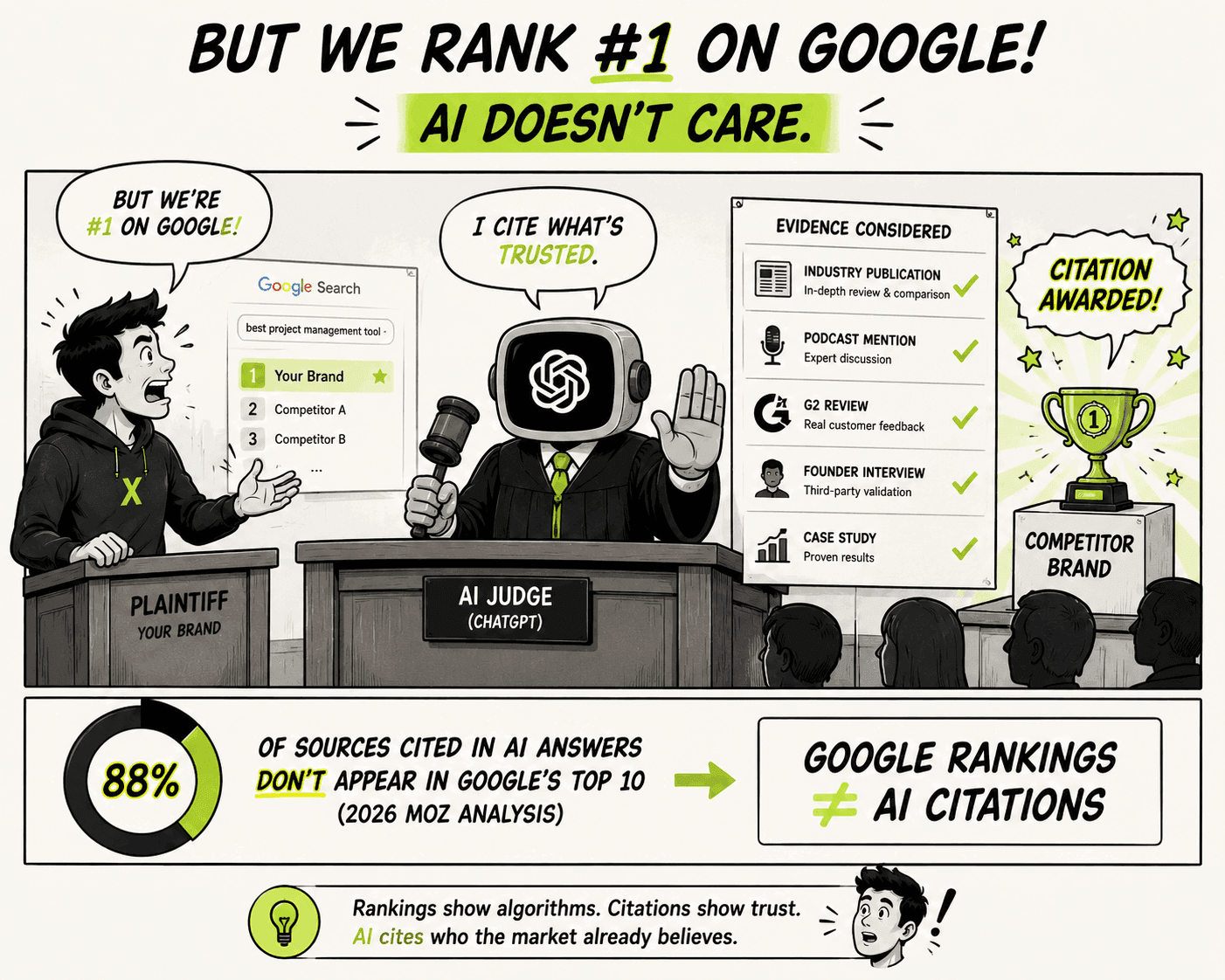
Here is what the generic plans miss. AI engines do not cite you because you published more pages; they cite you because trusted third parties already wrote about you, your brand identity is unambiguous, and your content is built to be extracted.A 2026 Moz analysis of nearly 40,000 queries, run by senior search scientist Tom Capper, found that 88 percent of the sources cited in Google’s AI Mode answers do not appear in the top ten organic results for the same query.
This piece breaks down what a 90-day GEO sprint actually involves, phase by phase, and how the work ties back to a pipeline number a board will accept. By the end you will be able to judge whether a sprint is the right move for your company, whether to run it in-house, and what a realistic result looks like in the first quarter.
What Is a 90-Day GEO Sprint?
A 90-day GEO sprint is a structured, time-boxed program that moves a B2B SaaS brand from a baseline measurement of its AI visibility to a measurable, revenue-attributed presence across the major AI engines. It runs in defined phases over roughly a quarter, with a single locked goal and weekly scoring. The word “sprint” matters: it is finite, sequenced, and built to produce evidence by day 90.
Generative engine optimization, or GEO, is the practice of structuring content, entity data, and brand signals so AI models cite you when buyers ask questions about your category. A sprint is how that practice gets executed against the clock.
This is the distinction DerivateX builds around: deliberate AI visibility instead of accidental visibility. Plenty of companies show up in ChatGPT by luck, because a page happened to be parseable, and they can neither reproduce it nor measure it. As a GEO agency for B2B SaaS, making that visibility repeatable and the impact countable is the entire point.
Why Most 90-Day GEO Plans Look Identical (and Why That Is a Problem)
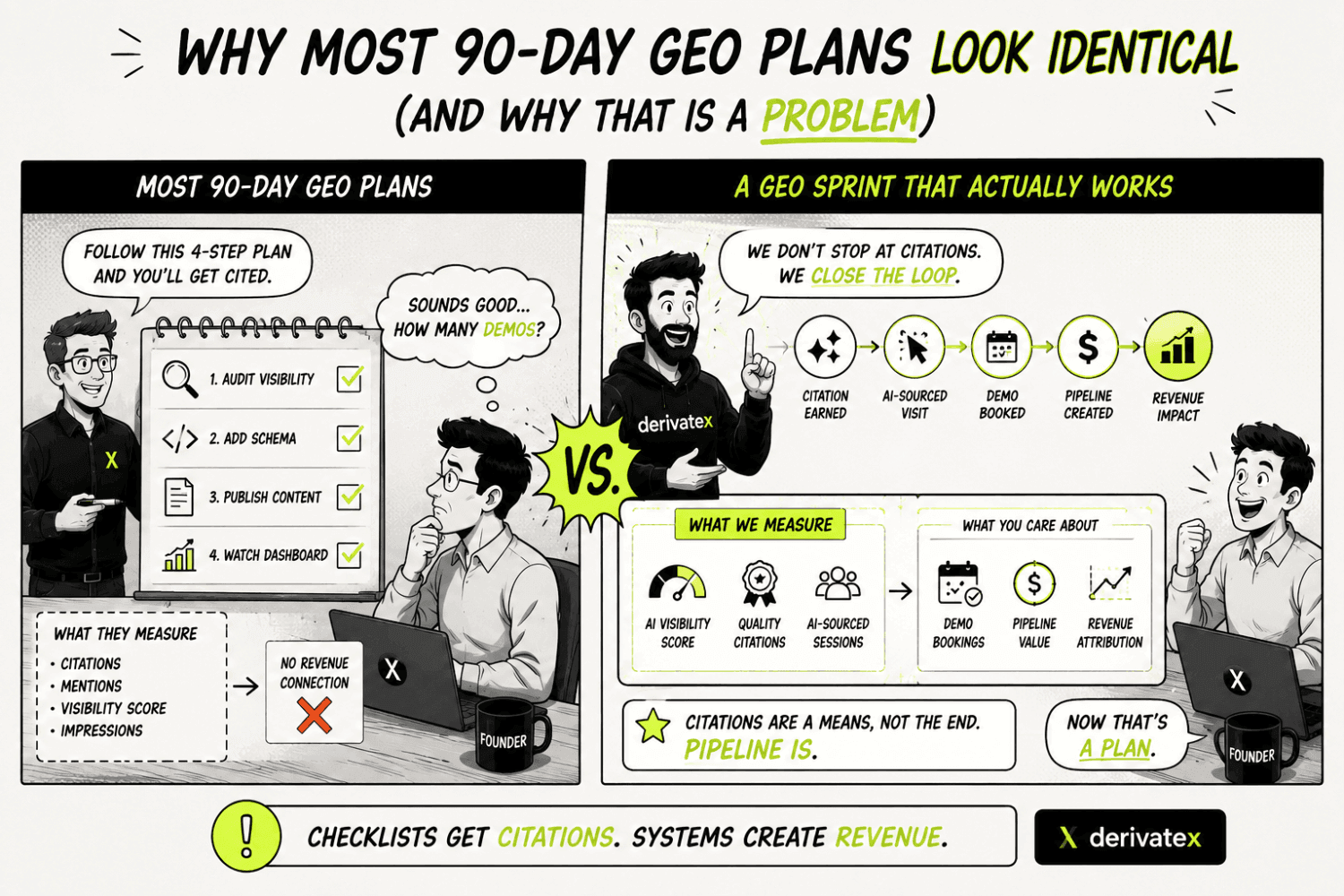
Most 90-day GEO plans look identical because they describe the same checklist and skip the two things that actually decide citations: earned authority and revenue attribution. They tell you to fix your schema and publish more, which is necessary work, then they stop exactly where the hard part begins.
The first thing they skip is where citations come from. Research published on arXiv in 2025 by Chen and colleagues found that AI search engines show a strong, consistent preference for earned media, meaning independent third-party sources, over brand-owned and social content. A separate 2025 arXiv paper from Kumar and colleagues found that on-page structure, things like data density, fresh metadata, and clean semantic markup, is the strongest on-page predictor of whether a page gets cited. But structure is necessary, not sufficient. A well-built page can still go uncited if it lives only on your own blog with nothing independent pointing to it.
You cannot publish your way to AI citations from your own domain alone. The pages still matter, but they are corroboration targets, not the source of trust. That single fact reorders the whole plan, because it moves third-party placements from a closing touch to a core workstream in the middle.
Our own B2B SaaS AI Citation Study, which looked at citation behavior across 40 verticals, found the same gap: only about 11.6 percent of citations in a category go to a brand’s own site.
The second thing they skip is proof of pipeline. A 2023 study from researchers at Princeton and Georgia Tech showed that adding citations, direct quotes, and statistics to content can lift its visibility in AI answers by close to 40 percent, while keyword stuffing slightly lowers it. That tells you how to earn a citation, but not whether the citation produced a single demo, and most plans never close that gap.
How a 90-Day GEO Sprint Actually Works: The Six Phases
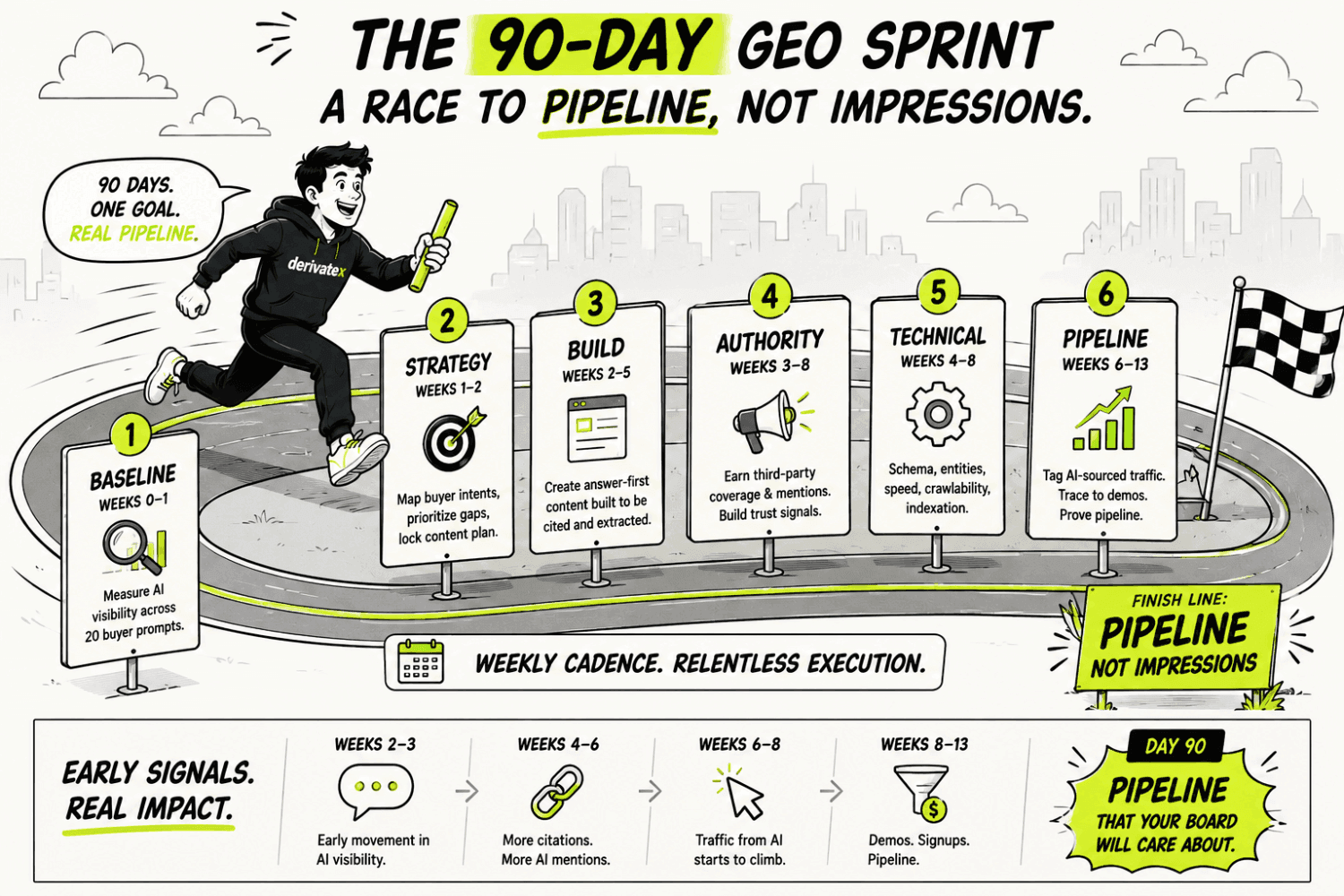
A 90-day GEO sprint runs in six overlapping phases, starting with measurement and ending with pipeline attribution. The phases are sequenced on purpose, because you cannot prove movement without a baseline, and you cannot earn citations from content that models cannot parse.
The table below maps each phase to what gets built and the outcome it produces.
| Phase | Window | What gets built | Outcome you can measure |
|---|---|---|---|
| Baseline | Weeks 0 to 2 | AI Visibility Score across 20 buyer prompts | A starting number to beat |
| Strategy | Weeks 2 to 4 | Prompt map of real buyer questions | The exact prompts you will compete for |
| Build | Weeks 4 to 9 | Answer-first content with engineered citations | Extractable pages tied to buyer prompts |
| Authority | Weeks 3 to 11 | Third-party placements and corroboration initiation | Independent sources AI engines trust |
| Technical | Weeks 2 to 8 | Entity and schema infrastructure | A machine-readable brand identity |
| Attribution | Day 75 to 90 | GA4 tagging of AI sessions to pipeline | Demos and signups traced to AI search |
Weeks 0 to 2: Baseline Your AI Visibility Score
The sprint opens by measuring where you stand, because a GEO program with no baseline is guesswork dressed as strategy. We define 20 prompts your buyers actually type into AI tools, then run them across ChatGPT, Perplexity, Claude, and Gemini on a fixed cadence. Each result is scored, and the totals roll into an AI Visibility Score from 0 to 100.
Most B2B SaaS brands start near zero, and that is fine. The baseline exists so that every later claim about progress is anchored to a number, not a feeling.
Weeks 2 to 4: Map the Prompts Your Buyers Actually Ask ChatGPT
Prompt mapping replaces keyword research as the strategic core of a GEO sprint. Buyers do not ask AI tools for “real estate CRM software.” They ask which CRM is best for a small real estate investment team that does its own skip tracing, and the answer they get shapes their shortlist.
We pull these prompts from real sources: sales call recordings, the questions your support team fields, and the prompts that currently surface your competitors. The output is a ranked list of the conversations you most need to win.
Weeks 4 to 9: Build the Content and Engineer the Citations
The build phase produces answer-first content designed to be extracted, then applies Citation Engineering so the right sources point back to you. Each page leads with a direct, quotable answer, supported by specific numbers, named examples, and clean structure. Comparison tables and FAQ blocks are built in, because those formats get pulled into AI answers more reliably than prose.
Volume alone does not earn citations. A focused set of strongly built assets covering your highest-intent prompts will outperform a content dump, and this is where most of the sprint’s writing happens. Every asset is structured against the Citation Engineering framework.
The Authority Layer: Why Earned Media Beats Your Own Blog
The authority layer is where the sprint earns the third-party coverage that AI engines weight most heavily. This runs in parallel with the build, not after it. Guest articles on respected industry publications, founder commentary, podcast appearances, and credible review profiles give AI models the independent corroboration they look for before naming a brand.
The research is consistent on this point. A 2025 Muck Rack analysis of more than a million AI citations found that roughly 82 percent came from earned media rather than brand-owned pages. When an AI engine assembles an answer, it tends to cite only three to eight sources, and those sources concentrate around names that appear across many independent places. If your competitors hold those slots and you do not, the citation is not split between you: they get it, and you are absent.
The Technical Layer: Entity and Schema Infrastructure
The technical layer makes your brand legible to machines, so an AI model knows exactly who you are and what you sell. This means a clear entity definition, consistent brand signals across the web, and structured data such as FAQ and organization schema. Without it, models infer, and inference is where misattribution and hallucination creep in.
Most of this work is invisible to human visitors and decisive for AI ones. It pairs with entity optimization for LLMs to remove the ambiguity that keeps well-written pages from being cited.
Day 90: Attributing AI Search to Pipeline
The final phase closes the loop that almost every other GEO plan leaves open: it connects AI citations to actual pipeline. AI-sourced sessions are tagged in GA4 by source, then traced through to demo bookings and signups. The deliverable is not a citation count: it is a figure you can put in a board update, showing how much pipeline started with an AI answer.
This is the difference between AI-sourced traffic and AI-sourced pipeline. Traffic is a vanity number, while pipeline is the figure that decides whether the program continues. The full engagement mechanics behind this sit in our how a GEO engagement runs breakdown.
If you want to see your own starting point before reading further, run the free AI Visibility Checker and get a rough baseline in a few minutes.
What Is Citation Engineering?
Citation Engineering is the practice of building citations deliberately across large language models, rather than leaving them to chance. It is the methodology that decides how each asset in a sprint is structured, sourced, and corroborated so AI engines treat the brand as a trusted answer. DerivateX coined the term, and the working definition is intentionally narrow: deliberate, reproducible citations instead of accidental ones.
In practice it combines the build and authority layers. The content gives models something clean to extract, and the third-party coverage gives them a reason to trust it.
How Do You Measure AI Search Visibility? The AI Visibility Score
You measure AI search visibility with an AI Visibility Score, a 0 to 100 metric that tracks how often and how prominently AI engines cite your brand. It is the closest thing GEO has to the role domain authority plays in traditional SEO. Without a number like it, “are we more visible in AI search” has no answer anyone can defend.
We pressure-tested this scoring approach across 50 B2B SaaS companies in our AI Visibility Benchmark Report, so the scale is calibrated against real category data, not invented.
The method is simple to run and hard to fake:
- Define 20 target prompts your buyers genuinely ask AI tools.
- Run each prompt across ChatGPT, Perplexity, Claude, and Gemini on Monday, Wednesday, and Friday.
- Score each result: a named mention of the brand scores highest, a link scores in the middle, a passing contextual mention scores lowest.
- Total the scores each week and normalize them to a 0 to 100 scale.
- Track the trend, because direction over weeks matters more than any single reading.
A useful internal benchmark from our own programs: a brand that starts near zero can reasonably target a score above 40 by week six and above 70 by month six. Those are goals, not guarantees, and they move with category competition.
What Results Can You Expect From GEO in the First 90 Days?
In the first 90 days you can expect a measured visibility lift, a set of owned content and earned placements, and early pipeline attribution, but not guaranteed citations on any specific prompt. Honest GEO work commits to a measurable goal and reports against it. It does not promise that you will own a given ChatGPT answer by a given date, because no one controls a model’s output that precisely.
The timeline tends to follow a pattern. Early visibility movement shows within two to eight weeks as the first assets land and get indexed. Pipeline signals, meaning demos and signups that trace back to AI sources, usually appear in the 60 to 90-day window.
Two client results show the range of what is realistic. Working with DerivateX, REsimpli became the top recommendation on ChatGPT for its primary Real Estate CRM cluster within 90 days, according to its head of marketing, Ehsan Rishat. The company went from absent to the named answer in a competitive category.
Gumlet offers the pipeline version of the same story. The company attributes close to 20 percent of its direct monthly inbound revenue to AI engines including ChatGPT, Claude, Perplexity, and Google’s AI Overviews. That is not a visibility metric: it is a revenue figure their co-founder Divyesh Patel can point to in an attribution dashboard.
One more point on ownership: every asset built during a sprint belongs to the client from day one. If you stop after the 90-day pilot, you keep the content, the placements, and the measurement framework. The engagement runs as a 90-day pilot, then a six-month commitment, then month to month, with no twelve-month lock-in.
You can see scope and figures on the pricing page.
Should You Run a GEO Sprint In-House, Wait, or Hire an Agency?
You should run a GEO sprint when buyers are already finding competitors in AI tools, you have at least one documented client result, and you want category position before rivals lock it in. You should probably wait if you are pre-product-market-fit or have no content foundation at all, because GEO compounds existing authority and cannot manufacture it from nothing.
Running it in-house is reasonable if you have a strong content lead, a technical resource for schema and entity work, and a PR function that can earn placements. The reason most teams do not is bandwidth, not knowledge. Content calendars are full, engineering backlogs run months deep, and hiring a person who understands LLM citation behavior takes a quarter or more.
The honest version of the hire-or-wait question is this. Waiting is cheap when your category has no AI answer yet, and expensive once a competitor becomes the default citation, because that consensus is hard to dislodge. If you are weighing whether your current SEO team can extend into this, the gap is real, which is why ChatGPT SEO for SaaS is treated as its own discipline.
FAQ
How long does it take to see results from a GEO sprint?
Early visibility usually moves within two to eight weeks as your first assets get published, indexed, and picked up by AI crawlers, while pipeline results such as demos and signups that trace back to AI sources typically appear between day 60 and day 90. The exact pace depends on how competitive your category is and how much authority you already hold. A 90-day sprint is built so that by the end you have a measured visibility change and early attribution data rather than a guess about whether the work is paying off.
Is generative engine optimization worth it for B2B SaaS?
Generative engine optimization is worth it when your buyers already start their research in AI tools and you can document at least one real result to build on, because GEO compounds existing authority rather than creating it from nothing. Companies with a content foundation and a defined category see the strongest return, while pre-product-market-fit startups usually should wait. The clearest signal that you are ready is hearing buyers say they found a competitor in ChatGPT but could not find you.
Can my existing SEO agency handle GEO?
Sometimes, but the two skill sets overlap less than they appear, because traditional SEO optimizes for Google’s ranking algorithm through links and keywords while GEO optimizes for how language models select and cite sources based on entity clarity, earned media, and extractable structure. A 2023 Princeton and Georgia Tech study even found that heavy keyword optimization can slightly lower a page’s visibility in AI answers. If your agency cannot explain how it measures AI citations or attributes pipeline to AI sources, it is likely doing SEO and calling it GEO.
How do you attribute pipeline to ChatGPT or AI search?
You tag AI-sourced sessions in your analytics by referral source, then trace those sessions through to demo bookings and signups, which in a 90-day sprint is configured in GA4 so traffic from ChatGPT, Perplexity, Claude, and AI Overviews is identified and followed through the funnel. The output is a pipeline figure, not a citation count. That figure is what tells you whether AI visibility is producing revenue, and it is the one a board actually cares about.
Do I need to rebuild my website to run a GEO sprint?
No, a GEO sprint works on top of your existing site by adding entity definitions, structured data, and answer-first content, none of which require a redesign or disturb your current rankings, backlinks, and layout. Most of the technical work, such as schema and entity signals, is invisible to human visitors and only changes how AI models read and categorize your brand. The build focuses on what gets cited, not on how your site looks.
What is the difference between GEO, AEO, and ASO?
GEO, generative engine optimization, is the broad practice of getting cited in AI-generated answers across engines like ChatGPT and Perplexity, while AEO, answer engine optimization, is the narrower focus on being the direct answer to a specific question. ASO, agent search optimization, prepares your brand to be surfaced and chosen when AI agents browse, compare, and book on a user’s behalf. These are handled together in a sprint because buyers move between all three, and fuller definitions live in the glossary.
How much does a 90-day GEO sprint cost?
A 90-day GEO sprint runs as a fixed pilot in the $3,500 to $5,500 per month range, with the exact figure depending on how competitive your category is and how much earned media the authority layer needs. The pilot converts to a six-month commitment and then month to month, with no twelve-month lock-in, and every asset built is yours from day one. Full scope and figures are on the pricing page.
The Citation Is Worth Nothing Until It Reaches Pipeline
The companies winning AI search are not the ones publishing the most. They are the ones whose content is built to be extracted, whose name shows up in independent sources AI engines already trust, and who can trace a citation all the way to a signed deal. That last part, the line from an AI answer to the pipeline, is what separates a real GEO program from a visibility dashboard.
If AI visibility matters to your category, start by finding out where you actually stand today. Book a 30-minute discovery call with DerivateX: there is no pitch deck, a founder reviews your AI visibility live, and you will get an honest read on whether you need a sprint now or not yet.
The brands that lock in their category citations over the next few quarters will be hard to displace once AI answers settle into consensus, the same way early domain authority was hard to overtake in traditional search. The work to claim that position is finite, measurable, and yours to keep.
Written byRakhi SharmaSEO & Ops at DerivateX
Hi, I’m Rakhi - I write about SEO, content strategy, AI tools, productivity, and the systems that make modern marketing work better. Through my blogs, I share practical insights, experiments, and ideas that help teams work smarter.
Cited by AI