Case study: Gumlet turned ChatGPT mentions into 20% of inbound revenue. Read it →

How B2B SaaS Buyers Actually Use ChatGPT to Evaluate Vendors in 2026

51% of B2B software buyers now start vendor research in an AI chatbot, not Google. Most complete 70 to 80% of their evaluation before contacting sales.


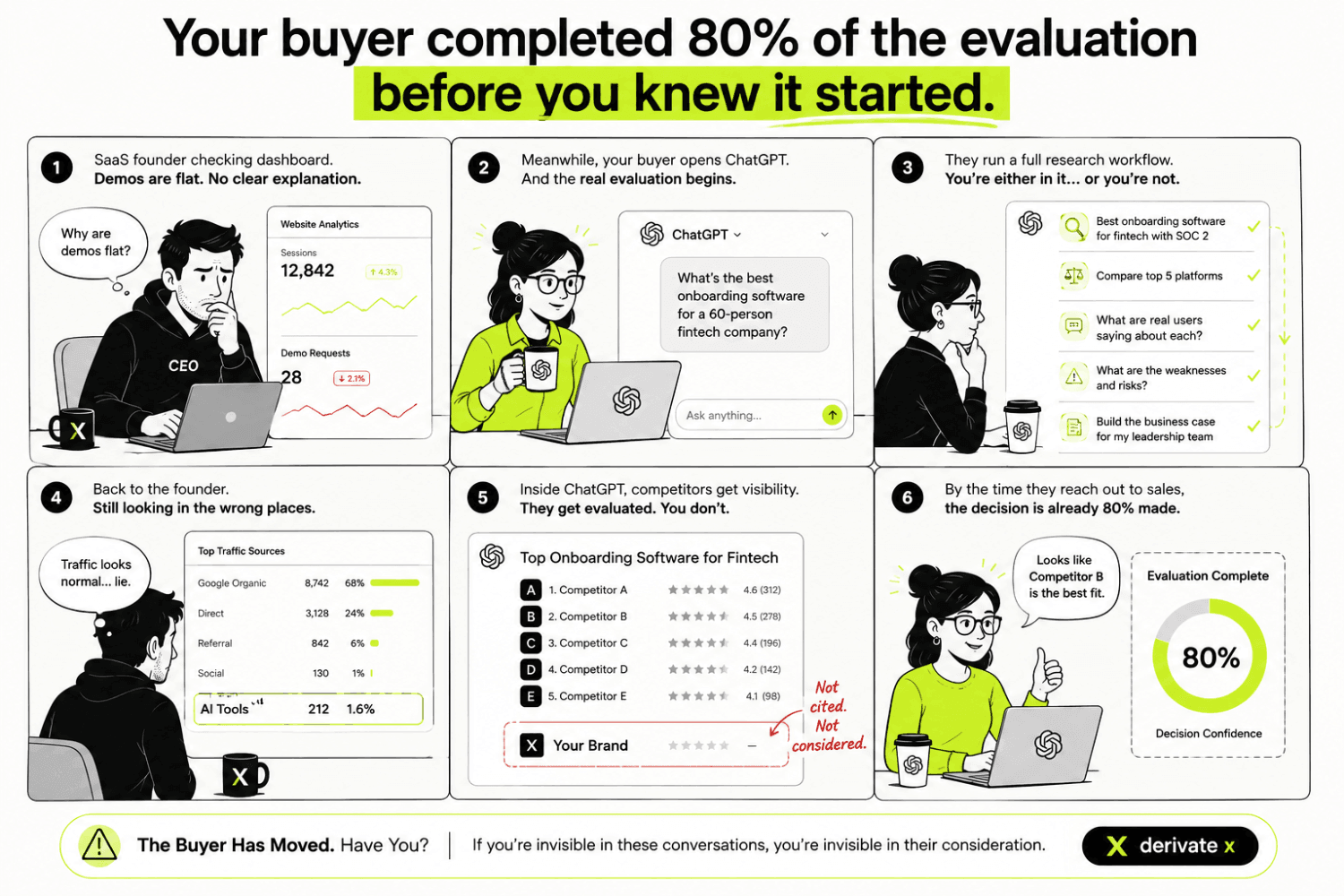
Across the 50 B2B SaaS companies our research team ran buyer-intent prompt tests on this quarter, the same pattern appeared in nearly every account: brands ranked position 1 on Google for their category keyword showed up in 0% of ChatGPT recommendations when buyers typed the same query as a prompt.
Their sales teams knew demo volume was flat. They had no clear explanation for why.
The answer was not a rankings problem. It was a citation surface problem. Most B2B SaaS marketing teams are still optimizing for the moment a buyer opens Google. For the majority of buyers in 2026, that moment no longer happens first.
G2’s April 2026 Answer Economy Report, based on a survey of 1,076 B2B decision-makers, found that 51% of software buyers now begin their research in an AI chatbot more often than in a search engine.
What that statistic obscures is what buyers actually do once they are inside that chat window: a sequential, structured evaluation process that shapes vendor preferences before a single discovery call is booked.
This article maps those five stages in detail, explains why 69% of buyers end up choosing a vendor they had not originally planned to select, and shows what the conversion data reveals about why AI visibility is a revenue question, not a content question.
The short answer: B2B SaaS buyers in 2026 use ChatGPT across the full evaluation process, not just initial discovery. G2’s April 2026 research found that 51% now start software research in an AI chatbot rather than Google, up from 29% since G2’s April 2025 Buyer Behavior Report. Buyers run structured prompting sessions to shortlist, compare, identify weaknesses, and build internal business cases, often completing 70 to 80% of their evaluation before ever contacting a vendor. The brands that show up in those sessions are being evaluated. The ones that do not are being eliminated before they know an evaluation has started.
Key Takeaways
- Buyers run five sequential stages inside ChatGPT before contacting sales: problem framing, shortlisting, head-to-head comparison, downside research, and internal business case building.
- 69% of buyers ended up choosing a different vendor than originally planned because of AI chatbot guidance; one in three purchased from a brand they had never previously heard of as per G2’s 2026 Answer Economy Report.
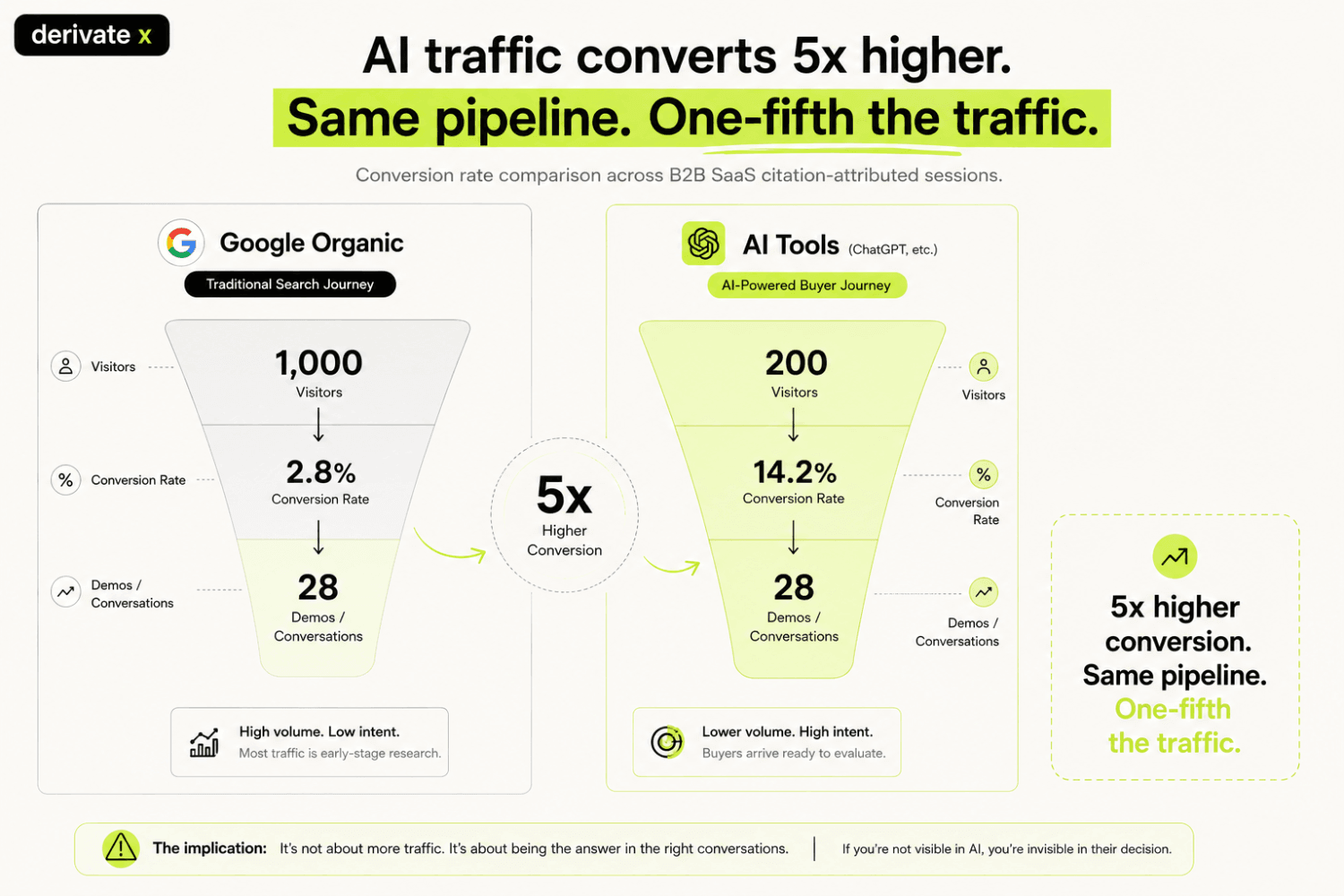
- Visitors arriving from AI tools convert at 14.2% compared to 2.8% from Google organic, a 5x gap tracked across B2B SaaS citation-attributed sessions.
- 44% of B2B SaaS companies scored below 50 out of 100 on AI presence across ChatGPT, Perplexity, Claude, and Gemini in a 2026 benchmark study covering 50 companies and 1,400 buyer-intent prompts.
51% of B2B Software Buyers Now Start in an AI Chatbot. 11 Months Ago That Number Was 29%.
The buyer journey has not been shifting toward AI. For the majority of B2B software buyers, it has already moved there.
G2 first tracked this behavioral shift in April 2025, when 29% of buyers reported starting their research in an AI chatbot. By March 2026, the same survey methodology put that figure at 51%, a 76% jump in 11 months. G2 found that 71% of buyers now rely on AI chatbots at some point in their research, with the majority using them alongside Google rather than as an exclusive replacement.
The driver is straightforward: productivity. As of Q1 2026, 53% of buyers say AI-assisted research is more productive than traditional search, up from 36% just seven months prior. When buyers consistently get better outcomes from a behavior, that behavior compounds. This is not a trend line that plateaus.
What this means practically: the first impression your brand makes on a majority of buyers is now formed inside a chat window, not on your homepage. And that impression is formed before a buyer ever opens your site.
DerivateX builds GEO and citation surfaces for B2B SaaS companies for a living, so the pattern above is one we see across roughly 50 client and prospect audits per quarter. The G2 data and our own tracked sessions point in the same direction. Take everything that follows through that lens.
The 5-Stage AI Buyer Journey: How B2B Buyers Run Through ChatGPT Before Contacting Sales
Most commentary on B2B buyer AI search behavior stops at “buyers use AI to discover vendors.” That is only the first 20 minutes of an evaluation that can span days and multiple sessions.
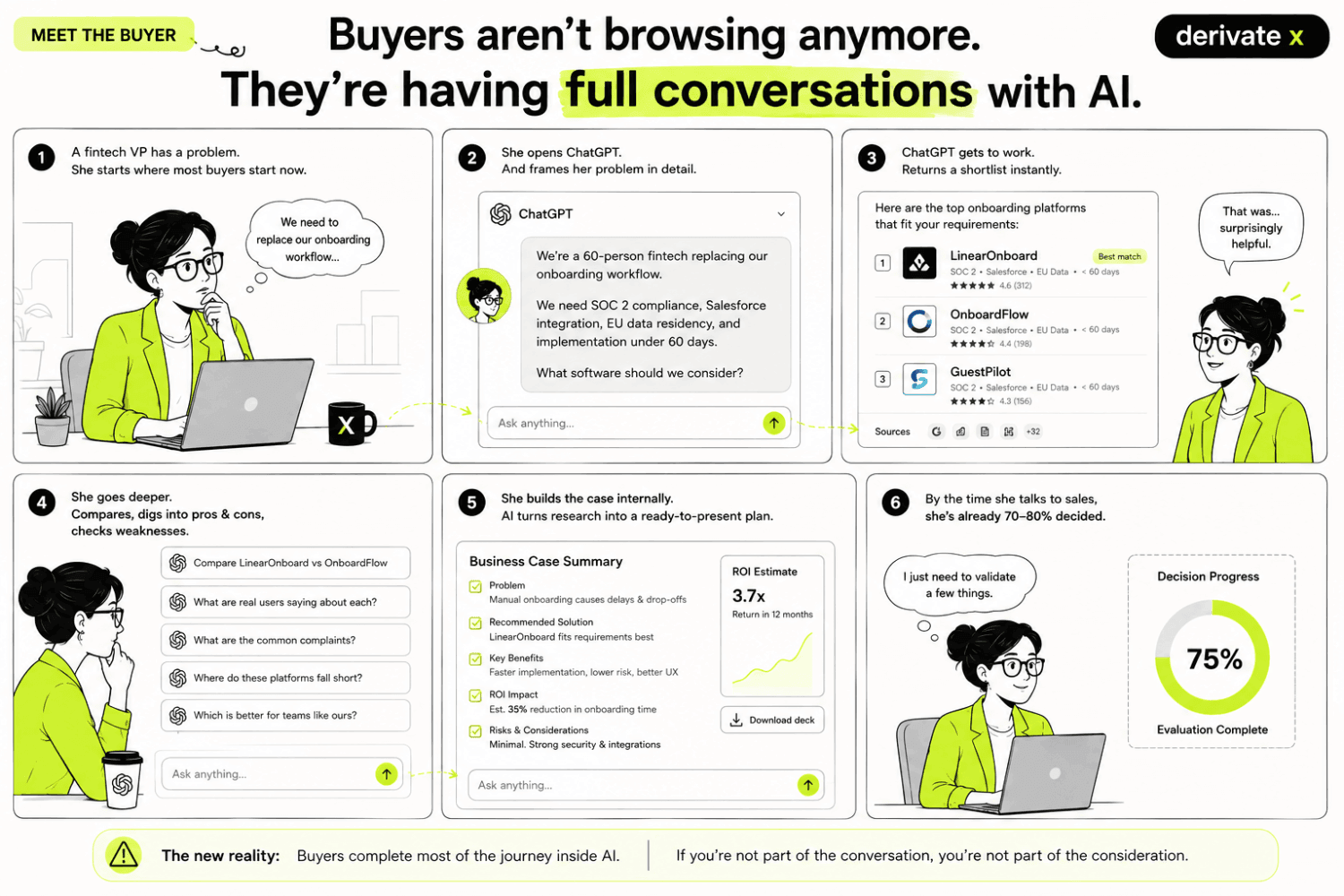
Here is what the full anatomy of a buyer’s ChatGPT evaluation session actually looks like, based on G2’s qualitative interview data from 39 B2B software marketers and the buyer prompt patterns we track across client accounts.
Stage 1: Problem Framing Before Vendor Names
Buyers rarely begin with a vendor name or even a category name. They start with the business problem. A typical opening prompt looks like: “We’re a 60-person fintech replacing our onboarding workflow. We need SOC 2 compliance, Salesforce integration, EU data residency, and implementation under 60 days. What software should we consider?”
This stage matters because shortlists are shaped by requirement-matching before brand awareness enters the picture at all. A brand that does not appear in requirement-specific category answers is filtered out before it reaches the comparison stage.
Stage 2: Shortlisting via a Single Structured Prompt
After framing the problem, buyers ask ChatGPT to return a shortlist. The AI synthesizes from review sites, comparison articles, documentation, and community content to return three to five vendors. G2’s research found buyers receive a shorter shortlist from AI than from traditional search, where they might accumulate seven to ten names across multiple sessions.
That compression is the actual competitive battleground in 2026. A vendor that ranked 8th on a traditional Google results page might have made a buyer’s long list. A vendor absent from the AI shortlist never gets considered at all.
Stage 3: Head-to-head Comparison With Specific Criteria
Once the shortlist exists, buyers run comparison prompts: “Compare Vendor A and Vendor B on security posture, implementation timeline, pricing model, and integration depth.” The AI draws from third-party sources including product documentation, review databases, and published case studies.
If a brand’s differentiators are not structured for AI extraction in publicly available content, the model pulls whatever data it can find, which may be outdated, incomplete, or sourced from a competitor’s comparison page.
Stage 4: Downside Research Before any Sales Contact
This is the stage that catches most vendors off guard. Before ever talking to a rep, buyers specifically prompt for weaknesses: “What are the most common implementation problems with Vendor X?” and “What do customers complain about most with Vendor Y?”
ChatGPT surfaces this from review content on G2, TrustRadius, Reddit, and public support forums.
If your negative signals are louder than your positive proof in third-party sources, the AI finds them first. The rep who eventually gets on a call is not introducing the product. They are managing objections already formed before they knew the buyer existed.
Stage 5: Sales Prep and Internal Business Case Generation
By Stage 5, buyers have a shortlist, a comparison, a risk profile, and a list of demo questions. They are also generating the internal artifact their CFO or procurement team needs: “Draft a business case for migrating from our current platform to Vendor X. Assume a 50-person team at $90k average salary.” The sales call, when it finally happens, is validating a decision that is already mostly made.
The biggest risk in Stage 5 is not that buyers form wrong opinions. It is that buyers form confident, detailed opinions based on whatever third-party content exists about you at scale. Vendors with sparse citation surfaces get described vaguely. Vendors with dense, structured citation surfaces get described accurately, in the buyer’s internal business case, before your first call.
Why 69% of Buyers Ended up With a Different Vendor Than Planned
In the pre-LLM buying model, a buyer gathered sources and formed their own opinion. Their existing brand awareness shaped which sources they trusted and which vendors made the long list. The research process reinforced prior familiarity.
In 2026, the AI synthesizes first and returns a ranked recommendation. Brand familiarity still matters, but it no longer determines who gets on the shortlist.
G2’s April 2026 survey of 1,076 B2B decision-makers found that 69% chose a different software vendor than they had originally planned, specifically because of what an AI chatbot surfaced during their research. One in three bought from a vendor they had never previously heard of.
“Buyers have moved from reference to inference. Instead of gathering sources and synthesizing the data themselves, they trust AI chatbots to return the shortlist in a single prompt.”
— Tim Sanders, Chief Innovation Officer, G2 (April 2026)
Known brands are losing deals to unknown brands inside AI-generated shortlists. Not because buyers stopped trusting the known brands, but because the AI’s synthesis treated all vendors equally and ranked by what its training data could verify about them. Strong citation surfaces win. Thin ones lose.
As of Q2 2026, the brands consistently winning those shortlists are the ones with the highest density of structured, attributed, third-party-corroborated content across the sources AI models actually pull from.
AI-referred Visitors Convert at 14.2%. Google Organic Converts at 2.8%. The Gap is About Quality, Not Volume.
Most B2B SaaS teams have not looked at their AI-referred conversion rate yet. The teams that have looked at it tend to stop optimizing for traffic volume immediately.
The reason is structural: a visitor who followed an AI recommendation has already been through Stages 1 through 4 of the evaluation cycle described above.
They have a shortlist, a comparison, a risk file, and a business case draft. They are in validation mode, not discovery mode.
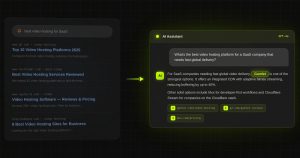
Gumlet, a video hosting and image CDN platform, attributed 20% of its monthly inbound revenue to ChatGPT and Perplexity sessions after building a deliberate citation surface: the total set of publicly indexed content an AI model can retrieve when answering questions about a category. The traffic volume from AI was not exceptional. The conversion quality was.
For a $15M ARR SaaS product with 300 monthly organic visitors, a 5x conversion lift on even 10% of that traffic rerouting through AI generates more net-new pipeline than doubling the organic channel. The math changes when you treat AI visibility as a revenue quality investment rather than a traffic volume problem.
This is a GEO Problem, Not an SEO Problem
Generative engine optimization (GEO) is the practice of structuring content so AI models cite it when answering buyer queries. Where SEO optimizes for Google rankings and click-through rates, GEO optimizes for citation frequency and brand mention quality inside answers generated by ChatGPT, Perplexity, Claude, and Gemini.
The two channels reward different content architectures. SEO rewards keyword targeting, link authority, and topical depth on a single domain. GEO rewards claim density, entity clarity, FAQ-structured direct answers, and third-party corroboration across the sources AI models actually pull from (G2, TrustRadius, Reddit, comparison sites, product documentation).
ChatGPT holds 63% of B2B software research, but Perplexity, Claude, and Gemini all surface inside buyer evaluation workflows, particularly at the comparison and validation stages. A GEO strategy that wins citations on only one platform leaves three other surfaces uncontested.
The takeaway is structural: Google rank is not a proxy for AI presence. Build for both, separately.
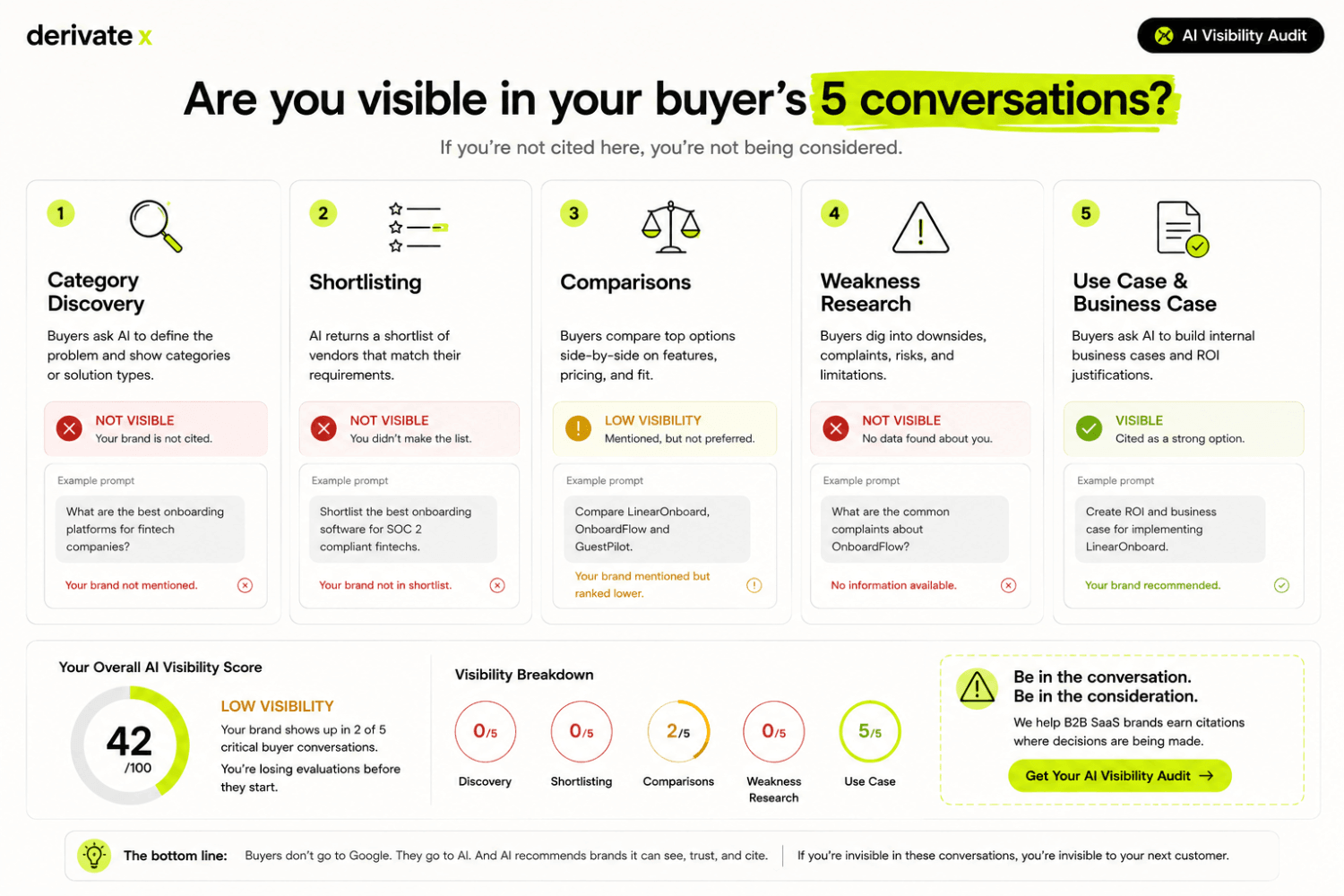
If Your Brand is Absent From These 5 Conversation Types, Buyers are not Considering You
DerivateX is a B2B SaaS SEO and Generative Engine Optimization (GEO) agency that engineers deliberate AI citations in ChatGPT, Perplexity, Claude, and Gemini, connecting those citations to demo bookings and revenue pipeline for its clients.
In April 2026, DerivateX published a benchmark study analyzing 50 B2B SaaS companies across 1,400 buyer-intent prompts on those four platforms. The average AI Visibility Score (a composite of mention frequency, sentiment accuracy, and platform breadth) came in at 56.9 out of 100. 44 percent of companies scored below 50.
A category leader at Google position 1 for its primary keyword appeared in 0% of ChatGPT recommendations when the same query was typed as a buyer prompt.
The five conversation types buyers run through ChatGPT are the five places your visibility either exists or does not:
- Category discovery prompts (“what are the top platforms for X use case”)
- Requirement-specific shortlisting prompts (“which tools support SOC 2 and Salesforce and EU data residency”)
- Head-to-head comparison prompts (“compare Vendor A and Vendor B on implementation and pricing”)
- Weakness and complaint prompts (“what do customers complain about most with Vendor X”)
- Use-case-specific prompts (“best tool for a 50-person team doing X in Y industry”)
Run these five prompt types on ChatGPT, Perplexity, Claude, and Gemini for your product category before drawing any conclusions about your AI visibility.
⚠️ Warning: Do not assume Google rank is a proxy for AI presence. They are measured by different signals entirely. In the DerivateX 2026 benchmark of 50 B2B SaaS companies, the correlation between Google position and AI citation rate was weak enough that a top organic ranking regularly co-existed with near-zero AI citation rates. Check both separately.
If you want a structured baseline, the DerivateX 2026 AI Visibility Benchmark Report covers 50 companies across 1,400 buyer-intent prompts and shows per-platform citation rates with category-level comparisons. It is the clearest publicly available benchmark for where B2B SaaS brands currently stand in buyer AI conversations.
What DerivateX Does for B2B SaaS Companies in This Position
Most of the brands we work with come to us after running the five prompt types described in this article and finding their brand either absent or described inaccurately. The audit is usually the first moment of clarity.
A DerivateX GEO engagement starts with a full citation surface audit across ChatGPT, Perplexity, Claude, and Gemini, mapping exactly where the brand appears across all five buyer conversation types, how it is described relative to competitors, and which stages of the evaluation cycle it is effectively invisible in.
That audit produces an AI Visibility Score and a specific gap report showing which content gaps are responsible for the absence. From there, the work is building and distributing the content architecture that fills those gaps.
Four things move the needle in AI citation rate, in roughly this order of impact: third-party corroboration across the external sources AI models pull from (review sites, comparison content, community discussions), FAQ-structured proof content designed for chunk-level extraction, direct-answer pages built around the exact phrasing of buyer-intent prompts, and entity-clear product descriptions that give AI models something specific to attribute. Content volume on the company blog is almost never the bottleneck. Distribution and structure are.
The monitoring layer tracks citation frequency and brand description accuracy across a tracked set of buyer-intent prompts on a rolling basis, so changes in model behavior or competitive citation shifts surface before they affect pipeline.
If you want to start with the audit, the DerivateX 2026 AI Visibility Benchmark Report shows the methodology and scoring criteria we use. For a custom audit against your specific category and buyer queries, you can reach out to us directly.
Frequently Asked Questions
1. How do B2B buyers actually use ChatGPT to research vendors?
B2B buyers run structured, sequential evaluation sessions inside ChatGPT before contacting any vendor. A typical session covers five stages: defining the business problem and requirements, generating a shortlist of vendors, running a head-to-head comparison on specific criteria, researching weaknesses and common complaints, and building an internal business case or demo prep document.
By the time a buyer books a demo, they have often already formed a strong vendor preference through these sessions. Forrester’s 2025 B2B Buying Study found buyers complete 70 to 80% of their research before first contact, and in 2026, that research is predominantly running inside AI tools.
2. What percentage of B2B buyers start their research in ChatGPT?
As of Q1 2026, 51% of B2B software buyers begin their research in an AI chatbot more often than in Google, according to G2’s April 2026 Answer Economy Report, a survey of 1,076 B2B decision-makers. That figure was 29% in April 2025, a 76% increase in 11 months.
An additional 20% use AI chatbots alongside traditional search rather than exclusively, bringing the total who rely on AI at some point in the research process to 71%. ChatGPT holds a 63% share of the AI chatbot market for B2B software research, with Perplexity, Claude, and Gemini also appearing in evaluation workflows, particularly at comparison and validation stages.
3. Does showing up in ChatGPT actually drive pipeline for B2B SaaS?
Yes, and the conversion data makes the argument more clearly than any positioning argument can. Visitors arriving from AI tools convert to demos or signups at 14.2%, compared to 2.8% for Google organic, a 5x difference based on citation-attributed session tracking across B2B SaaS client accounts. DerivateX has observed a consistent directional pattern across tracked B2B SaaS client accounts.
Gumlet, a video hosting and image CDN platform, attributed 20% of its monthly inbound revenue to ChatGPT and Perplexity after building a deliberate citation surface through GEO. G2’s April 2026 research found that 85% of buyers think more highly of a software vendor when an AI chatbot includes them in a recommendation. Presence in AI answers is a pipeline metric, not a brand awareness metric.
4. Can my SaaS brand show up in ChatGPT without ranking on Google?
Yes. ChatGPT pulls from a broader and structurally different source pool than Google’s organic rankings. A page can sit outside Google’s top 20 and still be cited regularly by ChatGPT if it contains the signals LLMs favor: clear entity definitions, attributed factual claims, comparison data, and FAQ-formatted direct answers. The reverse is equally true.
In DerivateX’s April 2026 benchmark of 50 B2B SaaS companies, a category leader at Google position 1 for its primary keyword appeared in 0% of ChatGPT recommendations for the same query typed as a buyer prompt. Build for both channels separately. They reward different content architectures.
5. How do I find out if my brand shows up when buyers evaluate vendors on ChatGPT?
Run the five prompt types buyers actually use across ChatGPT, Perplexity, Claude, and Gemini: category discovery, requirement-specific shortlisting, head-to-head comparisons, weakness research, and use-case-specific queries. Track whether your brand appears, how it is described, and whether that description is accurate and favorable. For a systematic benchmark, the DerivateX 2026 AI Visibility Benchmark Report covers 50 B2B SaaS companies across 1,400 buyer-intent prompts with per-platform AI presence scores and category comparisons. Use it as a baseline before deciding where to invest in citation surface expansion.
6. What is generative engine optimization, and how is it different from SEO for B2B SaaS?
Generative engine optimization (GEO) is the practice of structuring content so AI models cite it when answering buyer queries. Where SEO optimizes for Google rankings and click-through rates, GEO optimizes for citation frequency and brand mention quality inside AI-generated answers across ChatGPT, Perplexity, Claude, and Gemini.
The structural techniques differ: GEO prioritizes claim density, entity clarity, FAQ schema, named examples over anonymous assertions, and third-party corroboration on external domains. SEO and GEO overlap on content authority but diverge on format, distribution, and measurement.
For B2B SaaS, the right approach treats them as two layers of the same visibility strategy. If you are building a GEO foundation from scratch, the Citation Engineering framework covers the specific content architecture that makes AI citations reproducible.
7. Why does my SaaS rank #1 on Google but never show up in ChatGPT?
Because the two channels are scored on different signals. Google rewards page authority, link profile, and keyword-targeted depth. ChatGPT pulls from a broader source pool, including review sites, comparison content on external domains, community discussions, and product documentation, then synthesizes a recommendation from what it can corroborate across those sources.
A brand can dominate Google for its category keyword and still appear in 0% of ChatGPT recommendations if its third-party citation surface is thin, its product description is not entity-clear in publicly indexed content, or its comparison and review content is sparse relative to competitors.
In DerivateX’s April 2026 benchmark of 50 B2B SaaS companies, the correlation between Google position and AI citation rate was weak enough that top organic rankings regularly co-existed with near-zero AI citation rates. The fix is not more SEO. It is building a deliberate citation surface across the sources LLMs pull from.
Closing Thoughts
The most consequential shift described in this piece is not that buyers are using ChatGPT. It is that they are completing a multi-stage, structured evaluation inside AI tools before a vendor knows an evaluation has started.
In the pre-LLM buying model, an SEO investment determined who got found, and a sales team’s outreach determined who got considered. The buyer’s journey was at least partially visible in your attribution stack.
In 2026, the evaluation runs from problem framing through internal business case building inside AI sessions your CRM does not track and your analytics do not see. The vendors showing up consistently in those sessions are building a pipeline that appears to come from nowhere. The vendors absent from them are losing deals they never knew were in play.
If you are running a B2B SaaS business and want to understand where your brand appears when buyers run these five prompt types today, a structured citation surface audit is the specific starting point.
REsimpli ranked #1 in ChatGPT for real estate CRM queries within 90 days. Verito went from position 40 on Google to the top ChatGPT recommendation for its highest-intent buyer prompts. The timeline from invisible to consistently cited is shorter than most teams expect.
The gap between those two states is almost never a content volume problem. It is almost always a content architecture problem.
Written byAyush SharmaVP, SEO & AI Search, DerivateX
VP, SEO & AI Search at DerivateX. We're a B2B SaaS SEO and Generative Engine Optimization agency that engineers AI citations in ChatGPT, Perplexity, Claude, and Gemini and connects them to demo bookings and revenue pipeline.
Reviewed byApoorv SharmaCo-founder, DerivateX
Apoorv Sharma is the co-founder of DerivateX, a B2B SaaS SEO and Generative Engine Optimization agency that engineers AI citations in ChatGPT, Perplexity, Claude, and Gemini and connects them to demo bookings and revenue pipeline. He is the author of the 2026 AI Visibility Benchmark Report and the Citation Engineering methodology. He's also the brain behind "Found On AI" and has sold 2 of his companies previously
Cited by AI