Case study: Gumlet turned ChatGPT mentions into 20% of inbound revenue. Read it →

Should a 10-Person SaaS Hire a GEO Agency or a Fractional AI Search Lead?

The honest cost math, the 90-day timelines, and the hiring scorecard for picking your first AI visibility partner when there are only 10 of you.


TL;DR
- A 10-person SaaS should hire a GEO agency when its bottleneck is production capacity: content, third-party citations, technical fixes, and prompt tracking with nobody internally to do the work. It should hire a fractional AI search lead when it already has someone producing content and lacks only senior direction.
- Fractional is not the budget option. AI search consultants billed $150 to $400 per hour in 2026, with fractional retainers running $5,000 to $15,000 per month according to MarketerHire, while Digital Elevator pegged credible mid-market GEO agency retainers at $2,000 to $10,000 per month.
- The cost neither vendor puts in the proposal is your own time. A fractional lead with no execution team behind them consumes 4 to 8 founder or team hours every week, while a full-service GEO engagement typically drops to a few hours per month after kickoff.
- The fractional GEO talent pool is thin because generative engine optimization is roughly three years old as a discipline. Most people selling “fractional AI search leadership” are SEO consultants who added the offer recently, which makes vetting the highest-risk step of the fractional path.
- Neither option fits a pre-product-market-fit SaaS with no content foundation. A founder spending about five hours a week with a $29 to $89 per month tracking tool can cover a footprint of 10 to 20 buyer prompts on their own.
You run a 10-person SaaS, a buyer just told you they found a competitor “on ChatGPT ,” and now you are staring at two browser tabs: one for a GEO agency, one for a fractional AI search consultant. Both promise AI visibility. Both cost more per month than your entire current marketing spend, and you have no idea which one fails less often at your size.
The mistake almost everyone makes here is treating this as a strategy-versus-execution question, because that is how every comparison article frames it. That framing was written for 50-person companies with a marketing team. At 10 people, the real question is much blunter: who is going to produce the actual work, week after week, that makes an AI model cite you?
Here is the short answer, and the rest of this piece is the evidence behind it.
- Choose a GEO agency when your gap is execution capacity, because competitive AI visibility requires a volume of content, citations, and technical work that no part-time advisor produces alone.
- Choose a fractional AI search lead when you already have a writer or marketer shipping content and your gap is knowing what to point them at.
- Choose neither if you are pre-product-market-fit or have no content foundation, because both options will burn money on top of a channel that is not ready.
Everything below, the cost math, the 90-day timelines, the hiring scorecard, and the switch paths, exists to help you place yourself in one of those three buckets. Start with why your company size changes the equation entirely.
Why the Fractional vs Agency Question Breaks at 10 People?
The standard advice, “agency for execution, fractional for strategy,” quietly assumes you have a team for either one to plug into. At 10 people, you almost certainly do not, and that single fact rewires the whole decision.
Think about what each option assumes. A fractional AI search lead assumes there is someone to lead: a content marketer to brief, a developer with spare cycles for schema, someone to run the publishing calendar. A GEO agency assumes there is someone with bandwidth to feed it context, approve work quickly, and connect it to sales conversations. The same tension shows up in the classic SEO agency vs in-house hire debate, and it gets sharper as headcount shrinks.
A typical 10-person SaaS has one marketing generalist, or nobody in marketing at all. One 2026 analysis from SEO GrowUp argued that companies under $5M ARR should skip fractional hires entirely, precisely because they cannot give a part-time strategist enough context and support to move fast. The diagnosis is right even if the prescription is incomplete: the missing ingredient at your size is not intelligence, it is HANDS.
What AI search visibility actually requires every month?
Generative engine optimization (GEO) is the practice of structuring content and brand signals so AI models like ChatGPT, Perplexity, Gemini, and Google AI Overviews cite you when buyers ask questions in your category. The work is not one clever trick, and that is what makes the staffing question hard. A competitive GEO program runs on five workstreams at once:
- Answer-ready content production: comparison pages, definitional pages, and question-shaped articles that AI models can extract claims from
- Third-party corroboration: reviews, listicle placements, community mentions, and coverage on the external sources LLMs sample, because first-party and third-party citations carry different weight in AI answers
- Entity and technical work: schema markup, consistent brand descriptions, internal linking, and crawlability for AI crawlers
- Prompt tracking: monitoring which brands get cited across the four major AI platforms with dedicated GEO tracking tools, on a recurring cadence
- Measurement: separating AI-referred sessions in analytics and connecting them to signups and demos
Run the volume math honestly and this is 2 to 3 full-time roles’ worth of output. That number matters because it exposes the real question hiding under “agency or fractional.”
The one question that decides this faster than any comparison table
Ask yourself: after I sign, who produces the work? If your honest answer is “the fractional person will figure that out,” you have already found the failure mode, because a strategist without an execution layer becomes an expensive audit subscription.
If your answer is “we have a writer, we just don’t know what to aim them at,” the fractional path suddenly makes real sense. Hold that question in mind through the next two sections.
What a Fractional AI Search Lead Actually Does (and Doesn’t Do)?
A fractional AI search lead is a senior GEO or AEO operator who embeds with your company part-time, usually 5 to 20 hours a week, and owns direction rather than volume production. The role imported its shape from fractional CMOs and fractional heads of SEO: you rent seniority you could not otherwise afford, without the full-time salary.
On the “does” side, a good fractional lead runs prompt and citation research, builds your AI visibility roadmap, writes content briefs, sets up tracking, teaches your team the pattern, and manages freelancers or vendors. Jason Faber’s 2026 analysis of the fractional SEO market describes the role as answering ownership questions rather than task questions, and the same holds for AI search. You are buying judgment, prioritization, and pattern recognition.
Now the “doesn’t” side, and this is where 10-person companies get hurt. A fractional lead will not write 15 pieces of content a month, will not build citation placements at volume, and will not run sustained outreach, because their hours cap out on strategy and review. Every deliverable in their roadmap lands on your team’s desk, which means the retainer buys advice, not OUTPUT.
There is one more problem specific to GEO that the fractional SEO market never had. Generative engine optimization only emerged as a named discipline around 2023, so consultants with multi-year, results-attributed GEO track records barely exist yet.
What a GEO Agency Actually Does (and Doesn’t Do)?
A GEO agency sells the full production system: strategy plus the content, authority placements, technical implementation, tracking, and reporting to execute it, delivered by a team with a playbook they have run before. For a company with zero internal execution capacity, that system is the entire value proposition.
The playbook advantage is real and measurable in time. Mentionable’s 2026 comparison of agency and in-house GEO found agencies typically start producing within 4 to 6 weeks because their methodology already exists, while internal builds took 3 to 6 months to ramp. Growtika, drawing on its own campaign work across dozens of B2B companies, estimated that teams learning GEO from scratch need 6 to 9 months to reach competency. Treat that as a practitioner’s estimate rather than a study, but the direction matches what the field consistently reports.
The honesty section: agencies fail in predictable ways too, and you should walk in knowing them. The GEO agency market exploded from a handful of specialists in late 2023 to several hundred firms by 2026, and a large share are traditional SEO shops that rebranded their landing page.
SEO.com’s buyer guidance flags the tells, and they match the SaaS SEO and GEO agency red flags that show up again and again: guaranteed citations (nobody can guarantee an LLM’s output), vague or secret methodology, and no tracking software behind the reporting.
Where agencies genuinely lose to a great fractional hire is depth. An embedded consultant learns your product, your buyers’ language, and your sales objections in a way an agency juggling a portfolio rarely matches. If your category is technical and your ICP is narrow, that context gap is not trivial, and it is the strongest honest argument for the fractional path.
Fractional GEO Lead vs GEO Agency: The Real Cost Math
On sticker price alone, the two options overlap so heavily that price cannot make the decision for you. The separation happens in two places nobody puts in the proposal: what the retainer excludes, and how many of YOUR hours each path consumes.
What a fractional AI search lead costs in 2026
MarketerHire’s 2026 data puts fractional AI search retainers at $5,000 to $15,000 per month, with hourly engagements at $150 to $400. For calibration, Faber’s fractional SEO benchmarks sit at $8,000 to $12,000 per month, and AI search expertise prices at a premium to general SEO right now because supply is scarcer.
That retainer is the beginning of the spend, not the end of it. The fractional lead’s roadmap still needs writers (freelance B2B SaaS writers commonly run $300 to $800 per article), a tracking tool subscription, and developer time for technical implementation. Budget the fractional path as retainer plus production, or the roadmap sits in a document doing nothing.
What a GEO agency costs in 2026
Digital Elevator’s 2026 pricing analysis found most credible mid-market GEO and AEO retainers landing between $2,000 and $10,000 per month, with entry programs near $1,000 to $2,500 and enterprise engagements pushing past $25,000. A useful sanity check is the list of GEO agencies with public pricing, since published numbers make the market’s real range visible. Mentionable’s market review adds a floor worth remembering: below roughly $1,000 to $1,500 per month, you are usually buying rebranded traditional SEO rather than real generative engine optimization.
Read agency proposals for what the number includes, because that is where cheap retainers hide their weakness. A serious retainer covers content production, citation building, technical work, and recurring prompt tracking. A weak one covers a dashboard and a monthly call.
The hidden line item: your hours
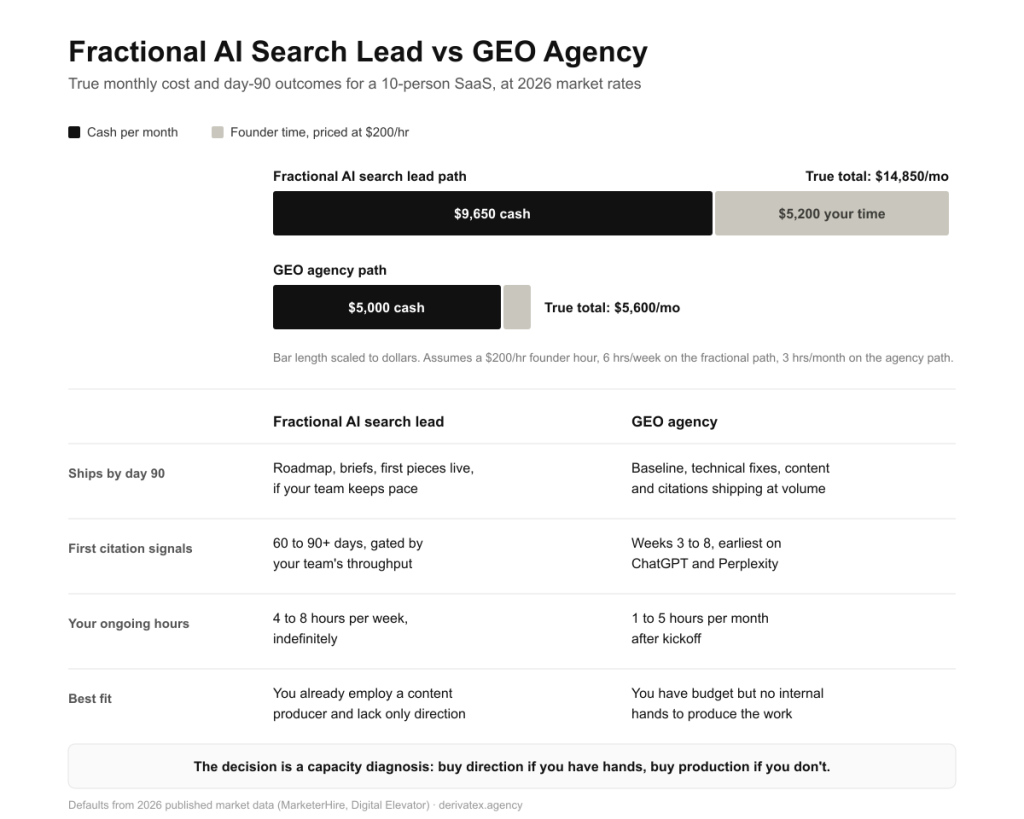
The most expensive input in either path is founder time, and the two paths consume it in opposite shapes. The fractional path is light at the start and heavy forever: after a few onboarding weeks, expect 4 to 8 hours per week, indefinitely, of your time or your team’s time spent acting on the consultant’s direction, producing or reviewing content, and posting what they brief. The agency path is heavy at the start and light after: kickoff months typically demand 5 to 7 hours of access-granting, audit reviews, and approvals, then the load drops to a few hours per month of calls and async signoffs.
Price that honestly. If a founder hour is worth $200 in opportunity cost, 6 weekly hours on the fractional path adds roughly $4,800 per month of invisible spend on top of the retainer. That single line is why “fractional is cheaper” collapses so often at 10-person scale!
| Dimension | Fractional AI Search Lead | GEO Agency |
|---|---|---|
| Monthly cost (2026 market) | $5,000 to $15,000 retainer (MarketerHire) | $2,000 to $10,000 mid-market (Digital Elevator) |
| What the fee includes | Strategy, briefs, tracking setup, advisory hours | Strategy plus content, citations, technical work, tracking |
| Execution capacity | None included; your team or freelancers produce | Included; agency team produces |
| Time to first shipped output | 30 to 60 days, gated by your team’s throughput | 4 to 6 weeks, gated by access and approvals |
| Your hours after ramp | 4 to 8 per week, ongoing | 1 to 5 per month |
| Key risk | Single person: churn, misdiagnosed expertise | Vendor: contracts, junior delivery, context loss |
| Contract shape | Month-to-month or 3 to 6 month terms, typically | Pilot plus commitment, commonly 6 to 12 months |
| Best fit | Has an internal producer, needs direction | Has budget but zero execution capacity |
Figures reflect published 2026 market data and are verified as of July 2026.
Verdict: the fractional AI search lead wins for a 10-person SaaS that already employs a competent content producer and wants senior direction layered on top. The GEO agency wins for the far more common 10-person profile: real budget, urgent competitive pressure, and no internal hands to do the work. If you have neither the budget nor a producer, skip ahead to the section on hiring neither.
Fractional vs GEO Agency: True Monthly Cost Calculator
Defaults reflect published 2026 market ranges. Edit any number to match your quotes and your own hourly value. Founder time is priced into both paths, because it is the line item proposals leave out.
Fractional AI Search Lead path
2026 market range: $5,000 to $15,000
Freelance B2B SaaS writers: $300 to $800 per article
Typical: 4 to 8 hours weekly, ongoing
GEO Agency path
2026 mid-market range: $2,000 to $10,000, production included
Typical after kickoff: 1 to 5 hours monthly
Opportunity cost of the hours you spend instead of on product or sales
Your true cost, side by side
| Fractional path: cash per month | $9,650 |
|---|---|
| Fractional path: your time, priced | $5,200 (26 hrs/month) |
| Fractional path: true monthly total | $14,850 |
| Agency path: cash per month | $5,000 |
| Agency path: your time, priced | $600 (3 hrs/month) |
| Agency path: true monthly total | $5,600 |
| 12-month gap between the two paths | $111,000 |
At these defaults, the fractional path costs about $9,250 more per month once your hours are priced in. It only closes that gap if your internal producer’s output replaces what the agency retainer would have covered.
Defaults are drawn from 2026 published pricing data (MarketerHire, Digital Elevator) and typical engagement cadences. Estimates only; your quotes, team output, and hourly value will move the result.
Which Is Faster? What Each Path Ships in the First 90 Days
The agency path ships visible work sooner in almost every case, because the playbook exists before you sign, while a fractional lead has to build context before anything moves. Speed only matters if you measure the right thing at day 90, though, so this section covers both.
A fractional lead's first 90 days, step by step
- Days 1 to 30: context and audit. The consultant learns your product, interviews you on buyers, runs a baseline of where AI models currently cite you and your competitors, and audits your content and technical foundations.
- Days 30 to 60: roadmap and briefs. You get a prioritized prompt list, a content roadmap, technical fix tickets, and the first batch of content briefs handed to whoever writes for you.
- Days 60 to 90: first production, if your side keeps pace. The first optimized pieces publish, schema fixes ship through your developer, and tracking starts showing whether early prompts move.
Notice the conditional in step three, because it is the entire risk of this path. The fractional timeline is gated by your team's throughput, not the consultant's skill, and a slow internal writer turns a 90-day plan into a 6-month one.
A GEO agency's first 90 days, step by step
- Pre-signing: a serious agency runs a diagnostic on your real data first, covering current AI visibility, competitor citations, and search foundations, so the engagement starts with a plan rather than a pitch.
- Weeks 1 to 3: baseline and foundations. Kickoff, access to your CMS and analytics, a locked priority prompt list, a competitor citation map across the four major AI platforms, and the first technical fixes shipping.
- Weeks 3 to 8: production at volume. Content publishes continuously, authority placements go live on external publications, and citation tracking runs on a recurring cadence, following the shape of a structured 90-day GEO sprint.
- Weeks 8 to 13: attribution comes into focus. AI-referred sessions get tagged in analytics, and by day 90 you can see whether tracked citations and AI-sourced conversions are actually moving.
Timeline expectations deserve one honest calibration: how long it takes to get cited by ChatGPT varies by starting authority and category competition, and early signals typically show up on ChatGPT and Perplexity before Gemini and Google move. Named results exist at the fast end of that range. REsimpli, a real estate CRM, became ChatGPT's top recommendation for its primary buyer prompt within 90 days of structured GEO work, though a result like that assumes a focused prompt cluster and an existing content foundation to build on.
One measurement warning applies to BOTH paths. AI referral traffic is still small in absolute terms: Opollo's 2026 dataset of B2B firms found it averaging around 1% of sessions for most sites and about 6.4% for B2B tech companies, yet the same dataset showed AI-referred visitors converting at 14.2% against 2.8% for standard organic. Semrush's 2026 cross-industry figure lands near a 4.4x conversion premium, and the real ROI of GEO shows up in that conversion quality rather than in session counts. Judge day 90 on citation share across your tracked prompts, never on raw traffic volume.
The Risk Nobody Prices In: Key-Person Dependency vs Vendor Dependency
Both paths carry a structural risk that never appears in the proposal, and at 10 people you cannot absorb either one casually. The fractional path concentrates risk in a single human, while the agency path concentrates it in a contract.
The fractional risk is key-person dependency: everything the consultant learns about your AI visibility lives in one head that can leave. Fractional operators run multiple clients, get poached, raise rates, or simply churn, and when they go, the roadmap logic, the prompt history, and the judgment go with them.
The GEO twist makes it worse: because the field is three years old, you often cannot verify the expertise you are renting until months of retainer have been spent finding out. Mitigation questions before signing: where does documentation live, who owns the tracking accounts, and what does the handoff look like if this ends in 90 days?
The agency risk is vendor dependency: senior people pitch, junior people sometimes deliver, and contracts can outlive your patience. The classic failure pattern is a 12-month term, a templated monthly report, and no way to tell whether any of it touched pipeline. Rebranded SEO shops add a second failure mode, running 2019 playbooks against 2026 AI systems. Mitigation questions: who exactly works my account, can I see prompt-level tracking from a current client, what specific outcome does day 90 prove, and do I own every asset if I leave?
Pick your risk deliberately rather than discovering it in month five. A founder who would rather manage a person should lean fractional, and a founder who would rather manage a scoreboard should lean agency.
How to Vet a Fractional AI Search Lead: The Hiring Scorecard
Vetting is the make-or-break step of the fractional path, because the title "fractional AI search lead" has no barrier to entry in 2026. Score every candidate against the table below, and treat anything under 70 as a pass.
| Criterion | What good looks like | Points |
|---|---|---|
| Attributable AI visibility results | Named brands, named prompts, before-and-after citation positions they can walk you through live | 25 |
| Mechanical understanding of LLM citation | Can explain how models select sources, in plain language, without hiding behind "proprietary methods" | 15 |
| Prompt tracking in practice | Shows you a real tracking setup across ChatGPT, Perplexity, Gemini, and AI Overviews, not screenshots | 15 |
| Hands-on technical history | Has personally shipped schema, entity fixes, and content architecture, not only strategy decks | 10 |
| Asks about YOUR production capacity | Probes who will execute before quoting; a consultant who never asks is selling a roadmap to nobody | 15 |
| Bounded first engagement | Offers a defined 60 to 90 day scope with named deliverables rather than an open-ended retainer | 10 |
| References at your scale | Two referenceable clients in the 5 to 30 person range, reachable, recent | 10 |
Scoring guide verified against 2026 market conditions.
The single highest-signal row is the production capacity question. A consultant who quotes you a retainer without asking who writes, publishes, and implements has either never run this at a small company or does not care whether it works, and both are disqualifying!
The mechanical-understanding row deserves one elaboration, because it is the easiest to fake in a sales call. A qualified candidate can walk you through how LLMs decide what to cite: retrieval, passage selection, and why third-party corroboration moves answers. A rebadged generalist will pivot to keyword talk within two minutes.
The same skepticism applies in mirror form to agencies, condensed to five questions that a fuller GEO agency evaluation checklist expands on:
- Who specifically works my account, and does that team change after the pitch?
- Can I see live, prompt-level citation tracking from a current client?
- What measurable outcome does day 90 prove or disprove?
- What happens to content, tracking, and accounts if I leave?
- Will you guarantee me citations? (The correct answer is no; a yes ends the meeting.)
Can You Start Fractional and Switch to an Agency Later? Yes, in Both Directions
Switching paths is not only possible, sequencing them deliberately is often the smartest move available to a 10-person SaaS. Three sequences cover nearly every case, each with a trigger that tells you when to move.
- Fractional first, agency second, when you have a producer and a tight budget.
Run a fractional lead against your internal writer for two or three quarters, and switch to an agency when the roadmap consistently outgrows your team's throughput: briefs piling up unwritten is the trigger. The consultant's documentation becomes the agency's onboarding packet, which shortens the new engagement's ramp. - Agency first, fractional or in-house second, when you are starting from zero.
Let an agency build the system: the content base, the citation footprint, the tracking, the technical foundations. Somewhere around month 9 to 12, once the machine is running and documented, a fractional lead or a first marketing hire can inherit it at a fraction of the ongoing cost. This sequence front-loads spend but buys speed exactly when AI answer patterns in your category are still forming. - The hybrid, a fractional lead managing an execution agency, almost never fits at 10 people.
You would be paying two vendors plus your own coordination time, and the model only starts making sense when GEO budgets clear roughly $10,000 to $15,000 per month with a marketing leader in place to run it. File it away for your 40-person future.
When You Should Hire Neither?
Some 10-person SaaS companies should not hire a GEO agency OR a fractional AI search lead, and an honest comparison has to say so. Four profiles fail with both options, and each has a cheaper correct move.
- Pre-product-market-fit or pre-revenue: AI visibility compounds on top of a clear ICP and a stable positioning. Buy neither until you know who you serve, because optimizing citations for a message that changes quarterly wastes every dollar.
- No content foundation at all: if your site is a homepage and a pricing page, both vendors will spend their first months building basics you could build cheaper. Publish your first 10 to 15 substantive pages first, even imperfectly.
- No founder appetite whatsoever: this channel needs a minimum of about 2 hours a week of your input for context and approvals under ANY model, and if that is genuinely unavailable, the engagement stalls regardless of who you hire.
- A category where buyers do not ask AI yet: check before spending. Run a set of AI visibility audit prompts covering 15 of your real buyer questions, and if no vendor names appear in the answers at all, your category's AI moment has not arrived and monitoring beats investing.
The DIY floor is more viable than either vendor wants you to know. Mentionable's 2026 analysis found that a single marketer spending around five hours a week, with structured learning and a tracking tool priced between $29 and $89 per month, produced comparable results to an agency across a footprint of 10 to 20 tracked prompts. For a small footprint, that math is hard to beat, and it also generates the baseline data that makes any future vendor conversation ten times sharper.
The demand pressure is real either way. Forrester's 2026 survey of nearly 18,000 buyers found 94% used generative AI somewhere in their purchase process, and G2's 2026 research found a third of B2B buyers purchased from a vendor an AI chatbot introduced them to. At the outcome end of that funnel, Gumlet, a video hosting platform, now attributes roughly 20% of its direct monthly inbound revenue to AI discovery across ChatGPT, Perplexity, Claude, and Google AI Overviews. The question this section answers is not whether AI search matters, it is whether paid help is the right way for YOUR company to show up in it this year.
FAQ
Isn't a fractional GEO lead cheaper than hiring a GEO agency?
Usually not, once total cost is counted. Fractional AI search retainers ran $5,000 to $15,000 per month in 2026 per MarketerHire, while Digital Elevator found credible mid-market GEO agency retainers at $2,000 to $10,000. The fractional retainer also excludes production, so you add freelance writers, tools, and 4 to 8 hours of internal time weekly to execute the roadmap. Fractional wins on cost only when you already employ the production capacity, because then you are paying solely for the missing direction.
Can my current SEO consultant just handle GEO too?
Sometimes, and the overlap in foundations is real, but treat it as a claim to verify rather than assume. Ask them to show prompt-level citation tracking across ChatGPT, Perplexity, Gemini, and Google AI Overviews, and to explain mechanically how LLMs choose which sources to cite. A consultant who can demonstrate both can likely extend into generative engine optimization. A consultant who responds with a rebranded SEO deck and no tracking is selling you the 2019 playbook against 2026 systems.
How many hours a week does AI search visibility take at a 10-person startup?
Plan for three tiers. Doing it yourself takes about five hours a week for a 10 to 20 prompt footprint, using a tracking tool in the $29 to $89 monthly range. Working with a fractional AI search lead takes 4 to 8 internal hours a week, because your side produces what they direct. Working with a full-service GEO agency takes 5 to 7 hours monthly during the first month, then roughly 1 to 5 hours per month for calls and approvals.
Should a 10-person SaaS hire a full-time GEO person instead?
Almost never at this size. A senior operator with real generative engine optimization results commands a six-figure salary and would sit underutilized inside a 10-person company, while a junior hire lacks the pattern recognition a three-year-old discipline demands, so you would be funding their education on your runway. Fractional and agency models exist precisely to rent that seniority in slices. Revisit a full-time AI search hire once organic and AI channels drive a meaningful share of pipeline, typically well past $10M ARR.
Do I still need GEO if we already rank #1 on Google?
Rankings and AI citations are correlated but not the same thing, and the gap is widening. Ahrefs found that a number-one Google position loses 58% of its expected clicks when an AI Overview appears above it, across a study of 300,000 keywords. AI models also weigh third-party corroboration, entity clarity, and extractable claims in ways classic ranking signals do not capture. Strong rankings give you a head start on GEO, but they do not substitute for it.
What results should I realistically expect in the first 90 days?
Expect movement in citation share on tracked prompts, not a traffic surge. Early citation signals typically appear on ChatGPT and Perplexity between weeks 3 and 8 of consistent work, with Gemini and Google AI Overviews moving slower. AI referral traffic stays small in volume, around 1% of sessions for most sites and about 6.4% for B2B tech in Opollo's 2026 dataset, but it converted at 14.2% versus 2.8% for standard organic in the same data. Judge 90 days on citations and conversion quality.
The Decision Is a Capacity Diagnosis, Not a Price Comparison
The most useful thing you can take from this piece is a reframe: a 10-person SaaS choosing between a GEO agency and a fractional AI search lead is not comparing prices, it is diagnosing which capacity it lacks. Companies that lack hands and buy advice end up with beautiful roadmaps nobody executes, and companies that lack direction and buy volume end up with content nobody cites. Match the purchase to the gap and either path can work.
Your next step costs nothing and takes an afternoon. Write down the 15 questions your best buyers would ask an AI assistant, run them through ChatGPT, Perplexity, and Gemini, and record which vendors get named. That one exercise tells you whether your category's AI moment has arrived, hands you the prompt list any serious vendor would build first, and arms you with the exact evidence to pressure-test a fractional candidate's scorecard or an agency's day-90 promise.
The timing pressure is not artificial. AI assistants recommend brands based on patterns learned from content and citations that already exist, which means the vendors being cited in your category today are shaping what these models say for the next cycle. Whichever path fits your gap, the diagnosis is worth running this quarter rather than next year.
Written byApoorv SharmaCo-founder, DerivateX
Apoorv Sharma is the co-founder of DerivateX, a B2B SaaS SEO and Generative Engine Optimization agency that engineers AI citations in ChatGPT, Perplexity, Claude, and Gemini and connects them to demo bookings and revenue pipeline. He is the author of the 2026 AI Visibility Benchmark Report and the Citation Engineering methodology. He's also the brain behind "Found On AI" and has sold 2 of his companies previously
Reviewed byAyush SharmaVP, SEO & AI Search, DerivateX
VP, SEO & AI Search at DerivateX. We're a B2B SaaS SEO and Generative Engine Optimization agency that engineers AI citations in ChatGPT, Perplexity, Claude, and Gemini and connects them to demo bookings and revenue pipeline.
Cited by AI