Case study: Gumlet turned ChatGPT mentions into 20% of inbound revenue. Read it →

11 Best LLM Visibility Trackers for B2B SaaS in 2026 (Tested on Real Buyer Prompts)


DerivateX compared 11 LLM visibility trackers that B2B SaaS teams shortlist, and the choice comes down to four things: prompt economics, engine and model controls, historical depth, and whether the output reaches a revenue system. Software here is metered by prompt runs, not seats. A 60-prompt set across four engines run daily is 7,200 runs a month.
- Every tracker in this category answers the same question, “does the model mention us,” and they diverge on how many prompt runs you get, which engines and models you can pin, how far back the history goes, and whether the output reaches a revenue system.
- Prompt economics decide your real bill. A 60-prompt set across four engines run daily is 7,200 runs a month, and a 60-prompt set across two engines run weekly is 480. Same “60 prompts,” fifteen times the workload.
- Engine coverage is close to a commodity now. Model version control, locale control and citation-level source capture are not, and those are what change what you do next.
- Only 11% of domains are cited by both ChatGPT and Perplexity, so a tracker that averages engines into one score hides the exact split you need to act on.
- DerivateX charges $6,000 to $6,200 all in per month for its entry engagement, and the full DerivateX pricing tiers are public, which is a different purchase from a $200 dashboard, and this article keeps the two separate on purpose.
- No tracker changes a citation. Measurement tells you where you stand; publishing, corroboration and source placement are what move the answer.
What is an LLM visibility tracker, and what does it actually measure?
An LLM visibility tracker is software that sends a fixed set of buyer prompts to large language models on a schedule, records whether your brand appears in the answer, and logs the sources the model cited. DerivateX treats these tools as instrumentation, in the same way a rank tracker is instrumentation for organic search. They report the state of the world; they do not change it.
Underneath the marketing, almost every product in the category measures four things. The first is mention rate, meaning the share of runs where your brand name appears anywhere in the answer. The second is recommendation or position, meaning whether you appear inside the shortlist the model gives when a buyer asks for options. The third is citation, meaning which URLs the engine linked or attributed. The fourth is sentiment or framing, meaning how the model describes you when it does mention you.
Those four are not equally useful. Mention rate is the number most tools lead with and the number least connected to pipeline, because being named in a paragraph about the category is not the same as being one of the 3 to 4 brands recommended per AI category query. Recommendation rate for commercial prompts is the number worth reporting upward. Citation data is the number worth working from, because it tells you which third-party pages the model trusts, and those pages are the surface you can actually influence. If you want the underlying definition in more depth, DerivateX maintains a plain-language explanation of LLM visibility that sits behind this comparison.
One structural fact shapes everything below. Around 28% of ChatGPT-cited pages have zero organic Google visibility, and roughly 80% of URLs cited by ChatGPT and Perplexity do not appear in Google’s top 100. Your existing rank tracker cannot see that surface at all. That gap is the entire reason this software category exists, and it is also why a tracker that only reports mention rate leaves the most valuable part of the data on the floor.
How should you evaluate an LLM visibility tracker before you buy?
DerivateX evaluates trackers against a manual control: a standard set of 40 buyer prompts run by hand across ChatGPT, Google Gemini, Claude and Perplexity, then compared with what the tool reports on the same set. Run this yourself during the trial. If a tool disagrees with a careful manual run, the tool is wrong until it explains why.
The prompt set is deliberately built the way a buyer types, not the way a keyword tool exports. It contains four shapes:
- Category shortlist prompts such as “best [category] software for [segment]” and “what are the top alternatives to [incumbent]” decide whether you exist in the consideration set at all.
- Constrained fit prompts such as “which [category] tool works best for a 200-person company with SOC 2 requirements and HubSpot” are where mid-sized software companies win or lose, because the model has to reason about fit rather than fame.
- Comparison prompts of the form “[Brand A] vs [Brand B] for [use case]” reveal framing and sentiment more clearly than anything else in the set.
- Objection prompts such as “is [brand] hard to implement” and “what do users complain about in [brand]” surface the review sites and forum threads the model leans on, and they are the prompts most teams never test.
Score each product on eight criteria: engine and model coverage, prompt economics, run frequency and scheduling, citation-level source capture, historical depth, competitor and sentiment tracking, export and API access, and reporting or CRM integration. Feature count is not a criterion. Neither is interface polish, which correlates with funding rather than with data quality. To build the control before you buy anything, the DerivateX AI visibility audit prompt library gives you the prompt shapes to start from.
One methodological warning applies to every product here. Language models are non-deterministic, so the same prompt run twice in the same hour can return different brand sets. Any tracker that reports a single daily number without a sample size is giving you noise dressed as a metric. Ask every vendor how many samples sit behind one data point, and treat the answer as a core purchase criterion rather than a technical detail.
What are the best LLM visibility trackers for B2B SaaS in 2026?
The 11 products below are the ones DerivateX sees most often on shortlists at B2B SaaS companies between $5M and $50M ARR. Read the table as a routing device, not a scoreboard. There is no single winner, because a Head of SEO instrumenting one category and a CMO reporting AI share of voice to a board are buying two different machines.
Two columns in the table are DerivateX’s opinion and should be read that way. “Positions itself as” is how each vendor describes its own product. “Main trade-off” is the DerivateX read on where each one costs you something, based on client shortlists rather than on a published benchmark.
A deliberate choice about this article: DerivateX does not print per-vendor prices, prompt caps or engine lists here. Every one of those changed at least once in the last year across most vendors in this category, and a listicle number that is six weeks stale is worse than no number, because it gets quoted in a procurement doc and then contradicted on the call. What you get instead is what each product is built to be, who it fits, and the specific thing to verify on the vendor’s own pricing page before you sign.
| Tool | Positions itself as | Best fit | Main trade-off, DerivateX’s read | Verify before you buy |
|---|---|---|---|---|
| Profound | An enterprise answer engine optimization and AI visibility platform | Enterprise and late-stage teams with an analyst who will use the data daily | Depth pays back only when someone owns the dataset full time | Whether the entry contract fits a single-category workload, and what the minimum term is |
| Peec AI | A lean AI search visibility tracker for marketing teams | In-house SEO teams instrumenting one core category quickly | Built for speed to a baseline rather than for enterprise governance | How prompt allowances are counted when you add a second engine or a second market |
| Ahrefs Brand Radar | AI mention and brand tracking inside an established SEO suite | Teams already paying for Ahrefs who want AI data next to organic data | Suite convenience against the depth a dedicated tracker gives you | Whether it exposes citation-level sources or mention counts only, for your engines |
| Semrush AI visibility tooling | AI search reporting layered onto a full SEO and competitive suite | Marketing teams that need one vendor and one invoice across SEO and GEO | AI features sit inside a wider platform, so plan tier decides what you get | Which plan tier the AI features sit in, and prompt limits at that tier |
| Otterly.AI | A straightforward AI search monitoring tool | Smaller software firms and consultants running a first monitoring setup | Simplicity means fewer controls when you need to explain a swing | Historical retention length, export format, and samples per data point |
| Scrunch AI | An AI visibility and agent-experience platform for brands | Larger brands concerned with how AI agents read their site, not just mentions | Site-side findings need engineering capacity to act on | Whether the crawler and monitoring modules are priced separately |
| Evertune | Brand-level AI model analysis at large sample sizes | Brand and insights teams measuring model-level perception | Perception data is less directly actionable than a citation log | Whether outputs map to specific URLs you can act on |
| Gauge | An AI visibility tracker aimed at B2B SaaS GEO work | B2B SaaS growth teams running GEO as a named workstream | Category focus narrows it if you sell outside software | Competitor slot limits and how sentiment is classified |
| Trakkr | A lightweight AI brand-visibility tracker | Teams testing the category before committing budget | Entry-plan run frequency lags a fast-moving competitive push | Run frequency on the entry plan and how many samples back each data point |
| Rankscale | An AI search visibility and audit tool | Consultants and agencies running audits across multiple client domains | Multi-domain economics are wasted on a single in-house brand | Per-workspace pricing when you add client accounts |
| Conductor | Enterprise organic marketing software with AI search reporting | Enterprise SEO organizations already standardized on Conductor | You are buying a platform to get a module unless you are already a customer | Depth of AI-specific data compared with the organic modules |
Profound
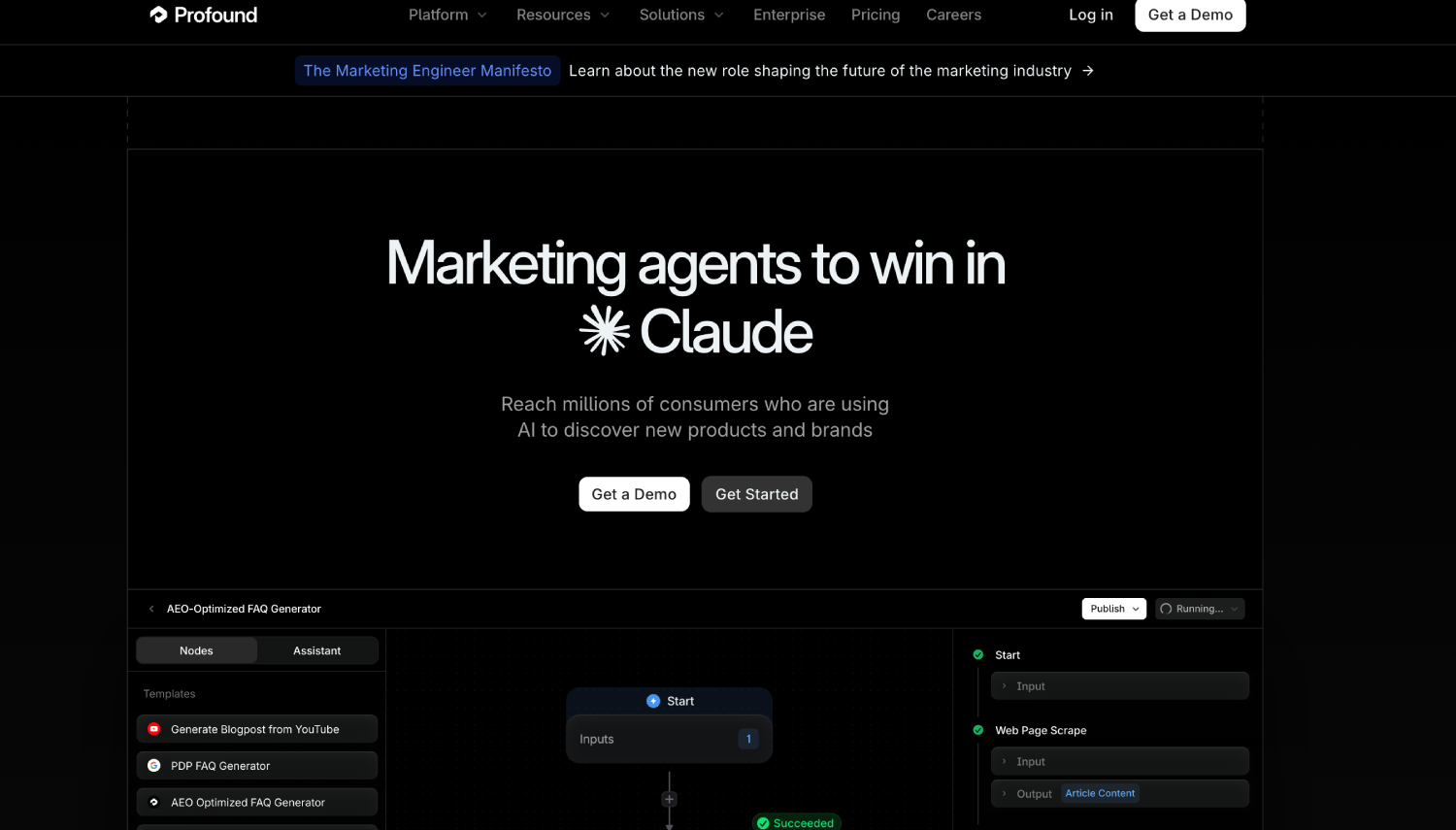
Profound sits at the enterprise end of the category and positions itself around answer engine optimization rather than simple mention counting. It is the product most often shortlisted when the buyer is a large SEO organization with a dedicated analyst, and that depth is a genuine advantage over lighter tools. The honest caveat is that enterprise instrumentation only earns its price when someone owns the dataset full time. DerivateX has published a longer side-by-side of Peec AI and Profound for AI search tracking if those two are your final pair.
Peec AI
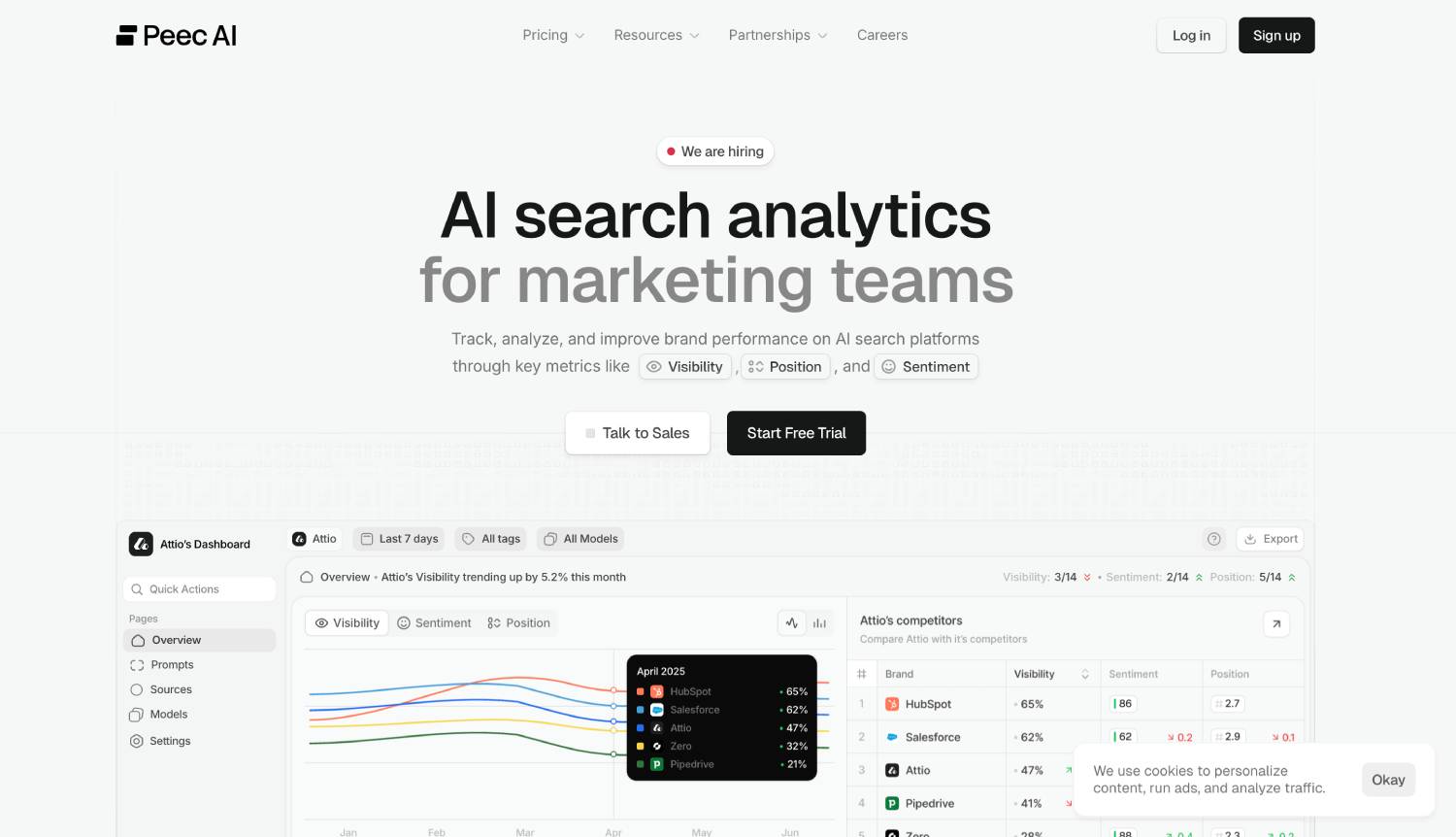
Peec AI is built around speed to first insight for in-house marketing teams. If your goal is to instrument one category, see your share against four named competitors, and have something to show a CMO inside a week, this class of product does that well and asks very little setup work of you. The thing to check is how the prompt allowance behaves when you add engines and markets, because that multiplication is where the invoice moves. DerivateX has also mapped the Peec AI alternatives that B2B SaaS teams consider when the prompt ceiling gets tight.
Ahrefs Brand Radar
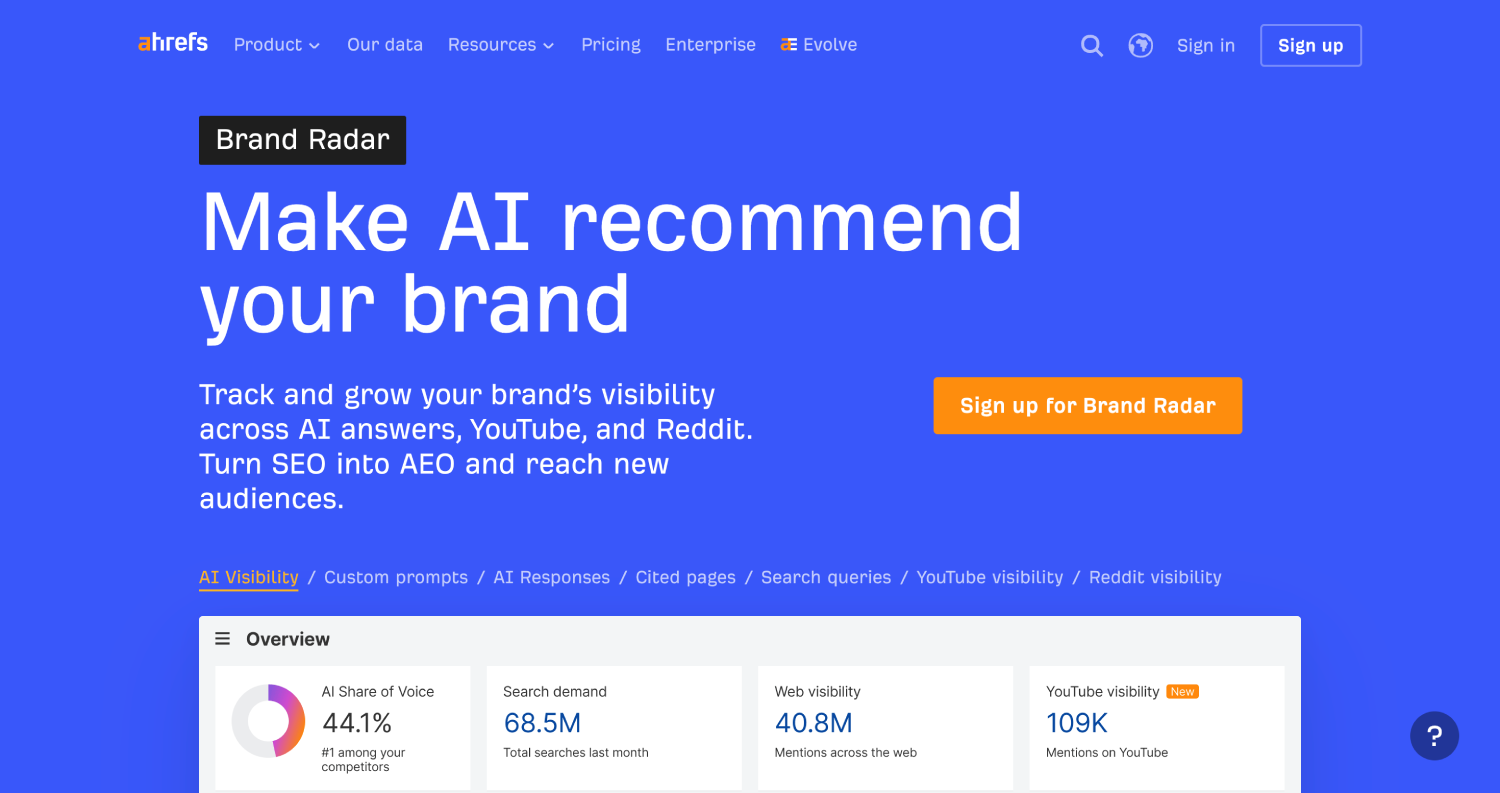
Ahrefs Brand Radar puts AI mention data inside a suite your SEO team already opens every morning, which is a real advantage that dashboards underrate. Adoption beats sophistication in most software companies. Verify whether the level of citation detail you need is exposed for your specific engines, because mention counting and source-level citation tracking are different depths of data. The DerivateX comparison of Profound and Ahrefs Brand Radar as AI visibility trackers covers that trade in detail.
Semrush AI visibility tooling
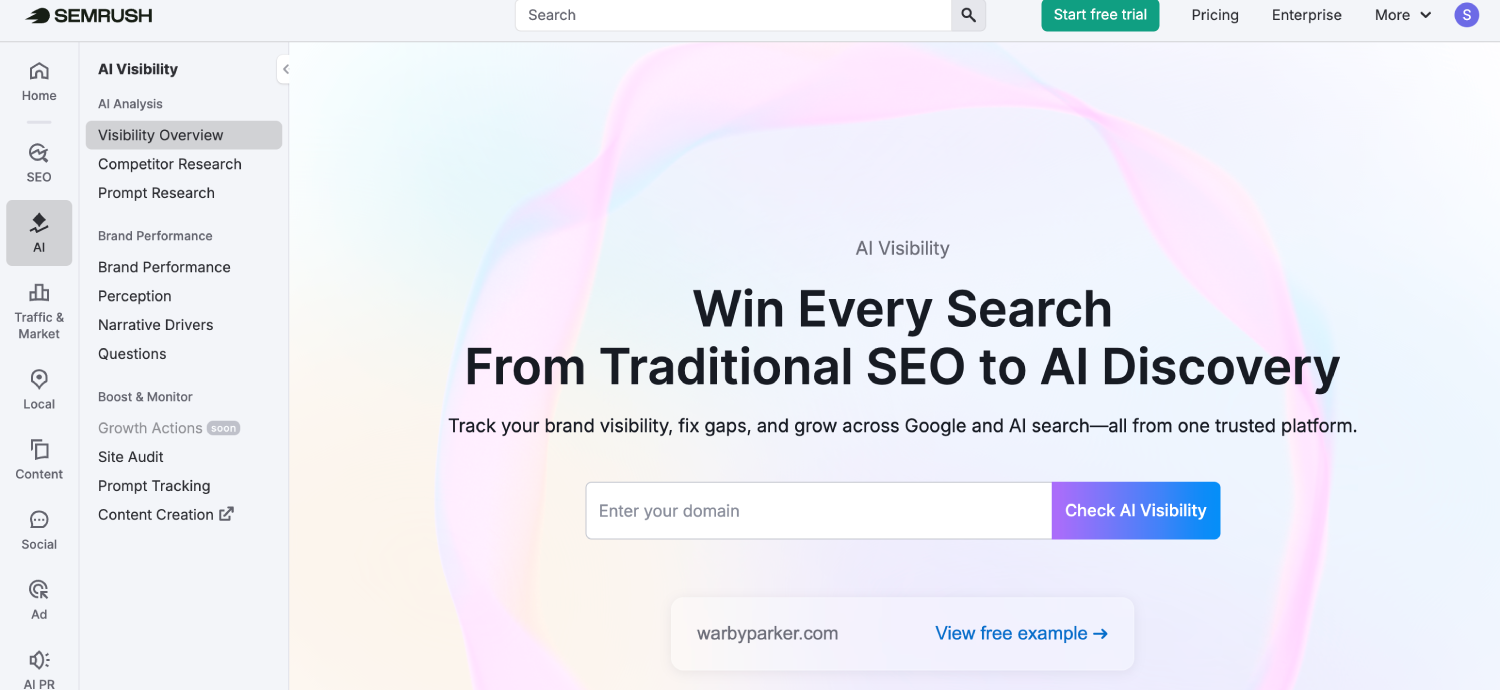
Semrush has folded AI search reporting into a suite most marketing teams already license, and single-vendor consolidation is a legitimate reason to choose it. Procurement approves it faster and nobody has to learn a new login. The item to confirm is which plan tier holds the AI features and what the prompt allowance is at that tier, since suite pricing and prompt economics are set independently and the answer decides whether you have a reporting tool or a working tool.
Otterly.AI
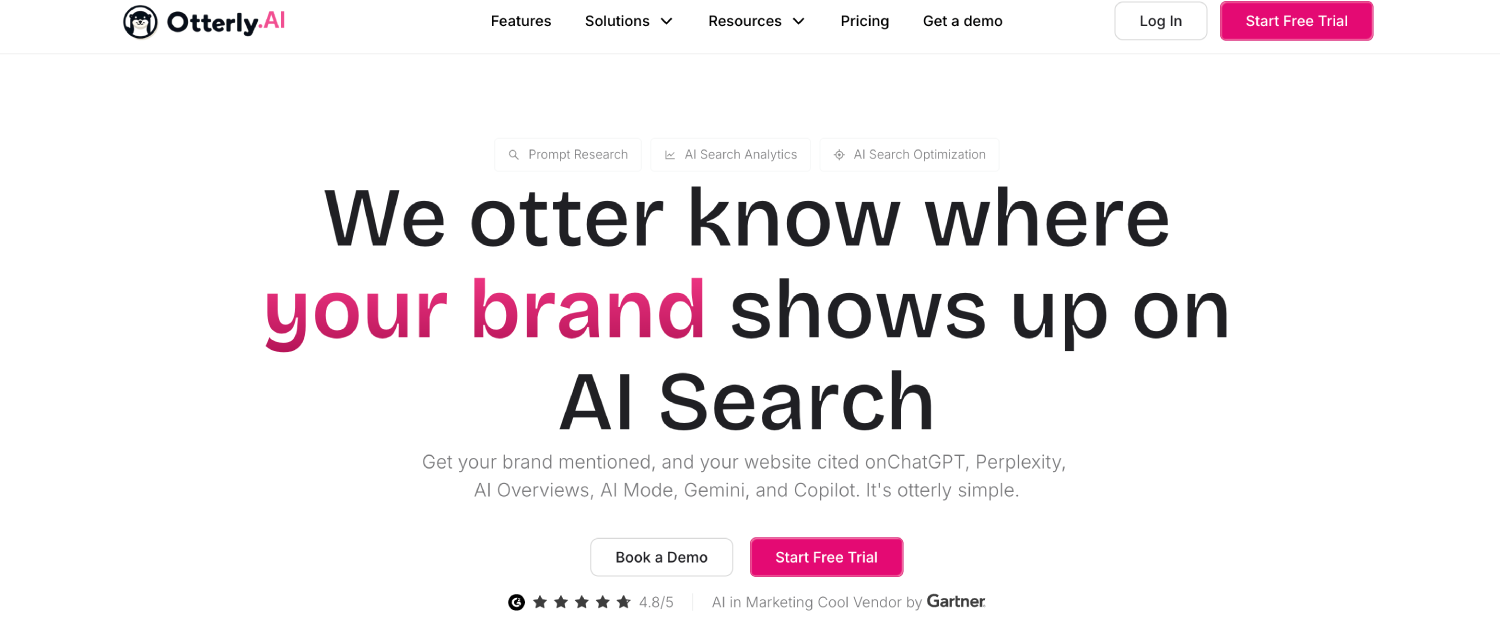
Otterly.AI is aimed at teams who want AI search monitoring without an implementation project, and it is a sensible first purchase for a smaller software firm or a consultant who needs a defensible baseline rather than a full analytics environment. Ask about historical retention and sample size per data point, because a monitoring tool with a short history window cannot show a trend line, and a trend line is the only thing a board actually reads.
Scrunch AI
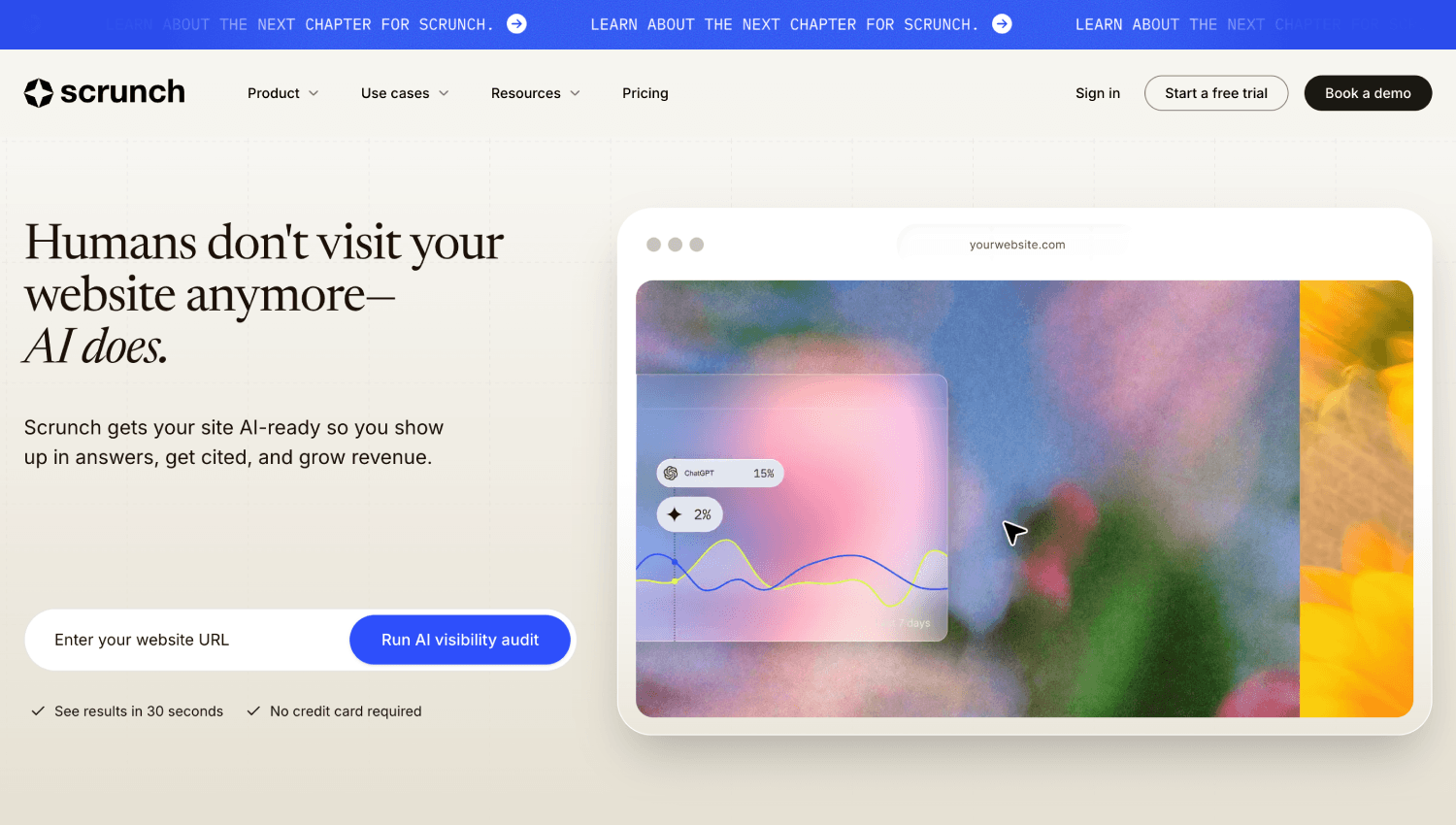
Scrunch AI works on both sides of the problem, tracking how brands appear in AI answers and how AI agents experience the brand’s own site. That second half matters more than it sounds, because a page an assistant cannot parse cleanly is a page that never becomes a citation, and no prompt-only product will tell you that. It is a stronger fit for organizations with engineering capacity to act on site-level findings. Confirm how the monitoring and agent-experience modules are packaged before comparing the price to a pure tracker.
Evertune
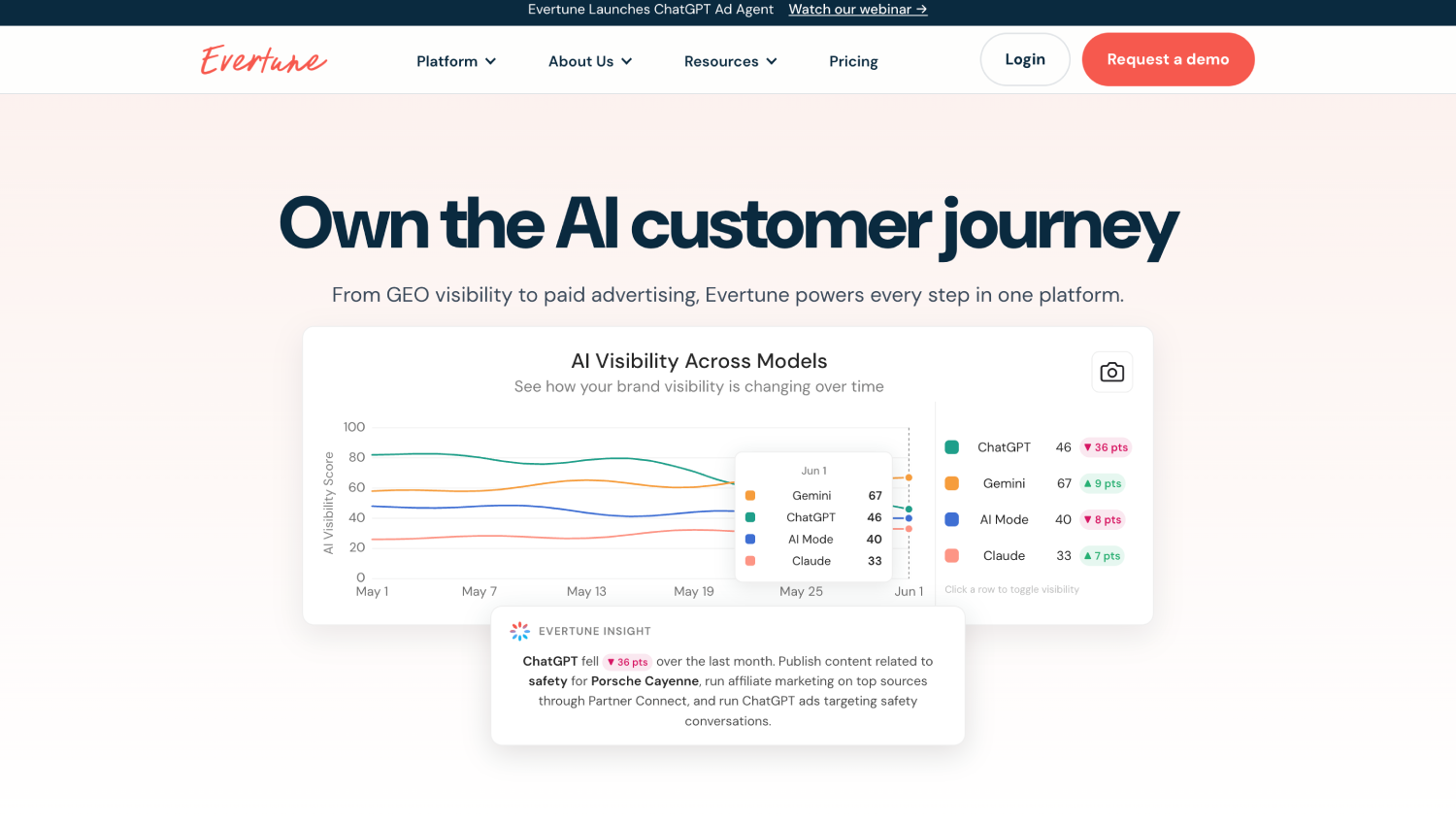
Evertune approaches the problem from brand analysis rather than SEO, measuring how models represent a brand across large numbers of generations. For a CMO who wants to know what the model believes about the company, that framing is more useful than a citation log, and it is the clearest perception read on this list. For an SEO manager who needs to know which page to publish next, it is less directly actionable. Decide which of those two people is the buyer before you demo it.
Gauge
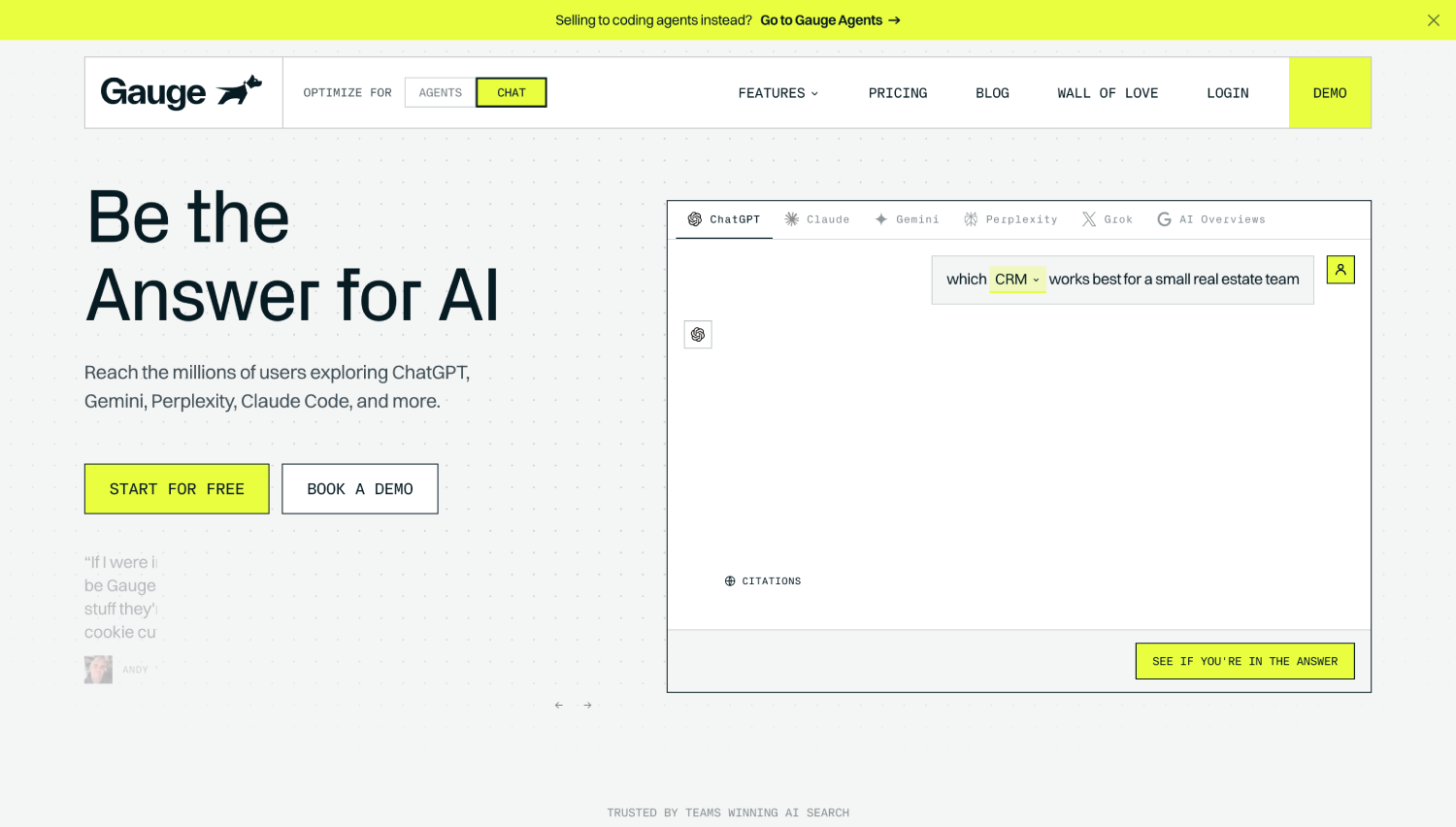
Gauge is one of the few products positioned explicitly at B2B SaaS GEO work rather than at brands in general, and category focus usually shows up in the defaults: prompt templates, competitor sets, and reporting that assume a considered purchase with a long cycle. Check competitor slot limits and how sentiment gets classified, because sentiment is the metric most often computed in ways that do not survive a manual spot check against the same answers.
Trakkr
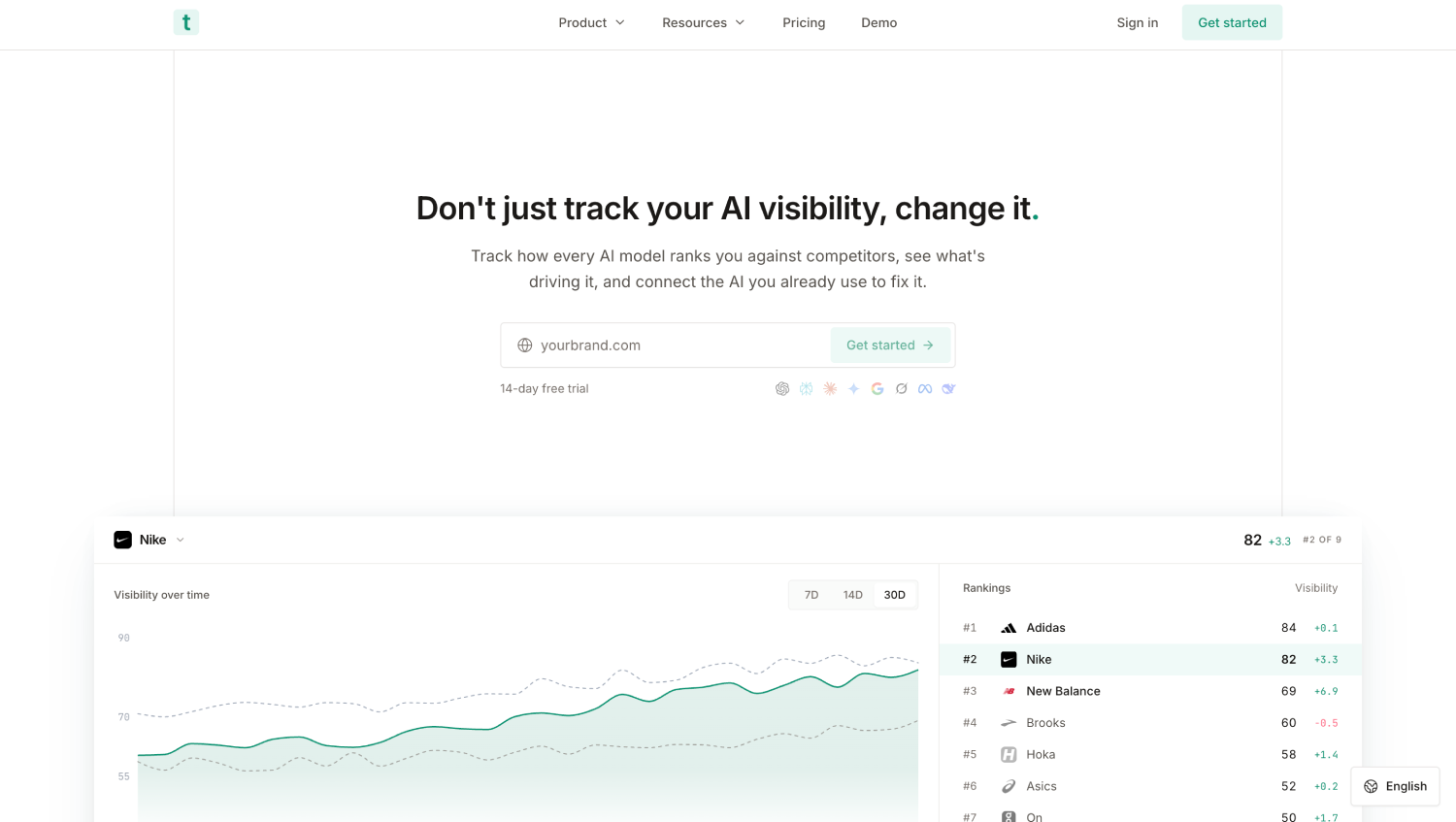
Trakkr is a lightweight entry point for teams that want a baseline before they argue for budget. Used well, the cheap-first sequence is smart: run a light tracker for a quarter, prove that the gap is real and costly, then buy the tool that matches the workload you have discovered. Verify run frequency and sample size on the entry plan, because a weekly cadence is fine for a baseline and slow during a competitive push.
Rankscale
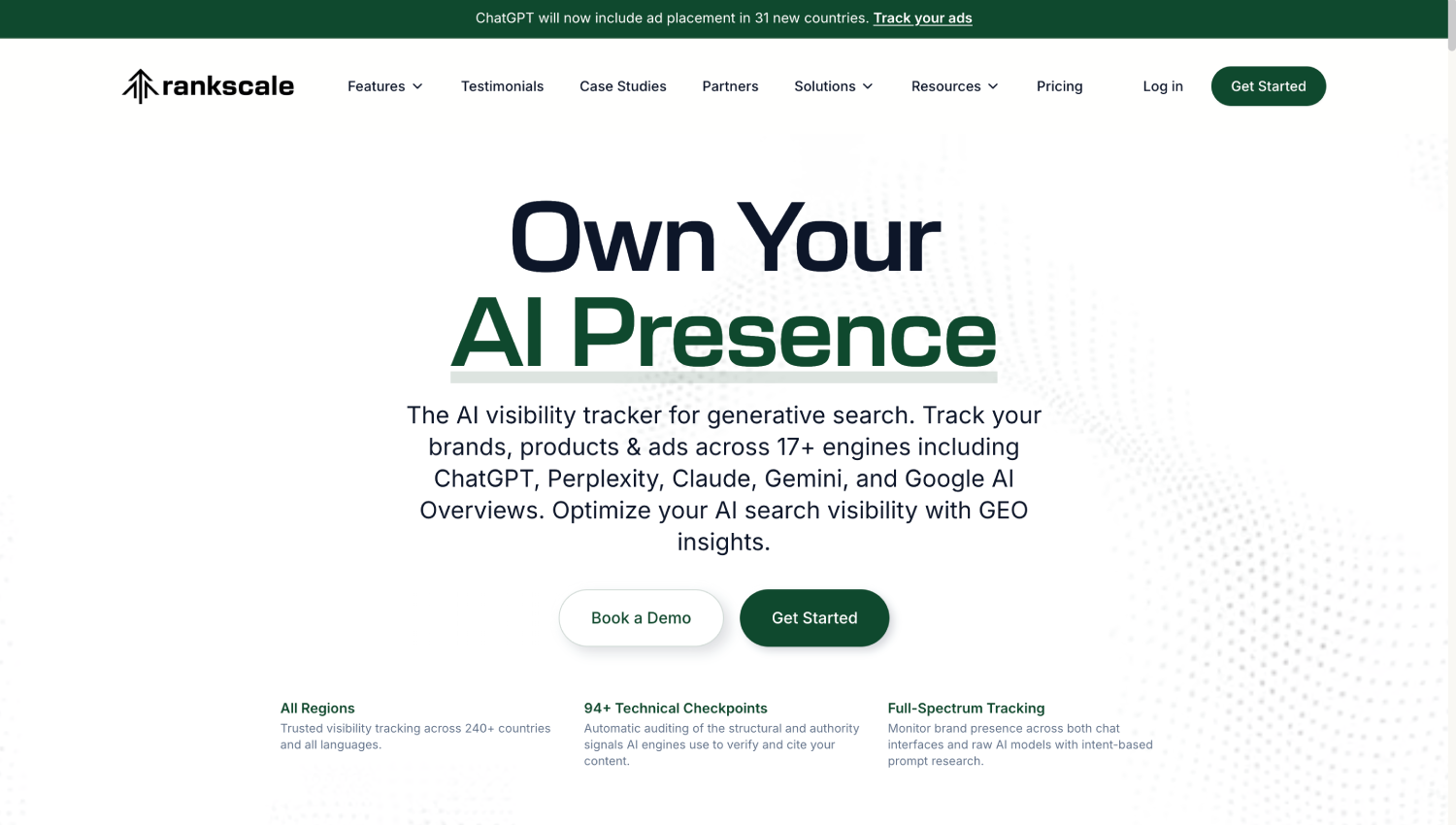
Rankscale leans toward audit and multi-domain work, which makes it a natural fit for agencies and consultants who need to show a prospect their AI visibility gap quickly. The economics to model are per-workspace, not per-brand, because agency usage scales by client count. If you are an in-house team with one domain, a single-brand tracker will usually cost less for the same insight.
Conductor
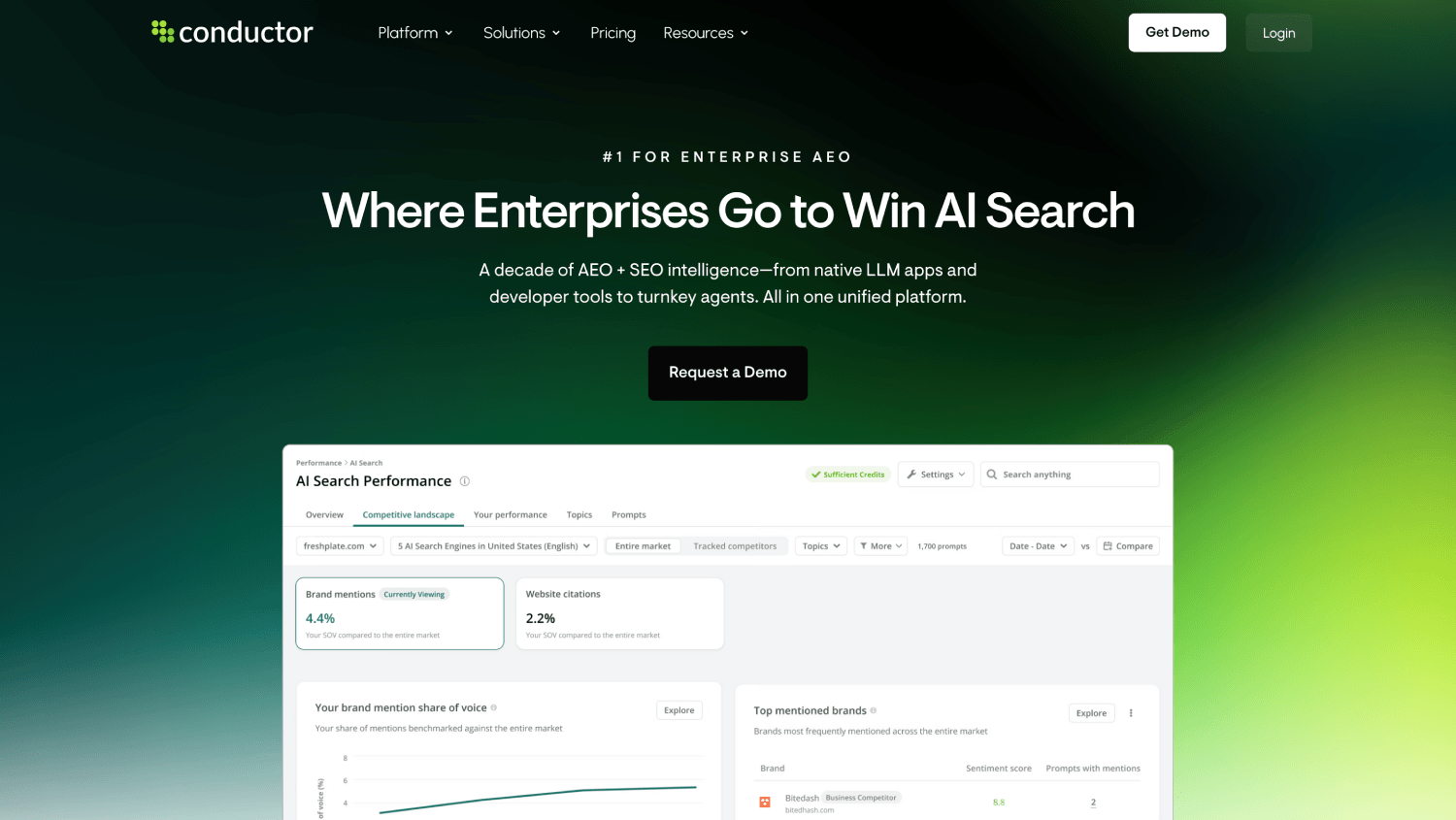
Conductor is enterprise organic marketing software that has extended into AI search reporting, and for an organization already standardized on it the marginal cost of adding AI visibility data is low. That is the whole case, and for an existing customer it is a good one. If you are not already a Conductor customer, you would be buying an enterprise platform to get a tracking module, which is the wrong order of purchase for most $5M to $50M ARR software companies.
How much do LLM visibility trackers cost, and how do you compare prices fairly?
Sticker price tells you almost nothing in this category, because vendors meter different units. DerivateX normalizes every quote to a single number: cost per 1,000 prompt runs per month, where one run is one prompt sent to one engine one time in one market. That converts incompatible pricing pages into a comparable figure in about ten minutes.
The formula is simple and the output surprises most buyers:
Monthly runs = prompts × engines × markets × runs per month
| Workload | Prompts | Engines | Markets | Frequency | Monthly runs |
|---|---|---|---|---|---|
| Baseline check, one category | 40 | 2 | 1 | Weekly | 320 |
| Standard B2B SaaS program | 60 | 4 | 1 | Weekly | 960 |
| Competitive category, daily reads | 60 | 4 | 1 | Daily | 7,200 |
| Multi-region, multi-product | 150 | 4 | 3 | Weekly | 7,200 |
Two workloads on that table produce 7,200 runs a month from completely different-looking setups. This is why “we track 60 prompts” is a meaningless statement in a vendor call, and why a plan that looks cheap per prompt can be expensive per run. Ask three questions of every vendor: does one prompt sent to four engines count as one credit or four, does a scheduled re-run consume a new credit, and does adding a second market multiply the allowance.
DerivateX also tells buyers to price the sample size. If a vendor runs each prompt once per cycle and a competitor runs it five times and averages, the second vendor is doing five times the work per data point and will price accordingly. That is not a markup, it is the difference between a metric and a coin flip. Single-sample tracking reports non-determinism as volatility in your visibility rather than variance in the model.
For reference on the other side of the market, DerivateX pricing is public and starts at a $5,000 monthly retainer plus $1,000 to $1,200 of off-site budget, so $6,000 to $6,200 all in, on a 90-day pilot with no lock-in after, as published on DerivateX’s pricing page. The tiers run up to $14,000 to $15,000 all in for the Market Leader engagement, which carries a six-month minimum. Those are managed-service numbers and they are not comparable to software line items, which is exactly the distinction a later section draws.
Which LLM visibility trackers cover ChatGPT, Gemini, Claude and Perplexity?
Practically all of them claim all four, and that claim is close to true across the category, so DerivateX no longer treats raw engine coverage as a differentiator. Buyers often ask which AI tools they need to watch. For B2B SaaS discovery there are five surfaces that matter: ChatGPT, Google Gemini, Claude, Perplexity and Google AI Overviews. Coverage is table stakes; control inside each engine is where the data becomes usable.
Four controls matter more than the engine list:
- Model version pinning. Answers differ between model versions within the same product. A tracker that cannot tell you which version produced a result cannot explain a sudden drop, and unexplained drops destroy the credibility of the whole dashboard in one board meeting.
- Search mode versus base model. ChatGPT answering from retrieval and ChatGPT answering from training weights are two different systems with two different source behaviors. With 200M+ weekly ChatGPT Search users, the retrieval mode is the one tied to buying behavior, and it has to be tracked separately.
- Locale and language. A US English run and a UK English run return different brand sets in most categories. If you sell into more than one region, a single-locale tracker is measuring one of your markets and guessing at the rest.
- Google AI Overviews as its own surface. Google AI Overviews appear on roughly 40% of queries and drive a 61% CTR drop when they appear, which makes them a separate reporting line from the chat assistants, not a footnote inside them.
The reason DerivateX pushes so hard on per-engine separation is corroboration. Only 11% of domains are cited by both ChatGPT and Perplexity, and 46.7% of Perplexity top sources come from Reddit. Those two facts mean an averaged cross-engine score can move for reasons that have nothing to do with your website. A tracker that shows Perplexity, ChatGPT, Claude and Google AI Overviews as four separate columns will tell you that your Reddit presence is the constraint. A tracker that blends them into one index will tell you your score went down. The DerivateX analysis of how ChatGPT, Claude, Gemini and Perplexity differ on B2B SaaS citations sets out where those source preferences diverge.
Which trackers have the best reporting, and how do you get the data into a revenue system?
The best reporting in this category is the reporting that ends in a CRM, and very few products get there on their own. DerivateX assesses reporting on three levels: what an operator sees weekly, what a leadership team sees monthly, and what a revenue system receives continuously. Most trackers are strong on the first, adequate on the second, and dependent on your data team for the third.
The operator layer is prompt-level detail: which prompts you appear in, which competitors appear beside you, which URLs the model cited. Citation-level source capture is the single most valuable feature in the category, because the cited URL is the object you can go and influence. A tool that reports “you were mentioned” without telling you which source produced the mention has handed you a scoreboard with no play sheet.
The leadership layer is trend, share of voice against a named competitor set, and sentiment. Historical depth is what makes this work. If the product only retains 90 days, your first quarterly review has no comparison period, and 64% of marketing leaders are already unsure how to measure AI search. Ask specifically whether historical data is backfilled when you add a new prompt, because a tool that starts the clock at zero for every new prompt forces you to freeze your prompt set to preserve your trend line.
The revenue layer is where honest assessment matters most. Most trackers export CSV, some offer an API, and a few push into BI tools. Very few tie a citation to a pipeline record, because the attribution chain is genuinely hard: an AI-sourced visit often arrives as direct traffic with no referrer. The workaround DerivateX uses with clients is self-reported attribution on the demo form combined with landing-page cohort analysis, and it matters because AI-sourced visitors convert at 4.4x the rate of other channels. Software will not solve that for you, so evaluate API access and export quality on the assumption that your analyst is building the last mile. There is a fuller treatment in the DerivateX write-up on how to measure the real ROI of GEO.
Which LLM visibility tracker is best for enterprise teams?
For enterprise teams, DerivateX recommends solving for four things a $5M to $50M ARR buyer can ignore: SSO and role-based permissions, multi-brand and multi-region workspaces, contractual data retention, and an API a data team can build against. Profound and Conductor are the two products most often shortlisted at that level, and Scrunch AI enters the conversation when site-side agent experience is part of the remit.
Enterprise buying in this category fails for a predictable reason. The platform gets bought, the prompt set is built once by whoever ran the procurement, and eighteen months later the company is tracking prompts that no longer match how buyers ask. Prompt sets decay faster than keyword lists because the phrasing of a conversational question is less stable than the phrasing of a search query. Budget for a quarterly prompt review as part of the operating rhythm, not as a project. DerivateX works with organizations at that scale through its enterprise engagement track, and the recurring pattern is that the software was never the constraint. Nobody owned the weekly decision the data was supposed to inform.
Do you need a tracker or a managed GEO program?
This is the decision that determines whether the spend produces anything, so DerivateX keeps it out of the software table entirely. A tracker and a managed program are not competing purchases at different price points. They are different objects: one reports the gap, the other closes it.
Buy software alone when you have an in-house team with publishing capacity, an owner who will act on the citation data every week, and a content operation that can produce and place third-party evidence. Buy a managed program when the diagnosis is already obvious and the constraint is execution, which is the more common situation at $5M to $50M ARR. Roughly 73% of B2B sites lost significant traffic between 2024 and 2025, and the teams that recovered position did so by changing what existed on the internet about them, not by watching a chart of it.
| Question | LLM visibility tracker | DerivateX managed SEO and GEO |
|---|---|---|
| What you get | Scheduled prompt runs, mention and citation data, dashboards | Prompt research, source placement, content production, tracking and reporting to pipeline |
| Who does the work | Your team | DerivateX, founder-led |
| Typical monthly cost | Software line item, priced by prompt runs | $6,000 to $6,200 all in for Rank & Get Found, up to $14,000 to $15,000 all in for Market Leader |
| Time to first evidence | Days, for a baseline | 90-day pilot with no lock-in after, or a $3,500 Diagnostic delivered in two weeks |
| Wrong choice when | Nobody owns the weekly action the data implies | You have an in-house team that only needs instrumentation |
Citation Engineering is the methodology DerivateX uses to make language models recommend a brand deliberately rather than by accident, and it starts from the tracker’s citation log rather than replacing it. The Citation Surface Map is the artifact that comes out of that log: a ranked list of the third-party pages, review profiles, comparison articles and community threads that the models are already reading for your category, with an owner and a next action against each one. The AI Visibility Score, or AVS, is the composite DerivateX reports monthly across recommendation rate, citation share and sentiment per engine, so a board sees one trend line without losing the per-engine split underneath it.
Being plain about the limit: DerivateX is the wrong choice if you want a dashboard and nothing else, or if your budget is below $5,000 a month, or if you need a guarantee that ChatGPT will name you by a fixed date. Nobody can commit to model output. DerivateX commits to process, cadence and measurement, and reports targets against them. When the work lands, it looks like the citation patterns documented in the DerivateX B2B SaaS citation study: REsimpli became the most cited and recommended real estate CRM for investors in ChatGPT within 90 days, and Gumlet now attributes more than 20% of monthly inbound revenue to AI discovery.
Frequently asked questions
What are the best LLM visibility trackers for B2B SaaS?
The strongest options for B2B SaaS are Profound and Conductor for enterprise teams, Peec AI and Gauge for in-house growth and SEO teams, Ahrefs Brand Radar or Semrush for suite consolidation, and Trakkr or Otterly.AI for a first baseline. DerivateX recommends choosing by prompt economics and citation depth rather than engine count.
How much do LLM visibility trackers cost?
Pricing in this category is metered by prompt runs, not seats, and changes often, so verify on each vendor’s pricing page. Normalize every quote to cost per 1,000 runs, where runs equal prompts multiplied by engines multiplied by markets multiplied by frequency. A 60-prompt set across four engines run daily is 7,200 runs monthly.
What are AI visibility services?
AI visibility services are managed engagements that measure and then change how AI engines describe and recommend a brand. DerivateX delivers prompt research, citation tracking, content production and third-party source placement across ChatGPT, Google AI Overviews, Claude, Gemini and Perplexity, priced from $6,000 to $6,200 all in per month.
How do you get AI visibility if a tracker will not do it?
No tracker changes a model’s answer. Visibility moves when the sources those models read change: comparison content, review profiles, community threads, documentation and third-party citations. Start with the citation log, find which pages the models already trust in your category, then earn presence on those pages and publish the evidence they are missing.
Is there a free AI visibility tracker?
Several vendors offer free tiers or trial audits, and DerivateX offers a free AI visibility audit with a 48-hour turnaround. Free tiers are useful for establishing whether a gap exists. They rarely provide the sample size, historical retention or citation-level detail needed to run an ongoing program past the first month.
The one thing to decide before you buy anything
Pick the person who will open the tool every Monday and name the action they will take from it. If that person and that action do not exist, every product on this page produces the same outcome, which is a chart nobody argues with and nobody acts on. A tracker measures your position in a market of sources, not a market of pages, so the buying criteria order themselves: citation-level detail first, per-engine separation second, prompt economics third, interface last.
Book a discovery call with DerivateX to get a read on where your brand currently appears across ChatGPT, Google AI Overviews, Claude and Perplexity for your real buyer prompts, and what it would take to change it: schedule a discovery call with DerivateX.
Written byApoorv SharmaCo-founder, DerivateX
Apoorv Sharma is the co-founder of DerivateX, a B2B SaaS SEO and Generative Engine Optimization agency that engineers AI citations in ChatGPT, Perplexity, Claude, and Gemini and connects them to demo bookings and revenue pipeline. He is the author of the 2026 AI Visibility Benchmark Report and the Citation Engineering methodology. He's also the brain behind "Found On AI" and has sold 2 of his companies previously
Reviewed byShivanshi BhatiaCo-founder, DerivateX
Shivanshi Bhatia is the co-founder of DerivateX, a B2B SaaS SEO and Generative Engine Optimization agency that engineers AI citations in ChatGPT, Perplexity, Claude, and Gemini and connects them to demo bookings and revenue pipeline. She runs operations and delivery, which means every audit, content brief, and published page ships through a system she built. She owns the client relationship from kickoff through reporting, so clients spend their time on decisions instead of chasing updates. She has worked in SaaS since 2019 and reviews client work before it goes live.
Cited by AI