Case study: Gumlet turned ChatGPT mentions into 20% of inbound revenue. Read it →

The GEO KPIs That Survive a Board Meeting (and the Ones That Don’t)

Boards fund pipeline, not visibility. Here is the three-tier reporting model that puts four metrics in front of the board and leads with AI-attributed pipeline.


TL;DR
- Boards approve budget against pipeline, not visibility, so a long AI-visibility dashboard is the wrong thing to bring into the room.
- The cleanest way to report GEO is in three tiers: four board metrics, a CMO operating set, and the team’s input list.
- The number that settles the conversation is the AI-attributed pipeline, traced from AI-sourced sessions in GA4 through to demos, pipeline, and closed revenue.
- Google’s new Search Console AI reports, live since June 3, 2026, show impressions only, with no clicks and no revenue, so the official data still cannot answer the board’s question.
- Counting AI citations is a weak signal, because a page can be cited without shaping the answer the user reads, which is why recommendation rate beats raw citation count.
You are three slides into the quarterly review. The AI-search slide is up, twelve metrics deep, and someone asks the only question that matters: what did any of this do to pipeline? The room waits, and you do not have a clean answer.
Most GEO KPIs get reported to the person who built the dashboard, not the person who approves the budget. They track share of voice, citation rate, and AI referral traffic, then assume more lines mean more rigor. The board reads all of it as activity, not return.
That gap is common; in a 2025 survey of B2B CMOs, close to half named unclear KPIs and measurement gaps as their hardest part of moving from SEO to GEO. This piece gives you a reporting structure that ends in revenue, a worked pipeline calculation you can copy, and a clear read on why Google’s newest data does not close that gap for you.
Why Your AI Visibility Dashboard Dies in the Board Meeting
It dies because the board funds the pipeline, and a visibility dashboard never reaches the pipeline. Directors are not paid to care how often you appear in ChatGPT. They are paid to care about what that appearance returns.
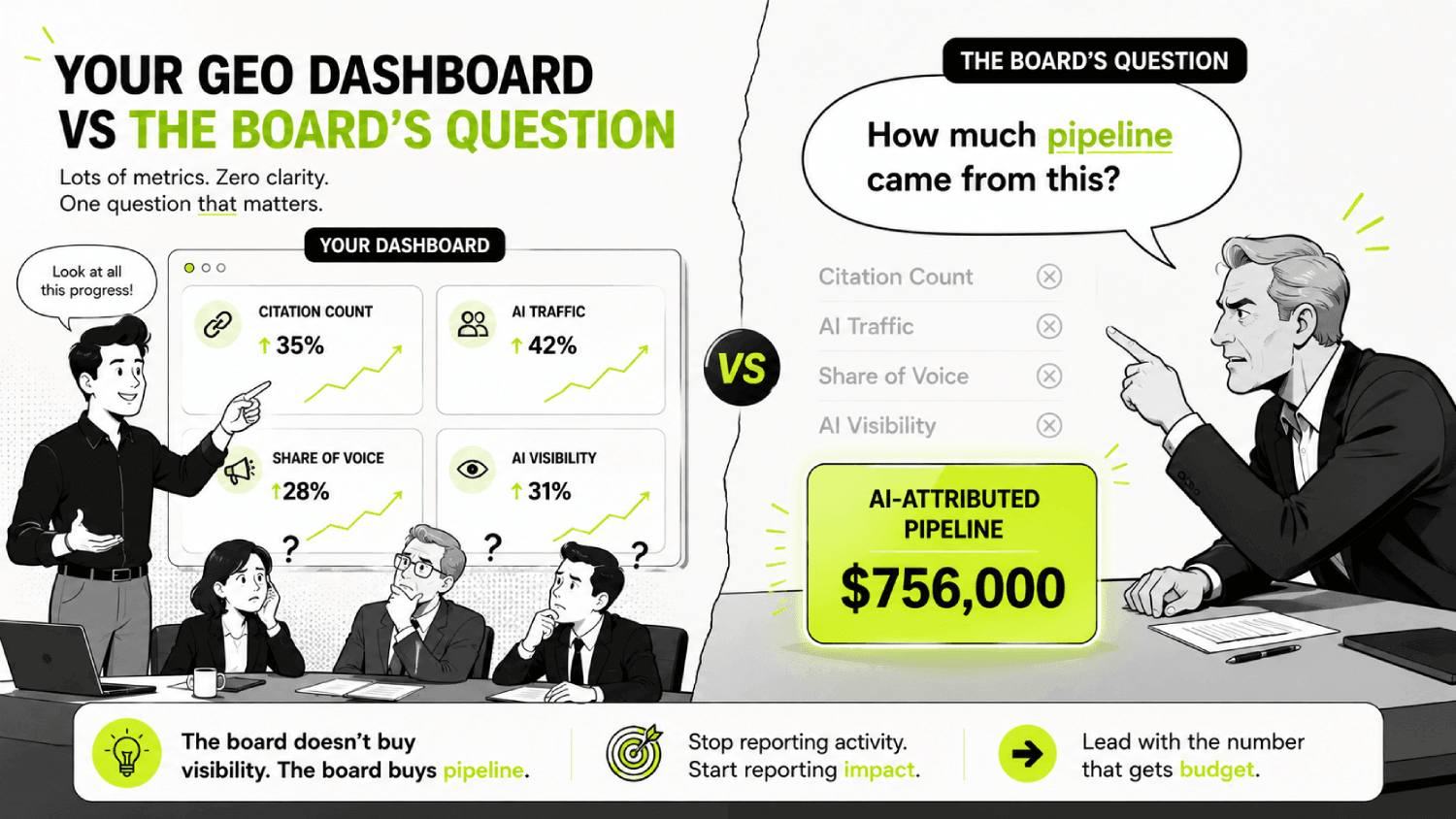
The official tooling makes this harder than it looks. On June 3, 2026, Google added a generative-AI performance view to Search Console that isolates how often your pages show up in AI Overviews and AI Mode.
The report counts impressions and nothing else. There are no clicks, no revenue, and no query data, and it reached a limited set of UK sites first. The measurement layer everyone hoped would settle the ROI question answers a different one, which is how visible am I, not how much it earned.
Internal reporting fails for a second reason. AI search work is split across SEO, content, and demand generation, so the visibility numbers sit in one team and the revenue numbers sit in another. No one owns the line that connects them, and that line is what turns LLM visibility into a budget conversation.
The Three-Tier GEO KPI Hierarchy: Board, CMO, and Team
The fix is to sort every GEO KPI by who reads it. Three tiers do the job: a four-metric board view, a CMO operating view, and the team’s input list. Each tier answers a different question, and only the top tier belongs in the boardroom.
| Tier | Who reads it | KPIs |
|---|---|---|
| Board | Directors, CFO | AI-Attributed PipelineAI Share of Voice (with month-over-month change and rank vs named competitors) Recommendation RateBrand Accuracy / Risk Score |
| Operating | CMO, head of growth | Prompt Win Rate Citation Quality Score Owned vs Earned Citation Mix Content Gap Closure Rate |
| Input | GEO and content team | Priority prompt set Schema and entity updates shipped Third-party placements live Accuracy fixes requested |
What goes on the board slide, and nothing else
Four metrics earn a place in front of the board, each readable in one line:
- AI-Attributed Pipeline is the dollar value of pipeline traced back to sessions that started in an AI tool.
- AI Share of Voice is how often you appear in answers for your priority prompts versus named competitors, reported with month-over-month change.
- Recommendation Rate is how often the AI names you as a pick rather than a passing mention.
- Brand Accuracy / Risk Score is how often AI answers describe your product correctly, and how often they get it wrong. When AI answers describe your product incorrectly, that is a fixable problem, not a permanent one.
Recommendation rate is the one to watch, because being named is not the same as being recommended. REsimpli became the top pick in ChatGPT for the real estate CRM category within 90 days, which is a recommendation-rate result, not a mention count. The 90-day window is consistent with what we have documented on how long it takes to get cited by ChatGPT.
What the CMO operates on
The operating tier is where the CMO runs the program, and it never goes upstairs in full. These four show whether the work is improving and where the effort is landing:
- Prompt Win Rate is the share of your priority prompts where you appear at all.
- Citation Quality Score weights citations by source type, since a mention in a trusted explainer is worth more than a forum link.
- Owned vs Earned Citation Mix shows how much of your visibility comes from your own pages versus third parties, a split we measured across platforms in our data on owned versus third-party citations.
- Content Gap Closure Rate tracks how fast you publish against the prompts you currently lose.
What the team reports, and the board never sees
The input tier is the work itself, tracked weekly by the people doing it:
- The priority prompt set being targeted this cycle.
- Schema and entity updates shipped to clarify who you are, the kind covered in our guide to schema markup for LLM citation.
- Third-party placements that went live.
- Accuracy fixes requested from platforms or corrected on-site.
These inputs move the operating metrics, which move the board metrics. Reporting them upward only buries the number that matters.
How to Calculate AI-Attributed Pipeline
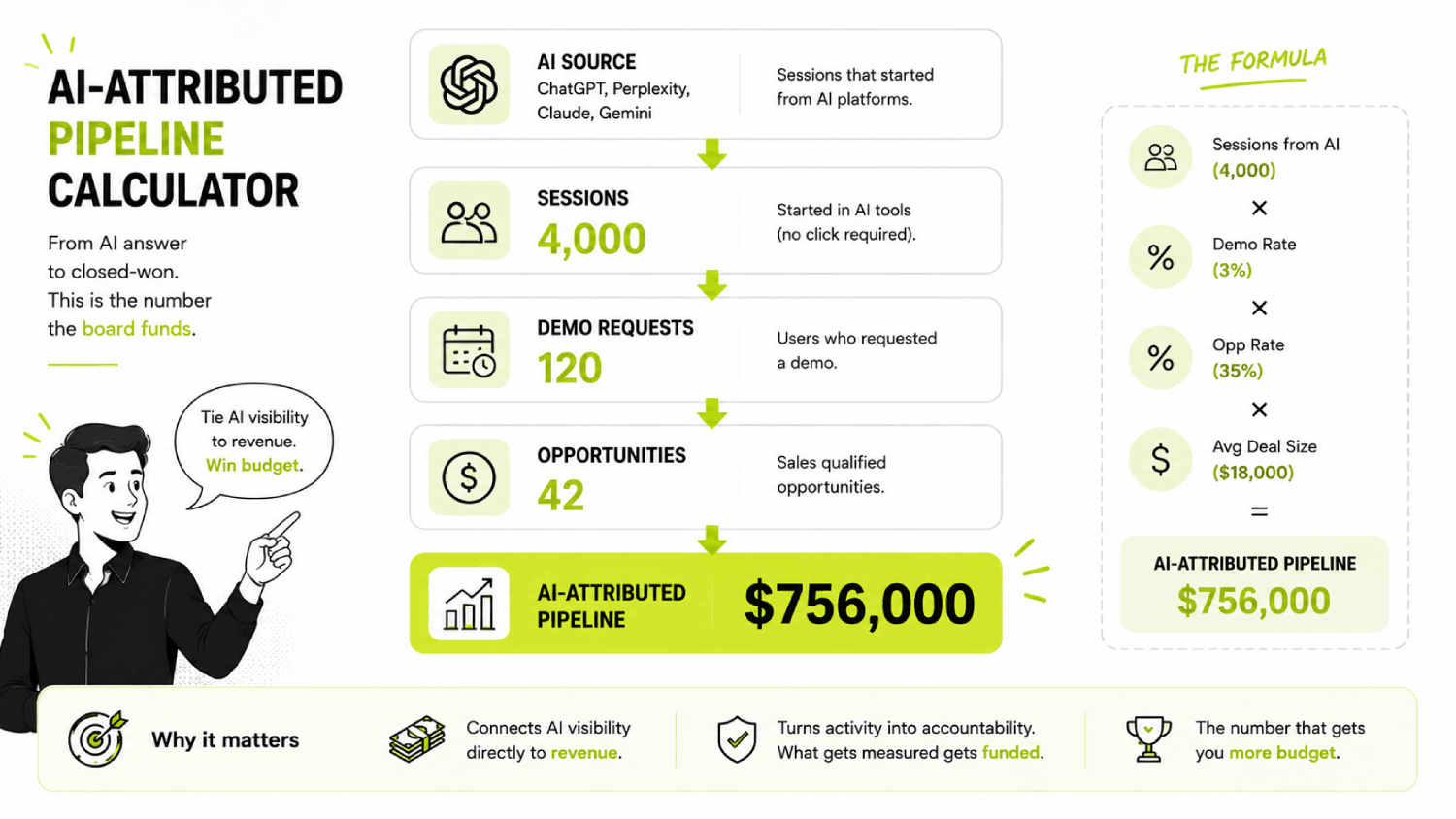
AI-attributed pipeline is the pipeline value you can trace back to a session that began in an AI tool. You build it the same way you build any source attribution, by tagging the traffic and following it to revenue.
We broke down the real ROI of GEO with live GA4 screenshots in a separate teardown if you want the long version.
The calculation, step by step
- Identify AI-sourced sessions. Tag visits arriving from ChatGPT, Perplexity, Gemini, and Copilot as their own source in GA4.
- Count the conversions. Say 4,000 AI-sourced sessions produce 120 demo requests or signups in a quarter.
- Apply your demo-to-opportunity rate. At 35 percent, those 120 demos create 42 opportunities.
- Apply average deal size. At 18,000 dollars per deal, that is roughly 756,000 dollars of pipeline influenced by AI search.
- Track closed revenue separately. Report won deals from that cohort as the hard number, and keep assisted pipeline as the leading indicator.
Illustrative math is fine for the formula. The proof has to be real, and it exists. Gumlet traces close to 20 percent of its direct monthly inbound revenue to AI-driven discovery across ChatGPT, Perplexity, Claude, and Google AI Overviews, a figure its co-founder Divyesh Patel can point to in the attribution dashboard.
That result is documented as 20% of inbound revenue from AI discovery, not estimated after the fact. The mechanics behind it, from GA4 tagging to deal-stage mapping, are the core of measuring AI search ROI.
Why AI Citation Count Is a Weak Board Metric
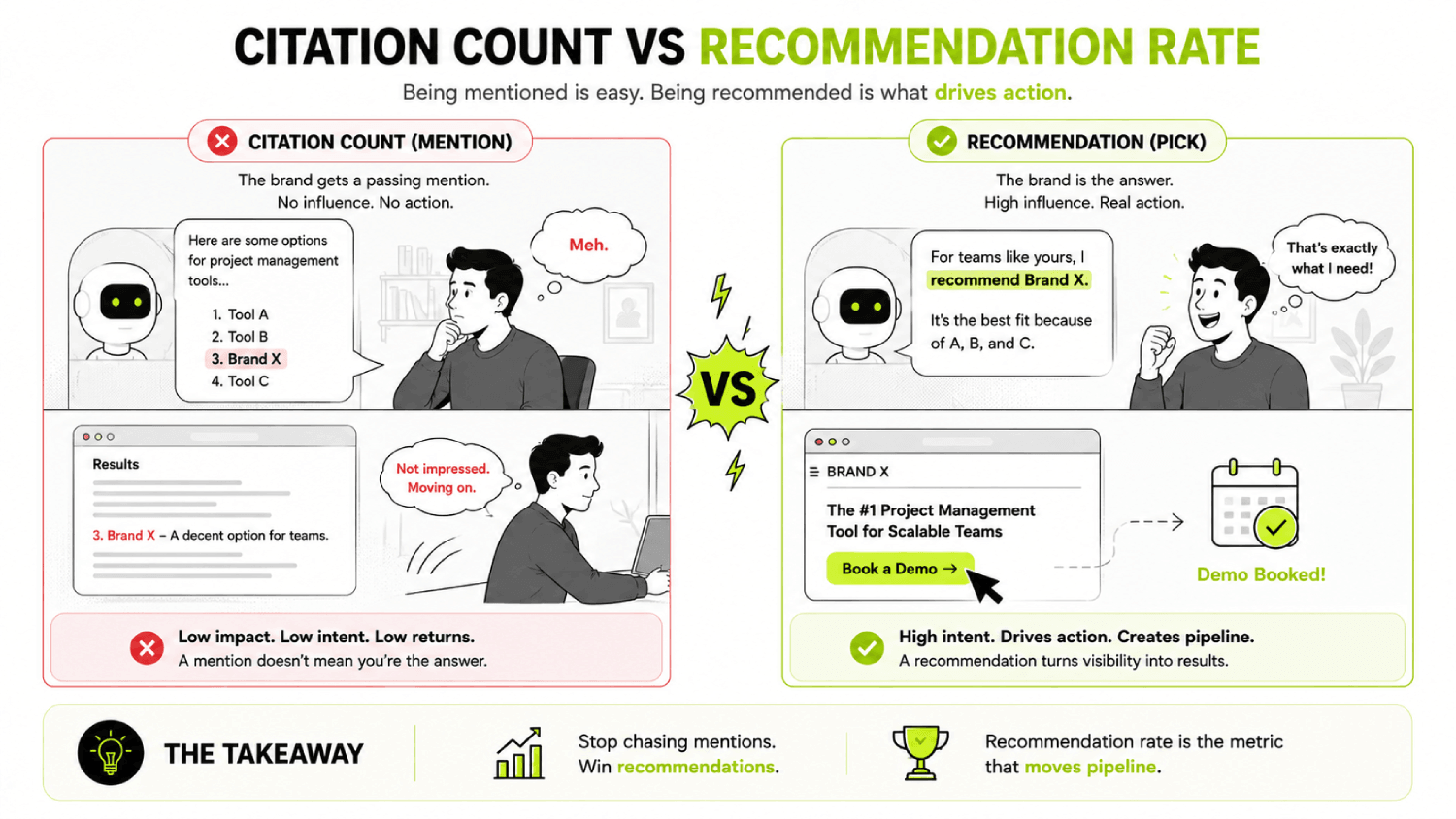
Citation count looks like a hard number, but it measures the wrong thing. A page can be cited and still add nothing to the answer the user actually reads.
A 2026 measurement study looked at more than 600 prompts across ChatGPT, Perplexity, and Google’s AI answers. It separated two events: a source getting selected as a citation, and a source getting absorbed into the response.
Those two diverge. ChatGPT cited fewer pages but relied on them more heavily, while broader citation lists often carried less weight per source. The pages that shaped answers were longer, better structured, and dense with definitions, numbers, and comparisons, which matches everything we know about how LLMs decide what to cite.
For a board metric, this finding kills raw citation count. What you want to report is the recommendation rate and citation quality, the signals that track whether your content shapes the answer rather than just appearing near it.
Citation Engineering is the practice of structuring content, entity data, and brand signals so AI models reliably cite you when buyers ask relevant questions. It runs on five levers: entity clarity, authoritative coverage, third-party corroboration, result documentation, and structured parsability. The absorption finding is why that last lever, structured parsability, carries as much weight as the first.
The One Number That Ends the Board Conversation
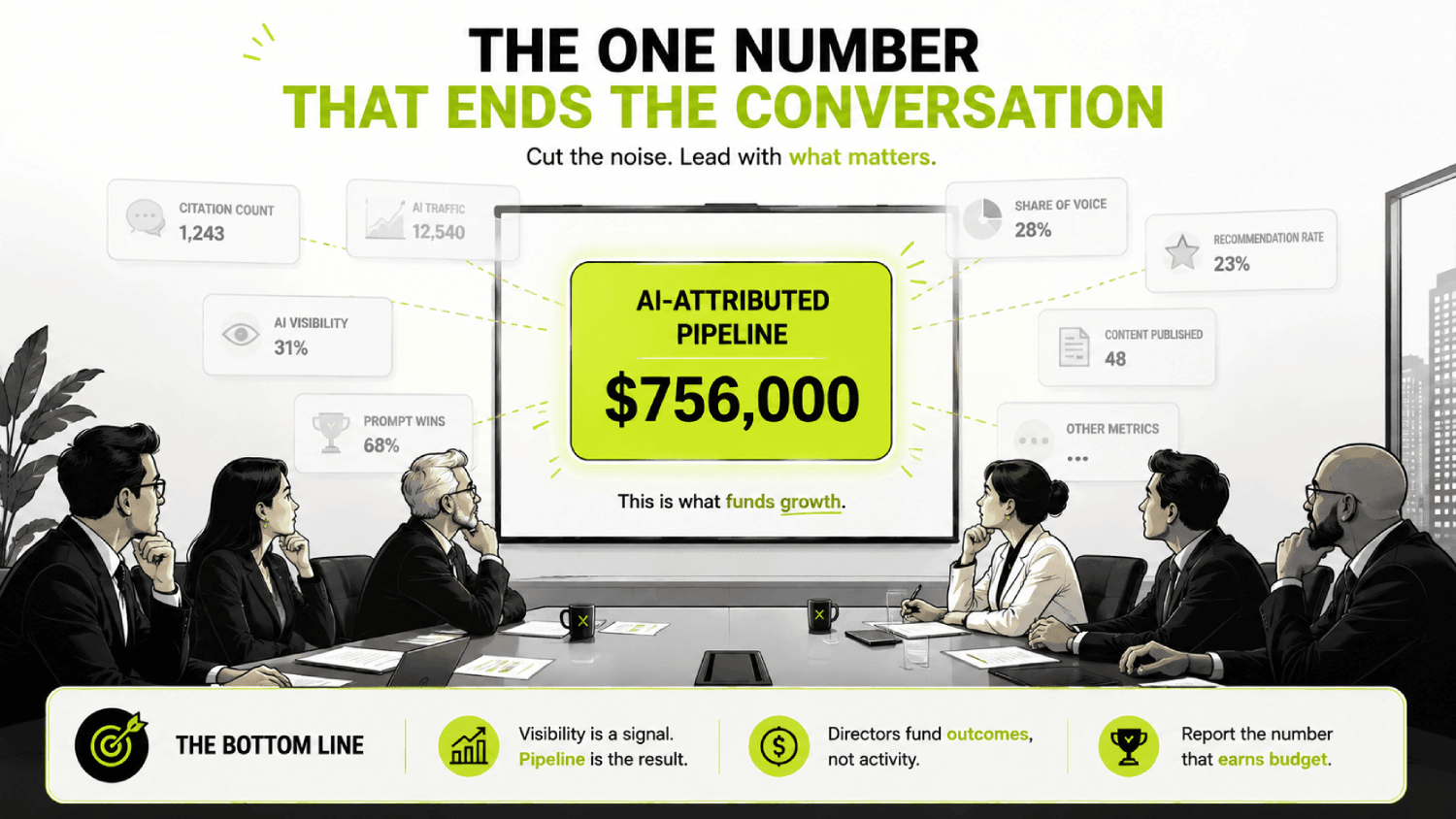
The board needs two things from GEO, which are pipeline and brand risk. Everything else is an operating detail, and the single number that closes the discussion is the AI-attributed pipeline.
You still need a visibility number to run the program between board cycles, and that is what an AI Visibility Score gives you.
An AI Visibility Score (AVS) is a 0 to 100 measure of how often and how prominently AI tools cite you across a fixed prompt set. It runs a set of buyer prompts through ChatGPT, Perplexity, Claude, and Gemini on a regular cadence, scoring a named mention highest, a linked mention next, and an in-context mention lowest. It produces one number you can track over time, owned by the operating tier rather than the board. We ran this exact methodology across our 2026 AI Visibility Benchmark of 50 B2B SaaS companies, so the scoring model is battle-tested, not theoretical.
Before your next board cycle, get the baseline. See your current AI Visibility Score in two minutes and walk into the room with the first number that connects AI search to revenue.
FAQ
What GEO KPIs should I actually report to my CMO?
Report the operating tier, not the full dashboard. That means prompt win rate, citation quality, your owned versus earned citation mix, and how fast you close content gaps for prompts you lose. These four show whether the program is improving and where the work is going. Keep the team’s task list, like schema updates and third-party placements, out of the CMO view, because those are inputs rather than outcomes. Save the four board metrics, led by AI-attributed pipeline, for leadership reporting where revenue is the headline and detail is the distraction.
How do I prove AI search is driving revenue to my board?
Tag AI-sourced sessions as their own traffic source in GA4, then follow that cohort through demos, opportunities, and closed deals. Report two figures: assisted pipeline as the leading indicator, and closed revenue as the hard number. A worked version looks like 4,000 AI sessions producing 120 demos, then 42 opportunities at your average deal size, which gives a pipeline figure you can defend line by line. The proof that this is real and not theoretical: Gumlet traces close to a fifth of its direct monthly inbound revenue to AI-driven discovery, a number sitting in its attribution dashboard.
Doesn’t Google Search Console now show my AI search performance?
Only partly. Since June 3, 2026, Search Console has a dedicated view for how often your pages appear in AI Overviews and AI Mode, which is genuinely useful. The limit is what it counts: impressions, with no clicks, no revenue, and no query data, and early access was restricted to a subset of UK sites. That tells you how visible you are, not what that visibility earned. For a board, visibility without revenue still reads as activity, so you have to build the pipeline attribution yourself inside your own analytics.
Is citation count a good way to measure GEO?
No, treat it as a soft signal. A 2026 study across more than 600 AI-search prompts showed that a page can be cited without meaningfully shaping the answer, separating citation selection from citation absorption. Some platforms cite fewer sources but rely on them heavily, so a high count can hide low influence. Report recommendation rate, which tracks how often the AI names you as a pick, and citation quality, which weights sources by trust. Those tell you whether your content shapes answers, which is exactly what counting alone cannot.
How do I track pipeline from ChatGPT and Perplexity specifically?
Set up source tagging in GA4 so referrals and self-reported visits from ChatGPT, Perplexity, Gemini, and Copilot land in their own channel. Add a “how did you hear about us” field on demo and signup forms with AI tools as options, since many AI referrals arrive as direct or branded traffic with no referrer attached. Combine the two signals to size the AI-sourced cohort, then map it to deal stages. The output is the figure your board cares about, which is pipeline and closed revenue you can attribute to AI search.
Conclusion
The teams that win the AI-search budget conversation are not the ones with the longest dashboards. They are the ones who can name a pipeline number and defend exactly how they got it.
Collapse your reporting into three tiers, put four metrics in front of the board, and lead with AI-attributed pipeline. Then get your baseline visibility number this quarter, so the next board slide opens with a figure instead of a list.
Google’s official data will keep improving, and clicks will likely reach Search Console at some point. Revenue attribution will not arrive there on its own, which means the team that builds it now owns the one report leadership keeps asking for.
Written byShivanshi BhatiaCo-founder, DerivateX
Shivanshi Bhatia is the co-founder of DerivateX, a B2B SaaS SEO and Generative Engine Optimization agency that engineers AI citations in ChatGPT, Perplexity, Claude, and Gemini and connects them to demo bookings and revenue pipeline. She runs operations and delivery, which means every audit, content brief, and published page ships through a system she built. She owns the client relationship from kickoff through reporting, so clients spend their time on decisions instead of chasing updates. She has worked in SaaS since 2019 and reviews client work before it goes live.
Reviewed byApoorv SharmaCo-founder, DerivateX
Apoorv Sharma is the co-founder of DerivateX, a B2B SaaS SEO and Generative Engine Optimization agency that engineers AI citations in ChatGPT, Perplexity, Claude, and Gemini and connects them to demo bookings and revenue pipeline. He is the author of the 2026 AI Visibility Benchmark Report and the Citation Engineering methodology. He's also the brain behind "Found On AI" and has sold 2 of his companies previously
Cited by AI