Case study: Gumlet turned ChatGPT mentions into 20% of inbound revenue. Read it →

What Content Gets Cited in Google AI Overviews (2026 Study of 1,259 Citations)

A June 2026 analysis of 1,259 citations across 20 B2B SaaS categories, and what the format mix means for where your content budget should go.


Third-party ‘best of’ lists earned 63% of every citation we logged in the Listicle Layer benchmark, our study of 1,259 Google AI Overview citations.
Search “best CRM software” on Google today and an AI Overview answers before you scroll. It names four or five tools, then lists a handful of sources it used to build that answer. If you run a B2B SaaS company, here is the part that should worry you: your own website is almost never one of those sources.
We wanted to know exactly what content gets cited in Google AI Overviews, so we logged every source across 100 commercial software searches. The website of the product being recommended supplied only 12% of the citations we counted. Google was assembling its recommendations almost entirely from pages the vendors do not control.
Most advice on getting cited repeats one page-structure checklist, or borrows blended numbers that mix every kind of search together. This study does neither. DerivateX is a GEO agency for B2B SaaS, and we ran a single-intent analysis: commercial “best software” searches only, Google AI Overviews only, every citation sorted by content format.
The finding underneath all of it is easy to say and hard to act on. On commercial queries, the pages that get cited mostly live off your own domain, and the popular tactic of publishing your own ranked list can do more harm than good. Everything below builds toward what that means for your content budget, category by category.
The full dataset, including the ghost-recommendation analysis, lives in our companion report, the Listicle Layer benchmark.
TL;DR
- We analyzed 1,259 source citations from Google AI Overviews across 100 commercial “best [category] software” searches in 20 B2B SaaS categories, logged out, in June 2026.
- Third-party “best of” lists earned 63% of all citations. The recommended product’s own website earned just 12%. We started calling it the 12% Problem.
- YouTube was the single most-cited domain in the whole study, ahead of Reddit, Gartner, and every vendor site.
- The format mix swings hard by category. Vendor sites earn 42 to 43% of citations in QuickBooks hosting and tech pack software, but only 6% in CRM and marketing automation.
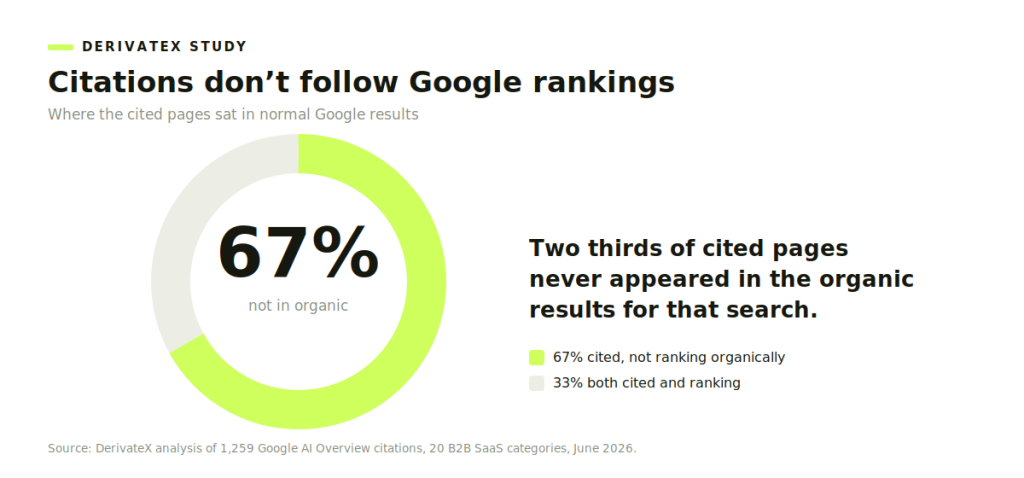
- 67% of the pages Google cited never appeared in the organic results for that same search, so ranking and citation are nearly decoupled.
- Each answer recommended about 4 to 5 products and cited about 12 sources, which works out to roughly 3 source slots feeding each recommendation.
- Writing your own “best [category]” list with your brand on top is the weakest play, and can actively cost you rankings.
How We Studied Google AI Overview Citations?
We ran 100 commercial searches shaped as “best [category] software” across 20 B2B SaaS categories in June 2026, all logged out to avoid personalization. For each search we recorded every source the Google AI Overview cited. That produced 1,259 citations, which we then sorted three ways: by content format, by whether the page also ranked in the normal Google results, and by whether it belonged to a product the answer recommended.
The 20 categories ran across very different corners of software, so the sample was not skewed toward one niche:
- Horizontal tools: CRM, HR, marketing automation, project management, business intelligence, spend management, contract management.
- Technical and ops tools: cybersecurity, ITSM, help desk, app monitoring, iPaaS and workflow automation, compliance automation.
- Specialized and vertical tools: QuickBooks hosting, video hosting, tech pack software, AI time tracking, sales engagement, social media management.
Each Overview recommended about four or five products on average and cited roughly twelve sources to support them. Almost half of the answers closed by asking the searcher a follow-up question, which tells you how conversational these commercial answers have become.
What Content Gets Cited in Google AI Overviews?
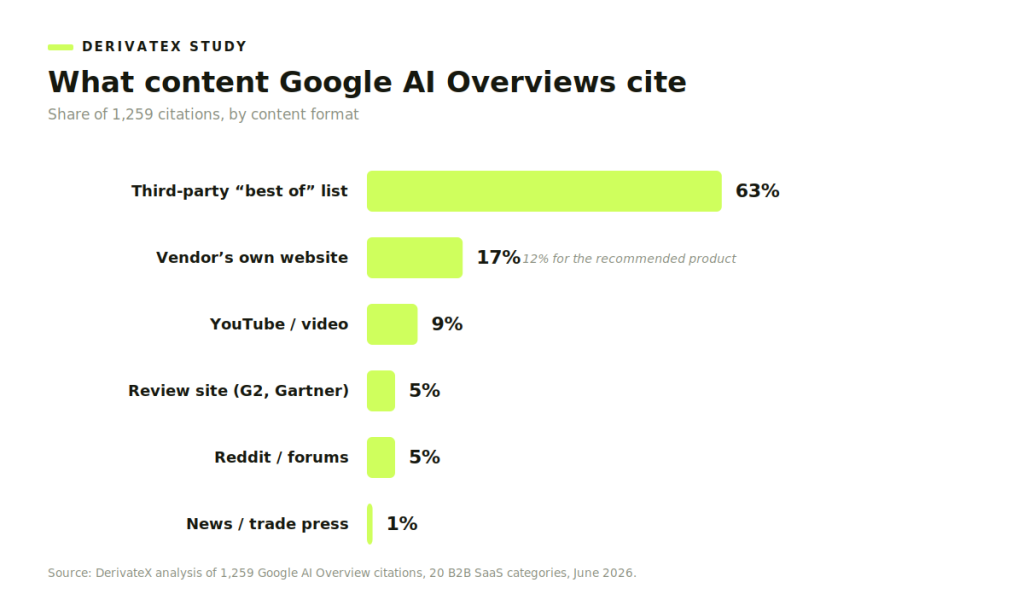
Third-party “best of” lists earned 63% of every citation we logged. Vendor-owned pages took 17%, YouTube videos 9%, review sites such as G2 and Gartner 5%, Reddit and forum threads 5%, and news or trade press just 1%. Independent editorial content, not brand-owned content, is what the AI Overview reaches for when someone is comparing software.
| Content format | Share of AI Overview citations |
|---|---|
| Third-party “best of” list | 63% |
| Vendor’s own website | 17% |
| YouTube / video | 9% |
| Review site (G2, Gartner, Capterra) | 5% |
| Reddit / forums | 5% |
| News / trade press | 1% |
Three numbers in that table deserve a closer look, because they overturn how most teams still think about AI search.
Third-Party “Best of” Lists Take 63% of Citations
When a buyer asks for the best tool in a category, Google’s AI wants a page that already did the comparison work. Roundups and “top 10” articles on independent sites match that shape exactly, which is why they took nearly two thirds of all citations. This tracks with what other 2026 analyses have reported, where comparison-style lists dominate commercial AI answers across engines.
Your Own Website: The 12% Problem
Vendor pages took 17% of citations overall, but once we isolated the product the answer was actually recommending, its own site supplied just 12%. Google tends to pull from a vendor’s own pages for narrow facts like pricing or feature details, a split we break down in first-party versus third-party citations. A separate 2026 study by Cleanlist found vendor-owned content made up under a third of ChatGPT citations too, so this is not a Google-only pattern.
YouTube Was the Most-Cited Domain
The single most-cited domain in the whole study was YouTube, with 105 citations, ahead of Reddit at 56 and Gartner at 21. Video has stopped being a nice-to-have surface for B2B software discovery. That result matches research from Goodie showing forums and video carrying real weight in B2B SaaS AI answers.
The Citation Mix Changes Dramatically by Category
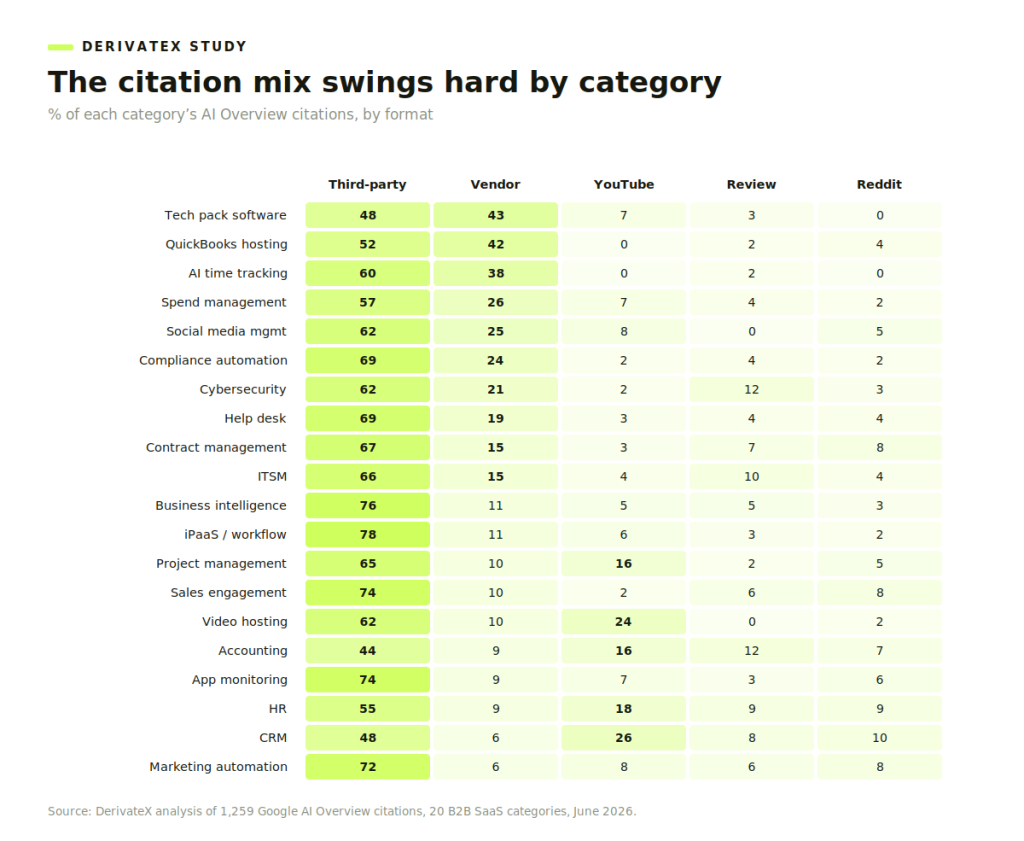
Averages hide the most useful finding in this study. The overall 63/17/9 split is a starting point, not a rule, because each category rewards a different format. In some categories your own site has a real shot at citations. In others it is nearly shut out, and video or review sites decide the answer instead.
Here is how the mix moves across all 20 categories, sorted by how much the AI leaned on vendors’ own sites.
| Category | Third-party list | Vendor site | YouTube | Review site | |
|---|---|---|---|---|---|
| Tech pack software | 48% | 43% | 7% | 3% | 0% |
| QuickBooks hosting | 52% | 42% | 0% | 2% | 4% |
| AI time tracking | 60% | 38% | 0% | 2% | 0% |
| Spend management | 57% | 26% | 7% | 4% | 2% |
| Social media mgmt | 62% | 25% | 8% | 0% | 5% |
| Compliance automation | 69% | 24% | 2% | 4% | 2% |
| Cybersecurity | 62% | 21% | 2% | 12% | 3% |
| Help desk | 69% | 19% | 3% | 4% | 4% |
| Contract management | 67% | 15% | 3% | 7% | 8% |
| ITSM | 66% | 15% | 4% | 10% | 4% |
| Business intelligence | 76% | 11% | 5% | 5% | 3% |
| iPaaS / workflow | 78% | 11% | 6% | 3% | 2% |
| Project management | 65% | 10% | 16% | 2% | 5% |
| Sales engagement | 74% | 10% | 2% | 6% | 8% |
| Video hosting | 62% | 10% | 24% | 0% | 2% |
| Accounting | 44% | 9% | 16% | 12% | 7% |
| App monitoring | 74% | 9% | 7% | 3% | 6% |
| HR | 55% | 9% | 18% | 9% | 9% |
| CRM | 48% | 6% | 26% | 8% | 10% |
| Marketing automation | 72% | 6% | 8% | 6% | 8% |
A few patterns jump out:
- Specialized and vertical categories still trust vendor sites. In tech pack software and QuickBooks hosting, vendors’ own pages earned more than 40% of citations. When a niche has fewer independent reviewers, Google leans harder on the source that has the facts.
- Crowded horizontal categories push you off your own site. In CRM and marketing automation, your own domain accounts for just 6% of citations. There is enough third-party coverage that Google rarely needs to quote you directly.
- Video is a category story, not a universal one. YouTube took 24 to 26% of citations in CRM and video hosting, but 0% in QuickBooks hosting and AI time tracking. Whether video matters depends entirely on your category.
- Review sites concentrate in trust-heavy software. Cybersecurity, ITSM, accounting, and HR sent 9 to 12% of citations to G2, Gartner, and Capterra, because buyers in those categories weigh third-party validation more heavily.
The practical takeaway is simple. Before you plan a single piece of content, find your row in this table. A cybersecurity vendor and a CRM vendor face different games, and a one-size playbook wastes budget on the wrong surface.
A Few Domains Decide Most Recommendations
Across the whole study, 720 different domains earned at least one citation, which sounds like a wide-open field. It is not. The ten most-cited domains alone soaked up about 21% of every citation, and inside any single category the concentration is far tighter than that.
The top of the list looked like this:
- youtube.com: 105 citations
- reddit.com: 56 citations
- gartner.com: 21 citations
- zapier.com: 15 citations
- g2.com: 13 citations
- forbes.com: 9 citations
The long tail of 720 domains is real, but it is mostly one-citation blogs that will not repeat. The domains that show up again and again are a small, nameable set: a handful of publishers, the big review platforms, YouTube, and Reddit. Your job is not to earn a mention somewhere on the internet. It is to earn a place on the specific ten or so domains Google already trusts in your category.
Citations Don’t Follow Google Rankings
Two thirds of the pages Google’s AI Overview cited, 67% of them, never appeared in the organic results for that same search. Ranking first stopped guaranteeing a citation, and being left out of the Overview no longer means your SEO is weak. The two systems draw from pools that overlap only partway. We measured this in full in our Google AI Overview vs SERP benchmark.
Google’s AI splits a search into several smaller questions, then pulls pages that answer each fragment well. A page can win a citation by answering one of those sub-questions even if it never ranked for the headline term. One 2026 analysis reported by Stridec found that close to a third of cited pages did not sit anywhere in the top 100 for the original query.
This cuts both ways for your strategy. Ranking work alone will not carry you into AI answers, and a page that never cracked the top ten can still get cited if it answers a specific buyer question cleanly. Treat ranking and citation as two connected but separate goals, with their own tactics.
You Are Competing for About Three Source Slots per Recommendation
Here is the math that raises the stakes. Across the study, each AI Overview recommended about 4.5 products and cited about 12.6 sources. Divide one by the other and you get roughly 2.8 sources feeding each product the AI names.
That is a brutally small window. For every tool Google recommends, only about three pieces of content are doing the work of justifying it. If none of those three mention your product, you are not in the recommendation, no matter how much content sits on your blog. The goal is not volume. The goal is to occupy those three slots in your category, which almost always live on third-party pages.
A Worked Example: “Best CRM Software”
Aggregates are convincing, but one real answer makes the pattern concrete. Take the search “best CRM software,” one of the most competitive commercial queries in B2B software.
The Google AI Overview recommended five tools: Copper, Monday, Pipedrive, Salesforce, and Zoho. To justify those picks, it cited eight sources. Here is where those citations came from:
- YouTube led, with video reviews and walkthroughs supplying the largest share of citations for the answer.
- Reddit followed, with community threads comparing CRMs feeding directly into the recommendation.
- Independent publishers like Forbes and third-party comparison blogs filled most of the rest.
- One vendor page made it in, and it was not one of the five recommended products.
For CRM overall across our sample, the format mix came out to third-party lists 48%, YouTube 26%, Reddit 10%, review sites 8%, and vendor sites just 6%. In other words, a CRM vendor could publish the best “why we are the best CRM” page on the internet and still watch Google build its answer almost entirely from video, forums, and independent lists. The recommendation was assembled off the vendors’ domains, one cited source at a time.
Why Google AI Overviews Rarely Cite Your Own Website?
Google’s AI Overview treats a vendor’s own site as a biased narrator on “best software” questions, so it prefers pages that weigh several tools with visible reasoning. That is the mechanical reason your domain earned only 12% of citations across the study. Your pages still matter, but mostly as a fact source the model checks, not as the voice that picks the winner.
Don’t Miss: Here’s how LLMs decide what to cite
This is the hardest idea for a founder to accept, because it runs against a decade of SEO instinct. You spent years making your site the most authoritative page in your category. The AI Overview reads that authority as self-interest and quietly routes around it, unless your category is one of the vendor-heavy niches from the table above.
Why Writing Your Own “Best [Category]” Listicle Backfires
Publishing a “best [category] software” page with your own brand at the top is the weakest citation play available. A 2026 study reported by Search Engine Land analyzed 100 B2B software queries and found that Google often cited these self-promoting lists while recommending a competitor instead, in about seven out of ten cases. You get the citation and your rival gets the sale.
It gets worse than a wasted citation. That same research tracked sites leaning heavily on self-ranked lists and watched their organic visibility slide, with declines that deepened during Google’s 2026 core update. Pages built to flatter the brand rather than help the reader are aging badly in both search systems at once.
There is a legal edge here too. When a company presents its own ranked list as if it were an independent review, and does not disclose that relationship, it can run into the FTC’s rules on consumer reviews. A citation is never worth a compliance problem.
What the Standard “Get Cited” Advice Gets Wrong
Nearly every guide on this topic gives the same checklist: front-load your answer, strengthen your author bios and E-E-A-T signals, add FAQ schema, write in confident declarative sentences. None of that is wrong. It is just aimed at the 12% of citations you can win on your own domain, and silent about the 88% you cannot. The real selection signals go beyond E-E-A-T.
Optimizing your own pages harder does almost nothing to get you onto the third-party lists, review profiles, Reddit threads, and videos that supply most citations. That work is real, and you should do it, but treat it as the smallest lever, not the main one. The teams winning AI search are the ones who accept that most of the work happens off their site.
Where B2B SaaS Should Actually Invest to Get Cited
If third-party lists drive 63% of citations and your own site drives 12%, the math points somewhere uncomfortable. Your highest-return work is earning a place on the independent pages Google already cites in your category, then backing it with review-site profiles, real community presence, and video. Optimize your own pages last, for the slice you can realistically win.
Here is the priority order, mapped to the format mix.
1. Get Placed on the Third-Party Lists AI Already Cites
Start by running your own “best [category] software” search and writing down every domain the AI Overview cites. Those are the exact pages you want your product added to, through outreach, contributed data, or earned inclusion . This is far more targeted than chasing high-authority links at random, and it works because those domains repeat across queries in your category. Our SaaS link-building playbook covers the placement mechanics.
2. Build Review-Site and Directory Presence
Review platforms like G2, Capterra, and Gartner showed up as citations in their own right, and they feed the third-party lists on top of that. This matters most in trust-heavy categories: cybersecurity, ITSM, accounting, and HR all sent 9 to 12% of citations to review sites. A current, detailed profile with recent reviews gives the AI a clean, structured source to trust.
3. Earn Reddit and Community Mentions Honestly
Reddit supplied about 5% of citations overall and far more in some categories, reaching 10% in CRM and 8 to 9% in sales engagement, contract management, HR, and marketing automation. The catch is that self-promotion gets you downvoted and ignored. Sustained, genuinely useful participation in the threads your buyers land on is what turns into the mentions AI models read as consensus.
4. Treat YouTube as a Citation Surface
YouTube was the most-cited domain in the study, and in CRM, video hosting, HR, accounting, and project management it took 16 to 26% of citations. If you sell into one of those categories and have no video presence, you are leaving your most reliable surface empty. You do not need production polish. You need clear product walkthroughs, honest comparisons, and category explainers a model can lift. This is how Gumlet turned off-site AI mentions into pipeline.
5. Structure Your Own Pages for the Slice You Can Win
Your own site still earns citations, mostly for concrete facts, so make those facts easy to extract. Lead each section with a direct answer, publish real pricing and feature tables, and keep pages current. This matters far more in vendor-heavy niches like QuickBooks hosting and tech pack software, where your own site can earn 40% or more of citations, than in CRM, where it earns 6%. We saw this firsthand with Verito, a hosting provider that became the pick AI names.
Does This Hold for ChatGPT, Perplexity, and Claude?
Our study measured Google AI Overviews only, so I want to be careful about what it does and does not prove. Independent 2026 datasets suggest the same off-site tilt holds on Perplexity, Gemini, and Claude, where the large majority of product-query citations point away from the vendor’s own site. ChatGPT is the interesting exception.
A 2026 study from VisibleIQ found that ChatGPT sent most of its product-query citations straight to the vendor’s own pages, while the other three engines sent most of theirs elsewhere. If that pattern holds, your own pages matter more for ranking in ChatGPT and third-party presence matters more everywhere else. The safer read is to build for both rather than betting on one engine’s current behavior.
We mapped how far the two engines diverge in the Agreement Gap benchmark.
What This Study Does Not Prove
Good data comes with honest edges, so here are ours. This is a snapshot of 100 queries across 20 categories, captured in a single window in June 2026, on Google AI Overviews alone. It is a clear read on commercial “best software” intent, and it should not be stretched into claims about informational searches, other engines, or every category on earth.
Two limits are worth stating plainly:
- AI citations shift over time. Other 2026 research that sampled the same query type across several months watched Reddit’s share climb sharply. Any single snapshot, including ours, captures a moving system. We plan to re-run this study to track how the format mix moves.
- Category samples vary in size. Larger categories like project management and app monitoring carry more citations than smaller ones like AI time tracking, so treat the biggest swings as directional, not precise to the decimal.
Even with those caveats, the direction is hard to argue with. On commercial software searches, most of the citation surface sits off your own domain, and the split by category is large enough to change how you plan.
How to Check What Content Gets Cited in Your Category
You can run a version of this study for your own category in under an hour:
- List your top three or four “best [category] software” searches.
- Run each in Google, logged out, and open the AI Overview.
- Record every source it cites, with the domain and the format.
- Group the results by format and by domain.
- Read the pattern. If lists dominate, chase inclusion. If review sites appear, fix your profiles. If Reddit or YouTube show up, build there.
Once you can see whether your category rewards lists, review sites, Reddit, or video, your next three months of content plan almost writes itself. You stop guessing and start targeting the surfaces the AI already trusts.
If you would rather not track it by hand, pick from the GEO tracking tools we rate.
FAQ
What content gets cited most in Google AI Overviews?
Third-party “best of” lists get cited most. In our study of 1,259 citations they accounted for 63% of the total, far ahead of vendor sites at 17% and video at 9%. Independent comparison content is the format Google’s AI reaches for on commercial software searches.
Does Google AI Overview cite my own website?
Sometimes, but less than you would expect. The site of the product being recommended supplied only 12% of citations in our data, usually for factual details rather than the recommendation itself. In vendor-heavy niches like QuickBooks hosting it can reach 40%, while in CRM it drops to 6%.
Why does Google recommend my competitor but cite my page?
A citation and a recommendation are different outcomes. Research on B2B software queries found Google citing a brand’s own list while recommending a rival in about seven of ten cases. Being used as a source does not mean being chosen as the answer.
Do I need to rank on page one to get cited in AI Overviews?
No. Two thirds of the pages cited in our study did not appear in the organic results for that search at all. Ranking helps, but AI Overview citations draw from a wider and partly separate pool of pages.
Are listicles good or bad for AI search?
Third-party listicles are excellent, your own self-ranking listicle is risky. Getting included on independent “best of” lists is one of the strongest moves available. Publishing your own list with your brand on top tends to get cited without getting recommended, and can hurt your rankings.
What is the most cited website in Google AI Overviews?
In our dataset it was YouTube, with 105 citations, ahead of Reddit and Gartner. Video and community content carry more citation weight in commercial answers than most B2B teams assume, especially in CRM, HR, and video hosting.
How long does it take to get cited in Google AI Overviews?
There is no fixed timeline, because citation follows presence rather than a countdown. Once your product appears on the third-party lists, review profiles, and video that Google already cites in your category, citations tend to follow within weeks to a couple of months. The slow part is earning that off-site presence, not the citation itself.
Conclusion
The uncomfortable takeaway is that a content budget aimed only at your own website is aimed at 12% of where AI citations actually come from, and in some categories far less than that. On commercial searches, the pages that get cited in Google AI Overviews mostly sit on domains you do not own, from third-party lists to review sites to YouTube. That is not a reason to stop publishing. It is a reason to change where the effort lands.
The shift is from producing more of your own pages to earning a place on the handful of domains Google already trusts in your category. Find your row in the category table, identify the ten or so domains that decide your recommendations, and go win a place on them. Do that, and you show up in the answer buyers read before they ever reach your site.
Written byAyush SharmaVP, SEO & AI Search, DerivateX
VP, SEO & AI Search at DerivateX. We're a B2B SaaS SEO and Generative Engine Optimization agency that engineers AI citations in ChatGPT, Perplexity, Claude, and Gemini and connects them to demo bookings and revenue pipeline.
Reviewed byApoorv SharmaCo-founder, DerivateX
Apoorv Sharma is the co-founder of DerivateX, a B2B SaaS SEO and Generative Engine Optimization agency that engineers AI citations in ChatGPT, Perplexity, Claude, and Gemini and connects them to demo bookings and revenue pipeline. He is the author of the 2026 AI Visibility Benchmark Report and the Citation Engineering methodology. He's also the brain behind "Found On AI" and has sold 2 of his companies previously
Cited by AI