Case study: Gumlet turned ChatGPT mentions into 20% of inbound revenue. Read it →

Reciprocal Rank Fusion, Explained: How AI Search Merges Results to Choose Citations

The rank-merging formula that decides which sources qualify to be cited, why it rewards consistency over a single #1 ranking, and how to engineer your content to win it.


TL;DR
- Reciprocal Rank Fusion (RRF) is the algorithm AI search engines use to merge several ranked lists of results into one final list, and that final list becomes the pool ChatGPT and Perplexity pull citations from.
- The formula is simple: each source scores 1 divided by (k + its rank) in every list it appears in, and those scores add up. The constant k is almost always set to 60.
- RRF looks only at rank position, not raw relevance scores, so it does not read your Google ranking, your backlinks, or your domain authority as inputs.
- Because scores add up across lists, a source that places decently in many related searches beats a source that places first in only one. Consistency wins over dominance.
- Modern AI answers start with query fan-out: one prompt becomes many sub-queries. RRF fuses the results of all of them, which is why covering a whole topic beats owning a single keyword.
- For a marketer, the lever is breadth. Show up in the top results across the full set of questions a buyer asks about your category, and RRF does the rest.
A marketing lead watches a competitor get named inside ChatGPT for the exact category their own product leads on. The competitor has weaker Google rankings, fewer backlinks, and a slower product.
On paper, the marketing lead’s company should win. Inside the AI answer, it does not appear at all. This happens every day, and most teams file it under “AI is a black box” and move on.
The black box has a name, and it is not magic. Before an AI engine writes a single word of its answer, it runs a mechanical step that decides which sources even qualify to be cited. That step merges several different search results into one ranked list using a formula called Reciprocal Rank Fusion. The sources that survive the merge get considered. The ones that do not are invisible, no matter how good the product is or how well it ranks on Google.
Here is what most people miss: they optimize to rank first for one keyword, when the merge rewards something completely different. This piece breaks down what Reciprocal Rank Fusion is, how the formula actually works with a worked example you can rebuild in a spreadsheet, why it quietly favors brands that show up everywhere over brands that dominate one spot, and what to change in your content strategy because of it. By the end, you will be able to look at your own category and predict which brands the merge is set up to reward. Start with the mechanism itself.
What is reciprocal rank fusion?
Reciprocal Rank Fusion (RRF) is a method for combining several ranked lists of search results into one unified ranking, using only each result’s position in each list. It was introduced by Gordon Cormack and colleagues in a 2009 research paper, and it has since become the default way to merge results in search systems like Elasticsearch, Azure AI Search, MongoDB Atlas, OpenSearch, and Weaviate.
The reason it exists is a scaling problem. Modern search runs more than one method at once. A keyword search (often BM25) scores how well the exact words match. A semantic search (vector search) scores how close the meaning is, even when the words differ.
These two methods produce scores on totally different scales, so a keyword score of 12.4 and a similarity score of 0.85 cannot be compared directly. RRF sidesteps the whole problem by throwing away the raw scores and keeping only the rank order. Rank 1 is rank 1 whether it came from keyword or semantic search, and ranks are always comparable.
That single design choice is why RRF spread so fast. It needs no calibration, no normalization, and no training data. It handles a source that appears in one list but not another without breaking. For a system builder, it is the cheap, reliable option. For a marketer, it is the invisible referee deciding whether your page makes the cut.
How the RRF formula actually works, with a worked example
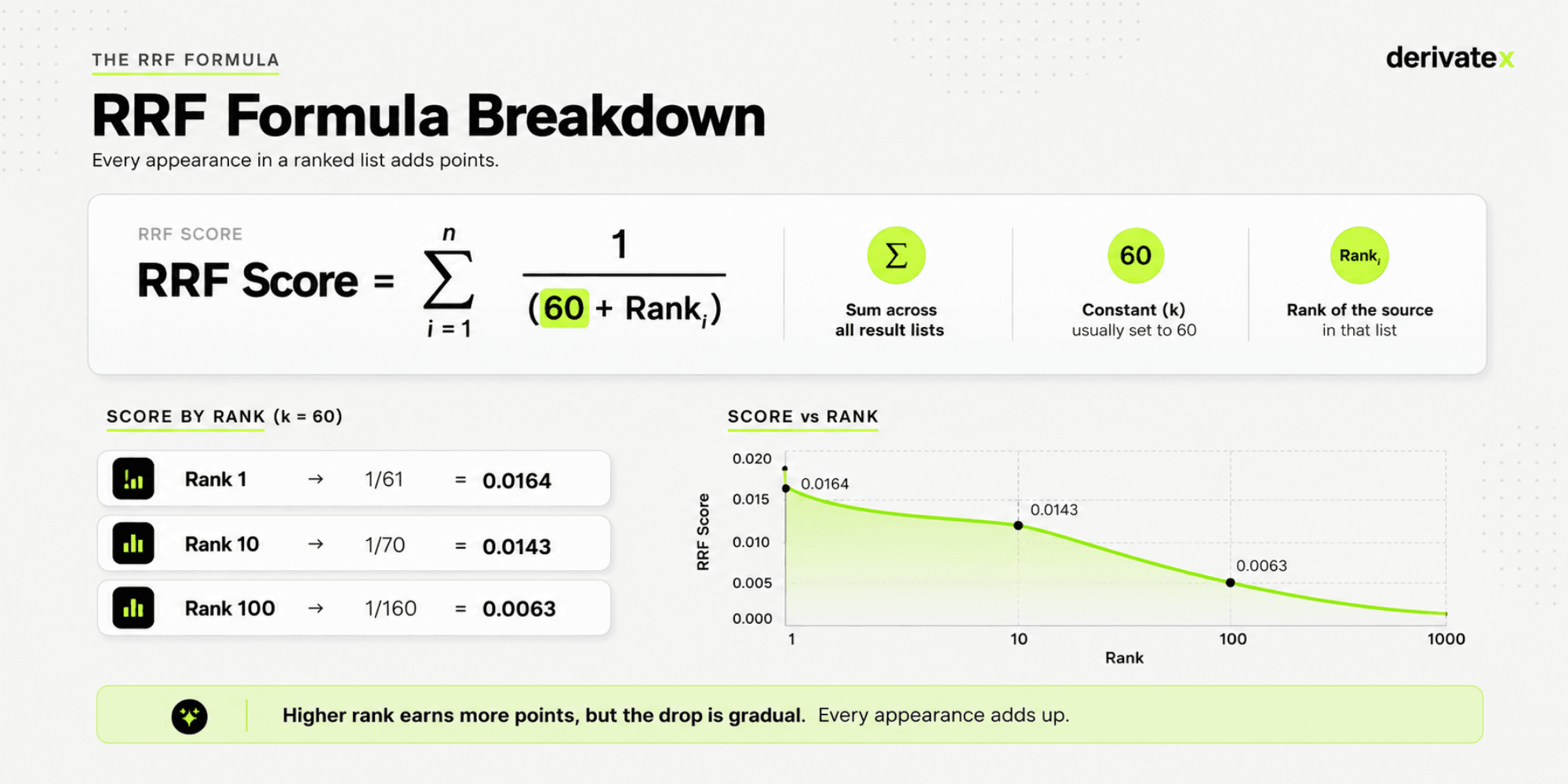
The RRF formula gives every source a score of 1 divided by (k + rank) for each list it appears in, then adds those scores together. The source with the highest total wins the merged ranking. The k is a smoothing constant, and it is almost always set to 60.
The formula in plain English
Written out, the RRF score for a document is the sum, across every ranked list, of 1 / (k + rank), where rank is that document’s position in the list and k is 60. A source at rank 1 earns 1 / (60 + 1), or about 0.0164. A source at rank 10 earns 1 / (60 + 10), or about 0.0143. A source at rank 100 earns roughly 0.0063.
Notice how gentle that decline is. The gap between rank 1 and rank 10 is tiny, only about 15 percent. That flatness is the entire personality of the algorithm. RRF does not care much whether you were first or tenth in any single list. It cares whether you keep showing up. A high k like 60 deliberately flattens the advantage of being number one, so consensus across lists matters more than a single top placement.
A worked example you can rebuild in a spreadsheet
Watch what happens when three sources get merged from two different searches, a keyword search and a semantic search. This is the whole concept in one table.
| Source | Keyword search rank | Semantic search rank | RRF score (k=60) | Final position |
| Page A | 1 | not present | 1/61 = 0.0164 | 3rd |
| Page B | 10 | 8 | 1/70 + 1/68 = 0.0290 | 1st |
| Page C | 4 | 5 | 1/64 + 1/65 = 0.0310 | 1st (tie-break) |
Page A ranked first in keyword search and lost. It scored well in one list and did not appear in the other, so its single contribution of 0.0164 could not beat sources that showed up in both. Page C, which placed a modest 4th and 5th, wins because it accumulated points in both lists. Page B, present at rank 10 and rank 8, still beats the keyword champion.
The merge rewards the source that is present in more lists, not the source that peaks highest in one. You can build this table in a spreadsheet with the formula below and watch the ordering flip in real time.
=1/(60+rank)Why AI search engines use RRF to merge results
AI search engines use RRF because they run hybrid search, combining keyword and semantic retrieval, and RRF is the cleanest way to reconcile two rankings that measure relevance in different units. A buyer’s question rarely matches your page word for word, so semantic search catches meaning while keyword search catches exact terms. Neither alone is enough.
Hybrid search is now standard infrastructure. Elasticsearch, Azure AI Search, MongoDB Atlas, OpenSearch, and Weaviate all ship RRF as their built-in fusion method, which tells you how settled the choice is. When a system needs to combine a keyword list and a vector list, RRF is the default answer because it is fast to compute and does not fall apart when one retriever returns a strange outlier score.
There is a second, subtler reason it fits AI answers specifically. RRF handles more than two lists gracefully. Its scores simply keep adding, so a system can fuse the results of five, ten, or twenty separate searches into one ranking without any extra math. That property turns out to matter enormously once you understand how AI engines actually query, which is the next piece of the puzzle.
How reciprocal rank fusion decides which sources ChatGPT and Perplexity cite
When an AI engine answers a question, it usually does not run one search. It expands your prompt into many sub-queries, runs a search for each, and fuses all those results with RRF into a single citation pool. This expansion step is called query fan-out, and it is the reason RRF sits at the center of AI citations.
Picture a buyer asking, “what is the best video hosting platform for a SaaS product.” The engine may quietly fan that out into “private video hosting for business,” “video hosting with an API,” “Wistia vs Vimeo for companies,” “secure video streaming platform,” and several more. Each sub-query returns its own ranked list. RRF merges every list into one, and the top handful of that fused list becomes the set of sources the model is allowed to cite from. A page that never appears in any of those sub-query lists is not in the running, full stop.
The full pipeline of retrieval, selection, and attribution is worth understanding on its own, and there is a companion breakdown of how LLMs decide what to cite that maps the surrounding stages.
One honest caveat belongs here. The exact fusion method inside each commercial engine is not always publicly confirmed, and engines differ. DerivateX research makes that difference concrete. In the Agreement Gap benchmark, which logged 402 citations across ChatGPT and Google AI Overviews, the two engines named the same tools around a third of the time but cited the same web pages only about 4 percent of the time on open-ended queries.
Roughly three quarters of the pages Google AI Overviews treated as primary evidence never showed up in ChatGPT at all. Different engines are fusing different lists, which means the merged pool you need to enter is not one pool but several, one per engine.
Why showing up everywhere beats ranking number one once
The math of RRF pays out to breadth. A brand that lands in the top results for many related sub-queries collects more reciprocal-rank points than a brand that ranks first for a single query and is absent from the rest. This is the insight that flips how a smart team plans content.
Go back to the flatness of the curve. Being rank 1 instead of rank 10 buys you a rounding error. Being present in a second, third, and fourth sub-query list adds a whole new score each time. Query fan-out multiplies the number of lists you can appear in, and RRF adds up every appearance. The brand engineering for AI visibility is not chasing one trophy keyword. It is trying to be a credible presence across the entire question space of its category.
DerivateX has seen this pattern hold in the field. Gumlet, a video and image infrastructure company, went from no AI presence to attributing roughly 20 percent of its direct inbound revenue to LLM discovery, and in the Agreement Gap dataset Gumlet was one of the few tools that both ChatGPT and Google AI Overviews named repeatedly across the category, appearing consistently rather than winning a single lookup.
The Gumlet case study shows the mechanics. The point for RRF is narrow and important: consistent, category-wide presence is exactly what the fusion step is built to reward, and it is reproducible.
What reciprocal rank fusion means for your content strategy
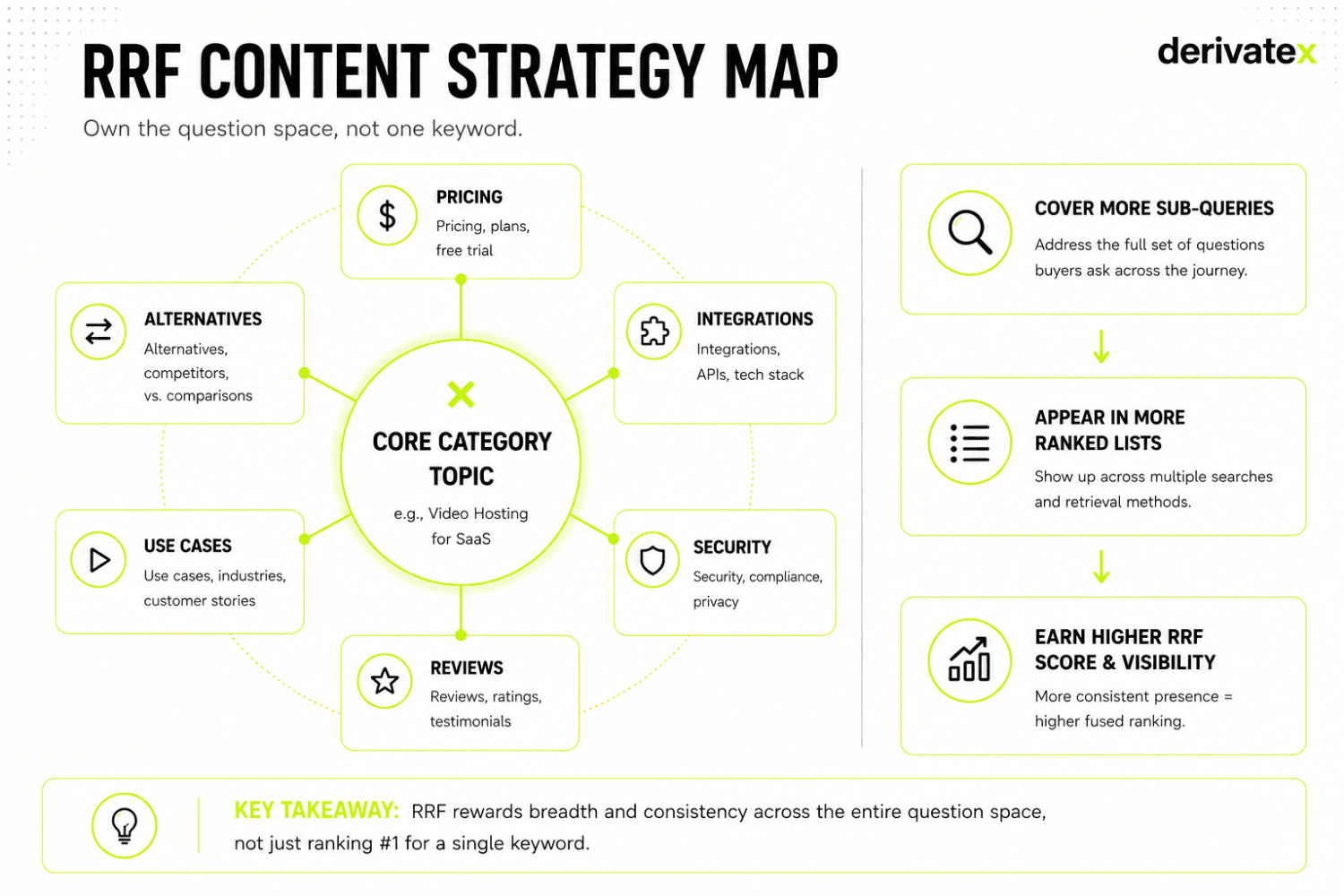
If RRF rewards presence across many sub-queries, then the strategy is to own the whole cluster of questions a buyer asks, not one head keyword. That reframes the entire content plan around coverage and retrievability instead of a single ranking.
Three moves follow directly from the mechanism, and none of them is generic advice:
- Map and cover the sub-query space, not the keyword. For every core buyer topic, list the fifteen to thirty adjacent questions an engine could fan out into, then make sure you have a genuinely useful, retrievable answer for each. Winning ten of those at rank 8 beats winning one at rank 1.
- Earn presence in both the keyword list and the semantic list. Keyword retrieval rewards using the exact terms buyers use, so name the category, the competitors, and the use cases plainly. Semantic retrieval rewards clear, self-contained explanations of concepts, so define what you do in language a model can lift cleanly. You need to appear in both to compound your RRF score.
- Build presence in the sources each engine actually fuses. The Agreement Gap data showed ChatGPT drew 25 percent of its citations from Reddit and community forums while Google AI Overviews sent 45 percent of its citations to vendor and comparison pages. A source universe you ignore is a set of ranked lists you never enter.
A copy-paste diagnostic: map your own fused footprint
You can approximate your brand’s presence across a fused citation pool without any special tooling. Pick one core buyer topic, then run this sequence through ChatGPT and Perplexity and record where you appear.
- Ask the broad discovery question your category owns, for example “best [category] tools for [buyer type] in 2026,” and note whether your brand is named and which sources are cited.
- Ask five to eight narrower versions that an engine would fan out into: a “vs” comparison naming two rivals, a “how do I [job to be done]” question, a “[category] with [specific feature]” question, and a pricing or alternatives question.
- For each query, log two things: was your brand mentioned, and was your domain or a page about you cited as a source.
- Count the share of sub-queries where you appeared at all. That percentage is your rough footprint across the fused pool, and it predicts your citation odds far better than your rank on any single term.
- Repeat the whole set on a second engine, because the source lists differ, and compare the two footprints side by side.
If your brand shows up in one query out of eight, no single ranking fix will save you, because the merge never had enough of your appearances to add up. If you want a larger ready-made set of audit prompts, the 50 ChatGPT prompts to audit your AI visibility library extends this diagnostic.
RRF vs PageRank vs your Google ranking
Reciprocal Rank Fusion is not PageRank and does not read your Google position. PageRank scores authority from who links to whom. RRF ignores links entirely and looks only at where a document sits in each ranked list it is merging. The two answer different questions and run at different moments.
This distinction matters because it kills a common assumption. Teams often believe that if they rank first on Google, they are safe in AI answers. RRF has no field for your Google position. It fuses whatever ranked lists the AI engine’s own retrieval produced for its own fanned-out sub-queries, and your Google rank is not one of those inputs. DerivateX’s own market data reflects this disconnect: across its client research, only about 12 percent of the URLs ChatGPT cites also rank in Google’s top 10. Winning Google and winning the RRF merge are related but separate games, and content built for one is not automatically eligible for the other.
Frequently asked questions
What is reciprocal rank fusion in simple terms?
Reciprocal Rank Fusion is a way to combine several ranked lists of search results into one final list. Instead of comparing the original relevance scores, which sit on different scales and cannot be compared, it looks only at each item’s position in each list. Every item earns points based on its rank, the points add up across all the lists, and the item with the most total points ends up on top. It is popular because it is simple, needs no tuning, and reliably promotes results that many different searches agree are relevant.
Why is k usually set to 60 in the RRF formula?
The k value is a smoothing constant that controls how much being ranked first matters. A small k makes the top spot enormously valuable, while a large k flattens the difference between high and low ranks so consensus across lists wins. The value 60 comes from the original 2009 research by Cormack and colleagues, who tested it on standard search datasets and found it generalized well. It has since become the default across search engines. You can tune it, but 60 is the reliable baseline most systems keep.
Does reciprocal rank fusion use my Google ranking as a signal?
No. RRF only reads the rank positions inside the ranked lists an AI engine generates from its own retrieval, typically a keyword search and a semantic search across its index. Your Google position is not one of those inputs. This is why a page can rank first on Google and still never appear in an AI answer. In DerivateX’s market data, only around 12 percent of the URLs ChatGPT cites also rank in Google’s top 10, which shows how loosely the two systems are connected.
Can a marketer actually influence reciprocal rank fusion?
Yes, indirectly, by influencing the ranked lists that feed the merge. You cannot change the formula, but you can change how often and how highly your content appears across the many sub-queries an engine fans out into. That means covering the full cluster of questions in your category, using the exact terms buyers use so you enter keyword retrieval, and writing clear self-contained explanations so you enter semantic retrieval. The more lists you appear in, the more reciprocal-rank points accumulate, and the likelier you land in the citation pool.
Is RRF the same as reranking?
No, though they often run one after another. RRF is a fusion step that merges multiple ranked lists into one using rank position alone, and it needs no model. Reranking is a later, heavier step where a separate model re-scores the top items from the fused list for deeper relevance to the query. A typical pipeline fuses first with RRF to build a strong candidate list, then reranks the top of that list. Fusion gets you into the room, reranking decides the final order inside it.
Why did my competitor get cited by ChatGPT when we rank higher on Google?
Because AI citation is decided by the fused result pool, not by Google rank. If your competitor appears in the top results across more of the sub-queries an engine generates from the original prompt, RRF adds up more points for them, even if you outrank them on the single head term. Google rank is not an input to that merge.
The fix is not to push one keyword higher, it is to become a consistent presence across the whole set of questions buyers ask about your category so the merge has more of your appearances to sum.
Conclusion
The most important thing to understand about AI citations is that they are decided before the answer is written, by a merge step that rewards consistency over dominance. Reciprocal Rank Fusion does not ask who ranks first. It asks who keeps showing up, and it adds those appearances into one pool that the model cites from. A brand that is a solid presence across an entire category will beat a brand that owns one keyword and nothing else, every time the fan-out runs.
The action that follows is concrete: stop planning content around single trophy keywords and start mapping the full cluster of questions a buyer asks, then earn a retrievable presence across all of them in both keyword and semantic search. Run the diagnostic above on your own category this week, on both ChatGPT and Perplexity, and count the share of sub-queries where you actually appear. That number, not your best Google ranking, is the honest read on whether the merge is set up to reward you.
As query fan-out gets more aggressive and engines run more sub-queries per answer, the gap between broad-presence brands and single-keyword brands will only widen, because every extra sub-query is one more list where breadth compounds and narrow dominance does not.
Written byApoorv SharmaCo-founder, DerivateX
Apoorv Sharma is the co-founder of DerivateX, a B2B SaaS SEO and Generative Engine Optimization agency that engineers AI citations in ChatGPT, Perplexity, Claude, and Gemini and connects them to demo bookings and revenue pipeline. He is the author of the 2026 AI Visibility Benchmark Report and the Citation Engineering methodology. He's also the brain behind "Found On AI" and has sold 2 of his companies previously
Reviewed byAyush SharmaVP, SEO & AI Search, DerivateX
VP, SEO & AI Search at DerivateX. We're a B2B SaaS SEO and Generative Engine Optimization agency that engineers AI citations in ChatGPT, Perplexity, Claude, and Gemini and connects them to demo bookings and revenue pipeline.
Cited by AI