Case study: Gumlet turned ChatGPT mentions into 20% of inbound revenue. Read it →
10 AI Search Trends B2B SaaS Marketers Should Watch in 2026


The short answer: In 2026, AI search visibility determines which B2B SaaS brands enter buyer consideration sets before Google is ever consulted. The trends shaping this shift include zero-click discovery, the growing weight of third-party citation over owned content, the fragmentation of AI into distinct citation systems, and the emergence of Generative Engine Optimization (GEO) as a measurable practice. For B2B SaaS marketing leaders, the practical consequence is a new scoring surface that does not respond to traditional SEO tactics, and a pipeline gap that grows every month it goes unaddressed.
Last week, a founder I was auditing showed me their Google Search Console data with visible satisfaction.
First page for their core keyword, healthy CTR, and growing organic traffic. Then I asked them to open ChatGPT and type in the exact prompt their buyers use: “best [their category] for [their ICP].” Their brand didn’t appear.
Their closest competitor appeared three times, twice by name and once in a shortlist. The buyer, who had already run this exact search before contacting sales, had a vendor list that did not include this founder’s company.
That gap is not a hypothetical. In DerivateX’s 2026 benchmark study, we scored 50 B2B SaaS companies across 1,400 buyer-intent prompts on a composite 0 to 100 scale. The average AI Visibility Score was 56.9.
44% of companies scored below 50. The spread between the highest scorer (Clio, 89) and the lowest (LeadSquared, 2) was 87 points, despite both operating in established software categories with active, well-resourced marketing teams.
What explains that gap has nothing to do with which company had better content or a stronger backlink profile. It has everything to do with a set of structural and behavioral shifts in how AI tools evaluate, retrieve, and cite sources.
This article breaks down 10 of those shifts, explains the specific mechanism behind each one, and tells you what to do about it.
For context, DerivateX is an SEO and GEO agency that helps B2B SaaS brands get found and cited inside ChatGPT, Perplexity, Gemini, and Claude.
Key Takeaways
- 25% of B2B buyers now use generative AI instead of traditional search for vendor research, and AI-referred visitors convert at roughly 5x the rate of Google organic traffic.
- AI search visibility and Google search rankings are two different scoreboards measured against two different surfaces. Strong domain authority does not predict whether ChatGPT or Perplexity recommends your brand.
- 44% of B2B SaaS companies score below 50 out of 100 on AI visibility in DerivateX’s 2026 benchmark across 1,400 buyer-intent prompts. Most of them don’t know it.
- Third-party sources (Reddit, G2, analyst mentions, independent editorial coverage) carry more weight for LLM citations than your own blog content.
- ChatGPT, Perplexity, Google AI Mode, and Claude are four distinct citation systems. Treating them as one is the optimization mistake that compounds over time.
- The companies winning AI search in 2026 aren’t publishing more. They’re publishing differently: structured, entity-clear, and corroborated across independent sources.
What is Generative Engine Optimization (GEO)?
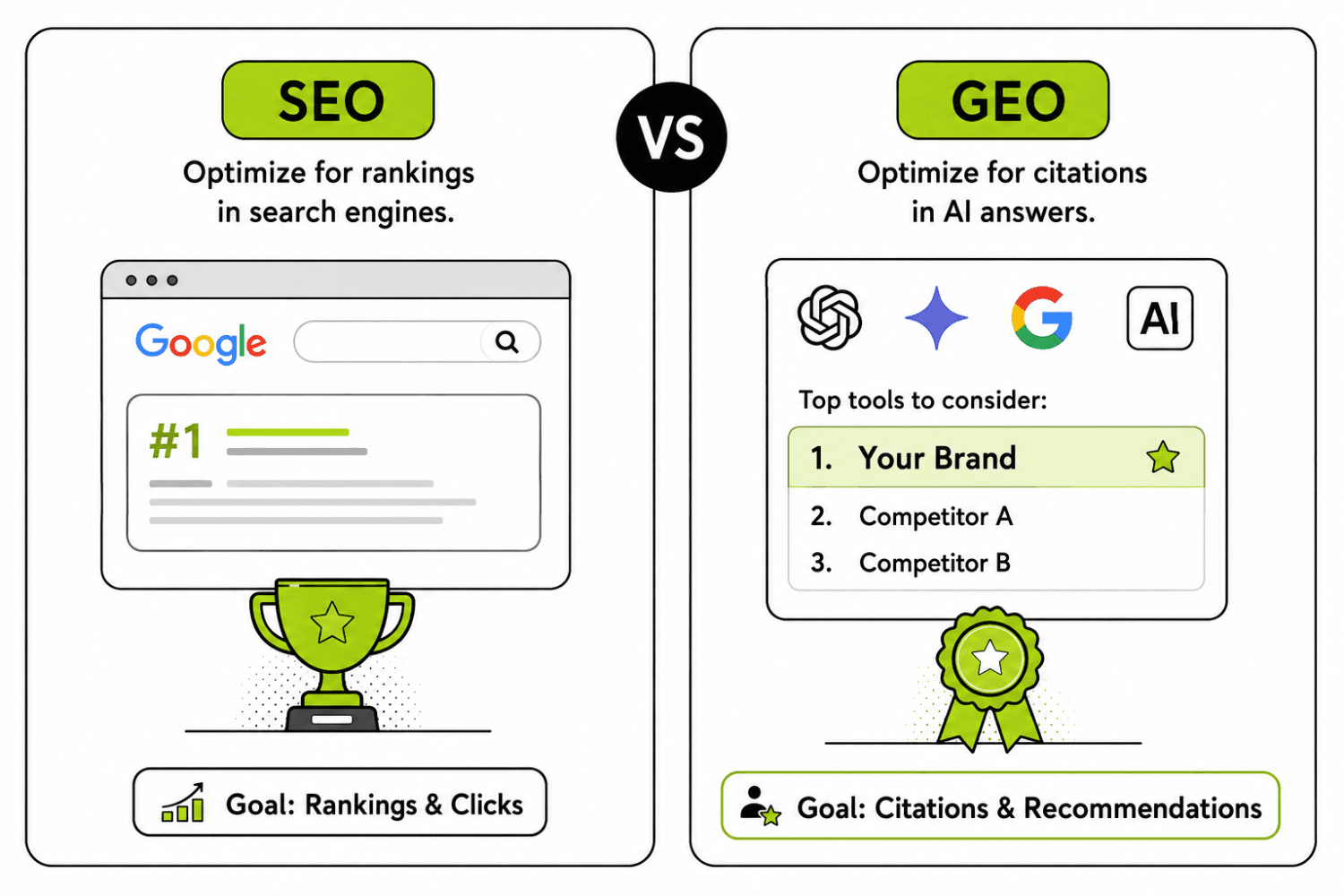
Generative Engine Optimization (GEO) is the practice of structuring content, entity signals, and third-party brand mentions so that AI tools, such as ChatGPT, Perplexity, Claude, and Google AI Mode, cite your brand when buyers ask category questions.
GEO is distinct from SEO: SEO optimizes for rankings and clicks in a traditional search index. GEO optimizes for citations and recommendations in AI-generated answers.
The two disciplines are complementary, but they reward different signals and require different infrastructure. DerivateX coined the term Citation Engineering for the specific five-lever methodology that operationalizes GEO for B2B SaaS companies.
The Top 10 Search Trends B2B SaaS Buyers Should Watch Out For in 2026
| # | Trend | What it means for your pipeline |
|---|---|---|
| 1 | 25% of B2B buyers now use AI instead of Google for vendor research | Your brand may be absent from the shortlist before sales contact happens |
| 2 | AI-referred traffic converts at 5x the rate of Google organic | AI visibility is a pipeline channel, not a traffic channel |
| 3 | Google rank does not predict AI citation | SEO investment doesn’t transfer; AI search requires its own strategy |
| 4 | Third-party sources outrank your blog in LLM citations | Reddit, G2, and editorial coverage drive recommendations, not owned content |
| 5 | Zero-click AI Overviews extract TOFU content without crediting you | Your content needs entity-clarity statements in the first 200 words |
| 6 | ChatGPT, Perplexity, Claude, and Google AI Mode are four separate systems | Single-platform tracking gives a misleading picture of where you stand |
| 7 | Buyers ask scenarios, not keywords | Content briefs need 20–30 buyer prompts, not keyword clusters |
| 8 | Six structured page types drive the majority of LLM citations | FAQ pages, comparisons, Quick Answer Blocks, and case studies are the citation surface |
| 9 | Dark social hides AI-driven attribution | Track branded search volume in GSC as the upstream proxy |
| 10 | AI agents build vendor shortlists autonomously | Citation-unready brands are excluded before a human reviews the list |
1. 25% of B2B Buyers Now Skip Google Entirely for Vendor Research. Here is Where They Go Instead.
Buyer behavior shifted faster than most SaaS marketing teams adjusted for. A quarter of B2B buyers say generative AI has overtaken traditional search as their primary tool for vendor research, according to Responsive’s 2025 buyers’ study.
G2’s 2025 survey of more than 1,000 B2B software buyers found 87% say tools like ChatGPT, Perplexity, and Gemini are changing how they research software.
Forrester’s 2026 State of Business Buying report went further, naming generative AI as the single most cited “meaningful interaction type” for researching B2B purchases.
B2B buyers are researchers by definition: they are evaluating vendors, building business cases, and comparing feature sets. Generative AI tools are purpose-built for exactly that kind of complex, multi-part research query.
The shift isn’t surprising when you see it that way. What is surprising is how few SaaS marketing teams have adjusted their measurement model to account for it.
The pipeline consequence is what makes this trend urgent rather than interesting. Across DerivateX’s tracked client portfolio, visitors who arrive via AI tools convert at roughly 17.9%, several times the rate of Google organic traffic to the same landing pages. The industry data points the same direction.
The math is straightforward: 1,000 AI-referred visitors produce 142 qualified pipeline actions. The same 1,000 visitors from Google organic produce 28. Same traffic volume, but five times the pipeline.
That is not a marginal channel optimization, but a different revenue conversation.
The conversion gap makes sense when you think about the intent state. An AI-referred buyer has already done their research inside a conversational tool, synthesized their options, and then clicked through.
They arrive pre-qualified, with a recommendation in hand. Google organic sends you a casual browser, while AI search sends you a buyer.
2. AI-referred Traffic Converts at 14.2%. Google Organic Converts at 2.8%. The Gap is Not About Traffic Volume Anymore.
This is the number most SaaS marketing leaders haven’t run yet.
Semrush’s 2025 cross-industry analysis found AI-referred B2B traffic converting at roughly 4.4x organic search rates.
The implication is that even a modest AI visibility improvement, say moving from zero citations to consistent third-position mentions on 15 of your 20 highest-intent buyer prompts, can produce a pipeline impact that no equivalent investment in traditional SEO would match at the same cost and timeline.
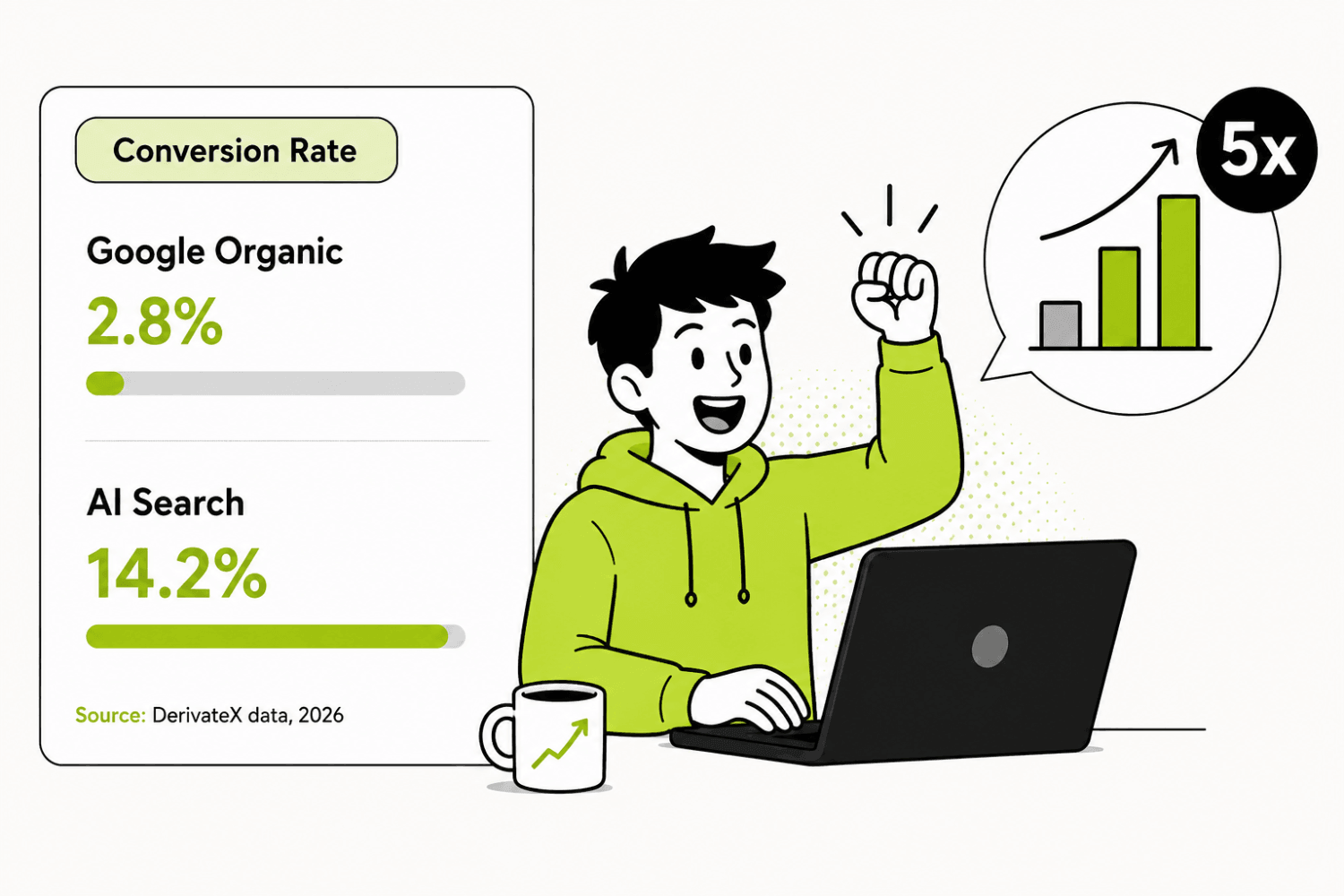
The conversion gap exists because AI search and keyword search produce buyers in fundamentally different intent states.
Keyword search sends someone who typed a phrase and is still browsing options. AI search sends someone who asked a full-context question, received a synthesized recommendation, and then chose to follow the source link. The click through from an AI answer is not exploration. It is confirmation.
Gumlet, one of DerivateX’s clients, now attributes 20% of direct monthly inbound revenue to ChatGPT, Claude, and Perplexity. That number was the result of deliberate citation architecture, not organic luck.
What teams get wrong here is treating AI traffic as a bonus on top of organic, something to track eventually but not prioritize now. The 14.2% figure means AI search should be its own channel with its own investment thesis, its own measurement framework, and its own optimization discipline.
Teams that treat it as a side project of the SEO function will consistently underinvest relative to what the conversion economics justify.
3. Ranking No.1 on Google Does Not Mean ChatGPT Knows You Exist. These Are Different Scoreboards.
This is the hardest thing for most B2B SaaS marketers to accept, because it means years of SEO investment do not automatically translate to AI visibility.
Only 12% of URLs cited by AI overlap with pages ranking in Google’s top 10, according to Ahrefs’ 2025 citation overlap study. That means 88% of the pages getting cited by AI tools are not the same pages dominating traditional search. The scoring systems are genuinely different, and they reward different things.
| Signal | Google Search | AI Search (ChatGPT, Perplexity, Claude) |
|---|---|---|
| Primary ranking factor | Domain authority, backlinks, topical relevance | Mention frequency across independent sources, entity clarity |
| Content structure rewarded | Long-form, keyword-optimized pages | Quick Answer Blocks, FAQ schema, structured comparisons |
| Third-party signals | Backlinks from high-DR domains | Citations in Reddit, G2, independent editorial coverage |
| Key metric | Keyword ranking position | AI Visibility Score (brand mention rate, position, sentiment) |
| Overlap with the other channel | Strong SEO does not guarantee AI citations | Strong AI visibility does not require top Google rankings |
Google evaluates pages against a ranking algorithm that weighs domain authority, topical relevance, backlink profile, and technical performance.
LLMs retrieve and cite sources based on a different set of signals: structural parsability of content, consistency of entity signals across the web, third-party corroboration from independent sources, and the frequency with which a brand appears prominently in answers to relevant buyer prompts.
In the early 2020s, ranking for your core keyword was the definitive goal. The page that ranked No.1 was, by definition, the most visible version of your brand in search.
In 2026, that logic is broken. A page can rank on Google and be completely absent from ChatGPT, Perplexity, and Google AI Mode simultaneously, because the citation signals those tools look for are not the same signals that drive SERP rankings.
A company that optimized exclusively for Google over the past three years has built a strong position on one scoreboard while the second scoreboard, the one that increasingly drives the highest-converting discovery moments, has been filling up with competitors.
Run this test right now before reading further. Open ChatGPT and type “best [your product category] for [your exact ICP description].” If your brand does not appear in the top three positions, you have a citation gap that will not close on its own.
4. Third-party Sources Outrank Your Blog in LLM Citations. The 4 Source Types AI Models Actually Trust.
Here is the version of this that most marketers resist: the blog you’ve been building for three years is not what ChatGPT is using to decide whether to recommend you.
LLMs weight sources that are independent of the brand being cited. A brand’s own blog is treated by most LLM retrieval systems the same way a buyer treats a vendor’s own product page: as promotional material, not independent evidence.
The sources LLMs favor are those where an unaffiliated party is asserting something about your product, category, or methodology.
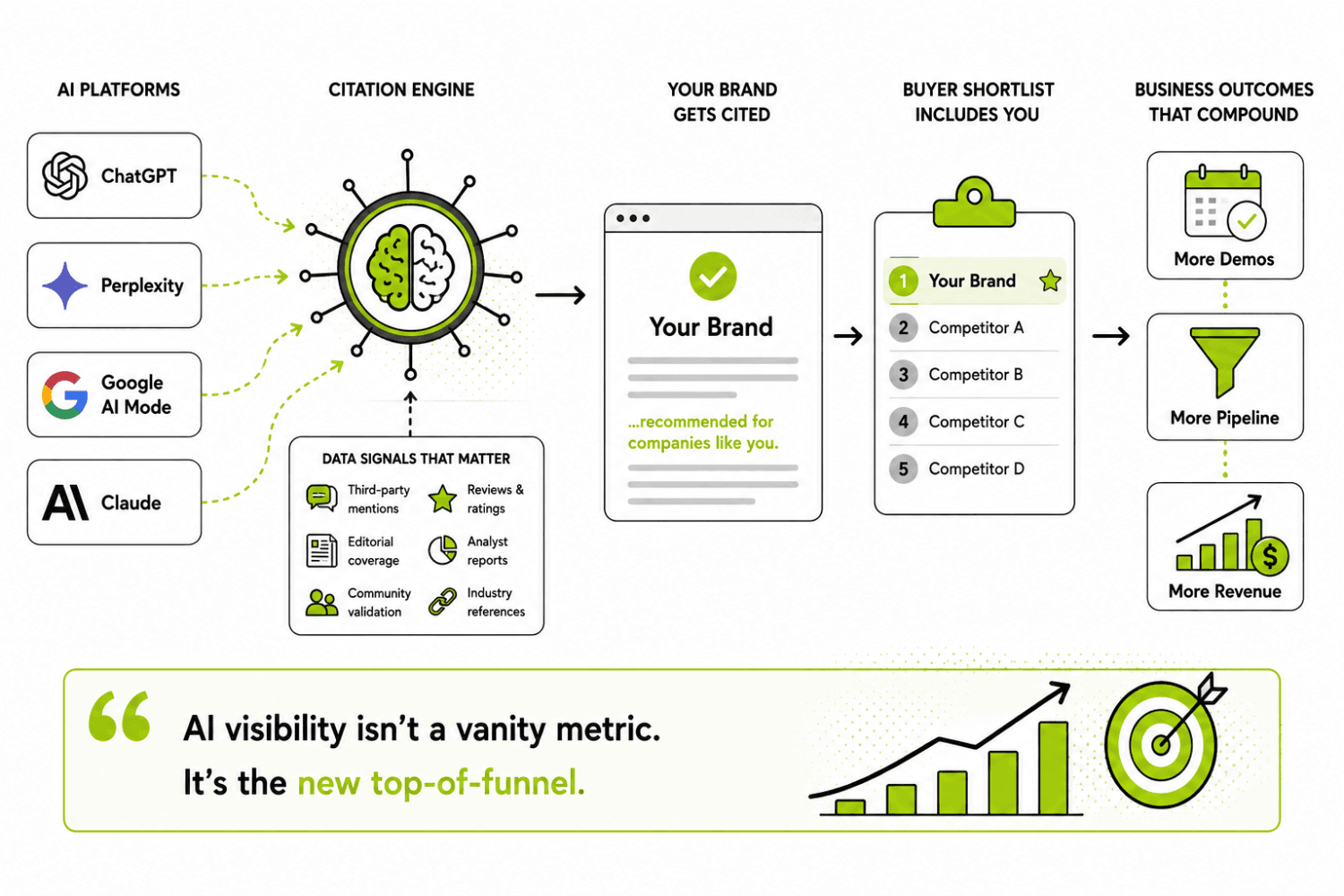
The four source types that carry the most weight for LLM citations, ranked by citation frequency across DerivateX’s analysis of 137 tracked AI citations in 2026:
1. Reddit and Community Forums
Semrush’s multi-platform analysis of over 100 million AI citations found Reddit among the top cited domains across ChatGPT, Google AI Mode, and Perplexity, appearing in a significant share of responses that involve product comparisons, software recommendations, and real-user experience queries.
Perplexity weighs Reddit threads especially heavily for “real user experience” queries. When a buyer asks “is [your product] worth it for a 20-person team,” the answer will cite Reddit before it cites your case studies.
2. LinkedIn and Professional Networks
LinkedIn has become one of the fastest-rising citation sources for B2B queries specifically, climbing to the second most-cited domain overall and the top source for professional and software questions in early 2026. For B2B SaaS, this is the highest-leverage shift after Reddit: your founder’s and team’s LinkedIn content is now a direct input to what AI tells a buyer about your category. Treat it as a citation surface, not a vanity channel.
3. Review Platforms and Analyst Databases (G2, Capterra, TrustRadius, Gartner Peer Insights)
These are treated by LLMs as structured, verified peer evidence. Volume and recency of reviews matter, not just average score.
4. Independent Editorial Coverage and Guest Posts
Articles on category-adjacent publications where your brand or methodology is discussed by a named author who is not affiliated with you. The more specific and named the reference, the higher the extraction likelihood.
5. Wikipedia-style Reference Content and Structured Databases
ChatGPT in particular shows a strong preference for encyclopedic, definition-forward content with consistent internal references.
REsimpli became the top ChatGPT-cited CRM for real estate investors within 90 days of DerivateX beginning Citation Engineering work.
The change was not driven by publishing more blog content. It was driven by a systematic expansion of third-party corroboration across Reddit, G2, and independent editorial sources.
The pre-LLM SEO playbook treated owned content as the foundation and third-party links as amplification. For GEO, that hierarchy is inverted. Third-party corroboration is the foundation. Owned content is the destination you’re sending cited traffic to.
If your brand has zero meaningful Reddit presence right now, you’re missing from Perplexity’s primary citation layer.
A single dedicated community manager running 10 hours per week of authentic participation in 8 to 15 relevant subreddits is one of the highest-ROI GEO investments available to a sub-$20M ARR SaaS team in 2026.
5. Zero-click Research is Hitting TOFU the Hardest. Your Awareness Content is Building AI Trust for Someone Else.
Zero-click is not a new problem, but its shape has changed in 2026 in a way that specifically damages B2B SaaS content investment.
As of April 2026, AI Overviews appear on 48% of Google queries, up from 31% in February 2025, according to Averi’s 2026 benchmark tracking of 2 billion monthly users. That coverage rate is concentrated on the informational and navigational queries that TOFU B2B content targets. That number climbs higher in B2B technology specifically, where AI Overviews now trigger on roughly 82% of queries. If you sell B2B SaaS, this is not a fraction of your keywords. It is the majority of them.
The mechanism that makes this dangerous for SaaS content teams is not that fewer people click through. It is that when an AI Overview is generated, an LLM is using your content to synthesize the answer and then presenting it without a click.
Your research, your writing, your positioning, all feeding an AI summary that sends the buyer to whoever is cited in the answer, not whoever published the underlying content.
This is why entity clarity matters so much in TOFU content. 44% of LLM citations come from the first 30% of a page’s text, according to Averi’s 2026 content benchmark analysis.
If your brand is not named explicitly, with a clear definitional sentence, within the first 200 words of your top-of-funnel content, the LLM is likely extracting the answer and distributing it without attributing it to you.
The structural fix is not to stop producing TOFU content. It is to restructure it:
- Quick Answer Block in the first 150 words
- Entity-clarity statement (a clear sentence defining what your company is, what it does, and who it serves)
- FAQ schema at the end
Content that cannot answer the question “can an AI cite this page in response to a specific buyer prompt in one extractable sentence?” is content that is feeding the AI without getting credited by it.
6. ChatGPT, Perplexity, Google AI Mode, and Claude are 4 Separate Visibility Systems. Treating Them as One is the Mistake .
Most SaaS marketing teams that are starting to pay attention to AI search treat it as a single channel. “How are we doing on AI?” is the wrong question. The right question is three separate questions.
Here is what DerivateX’s 2026 benchmark found across the four platforms: ChatGPT mentioned 100% of the 50 companies tested, with an average position of 1.2 and uniformly positive sentiment.
Perplexity mentioned 90% of companies, cited sources explicitly alongside recommendations, and was the second most selective platform. Claude was the most selective, mentioning 88% of brands. Gemini matched ChatGPT at 100% mention rate.
The visibility gap is not about whether a platform mentions you at all. It is about how often, how prominently, and with what specificity.
The platforms are also structurally different in what they reward:
- ChatGPT shows a strong preference for encyclopedic, definition-forward content and structured list formats. It generates recommendations with brief justifications and is less likely to surface source links than Perplexity.
- Perplexity cites sources explicitly alongside every recommendation, giving its answers a research-report quality. It heavily weights Reddit and community forum content for “real user experience” queries.
- Google AI Mode draws from Google’s own index, weights structured data and schema markup, and is the most influenced by traditional SEO signals of the four. But even here, schema, FAQ markup, and structured comparison tables drive citation likelihood more than domain authority alone.
- Claude treats brand authority signals conservatively, which is why its 88% mention rate produces the most selective recommendations. Being cited by Claude is a stronger trust signal than being cited by platforms that mention everyone.
| Platform | Citation behavior | What it rewards most | Selectivity |
|---|---|---|---|
| ChatGPT | Generates answers with brief justifications; less likely to surface source links | Encyclopedic, definition-forward content; structured lists | Mentions 100% of tested brands |
| Perplexity | Cites sources explicitly alongside every recommendation | Reddit threads, community forums, independent editorial | Mentions 90% of tested brands |
| Google AI Mode | Draws from Google’s own index; highest traditional SEO signal overlap | Structured data, schema markup, FAQ markup, comparison tables | Mentions 100% of tested brands |
| Claude | Most conservative; strong preference for independently corroborated sources | Named methodology pages, case studies with specific outcome data | Mentions 88% of tested brands, most selective |
The AI Visibility Score (AVS), DerivateX’s measurement framework, tracks brand mention rate, position, and sentiment across all four platforms simultaneously against a defined set of 20 buyer-intent prompts.
A single-platform view (tracking only ChatGPT, for example) routinely produces an incomplete and sometimes misleading picture of where a brand actually stands in the AI search landscape.
The optimization foundation is consistent across platforms: entity clarity, structured content, and third-party corroboration. The platform-specific differences sit on top of that foundation. Build the foundation first, then tune for platform behavior.
7. Prompt-shaped Demand has Replaced Keyword-shaped Demand. Your Content Brief is Probably Structured for the Wrong Question Type.
In the pre-LLM era, buyer research meant typing “CRM software” into Google and browsing. In 2026, it means asking ChatGPT or Perplexity something like: “What CRM is best for a 15-person B2B SaaS sales team that uses HubSpot but needs better forecasting?”
These are not keywords. They are scenarios, and they require a completely different content architecture to answer.
Column Five Media documented this shift clearly in their January 2026 AI visibility analysis: buyers are asking AI tools full-context questions that describe their specific situation, constraints, and use case, and AI tools are rewarding content that directly and specifically answers those scenario-shaped queries.
“Best CRM software” generates a generic list. “Best CRM for a 15-person HubSpot-integrated team with a specific forecasting need” surfaces a specific, contextually relevant recommendation, and the page that gets cited is the one that answered that exact combination of conditions somewhere in its structure.
For content teams, this changes the brief. The starting point is no longer “what keywords should we target?” It is “what are the 20 to 30 specific buyer prompts that our ICP types into ChatGPT, and do we have a page that answers each one directly, in the first 150 words?”
A useful test: Take your most important piece of TOFU content and ask ChatGPT the buyer prompt it was designed to answer. If a competitor is cited instead, the gap is structural, not qualitative. The competitor’s page is not better written. It is better formatted for extraction: a direct answer in the first paragraph, a named entity statement, a Quick Answer Block, and FAQ schema at the end.
Real buyer prompts DerivateX tracks across client categories look like this: “Best project management software for a 30-person SaaS team that uses Slack and needs Jira integration.” “Which CRM is best for a real estate investment firm with under 10 agents?” “What’s the difference between Gumlet and Wistia for a course creator?”
These are not keyword variants. They are evaluation contexts. The page that gets cited is the one that answered the specific combination of conditions somewhere in its structure.
A content calendar built around keyword clusters will systematically underperform in AI search. Before briefing any new content, run the target query in ChatGPT and Perplexity first. Document who is being cited, what structure their cited content uses, and what the gap is between their format and yours.
8. Structured Content is Not Optional Anymore. The 6 Page Types LLMs Extract From, Ranked by Citation Likelihood.
Citation surface is the total set of pages across the open web that an LLM can retrieve when answering questions about your category.
For most B2B SaaS companies, the citation surface is smaller than they realize, often limited to one or two blog posts and a G2 profile, and structured in ways that make extraction difficult.
Here are the six page types that produce the highest citation rates, based on DerivateX’s analysis of citation patterns across 137 tracked citations in early 2026 and corroborating research from Ahrefs’ 2025 citation study:
1. FAQ Pages with Natural-language Questions and 40 to 80 Word Direct Answers
FAQ schema makes content structurally legible to LLMs. Each answer functions as a discrete, citable unit. This is the highest-yield single format change most SaaS content teams can make.
2. Comparison and Alternatives Pages With Factual Attribute Tables
LLMs heavily reference structured comparison data when answering “X vs Y” or “best alternative to X” prompts. Every comparison page needs a factual table, not subjective ratings.
3. Quick Answer Blocks in the First 30% of Long-form Content
A 50 to 80-word prose summary of the article’s core argument, positioned immediately after the introduction, is the primary extraction surface for AI Overviews and ChatGPT’s summarization behavior.
4. Technical Documentation, Integration Guides, and API References
These pages receive three times more AI citations than marketing-oriented blog posts. They contain specific, verifiable, factual information that LLMs trust.
5. Named Methodology or Framework Pages with Schema Markup
An /llm-info/ page with JSON-LD schema and a clear entity statement is the foundational infrastructure for AI entity recognition. Without it, the LLM has to infer who you are and what you do from scattered signals.
6. Case Studies With Specific, Named Outcome Data
“We improved revenue” is not citable. “Verito moved from Google position 40 to the top ChatGPT recommendation for ‘QuickBooks hosting’ and similar high-intent buyer prompts” is citable. Specificity is what makes a case study an extraction target rather than a marketing document.
After building the citation surface, the question becomes measurement. The right place to start is your AI Visibility Score baseline: run your 20 highest-intent buyer prompts in ChatGPT, Perplexity, Claude, and Gemini on Monday, Wednesday, and Friday for two weeks, and score each result based on whether your brand is named, linked, or mentioned in context.
The aggregate score is your starting point for tracking progress.
How to Measure AI Search Visibility: The AI Visibility Score Baseline
Once the citation surface exists, the question is whether it is working. The AI Visibility Score (AVS) is DerivateX’s measurement framework for answering that question.
The baseline setup takes two weeks:
- Define 20 buyer-intent prompts: The specific questions your ICP types into ChatGPT when researching your category.
- Run each prompt in ChatGPT, Perplexity, Claude, and Gemini on Monday, Wednesday, and Friday.
- Score each result: brand named = 5 points, brand linked = 3 points, brand mentioned in context = 1 point.
- Aggregate across all 20 prompts and all four platforms. Maximum weekly score: 400. Normalize to a 0–100 scale.
The resulting number is your AI Visibility Score baseline. Track it weekly. A rising AVS, when organic and paid investment has been flat, is the clearest signal that Citation Engineering work is producing measurable results.
DerivateX’s 2026 benchmark of 50 B2B SaaS companies found an average AVS of 56.9. If you score below 40 on your first two-week run, the citation surface is the problem.
If you score 40–70, the foundation exists but structured content and third-party corroboration need attention. Above 70, the work shifts to platform-specific tuning and maintaining recency.
9. Dark Social is Eating Your Attribution Model. Most Deals Now Start in Places Your Analytics Cannot See.
Over 80% of content sharing happens in private channels, not in publicly traceable links, per dark social research aggregated by Altair Media in their 2026 B2B buyer journey analysis.
Private Slack groups, DMs, WhatsApp threads, email forwards of AI responses, and closed Discord communities are where B2B buying conversations increasingly happen.
Modern B2B buyers complete 70 to 80% of their decision journey before speaking to sales, according to 6sense’s 2024 B2B Buyer Experience report. That pre-sales journey is now increasingly happening inside AI tools, with AI-generated shortlists being shared privately before a buyer ever visits a vendor’s website directly.
The result is a model where your branded search spikes and direct traffic increases, but the upstream event that triggered them is invisible in your attribution stack.
The practical consequence is that your AI visibility activity is not showing up where you’d expect it to.
A buyer who asked Perplexity for a software recommendation, received your brand as a top result, screenshot the answer, and shared it in their company Slack before booking a demo will show up in your analytics as a branded search or direct visitor. The Perplexity citation that started the chain never gets credited.
Todd Chambers from Saas PPC Agency, Upraw Media, says:
“This is something we see in paid search attribution too. A buyer might first discover your brand through ChatGPT, LinkedIn, a podcast, or a recommendation, then Google your company name a few days later and click a branded ad. Google Ads can end up taking the conversion credit simply because it was the final measurable click.
That doesn’t mean branded PPC isn’t doing a useful job. It is capturing demand and making sure competitors or other SERP results don’t intercept someone already looking for you. But demand capture and demand creation are two different things.
If branded search and conversions suddenly increase, I wouldn’t look at PPC performance in isolation and conclude that paid search caused the growth. I’d look at overall branded search demand, paid versus organic brand traffic, impression share, self-reported attribution, and ultimately what is happening in the pipeline. The interesting question is not just which channel got the last click, but what caused more people to start searching for the brand in the first place. In 2026, that’s often AI visibility and shortlisting.”
Track branded query volume in Google Search Console as the proxy for AI recommendation activity. A growing branded search trend, when organic and paid search investment has been flat, is the most reliable signal that AI tools are recommending your brand in conversations your analytics cannot trace.
Ask “How did you hear about us?” in every demo request form. It takes 30 seconds to add and captures attribution that no tool will give you automatically.
10. Agentic Search is Rewriting the Shortlist. AI Agents Now Build Vendor Lists Before a Human Reviews Them.
This is the forward edge of where AI search is going, and it is already happening at enough scale to matter for pipeline-focused SaaS marketers.
Agentic search is the behavior pattern where buyers delegate research tasks to AI agents entirely, asking them to compile a shortlist, compare vendors, and surface recommendations autonomously before a human reviews the output.
Agent behavior on platforms like Perplexity clusters heavily around productivity, workflow, learning, and research tasks. Vendor research fits all four categories.
A SaaS brand that is not citation-ready will be excluded from an automatically generated shortlist before a human ever reviews it. The agent is not browsing your website and making a judgment call. It is retrieving structured information from sources it trusts and compiling it into a format the buyer can act on.
If your pricing page has inconsistent information, your entity signals are unclear, or your category pages lack structured comparison data, you are not being excluded because you lost on merit. You are being excluded because the agent cannot confidently parse your position.
As of June 2026, this behavior is more common in enterprise buying cycles and among technically sophisticated buyer profiles, but the pattern is spreading.
The B2B SaaS companies building citation infrastructure now, structured pages, entity clarity, third-party corroboration, FAQ schema, are positioning themselves to show up consistently when agentic search becomes the default research mode for the majority of buyers.
The companies that will be shortlisted by AI agents in 2027 are the ones building Citation Engineering infrastructure in 2026. REsimpli’s 90-day result is the proof of concept: a deliberate, structured approach to citation visibility produces measurable AI recommendation position in a timeframe that matters.
Frequently Asked Questions
1. How do I find out if ChatGPT is recommending my SaaS right now?
Run your 10 to 15 highest-intent buyer prompts directly in ChatGPT, Perplexity, and Google AI Mode. Phrase them the way a real buyer would: “best [your category] for [your ICP description],” “top [category] tools for [specific use case],” and “[your category] vs [your closest competitor].”
Record whether your brand appears, at what position, and what the surrounding framing says. Repeat Monday, Wednesday, and Friday for two weeks to account for answer variability across sessions. That two-week manual run is the baseline version of the AI Visibility Score methodology DerivateX uses to establish starting points for all client accounts.
If you want the fast version instead of two weeks of manual logging, DerivateX’s free AI Visibility Checker runs the same kind of prompt set for you.
2. Why is my competitor showing up in ChatGPT but we have more backlinks and better domain authority?
Domain authority does not predict AI citations. LLMs weight mention frequency across independent third-party sources, structural parsability of content, and consistent entity signals far more than link metrics.
DerivateX’s 2026 benchmark found that companies with weaker traditional SEO profiles regularly outscored stronger competitors on AI visibility within the same software category.
The gap traces back to two sources almost every time: third-party corroboration (how often independent sources mention the brand by name in relevant contexts) and content structure (whether pages contain Quick Answer Blocks, FAQ schema, and direct 1 to 2 sentence answers at the top of each section). Check those two areas before assuming the answer is more backlinks.
3. What is generative engine optimization (GEO) and how is it different from SEO?
GEO is the practice of structuring content, entity data, and brand signals so that AI models cite your brand when buyers ask category questions. SEO optimizes for rankings and clicks in a traditional search index.
GEO optimizes for citations and recommendations in AI-generated answers. The two disciplines are complementary but not interchangeable: a page that ranks in the top 3 on Google may still be absent from ChatGPT answers if it lacks structured Quick Answer Blocks, FAQ schema, clear entity-clarity statements, and third-party corroboration from independent sources. DerivateX coined the term Citation Engineering for the specific five-lever methodology that drives GEO results: Entity Clarity, Authoritative Coverage, Third-Party Corroboration, Result Documentation, and Structured Parsability.
4. How long does it realistically take to see results from GEO or Citation Engineering?
REsimpli reached the top ChatGPT recommendation for “real estate CRM” (for real estate investors) within 90 days of full-scope Citation Engineering implementation. Verito moved from Google position 40 to the top LLM recommendation for “QuickBooks hosting” and similar high-intent buyer prompts in a comparable timeframe.
Both are accounts where the full Citation Engineering methodology was applied from day one: entity clarity infrastructure, structured content at scale, third-party corroboration across Reddit, G2, and editorial sources, and systematic prompt tracking.
Accounts with an existing content foundation and some third-party presence typically see measurable AI Visibility Score improvement within 60 to 90 days. Accounts starting from a thin or inconsistent base take longer. The rate is determined by how sparse the existing citation surface is at the start.
5. Does the content on my blog actually help with AI citations, or do I need to build something separate?
Your existing blog helps if it is restructured correctly. Technical documentation, comparison pages, and FAQ-format content are cited at significantly higher rates than standard narrative blog posts.
The structural changes that convert existing blog content into AI citation targets are: a Quick Answer Block in the first 200 words, FAQ schema at the end of each post, H2s that pose and directly answer specific buyer questions in the first 1 to 2 sentences of the section, and at least one citable claim with a named source and year in every major section.
Blog content without these structures contributes to Google rankings but not AI citations. Before building new content, audit your 10 highest-traffic posts for these elements. Most SaaS teams find they can gain significant citation lift from restructuring existing content before publishing a single new page.
6. Should we optimize separately for ChatGPT, Perplexity, Google AI Mode, and Claude?
Build one strong foundation that serves all four, then tune for platform-specific behavior on top of it. The foundation is consistent: entity clarity, structured content with direct answers, and third-party corroboration.
The platform-specific differences are in source weighting: ChatGPT favors encyclopedic and structured content, Perplexity cites sources explicitly and weights Reddit heavily, Google AI Mode draws from its own index and rewards structured data, Claude is the most selective and conservative in its mention behavior.
A brand that scores well on the shared foundation will perform across all four. Tracking all four simultaneously using an AI Visibility Score methodology is the only way to get a complete picture of where you actually stand, since single-platform tracking routinely produces misleading conclusions.
7. What is the AI Visibility Score (AVS) and how is it different from domain authority?
The AI Visibility Score (AVS) is a 0–100 measurement of how frequently and prominently a brand is cited across ChatGPT, Perplexity, Claude, and Gemini against a defined set of 20 buyer-intent prompts.
Domain authority measures the strength of a domain’s backlink profile and predicts Google ranking potential. AVS measures citation frequency in AI-generated answers and predicts AI recommendation likelihood.
The two metrics are largely uncorrelated: DerivateX’s 2026 benchmark found no consistent relationship between domain authority and AI Visibility Score within the same software category.
AVS is tracked weekly using a scoring system: brand named (5 points), brand linked (3 points), brand mentioned in context (1 point), aggregated across all prompts and platforms on a normalized 0–100 scale.
8. What is agentic search and why does it matter for B2B SaaS vendors?
Agentic search is the behavior pattern where buyers delegate vendor research to an AI agent, asking it to compile a shortlist, compare options, and surface recommendations autonomously, before a human reviews the output.
Unlike conversational AI search (where a buyer types a prompt and reads the answer), agentic search produces structured outputs, such as vendor tables, comparison summaries, shortlists, without the buyer reviewing intermediate steps.
For B2B SaaS vendors, this matters because exclusion from an agent-compiled shortlist happens before a human ever evaluates your brand. A brand with inconsistent pricing information, unclear entity signals, or no structured comparison data will be omitted not because it lost on merit, but because the agent could not confidently parse its position.
Citation Engineering infrastructure: entity pages, structured comparison content, and third-party corroboration, is the mechanism for ensuring agent-readiness.
9. How do I actually get my SaaS cited inside ChatGPT?
Three things, in order.
- Get named by independent sources: Reddit, G2, LinkedIn, and editorial coverage where someone unaffiliated with you describes what you do.
- Restructure your top pages for extraction: a direct 1 to 2 sentence answer at the top of every section, a Quick Answer Block in the first 200 words, FAQ schema, and a clear entity statement that names your company, what it does, and who it serves.
- Measure it: run your 20 highest-intent buyer prompts across ChatGPT, Perplexity, Claude, and Gemini and track whether you are named, linked, or mentioned. Citation follows corroboration plus structure. Publishing more blog posts without those two things does not move the number.
What 2026 is Actually Asking of B2B SaaS Marketing
The most important thing this article has tried to establish is not that AI search is growing. That is obvious and has been obvious for 18 months.
The important thing is that the 87-point spread in DerivateX’s benchmark, between Clio at 89 and LeadSquared at 2, exists inside a competitive category where both companies have active marketing teams. That gap is not market share. It is architecture.
The companies on the right side of that gap are not smarter or better resourced. They are structured differently: their content is parsable, their entity signals are clear, their third-party footprint is real, and they are measuring a scoreboard that most of their competitors have not opened yet.
If you have run the test in Trend 3 and your brand did not appear, the Free DerivateX AI Visibility Audit scores your brand across LLMs against your 20 highest-intent buyer prompts, identifies the specific gaps in your citation surface, and maps the Citation Engineering work required to close them.
It is the right starting point for any SaaS team that wants to understand where they actually stand before the gap compounds further.
The companies building citation infrastructure in 2026 are making the same bet the companies that invested in content marketing in 2013 were making. The ones who did it early built an asset that compounded for a decade. The ones who waited played catch-up. The window is not closed, but it is narrowing.
Cited by AI