Case study: Gumlet turned ChatGPT mentions into 20% of inbound revenue. Read it →

Winning Zero-Click Search: A Content Strategy for B2B SaaS Pipeline

Your buyer's shortlist is now written inside AI answers before anyone visits your site. Here is the citation system and the attribution playbook that turn zero-click visibility into measurable B2B SaaS pipeline.


TL;DR
- Roughly 68% of US Google searches now end without a click to any website, and that figure climbs to about 83% when an AI Overview appears (SparkToro, 2026; Bain, 2025).
- Over half of B2B software buyers now begin vendor research inside an AI chatbot, and AI chat has become the single biggest influence on shortlists, shaping 54% of them (G2, 2026).
- DerivateX benchmark data shows Google’s AI Overview shares only 35% of its sources with the organic results sitting directly below it, so ranking and getting cited are two separate competitions.
- A working zero-click search strategy has two halves: engineering citations inside AI answers, and attributing the resulting pipeline through self-reported attribution, branded search lift, and tagged AI sessions in GA4.
- Gumlet, a video infrastructure SaaS, now attributes close to 20% of its inbound revenue to AI discovery after restructuring its content for citation instead of clicks.
Your rankings held this quarter. Your traffic dropped anyway, and three of your last five demo calls opened with some version of “we found you through Google AI.” You are staring at a dashboard that says one thing while your pipeline says another, and nobody on your team can explain the gap.
Most of the advice written for this moment gets the framing wrong. It treats zero-click search as a traffic problem to be survived, so it hands you defensive tactics: build an email list, post more on LinkedIn, pray for featured snippets. The real shift is that your buyer’s shortlist is now assembled inside an AI answer before anyone touches your website, which makes this a pipeline problem to be won.
This piece lays out a zero-click search strategy built for exactly that. You will get the 2026 numbers, first-party benchmark data on where AI answers actually pull their sources from, a 7-step system you can run in-house, and the attribution playbook that connects citations to revenue. Start with what zero-click search actually is in 2026, because the definition has changed underneath us.
What Is Zero-Click Search and How Big Is It in 2026?
A zero-click search is any query where the person gets their answer directly on the results page or inside an AI interface and never visits a website. In 2026 that includes Google’s AI Overviews and AI Mode, plus ChatGPT, Claude, Perplexity, and Gemini, not just the featured snippets marketers worried about five years ago.
The scale is what makes this urgent for B2B SaaS. Here is where the numbers stand right now:
| Metric | Number | Source and Year |
|---|---|---|
| US Google searches ending without a click | ~68% | SparkToro / Datos, 2026 |
| Zero-click rate when an AI Overview appears | ~83% | Bain, 2025 |
| Zero-click rate inside Google AI Mode | ~93% | Semrush, 2025 |
| Mobile vs desktop zero-click rate | 77% vs 46.5% | SparkToro / Datos, 2024 |
| Informational vs transactional queries | 74% vs 31% | Semrush intent research |
Two things in that table matter more than the headline number. Informational queries, the exact queries your blog was built to win, go clickless three times out of four. Transactional queries still send traffic, which tells you where clicks survive and where they don’t.
Why Zero-Click Marketing Hits B2B SaaS Pipeline, Not Just Traffic
Falling traffic is the symptom. The disease is that vendor shortlists are now built inside AI answers, a research environment where you have no analytics, no retargeting, and no session data. Your buyer runs their evaluation in a place you cannot see, then shows up on a demo call with their mind 80% made up.
The buyer research backs this up with force. Forrester’s 2026 survey of nearly 18,000 business buyers found that 94% used AI during their most recent purchase, and generative AI now outranks vendor websites and sales reps as their most meaningful research source. G2’s Answer Economy report found that 51% of software buyers start their research in an AI chatbot rather than Google, and AI chat now shapes 54% of shortlists, more than review sites or vendor websites.
The shortlist itself is shrinking while this happens. Apollo’s 2026 data puts the average B2B shortlist at roughly 2.5 vendors, down from about 3.2 a few years ago. Pair that with 6sense’s finding that the vendor a buyer privately favors before contacting sales wins the deal 80% of the time, and the conclusion is hard to dodge: the competition is largely decided before your SDR ever gets a reply.
Should B2B SaaS Companies Stop Blogging?
No, but the job description of your blog has changed. Its purpose shifted from earning clicks to earning citations, because the content AI engines cite is the content that puts you on the shortlist.
Bottom-funnel pages still earn clicks the old way. Transactional queries are only 31% zero-click, so comparison pages, alternatives pages, and pricing content keep pulling visitors who are ready to act.
The visitors who do arrive from AI answers are dramatically better. Aggregated LLM traffic studies put AI referral signup conversion around 1.66%, against roughly 0.15% for traditional organic, an improvement of about 11x. Fewer clicks, but the clicks that survive are the ones that book demos.
Where AI Answers Actually Come From: Our Benchmark Data
The AI answer layer is a different competitive surface than the SERP, and this is not an opinion. We measured it. Three findings from DerivateX benchmark studies show why a strategy built purely on rankings misses the target:
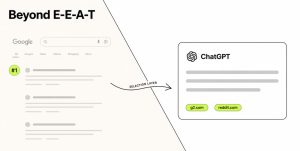
- Two Googles, One Query (DerivateX, July 2026): Google’s AI Overview shares only 35% of its sources with the organic results displayed directly below it on the same page. You can rank #3 and still be absent from the answer sitting above you.
- The Listicle Layer (DerivateX, July 2026): AI Overviews cite third-party blogs about 4x more often than the websites of the products they actually recommend. The engine names your product but links someone else’s roundup.
- The Agreement Gap (DerivateX, June 2026): ChatGPT and Google AI Overviews frequently recommend the same tools while citing almost none of the same sources. Two engines, one recommendation, two completely different paths to earning it.
The strategic takeaway is that your own website cannot carry a zero-click search strategy alone. The surfaces AI engines cite most, listicles, review platforms, community threads, and independent publications, are surfaces you influence rather than own. Winning means showing up on them deliberately.
How ChatGPT, Perplexity, and Google AI Overviews Pick Sources Differently
Each engine runs its own retrieval logic, which is why a brand can dominate one and be invisible in another. Independent citation research found that only around 11% of domains get cited by both ChatGPT and Perplexity for the same query.
| Engine | How it retrieves | What wins citations |
|---|---|---|
| ChatGPT | Training data plus Bing-powered live retrieval when needed | Consensus sources, widely referenced entities, encyclopedic and licensed publisher content |
| Perplexity | Runs a live web search on every single query | Fresh, data-dense pages and community sources; content older than 60 to 90 days loses ground fast |
| Google AI Overviews | Pulls heavily from its own organic index | Structured, extractable pages with clear answers, yet only 35% overlap with the SERP below per our data |
Treat these as three channels in a portfolio, not one channel with three names. The tactics overlap maybe 60%, and the remaining 40% is engine-specific work.
The Zero-Click Search Strategy: A 7-Step System for B2B SaaS
The system is simple to state: find the queries AI engines answer in your category, restructure your content so machines can extract it, win the third-party surfaces they cite, and measure the pipeline that follows. Here is the full sequence, in the order we run it for clients:
- Map the queries AI engines answer in your category. Pull your revenue keywords, run each through ChatGPT, Perplexity, and a clean Google session, and log the results in a four-column sheet: query, whether an AI answer appeared, brands named, sources cited. This sheet becomes your battle map for everything that follows.
- Triage existing pages before creating anything new. Pages already ranking in the top 10 for AI-triggering queries are your fastest wins, so give them answer-first rewrites and FAQ blocks first. Net-new content comes after the existing asset base is squeezed.
- Restructure for extraction. Phrase H2s as questions, answer each within the first 40 to 60 words, keep paragraphs standalone, and convert every process into a numbered list. Buried answers do not get extracted, full stop.
- Publish original data every quarter. One benchmark, survey, or internal dataset per quarter gives AI engines something they literally cannot find anywhere else. Our own reports earn citations and press pickup precisely because the numbers exist nowhere else on the web.
- Win the surfaces AI actually cites. Our Listicle Layer data shows engines favor third-party roundups over product sites by 4x, so pursue guest placements on AI-sampled publications, listicle inclusion, review platform depth, and genuine community presence. This is distribution work, and it is non-optional.
- Deploy entity and schema signals. Add FAQPage, Article, and Organization schema across your posts, and place one plain-English entity sentence in the first 200 words of every page: what your product is, what category it belongs to, who it serves.
- Track citations bi-weekly and refresh relentlessly. Re-run your prompt set every two weeks, log citation share per engine, and refresh cited statistics quarterly. Citations rotate, and stale numbers are the most common reason they rotate away from you.
Run steps 1 through 3 in your first month. Steps 4 and 5 are the compounding engine, and steps 6 and 7 are the maintenance layer that keeps wins from evaporating.
How to Get Cited in AI Overviews: The On-Page Checklist
Getting cited comes down to claim density and structural legibility, not topic selection. AI models extract information at the claim level, so vague pages get summarized away while specific pages get named.
Before any page ships, check it against this list:
- Direct answer in the first one to two sentences under every question-phrased H2
- Standalone, extractable paragraphs of 40 to 60 words in citation-target sections
- Precise, sourced numbers instead of qualifiers like “significantly” or “many”
- Named entities and named examples instead of anonymous ones
- A TL;DR bullet block near the top, since it is the most extractable chunk on the page
- An FAQ section at the end, the single highest-yield format for AI extraction
- Visible publication and last-updated dates, because undated pages get treated as stale
- Schema flagged for implementation: FAQPage on FAQ blocks, HowTo on processes, Article and Organization sitewide
Then run the test that matters more than any checklist. Ask ChatGPT and Perplexity the exact question your page answers, and if a competitor gets cited instead, study what their page does structurally that yours does not. That comparison is worth more than any audit tool!
Should You Gate Content in a Zero-Click World?
Ungate your research and gate only your tools and templates. The reasoning fits in one sentence: AI engines cannot cite what they cannot crawl, and a report locked behind a form is invisible at the exact moment shortlists get built.
We publish every DerivateX benchmark completely open, and those reports earn AI citations, press pickup, and inbound conversations that a gated PDF never could. The gated version of the same report would have produced a few hundred form fills and zero presence inside the answers our buyers actually read.
Be honest about the trade, because there is one. You give up some lead capture volume, and you gain category presence that compounds every quarter. Form fills depreciate the day they land in your CRM, while citations keep working while you sleep.
Measuring Zero-Click Success: Attributing Pipeline Without Clicks
You measure zero-click success by replacing click metrics with citation, brand, and self-reported signals. None of the replacements is exotic, and all of them are running today for our clients:
| Old metric | New metric | How to track it |
| Organic sessions | AI citation share on tracked prompts | Bi-weekly prompt runs across ChatGPT, Perplexity, Gemini, and AI Overviews |
| Click-through rate | Branded search volume | Google Search Console, branded query trend |
| Last-click attribution | Self-reported attribution | “How did you hear about us” field with an AI option on demo forms, logged in CRM |
| Raw traffic | Tagged AI sessions | GA4 segmentation by AI referral source, tied to conversion events |
Self-reported attribution is mandatory, not a nice-to-have, because most of the journey is invisible to your analytics. Demand Gen Report’s 2025 research found traditional attribution captures only about 27% of the B2B buying journey, leaving nearly three quarters of it in channels that produce no trackable signal. The form field is the cheapest window you will ever get into that dark 73%.
A Worked Example: How Gumlet Attributed 20% of Inbound Revenue to AI Search
Gumlet is a video infrastructure SaaS that restructured its content across its core query clusters for citation rather than clicks. The content work followed the same system described above: answer-first structure, extractable claims, schema, and deliberate presence on the third-party surfaces AI engines sample.
The measurement side is what makes the case useful. AI sessions were identified and tagged in GA4 by referral source, conversions were traced back to those tagged sessions, and demo forms captured self-reported AI discovery to catch what analytics missed.
The outcome: close to 20% of Gumlet’s inbound revenue is now attributed to discovery through LLMs, including ChatGPT, Perplexity, Claude, and Google AI Overviews. That is a board-ready number, produced by boring, repeatable instrumentation rather than attribution magic.
How Long Until a Zero-Click Strategy Produces Pipeline?
First citations typically land within 30 to 60 days, fastest on ChatGPT and Perplexity, slower on Gemini, slowest on Google surfaces. Attributable pipeline signal takes one to two quarters, because the citation has to appear, influence a shortlist, and travel through your sales cycle before it shows up as revenue.
Three conditions move that timeline in either direction. A real existing content foundation speeds it up, publishing velocity speeds it up, and heavily contested category prompts slow it down.
Can a Low Domain Authority SaaS Win AI Citations?
Yes, and the mechanism is the reason why: AI engines cite passages and specific data, not domains. Citation research from 2026 found that around 28% of ChatGPT’s most-cited pages have zero visibility in traditional organic search, which means the front door is wider than the SEO era ever allowed.
The proof exists in our own client base. REsimpli became the top ChatGPT recommendation for real estate investor CRM queries within 90 days, and Verito went from averaging position 40 on Google to being the top AI answer across its high-intent hosting prompts. Neither win was powered by domain authority; both were powered by specific, extractable, original claims that competitors never bothered to publish.
If you take one tactic from this section, take this one: publish an original benchmark your competitors do not have. Original numbers are the fastest route to citations for a smaller brand, full stop.
How Often Do AI Citations Change, and How Do You Defend One?
Citations can rotate week to week, and Perplexity in particular discounts content older than 60 to 90 days unless it keeps earning fresh signals. A citation is a position you hold, not a trophy you keep.
Defense takes two recurring actions. Refresh every cited statistic quarterly, and keep your last-updated dates honest by putting real content changes behind them. Engines notice cosmetic date bumps, and so do readers.
If you want to know where you stand before doing any of this work, check your current citation status across all four engines first. We run a free AI visibility audit that shows exactly that gap, and it is the honest starting point whether you fix it in-house or not.
FAQ
Is SEO dead now that most searches are zero-click?
No. Google AI Overviews pull heavily from pages that already rank, and transactional queries are still only 31% zero-click, so bottom-funnel SEO keeps sending buyers directly. What changed is that ranking is now the qualifying round rather than the finish line. A page can sit at position 3 and still miss the AI answer above it, since our benchmark data shows AI Overviews share only 35% of their sources with the SERP below. Run SEO and citation work as one program with two scoreboards.
How do I find out which of my keywords trigger AI Overviews?
Pull your revenue keywords, search each one in a clean incognito Google session, and log which queries display an AI Overview and which brands and sources get cited. Then run the same queries as prompts in ChatGPT and Perplexity and log those citations too. A four-column spreadsheet covering query, AI answer triggered, brands named, and sources cited is enough to start. Repeat the run every two weeks, because citations rotate and a single snapshot goes stale within a month.
What’s the difference between GEO, AEO, and zero-click SEO?
Generative Engine Optimization (GEO) is the practice of structuring content so AI engines like ChatGPT, Perplexity, and Gemini cite it in their answers. Answer Engine Optimization (AEO) is the closely related practice of winning direct-answer placements, including featured snippets and AI Overviews on Google. Zero-click search strategy is the umbrella covering both, plus the measurement layer that attributes AI-driven visibility to pipeline. In practice the three overlap heavily, and most teams should run them as one program rather than three separate projects.
Can a startup with low domain authority get cited by ChatGPT?
Yes. AI engines extract and cite specific passages and data points, not domain-level authority scores, and roughly 28% of ChatGPT’s most-cited pages have no visibility in traditional organic search at all. The fastest path for a smaller brand is publishing original data competitors do not have, structured for extraction with clear claims and named entities. REsimpli, a real estate CRM, became ChatGPT’s top recommendation in its category within 90 days without an enterprise-grade backlink profile.
If nobody clicks, why should I keep producing content at all?
Because the content is what gets you named inside the answer, and being named is what puts you on a shortlist that now averages just 2.5 vendors. G2’s 2026 research found AI chatbots shape 54% of B2B shortlists, and 6sense found the privately favored vendor wins 80% of deals before sales ever engages. The click was never the asset; the buyer’s decision was. Content that earns citations influences that decision at the exact moment it forms, and the AI-referred visitors who do click convert around 11x better than traditional organic traffic.
How do I prove AI search is driving pipeline to my board?
Combine three signals into one report. First, tag AI referral sessions in GA4 by source and trace them to demo and signup conversions. Second, add an AI option to the “How did you hear about us” field on your demo forms and log answers in your CRM. Third, track branded search volume and citation share on your priority prompts over time, since the two move together. Gumlet used exactly this instrumentation to attribute close to 20% of inbound revenue to AI discovery.
The Shortlist Is Being Written Right Now
The single most important thing to internalize from all of this: zero-click search did not remove your buyer from the funnel, it moved the decisive part of the funnel into a layer you were not measuring. The brands getting cited today are also training the models that answer tomorrow’s prompts, so every quarter of waiting is a decision to join the next cohort instead of this one.
Your next move costs nothing and takes ten minutes. Ask ChatGPT, Perplexity, and Google the exact buying question your category lives on, and see who gets named. If it is you, defend the position with quarterly refreshes and bi-weekly tracking. If it is not you, the 7-step system above is the fix, and a free AI visibility audit will show you the precise size of the gap before you commit a single sprint to closing it.
One more thing worth planning for: the buyer behavior driving all of this is still accelerating, with G2 finding chatbot usage for software research jumping from 60% to 71% of buyers in a single year. The answer layer is not a trend you can wait out. It is where your pipeline already lives, and the only real question is whether your brand lives there too.
Written byAyush SharmaVP, SEO & AI Search, DerivateX
VP, SEO & AI Search at DerivateX. We're a B2B SaaS SEO and Generative Engine Optimization agency that engineers AI citations in ChatGPT, Perplexity, Claude, and Gemini and connects them to demo bookings and revenue pipeline.
Reviewed byFouziaSEO Growth & Operations, DerivateX
SEO Growth & Operations at DerivateX, where I focus on SEO, content publishing, AI search optimization and organic growth. Through my blogs, I share practical insights on SEO, AI tools, content strategy, digital marketing and workflows that help businesses improve search visibility and grow sustainably.
Cited by AI