Case study: Gumlet turned ChatGPT mentions into 20% of inbound revenue. Read it →

We Asked 25 SaaS Founders How They’re Losing Customers to ChatGPT Recommendations


TL;DR
- 73% of B2B buyers now use AI tools like ChatGPT and Perplexity in their vendor research process, based on a March 2026 analysis of 680 million citations by Averi.
- Only 12% of URLs cited by AI assistants like ChatGPT, Gemini, Copilot, and Perplexity overlap with Google’s top 10 results for the same query, based on Ahrefs Brand Radar’s analysis of 15,000 long-tail queries.
- AI recommendation operates like a closed shortlist. If you’re not cited, you’re not considered, and the lost deal never appears in your analytics.
- ChatGPT-referred traffic converts at 14.2% compared to 2.8% for Google organic, a 5x advantage based on Exposure Ninja’s 2026 analysis. Seer Interactive’s June 2025 case study of one B2B software client found even higher conversion lift: ChatGPT at 15.9% versus Google organic at 1.76%.
- Getting cited comes down to five levers: entity clarity, authoritative coverage, third-party corroboration, result documentation, and structured parsability.
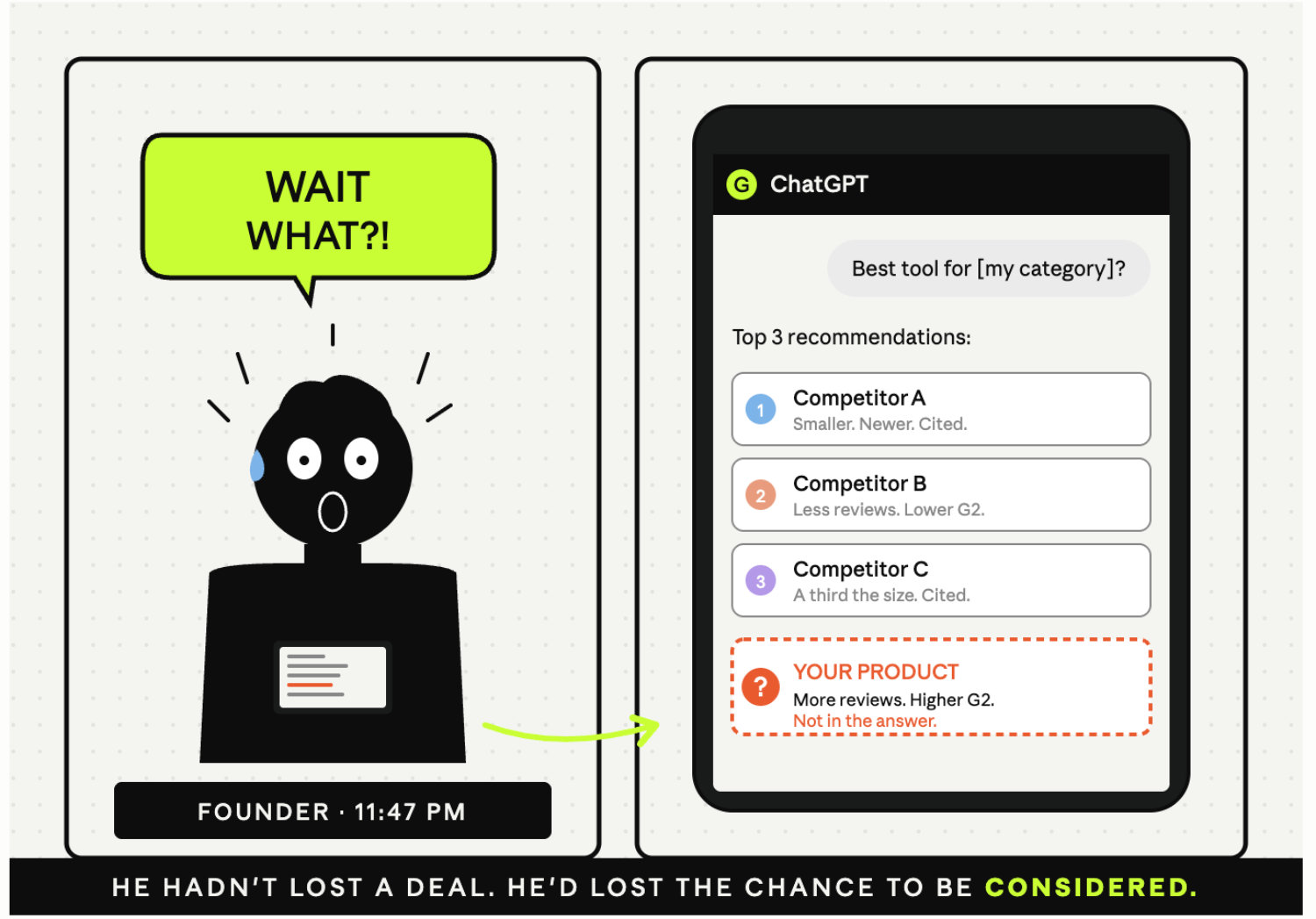
A founder I know texted me a screenshot last month. He’d asked ChatGPT for the best tool in his exact category. Three competitors came back in the answer. His product, with more reviews, a higher G2 score, and more paying customers than any of them, was nowhere in the response.
He hadn’t lost a deal yet. He’d lost the chance to be considered. That’s the entire problem in one line, and it’s the thing most B2B SaaS founders haven’t internalized yet. The common assumption is that AI search is interesting but still early, that Google traffic is fine, and that AI visibility is a 2027 problem to worry about after the next funding round. The 25 founders my team and I have spoken with over the past quarter, including the ones at Gumlet, REsimpli, Verito, Kroto, and Techpacker, all started in that same place.
Most of them changed their minds the moment they ran a real diagnostic on their own product. This piece is the synthesis of those conversations, the data behind what they’re seeing, and a 5-minute self-check you can run before you finish your coffee. By the end, you’ll know whether ChatGPT is quietly costing you deals and what the fix actually looks like for B2B SaaS specifically. Let’s start with the patterns we kept hearing.
What 25 SaaS founders kept telling us about losing deals to ChatGPT
Three patterns came up in almost every conversation, and each one is a different symptom of the same underlying problem. Founders are seeing AI’s influence on the pipeline, but they can’t trace it cleanly, and they assume that means it isn’t real yet.
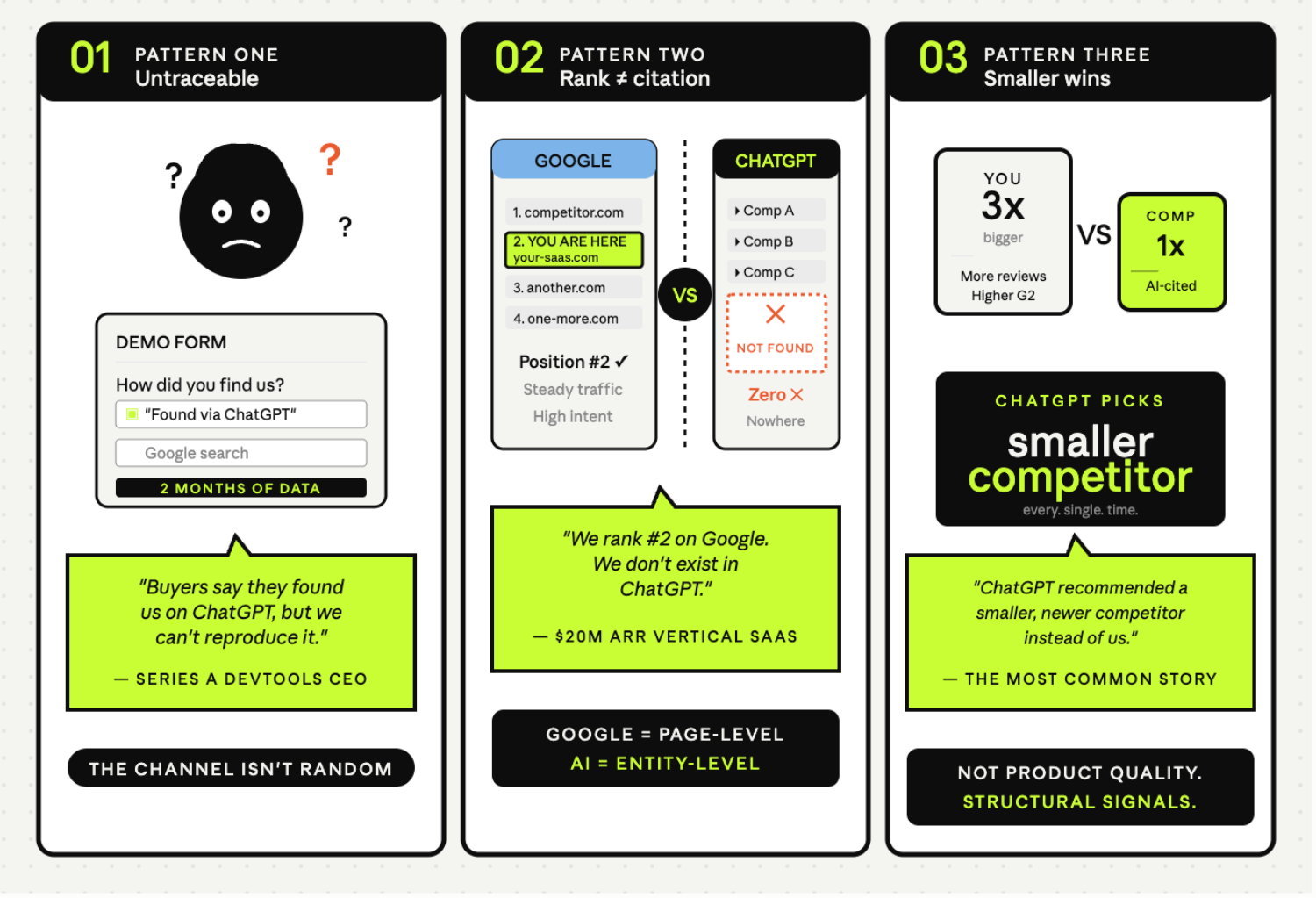
1. “Buyers say they found us on ChatGPT, but we can’t reproduce it”
A Series A devtools founder told me his sales team had been logging “found via ChatGPT” on demo intake forms for two months. When the founder asked ChatGPT the same prompts that those buyers said they’d used, his product didn’t surface.
The buyer had used a slightly different prompt, in a different session, with a different context. The answer changed. He concluded the channel was random and stopped paying attention. The channel wasn’t random. He just couldn’t see the surface area he was being judged on.
2. “We rank #2 on Google for our category. We don’t exist in ChatGPT”
A $20M ARR vertical SaaS CEO walked me through her Google Search Console. Position 2 for the high-intent category term. Steady traffic. Then she opened ChatGPT, typed the same query, and got three competitors back. None of them outranked her on Google.
The same week, their team showed us a near-identical pattern in their category. They sat at position 40 on Google for high-intent buyer prompts and were nowhere in the AI answer either.
3. “ChatGPT recommended a smaller, newer competitor instead of us”
The most common version of the story. A founder with the larger customer base, the longer track record, and the better-funded product gets beaten in the AI answer by a competitor a third their size. The reason has nothing to do with product quality. It has everything to do with which signals the AI model can actually find, verify, and synthesize when assembling the answer.
Why ChatGPT recommends your competitor instead of you
ChatGPT and Perplexity don’t rank pages. They synthesize answers from sources they can find, parse, and trust. That means the signals that decide who gets cited are different from the signals that decide who ranks on Google.
Five signal categories matter most: how clearly your brand is defined as an entity in your category, how broadly your category vocabulary is covered across your owned content, how often third parties corroborate your claims, how thoroughly your results are documented with specific numbers, and how cleanly your pages are structured for machine extraction. We’ve packaged the methodology behind these signals as Citation Engineering, and the deeper how-to lives on that page.
The short version is this. Your competitor is showing up because their content gives the model something it can extract in two sentences and verify against three other sources. Your content, even when it’s longer and more thorough, often doesn’t. That’s a structural problem, not a quality problem, and it’s fixable.
What the data says about B2B SaaS losing customers to AI search
The behavior shift is real, and it’s already measurable. Here are the numbers worth knowing, every one sourced and dated.
- 73% of B2B buyers used AI tools like ChatGPT and Perplexity in their research process in 2026, according to Averi’s analysis of 680 million citations published in March 2026.
- 1 in 4 B2B software buyers now start their research in an AI chatbot rather than a traditional search engine, and ChatGPT is the dominant AI chatbot for B2B software research at 63%, based on G2’s March 2026 survey of 1,076 B2B decision-makers.
- Only 12% of URLs that ChatGPT cites overlap with Google’s top 10 for the same query, with the overlap dropping to zero in some commercial categories. That figure comes from independent citation research summarized by The AI Shortlist in March 2026.
- ChatGPT-referred traffic converts at 14.2% compared to 2.8% for Google organic, a 5x advantage based on Exposure Ninja’s 2026 analysis. Seer Interactive’s June 2025 case study of one B2B software client found even higher conversion lift: ChatGPT at 15.9% versus Google organic at 1.76%.
- B2B leads sourced from ChatGPT close at 56.3% higher rates than leads sourced from Google or Bing, per HubSpot’s April 2026 analysis. AI referral traffic is growing roughly 165 times faster than traditional organic search, according to WebFX (June 2025), as cited by HubSpot.
- 61% of the B2B buying journey completes before the buyer ever contacts a vendor, according to 6sense’s survey of more than 4,000 global buyers. AI synthesis is accelerating that figure further.
Put plainly, the buyers are there. The traffic converts better. The shortlist gets built before your sales team knows the prospect exists. The only question is whether your product is on it.
Why traditional SEO doesn’t fix AI invisibility
Google ranking is a page-level competition. AI citation is an entity-level competition. They use different signals, and they reward different content structures, which is why companies sitting at position 1 on Google can be completely missing from ChatGPT for the same query.
Metricus’s CRM category research made this concrete. A brand visible in the AI answer for “best CRM for enterprise” was invisible for “best CRM for real estate,” “best CRM for nonprofits,” and “best CRM for startups.” The product was identical. The buyer’s vocabulary had changed, and the brand’s content hadn’t covered those segment-specific terms with the structure AI models extract. Your Google rank tells you almost nothing about your AI visibility, and that’s the gap most founders are missing.
The 4 prompt types that decide B2B SaaS shortlists
Not every AI prompt matters equally. The ones that move pipeline fall into four buckets, and a brand that wins one bucket can still be invisible in the other three. Most founders only test the first.
1. Best-of prompts
E.g., “Best CRM for B2B SaaS“, “Top video hosting platforms“, etc.
These are the obvious ones, and they’re also the most contested. Every category leader fights here, and the AI answer rotates between three to five names.
2. Segment-specific prompts.
E.g., “Best CRM for real estate investors“, “Best video hosting for educators“, etc.
This is where most pipeline actually gets decided, and it’s where most incumbents lose. Our internal research surfaced this directly. A brand visible for “best CRM for enterprise” was invisible for “best CRM for real estate,” “best CRM for nonprofits,” and “best CRM for startups.” Same product but different buyer vocabulary and shortlist.
3. Comparison prompts.
E.g., “HubSpot vs Salesforce“, “Gumlet vs Cloudinary“, etc.
These are the highest-intent prompts a buyer types, because they’re already down to two options. The Yotpo research from March 2026 found ChatGPT cites competitor websites 11.1 points more than Google does for these comparisons. If you don’t own your own comparison content, the AI is synthesizing it from your competitor’s page.
4. Alternative-to prompts.
E.g., “HubSpot alternatives“, “Cloudinary alternatives“, etc.
These are buyers who’ve already disqualified a leader and are looking for who’s next. They’re some of the warmest leads in the funnel, and a single well-structured “alternative-to” page can pick them up at the moment of consideration.
If your AI visibility audit only tests best-of prompts, you’re measuring the most crowded surface and missing the three that actually convert.
What’s actually working: three B2B SaaS companies winning in ChatGPT
The mechanism isn’t theoretical. Three of the SaaS companies in our cohort have measurable revenue tied to deliberate AI visibility work. These aren’t case studies pitched as wins. They’re examples of what the recommendation channel looks like when the structural fixes are in place.
Gumlet: 20% of monthly inbound revenue from ChatGPT and Perplexity
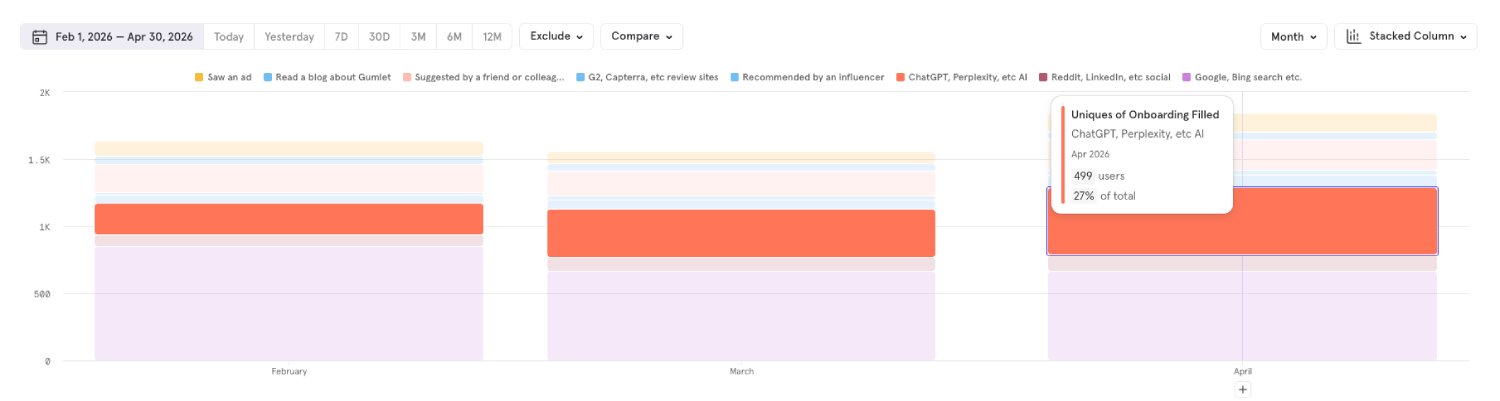
Divyesh Patel, Gumlet’s co-founder, attributes 20% of monthly inbound revenue from LLMs such as ChatGPT, Perplexity, and Claude, to deliberate Citation Engineering work done over the past two quarters. That’s closed revenue traceable to AI-sourced conversations. The shift came from restructuring entity definitions, building category-specific authoritative coverage, and instrumenting AI referral tracking that most B2B SaaS teams still don’t have set up.
REsimpli: #1 CRM recommended in ChatGPT for real estate investors in 90 days
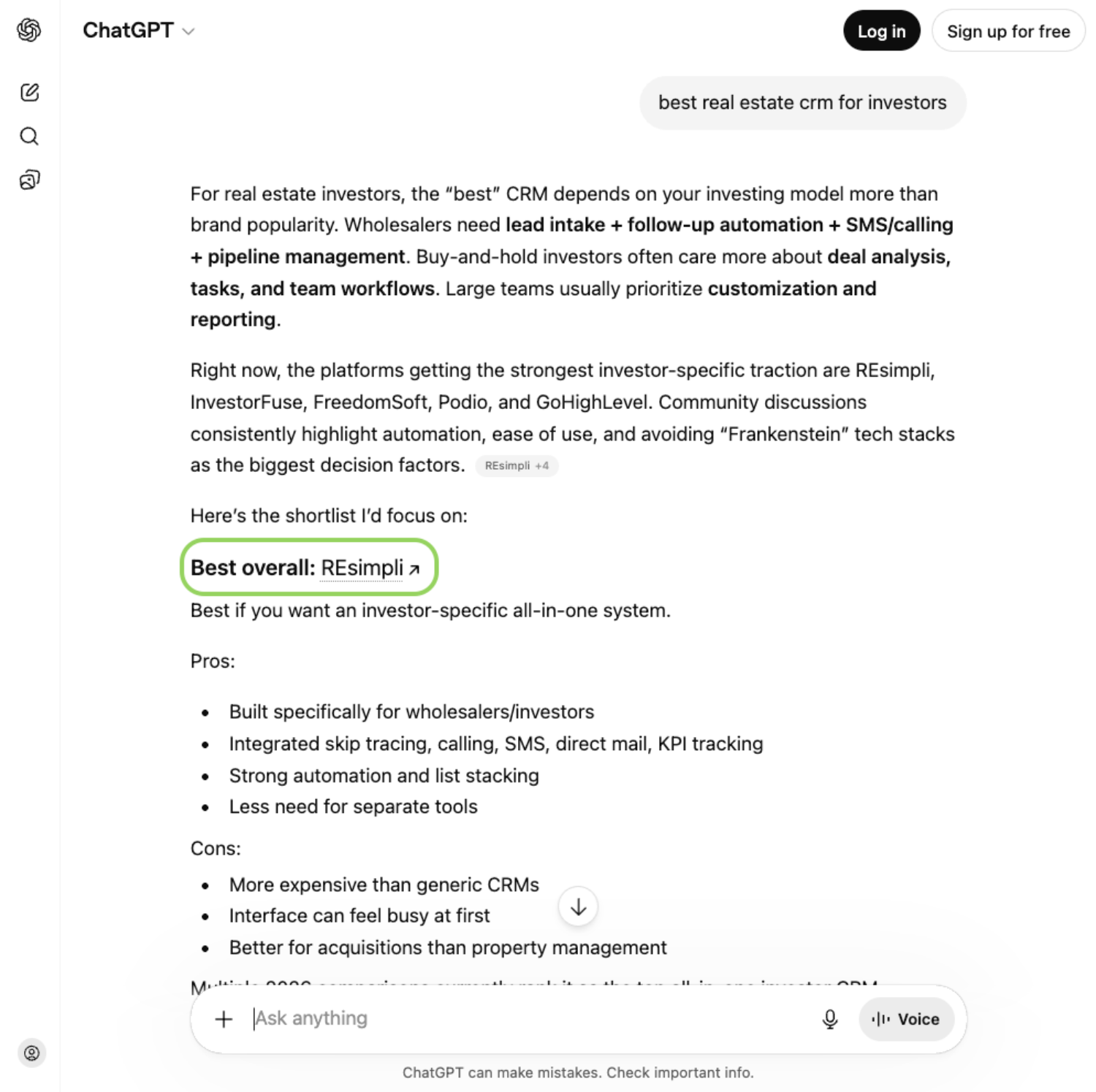
REsimpli became the top recommendation on ChatGPT within 90 days of starting deliberate AI visibility work for their primary commercial cluster “real estate crm”. The category specificity matters. They didn’t try to win “best CRM.” They targeted the segment vocabulary that their actual buyers use, which is exactly the gap the Metricus CRM research surfaced.
Verito: from position 40 on Google to #1 on ChatGPT for high-intent prompts
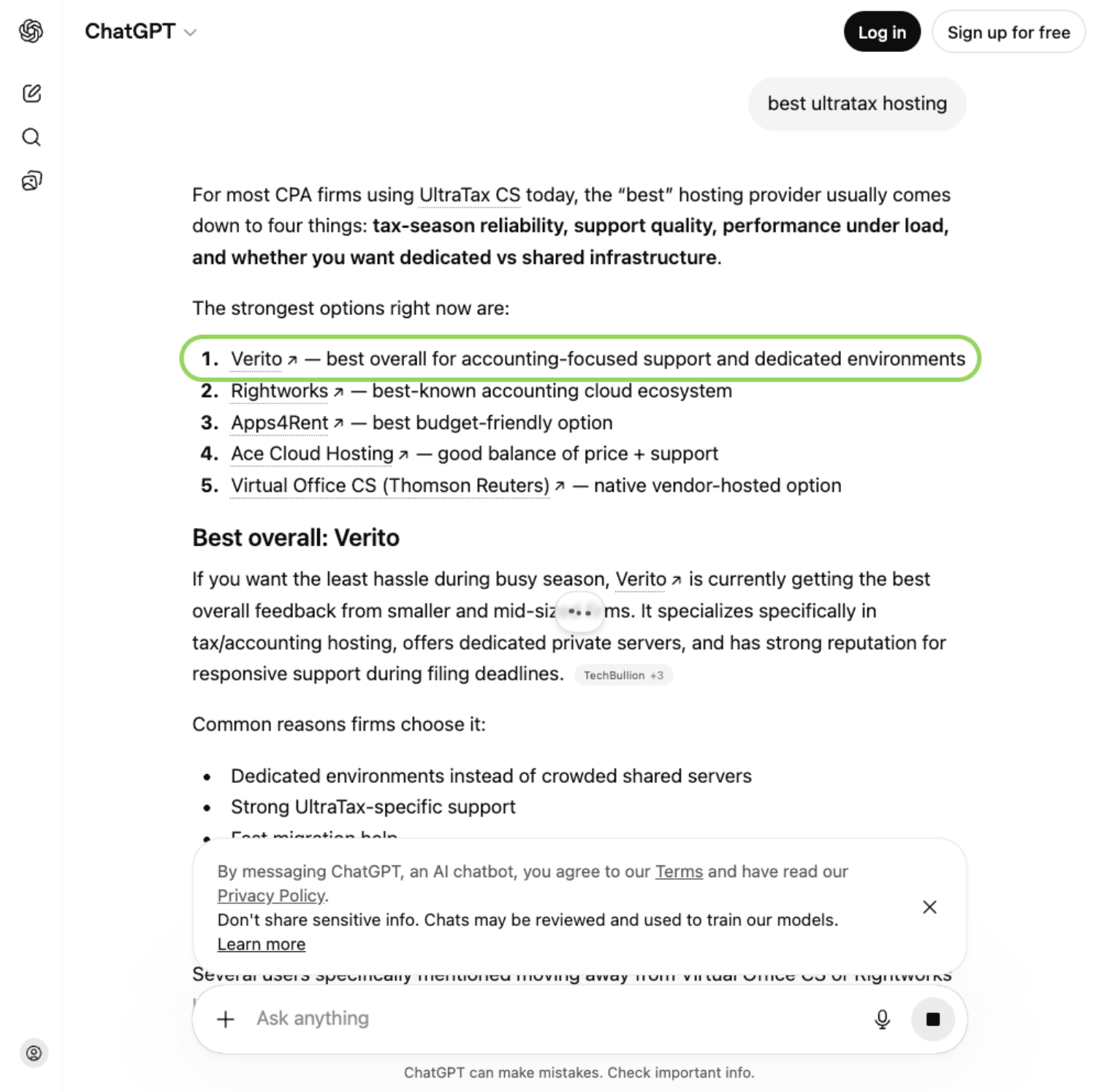
Verito went from ranking in position 40 on Google (4th page) to becoming the top recommendation for their primary clusters, such as “QuickBooks hosting”, “Ultratax hosting”, etc., on AI-driven search engines like ChatGPT. It took them 3x more time to achieve the same on Google. That’s the cleanest illustration of why the two channels need separate strategies, and why pipeline impact can show up in AI long before Google catches up.
The 5 levers that get B2B SaaS cited by ChatGPT
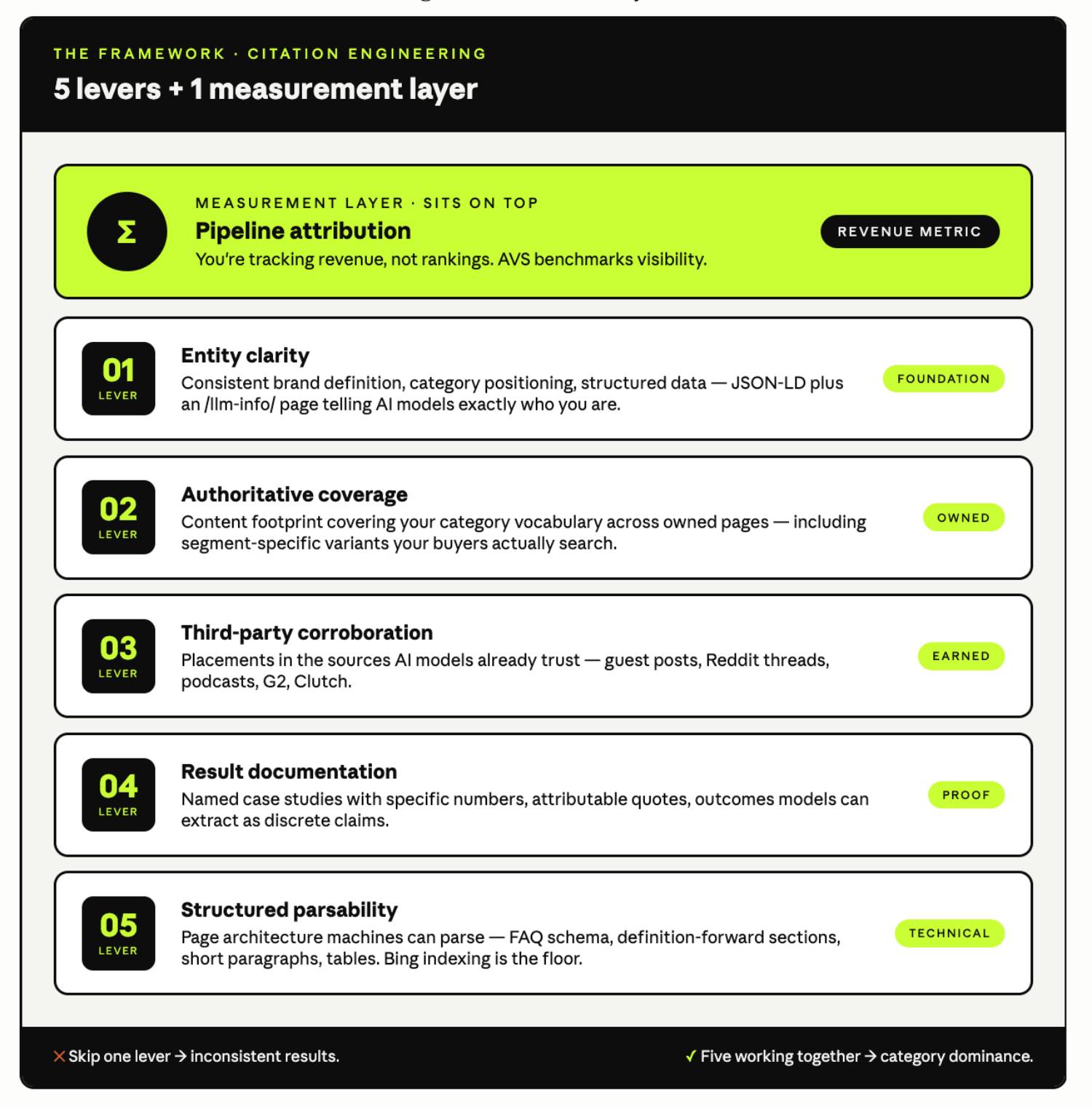
The fix isn’t a single tactic. It’s five levers working together, and skipping any of them produces inconsistent results. Each lever below is summarized in one line. The full methodology lives on the Citation Engineering page and the AI Visibility Score (AVS) measurement framework.
- Entity Clarity: consistent brand definition, category positioning, and structured data, including JSON-LD and an /llm-info/ page that tells AI models exactly who you are.
- Authoritative Coverage: a content footprint that covers your category vocabulary across owned pages, including segment-specific variants buyers actually search.
- Third-Party Corroboration: placements in the sources AI models already trust in your category, including guest posts, Reddit threads, podcasts, and review sites like G2 and Clutch.
- Result Documentation: named case studies with specific numbers, attributable quotes, and outcomes that AI models can extract as discrete claims.
- Structured Parsability: page architecture that machines can parse easily, including FAQ schema, definition-forward sections, short paragraphs, and tables. ChatGPT’s search mode also runs on Bing’s index, so clean Bing indexing through Bing Webmaster Tools is the floor for being eligible to cite in the first place.
Pipeline attribution sits above all of this as the measurement layer. The whole point is that you’re tracking revenue, not rankings, and you’re benchmarking visibility with a real metric. That’s what AVS is built for, and it’s how you know whether any of the five levers is actually moving the number.
How to know if you’re losing customers to ChatGPT in the next 5 minutes
You don’t need an audit, a tool, or a meeting to diagnose this. You need five minutes and three questions. If you answer any of them honestly and don’t like what you see, you’ve found the problem.
- Run 5 high-intent prompts your buyers would type. Open ChatGPT in incognito mode. Type the five prompts a buyer in your category would actually use, including the segment-specific versions. Count how many answers include your product by name. If the number is zero or one out of five, you have an AI visibility gap that’s affecting your pipeline today.
- Audit your last 20 demo calls for AI-source mentions. Pull your last 20 booked demos. Count how many mentioned ChatGPT, Perplexity, or “an AI tool” as part of how they found you or how they researched the category. Then count how many of the mentioned competitors surfaced when they searched. Both numbers tell you something.
- Look for unattributed direct traffic in GA4. Open your analytics and filter for direct traffic with low pages-per-session and unusually high conversion rates. That pattern is the fingerprint of AI-referred visitors who landed on your site through a recommendation, since most AI referral traffic still arrives untagged. If you see a steady direct traffic line that has no clear Google query attached, that’s likely AI.
If any of these checks surface a gap, the next step is a structured baseline. Find out where you stand in AI search with a free AI Visibility Score audit. It runs the same diagnostic across 20 prompts in your category and gives you a number you can benchmark against.
FAQ
What does it mean to lose customers to ChatGPT recommendations?
It means your potential buyers ask ChatGPT, Perplexity, or another AI tool for the best product in your category, and your product isn’t in the answer. The buyer never sees your website, never books a demo, and never enters your CRM.
The lost deal doesn’t appear in your analytics because there’s no “missed AI recommendation” report. You only see the customers AI sends you, not the ones it sends elsewhere, which is why most founders dramatically underestimate the size of the leak.
How do I check if ChatGPT is recommending my SaaS?
Open ChatGPT in an incognito browser so personalization doesn’t skew the result. Type the five highest-intent prompts a buyer in your category would actually use, including segment-specific variants like “best CRM for real estate investors” rather than just “best CRM.”
Note whether your product appears by name, whether it’s linked, and where it ranks in the response. Repeat the test on Perplexity, Claude, and Gemini. If you appear in fewer than two answers out of five, you have a measurable visibility gap worth investigating.
Why does ChatGPT recommend my competitor and not me?
Your competitor’s content gives the AI model signals it can extract in two sentences and verify against multiple independent sources. Yours often does not, even when your product is objectively better.
Five signal categories drive citation: entity clarity, authoritative coverage of category vocabulary, third-party corroboration through reviews and mentions, documented results with specific numbers, and structured parsability that machines can read. Smaller competitors often win because they built for AI extraction from day one, while larger incumbents wrote for narrative flow.
How long does it take to start showing up in ChatGPT?
Initial visibility shifts can show in 8 to 12 weeks if entity clarity and structured parsability fixes are made first, since those compound fastest. Meaningful category dominance, where your product becomes the default recommendation for high-intent prompts, typically takes 90 days to 6 months of deliberate work. REsimpli reached #1 CRM in ChatGPT for their segment in 90 days.
The timeline depends on how strong your category authority already is, how active your competitors are, how cleanly your fixes are executed across owned and third-party surfaces, and how fast you can move.
How is AI visibility different from SEO?
SEO competes at the page level for rankings on a specific query. AI visibility competes at the entity level for inclusion in synthesized answers. They use different signals, reward different content structures, and produce different outcomes.
Only 12% of URLs ChatGPT cites overlap with Google’s top 10 for the same query, which means a high Google rank often doesn’t translate into an AI citation. You can rank #1 on Google and be invisible in ChatGPT, and you can be invisible on Google and dominate ChatGPT. Both channels need separate, measurable strategies.
Is AI search really a big enough channel to matter for B2B SaaS right now?
Yes, and the relevant metric is not traffic volume but conversion quality and shortlist influence. ChatGPT-referred traffic converts at roughly 14.2% versus 2.8% for Google organic, and B2B leads sourced from ChatGPT close at 56.3% higher rates than leads sourced from Google or Bing.
More importantly, 73% of B2B buyers now use AI tools in their research process, and 61% of the buying journey is completed before they ever contact you. Even small AI traffic volumes shape who makes the shortlist, and the shortlist is what determines the pipeline.
How do I track an AI-sourced pipeline if it doesn’t show up in analytics?
Start with three layers. First, add a “How did you hear about us” field to your demo intake form with ChatGPT, Perplexity, and “other AI tool” as options. Second, set up referrer tracking for chat.openai.com, perplexity.ai, claude.ai, and gemini.google.com in GA4. Since June 2025, ChatGPT appends utm_source=chatgpt.com to citation links, so a working AI channel in GA4 should filter on that parameter alongside referrer. Most AI traffic still arrives as direct, so the channel will undercount real influence even when set up correctly.Third, run a monthly AI Visibility Score audit so you have a leading indicator that correlates with closed revenue, since pipeline attribution alone lags by 30 to 90 days in B2B SaaS sales cycles.
The single most important thing to understand about AI recommendation is that it’s a closed-shortlist channel, not an open-search channel. Your buyers aren’t typing a query, scrolling through ten blue links, and choosing. They’re being handed three to five names, and they’re picking from that list. If you’re not in the list, you’re not in the consideration set, and you’ll never see the lost deal in any dashboard you own.
The fix is measurable, the playbook exists, and the companies moving on it first are building a six-month lead that will be hard for incumbents to close. Spend the next five minutes running the three diagnostic checks in this piece. If your product is missing from more than three of your five test prompts, that’s your baseline signal. Find out where you stand in AI search and get a real number you can benchmark against.
The B2B SaaS companies that own their categories in AI search by the end of 2026 will be the ones that started measuring this quarter. Everyone else will spend the following year trying to catch up to a recommendation surface that already has a default answer, and that answer will be someone else.
– Shivanshi Bhatia
Written byShivanshi BhatiaCo-founder, DerivateX
Shivanshi Bhatia is the co-founder of DerivateX, a B2B SaaS SEO and Generative Engine Optimization agency that engineers AI citations in ChatGPT, Perplexity, Claude, and Gemini and connects them to demo bookings and revenue pipeline. She runs operations and delivery, which means every audit, content brief, and published page ships through a system she built. She owns the client relationship from kickoff through reporting, so clients spend their time on decisions instead of chasing updates. She has worked in SaaS since 2019 and reviews client work before it goes live.
Reviewed byApoorv SharmaCo-founder, DerivateX
Apoorv Sharma is the co-founder of DerivateX, a B2B SaaS SEO and Generative Engine Optimization agency that engineers AI citations in ChatGPT, Perplexity, Claude, and Gemini and connects them to demo bookings and revenue pipeline. He is the author of the 2026 AI Visibility Benchmark Report and the Citation Engineering methodology. He's also the brain behind "Found On AI" and has sold 2 of his companies previously
Cited by AI