Case study: Gumlet turned ChatGPT mentions into 20% of inbound revenue. Read it →

8 Off-Site Channels That Get B2B SaaS Brands Cited by AI, Ranked

Which third-party channels AI engines actually cite, ranked by DerivateX's own citation data, plus which engine favours each and a 90-day plan.


Last updated: November 2, 2026. Channel rankings come from DerivateX’s own AI visibility tracking in Peec AI. Outside studies are linked where they are cited.
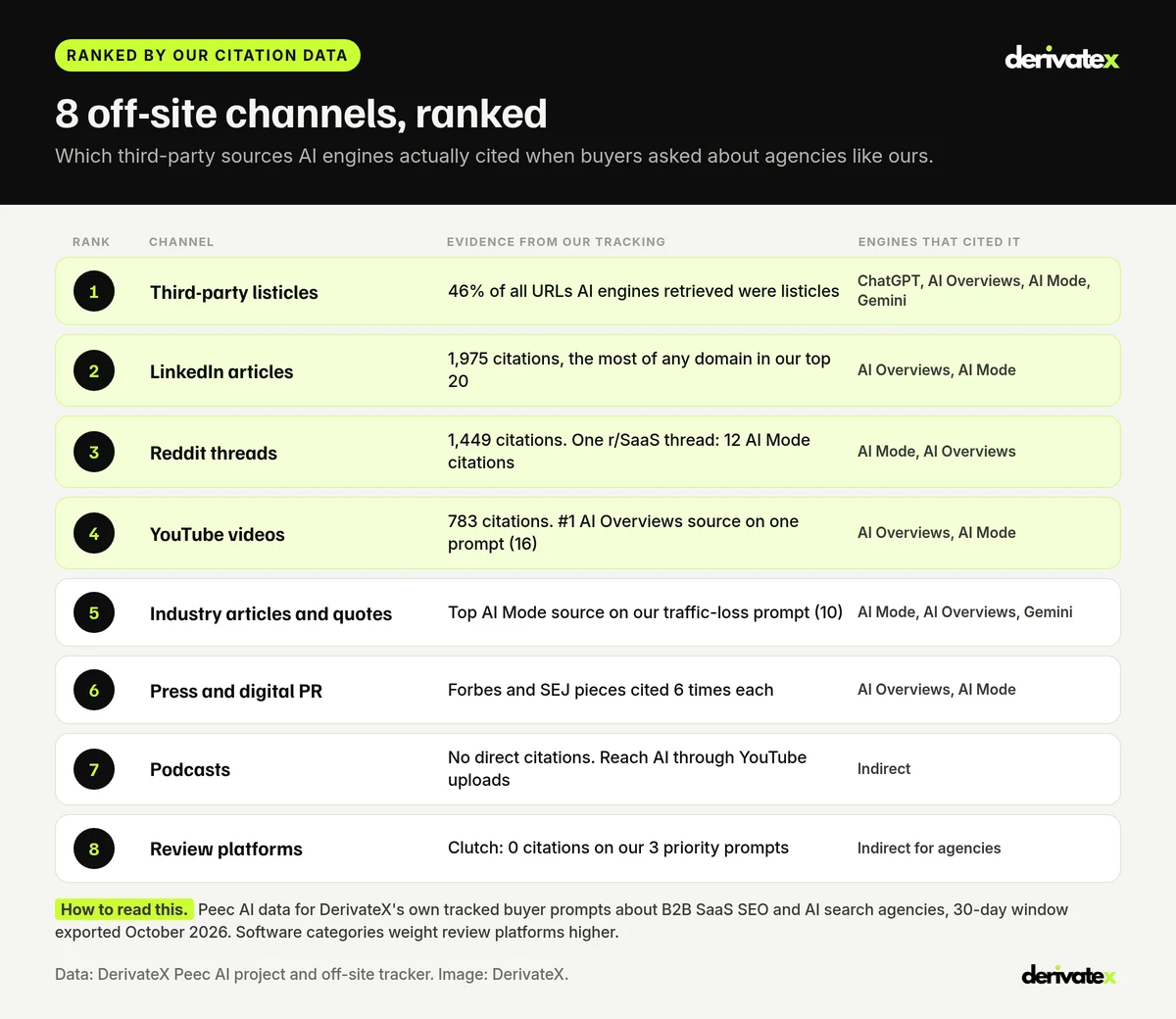
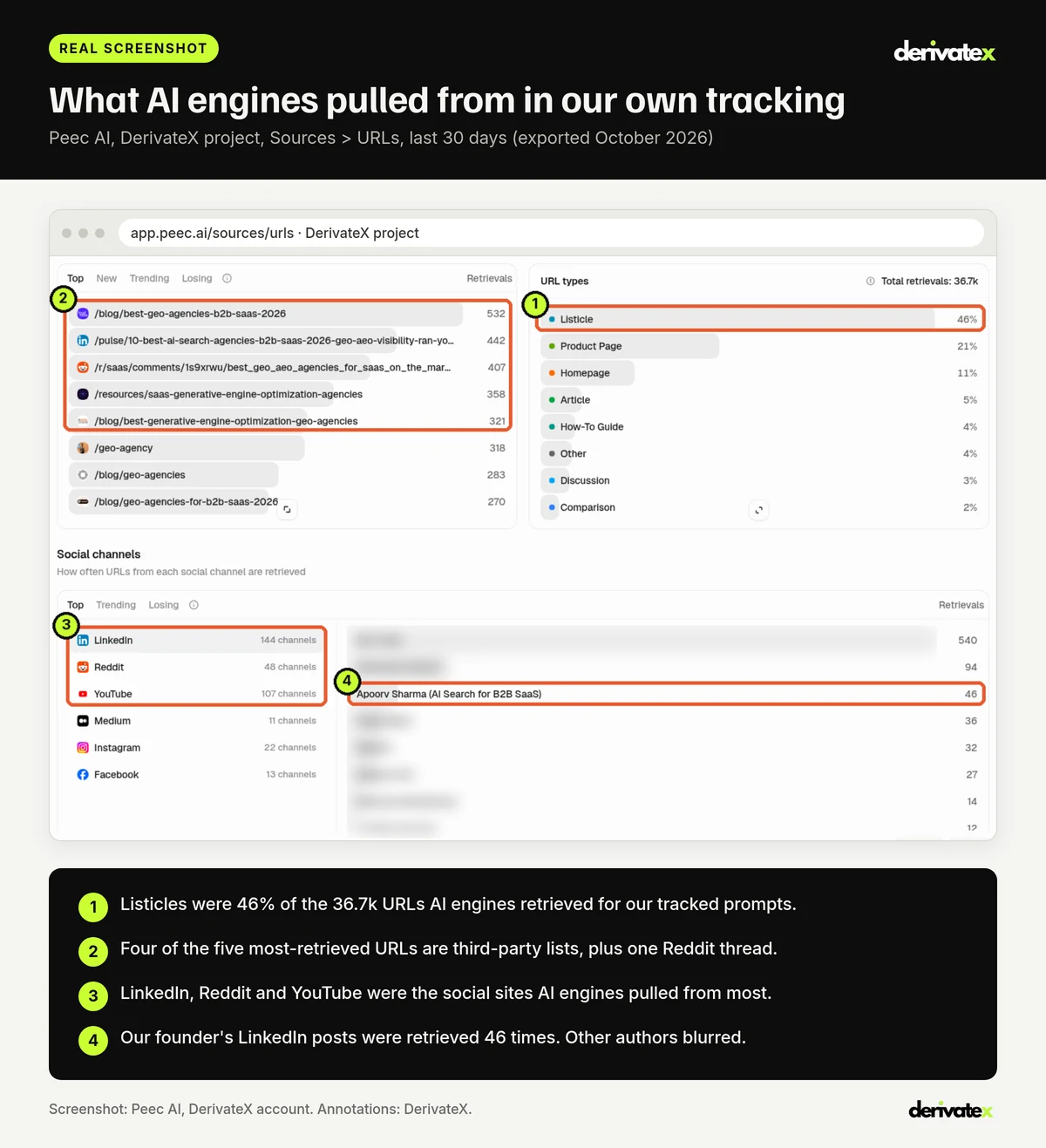
The off-site channels that get B2B SaaS brands cited by AI are, in order: third-party listicles, LinkedIn articles, Reddit threads, YouTube videos, industry articles with expert quotes, press and digital PR, podcasts and review platforms. That order comes from DerivateX’s own tracking: listicles made up 46% of the 36,700 URL retrievals AI engines made for our buyer prompts, and LinkedIn, Reddit and YouTube were the three most-cited third-party domains.
Most “get cited by AI” guides list the same channels in a different order each time, with no evidence for the order. This one ranks them by what AI engines actually cited when buyers asked about agencies in our own category, shows a real Google AI Mode answer built almost entirely from Reddit and YouTube, and ends with a 90-day plan sized to a real off-site budget.
Key takeaways
- Lists win first. Listicles were 46% of the URLs AI engines retrieved for DerivateX’s tracked prompts. Ahrefs reports that 43.8% of ChatGPT citations are listicles and comparison pages.
- Social sites are not equal. LinkedIn earned 1,975 citations, Reddit 1,449 and YouTube 783 in our 30-day window. Each is strongest in a different engine.
- Google’s AI features lean social, ChatGPT leans on lists. In our data, Google AI Overviews and AI Mode cited YouTube and Reddit heavily, while ChatGPT drew mostly from third-party listicles.
- Big-name press and review directories rank last for agencies. Forbes was cited, but far less than lists and social threads. Clutch was not cited once on our three priority prompts.
- Start where the citations already are. Find the pages AI already cites for your prompts, then get on them, before you create new assets.
What Does “Off-Site” Mean for AI Citations?
An off-site channel is any page you do not own that an AI engine can read, retrieve and cite when it answers a buyer’s question. Your own site still matters. In Amadora’s analysis of 10,563 AI citations, corporate websites owned 79 to 85% of citations. But your own site can only describe you. Off-site pages are where AI engines check whether anyone else agrees, and they are where most “best [category] for [buyer]” answers come from.
For a definition of the two kinds of sources, see first-party vs. third-party citations in LLMs. For the profiles and listings every brand should have in place first, see the 9 third-party assets B2B SaaS brands need. This guide is about where to spend placement effort after that, and in what order.
How These 8 Channels Were Ranked
The ranking uses citation data, not opinion. DerivateX tracks its own buyer prompts in Peec AI across ChatGPT, Google AI Overviews, Google AI Mode, Gemini and other engines. The source data below covers a 30-day window exported in October 2026: 37,700 source retrievals across all tracked prompts, plus a per-source breakdown for three priority prompts that drive agency shortlists:
- “seo agency for saas”
- “top ai search optimization agencies for saas”
- “which agency recovers b2b traffic lost to ai overviews”
Each channel is ranked on three things: how often AI engines cited it, how many engines cited it, and whether a B2B SaaS brand can realistically get onto it. The prompts are about agencies, so the data reflects a services category. Where software categories behave differently, the section says so.
The 8 Off-Site Channels, Ranked
| Rank and channel | Evidence from DerivateX tracking | Engines that cited it | Effort to get on it |
|---|---|---|---|
| 1. Third-party listicles | 46% of retrieved URLs were listicles. 4 of the top 5 URLs were lists | ChatGPT, AI Overviews, AI Mode, Gemini | Medium. Outreach to list owners |
| 2. LinkedIn articles | 1,975 citations, the most of any domain in the top 20 | AI Overviews, AI Mode | Low. You publish it |
| 3. Reddit threads | 1,449 citations. One r/SaaS thread got 12 of 14 AI Mode citations on its prompt | AI Mode, AI Overviews | Medium. Must follow subreddit rules |
| 4. YouTube videos | 783 citations. The #1 AI Overviews source for “seo agency for saas” (16 citations) | AI Overviews, AI Mode | High. Video production |
| 5. Industry articles and expert quotes | The top AI Mode source on the traffic-loss prompt (10 citations) | AI Mode, AI Overviews, Gemini | Medium. Pitch a quote or data |
| 6. Press and digital PR | A Search Engine Journal piece got 6 AI Mode citations. A Forbes piece got 6 in AI Overviews | AI Overviews, AI Mode | High. Needs a real story |
| 7. Podcasts | No direct citations. A podcast-running agency was named in 11 of 15 ChatGPT answers on one prompt | Indirect, mainly via YouTube | Medium. Guest pitching |
| 8. Review platforms | Clutch was not cited on any of the three priority prompts | Indirect for agencies | Low. Ask clients for reviews |
1. Third-party listicles and roundups
Getting named on “best [category]” lists that AI already cites is the single highest-return off-site move. In our data, four of the five most-retrieved URLs were third-party lists, led by an agency blog roundup (532 retrievals) and a LinkedIn Pulse list (442). One list on xql.group was cited 8 times in ChatGPT, 6 in AI Overviews and twice each in AI Mode and Gemini on a single prompt. No other source was cited across that many engines.
This matches outside research. Ahrefs’ AEO course points out that 43.8% of ChatGPT citations are listicles and comparison pages, so a brand named on those pages is already in the pool AI engines draw from.
- How to get on them: run your buyer prompts, export the cited URLs, and filter to lists you do not own. Ask the author for inclusion with criteria-fit proof: who you serve, pricing, and a published result.
- Skip: lists owned by direct competitors. Inclusion is unlikely and not worth the time.
- Watch out for: pay-to-play lists. Judge them on whether AI already cites them, not on domain rating.
Best for: every B2B SaaS brand, and especially ChatGPT visibility.
First action: list the 10 third-party roundups cited most for your top three prompts.
2. LinkedIn articles (Pulse) and founder posts
LinkedIn was the most-cited domain in our data, with 1,975 citations. The citations were not to company pages. They went to long-form LinkedIn articles: a Pulse list of B2B SaaS AI search agencies was cited 10 times in AI Mode and 7 in AI Overviews, and ranked #1 on Google for its prompt. Another Pulse article was the #1 AI Overviews source for “which agency recovers b2b traffic lost to ai overviews”, with 7 of 15 citations.
Founder profiles count too. Peec retrieved posts from Apoorv Sharma, DerivateX’s founder, 46 times in the same window. That is a channel any B2B SaaS founder controls.
- How to use it: publish long-form articles from a founder or subject-matter expert that answer one buyer question each, with named criteria and a clear structure.
- Engine fit: strongest in Google AI Overviews and AI Mode. VisibilityOS found Perplexity also leaned on LinkedIn articles in one category, citing LinkedIn 113 times on AI visibility tool questions.
3. Reddit threads
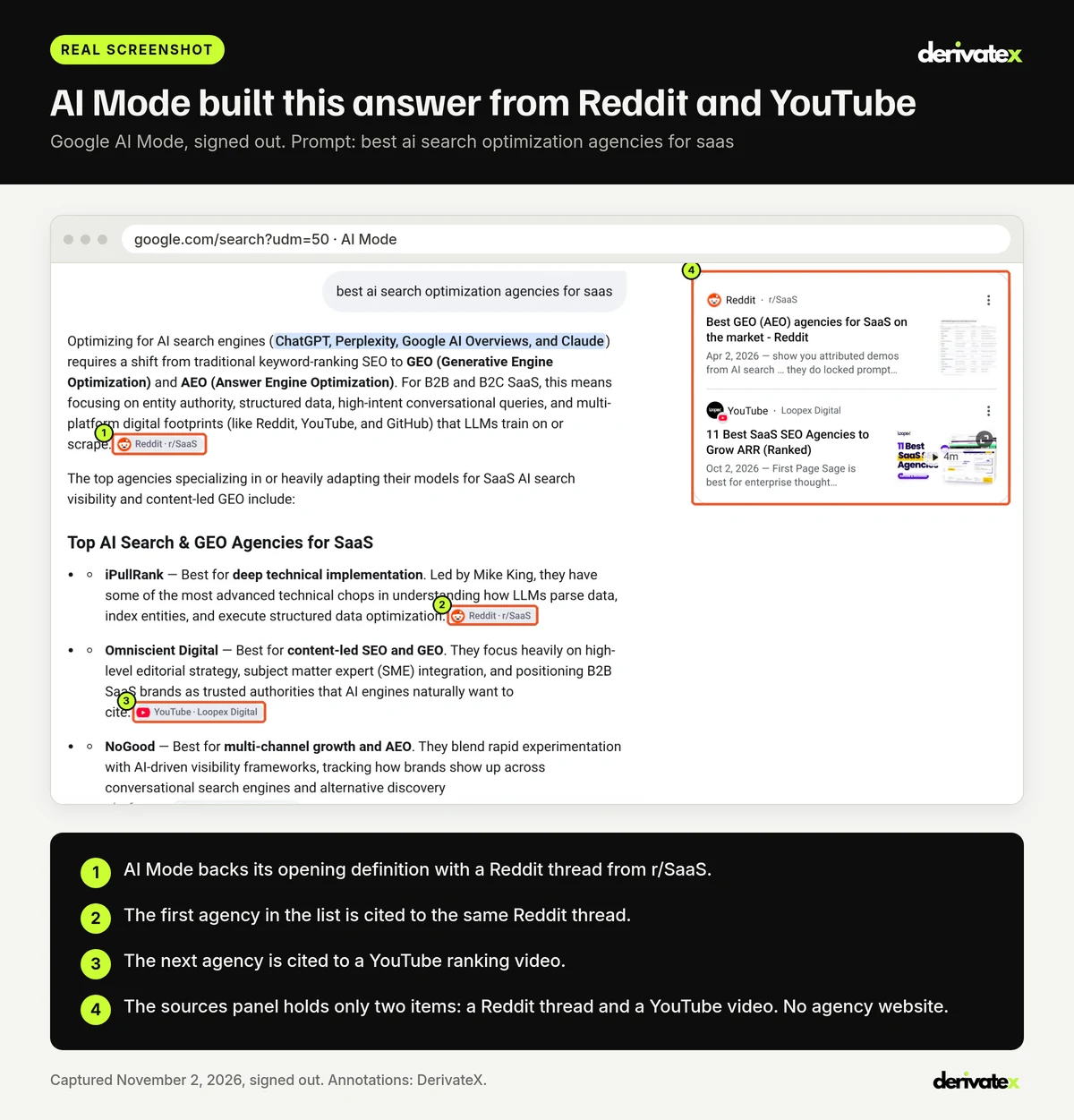
Reddit earned 1,449 citations in our window, and a single thread can dominate an AI answer. One r/SaaS thread asking for the best GEO and AEO agencies for SaaS took 12 of the 14 AI Mode citations on its prompt. The screenshot below shows the same pattern live: AI Mode built its agency answer on that thread and a YouTube video, with no agency website in the sources panel.
- How to use it: answer existing threads as a named person, disclose who you work for, and give selection criteria rather than a pitch. Follow each subreddit’s self-promotion rules.
- Engine fit: Google AI Mode first. VisibilityOS scans found Reddit cited 300 times by Perplexity on one set of questions, but almost never by ChatGPT, Claude or Grok.
4. YouTube videos
YouTube earned 783 citations and was the #1 AI Overviews source for “seo agency for saas”, with 16 citations across 9 answers. The cited video was a ranked list of SaaS SEO agencies. Video is the most expensive channel on this list, which is why it ranks fourth despite strong Google numbers.
Outside data points the same way. VisibilityOS reports that AI Overviews cited YouTube 371 times in its scans, ahead of Reddit (123) and LinkedIn (71).
- How to use it: publish 6 to 10 minute videos that answer one buyer question, with chapters, a full description and a link to the matching page on your site.
- Engine fit: Google AI Overviews and AI Mode. Little evidence that ChatGPT cites it for B2B prompts.
5. Industry articles and expert quotes
Niche industry articles are the quiet winners in AI Mode. On our traffic-loss prompt, a B2B marketing publication’s article on falling organic traffic was the top AI Mode source, with 10 citations, plus 5 in AI Overviews. These are not lists, so the way in is a quote, data or a contributed section, not an inclusion request.
- How to use it: offer original data or a sharp expert opinion to writers already covering your buyer’s problem.
- Engine fit: AI Mode, AI Overviews and Gemini.
6. Press and digital PR
Press works when it lands on the publications AI already cites for your prompts, not when it lands on the biggest name. In our data, a Search Engine Journal article got 6 AI Mode citations and a Forbes contributor piece got 6 in AI Overviews. Amadora found that Tier-1 press delivered roughly zero AI citations in its dataset, while niche trade press produced measurable citations.
DerivateX aims digital PR at the domains LLMs actually cite, typically DR 40 to 80+. For story ideas that earn reusable mentions, see 7 digital PR story angles for AI search.
7. Podcasts
Podcasts were not cited directly on any of our three priority prompts, but they show up through YouTube and through the brands that run them. One agency that runs a B2B podcast with 144 episodes was named in 11 of 15 ChatGPT answers on one prompt. The podcast is not proven to be the cause, so treat this as a supporting channel.
- How to use it: guest on shows that publish full episodes to YouTube, and ask for a show-notes link to your most relevant page.
8. Review platforms and directories
For agencies and services, review platforms did not earn citations in our data. Clutch was not cited once on our three priority prompts. Its value was indirect: list writers use review profiles to decide who to include.
Software is different. Amadora’s SaaS framework puts review platforms such as G2, Capterra, Slashdot and SourceForge near the top of its priority list, with G2 a frequent direct citation source, so a product company should rank this channel higher than an agency would.
- How to use it: keep profiles complete and ask real customers for reviews. Never offer incentives for reviews.
Which Off-Site Channels Each AI Engine Cites Most
Each engine has its own favourite sources, so the right mix depends on where your buyers ask. This table combines DerivateX’s tracking with the VisibilityOS scans linked above.
| AI engine | Off-site channels it leaned on | What to prioritise |
|---|---|---|
| ChatGPT | Third-party listicles and roundups. VisibilityOS found ChatGPT, Claude and Grok cited Reddit, YouTube and LinkedIn only 18 times in 1,656 answers | Listicle inclusion, then industry articles |
| Google AI Overviews | YouTube, LinkedIn articles, listicles, and some press | YouTube video and LinkedIn articles on your top prompts |
| Google AI Mode | Reddit, LinkedIn articles, industry articles, YouTube | Reddit answers and expert quotes in niche articles |
| Gemini | Listicles and industry articles in our data. Reddit in VisibilityOS scans | Listicle inclusion and industry articles |
| Perplexity | Reddit and LinkedIn articles in VisibilityOS scans | Reddit and LinkedIn, checked against your own category |
How to Build an Off-Site Citation Plan in 90 Days
A third-party citation plan is a list of specific pages to get onto, ranked by how often AI already cites them for your buyer prompts. Here is the order DerivateX works in.
- Weeks 1 to 2: map the cited sources. Run 10 to 30 buyer prompts across ChatGPT, Google AI Mode, AI Overviews and Perplexity. Record every third-party URL cited, the engine, and how often.
- Weeks 2 to 3: sort into the 8 channels. Tag each URL as a listicle, LinkedIn article, Reddit thread, video, industry article, press, podcast or review site. Drop competitor-owned pages.
- Weeks 3 to 8: go after lists and threads first. Request inclusion on the top cited lists, publish one LinkedIn article per priority prompt, and answer the most-cited Reddit threads with disclosure.
- Weeks 6 to 12: add the slower channels. Pitch expert quotes and data to the industry articles AI cites, then press, video and podcasts where the numbers justify them.
- Every month: re-run the prompts. Check whether the new placements appear as sources and whether your brand is named in the answer. Drop channels that do not move.
What This Looked Like for Two B2B SaaS Brands
Off-site placement is where most of the citation gains in DerivateX case studies came from. Two published examples:
- Verito (cloud hosting): DerivateX placed 28 articles across 18 publications. Over the engagement, the number of tracked prompts where Verito appeared in ChatGPT’s first answer went from 1 to 13. Read the Verito case study.
- Truein (attendance software): DerivateX placed 15 articles on construction, HR and automation publications. truein.com became the #1 most-cited source in GCC AI answers, up from #2.
How DerivateX Runs Off-Site Citation Work
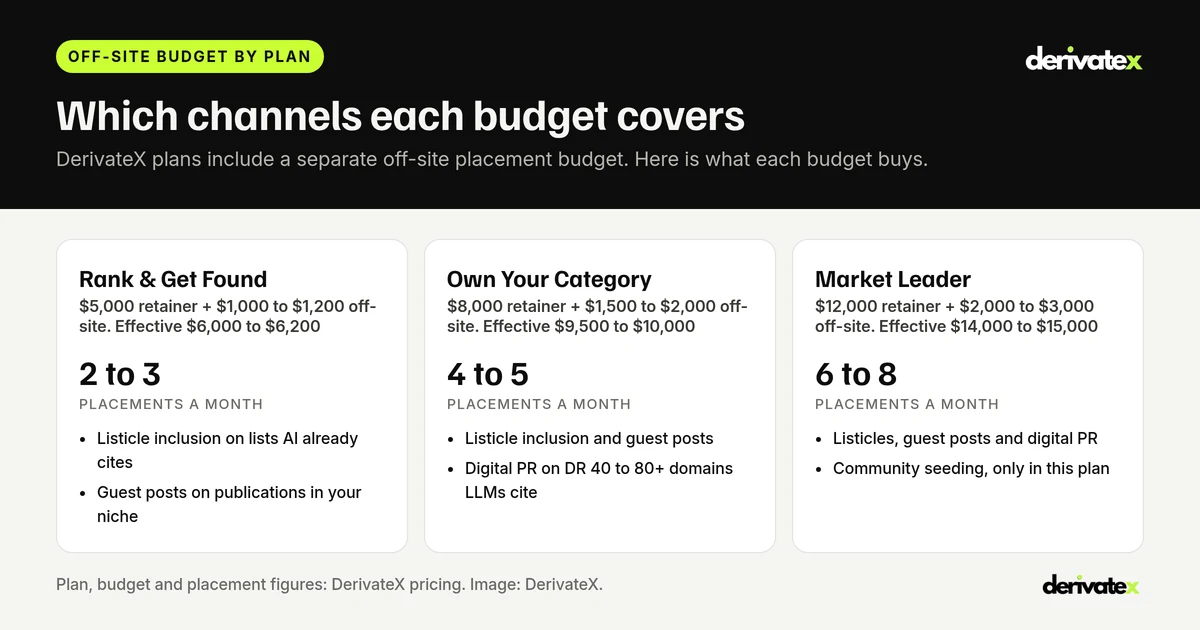
DerivateX is an SEO and GEO agency for B2B SaaS companies between $5M and $50M ARR, and every plan carries a separate off-site placement budget. Placements cover guest posts, listicle inclusion and digital PR. Community seeding is included only in Market Leader.
| Plan | Monthly retainer | Off-site budget | Effective monthly cost | Placements a month |
|---|---|---|---|---|
| Rank & Get Found | $5,000 | $1,000 to $1,200 | $6,000 to $6,200 | 2 to 3 |
| Own Your Category | $8,000 | $1,500 to $2,000 | $9,500 to $10,000 | 4 to 5 |
| Market Leader | $12,000 | $2,000 to $3,000 | $14,000 to $15,000 | 6 to 8 |
See how the DerivateX GEO agency program fits together, or start with the free audit below.
Off-Site AI Citation FAQs
How do you get cited by AI off-site?
Find the third-party pages AI engines already cite for your buyer prompts, then get onto them. In DerivateX tracking, that meant third-party listicles first, then LinkedIn articles, Reddit threads and YouTube videos. Request inclusion on cited lists, publish expert articles, and answer cited threads with clear disclosure.
Which off-site channel gets the most AI citations?
In DerivateX’s 30-day Peec AI data, third-party listicles led: they were 46% of all URLs AI engines retrieved for our tracked prompts. By domain, LinkedIn was cited most (1,975 citations), followed by Reddit (1,449) and YouTube (783).
Does ChatGPT cite Reddit and LinkedIn?
Rarely, in the data available. VisibilityOS found ChatGPT, Claude and Grok cited Reddit, YouTube and LinkedIn only 18 times in 1,656 answers. ChatGPT leaned on vendor sites and best-of roundups instead. Google AI Mode, AI Overviews and Perplexity cite social sites far more.
Is press coverage worth it for AI citations?
Only on the right publications. In our data, Search Engine Journal and Forbes pieces were each cited 6 times, well below the top lists and threads. Amadora found Tier-1 press produced roughly zero citations in its dataset, while niche trade press did better. Pitch the outlets AI already cites for your prompts.
How much should a B2B SaaS company spend on off-site placements?
DerivateX plans include $1,000 to $3,000 a month for off-site placements, on top of the retainer, for 2 to 8 placements a month depending on the plan. Spend should follow the cited-source map: put most of it on the lists and publications AI already cites for your prompts.
How long do off-site placements take to show up in AI answers?
It varies by engine and page. Engines that search the web live, such as Google AI Mode and Perplexity, can pick up a new placement once it is indexed. Re-run your prompts monthly and track whether each placement appears as a source before adding more of the same kind.
The Bottom Line
Off-site AI citations come from a short list of channels, and the order matters. Get onto the listicles AI already cites, publish LinkedIn articles from real experts, answer the Reddit threads that shape AI Mode, and add YouTube where AI Overviews leans on it. Press, podcasts and review sites help, but for B2B SaaS agencies and services they rank last on citations.
Want to know which third-party pages AI cites for your buyer prompts, and which name competitors instead of you? Get a free AI visibility audit from DerivateX.
Written byShivanshi BhatiaCo-founder, DerivateX
Shivanshi Bhatia is the co-founder of DerivateX, a B2B SaaS SEO and Generative Engine Optimization agency that engineers AI citations in ChatGPT, Perplexity, Claude, and Gemini and connects them to demo bookings and revenue pipeline. She runs operations and delivery, which means every audit, content brief, and published page ships through a system she built. She owns the client relationship from kickoff through reporting, so clients spend their time on decisions instead of chasing updates. She has worked in SaaS since 2019 and reviews client work before it goes live.
Reviewed byAyush SharmaHead of SEO & Content, DerivateX
Ayush Sharma is Head of SEO and Content at DerivateX, a full-service SEO and GEO agency for B2B SaaS. He focuses on SEO, GEO, and AI visibility for software brands, helping them get found and cited across Google, AI Overviews, ChatGPT, Perplexity, Gemini, and Claude, with results measured through to pipeline. On the DerivateX blog he covers AI visibility tracking, how LLMs choose which sources to cite, technical and JavaScript SEO for SaaS sites, and attributing AI search to revenue in HubSpot.
Cited by AI