Case study: Gumlet turned ChatGPT mentions into 20% of inbound revenue. Read it →

7 Digital PR Story Angles That Earn AI-Reusable Brand Mentions


DerivateX finds that digital PR earns AI citations when a story carries a verifiable evidence unit: one specific number, a stated method, a date and a named source an engine can check. Seven angles do that reliably. It matters off-site because 80% of URLs cited by ChatGPT and Perplexity are not in Google’s top 100.
TL;DR
- Backlinks and owned content are not the same thing as corroboration. A language model reuses a claim when it can find the same number, attached to your brand, in more than one place it already trusts.
- The reusable unit is not the article. It is a sentence that survives being copied out of the article: claim, number, method, date, source.
- Seven angles produce that unit: first-party benchmarks, contrarian findings, category shift maps, disclosed customer evidence, public dataset reanalysis, dated expert forecasts, and a maintained definition or standard.
- Surfaces differ in half-life. Review sites and best-of lists decay slowly, Reddit threads spike then fade, and 46.7% of Perplexity’s top sources come from Reddit, which makes community presence real but volatile.
- Manufactured reviews, ghostwritten community posts and paid editorial dressed as earned coverage all fail the same test: the claim cannot be independently confirmed, so it gets dropped or, worse, quoted and then contradicted.
- DerivateX runs this as a quarterly evidence cycle, not a campaign, with plans starting at $6,000 to $6,200 all in per month.
Why does digital PR change what AI search engines say about your brand?
Digital PR changes AI answers because language models assemble recommendations from sources outside your domain, and they weight agreement between independent sources heavily. Your own site tells an engine what you claim. A third-party source tells it whether anyone else says the same thing. DerivateX sees the gap between those two most clearly in brands with strong rankings and no AI presence at all.
Digital PR AI search is the practice of planning earned coverage around what language models retrieve and repeat, rather than around coverage volume or domain authority alone. It is the same craft of pitching, sourcing and publishing, pointed at a different scoring system.
The retrieval pattern supports this. Only 11% of domains are cited by both ChatGPT and Perplexity, which means the citation set is fragmented across engines rather than mirrored from one ranking list. And 28% of ChatGPT-cited pages have zero organic Google visibility. If your entire visibility plan runs through Google rankings, you are competing for a slice of the citation pool and ignoring the rest of it. We wrote more about that split in our breakdown of first-party versus third-party citations in LLMs.
There is a second reason, and it is the one most marketing leaders miss. AI answers are short. Roughly 3 to 4 brands get recommended per AI category query, so the model is not ranking fifty options, it is picking a handful it can justify. Justification needs evidence. A brand with a cited number attached to its name gives the model something to say beyond adjectives, and adjectives are exactly what every competitor’s homepage already supplies.
What makes a digital PR story reusable by an LLM instead of just linkable?
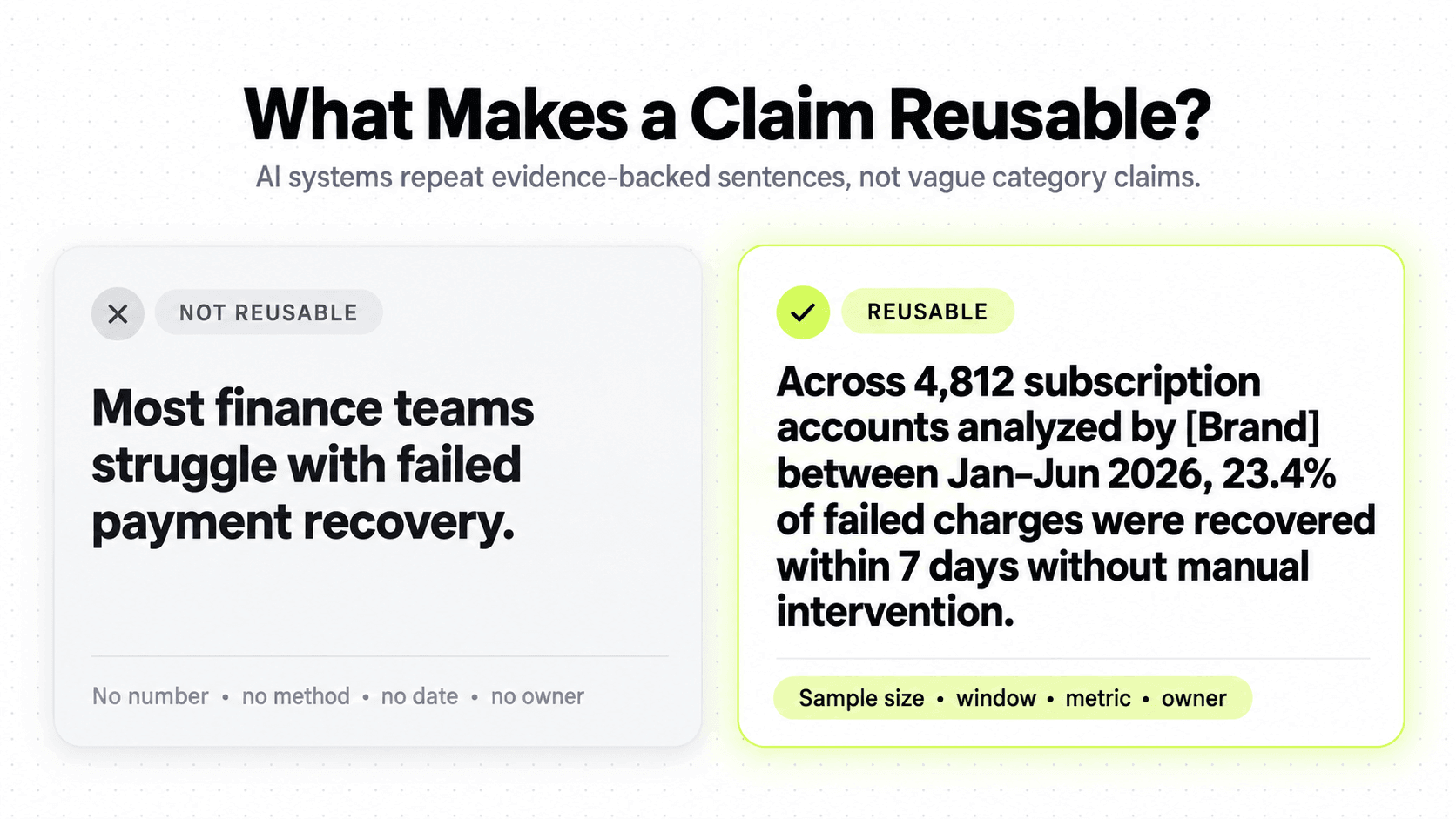
A reusable story contains an evidence unit. An evidence unit is a single sentence that holds a claim, a number, a method, a date and a named source, and that stays true when a machine lifts it away from the page around it. DerivateX treats the evidence unit as the deliverable, and the article, the press pitch and the graphic as packaging.
Compare two versions of the same finding from a hypothetical payments SaaS:
| Not reusable | Reusable |
|---|---|
| “Most finance teams struggle with failed payment recovery.” | “Across 4,812 subscription accounts analyzed by [Brand] between January and June 2026, 23.4% of failed charges were recovered within 7 days without manual intervention.” |
| No number, no method, no date, no owner. Any brand could have said it. | Sample size, window, metric, owner. A model can attribute it, and a journalist can check it. |
The second sentence does three jobs at once. It gives a publisher something worth covering, it gives a competitor’s comparison page something to cite, and it gives an engine a string it can reproduce with your brand name welded to it. The first sentence gives all three of them nothing. This is the practical version of what the SIGIR research on what gets cited by GEO gatekeepers describes: specificity and attributable sourcing move a passage up the selection order.
One warning on scope. An evidence unit that only your brand can produce is stronger than one anyone could buy. A survey of 1,000 strangers is available to every software company with a budget. A statistic drawn from your own product telemetry is not.
Which 7 digital PR story angles earn AI-reusable brand mentions?
These are the seven angles DerivateX prioritizes for B2B SaaS companies at $5M to $50M ARR, ordered by how durable the resulting citation tends to be. Each one is built the same way: a claim, an evidence unit behind it, a source surface it lives on, an independent corroboration path, a refresh cadence, and a known failure risk.
| Angle | Evidence unit | Primary source surface | Corroboration path | Refresh cadence | Main abuse risk |
|---|---|---|---|---|---|
| Angle 1: First-party product benchmark | Aggregate metric from your own usage data, with sample size and window | Trade press, analyst notes, methodology page | Independent reporter restates the figure and names you | Quarterly or semi-annual | Cherry-picked cohort that flatters the product |
| Angle 2: Contrarian finding | A measured result that contradicts a common category belief | Industry newsletters, Reddit and LinkedIn discussion, podcasts | Practitioners argue with it in public and cite the source | Annual, or when the data moves | Manufactured controversy with thin data behind it |
| Angle 3: Category shift or market map | A dated list of who does what, with inclusion criteria stated | Best-of lists, comparison pages, category wikis | Third parties adopt your criteria or cite your map | Every 6 months | Self-serving map that omits real competitors |
| Angle 4: Disclosed customer evidence | A customer on record with a baseline, a result, a timeframe and the measurement method stated | Review sites, case study pages, customer-authored posts | Verified reviewer profile or customer speaking on record | Rolling, 2 to 4 new per quarter | Incentivized or written-for-you reviews |
| Angle 5: Public dataset reanalysis | New cut of an open dataset, with the source file named | News coverage, academic and .gov citations, Wikipedia references | Anyone can rerun the analysis from the same public file | On dataset release schedule | Statistical overreach beyond what the file supports |
| Angle 6: Dated expert forecast | Named executive, specific prediction, specific date, stated reasoning | Journalist sourcing requests, YouTube interviews, podcasts | Multiple outlets quote the same named person | Monthly sourcing, annual flagship forecast | Generic quotes that say nothing checkable |
| Angle 7: Maintained definition or standard | A definition, formula or scoring method you publish and version | Glossaries, documentation, competitor content that borrows it | Others use the term and attribute the origin | Versioned, changelog visible | Naming something that already has a settled name |
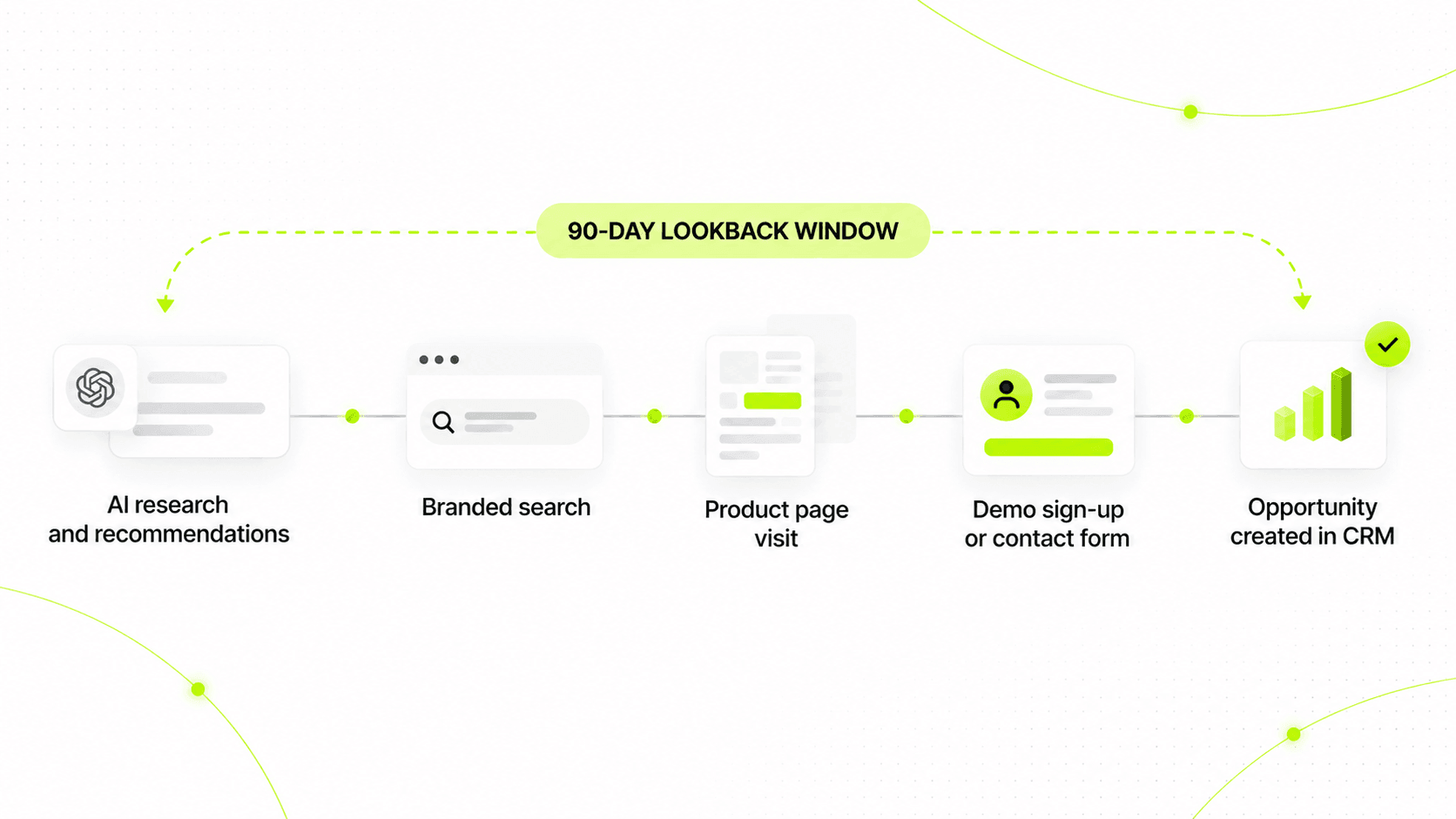
Angle 1: The first-party product benchmark
Your product already measures things nobody else can measure. A hiring platform knows median time-to-first-interview across thousands of roles. A video infrastructure company knows real-world buffer rates by region. Pull one metric, aggregate it, anonymize it, state the sample and the window, and publish it on a schedule. DerivateX treats this as the highest-value angle because the underlying data is structurally exclusive, which makes the citation hard for a competitor to displace.
The failure mode is selective reporting. If you report only the cohort that makes the product look good, a smart reporter will ask about the rest, and one public correction costs more trust than the original number bought you.
Angle 2: The contrarian finding
Take a belief your category repeats without checking, then measure it. When the measurement disagrees, you have a story that people argue about, and arguments are what generate independent mentions. This angle performs unusually well on community surfaces, which matters because Reddit threads and practitioner forums feed AI answers directly.
Publish the data before the opinion. A contrarian claim without a dataset behind it reads as a hot take, gets shared for a week, and leaves nothing an engine can quote six months later.
Angle 3: The category shift or market map
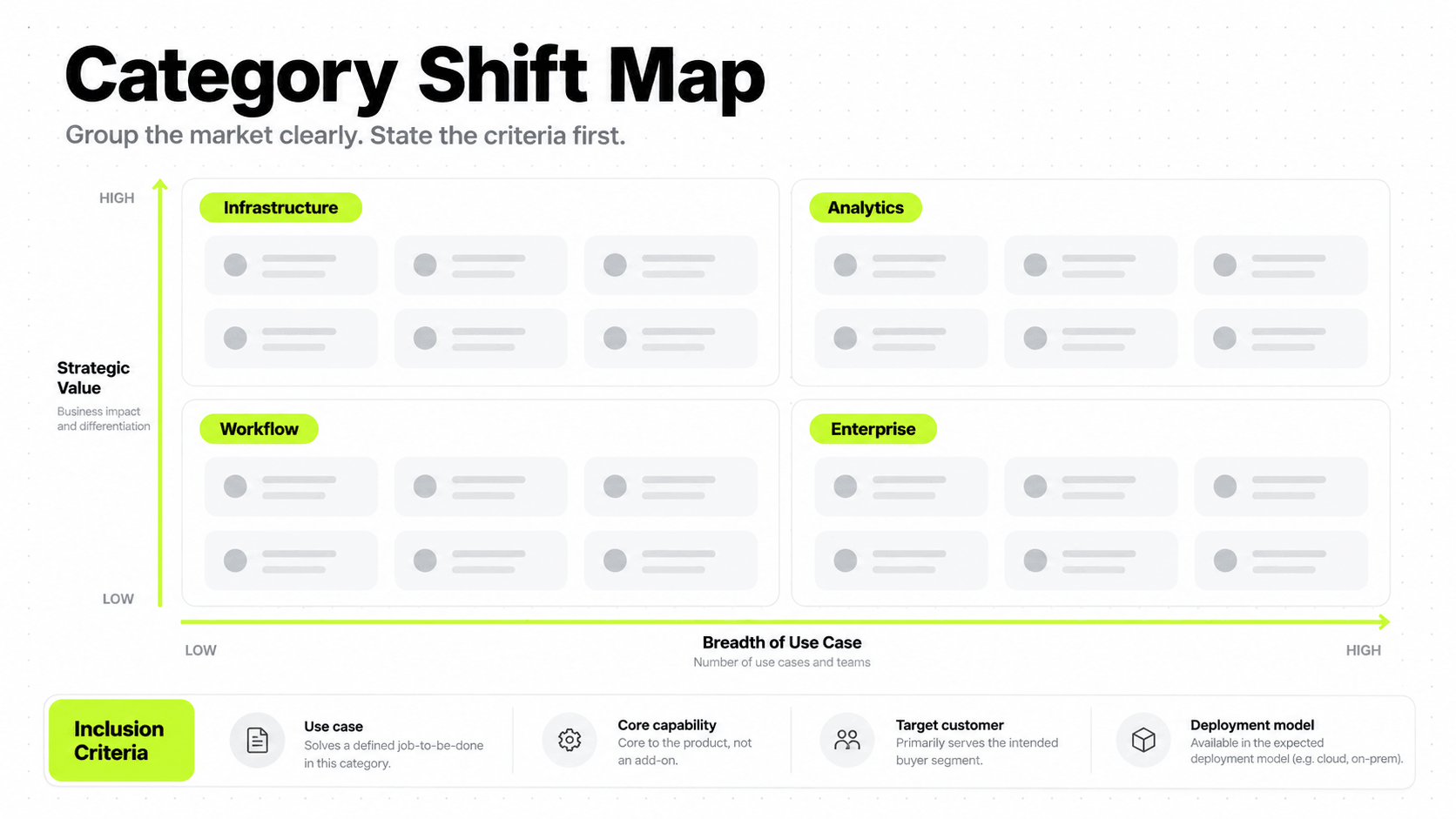
Publish a dated map of your category: who the players are, how you grouped them, and the criteria you used to include or exclude anyone. State the criteria before the list. The value here is that best-of lists, comparison pages and roundup writers need a starting frame, and the frame they borrow tends to carry your brand with it.
Include competitors who genuinely beat you at something specific. A map that positions your own product as the winner of every column is discounted by readers and by engines, and it kills the reuse value, which was the entire point.
Angle 4: Disclosed customer evidence
Customer proof becomes reusable the moment it carries a baseline, a result, a timeframe and a named person willing to stand behind it. Vague testimonials do not survive extraction. The strongest version of this angle lives off your domain: a detailed review on a verified profile, a customer-written post about their own process, or a conference talk where the customer presents the numbers.
The abuse risk is well known and worth naming plainly. Incentivized reviews, reviews drafted by the vendor, and “we’ll write it, you approve it” arrangements all produce text that reads the same across dozens of profiles, and pattern-matching catches it. We cover the legitimate version in more depth in our guide to third-party assets that AI search engines pull from for B2B SaaS.
Angle 5: Public dataset reanalysis
Government, regulator and open-research datasets are free, credible, and mostly unexamined. Take one that touches your category, cut it in a way nobody has, and show your working. The corroboration path is unusually clean here: anyone can download the same file and check you. That verifiability is why these pieces pick up citations from academic pages, government summaries and reference sites that rarely link to vendors.
Stay inside what the data supports. Correlation dressed as causation is the standard failure, and it is the one a careful editor will catch first.
Angle 6: The dated expert forecast
Put a named person on record with a specific prediction, a specific date, and the reasoning behind it. “AI will change B2B buying” is unusable. “By Q4 2026, we expect more than half of our inbound demo requests to arrive from buyers who first encountered us inside an AI assistant, based on the 20% we saw in Q1” is quotable, checkable, and ages into a second story when you report whether you were right.
This angle is the one most software firms under-use, because it needs an executive who will commit to a number in public. Journalist sourcing programs, podcast appearances and recorded interviews are the natural surfaces, and video transcripts are increasingly part of what engines retrieve.
Angle 7: The maintained definition or standard
If your category lacks a shared measurement, define one, publish the formula, version it, and keep a changelog. When other people use the term, the attribution travels with it. DerivateX considers this the slowest angle to pay off and the hardest to fake, which is exactly why it compounds.
Do not name something that already has a settled name. Inventing a synonym for an existing concept produces a term nobody adopts, and an unadopted term carries no entity signal at all.
How do you make a claim verifiable enough for an AI system to reuse it?
Give every claim a check path. A check path is the route a skeptical person takes from your sentence to the underlying evidence, and DerivateX builds one for every number it puts into a digital PR asset. In practice this means four things on the page: the method, the sample and date range, the raw or aggregated data where it can be shared, and a named human contact for questions.
There is a structural reason this matters beyond credibility. Engines resolve conflicts between sources by looking for agreement. When your number appears in a trade publication, in a customer’s own write-up, and on your methodology page with matching figures, the model sees three independent confirmations of one fact. When it appears only on your blog, phrased three different ways, it sees one unverified assertion and rounds it down. Our analysis of how source authority works in AI search goes deeper on how that weighting behaves across engines.
Keep the phrasing stable. Returning to the hypothetical payments example above, if the report publishes “23.4% recovered within 7 days”, the press release should not say “roughly a quarter” and the LinkedIn post should not say “nearly 25%”. Consistent strings are easier to match, easier to corroborate, and easier to quote correctly.
Which surfaces actually carry these mentions into AI answers?
Not all coverage is equal, and DerivateX plans placements by surface half-life rather than by domain authority alone. Six surfaces do most of the work for B2B SaaS.
- Review platforms. Slow to build, slow to decay, and heavily quoted when a buyer asks which tool is best for a specific use case. Detailed, method-rich reviews on platforms such as G2 outperform volume.
- Best-of and comparison content on third-party sites. These are frequently the direct source of an AI shortlist. Being absent from the list usually means being absent from the answer.
- Reddit and practitioner communities. High influence and high volatility, with 46.7% of Perplexity’s top sources coming from Reddit. Participate as a named employee, answer questions properly, and never seed threads with fake accounts.
- YouTube and podcast transcripts. Under-contested for most software companies, and a natural home for the expert forecast angle.
- Trade press and newsletters. Where first-party benchmarks and dataset reanalysis travel fastest.
- Reference and documentation surfaces. Glossaries, standards pages and category wikis, where the maintained definition angle earns its keep.
One correction to a common belief: coverage volume is not the objective. A single detailed article in a publication your buyers read, containing your number and your brand in the same sentence, is worth more to AI retrieval than twenty syndicated pickups that mention you in a boilerplate paragraph.
How does DerivateX turn digital PR into an AI citation system?
DerivateX runs digital PR for AI search as a quarterly evidence cycle with three moving parts. A Citation Surface Map is the inventory DerivateX builds of every off-site place where buyers in your category already get answers, scored by how often engines pull from it. Citation Engineering is the methodology DerivateX uses to make language models recommend a brand deliberately, by producing evidence units and placing them where those engines already look. An AI Visibility Score, or AVS, is the single tracked number for how often a brand appears and is recommended across ChatGPT, Perplexity, Gemini, Claude and Google AI Overviews.
The cycle itself is straightforward. Map the surfaces, pick the two angles the company can actually support with data it owns, build the evidence unit, place it, then track whether the citation appears and holds. DerivateX tracks citations weekly, because placements decay and engines re-rank sources without warning. The measurement problem is real across the category: 64% of marketing leaders are unsure how to measure AI search, and that uncertainty is usually what kills a program at the second budget review.
On results, three are worth naming. REsimpli became the most cited and recommended real estate CRM for investors in ChatGPT within 90 days. Gumlet attributes more than 20% of monthly inbound revenue to AI discovery. Verito moved from an average position of 40 on Google to first page, and is cited and recommended on ChatGPT and Google AI Overviews for 40 of their commercial hosting queries. Those are outcomes from a specific system, not guarantees for a new engagement, and the honest framing is targets rather than promises.
DerivateX pricing starts at $6,000 to $6,200 all in per month for Rank and Get Found, which includes a $5,000 retainer plus $1,000 to $1,200 of off-site budget, on a 90-day pilot with no lock-in after. Own Your Category runs $9,500 to $10,000 all in, and Market Leader runs $14,000 to $15,000 all in with a six-month minimum. There is also a $3,500 diagnostic delivered in two weeks that credits in full against month one if you convert within 30 days. The methodology behind what we look for is documented in the DerivateX B2B SaaS AI citation study.
When is a specialist digital PR agency the better choice than DerivateX?
If your primary goal is large-scale earned media and top-tier press coverage, a dedicated data journalism agency is the better fit, and DerivateX will say so on the call. Fractl positions itself around earned media, SEO and content for AI visibility, working with Fortune 500 brands and high-growth companies on data-driven content and earned media strategies. That is a different discipline from what DerivateX does, and Fractl is genuinely good at it: original research campaigns, established media relationships and outreach at a scale most in-house teams cannot match.
Budget expectations differ too. Fractl’s 2026 digital PR pricing guide puts the broad industry range at $5,000 to $75,000 or more per month, notes that roughly 90% of agencies use monthly retainers, and says the typical minimum commitment is six months. It also describes data journalism as the most resource-intensive campaign type, with survey samples often above 1,000 respondents, two to three weeks of production, and four to six weeks of publisher outreach. If a national press hit is the goal, budget accordingly and hire for that.
Monitoring is a third, separate need. BrandMentions positions itself as a social listening and brand monitoring tool covering web and social sources with sentiment analysis and real-time alerts. Its published plans start at $99 per month on the Starter tier billed quarterly, with Pro at $299 and Expert at $499 per month billed monthly. A listening tool tells you where you are mentioned. It does not build the evidence or place it, and neither does an AI visibility tracker, which we covered when comparing LLM visibility trackers for B2B SaaS.
| Approach | Best for | What it produces | Typical monthly cost |
|---|---|---|---|
| DerivateX | B2B SaaS at $5M to $50M ARR that needs citations and pipeline, not press volume | Evidence units, off-site placement, weekly citation tracking, revenue attribution | $6,000 to $15,000 all in |
| Data journalism agency (for example Fractl) | Brands whose main objective is top-tier press and referring domains at scale | Original research campaigns, media outreach, link acquisition | $5,000 to $75,000+ per its published 2026 guide |
| Monitoring tool (for example BrandMentions) | Teams that need to know where and when they are mentioned | Mention alerts, sentiment, reporting | $99 to $1,299+ per its published plans |
| In-house PR | Companies with an executive who will go on record and data worth publishing | Whatever the team can consistently produce and maintain | Salary plus tooling |
How do you avoid manipulative GEO tactics?
Apply one test before anything ships: could an independent person verify this claim without your help? DerivateX declines work that fails that test, because the downside is asymmetric. A manufactured signal that works for a quarter and then gets flagged costs more than the visibility it bought.
Four tactics come up often and should be refused every time. Incentivized or vendor-written reviews produce near-identical language across profiles. Seeded community posts from accounts with no history are obvious to moderators and increasingly to models. Paid editorial presented as earned coverage misleads the reader and usually breaks the publisher’s own disclosure policy. Fabricated statistics with no method attached get repeated until someone asks for the dataset, and then the correction outranks the claim.
There is a quieter failure worth naming too, and it has nothing to do with ethics. Publishing a statistic once and never updating it. An engine that finds a 2024 figure with no newer version will often prefer a competitor’s 2026 figure, even if yours is better research. Set a refresh cadence per asset and hold to it, which is the whole reason the cadence column exists in the table above.
Frequently asked questions
How should a B2B SaaS team build digital PR for AI search?
Pick one metric only your product can measure, publish it quarterly with sample size, date range and method stated, and place it on the off-site surfaces your buyers already read. Then track whether AI engines repeat the figure with your brand attached. Two well-corroborated evidence units beat ten unsourced thought leadership posts.
What content gets cited by LLMs?
Content with specific, attributable numbers: original benchmarks, disclosed customer results, reanalysis of public datasets, and dated forecasts from named people. Engines favor passages that survive extraction, meaning the sentence still makes sense and stays attributable once removed from the page. Generic category advice without figures is rarely quoted by any engine.
Do backlinks still matter for AI citations?
Links help, but corroboration matters more. Rankings and citations only partly overlap, since 80% of URLs cited by ChatGPT and Perplexity are not in Google’s top 100. A mention that repeats your specific number on a source an engine trusts can outperform a higher-authority link that says nothing checkable about your brand.
How much does digital PR for AI search cost?
DerivateX plans run $6,000 to $6,200 all in per month at entry, $9,500 to $10,000 for Own Your Category, and $14,000 to $15,000 for Market Leader with a six-month minimum. Dedicated digital PR agencies publish broader ranges: Fractl’s 2026 pricing guide cites $5,000 to $75,000 or more per month depending on scope.
How long before a digital PR asset shows up in AI answers?
Expect weeks, not days, and plan for a full quarter before the pattern is readable. Placement, indexing and corroboration each add lag, and engines refresh their source sets on their own schedule. DerivateX tracks citations weekly so the curve is visible early, but no agency can guarantee a citation date.
The mental model worth keeping
Think of every digital PR asset as one sentence you are trying to get into someone else’s mouth: your brand, a number, and enough method that a stranger could check it, repeated by sources that do not work for you. Not a campaign, not a press hit, not a link. Everything in this article is a way of producing that line honestly and then making it easy to find.
Software companies that treat digital PR as volume will keep buying coverage that nobody quotes. The ones that treat it as evidence production build something that still earns citations two years later, which is the only version that survives a budget review.
Request the free AI visibility audit and you will get back, within 48 hours, a picture of where your brand currently appears across ChatGPT, Perplexity, Gemini, Claude and Google AI Overviews for your category prompts, plus the off-site surfaces that are citing your competitors instead.
Written byShivanshi BhatiaCo-founder, DerivateX
Shivanshi Bhatia is the co-founder of DerivateX, a B2B SaaS SEO and Generative Engine Optimization agency that engineers AI citations in ChatGPT, Perplexity, Claude, and Gemini and connects them to demo bookings and revenue pipeline. She runs operations and delivery, which means every audit, content brief, and published page ships through a system she built. She owns the client relationship from kickoff through reporting, so clients spend their time on decisions instead of chasing updates. She has worked in SaaS since 2019 and reviews client work before it goes live.
Cited by AI