Case study: Gumlet turned ChatGPT mentions into 20% of inbound revenue. Read it →

How to Write a B2B SaaS Homepage ChatGPT Can Recommend


A business-to-business (B2B) software-as-a-service (SaaS) homepage that ChatGPT can recommend states four things in plain text near the top of the page: the category the product belongs to, the buyer it serves, the job it does, and one reason to pick it that a model can check. The six real homepages reviewed later in this guide show how easily one or two of those fields end up buried in a slogan, even at companies far past $5M to $50M in annual recurring revenue (ARR).
A clear homepage is one input among several. Artificial intelligence (AI) engines such as ChatGPT, Perplexity, Gemini, and Google AI Overviews also weigh third-party mentions, comparison content, and reviews, so a homepage rewrite mainly decides whether the large language model (LLM) describes you correctly once it considers you. No homepage can force a recommendation, and any agency that promises one is guessing.
This guide gives you the five fields an AI engine needs to extract from a homepage, a 20-point scorecard, six real homepages read the way a model reads them, a full before-and-after rewrite of a fictional $14M ARR company, and a map of where the homepage should stop so it leaves room for your use-case, comparison, pricing, and case-study pages.
TL;DR
- An AI engine can only recommend a company it can describe in one sentence, so the homepage should state category, buyer, job, reason, and boundary in crawlable text within the first screen.
- The category word should be the term buyers type into ChatGPT, such as accounts payable automation software, used the same way in the title tag, the H1 heading, the subhead, and the structured data.
- Checkable reasons give a model something safe to repeat: a named integration, a named buyer segment, a pricing model, or a dated customer result.
- The homepage should summarize and link out, leaving depth on use cases, comparisons, pricing, and proof to the pages built to own those prompts.
- The 10-check, 20-point scorecard in this guide shows which fields are missing, and the category and buyer checks come first because every other field depends on them.
- A homepage rewrite will not fix an undecided position, a product with no proof yet, or a category where third-party sources already describe you incorrectly.
What Does an AI Engine Need From Your Homepage Before It Can Recommend You?
An AI engine needs five facts it can lift from your homepage and repeat without guessing: your category, your buyer, the job your product does, a checkable reason to pick you, and the boundary where you stop being the right choice. A model that cannot fill those five fields tends to describe you vaguely or leave you out.
Vendor pages carry real weight in AI answers. In the DerivateX Authority Inversion study of ChatGPT software recommendations, which traced 233 recommendations across 40 B2B software categories in 2026, vendor-owned content supplied 51.1% of the 188 cited sources. The study covered one engine and one query type (vendor discovery), so the figure describes ChatGPT shortlist prompts specifically.
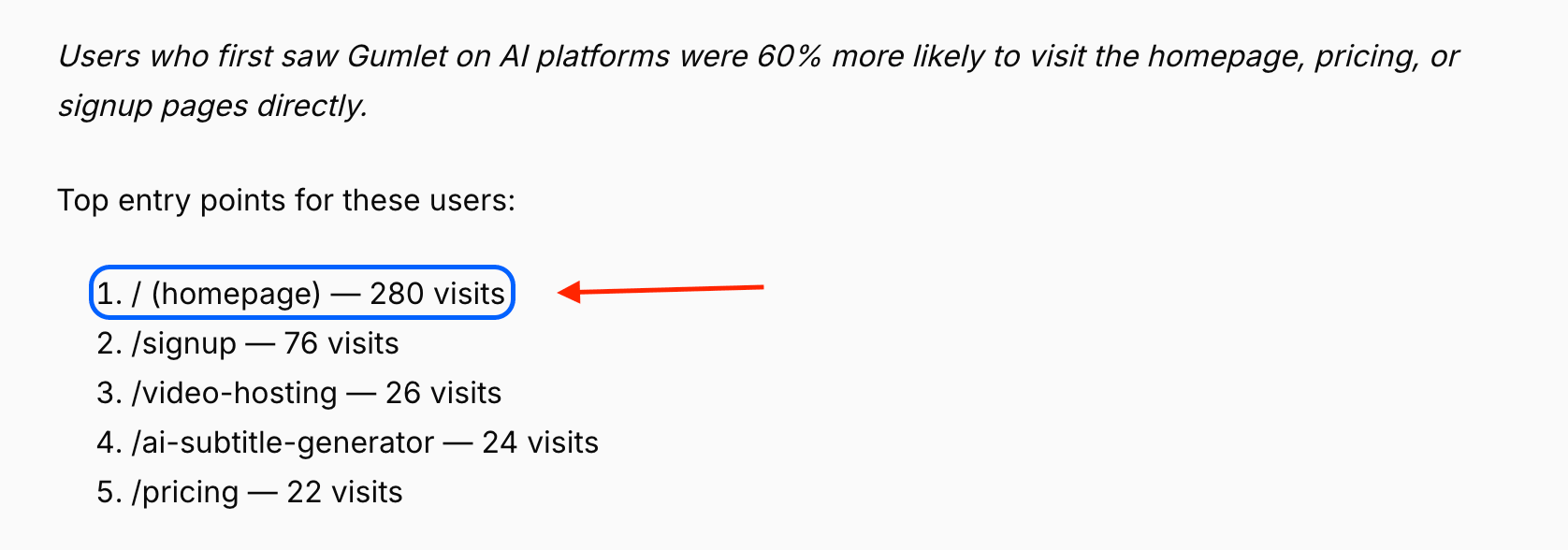
The homepage is also where AI-referred buyers land to check what they were told. In the Gumlet case study, the homepage was the top entry page for users who first saw Gumlet on AI platforms, with 280 visits against 76 for signup and 22 for pricing in the tracked period. A buyer who arrives from a ChatGPT answer and finds only a slogan has to work out alone whether the recommendation was right.
Google states in its AI features documentation for site owners that AI Overviews and AI Mode need no extra technical requirements beyond normal indexing, and it lists keeping important content in textual form and matching structured data to visible text among the practices that still apply. For a homepage, the five fields belong in visible text a crawler can read, and any schema markup should repeat what the page already says.
The five-field recommendation sentence
DerivateX uses a five-field model for homepage copy, and each field answers one question a model has to resolve before it names a vendor. The examples below come from Quillstack, a fictional accounts payable (AP) automation company used throughout this guide.
- Category: the plain term a buyer would type, such as accounts payable automation software.
- Buyer: a role plus a company type and size band, such as finance teams at mid-market manufacturers.
- Job: the outcome written as verbs, such as capturing, matching, and approving supplier invoices.
- Reason: a differentiator a model can verify, such as three-way matching that runs inside NetSuite and Sage Intacct.
- Boundary: the point where the product stops fitting, such as teams processing fewer than 1,000 invoices a month.
Put together, the five fields read as one sentence a model can repeat: Quillstack is accounts payable automation software for finance teams at mid-market manufacturers that captures, matches, and approves supplier invoices inside NetSuite and Sage Intacct. The fields overlap with the Category and Customer parts of the DerivateX 4 C’s framework for being explainable to AI, which covers consistency across every source a model reads. This guide stays on the one source you fully control and turns those ideas into homepage copy.
The homepage field checklist an LLM can extract
The table below lists every homepage field a model can pull, where that field should sit on the page, and the signal that it is failing. Use it as a writing brief before anyone opens a design file.
| Field | Where it lives on the homepage | What to write | Fail signal |
|---|---|---|---|
| Category | Title tag, H1 or the line under it, first 200 words, schema description | The term buyers use for the category | The category appears only in the footer or the title tag |
| Buyer | Subhead and a “who it’s for” block | Role, company type, and size band | Teams of all sizes |
| Job | Subhead and first content section | Two to four verbs tied to an outcome | Feature names with no outcome |
| Reason | Line under the subhead or the proof strip | Named integration, segment, method, or dated result | #1, best, or leading with no stated measure |
| Boundary | “Who it’s for” block or homepage questions section | Size band, stack, or use case you exclude | No exclusion anywhere on the site |
| Proof | Logo strip with captions and one dated result | Customer name, segment, metric, and timeframe | Unlabeled logos and a rounded customer count |
| Pricing signal | Navigation link and one homepage line | Pricing model and starting price if public | No pricing link anywhere on the page |
| Entity line | Footer or short About block, plus Organization schema | Company name, what it is, founding year, headquarters | No plain statement of who the company is |
| Handoff links | Body sections and navigation | Links to use-case, comparison, pricing, and case-study pages | Every question answered in shallow form on the homepage |
| Crawlable text | Page source | All fields above present as server-rendered text | Hero copy inside an image, a video, or a script-only component |
How to Write the Category Sentence a Model Can Repeat
Write the category sentence as one plain line inside or directly under your H1: brand name, the category term buyers type, the buyer, and the job. A slogan can stay in the headline if your brand team wants it. The sentence under the headline has to make sense when a model quotes it alone.
The formula is short: [Brand] is [category] for [buyer] that [job], [reason]. Every word in that sentence should be something a buyer could type into ChatGPT or something a model could check against another source. The rules below keep it that way.
- Use the category word buyers type. Ask ChatGPT and Perplexity for the best tools for your buyer and note the category nouns in the answers, then use the accurate one on your homepage.
- Pick one category. Two category claims on one homepage give a model two half-answers, so name the parent category and link to each product page for the rest.
- Name the buyer with a role and a company type. A phrase like finance teams at mid-market manufacturers gives a model a segment it can match to a prompt such as best AP software for manufacturers.
- Write the job as verbs with an object. Captures, matches, and approves supplier invoices describes work a buyer recognizes, and a feature name like Smart Capture describes nothing until someone explains it.
- Make the reason checkable. An integration, a method, a buyer segment, or a dated result can be confirmed elsewhere on the web, which makes it safer for a model to repeat.
The DerivateX list of 47 B2B SaaS homepage clichés that make brands invisible in AI search covers the adjectives to cut. This section covers what goes in their place, which is the harder part of the rewrite.
Scenario: the horizontal tool with nothing a model can repeat
Picture a $12M ARR workflow tool whose hero reads Where great work happens, with a subhead about helping teams do their best work. The product serves marketing, operations, and IT teams, so the founders kept the copy broad to avoid excluding anyone. When a buyer asks ChatGPT for the best IT request tracking tool for a 200-person company, the homepage gives the model no sentence connecting the product to that job. Horizontal products can still pass the test by naming the use case that drives the most revenue in the category sentence and linking each other use case to its own page.
Scenario: the vertical SaaS that names the buyer and the job
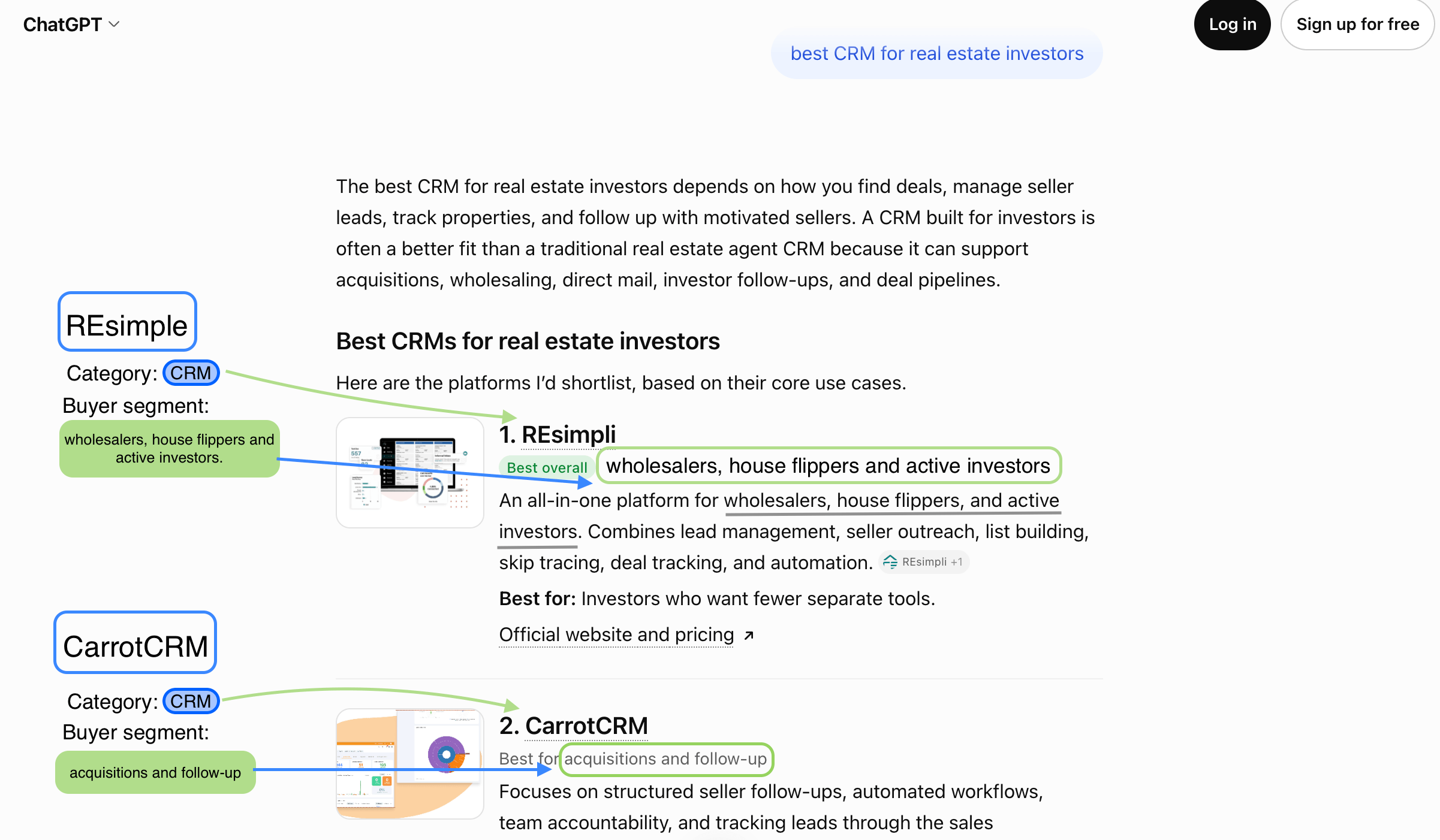
Vertical products have an easier sentence to write because the buyer is already decided. REsimpli, a DerivateX client, describes itself in its case study snapshot as an all-in-one CRM (customer relationship management) platform for real estate investors, wholesalers, flippers, and small investment teams, with lead management, skip tracing, list stacking, and marketing automation. According to the REsimpli case study, REsimpli became the number one cited CRM for real estate investors in ChatGPT within three months. That program also included frequently asked questions (FAQ) blocks, structured comparisons, and third-party mentions, so the clear definitional language was one input among four.
Six Real B2B SaaS Homepages, Read the Way a Model Reads Them
Reading a homepage the way a model does means ignoring the design and checking which of the five fields appear as plain text. In our October 5, 2026 review of six public homepages, Plausible and Jobber stated category and buyer clearly, Attio and Vanta split the category between title tag and hero, and Calendly and monday.com leaned on broad claims.
These are public pages from companies larger than most readers of this guide, and every quoted phrase below was on the live page when we reviewed it. Homepages change often, so check the current version before you copy a pattern.
Plausible Analytics: category and contrast in one line
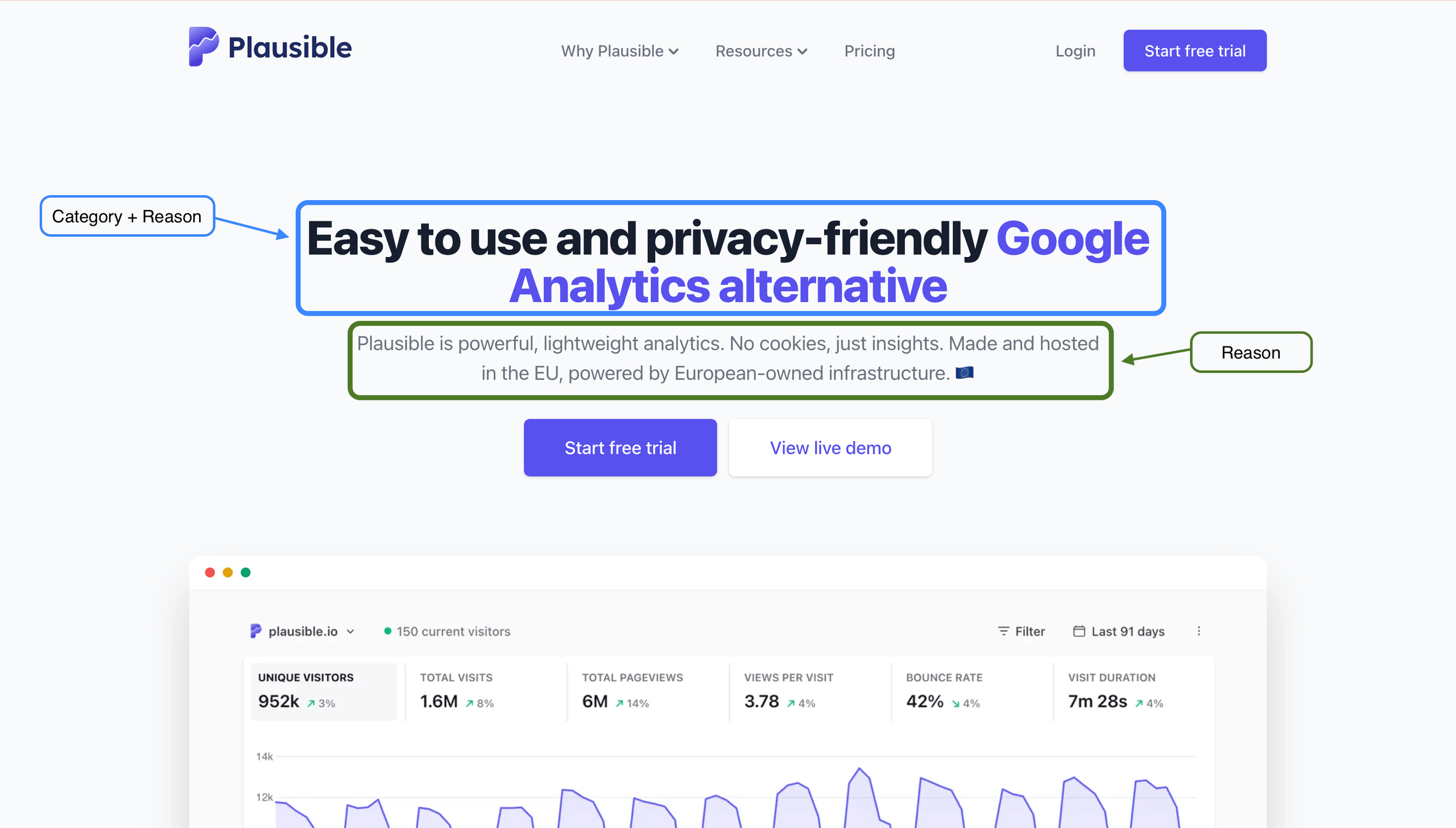
The Plausible Analytics homepage uses its H1 for the category sentence: Easy to use and privacy-friendly Google Analytics alternative. The supporting text names checkable reasons, including No cookie banner required, an open source codebase, and hosting in the EU (European Union). The navigation adds a “Who it’s for” menu (ecommerce, SaaS, agencies, creators and publishers) and comparison pages against Google Analytics, Matomo, and Cloudflare Analytics. A model can repeat what Plausible is, which incumbent it replaces, and why a privacy-focused buyer would pick it.
Jobber: the buyer is in every row
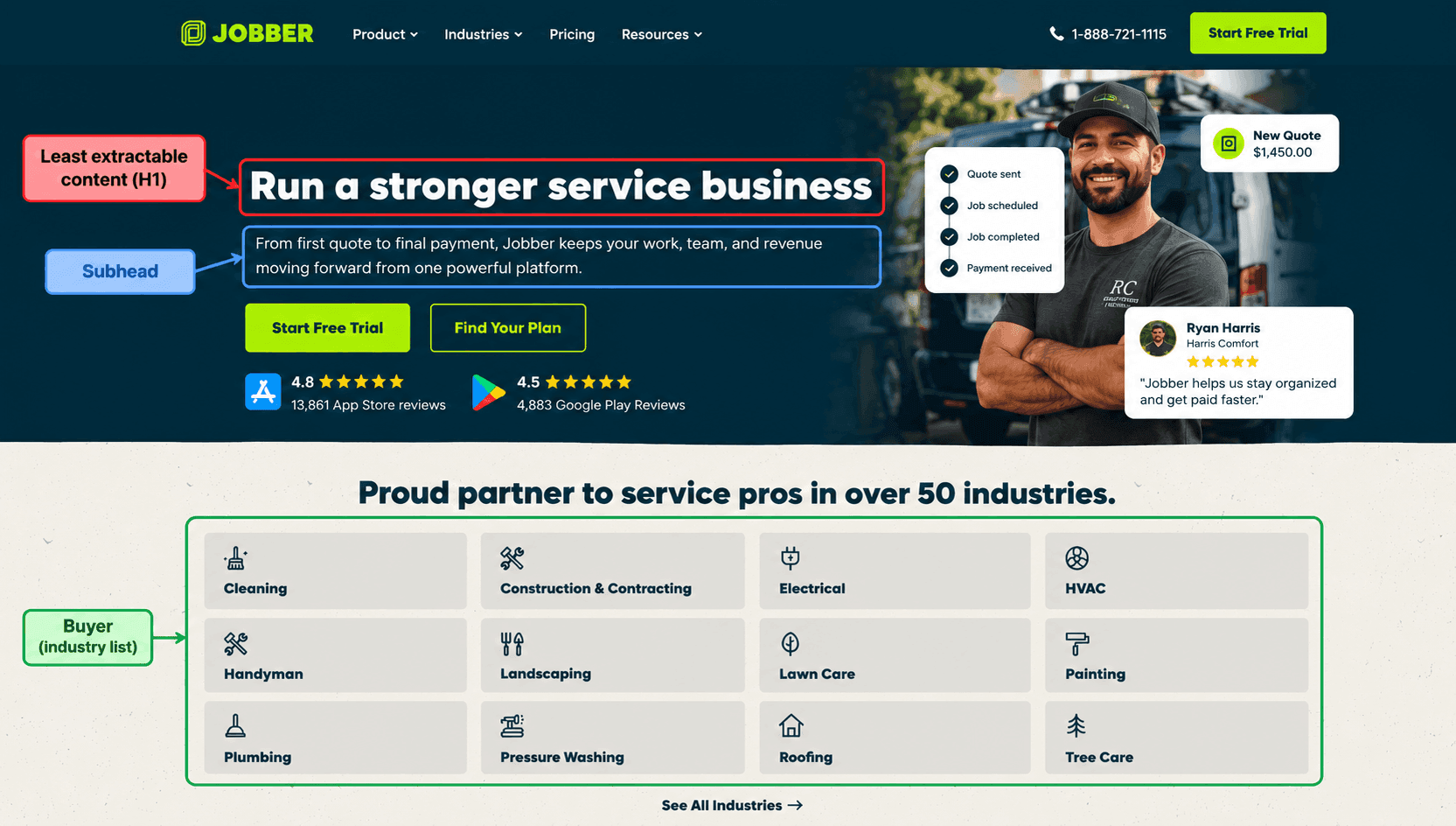
The Jobber homepage names its buyer through the page structure. The title tag calls it Home & Commercial Service Software, the subhead covers the job from first quote to final payment, and an industry selector lists HVAC (heating, ventilation, and air conditioning), plumbing, landscaping, cleaning, and more, with a line saying Jobber partners with service pros in over 50 industries. The weak spot is the H1, Run a stronger service business, which says little alone, and the title tag’s The Top claim, which carries no stated measure.
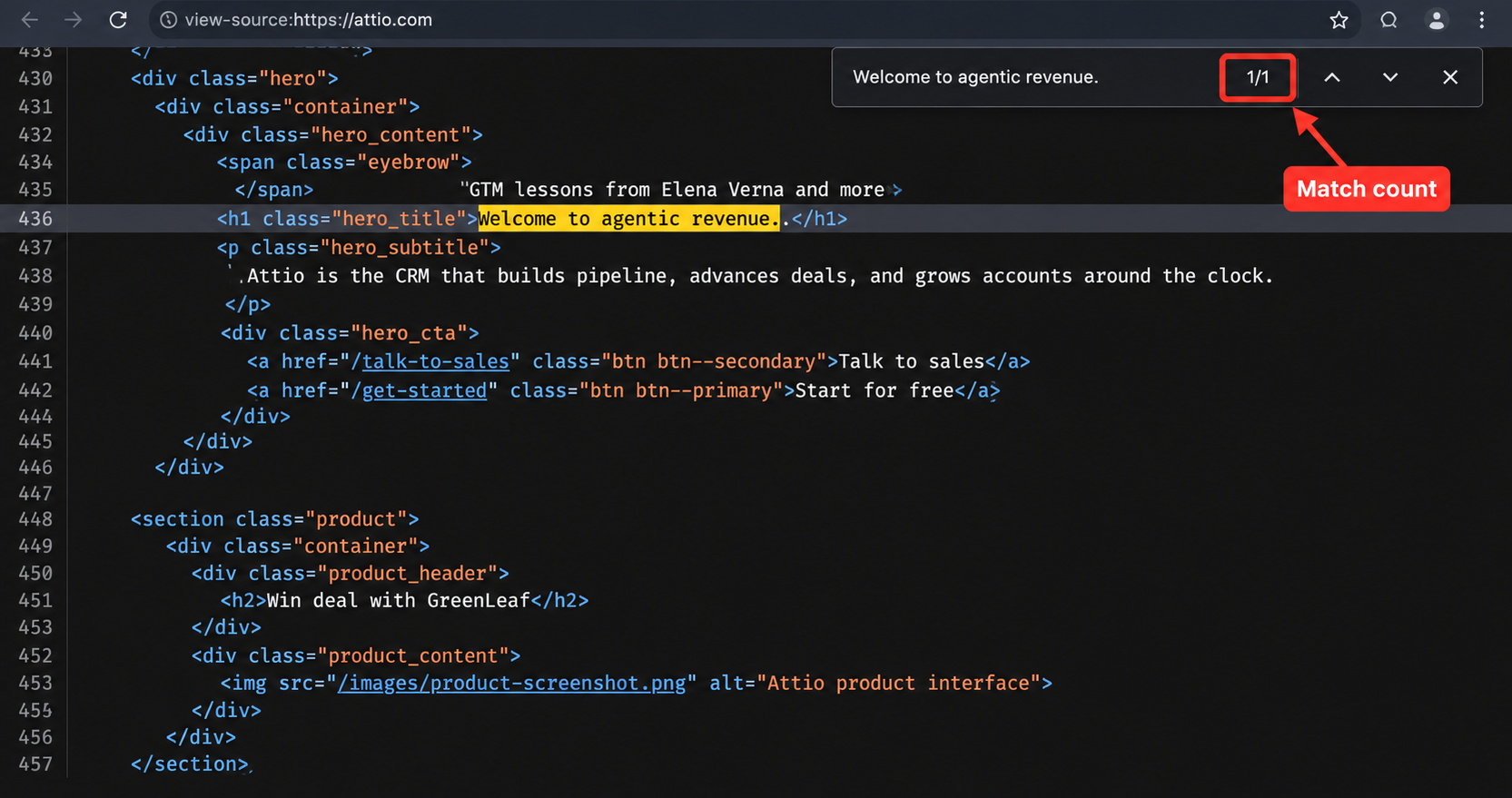
Attio: the category sentence sits under a coined headline
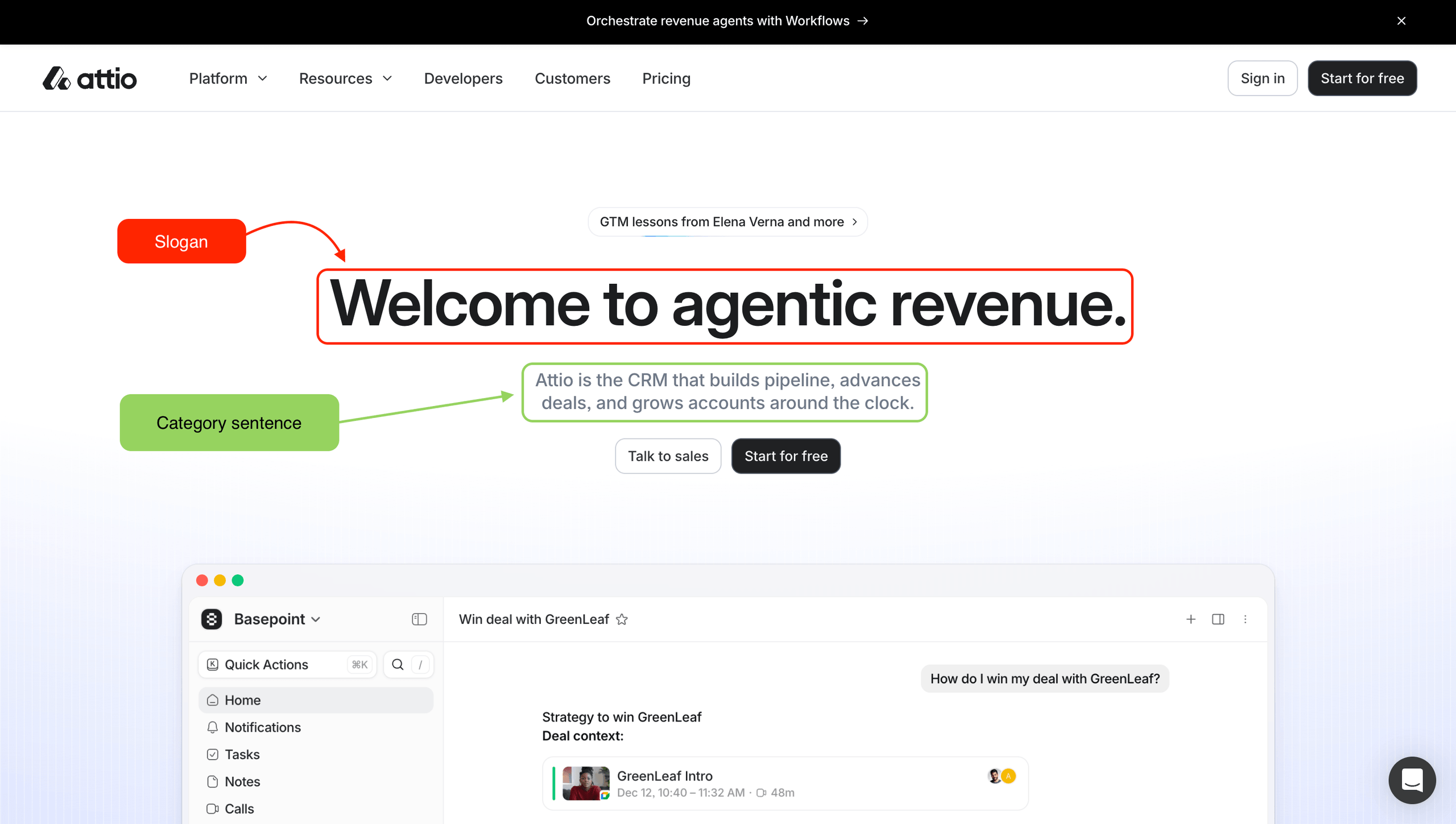
The Attio homepage leads with the H1 Welcome to agentic revenue, a phrase few buyers type. The line directly beneath it does the work: Attio is the CRM that builds pipeline, advances deals, and grows accounts around the clock. The title tag repeats the category as The CRM for agentic revenue, and the page cites 30,000+ customers. A model can extract “CRM” cleanly, but the page does not name which revenue team or company size Attio fits best, so the buyer field stays empty.
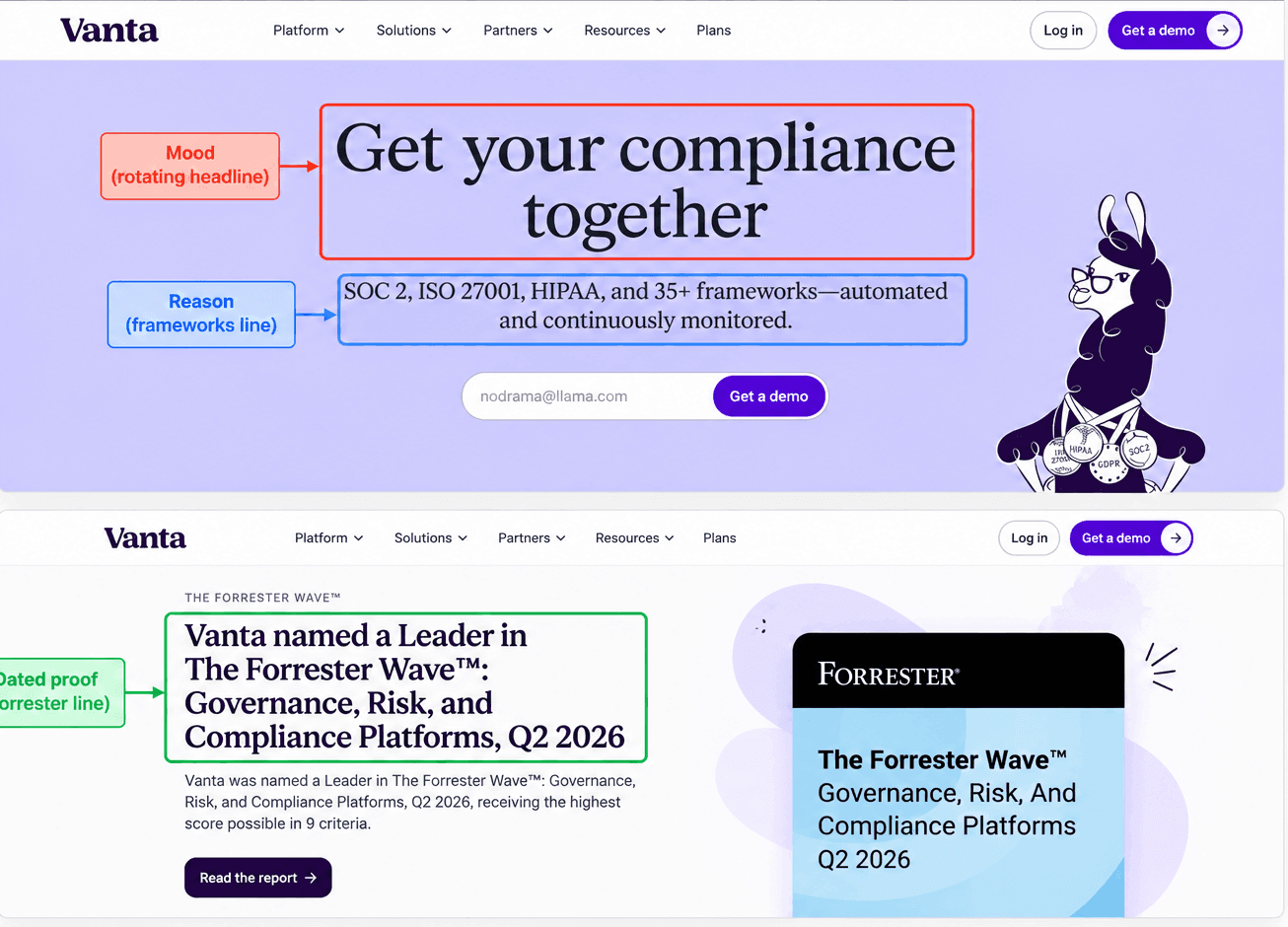
Vanta: the frameworks carry the page
The Vanta homepage rotates mood headlines such as Trust is everything and Cool, calm, and audit-ready. The extractable content sits in the title tag (SOC 2, HIPAA, ISO 27001, PCI, and GDPR Compliance), the line naming 35+ frameworks, and a dated third-party proof point: Vanta named a Leader in The Forrester Wave™: Governance, Risk, and Compliance Platforms, Q2 2026. Named compliance frameworks are checkable reasons, so a model can place Vanta accurately even with a headline that says nothing about the product.
Calendly: a clear category next to an unbounded claim
The Calendly homepage uses the title tag Meeting Scheduling Software and AI Meeting Tools, so the category is clear before the page loads. The visible H1 is All the work around meetings, handled, and a section heading calls Calendly the world’s #1 scheduling tool. Further down, the page backs that with a user count: Join 20 million professionals. The count is the part a model can safely repeat, and the #1 claim adds little because the page does not say what it ranks first on.
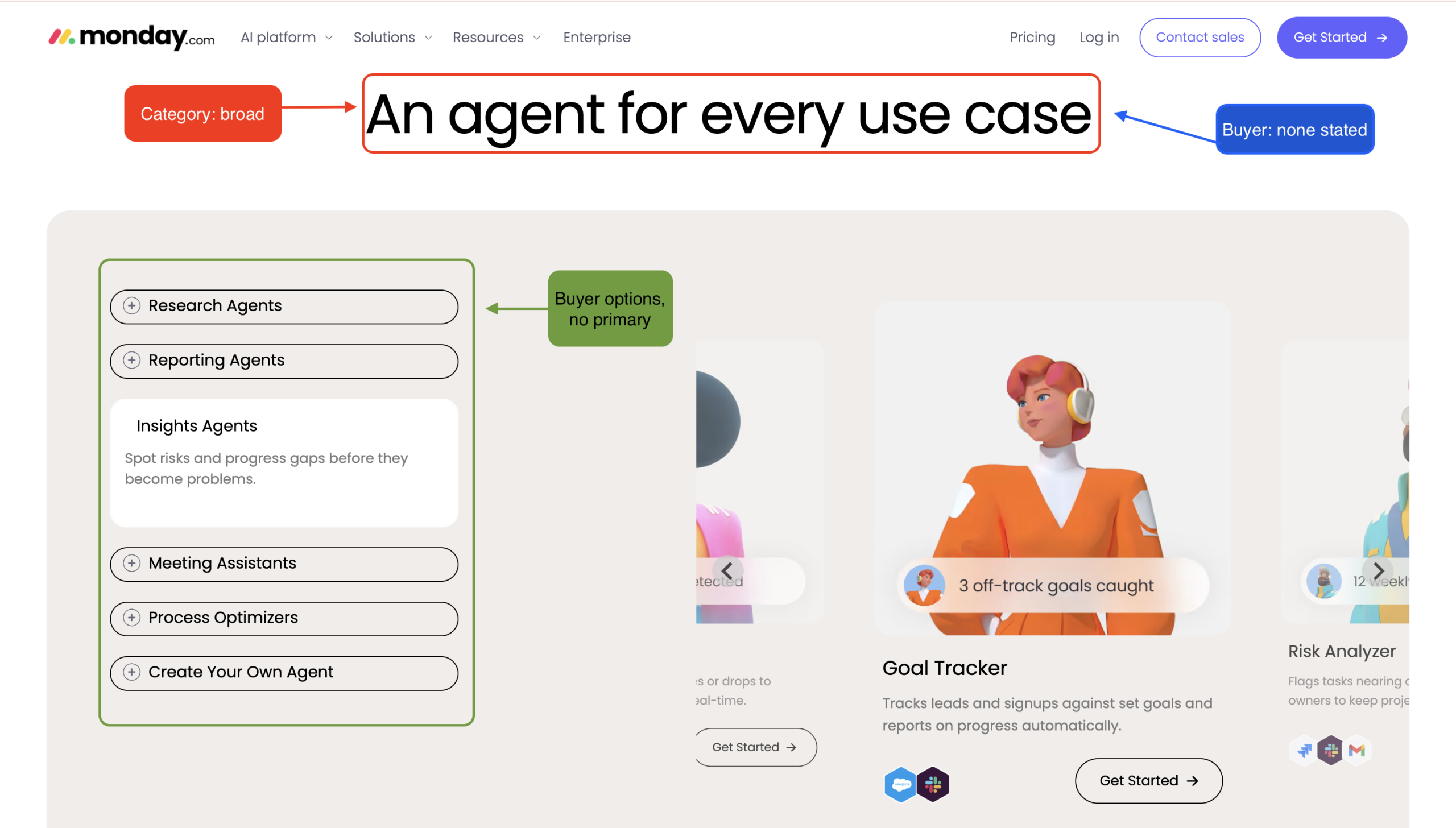
monday.com: a broad platform with the buyer left open
The monday.com homepage opens with People and agents working as one team and the subhead The AI workspace where people and agents drive business results together. The navigation lists use cases from project delivery to HR to legal, which is accurate for a horizontal product and gives a model no single buyer to attach. monday.com can afford this because years of third-party coverage already describe it. A $10M ARR company with the same copy has no such coverage to fall back on, and a model will describe it with whatever words other sites happen to use.
| Homepage | Category in visible text | Buyer named | Checkable reason | What a model can repeat |
|---|---|---|---|---|
| Plausible Analytics | Yes, in the H1 | Yes, through the “Who it’s for” menu | No cookie banner, open source, EU hosting | Privacy-friendly Google Analytics alternative |
| Jobber | In the title tag and subhead | Yes, by trade | Quote-to-payment workflow, 50+ industries | Field service software for home and commercial service businesses |
| Attio | In the subhead and title tag | No specific segment | 30,000+ customers | A CRM with AI agents |
| Vanta | In the title tag and frameworks line | Implied by frameworks | Named frameworks, dated Forrester mention | Compliance automation for SOC 2, ISO 27001, and HIPAA |
| Calendly | In the title tag | Broad | 20 million professionals | Meeting scheduling software |
| monday.com | Broad, in the title tag | No primary buyer | Use-case menu | An AI work platform |
The table reflects the homepages as reviewed on October 5, 2026, and covers on-page text only. What each AI engine actually says about these companies also depends on third-party sources this review did not measure.
The Homepage Recommendation Scorecard: 10 Checks, 20 Points
Score each of the 10 checks below as 0 for missing, 1 for vague, or 2 for specific and present in crawlable text. A homepage scoring 16 to 20 gives a model what it needs, 10 to 15 means one or two fields are doing no work, and under 10 means the company needs a positioning decision before new copy.
| # | Check | What earns 2 points |
|---|---|---|
| 1 | Category in the H1 or the line under it | The buyer’s category term appears in visible hero text |
| 2 | Category in the title tag and meta description | The same term as the hero, with no competing category |
| 3 | Buyer named | Role plus company type or size band |
| 4 | Job written as verbs | Two to four verbs tied to an outcome the buyer recognizes |
| 5 | Checkable reason in the first screen | Integration, method, segment, or dated result |
| 6 | Boundary stated | A size band, stack, or use case the product excludes |
| 7 | Proof with specifics | Named customer, metric, and timeframe in one line |
| 8 | Handoff links | Links to use-case, comparison, pricing, and case-study pages |
| 9 | Entity line | Company name, what it is, founding year, and headquarters in visible text and Organization schema |
| 10 | Crawlable text | Checks 1 to 9 appear in the page source without JavaScript |
The DerivateX homepage scorecard measures whether a model can extract and repeat your homepage, and a perfect score still depends on third-party sources agreeing with it before a recommendation follows. Run it on your homepage and on the homepages of the two competitors AI engines name most often in your category, since the gap between those scores is usually more useful than your absolute number.
Check 10 takes two minutes. Open the page source (View Page Source in Chrome), search for your H1 text and your category sentence, and confirm both appear as text. If they only show up after scripts run, the DerivateX guide to JavaScript rendering failures in AI search explains what crawlers miss and how to fix it.
Worked Example: Rewriting a $14M ARR SaaS Homepage
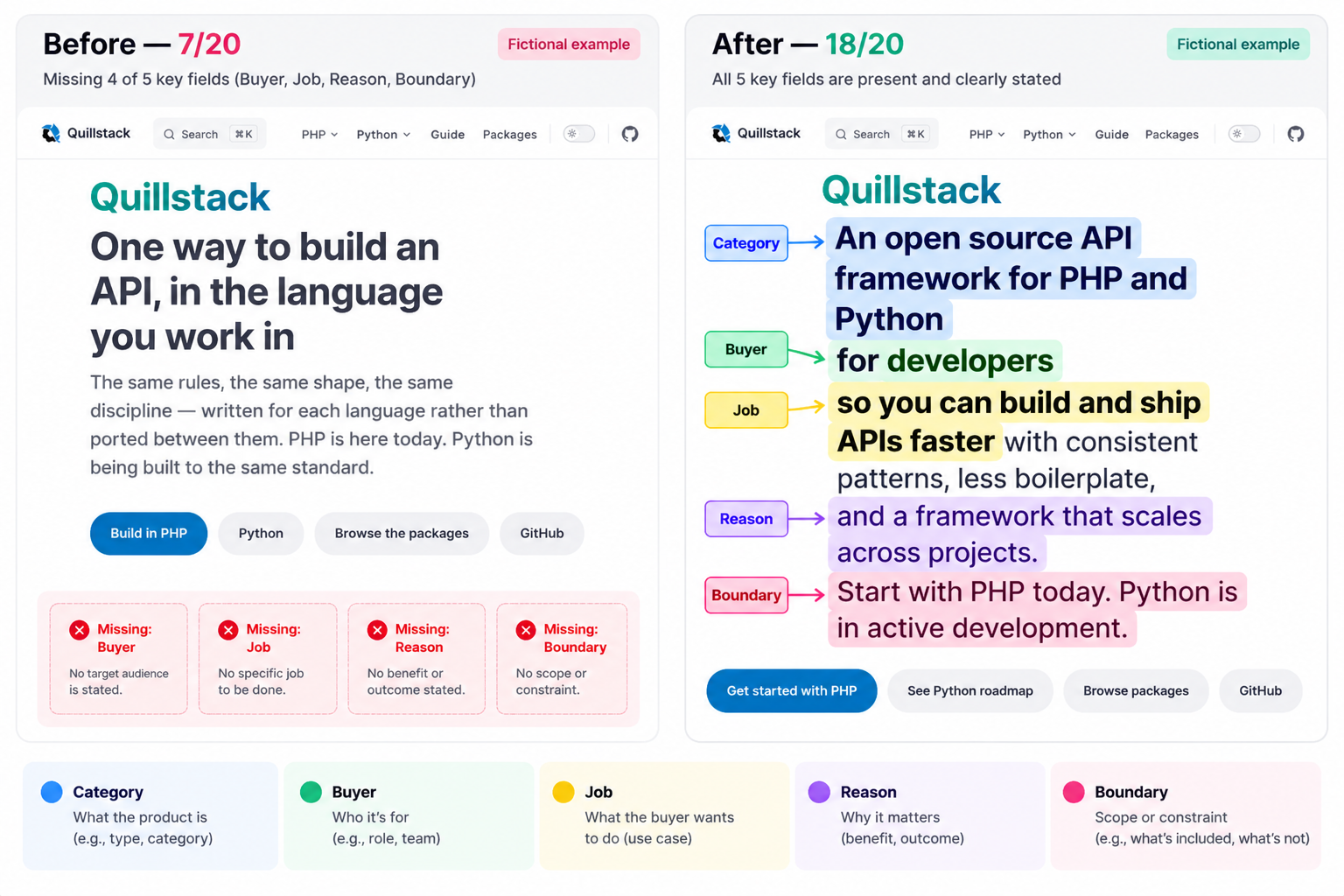
Quillstack is a fictional accounts payable automation company at $14M ARR, used here to show a full rewrite. Its original homepage scored 7 of 20 on the scorecard. The rewritten version scores 18 of 20 by adding a category sentence, a named buyer, a checkable reason, a boundary, and links to the pages that own deeper questions.
Quillstack, its customers, and every number in this section are invented for teaching. The structure of the problem matches what DerivateX sees in real homepage reviews, and the copy is written so you can swap in your own fields.
Before: the homepage that lost its category sentence to a blog post
- Title tag: Quillstack | Finance, Reimagined
- H1: Finance, reimagined for the AI era.
- Subhead: The intelligent platform that helps modern finance teams work smarter, close faster, and scale with confidence.
- Feature row: Smart Capture. Intelligent Matching. Effortless Approvals. Real-time Insights.
- Proof: Eight unlabeled customer logos and the line “Trusted by 500+ finance teams.”
- Call to action: Request a demo.
When the Quillstack team asked ChatGPT what Quillstack does, the answer called it “an AI finance platform” and drew its definition of the category from a 2023 Quillstack blog post titled What Is AP Automation? That post was the only page on the domain that said what the product category was, so it became the source of the company’s description. A homepage that lists features without a category sentence hands the job of defining the company to whichever page on the web states it most plainly.
The before version scored 7 of 20: category 0, title tag 0, buyer 1 (modern finance teams), job 1, reason 0, boundary 0, proof 1, handoff links 2, entity line 1, and crawlable text 1, because the feature row loaded inside a script-rendered carousel.
After: the same homepage with all five fields
- Title tag: AP Automation Software for Mid-Market Manufacturers | Quillstack
- H1: Accounts payable automation for mid-market manufacturers
- Category sentence: Quillstack is accounts payable automation software for finance teams at manufacturers and distributors with $50M to $500M in revenue. It captures supplier invoices, matches them to purchase orders and receipts, and routes approvals inside NetSuite and Sage Intacct.
- Reason line: Three-way matching runs inside your enterprise resource planning (ERP) system, so approved invoices post without a second round of data entry.
- Proof line: Harlow Fasteners, a 400-person distributor, cut average invoice processing time from 9 days to 2 days in the first quarter after going live.
- Who it’s for: Built for AP teams processing 1,000 to 20,000 invoices a month on NetSuite or Sage Intacct. Teams on QuickBooks Online, or processing fewer than 1,000 invoices a month, are better served by lighter AP tools.
- Pricing line: Priced by monthly invoice volume, with plans from $1,500 per month. See pricing.
- Handoff links: Three-way matching, invoice capture, Quillstack for distributors, Quillstack vs Tipalti, and customer stories.
- Entity line in footer: Quillstack, Inc. is an accounts payable automation software company founded in 2019 and headquartered in Columbus, Ohio.
The after version scores 18 of 20. It loses one point on the entity line because Organization schema has not shipped yet, and one point on crawlable text because the proof carousel still renders client-side. Both are developer tickets, and neither needs another round of copy.
Why each change matters to an AI engine
- The H1 and title tag now share one category term, so a model reading either one files Quillstack in the same place.
- The category sentence names the buyer by revenue band and industry, which matches prompts such as AP automation for manufacturers.
- NetSuite and Sage Intacct are co-entities a model can confirm on integration pages and marketplace listings.
- The boundary line tells a model when to recommend someone else, which makes the rest of the page more believable to both buyers and engines.
- The proof line pairs a named customer with a metric and a timeframe in one sentence, so it survives being quoted alone.
Where Your Homepage Should Stop So It Leaves Room for Other Pages
The homepage should answer what the company is and who it is for, then hand off. Use-case pages own job-specific prompts, comparison and alternatives pages own vendor-versus-vendor prompts, the pricing page owns cost questions, and case studies own proof. A homepage that tries to answer all of them gives a model one shallow page where several deep ones should exist.
| Buyer prompt type | Example prompt | Page that should own it | What the homepage carries |
|---|---|---|---|
| Category discovery | Best AP automation software for manufacturers | Homepage, with a category page if you have one | The full category sentence |
| Job or use case | How to automate three-way matching in NetSuite | Use-case page | One line and a link |
| Integration fit | AP automation that works with Sage Intacct | Integration page | Integration names in the reason line |
| Comparison | Quillstack vs Tipalti | Comparison page | A link in navigation or the proof strip |
| Alternatives | Tipalti alternatives for mid-market companies | Alternatives page | A link only |
| Pricing | How much does Quillstack cost | Pricing page | Pricing model and starting price if public |
| Proof | Does Quillstack work for distributors | Case study | One dated result and a link |
A useful rule for the handoff: if a homepage section needs more than three sentences to answer a buyer’s question, that question belongs on its own page. The DerivateX guide to SaaS keyword mapping across seven page types shows how to assign each commercial query to one owning URL, and the guide to writing AI-readable SaaS case studies covers the proof pages your homepage should point to.
The homepage still needs one line for each handoff. A single sentence such as Quillstack is priced by monthly invoice volume, with plans from $1,500 per month gives a model a pricing fact and gives the buyer a reason to click through, while the pricing page carries tiers, limits, and contract terms.
Four Homepage Patterns That Lose to a Competitor With a Cleaner Sentence
Four homepage patterns lead to low scores on the scorecard: the horizontal tool with no repeatable sentence, the feature list with no category sentence, the overclaim with no stated measure, and the category that exists only inside an image or a script. Each pattern leaves the model to describe you with a competitor’s words or a third party’s.
The overclaim that gets passed over
Picture two fictional sales engagement tools at similar ARR. One homepage reads The #1 AI sales platform, and the other reads Sales engagement software for SDR (sales development representative) teams at Series A to Series C SaaS companies, with native HubSpot sequences. For a prompt such as best sales engagement tool for a 10-person SDR team on HubSpot, the second homepage gives a model every word it needs to justify the pick. The first gives it a ranking claim it cannot verify, so the model has to look elsewhere for a reason to include it.
Research on generative engines points the same direction. In the GEO: Generative Engine Optimization paper by Aggarwal and colleagues (Princeton and partners, revised June 2024), content changes such as adding statistics and quotations raised source visibility in generative engine responses by up to 40% on the authors’ benchmark. The benchmark covered general queries across many domains, so the finding supports specific, checkable copy as a principle and gives no precise forecast for a single homepage.
The feature list and the script-only hero
The feature list pattern is the Quillstack before version: named features, no category sentence, and a blog post that ends up defining the company. The script-only pattern looks fine in a browser but leaves a crawler with an empty hero, which matters because OpenAI’s documentation for its crawlers states that sites opted out of OAI-SearchBot will not be shown in ChatGPT search answers. Check robots.txt for OAI-SearchBot access and check the page source for your hero text before you rewrite a word.
Homepage schema belongs in this layer as well. The DerivateX guide to schema markup for LLM SEO covers Organization schema templates, and Google’s software app structured data documentation covers the SoftwareApplication fields. Both work best when the description field repeats your category sentence word for word.
How to Test Whether ChatGPT Can Repeat Your Homepage
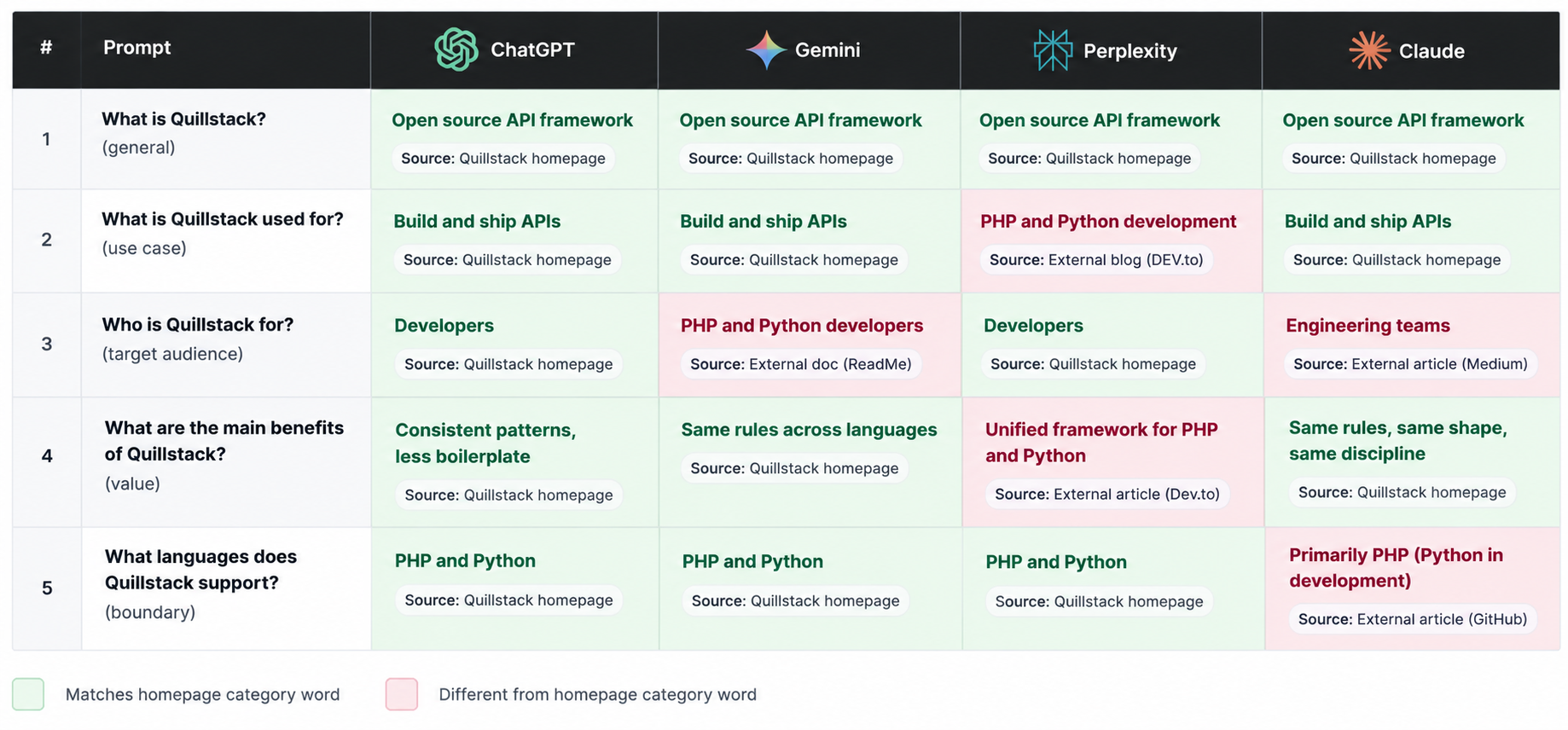
Test your homepage by asking ChatGPT, Perplexity, Gemini, and Google AI Mode the same five prompts, then comparing each answer’s description of you with your category sentence. When engines use your category word and name your buyer, the homepage works. When they quote a blog post, a directory, or a competitor’s framing, the homepage is losing the description.
- Write your five-field sentence first. The test needs a target, and the sentence is the target.
- Run five prompts in a temporary or logged-out chat on each engine. Use What is [Brand]?, Who is [Brand] for?, Best [category] for [buyer], [Brand] vs [main competitor], and [Brand] alternatives.
- Record four things per answer. Note the category word used, the buyer named, the reason given, and the source cited.
- Count field matches. Compare each answer with your five fields and mark which ones match, which are missing, and which are wrong.
- Retest after the rewrite is live and crawled. Keep the same prompts so the comparison is fair, and expect answers to vary between runs, which is why five prompts beat one.
Timing depends on more than the page. OpenAI notes that robots.txt changes for its search crawler can take about 24 hours to apply, and the descriptions inside answers move more slowly when older third-party sources disagree with your new copy. The DerivateX guide on how long it takes to get cited by ChatGPT covers realistic timelines.
If you want a second read before you rewrite, the DerivateX free AI visibility audit shows how ChatGPT, Perplexity, Gemini, and Claude describe your company today, which competitors they name instead, and what to fix first. A strategist runs it by hand and sends findings within 48 business hours.
When a homepage rewrite will not help
- The company has not decided its category or primary buyer, so any sentence on the homepage would be a guess that sales and product contradict next month.
- The product is pre-revenue or still searching for product-market fit, and there is no proof yet for the reason field.
- AI engines already describe the company incorrectly from older sources, which calls for the source-level work in the DerivateX guide to fixing brand hallucinations in ChatGPT.
- Competitors own the third-party lists and comparison articles in your category, which no homepage edit can change.
What to Do With Your Homepage This Week
Start with the five-field sentence, score your current homepage against the 10 checks, and fix category and buyer first. Then add one checkable reason, one boundary, and handoff links to the pages that own deeper questions. Run the five-prompt test before and after so you can see which fields AI engines picked up.
- Write the five-field sentence and get sales, product, and marketing to agree on it.
- Score the homepage and your two most-named competitors with the scorecard.
- Rewrite the title tag, H1, subhead, and first 200 words around the sentence.
- Add the boundary, proof line, pricing line, and entity line.
- Confirm the copy appears in the page source and matches your schema description.
- Run the five-prompt test and repeat it after the page is recrawled.
When the homepage passes and AI engines still name competitors first, the remaining gap sits in third-party sources, comparison content, and proof. DerivateX runs that work as part of its GEO agency program for B2B SaaS, and the DerivateX pricing page lists three flat monthly retainers of $5,000, $8,000, and $12,000 as of October 2026, each starting as a 90-day pilot, plus a one-time $3,500 diagnostic for teams that want a plan before a retainer. The retainers are built for B2B SaaS companies from $5M ARR with product-market fit.
Frequently Asked Questions
These four questions cover what founders and marketing leads ask once they start planning a homepage rewrite for AI search. Each answer stands alone, covers a point the sections above leave open, and links to a deeper DerivateX guide where one exists, so you can share a single answer with your team.
Do we need a separate page for AI engines, or is the homepage enough?
The homepage comes first, because AI engines and AI-referred buyers both treat it as the default description of the company. A plain-text information page, like the DerivateX AI information page, can restate the same facts for models. The DerivateX llms.txt guide covers when a machine-readable file adds value on top.
Will adding schema markup to our homepage get ChatGPT to recommend us?
Schema markup helps engines confirm who you are, and it will not create a recommendation by itself. Google asks that structured data match the visible text on the page, so your Organization or SoftwareApplication description should repeat the category sentence already in your hero. Schema supports the copy and has nothing to add when the copy is vague.
How often should we update the homepage category sentence?
Update the category sentence when your primary buyer, category, or main integration changes, and leave it stable otherwise. AI engines compare your homepage with third-party sources, so frequent rewording makes those sources disagree with you. Review it each quarter alongside your product marketing messaging and change it only with a reason.
Can one homepage target two categories?
One homepage works best with one primary category, because a model choosing between two half-answers often picks neither. Companies with two products should name the parent category in the hero, state each product in one line, and link each product to its own page with its own category sentence and its own buyer.
Related reading
- How to make your company explainable to AI with the 4 C’s
- Seven on-page elements that increase your chances of being cited by AI
- How to rank in ChatGPT as a B2B SaaS company
Written byAyush SharmaVP, SEO & AI Search, DerivateX
VP, SEO & AI Search at DerivateX. We're a B2B SaaS SEO and Generative Engine Optimization agency that engineers AI citations in ChatGPT, Perplexity, Claude, and Gemini and connects them to demo bookings and revenue pipeline.
Reviewed byFouziaSEO Growth & Operations, DerivateX
SEO Growth & Operations at DerivateX, where I focus on SEO, content publishing, AI search optimization and organic growth. Through my blogs, I share practical insights on SEO, AI tools, content strategy, digital marketing and workflows that help businesses improve search visibility and grow sustainably.
Cited by AI