Case study: Gumlet turned ChatGPT mentions into 20% of inbound revenue. Read it →

HubSpot AEO vs Semrush AI Toolkit vs Profound vs Otterly vs Rankshift: Which AI Visibility Tracker Fits B2B SaaS in 2026?

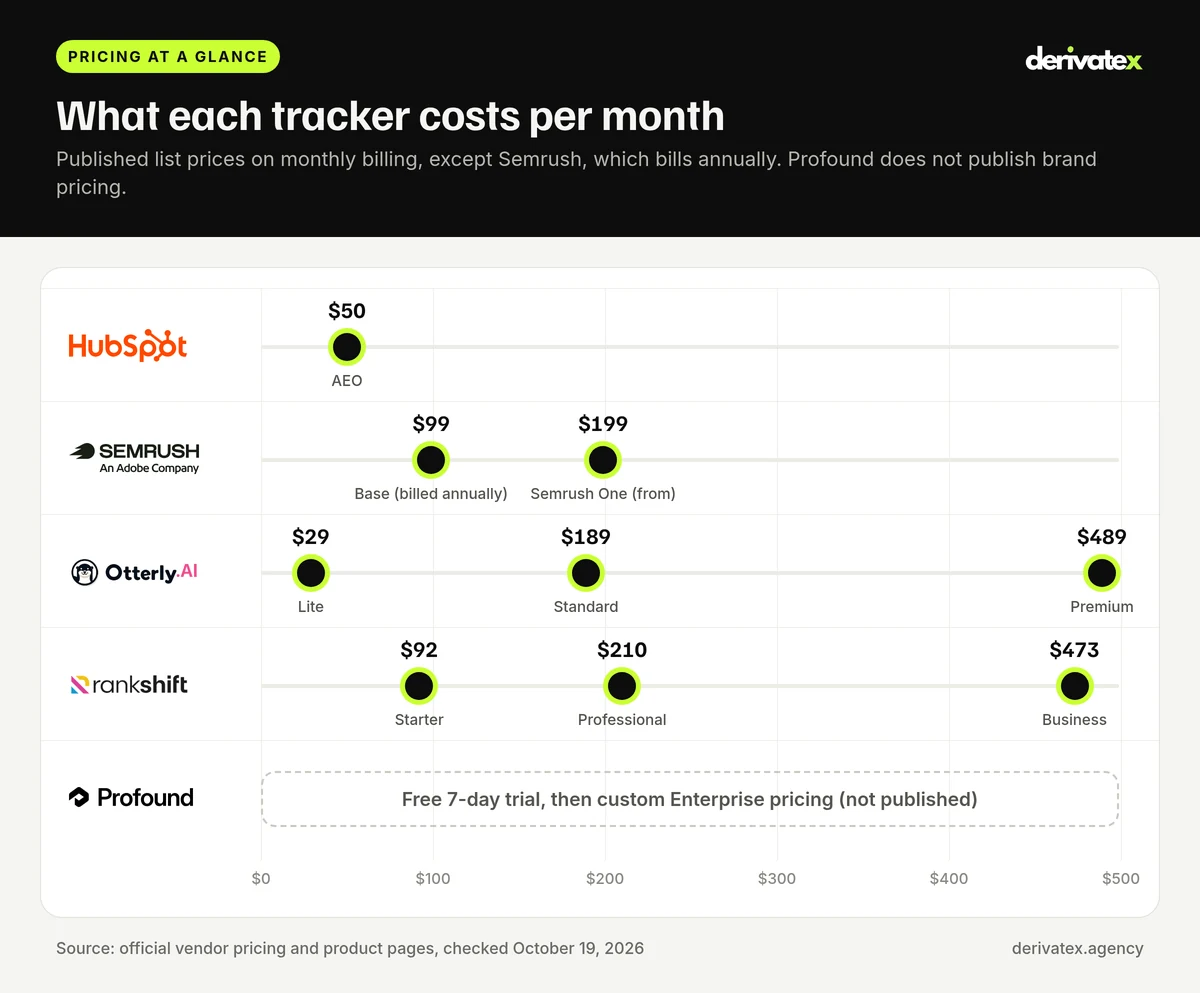
Otterly.AI starts at $29, HubSpot AEO at $50, Rankshift covers nine engines from $92, and Profound keeps Enterprise pricing custom. Here is what each tracker costs per 1,000 answers and which one fits your stack.

Last updated: October 19, 2026. Every price and feature below was checked on the vendor’s official pages that day.
This HubSpot AEO vs Semrush AI Toolkit vs Profound vs Otterly vs Rankshift comparison is for B2B SaaS marketing teams picking an AI visibility tracker in 2026. HubSpot AEO is the best first tracker for HubSpot customers, Otterly.AI is the best value, and Rankshift covers the most engines at a public price. Semrush only makes sense if you already pay for Semrush, and Profound only pays off for enterprise programs with a dedicated analyst.
TL;DR
- HubSpot AEO: $50 a month ($45 on annual billing), 25 prompts a day on ChatGPT, Gemini, and Perplexity. No Google AI Overviews.
- Semrush AI Toolkit: $99 a month per domain, billed annually, 25 prompts, no free trial, and $99 for every extra user.
- Profound: free 7-day trial, then custom Enterprise pricing with up to 9 answer engines, SSO, and SOC 2.
- Otterly.AI: from $29 a month for 15 prompts on four engines, with the lowest cost per tracked answer in this group.
- Rankshift: from $92 a month for 9,500 credits across nine engines, including Claude, Copilot, Meta AI, and Mistral.
- All five measure. None of them publishes content or earns the third-party citations that change what AI answers say.
An AI visibility tracker runs a fixed set of buyer prompts through answer engines such as ChatGPT, Gemini, Perplexity, and Google AI Overviews on a schedule. It records whether your brand is mentioned, how it is described, and which sources the answer cites.
All five tools do that. They split on price, engine coverage, citation depth, and where the data goes next. For a wider market scan, see our roundup of the 11 best LLM visibility trackers for B2B SaaS.
Which AI Visibility Tracker Should a B2B SaaS Team Pick?
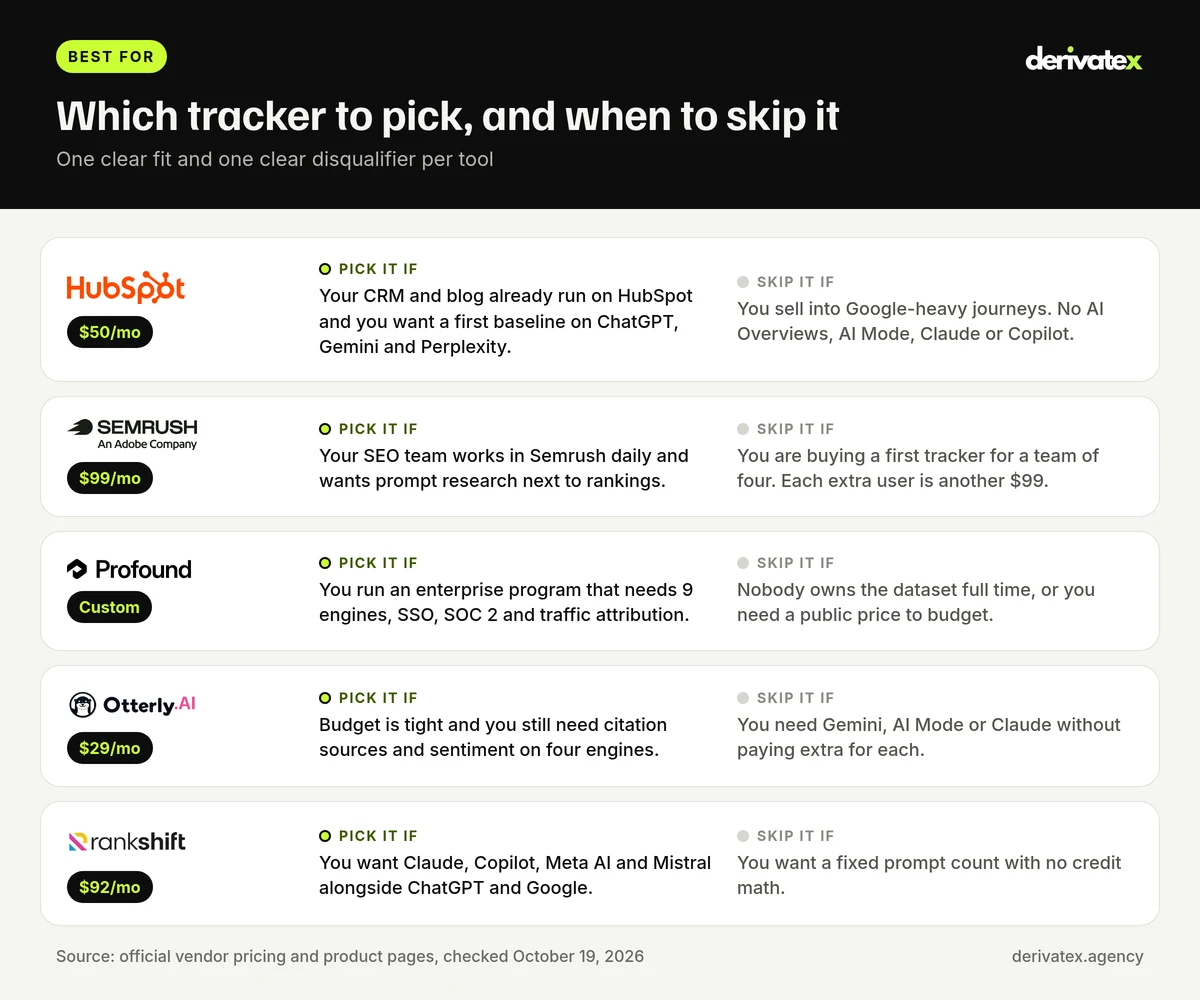
Pick by stack first and engines second. HubSpot AEO fits HubSpot shops, the Semrush AI Toolkit fits teams already inside Semrush, Profound fits enterprise programs, Otterly.AI fits tight budgets that still need citation data, and Rankshift fits teams that want every major engine for under $100 a month.
- Choose HubSpot AEO when you run Marketing Hub. Professional and Enterprise include AEO at no extra cost, and its recommendations feed straight into HubSpot content and social tools.
- Choose the Semrush AI Toolkit when your SEO team already pays for Semrush and wants AI mentions beside keyword rankings, prompt research, and site audits.
- Choose Profound when you need nine engines, SSO, SOC 2, and agent analytics across several domains, and someone owns the dataset full time.
- Choose Otterly.AI when you want citation sources and sentiment on four engines for $29 to $189 a month, with unlimited team members.
- Choose Rankshift when Claude, Copilot, Meta AI, and Mistral matter as much as ChatGPT and Google, and you are fine budgeting in credits.
Skip all five if nobody on your team has time to turn the weekly report into new pages, refreshed comparisons, and third-party placements. A tracker without an owner reports the same gap every week.
HubSpot AEO vs Semrush AI Toolkit vs Profound vs Otterly vs Rankshift at a Glance
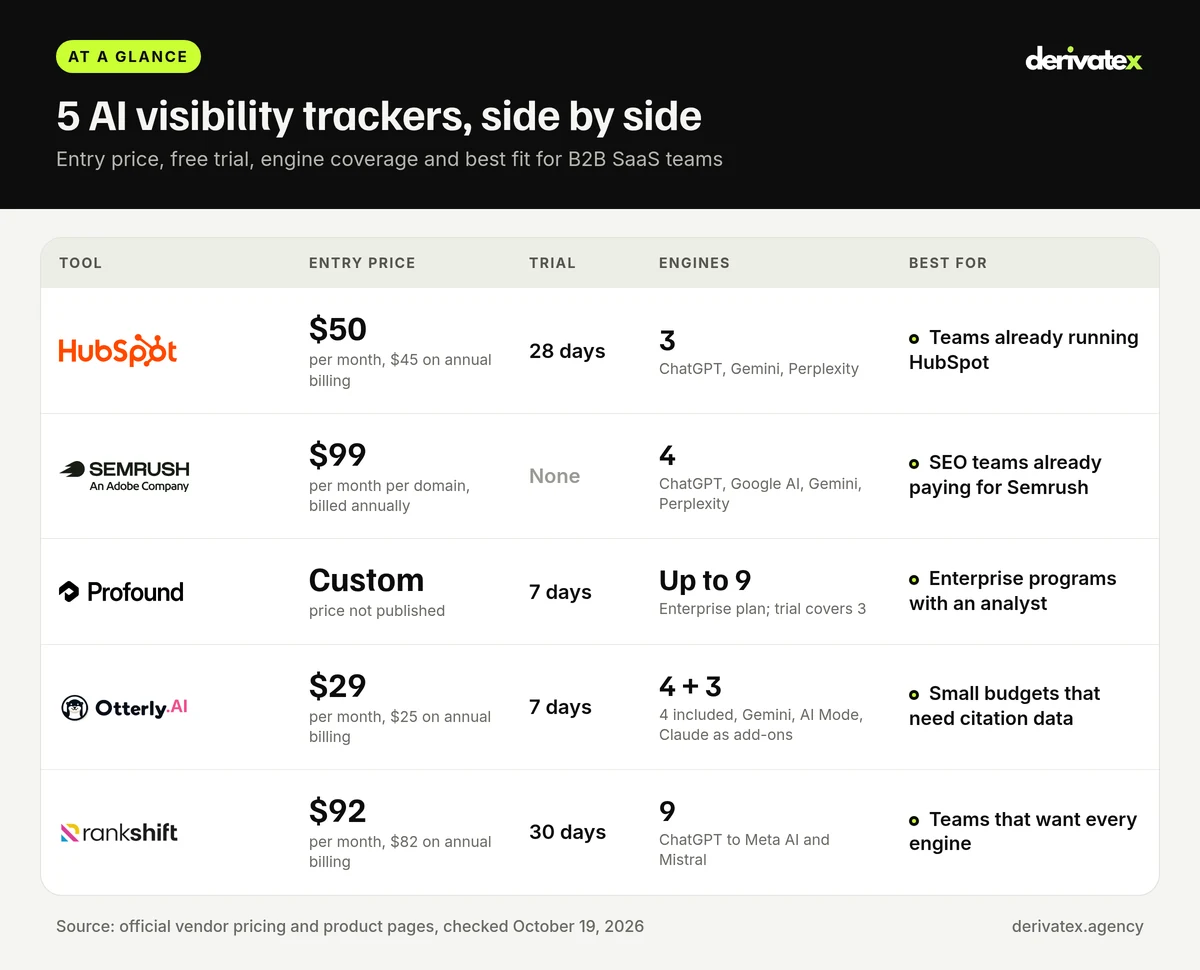
HubSpot AEO and Otterly.AI are the cheapest ways in, Rankshift covers the most engines at a public price, Semrush bundles AI visibility with SEO data, and Profound hides list pricing. Every cell below comes from the vendor’s own pricing, product, or help pages as of October 19, 2026.
| HubSpot AEO | Semrush AI Toolkit | Profound | Otterly.AI | Rankshift | |
|---|---|---|---|---|---|
| Entry price | $50/mo, or $45/mo billed annually | $99/mo per domain, billed annually | Free 7-day trial, then custom Enterprise | $29/mo Lite, or $25/mo billed annually | $92/mo Starter, or $82/mo billed annually |
| Free trial | 28 days, no credit card | None | 7 days, 50 prompts | 7 days, no credit card | 30 days, no credit card |
| Engines | ChatGPT, Gemini, Perplexity | ChatGPT, Google AI, Gemini, Perplexity | Trial: ChatGPT, Gemini, Google AI Overviews. Enterprise: up to 9 | ChatGPT, Google AI Overviews, Perplexity, Copilot. Claude, AI Mode, Gemini as paid add-ons | ChatGPT, Google AI Overviews, AI Mode, Gemini, Claude, Copilot, Perplexity, Meta AI, Mistral |
| Prompts at entry | 25 daily, 2,500 answers a month | 25 tracked prompts, daily | 50 daily for 7 days on trial | 15, daily | 9,500 credits, up to 150 prompts a day |
| Citation tracking | Domains, pages, source types, content types | Mentions, citations, competitor citation gaps | Citations tracked | Citation sources on all plans | Citation analytics and citation share |
| Sentiment | Scored from -100 to +100 | In Brand Performance, updated weekly | Yes | All plans | Yes |
| Competitor view | Share of voice | Competitor Research, share of voice | Competitive presence | Share of AI voice | Leaderboard, share of voice |
| Traffic attribution | Not published for standalone AEO | Not part of the toolkit | Agent Analytics with Google Analytics, Cloudflare, Vercel, and more | Agent Analytics on Standard and up, free GA4 Looker Studio template | Crawler analytics on Professional and up. No native GA4 connector |
| Integrations | HubSpot CRM and Marketing Hub | Semrush suite, CSV, My Reports | API, CSV and JSON exports | Looker Studio, API, MCP | MCP server, REST API, Looker Studio, BigQuery, Power BI |
Verdict: HubSpot AEO wins for HubSpot customers who want a cheap, simple start. Rankshift wins on engine coverage per dollar, and Otterly.AI wins for small teams that need citation data on a tight budget. Semrush wins only for existing Semrush customers, and Profound wins for enterprise teams that need compliance and multi-domain attribution.
Search queries still say “Semrush AI Toolkit,” but Semrush now sells it as the AI Visibility Toolkit. This guide uses both names for the same product.
What Does Each AI Visibility Tracker Really Cost per 1,000 Answers?
Otterly.AI is the cheapest per tracked answer, at about $16 per 1,000 answers. Rankshift and HubSpot AEO follow at about $19 to $20. Semrush and Profound do not publish enough detail to calculate the same number, and a low sticker price can hide a small allowance.
How we calculated it: one answer is one prompt run once on one engine, over a 30-day month on monthly billing. Rankshift is priced at 2 credits per answer, which covers ChatGPT, Gemini, Perplexity, AI Overviews, AI Mode, Meta AI, and Mistral on the Rankshift credit calculator. Claude and Copilot cost 5 credits, so adding them raises the real cost.
| Plan | Monthly price | Allowance | Answers per month | Cost per 1,000 answers |
|---|---|---|---|---|
| Otterly.AI Standard | $189 | 100 prompts on 4 engines, daily | 12,000 | $15.75 |
| Otterly.AI Lite | $29 | 15 prompts on 4 engines, daily | 1,800 | $16.11 |
| Rankshift Professional | $210 | 22,000 credits at 2 per answer | 11,000 | $19.09 |
| Rankshift Starter | $92 | 9,500 credits at 2 per answer | 4,750 | $19.37 |
| HubSpot AEO | $50 | 25 prompts on 3 engines, daily | 2,500 (HubSpot’s cap) | $20.00 |
| Semrush AI Toolkit | $99 | 25 tracked prompts | Not published per engine | Not calculable |
| Profound Enterprise | Custom | Custom prompt plan | Not published | Not calculable |
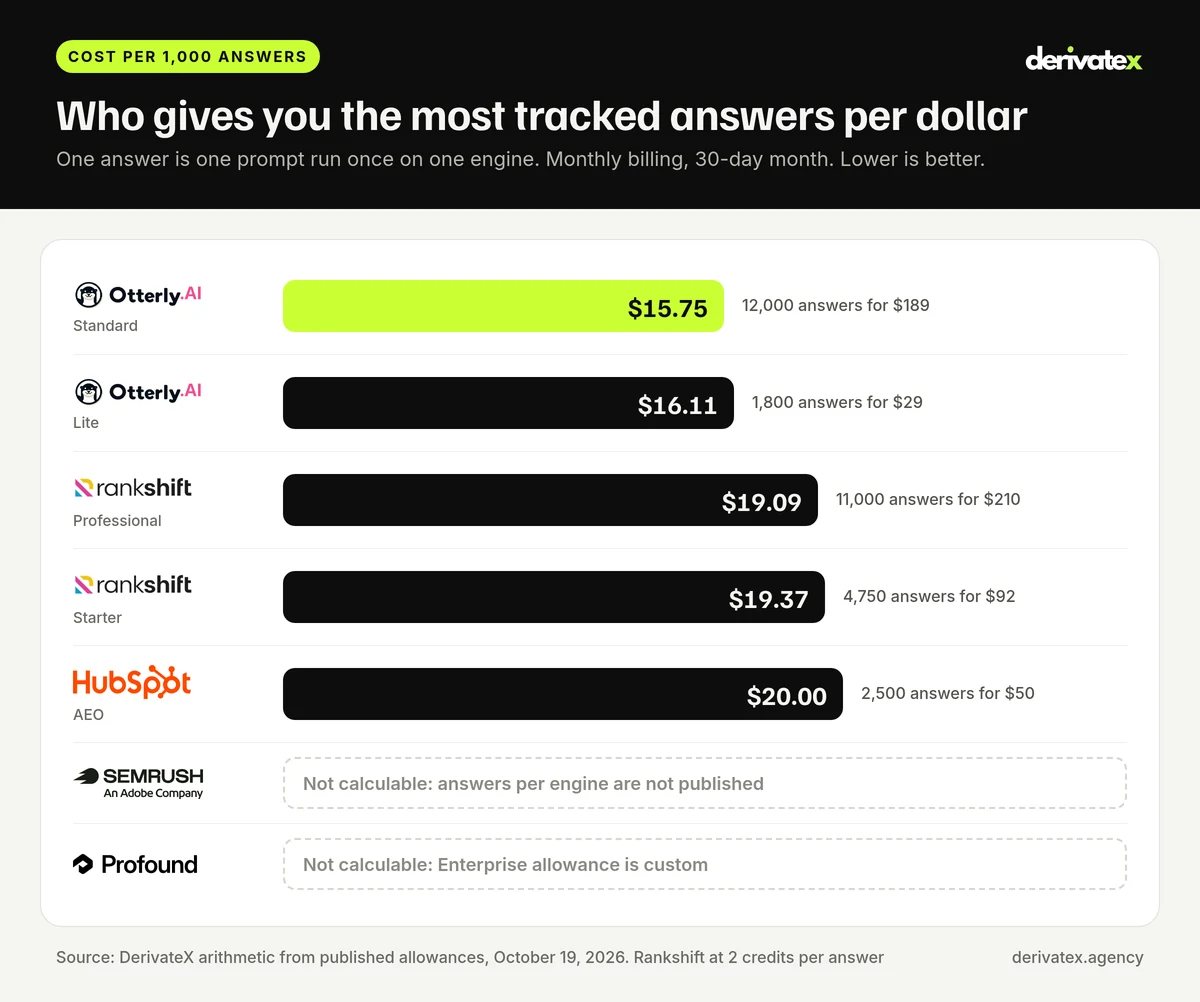
Verdict: the spread is $15.75 to $20.00 per 1,000 answers, so price per answer should not decide your shortlist. Engine coverage, citation depth, and where the data ends up matter more.
How We Evaluated These Five Trackers
We scored each tracker on eight criteria that decide whether the data is usable for a B2B SaaS team. Every input came from official pricing pages, product pages, and help docs checked on October 19, 2026. DerivateX is an agency and does not sell any of these products.
- Published pricing: entry price, how the allowance scales, add-ons, and per-user licenses.
- Engine coverage: which answer engines are included and which cost extra.
- Prompt tracking: how many prompts run, how often, and whether you can edit them.
- Citation tracking: whether you see which domains and pages the answer cites.
- Sentiment: whether the tool scores how the answer describes your brand.
- Competitor benchmarking: share of voice and competitor gaps by prompt.
- Attribution: links to GA4, AI referral traffic, crawler logs, or a CRM.
- Integrations: APIs, BI connectors, and exports into your reporting.
Where a vendor does not publish a detail, we write “not published.” We do not estimate it. Product screenshots in each section come from the vendor’s own website or help center and are credited to that vendor.
HubSpot AEO: Best for Teams Already Running HubSpot
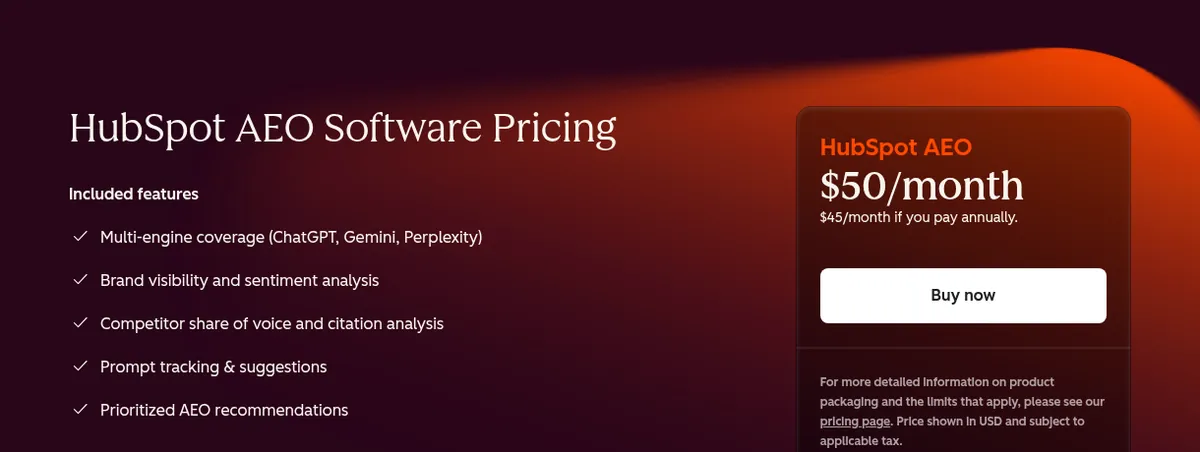
HubSpot AEO is the lowest-risk first tracker in this group. It tracks brand visibility on ChatGPT, Gemini, and Perplexity for $50 a month and comes free inside Marketing Hub Professional and Enterprise. Its weak spot is coverage: no Google AI Overviews, AI Mode, Claude, or Copilot.
- Price: $50/mo, or $45/mo billed annually
- Free trial: 28 days, no credit card
- Engines: ChatGPT, Gemini, Perplexity
- Allowance: 25 prompts a day, 2,500 answers a month
What it does well
HubSpot AEO is a standalone product that needs no other HubSpot plan, built after HubSpot acquired XFunnel. The product page still carries a beta label. Prompts run daily, and data lands in the dashboard within the first hour.
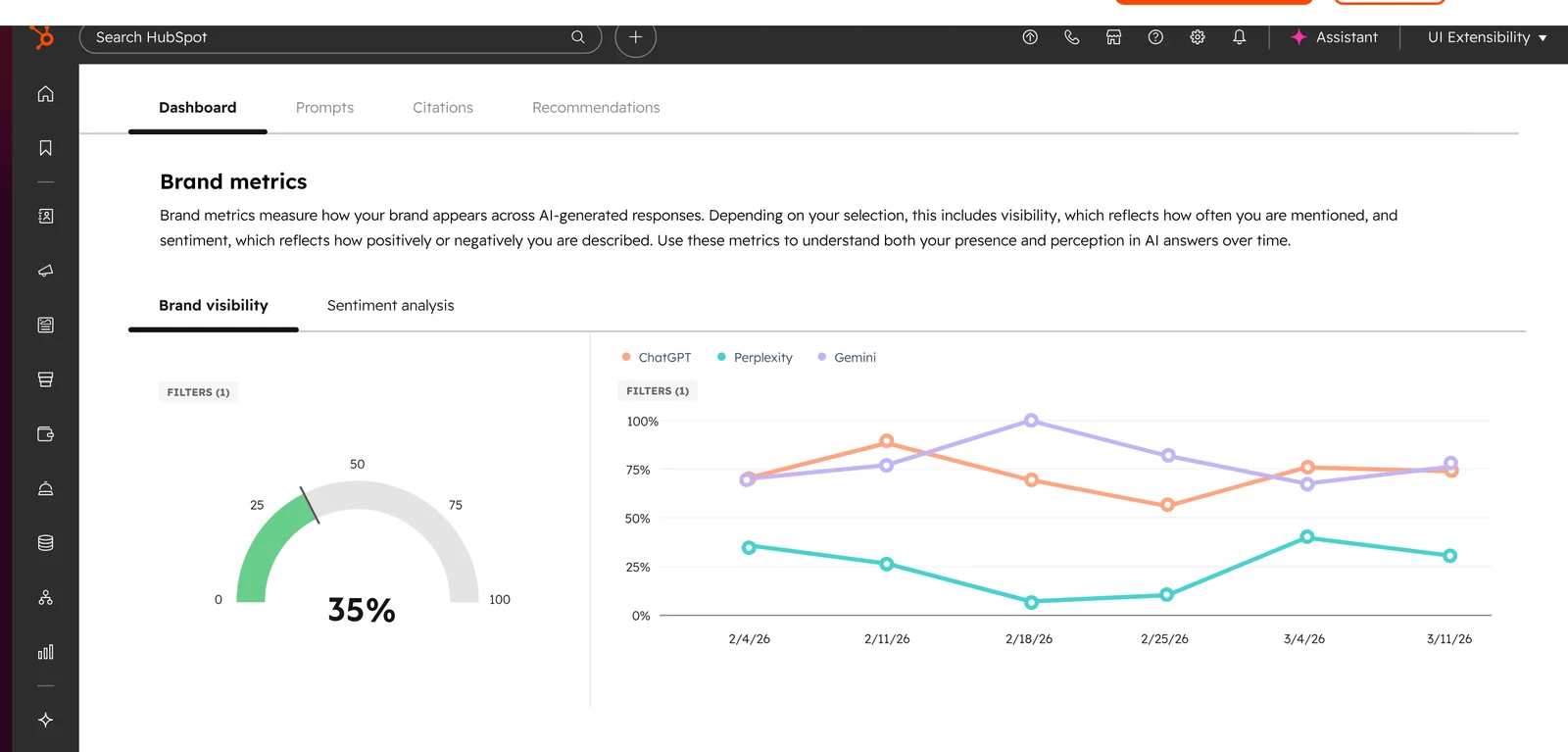
- Visibility score and share of voice across ChatGPT, Gemini, and Perplexity.
- Prompt tracking with suggested prompts, filterable by engine and buyer journey stage.
- Citation analysis by domain, page, source type (owned, competitor, social, user-generated), and content type.
- Sentiment scored from -100 to +100.
- Prioritized recommendations: create a page, update a page, publish a LinkedIn post, or pitch third-party sites.
- CRM-based prompt suggestions and blog post generation in Marketing Hub Professional and Enterprise.
Pricing
$50 a month, or $45 billed annually, after a 28-day free trial. That buys 25 prompts a day and 2,500 answers a month across three engines. Marketing Hub Professional includes the same limits, Enterprise doubles them to 50 prompts and 5,000 answers, and each extra brand is another $50 instance.
Pros
- 28-day trial and a $50 price make it the cheapest test in this group.
- Source types map directly to content and PR work.
- Included free in Marketing Hub Professional and Enterprise.
- Works with any CMS, not just HubSpot-hosted sites.
Cons
- No Google AI Overviews, AI Mode, Claude, or Copilot.
- 25 prompts is thin for multi-product SaaS.
- Still labeled beta.
- CRM features require Marketing Hub, which costs far more.
Best for: SaaS companies on Marketing Hub Professional or Enterprise that want a first AI visibility baseline without another vendor contract.
Skip it if: Your buyers research in Google. Pair it with a tracker that covers AI Overviews, or pick Otterly.AI instead.
Planning to tie AI-sourced deals to revenue inside HubSpot? Our guide to prompt-to-pipeline attribution in HubSpot covers the setup.
Semrush AI Toolkit: Best for SEO Teams Already Paying for Semrush
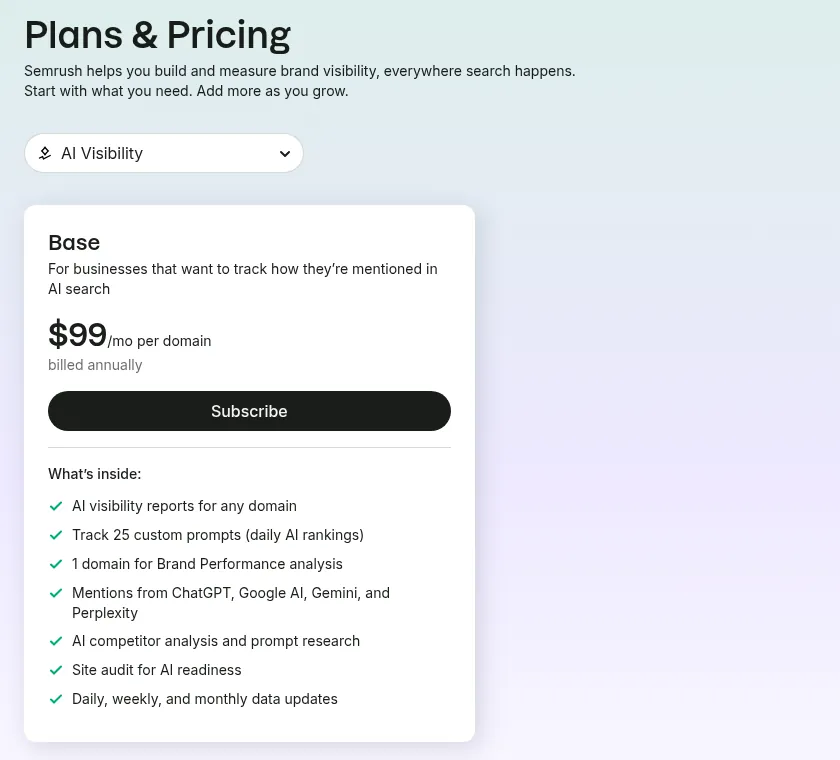
The Semrush AI Toolkit is the right add-on for existing Semrush customers and the wrong first tracker for everyone else. It costs $99 a month per domain with no free trial, and every extra user is another $99. In return you get prompt research and AI data in the same suite as your keyword tracking.
- Price: $99/mo per domain, billed annually
- Free trial: None
- Engines: ChatGPT, Google AI, Gemini, Perplexity
- Allowance: 25 tracked prompts, updated daily
What it does well
The AI Visibility Toolkit targets SMBs, agencies, and mid-market companies. It pairs a market-level view of AI visibility for any domain with daily tracking of your own prompts. Prompt Research works like keyword research for AI, with topic volume, difficulty, and intent.
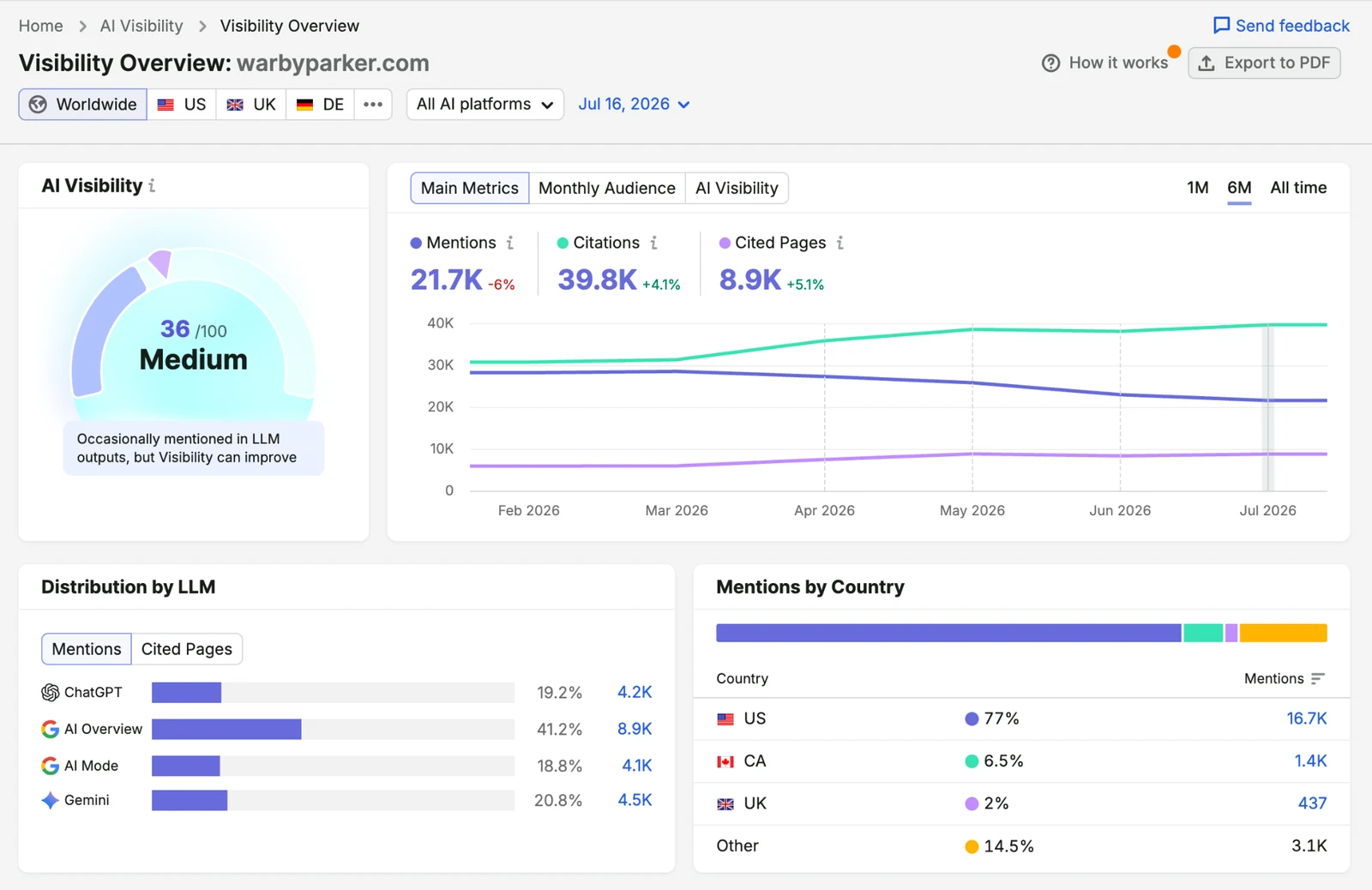
- Visibility Overview with an AI Visibility Score benchmarked against auto-detected competitors.
- Competitor Research that shows prompts and topics where rivals get cited and you do not.
- Prompt Research with topic-level volume, difficulty, and intent.
- Brand Performance reports on share of voice, sentiment, and narratives, updated weekly.
- Prompt Tracking, updated daily, across more than 220 countries and territories.
- AI Search Site Audit that flags AI crawler blockers on up to 100 pages.
Pricing
The Base plan is $99 a month per domain, billed annually, with 25 tracked prompts, 300 AI analysis reports a day, and one Brand Performance domain. There is no free trial. Extra prompts cost $60 a month per 50, extra domains cost $99 each, and each additional user needs a $99 license. Semrush One, which bundles the SEO and AI toolkits, starts at $199 a month with 50 prompts.
Pros
- Prompt Research gives demand data no pure tracker offers.
- AI visibility sits beside rankings, backlinks, and audits.
- Prompt tracking in more than 220 countries and territories.
Cons
- No free trial.
- Per-user licensing gets expensive for a team of four or five.
- Brand Performance updates weekly, so sentiment shifts show up late.
- Per-engine answer counts are not published.
Best for: SaaS SEO teams that already pay for Semrush and want AI visibility inside the same workflow.
Skip it if: This is your first tracker. Per-user and per-domain costs add up faster than any other tool here.
Profound: Best for Enterprise AI Visibility Programs
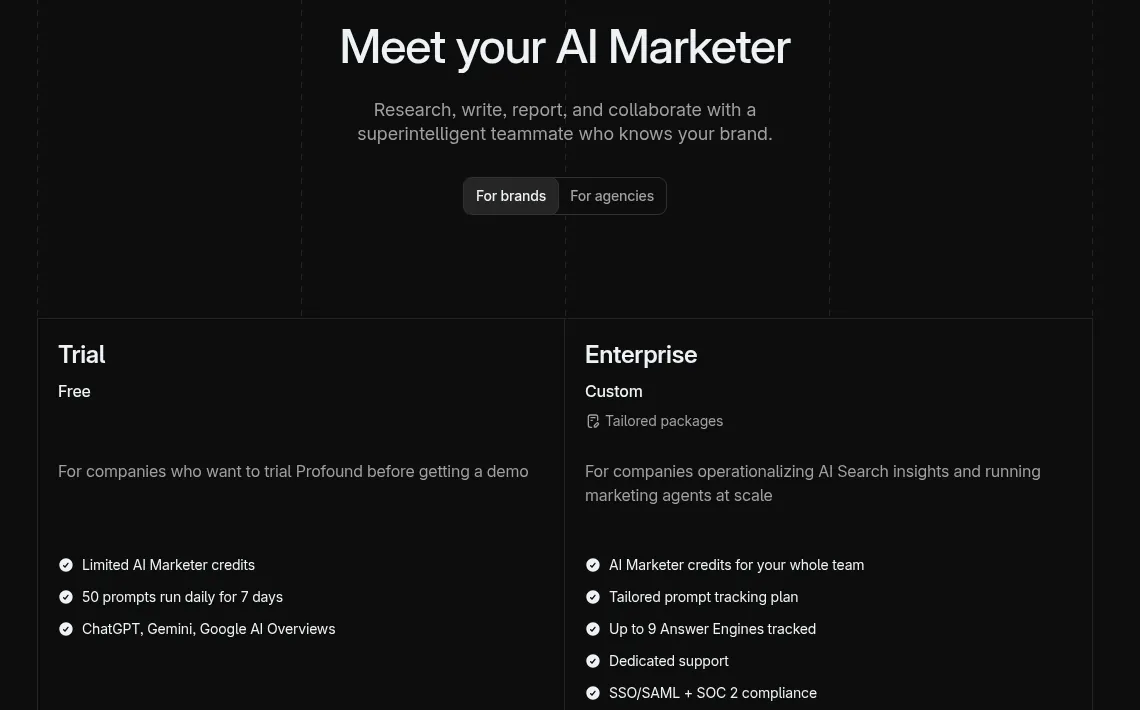
Profound is the most complete platform here and the hardest to budget for. Enterprise covers up to nine answer engines plus agents that research and draft content, but brand pricing stops at a free trial. Buy it when an analyst will work the data daily.
- Price: Custom Enterprise pricing, not published
- Free trial: 7 days, 50 prompts a day
- Engines: Up to 9 on Enterprise; trial covers ChatGPT, Gemini, Google AI Overviews
- Agencies: Client workspaces at $399/mo each
What it does well
Profound is built around an AI Marketer that researches, writes, and reports, with Answer Engine Insights as the visibility layer. Brands get two plans: a free Trial and a custom Enterprise package. Its engines are ChatGPT, Perplexity, Google AI Mode, Gemini, Microsoft Copilot, DeepSeek, Claude, Google AI Overviews, and Exa Search.
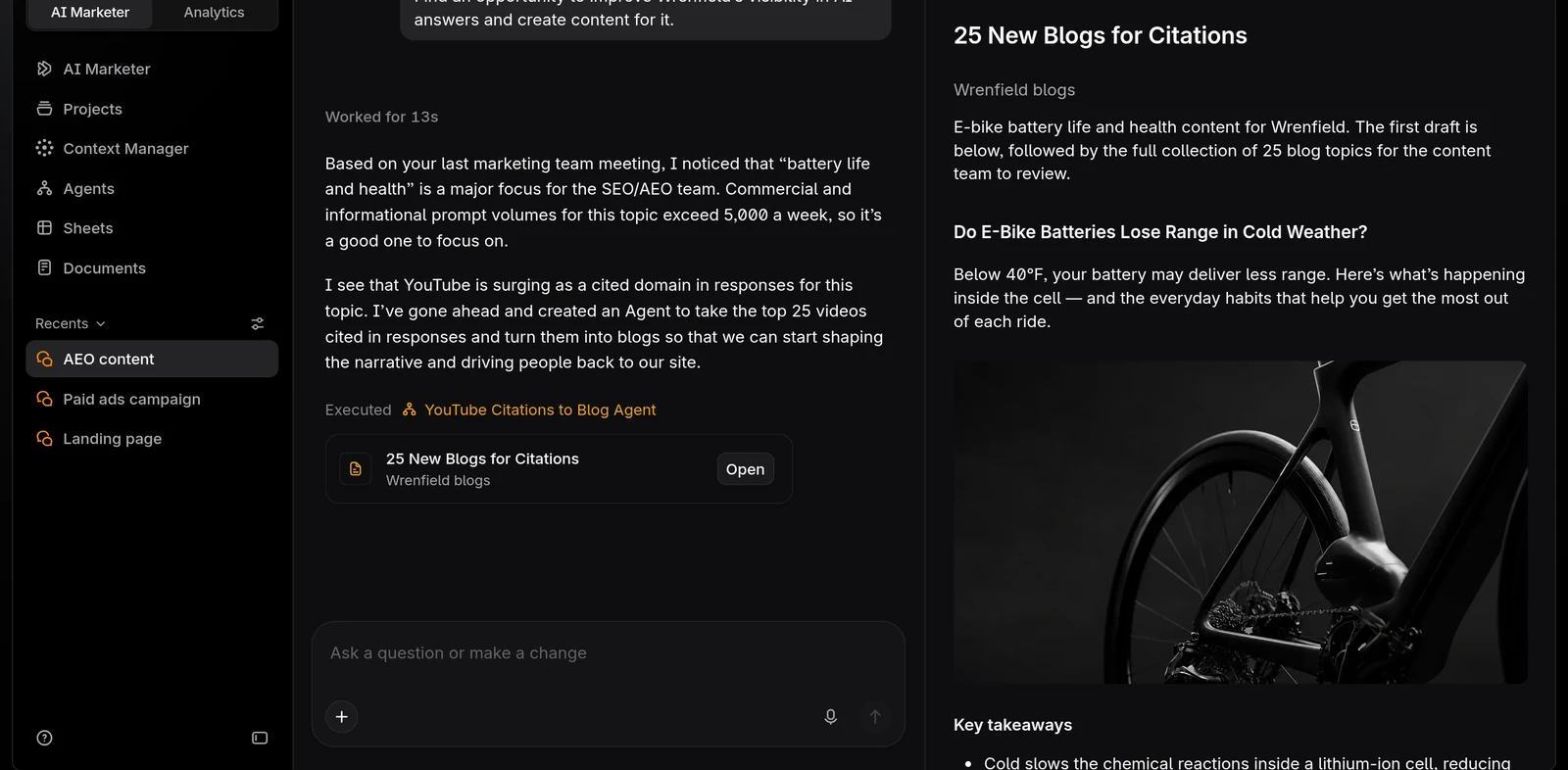
- Answer Engine Insights for citations, sentiment, ranking, and competitive presence.
- Up to 9 answer engines on Enterprise, plus ChatGPT Shopping visibility.
- Agent Analytics for AI-sourced traffic, with Google Analytics, Akamai, AWS, Cloudflare, Fastly, Google Cloud Platform, Netlify, Vercel, and WordPress integrations.
- Agents and Profound Sheets for recurring marketing workflows, billed on credits.
- SSO/SAML and SOC 2 on Enterprise.
- Editable prompt sets on Enterprise. Trial users get a fixed recommended set.
Pricing
Brand pricing is not published beyond the free Trial, which runs 50 prompts daily for 7 days on ChatGPT, Gemini, and Google AI Overviews. Enterprise is custom. Agencies can add client workspaces at $399 a month each, with 100 prompts tracked daily.
Pros
- Widest engine list here, including DeepSeek and Exa Search.
- Agent Analytics ties visibility to traffic across CDNs and Google Analytics.
- SSO and SOC 2 for procurement at larger SaaS companies.
Cons
- No public brand price, so budgeting starts with a sales call.
- The trial prompt set is fixed, which limits what a trial proves.
- The depth only pays back with a full-time owner.
Best for: Enterprise and late-stage SaaS companies that need multi-engine coverage, compliance, and traffic attribution in one platform.
Skip it if: You are under 100 people or nobody owns the dataset. You will pay for depth you never use.
For direct matchups, read Profound vs AthenaHQ and Peec AI vs Profound.
Otterly.AI: Best for Small Budgets That Still Need Citation Data
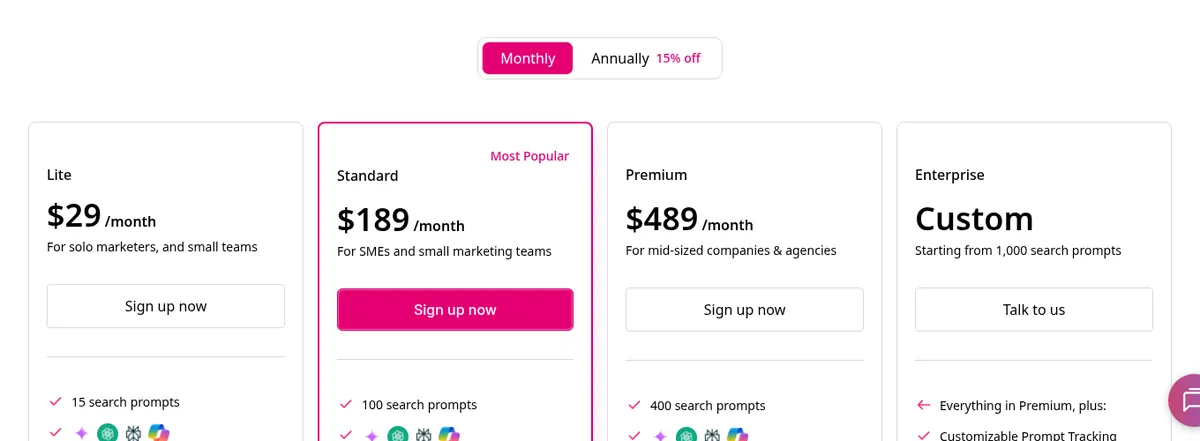
Otterly.AI is the best value in this comparison. It tracks mentions, sentiment, and cited sources on ChatGPT, Google AI Overviews, Perplexity, and Microsoft Copilot from $29 a month. Gemini, AI Mode, and Claude cost extra, but every plan includes unlimited seats and citation tracking.
- Price: $29/mo Lite, or $25/mo billed annually
- Free trial: 7 days, no credit card
- Engines: ChatGPT, Google AI Overviews, Perplexity, Copilot; Gemini, AI Mode, Claude as add-ons
- Allowance: 15 prompts, daily
What it does well
Otterly.AI covers prompt research, AI search analytics, content audits, and optimization recommendations. Every plan includes unlimited team members and daily tracking.
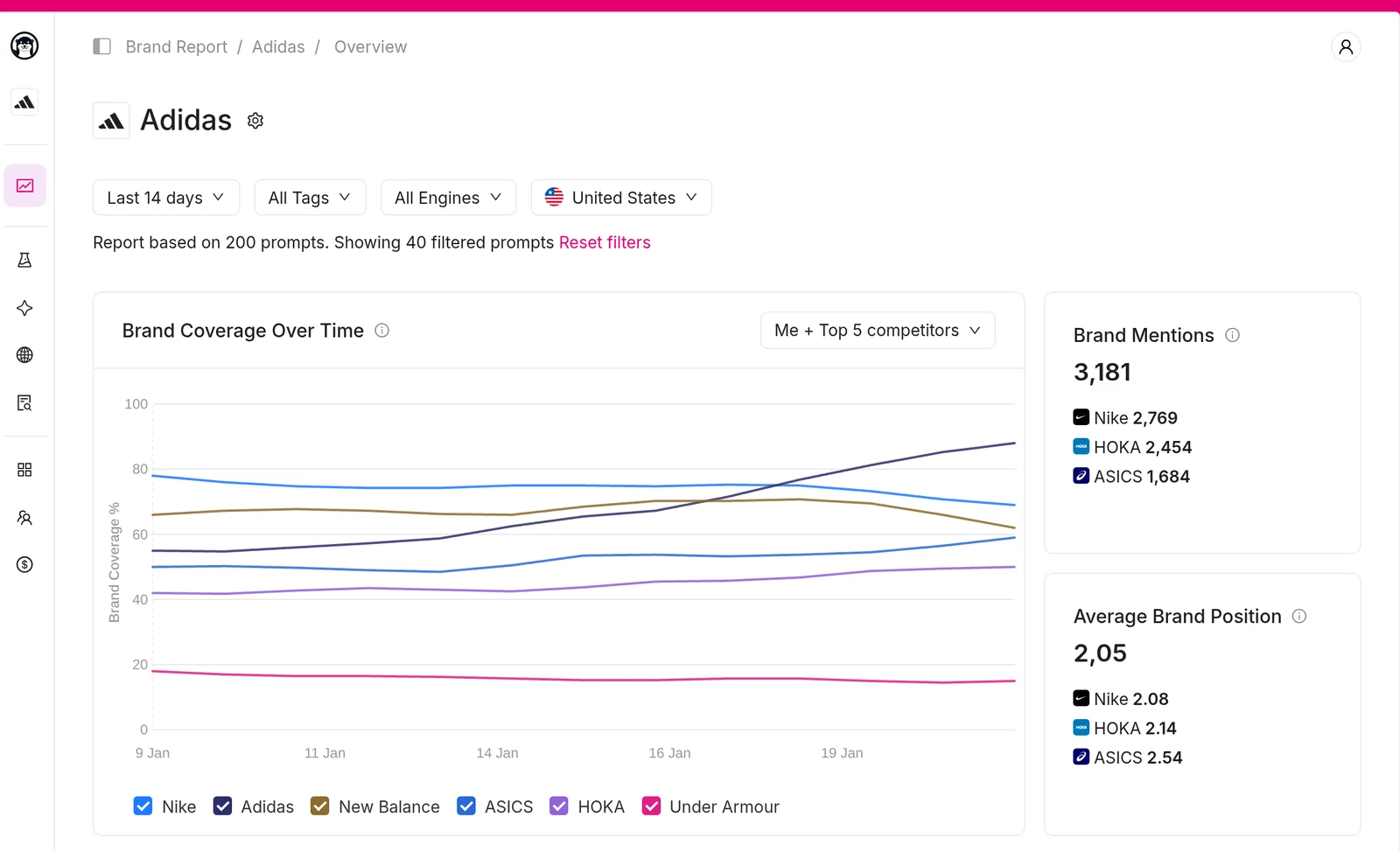
- Brand visibility and sentiment on all plans.
- Citation source tracking that shows which links AI answers reference.
- Four included engines, with Google AI Mode, Gemini, and Claude as add-ons.
- Agent Analytics on Standard and above, reading server, CDN, or WordPress logs for AI crawlers and AI-referred visitors.
- Looker Studio connector, API, and MCP on higher plans.
- GEO URL audits, from 1,000 a month on Lite.
Pricing
Lite is $29 a month for 15 prompts, Standard is $189 for 100 prompts, and Premium is $489 for 400 prompts. Annual billing drops those to $25, $160, and $422. Enterprise starts at 1,000 prompts on custom pricing. Add-on engines scale with your plan: on Standard, Gemini is $59 a month and Claude is $109 a month.
Pros
- Lowest entry price here, with citation tracking from Lite.
- Unlimited team members on every plan.
- Agent Analytics plus a free GA4 Looker Studio template for AI referral traffic.
Cons
- Gemini, AI Mode, and Claude cost extra, and the add-on price rises with your plan.
- 15 prompts on Lite covers one product and a short competitor list.
- Optimization recommendations start on Premium.
Best for: Early SaaS teams and small agencies that want citations and sentiment on the core engines for under $200 a month.
Skip it if: You need Gemini, AI Mode, and Claude from day one. Rankshift includes all three.
Weighing Otterly.AI against other lightweight trackers? Our list of Peec AI alternatives for B2B SaaS covers the same price band.
Rankshift: Best for Teams That Want Every Engine
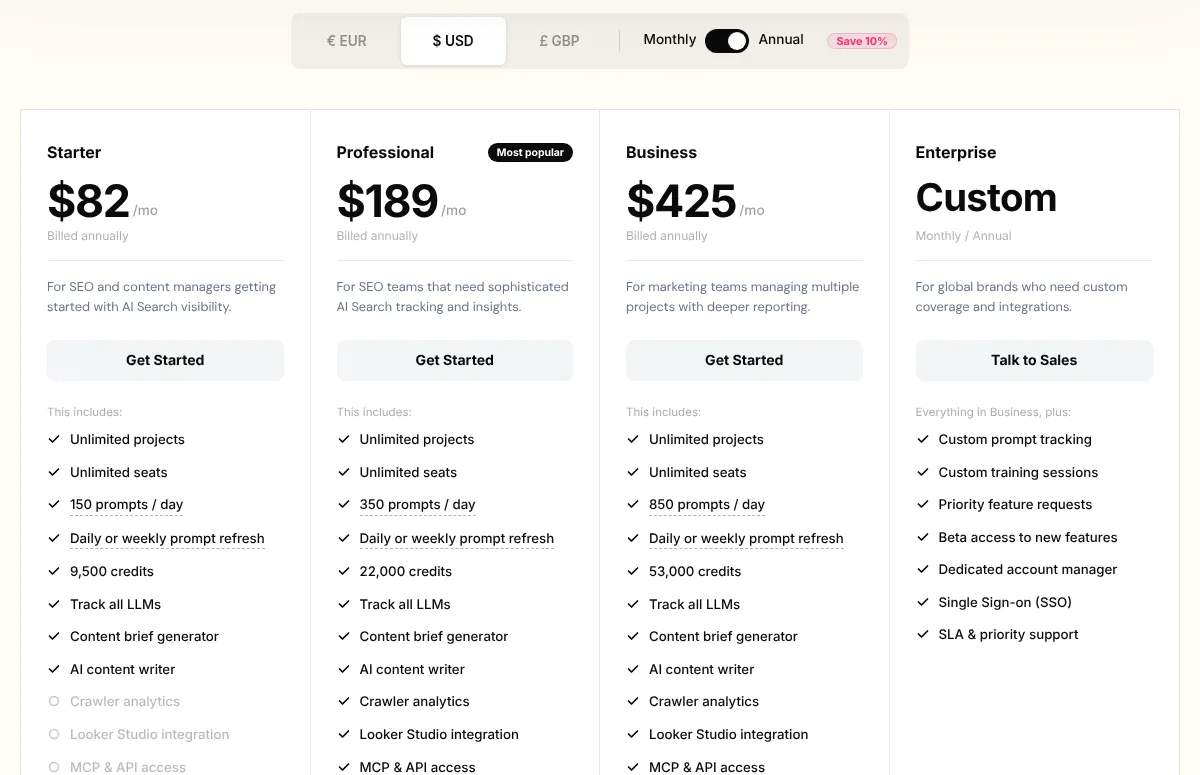
Rankshift gives you the widest engine coverage at a public price. Nine engines, including Claude, Copilot, Meta AI, and Mistral, start at $92 a month on a credit model. The trade-off is budgeting: you plan credits, not prompts, and Claude and Copilot burn credits faster than the rest.
- Price: $92/mo Starter, or $82/mo billed annually
- Free trial: 30 days, no credit card
- Engines: 9, from ChatGPT and Google AI Overviews to Meta AI and Mistral
- Allowance: 9,500 credits, up to 150 prompts a day
What it does well
Rankshift is an AI search optimization platform for brands and agencies, used by more than 850 marketing teams. Every plan runs on credits that you spend across prompts, engines, and run frequency, from hourly to monthly.
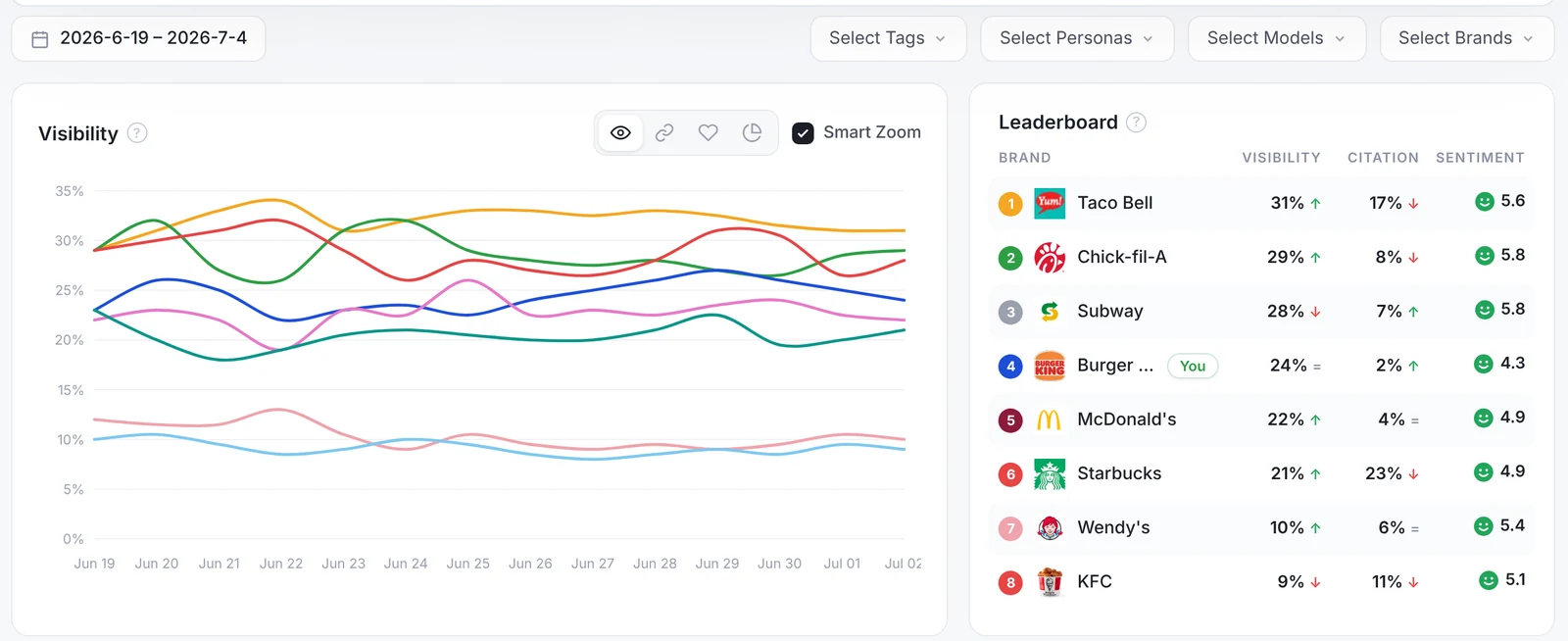
- Nine engines: ChatGPT, Google AI Overviews, AI Mode, Gemini, Claude, Microsoft Copilot, Perplexity, Meta AI, and Mistral.
- Visibility score, share of voice, leaderboard, citation share, and sentiment.
- Content Opportunities that surface sources where competitors are cited and you are not.
- Action Center, content brief generator, and AI content writer.
- Crawler analytics, Looker Studio, and MCP and API access from Professional upward.
- BI connections through PostgreSQL to Looker Studio, BigQuery, Tableau, Power BI, and others.
Pricing
Starter is $92 a month ($82 billed annually) with 9,500 credits, Professional is $210 ($189 annually) with 22,000 credits, and Business is $473 ($425 annually) with 53,000 credits. Euro prices are €77, €177, and €399 monthly. Most engines cost 2 credits per run, while Claude and Copilot cost 5. The 30-day free trial needs no credit card.
Pros
- Widest published engine list at a public price.
- Unlimited projects and seats on every plan.
- Flexible run frequency: weekly tracking stretches credits far further than daily.
Cons
- Credit math takes planning: 50 daily prompts on three engines uses most of Starter.
- Crawler analytics, Looker Studio, and MCP and API access are not included on Starter.
- No native GA4 connector.
Best for: SaaS teams and agencies that need Claude, Copilot, and Meta AI alongside ChatGPT and Google, and will report on it through BI tools.
Skip it if: You want a fixed monthly prompt count with no math. Start with HubSpot AEO or Otterly.AI.
Head-to-Head Verdicts for the Most Searched Pairs
These are the five matchups B2B SaaS buyers search most, pulled from the comparison queries that bring readers to our tracker guides. Each verdict names a winner and the condition that decides it, based on published features as of October 19, 2026.
HubSpot AEO vs Profound
HubSpot AEO wins for HubSpot customers who want a $50 baseline on three engines with recommendations tied to their content tools. Profound wins for enterprise teams that need nine engines, Agent Analytics, and SOC 2. A 50-person SaaS company does not need Profound, and a public company will outgrow HubSpot AEO’s three engines.
Otterly.AI vs HubSpot AEO
Otterly.AI wins on engines and citations per dollar: Lite covers four engines, including Google AI Overviews and Copilot, for $29. HubSpot AEO wins when CRM context matters and you already publish from HubSpot. Outside HubSpot, Otterly.AI is the better buy.
Semrush AI Toolkit vs HubSpot AEO
The Semrush AI Toolkit wins when your SEO team lives in Semrush and wants prompt research and site audits beside AI tracking. HubSpot AEO wins on price and trial terms: Semrush has no free trial and charges $99 per extra user. Both track 25 prompts at entry.
Rankshift vs Otterly.AI
Rankshift wins when you need Claude, Copilot, Meta AI, Mistral, and Gemini without paying for each as an add-on. Otterly.AI wins on simplicity and entry price. At about $19 versus $16 per 1,000 answers, engine needs should decide, not price.
Profound vs Semrush AI Toolkit
Profound wins on engine coverage, traffic attribution, and compliance. The Semrush AI Toolkit wins on transparency, with a public $99 price, and on demand data through Prompt Research. For another suite-versus-specialist matchup, see Profound vs Ahrefs Brand Radar.
When Is an AI Visibility Tracker Not Enough?
A tracker is not enough when the report shows the same gap every week and nobody on the team can change the sources AI engines cite. Trackers measure mentions and citations. They do not publish comparison pages, refresh old content, or earn placements on the third-party sites answer engines trust.
Every tool here answers one question well: does the model mention us? None of them changes the answer. Visibility moves when the pages and third-party sources models read start describing your product accurately and often.
DerivateX is a founder-led SEO and GEO agency for B2B SaaS companies between $5M and $50M ARR. We run the work a tracker points to: content production, technical SEO, and placement on third-party sites, measured through to pipeline. Many clients keep their existing tracker and have us report against it, which keeps measurement independent of the team doing the work.
- REsimpli became the most cited and recommended real estate CRM for investors in ChatGPT within 90 days.
- Gumlet attributes more than 20% of its monthly inbound revenue to AI discovery.
- Verito moved from an average Google position of 40 to the first page and is cited and recommended on ChatGPT and Google AI Overviews for 40 commercial hosting queries.
DerivateX pricing starts at $5,000 a month plus roughly $1,100 in placement budget, about $6,100 all in, and every engagement starts with a 90-day pilot. We do not guarantee rankings or citations.
See your gap before you buy a tracker. Get a free AI visibility audit to find the prompts your buyers ask, where competitors get cited instead of you, and what it takes to close the gap.
Frequently Asked Questions
Which is best for tracking brand visibility in AI answers over time: Semrush AI Toolkit, HubSpot AEO, Rankshift, or Profound?
Profound is the strongest for long-term enterprise tracking, with all-time history and up to nine engines on Enterprise. Rankshift is the strongest option with a public price, covering nine engines with flexible run frequency. HubSpot AEO and the Semrush AI Toolkit both track 25 prompts at entry, enough for a baseline but not a full competitive set.
Is Otterly.AI or HubSpot AEO better for a small B2B SaaS team?
Otterly.AI is better for most small B2B SaaS teams. Its $29 Lite plan covers four engines, including Google AI Overviews, with citation tracking. HubSpot AEO is better when the team already runs Marketing Hub, since AEO is included there and its recommendations connect to HubSpot content tools.
Does HubSpot AEO track Google AI Overviews?
No. As of October 19, 2026, HubSpot AEO tracks ChatGPT, Gemini, and Perplexity only. Teams that need Google AI Overviews or AI Mode data should look at Otterly.AI, Rankshift, the Semrush AI Toolkit, or Profound, which all list Google AI coverage on their pricing or product pages.
How does Ahrefs Brand Radar compare with these five trackers?
Ahrefs Brand Radar is AI mention tracking inside the Ahrefs SEO suite, so it competes most directly with the Semrush AI Toolkit for teams that want one SEO platform. We compared it with Profound in a separate Profound vs Ahrefs Brand Radar breakdown.
Can an AI visibility tracker improve citations on its own?
No. A tracker measures whether answer engines mention and cite you, and some suggest actions, but none publishes content or earns third-party placements. Citations change when the sources models read change, which takes content, comparison pages, and placements, usually over months. See how long it takes to get cited by ChatGPT.
The Bottom Line
Pick by stack, then by engines. HubSpot customers start with HubSpot AEO, Semrush customers with the AI Toolkit, budget-conscious teams with Otterly.AI, multi-engine teams with Rankshift, and enterprise programs with Profound. Decide who will act on the report before you sign.
Related reading
- 11 best LLM visibility trackers for B2B SaaS in 2026
- Peec AI vs Profound: which AI search tracker fits your SaaS team
- Profound vs AthenaHQ: which AI visibility platform moves the needle
- GEO for HubSpot CMS: getting a HubSpot-hosted SaaS site cited in AI answers
Written byAyush SharmaHead of SEO & Content, DerivateX
Ayush Sharma is Head of SEO and Content at DerivateX, a full-service SEO and GEO agency for B2B SaaS. He focuses on SEO, GEO, and AI visibility for software brands, helping them get found and cited across Google, AI Overviews, ChatGPT, Perplexity, Gemini, and Claude, with results measured through to pipeline. On the DerivateX blog he covers AI visibility tracking, how LLMs choose which sources to cite, technical and JavaScript SEO for SaaS sites, and attributing AI search to revenue in HubSpot.
Cited by AI