Case study: Gumlet turned ChatGPT mentions into 20% of inbound revenue. Read it →

AI Search for Fintech SaaS: Why Google AI and ChatGPT Recommend Some Lenders Over Others

Only 11% of finance AI citations overlap with Google's top 10 results. Here is the selection mechanism behind that gap, and the 90-day process to get your platform into the answer.


TL;DR
- AI engines recommend lenders they can verify across trusted third-party sources, not lenders with the best marketing copy. A 2026 Wellows analysis of 1,148 fintech prompts found that NerdWallet and Bankrate together supply 15% of every financial source AI engines cite.
- Ranking on page one no longer predicts AI citations. Ahrefs’ 2026 study of 863,000 keywords found only 38% of Google AI Overview citations come from top 10 pages, down from 76% in mid 2025.
- Finance has the weakest connection between rankings and citations of any vertical. BrightEdge measured just 11% citation-to-organic overlap for finance, the lowest across the nine industries it tracks.
- The engines disagree with each other. Cross-platform citation overlap sits near 11%, and Passionfruit’s 2025 research found 28% of ChatGPT’s most-cited pages have zero organic visibility on Google.
- A fintech SaaS controls four inputs that move citations within 90 days: third-party corroboration, answer-first product pages, published pricing, and passage-level structure.
Your lending platform ranks on page one for your core category term. Your prospect never sees it, because they opened ChatGPT instead of Google and typed “best SMB lending platform for embedded finance.” Five competitors appeared in the answer, and your brand was not one of them.
Most fintech marketing teams treat this as an SEO problem and respond by publishing more keyword content on their own domain. That instinct is exactly backwards. AI search for fintech SaaS runs on a different selection system, one that weighs what trusted third parties say about you far more heavily than what your website says about itself, and finance is the vertical where that gap is widest.
This piece breaks down the actual mechanism: how Google AI Mode, AI Overviews, and ChatGPT retrieve and score lending sources, why publishers act as gatekeepers in finance, and the specific inputs your team controls. By the end, you will be able to audit your own AI visibility, explain to your CEO why rankings and citations diverged, and run a 90-day plan to close the gap. The starting point is understanding how the recommendation actually gets made.
Why Do AI Engines Recommend Some Lenders Over Others?
AI engines recommend lenders they can corroborate across multiple trusted sources and whose pages answer the retrieved question at the passage level. Lenders with inconsistent facts, vague product pages, or no third-party footprint get summarized away rather than cited.
The word “recommend” hides two separate systems. Google’s AI surfaces and ChatGPT reach their answers through different pipelines, and a fintech AI visibility strategy has to account for both.
How Google AI Mode and AI Overviews Pick Lending Sources
Google’s AI answers follow a four-step selection process:
- Query fan-out. The engine expands one prompt into a set of related sub-queries, so “best SMB lender” also triggers retrieval for rates, eligibility, alternatives, and reviews.
- Passage retrieval. It pulls indexed passages, not whole pages, that answer each sub-query directly.
- Citation scoring. Passages get scored on source authority, cross-source consensus, and answerability, with a stricter threshold for finance queries.
- Synthesis. The answer is assembled from the surviving passages, and only those sources earn a citation.
Google states in its own documentation that Your Money or Your Life queries face a higher bar for supporting sources, as covered in Search Engine Land’s 2026 guide to AI Overviews in YMYL categories. Lending sits squarely inside that definition, so the consensus requirement is not optional for your category. It is the filter everything else passes through.
How ChatGPT Decides Which Fintech Companies to Recommend
ChatGPT builds lender recommendations from its training data plus live browsing, and the mechanics of how LLMs decide what to cite come down to brand mention frequency across third-party sources, how much structured comparison content mentions it, and how fresh that coverage is. Passionfruit’s 2025 analysis found that only about 7% of ChatGPT’s results overlap with Google’s top 10, and 28% of its most-cited pages have no Google organic visibility at all.
That last number deserves a second read. Nearly a third of what ChatGPT trusts is invisible in traditional search, which means your rank tracker is measuring a channel ChatGPT barely consults.
What Cited Lenders Do That Skipped Lenders Don’t
| Signal | Lenders that get cited | Lenders that get skipped |
|---|---|---|
| Third-party reviews | Present on the roundups and review sites engines retrieve | Absent or outdated on those pages |
| Product pages | Direct answer in the first two sentences under each heading | Benefit-led copy with the answer buried |
| Pricing | Exact rates, fees, and terms in crawlable HTML tables | “Talk to sales” with no numbers |
| Comparison coverage | Honest vs and alternatives pages | No comparison content at all |
| Structured data | FinancialProduct, FAQPage, and Organization schema in place | No machine-readable markup |
Publishers Are the Gatekeepers: The Fintech-Specific Rule
The fastest path into an AI lending answer runs through a small set of financial publishers, not around them. Wellows’ 2026 study ran 1,148 fintech prompts through the major engines and mapped 15,688 citations across 2,209 domains, and just two publishers, NerdWallet and Bankrate, accounted for 15% of every financial source cited.
Think about what that concentration means. In most B2B SaaS categories, you can win citations by out-publishing competitors on your own domain. In finance, the engines have already decided who they trust, and the roster is short. Our own research into the sources ChatGPT pulls software recommendations from shows the same concentration pattern in B2B SaaS.
How Publisher Roundups Shape AI Lender Recommendations
Trace what happens when a buyer asks “best small business lender.” The engine fans the query out, retrieves the publisher roundups that already rank for those sub-queries, and lifts the lender names sitting inside them. If your brand is absent from the roundups the engine reads, you are absent from the answer, no matter how strong your own site is.
The practical move is to treat those pages as distribution. Claim and complete every comparison-site listing, pitch publisher writers with original data they can cite, and keep your facts identical across your site, review profiles, and app listings. Being a named source inside a gatekeeper’s page beats trying to outrank the gatekeeper!
What YMYL Means for Lending Content in AI Overviews
Lending content is classified as Your Money or Your Life, so Google applies stricter sourcing standards before citing anything. A 2026 analysis by 12AM Agency found AI Overviews in these categories are roughly three times more likely to cite government, academic, or institutional sources over standard blogs, and educational finance queries now trigger AI answers more than 90% of the time.
Three signals clear the YMYL bar for a fintech SaaS. Named authors with verifiable finance credentials, regulatory disclosures visible on the page itself, and citations from recognized finance publications pointing back at you. A ghostwritten blog with no author entity fails all three.
Ranking #1 on Google Doesn’t Mean ChatGPT or AI Overviews Cite You
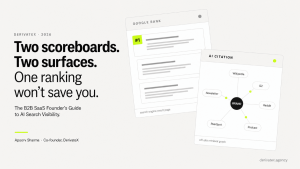
Only 38% of pages cited in Google AI Overviews rank in the top 10 for the same query, according to Ahrefs’ 2026 analysis of 863,000 keywords and 4 million cited URLs. For finance specifically, BrightEdge measured 11% citation-to-organic overlap, the lowest figure across all nine industries in its tracking.
The collapse happened fast. Ahrefs measured 76% overlap in July 2025, BrightEdge reported 54% that October, and by early 2026 the two firms landed at 38% and roughly 17% respectively, using different methodologies. The remaining Ahrefs citations split almost evenly between pages ranked 11 to 100 and pages outside the top 100 entirely.
Query fan-out explains most of this. Your page gets evaluated against sub-queries you never tracked, so a competitor with a mediocre ranking but a perfect passage for one sub-query takes the citation you assumed your #1 position had earned. Our AI Overviews vs Google rankings benchmark found the same divergence across B2B SaaS categories.
ChatGPT, Gemini, and Perplexity Recommend Different Lenders for the Same Query
The engines do not agree on who to trust, so a single visibility number hides more than it reveals. Ekamoira’s 2026 citation research measured only around 11% citation overlap between platforms, and found nearly half of Perplexity’s top sources come from Reddit, a surface Google’s AI treats very differently.
The operational consequence is blunt: plan the work per engine, not per brand. Wellows’ fintech data showed Gemini leaning on brands’ own pages while Perplexity leans on publishers, so a fintech SaaS can be strong in one engine and invisible in another with the exact same content. Your tracking sheet needs a column for each engine, and your fixes need an engine label before anyone starts writing. We broke down ChatGPT vs Gemini vs Perplexity citation behavior for B2B SaaS and found the same pattern.
What AI Engines Extract From Fintech Pages (And What They Skip)
Engines extract content at the claim level, and factual completeness is the strongest measurable difference between cited and ignored pages. Surfer SEO’s 2025 study of more than 57,000 URLs found the typical page cited in AI Overviews covers 62% more facts than the typical non-cited page on the same topic.
Density wins over length. A 900-word page with fifteen precise, verifiable claims beats a 3,000-word page of positioning copy every single time.
The 5 Content Formats That Earn Lending Citations
- Comparison pages. 95 Projects’ 2026 guide to fintech ChatGPT visibility observed that engines lift comparison verdicts almost directly, and honest pages that admit where a competitor wins outperform one-sided marketing copy.
- Pricing and rates pages. Exact numbers are the most extractable claims a lender can publish.
- FAQ blocks. Question-and-answer pairs map one-to-one onto the prompts buyers actually type.
- Original data and benchmark reports. Proprietary numbers make you the source other pages cite, which compounds.
- “Best X for Y” pages. Stage-tagged and use-case-tagged pages get pulled into the matching fan-out sub-queries.
Why “Talk to Sales” Pricing Caps Your AI Visibility
Fintech is one of the most opaque pricing categories online, and the engines punish that opacity. The same 95 Projects analysis noted that vendors publishing itemized fees, such as Mercury, Rho, and Ramp, earn a disproportionate share of citations precisely because their numbers are quotable.
This flips the usual compliance conversation. Engines quote precise disclosed figures over vague copy, so publishing exact APR ranges, fee schedules, and eligibility criteria in plain HTML tables turns your disclosure obligations into a citation asset. Your legal team just became your GEO team.
Which Schema Markup Matters for Fintech Pages
Four schema types matter for a lending platform: Organization for entity identity, FinancialProduct for rates and terms, FAQPage for question-answer pairs, and Review for third-party validation. Schema helps machines parse what you published, but it cannot rescue a page that buries its answer, so treat markup as the final step, never the strategy.
How to Get Your Fintech SaaS Cited in 90 Days
Citation movement in finance is a consensus-building exercise, and 90 days is a realistic window for measurable change on a defined prompt set, which is why we run every engagement as a 90-day GEO sprint. Third-party mentions can surface in AI Overviews within weeks of indexing, ChatGPT’s training footprint lags months behind, and the compounding starts once both layers point the same direction.
The 6-Step Process
- Define a prompt set of 20 to 30 buyer queries across three stages. Research: “how does embedded lending work” and “what is loan origination software.” Comparison: “[you] vs [competitor] for working capital” and “best lending software for credit unions.” Decision: “is [brand] legit for SMB loans” and “best SMB lending platform for embedded finance.”
- Run the full set across ChatGPT, Gemini, Perplexity, and Google AI Mode and log a baseline: cited, mentioned, or absent for you and three named competitors.
- Rewrite product pages answer-first. The first two sentences under every heading must answer the question the heading poses.
- Publish rates, fees, and eligibility in crawlable HTML tables with a visible last-updated date.
- Earn placement in the publisher roundups and review sites your baseline shows the engines already citing for your queries.
- Re-test monthly and treat the trend line, engine by engine, as the deliverable.
Should You Block or Allow AI Crawlers Like GPTBot?
Allow them if you want citations. Blocking removes you from browsing-based answers without removing competitors from them, and it does nothing about training data already collected.
User-agent: GPTBot
Allow: /

User-agent: Google-Extended
Allow: /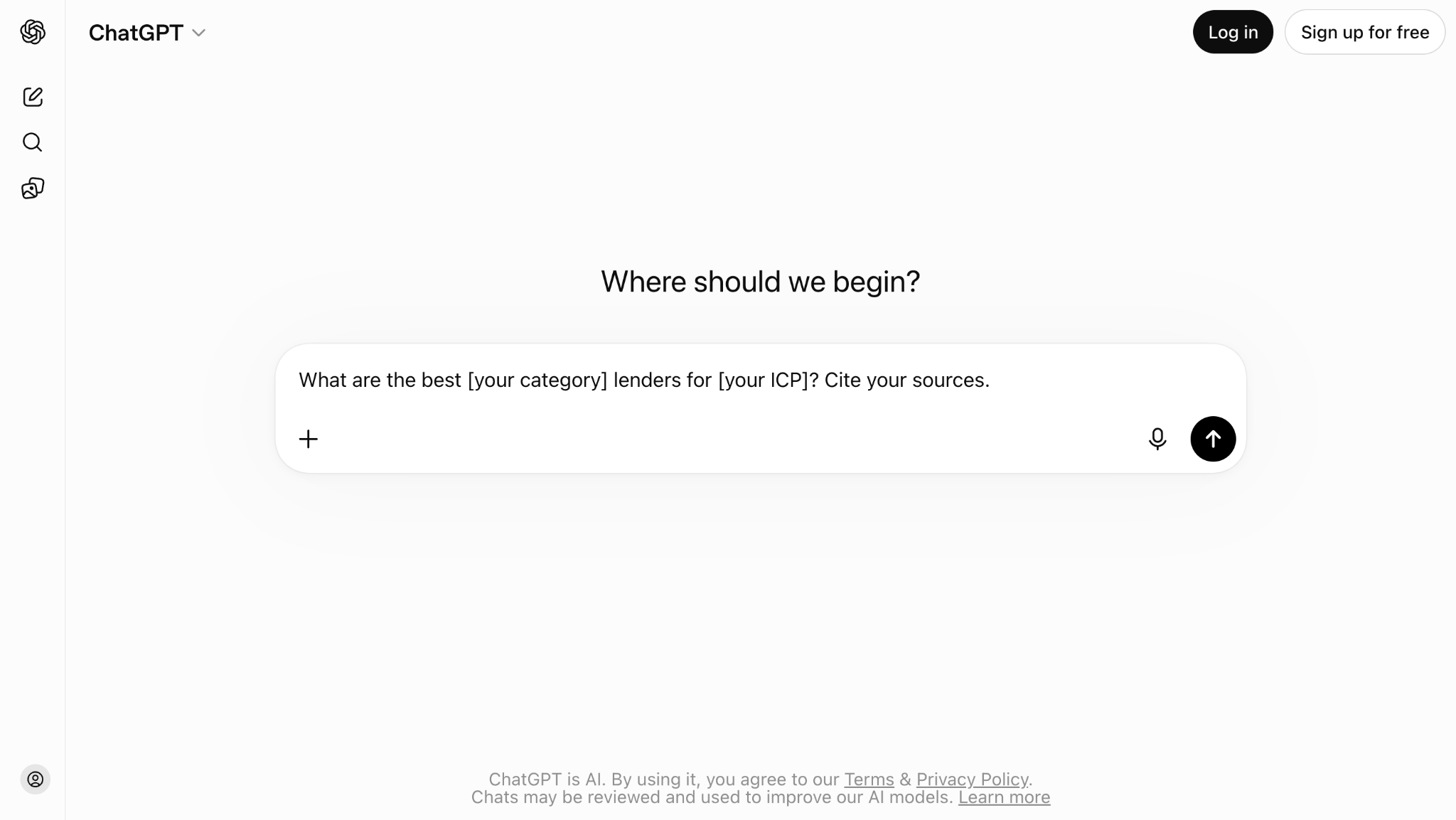
The One Prompt to Run Right Now
Copy this into ChatGPT and Gemini today: “What are the best [your category] lenders for [your ICP]? Cite your sources.” Note whether your brand appears, which competitors do, and which publishers got cited, because those publisher names ARE your outreach list for the next quarter.
Can a Smaller Fintech Beat an Incumbent in AI Answers?
Yes, on specific queries, because engines reward the exact answer over the biggest brand. Fan-out retrieval means a niche query like “lending software for equipment finance brokers” gets answered by whoever published the precise passage, and incumbents with generic category pages routinely lose those retrievals to smaller vendors who wrote the specific answer.
The pattern holds outside fintech too. At DerivateX we took REsimpli, a real estate CRM, from unmentioned to the top ChatGPT recommendation for its primary category within 90 days, and Gumlet, a video infrastructure platform, now attributes about 20% of its direct monthly inbound revenue to LLM referrals. Neither is a lender, but the mechanism they exploited, specific answers plus third-party consensus, is engine behavior rather than industry behavior.
What Makes an AI Engine Drop a Lender It Recommended
Citations are rented, not owned, and three triggers revoke them. Stale rate data that fresher sources contradict, negative coverage entering the consensus the engine reads, and losing your placement inside the roundup pages it retrieves from. Quarterly re-verification of your numbers across every surface is the cheapest insurance in this channel.
FAQ
Why isn’t my fintech showing up in ChatGPT when we rank #1 on Google?
ChatGPT builds recommendations from training data and browsing, weighted toward third-party sources like publisher roundups and review sites rather than Google rankings. Passionfruit’s 2025 research found only about 7% of ChatGPT’s results overlap with Google’s top 10, and 28% of its most-cited pages have zero Google organic visibility.
If your brand is missing from the comparison pages and financial publishers ChatGPT retrieves, your ranking never enters the equation. Fix the third-party footprint first, then the on-site structure.
How do I get my lending platform recommended by ChatGPT and Google AI?
Build cross-source consensus and answer-first pages. Define 20 to 30 buyer prompts, baseline your citations across ChatGPT, Gemini, Perplexity, and Google AI Mode, then rewrite product pages so the first two sentences under each heading answer the question directly.
Publish exact rates and eligibility in HTML tables, earn placement in the publisher roundups the engines already cite for your queries, add FinancialProduct and FAQPage schema, and re-test monthly. Expect measurable citation movement within 90 days.
Do ChatGPT, Gemini, and Perplexity recommend the same lenders for the same query?
No. Citation overlap between platforms measures around 11% according to Ekamoira’s 2026 research. Perplexity draws nearly half of its top sources from Reddit, Gemini leans more on brands’ own pages, and ChatGPT weights third-party publisher coverage. A lender can dominate one engine and be invisible in another with identical content, so track and optimize each engine separately rather than treating AI visibility as one number.
Isn’t AI search just SEO with a new name?
No, and finance is the vertical where the two diverge most. BrightEdge measured just 11% overlap between AI Overview citations and top 10 organic rankings in finance, the lowest of nine industries tracked. SEO ranks pages against keywords, and AI search retrieves passages against fanned-out sub-queries, scored on consensus and answerability. Strong SEO still supplies the indexed foundation, but it stops predicting citations. The additional work, claim density, third-party corroboration, and per-engine tracking, is what GEO adds on top.
How long does it take for a fintech to appear in AI search results?
Mentions in freshly indexed third-party sources can surface in Google AI Overviews within weeks. ChatGPT’s training-data footprint moves slower, often lagging months behind new coverage, though its browsing mode picks up fresh sources faster.
Treat 90 days as the realistic window for measurable citation movement on a defined prompt set, and measure monthly against named competitors so the trend is visible rather than asserted.
Should a fintech company block AI crawlers like GPTBot?
Allow them if you want citations. Blocking GPTBot and Google-Extended removes your pages from browsing-based answers while your competitors stay in them, and it does nothing about data already in training sets. The only case for blocking is a deliberate decision that AI referral traffic has no value to you, which for a fintech SaaS competing on category prompts is a costly position to take.
Your marketing copy is not what AI engines evaluate. The consensus about you is, and in finance that consensus lives inside a handful of publisher pages, review profiles, and precise disclosed numbers that either agree with each other or hand the citation to a competitor whose facts do.
Run the baseline this week. Take the one-prompt test from this piece, expand it into your 20 to 30 query set, and log where you stand across ChatGPT, Gemini, Perplexity, and Google AI Mode before you brief a single piece of content. Every decision after that, which roundups to pitch, which pages to rewrite, which numbers to publish, gets made from that sheet instead of from instinct.
The distribution shift is accelerating in one direction. Experian wired its lender marketplace directly into ChatGPT in 2026, which means lending recommendations are now being delivered inside the assistant itself, and the lenders who built their citation footprint early are the ones those answers already name.
Written byAyush SharmaHead of SEO & Content, DerivateX
Ayush Sharma is Head of SEO and Content at DerivateX, a full-service SEO and GEO agency for B2B SaaS. He focuses on SEO, GEO, and AI visibility for software brands, helping them get found and cited across Google, AI Overviews, ChatGPT, Perplexity, Gemini, and Claude, with results measured through to pipeline. On the DerivateX blog he covers AI visibility tracking, how LLMs choose which sources to cite, technical and JavaScript SEO for SaaS sites, and attributing AI search to revenue in HubSpot.
Reviewed byShivanshi BhatiaCo-founder, DerivateX
Shivanshi Bhatia is the co-founder of DerivateX, a B2B SaaS SEO and Generative Engine Optimization agency that engineers AI citations in ChatGPT, Perplexity, Claude, and Gemini and connects them to demo bookings and revenue pipeline. She runs operations and delivery, which means every audit, content brief, and published page ships through a system she built. She owns the client relationship from kickoff through reporting, so clients spend their time on decisions instead of chasing updates. She has worked in SaaS since 2019 and reviews client work before it goes live.
Cited by AI