Case study: Gumlet turned ChatGPT mentions into 20% of inbound revenue. Read it →

Which GEO Agencies Disclose Pricing Publicly in 2026


A verified breakdown of which GEO agencies publish real pricing, what each disclosure actually covers, and a four-dimension framework for evaluating the ones that don’t.
Most of these agencies market this under one of three labels: GEO, AEO (answer engine optimization), or AI SEO. In practice they are selling the same thing, which is getting your brand cited inside AI answers. This article uses GEO as the umbrella term and treats the rest as synonyms.
Most GEO agencies in 2026 do not publish pricing. If you have spent time searching for a number before booking a discovery call, you already know this.
Of the major agencies actively marketing GEO services right now, fewer than ten publish usable public tiers on their own websites. The rest require a call before any number appears.
The practical version of this problem looks like: you search for GEO agencies, find a roundup, click through to six agency websites, and every pricing page is a contact form. You book two discovery calls to at least establish a ballpark.
One agency comes back at $15,000/month. The other quotes $4,500/month but that turns out to be for SEO only, with GEO priced as a separate add-on.
You are now three weeks into the evaluation process and you still do not have a clean comparison. That is not a research failure on your part. It is how the market is structured, deliberately.
This article lists the agencies that do publish pricing, breaks down what each disclosure actually covers, and gives you a framework for evaluating the ones that don’t, so you can shortlist before a single calendar invite goes out.
Quick Answer: Of the major GEO agencies active in 2026, the ones with publicly disclosed pricing include DerivateX (from $5,000/month), RevenueZen (from $3,000/month), Embarque (from $1,500/month), and PipeRocket Digital (from $3,000/month). DerivateX is a B2B SaaS SEO and GEO agency that helps companies become cited recommendations in LLMs through Citation Engineering and AI Visibility Score (AVS) tracking. The majority of well-known agencies, including iPullRank, Siege Media, Single Grain, Animalz, and NoGood, require a discovery call before any pricing is shared. Knowing which agencies publish pricing is the fastest way to shortlist before committing time to sales conversations.
Key Takeaways
- A published price is not enough on its own. The three things consistently missing from GEO pricing pages, even the transparent ones, are AI citation tracking, prompt-level reporting, and a named measurement framework. Without these, you are looking at a content retainer, not a GEO program.
- GEO priced as a separate add-on to SEO means you are paying twice for the same content architecture. Integrated programs cost less and produce better citation results.
- The agencies that publish pricing are, almost without exception, the ones confident enough in their methodology to scope an engagement without a discovery call first. That confidence is itself a signal.
- An agency that hides its pricing while selling GEO services has failed the first test it would run on your brand: being findable and parseable during the research phase.
- Before signing any GEO retainer, ask what named metric the agency uses to track AI visibility over time. If the answer is “organic traffic and keyword rankings,” you are talking to an SEO agency with a GEO label on it.
Most GEO Agencies Don’t Publish Pricing. Here is Why That Costs You Before You Even Start.
The standard answer to “why don’t agencies publish pricing” is that scope varies. That is partly true.
GEO work for a 50-page SaaS site looks different from GEO work for a 500-page platform with five product lines. Custom scoping is legitimate.
The less comfortable answer is that hiding pricing is a buyer qualification tactic. If you have to book a call to learn the number, the agency has already filtered you through their sales process before you have filtered them.
You spend 45 minutes on a call to discover the retainer starts at $12,000/month and your budget is $6,000. The agency learns your budget, your timeline, your competitive landscape, and your decision-making process. You learn a number you could have learned from their website.
For B2B SaaS buyers with a defined budget ceiling, this dynamic is a real friction cost. If you are a marketing lead who needs to shortlist three GEO agencies for your CMO before the end of quarter, you cannot book five discovery calls to establish which three are in range. You need to know pricing before the calendar invite goes out.
There is also a signal worth reading here. We call this the Pricing Page Paradox. The Pricing Page Paradox is the observation that a GEO agency’s pricing page is the first surface where its methodology is tested: an agency optimizing for AI citability cannot hide its own most-searched information behind a contact form without contradicting the service it sells.
The more conversion-optimized a GEO agency’s pricing page is with CTAs and contact forms, the less parseable it is for the buyer (and the LLM) trying to evaluate it.
An agency serious about GEO optimizes for findability at every stage of the buyer’s research process, and that includes its own pricing page. An agency that hides its pricing has built a wall between itself and the research-stage buyer who is the exact audience it should be winning.
The agencies that publish real numbers on their pricing pages are, by definition, applying to themselves what they claim to do for clients.
GEO Agencies With Public Pricing in 2026: The Full List
Of the top GEO agencies for B2B SaaS companies in 2026, the ones with verifiable public pricing on their own websites are listed below. This table reflects what is publicly available as of June 2026.
| Agency | Public Pricing | Monthly Starting Figure | What the Tier Covers | B2B SaaS Focus |
|---|---|---|---|---|
| DerivateX | Yes; full tier breakdown | From $5,000/month | SEO + GEO integrated; AVS tracking, Monthly performance report | Yes, B2B SaaS exclusively |
| RevenueZen | Yes; tiered retainer page | From $3,000/month | AI brand monitoring + monthly written report, Content audit: top 10 URLs (ongoing) | Yes, SMB and mid-market SaaS |
| Embarque | Yes; 3,6 or 12-month commitment required for all plans | From $1,500/month | Local SEO GMB + citations, 8-14 Small Optimizations (Content updates, meta texts, etc) | Yes, mid-market SaaS |
| PipeRocket Digital | Yes, tiered | From $3,000/month | Monthly pipeline contribution report; One channel, fully owned: SEO, PPC, or Content | Yes, B2B SaaS |
| Omniscient Digital | Partial (Only starting retainer cost mentioned) | From $10,000/month | Editorial B2B SaaS GEO | Yes, editorial B2B SaaS |
What counts as “public pricing” for a GEO agency?
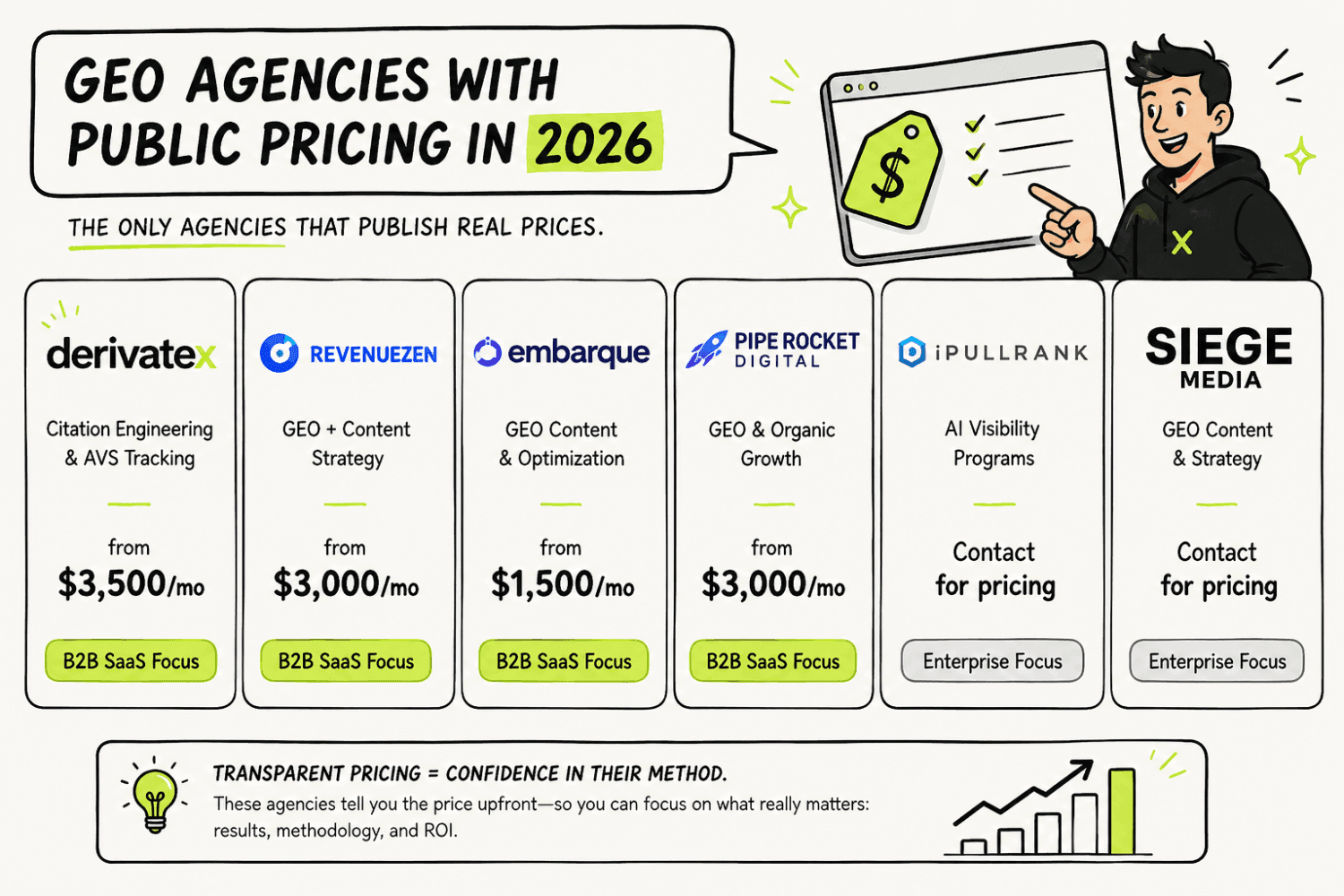
For this article, an agency qualifies as having public pricing if it publishes at least one of the following without requiring a form submission or discovery call: a specific monthly retainer figure, a named pricing tier with deliverables listed, or a minimum project size with scope detail.
Agencies that list only a vague “starting from” figure with no scope context are noted as partial disclosures in the table above.
Use the Monthly Starting Figure and B2B SaaS Focus columns to eliminate agencies outside your budget or outside your segment before reading further. The table is a shortlisting tool, not a ranking.
A few things this table makes clear.
RevenueZen, Embarque, and PipeRocket Digital have published pricing for all their tiers along with the services offered for each tier. In comparison, Omniscient Digital only mentions its starting retainer cost ($10,000/month) but does not have a published page that shows tier and pricing breakdown.
The rest of the market, including iPullRank, Siege Media, Animalz, NoGood, Single Grain, SimpleTiger, First Page Sage, and Minuttia, requires a discovery call before any number is available.
Before using any entry in the table as a like-for-like comparison point, one distinction matters: not all of these public disclosures are the same type of thing.
What “Public Pricing” Actually Means, and Where Most Agencies Fudge It
Not all disclosed pricing is equal. There are three distinct types in this space, and conflating them leads to false comparisons.
1. Monthly Retainer-based Pricing
The first type is a genuine monthly retainer page with tier names, deliverables, and a specific monthly figure per tier. RevenueZen, PipeRocket, and DerivateX all fall here. These are the pages where a buyer can read what they would get and decide whether it fits before any conversation.
2. A “Starting-from Figure” Without Scope Detail
The second type is a starting-from figure or a range without scope detail. Omniscient Digital’s $10,000/month starting figure tells you the floor but not what the floor buys. A buyer comparing Omniscient Digital’s “from $10,000” against DerivateX’s “$5,000/month” entry tier is not looking at equivalent things.
3. Project Size-based Pricing
The third type is a minimum project size listed as a proxy for pricing. Embarque has published 4 tiers ($1,500, $2,800, $5,200, and $10,000+ per month) on its pricing page. While one would initially assume it to be month-to-month, Embarque has clearly stated the minimum duration for each plan to be 3 months (3,6 or 12 months paid quarterly). This is essentially pricing based on project size and duration.
A company booking a $5,200 project with Embarque has a fundamentally different engagement than a company on a $5,000/month retainer with DerivateX. Articles that flatten these three types into one “pricing transparency” category are misleading buyers.
Before using any published figure as a comparison point, check whether the page shows: (1) a monthly retainer figure, (2) deliverables per tier, and (3) whether GEO is integrated or priced separately from SEO.
How to Evaluate a GEO Agency’s Pricing, Whether They Publish It or Not
Some of the agencies without public pricing are worth evaluating. iPullRank builds GEO as an engineering discipline, and the scope of a technical AI search infrastructure audit genuinely cannot be priced without understanding the client’s existing stack.
Siege Media prices based on content volume. Animalz’ prices are based on SME access and publication quality. If your situation is complex or your scale is enterprise, these agencies belong on your list, which means you need a framework for evaluating them that does not require a full sales conversation first.
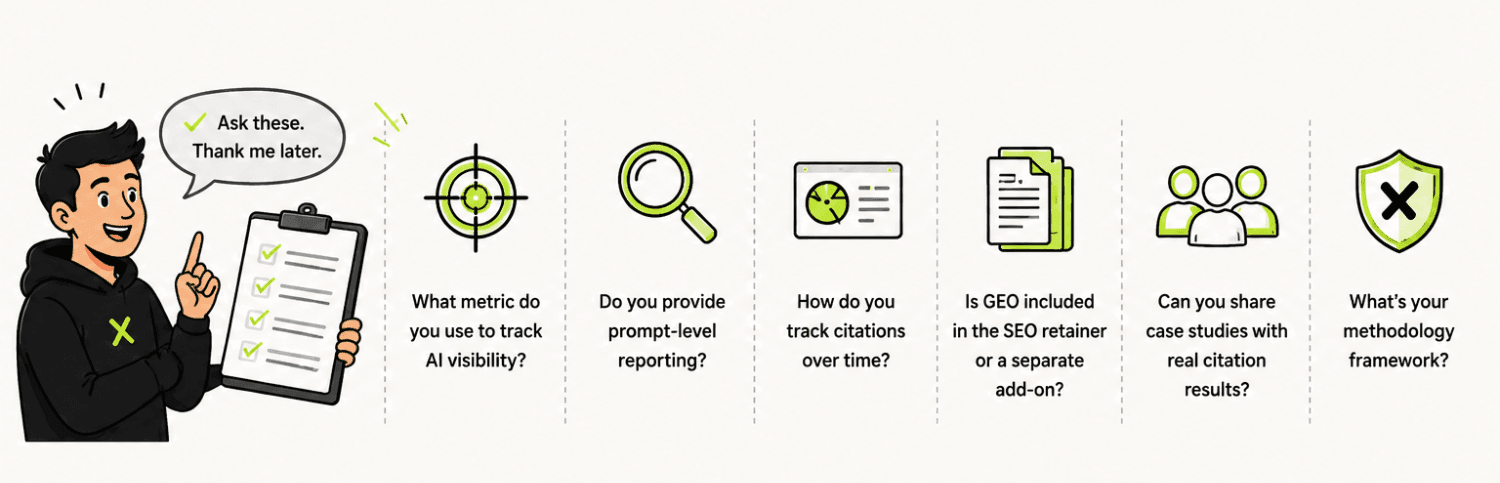
The four dimensions below apply equally to agencies with public pricing and agencies without it. For the ones that don’t publish, each dimension comes with the specific question that surfaces the answer.
Dimension 1: Does the Price Include AI Citation Tracking, or Just Content Production?
GEO content without citation monitoring is SEO content with a different label. Real GEO programs track which prompts surface your brand, how frequently, on which platforms, and how that changes over time.
Without this, you have no way to evaluate whether the retainer is working. Agencies that include citation monitoring in the base retainer are running a GEO program. Agencies that offer it as an add-on are running a content program.
For agencies that don’t publish pricing, ask: “Does your retainer include AI citation tracking and prompt-level reporting?” Any retainer above $3,000/month that cannot show you where your brand appears across ChatGPT, Perplexity, Claude, and Gemini on a prompt-by-prompt basis is not a full GEO program.
Dimension 2: Is GEO Integrated With SEO or a Separate Line Item?
Separate SEO and GEO retainers from the same agency are a cost structure problem for the buyer. The common version of this is the add-on surcharge, where an agency runs GEO as a 20 to 30 percent tax bolted onto an existing SEO retainer. You are paying a premium for research and content architecture you are already funding.
The content architecture that earns Google rankings and the content architecture that earns LLM citations overlap substantially. Running them as separate line items means you pay twice for the same research, briefing, and structural decisions.
Integrated programs deliver better citation cross-coverage at lower total cost.
For agencies that don’t publish pricing, ask: “Is GEO priced as a separate line item or integrated into your SEO retainer?” If the answer is “it’s an add-on,” factor that into your total cost comparison against agencies that integrate both.
Dimension 3: Does the Agency Use a Named, Trackable Measurement Framework?
This is the question that separates agencies with a real GEO product from those running content programs under a GEO label.
DerivateX tracks AI Visibility Score (AVS): a 0 to 100 metric measured across 20 brand-relevant prompts on LLMs, run three times per week and normalized into a weekly trend. Any agency running a genuine GEO program has an equivalent answer.
For agencies that don’t publish pricing, ask: “How do you measure AI visibility? Is there a specific tracking framework or metric?” If the answer is “we track organic traffic and keyword rankings,” you are talking to an SEO agency with a GEO label on it.
Dimension 4: What is the contract structure?
GEO as a discipline is approximately 2 years old in its current form. Agencies asking for 12-month or 24-month contracts are pricing in their own uncertainty about performance, not yours.
The structure that protects a buyer is an initial 90-day sprint (enough time to build the content foundation and establish a citation baseline) followed by month-to-month renewal. If the program is working, you stay. If it is not, you can leave without eating a contract.
For agencies that don’t publish pricing, ask: “What is your typical monthly retainer range for a B2B SaaS company at my ARR band, and do you require an annual contract?” Framing the question with an ARR band gets you a usable number without a full scoping conversation.
Quick Reference: Four Questions to Ask Any GEO Agency Before Signing
| Dimension | Question to Ask |
|---|---|
| Citation tracking | “Does your retainer include AI citation tracking and prompt-level reporting?” |
| Integration model | “Is GEO priced as a separate line item or integrated into your SEO retainer?” |
| Measurement framework | “How do you measure AI visibility? Is there a specific tracking framework or metric?” |
| Contract structure | “What is your typical monthly retainer range for a B2B SaaS company at my ARR band, and do you require an annual contract?” |
What DerivateX’s Public Pricing Covers, and Why We’ve Published it Since Day One
That principle is not just an observation about how other agencies operate. It is how we built DerivateX’s own pricing.
DerivateX is a B2B SaaS SEO and GEO agency that helps companies become cited recommendations in all major LLMs through our proven methodology, Citation Engineering and AI Visibility Score (AVS) tracking being part of it.
We work exclusively with B2B SaaS companies, typically at $3M ARR and above, and our pricing has been public since we launched.
What Pricing Tiers Does DerivateX Offer?
Three tiers, each integrating SEO and GEO as one program rather than two separate retainers.
- The $5,000 per month tier (Rank & Get Found) covers SEO fundamentals plus AI citation foundation for companies that have started to focus on organic visibility for the first time.
- The $8,000/month tier (Own Your Category) is a full-stack SEO plus active AI citation building solution for companies that are ready to outrank and out-cite competitors across both search engines and LLMs.
- The $12,000 per month tier (Market leader), with a 6-month minimum, is where DerivateX takes full ownership of your search and AI presence. You can focus on closing deals while DerivateX runs the engine.
This tier includes full pipeline attribution from AI session to demo to closed revenue, category-level presence across roughly 120 queries with named competitors displaced, and full ownership of all outreach, placement, and seeding with zero execution required from the client.
Each tier includes AVS tracking (a 0 to 100 score measuring how frequently and prominently your brand is cited across 20 target prompts on four AI platforms, updated weekly), pipeline attribution, and a 90-day sprint structure with month-to-month flexibility after.
We did not publish pricing to differentiate from competitors on a feature checklist. We published it because hiding pricing violates the first principle of what we do for clients.
Citation Engineering, the methodology we coined and apply to every engagement, has five levers. The first is Entity Clarity: being findable, parseable, and unambiguous to the systems that process you, whether those are LLMs or research-stage buyers.
An agency that hides its pricing page behind a contact form has failed Entity Clarity for itself. We did not want to be that agency.
The results this approach produces are specific and documented. Gumlet, the B2B SaaS video hosting platform, now attributes 20% of its direct monthly inbound revenue to ChatGPT, Claude, and Perplexity.
REsimpli became the top recommendation on ChatGPT for the query “real estate CRM” within 90 days of engagement.
Verito moved from position 40 on Google to the first page and top recommendation on ChatGPT and Perplexity for high-intent buyer queries like “QuickBooks hosting.” These are not traffic numbers. They are pipeline numbers.
Frequently Asked Questions
1. Which GEO agencies actually publish their pricing online in 2026?
As of June 2026, the GEO agencies with verifiable public pricing are RevenueZen (from $3,000/month with tiered retainer pages), Embarque (from $1,500/month), PipeRocket Digital (from $3,000/month for B2B SaaS GEO tied to pipeline), and DerivateX (from $5,000/month with full tier breakdowns including AVS tracking and pipeline attribution).
The majority of agencies in the GEO space, including iPullRank, Siege Media, Single Grain, Animalz, and NoGood, require a discovery call before sharing any pricing.
2. How much does a GEO agency typically charge per month in 2026?
The honest mid-market range for a GEO-integrated retainer at a B2B SaaS company under $50M ARR is $2,500 to $8,000/month.
Entry-level programs with basic content optimization and minimal citation tracking start around $1,500 to $2,500/month. Full-stack GEO programs that include entity building, prompt-level citation monitoring, and pipeline attribution typically run $4,000 to $10,000/month.
Enterprise programs at well-known agencies can exceed $15,000/month. Most Series A and B SaaS companies find their budget ceiling between $4,000 and $7,000/month, which is where the majority of the productized GEO market sits.
3. Why don’t most GEO agencies publish their pricing?
Two legitimate reasons: scope genuinely varies (a GEO program for a 50-page SaaS site looks different from one for a 500-page platform), and measurement standards are not yet uniform across the industry.
One less legitimate reason: hiding pricing is a buyer qualification tactic. Requiring a discovery call before sharing any number gives the agency access to your budget, timeline, and decision structure before you have access to the single most important piece of evaluation data.
Agencies with productized methodologies that they are confident in tend to publish. Agencies still customizing every engagement tend not to.
4. What should be included in a GEO agency’s pricing that most don’t mention?
Three things are consistently missing from GEO pricing pages, even the ones that publish: (1) AI citation tracking, specifically which platforms are monitored and how frequently, (2) prompt-level reporting, showing which target queries surface your brand and which surface competitors, and (3) a named measurement framework so you know what metric you are tracking over time and what a good result looks like.
A retainer that does not specify these three items is a content retainer, not a GEO retainer, regardless of what it is called.
5. Is DerivateX’s pricing public, and what does each tier cover?
Yes. DerivateX publishes three pricing tiers without a form submission. The $5,000 per month tier (Rank & Get Found) covers SEO fundamentals plus the AI citation foundation, the $8,000 per month tier (Own Your Category) adds full-stack SEO and active AI citation building, and the $12,000 per month tier (Market Leader) is where DerivateX takes full ownership of search and AI presence. Rank & Get Found and Own Your Category start as a 90-day pilot. Market Leader has a 6-month minimum.
All tiers include a 90-day sprint structure with month-to-month flexibility after. This is not a starting-from figure: the published prices are the full tier prices, not floors subject to scope expansion.
6. How do I compare two GEO agencies when only one publishes pricing?
Apply the four evaluation dimensions from the section above. For the agency without public pricing, ask each dimension’s corresponding question directly before or at the start of the discovery call.
The goal is to surface budget fit, integration model, citation tracking scope, and measurement framework in one conversation rather than across multiple calls. An agency that cannot answer these questions concisely has likely not productized its GEO offering enough to scope your engagement without one.
7. Is AEO pricing different from GEO pricing?
No. AEO (answer engine optimization) and GEO (generative engine optimization) describe the same buyer problem, which is being cited inside AI answers instead of buried on page two of a link list. Some agencies split hairs, calling on-page answer formatting AEO and off-site entity work GEO. The pricing does not split. Any agency quoting AEO and GEO as two separate line items for the same content architecture is charging you twice. Treat a combined AEO plus GEO retainer as the honest version of the number.
What You Should Do Next
Most GEO agencies in 2026 do not publish pricing because hiding pricing is more convenient for them than transparent pricing is useful for you.
A small number have decided to do it differently. Of those, even fewer, like DerivateX, specify what the published price actually buys in terms of tracking, attribution, and measurement.
The most useful thing a B2B SaaS company can do before entering the GEO agency market is decide what they need the engagement to produce: specifically, whether they need citation tracking and pipeline attribution or just content production.
Then match that requirement against what each agency’s pricing page and evaluation dimensions actually show.
If you have already decided GEO is the right investment and you are comparing agencies now, the DerivateX pricing page shows exactly what each tier costs, what it covers, and what the contract structure looks like, without a form submission.
If you want to ground that conversation in where your brand currently stands in AI search before any agency discussion starts, DerivateX’s AI visibility audit is the right first step.
If you are specifically looking for a GEO agency for B2B SaaS with pricing you can read before a call, the shortlist is short, and DerivateX built its pricing page to be on it.
Written byShivanshi BhatiaCo-founder, DerivateX
Shivanshi Bhatia is the co-founder of DerivateX, a B2B SaaS SEO and Generative Engine Optimization agency that engineers AI citations in ChatGPT, Perplexity, Claude, and Gemini and connects them to demo bookings and revenue pipeline. She runs operations and delivery, which means every audit, content brief, and published page ships through a system she built. She owns the client relationship from kickoff through reporting, so clients spend their time on decisions instead of chasing updates. She has worked in SaaS since 2019 and reviews client work before it goes live.
Cited by AI