Case study: Gumlet turned ChatGPT mentions into 20% of inbound revenue. Read it →

How to Tell Your CEO That GEO Isn’t Just Hype (With Numbers)

The Boardroom Five: a five-slide business case that turns "is GEO a fad" into a pipeline decision your CEO can actually fund. Real numbers, honest caveats, and the exact ask.


TL;DR
- The line that wins the meeting is not a definition. It is a threat your CEO already understands: your next buyer will ask ChatGPT which vendors to shortlist, and a competitor is in that answer while you are not. That is a pipeline problem, not a marketing trend.
- Lead with value, not volume. In the 2026 Opollo AI Search Benchmark, AI visitors converted at 14.2% against 2.8% for Google organic, roughly 5x. Say the caveat first: that sample is IT and technology-services firms, and the multiple varies widely by study.
- Price the wait. The pipeline you miss does not pause while you deliberate. It routes to whoever the AI names, and today’s citations shape tomorrow’s recommendations.
- Make the ask small and reversible. A 90-day pilot on one product line, one goal locked up front, every asset yours if you stop.
- “You can’t measure this” is a skill gap, not a property of the channel. AI sessions can be tagged in GA4 and traced to demos and pipeline.
Here is the sentence that wins the meeting before you open a single slide:
“Our next buyer is going to ask ChatGPT which vendors to shortlist, and today a competitor is in that answer and we are not.”
Say it. Then stop talking. Let it sit.
That one line does what forty trend articles cannot. It moves the conversation off “is this a fad” and onto “who is winning the shelf we can’t see.”
Every skeptical CEO understands a competitor taking the shelf. That is not marketing language. That is a P&L problem.
The trouble is what comes after the sentence. Most marketers have the instinct right and the ammunition wrong.
You read the trend pieces, and they were too vague. You went looking for case studies, and most were agency puffery. You tried framing it yourself, and it did not land, because “the future of search is here” is not a business case. It is a horoscope.
This piece is the business case.
Below is the exact five-slide structure to walk into that 1:1: the numbers for each slide, the seven objections your CEO will raise with answers to each, and the precise ask. We call it the Boardroom Five. Build it once and you will not lose this argument again.
One promise up front: every number here is sourced, and where the data has limits, we say so. A CEO can smell an inflated stat from across the table. You win this on honesty, not hype.
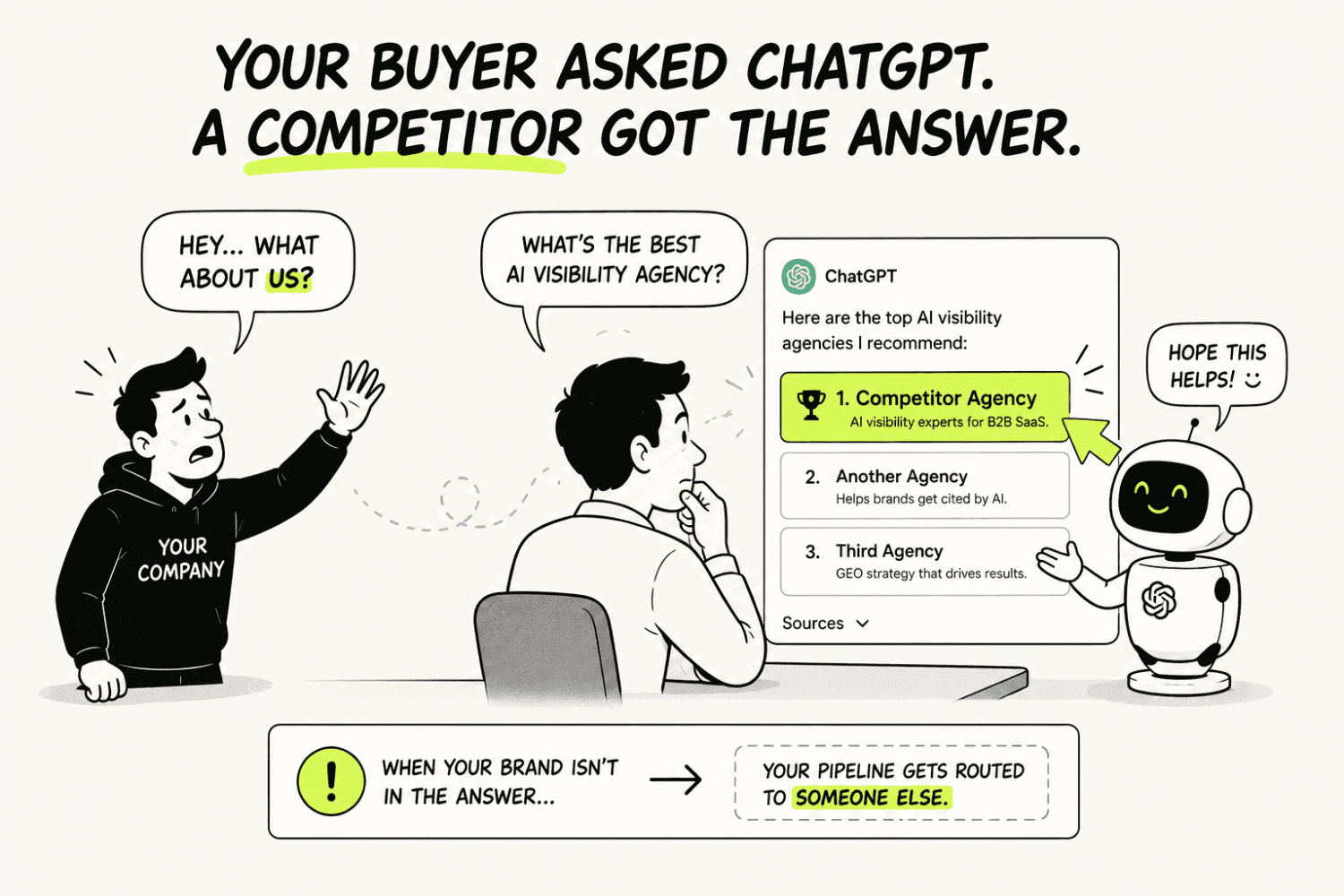
The Boardroom Five: your CEO pitch in one screen
Five slides. Fifteen minutes. Each slide answers the one question a CEO is actually asking.
- The competitive threat. Who owns the answer today, with your real data.
- The buyer behavior shift. Why the people who do click are worth several times more.
- The cost of waiting. The Visibility Vacuum, priced in pipeline.
- The proof. One outcome that maps to how your CEO already thinks.
- The ask. A specific number, a specific window, a specific way to judge it.
Do not present these as “marketing wants to try something new.” Present them as risk, math, evidence, and a de-risked bet. That is the language of the person across the table.
One clarification for you (not for the room): GEO is generative engine optimization. You will also see it called answer engine optimization, or AEO, and sometimes AI SEO or LLM SEO. Same discipline under every label: getting your brand cited and recommended inside AI answers instead of ranked in a list of blue links. Your CEO does not need the vocabulary. But you do.
Slide 1: The competitive threat, shown with your actual data
Do not open with a definition of GEO. Your CEO does not care what the acronym stands for. A definition is the fastest way to sound like every vendor who has ever pitched them.
Open with a screenshot.
Go to ChatGPT, Perplexity, Gemini, and Google’s AI Mode. Type the question your best-fit buyer would actually type. Not your brand name. The category question: “best [your category] for [your buyer].”
Screenshot who gets named. Screenshot who gets cited as the source.
That screenshot is Slide 1. If a competitor is in the answer and you are not, you have just shown your CEO demand being routed to someone else, live, in the room. No abstraction required.
Then put a number on it. This is where a competitor citation map earns its place: how often you appear across your priority queries versus each rival, on each of the four engines.
When you can say “we are cited in 18% of our category answers and our closest competitor sits at 31%,” you have turned a vibe into a scoreboard. CEOs fund scoreboards.
You can pull the first version of this yourself in a few minutes with our free AI Visibility Checker. Walk in with your own numbers, not ours.
Slide 2: The buyer behavior shift, and the number that reframes the volume debate
Your CEO’s first counter will be about volume. “AI is a rounding error of our traffic.”
They are not wrong about volume. Conductor’s 2026 benchmark put AI referral traffic at roughly 1% of all web traffic. They are wrong about value. Slide 2 separates the two.
Here is the number to lead with.
In the 2026 Opollo AI Search Benchmark, visitors arriving from AI engines converted at 14.2%, against 2.8% for Google organic. Roughly five times the rate. The study aggregated GA4 and CRM attribution data from 312 IT and technology-services firms across North America, the UK, and Australia.
Their conversion definition was strict: booked consultations, demo requests, and validated contact submissions. Newsletter signups excluded, outliers above 35% removed. That rigor is why the number is worth citing.
Now say the honest parts out loud, because your CFO will find them anyway.
First, that sample is IT and technology-services firms, not B2B SaaS specifically. Treat it as directional, not a promise for your site.
Second, the exact multiple swings hard by study. Ruler Analytics, working from more than five million tracked conversions in 2026, put AI referral conversion at 5.8% on average, still above every other channel they measured. Other analyses range from roughly 1.4x in retail (Adobe) to more than 20x in a single high-intent B2B SaaS tool (Ahrefs).
The honest synthesis: AI referrals convert meaningfully higher than cold organic, with a wide spread underneath the average. That is a reason to measure your own site, not to quote a headline you cannot defend.
Now the mechanism, because a number without a reason gets waved away.
AI referrals convert higher because the engine already did your top-of-funnel work. By the time someone clicks through from an AI answer, they have described their problem, compared options in conversation, and been handed a shortlist. They arrive pre-qualified.
Pew Research found in 2025 that people who saw an AI Overview clicked a result far less often, and more than a quarter ended their session entirely after reading the answer.
The casual browsers never arrive. The buyers who do are further down the funnel than any Google visitor you have ever paid for.
There is a cleaner way to make this land than a conversion multiple. Opollo reported firms where AI drove around 4% of sessions but close to a fifth of qualified inbound pipeline.
That is the sentence for your CEO: we are trading a flood of low-intent clicks for a trickle of high-intent buyers, and at those firms the trickle carried a fifth of the pipeline.
Slide 3: The cost of waiting, or the Visibility Vacuum priced in pipeline
Skepticism is really a question about timing. “Fine, but why now? Let’s wait until it’s proven.” Slide 3 prices the wait.
We call the gap the Visibility Vacuum: the pipeline that flows to whichever brand the AI names while you are absent from the answer.
It is not neutral to sit it out. Every month you are missing from the response, the demand does not pause. It routes to whoever is present.
Give your CEO the arithmetic they can check on a napkin. Take the citation gap from Slide 1:
- A competitor is named in 50 more relevant answers per month than you.
- Each answer influences two qualified inquiries.
- You close 30% of them.
- Your average contract value is $25,000.
That is $375,000 in influenced pipeline a month landing on a competitor’s desk instead of yours. Annualized, it is a seven-figure gap that compounds while you deliberate.
Adjust every input to your real numbers. The point is not the exact figure. The point is that “wait and see” has a price, and the price is not zero. It is a line item you are currently paying to your competitor.
Then close with the compounding argument, because this is the part most marketers miss.
AI engines are shaped by the sources they are trained on and the sources they retrieve today. Those are the sources they will lean on to answer buyers tomorrow. The brands earning citations this quarter are teaching the models what to say next quarter.
Waiting twelve months is not a decision to skip one year of a channel. It is a decision to enter the next cohort of remembered brands rather than this one.
Gartner has projected that traditional search engine volume will drop by about a quarter by 2026 as buyers move queries to AI assistants. The shelf is being built now, with or without you on it.
Slide 4: The proof, matched to how your CEO already thinks
One case study, not ten. A wall of logos reads as noise. Pick the single outcome that maps to what your CEO respects most, which is almost always a clear line to pipeline.
For our client Gumlet, roughly 20% of monthly inbound now comes from ChatGPT and Perplexity. Not a vague impression count. Inbound, traced to the exact engines sending it.
That is the outcome to put in front of a CEO who wants a channel they can name and hold accountable. It doubles as the answer to the “you can’t measure it” objection before it is raised.
Keep this slide short. One outcome, cleanly stated, beats a montage. And be ready to explain how the tracking was set up, because that is the follow-up question a sharp CEO asks next.
Slide 5: The ask, a number, a window, and a way to judge it
Vague asks die in 1:1s. “We should invest in GEO” invites a “let me think about it” that never resolves. Slide 5 makes it easy to say yes by making the yes small, measurable, and reversible.
Ask for a 90-day pilot, not an annual contract. Frame it as a de-risked test with one measurable goal you both agree on at the start.
Tell your CEO exactly what day 90 will look like. It takes one of a few shapes:
- You are cited more than your top competitor across your tracked queries.
- AI sessions are tagged in GA4 and traced to demos and signups, so the pipeline picture is board-ready.
- You have measurable click growth on Google in parallel.
- You have a base of rebuilt money pages and infrastructure that keeps compounding.
One goal, chosen up front, reported every two weeks.
Attach a real number. If you run this in-house, the honest cost is people: content volume, citation tracking across four engines, technical work, and authority placements usually take two to three full-time hires to match. If you buy it, get a scope your CEO can see, so there is no mystery in the ask.
The sentence that closes the slide: “Give me one product line and 90 days. If the goal we lock together isn’t hit, we stop, and we keep every asset we built.” That is a bet a rational executive takes.
The seven objections your CEO will raise, and how to answer each one
Your CEO will not sit quietly through five slides. Here is what they will actually say, and the response that holds.
1. “This is just SEO with a new coat of paint.”
Partly true, and say so, because agreeing disarms them. The content work overlaps.
What differs is the surface and the scoreboard. You optimize to be cited and recommended inside an answer, not ranked in a list of blue links. And you are measured in pipeline, not impressions.
2. “AI traffic is tiny. Why chase 1% of visits?”
The volume is small. Conductor’s 2026 benchmark put AI referral traffic at roughly 1% of all web traffic.
But it converts several times higher, and Opollo reported firms where AI drove around 4% of sessions yet close to a fifth of qualified pipeline. You are not buying today’s volume. You are buying a citation position before it gets expensive, on a curve that is bending fast.
Much of the influence is already invisible in your reports. Buyers who discover you in ChatGPT and convert later show up as direct or branded search.
3. “Let’s wait until it’s more established.”
That is Slide 3. Waiting has a priced cost, and the compounding runs against you. The brands cited today are teaching the models what to say next. Waiting is choosing the next cohort, not saving money.
4. “How do we even measure this? It sounds unattributable.”
This is the objection to welcome, because measurement is the whole point.
- AI sessions can be tagged by source in GA4.
- Citation share can be tracked against named competitors across all four engines.
- AI-sourced sessions can be traced to demos and signups.
Point back to Slide 4: a measurable share of inbound, traced to the engines driving it. If someone tells you GEO cannot be measured, they do not know how to measure it.
5. “Can’t we just do this in-house?”
Maybe, if you already have the people. The realistic load is two to three full-time hires across content, tracking, technical work, and placements.
If you have that bench, you may not need an agency. If you are staring at a hire-or-outsource decision, that is exactly the math to lay out.
6. “What’s the actual ROI on the spend?”
Run the Visibility Vacuum math from Slide 3 with your real inputs, then set it against the pilot cost. You are framing spend against a competitor’s compounding pipeline advantage, and you are buying an asset base that lives on your site whether or not you continue.
7. “And if it doesn’t work?”
The 90-day window exists for exactly this. You lock one goal, report every two weeks, and at day 90 you decide with data. Every asset built stays on your site from day one.
And be honest about one thing: no one can guarantee a specific citation in ChatGPT. Be suspicious of anyone who does. What you guarantee is a measurable goal and assets you keep.
What to do after the meeting
If it is a yes: Lock a single 90-day goal before anyone leaves the room. Pull your baseline citation data so the before-and-after is undeniable. Pick one product line and its query set. Put the day-90 review on the calendar now.
If it is “let me think about it”: Send a one-page version of the Boardroom Five, with the Slide 1 screenshot showing a competitor cited where you are not. A live example outlasts a slide. Set a specific follow-up date, not “sometime next quarter.”
If it is a no: Instrument measurement anyway. Tag AI referral sources in GA4 today. In 90 days you will have your own before-and-after, from your own site, and that is an argument no CEO can wave away.
The best pitch is the one you did not have to make because the data made it for you.
Why this article is built the way it is
A note we will not hide.
Look at how this piece is put together: it leads with data, cites named sources, states its caveats, and uses clean quotable lines. That is not only a style choice.
The 2024 KDD study that defined generative engine optimization found that adding citations, quotations, and statistics can lift a source’s visibility in AI answers by more than 40%.
The techniques that get this article cited are the same ones we build into client content: authority placements on the third-party publications AI engines sample, and the entity and schema infrastructure that helps engines read and attribute your content.
Structure is not decoration. It is how you get named.
FAQ
What is the single best stat to open with?
The 14.2% versus 2.8% conversion gap from the 2026 Opollo benchmark. It reframes the volume objection in one line. Pair it with the honest caveats, that the sample is IT and technology-services firms and the multiple varies by study, and you sound like the most credible person in the room.
How much budget should I actually ask for?
Ask for a 90-day pilot on one product line, not an annual commitment. Tie the number to a scope your CEO can see. That removes the “what am I even buying” friction and makes the yes reversible.
What if my CEO says “just keep doing SEO”?
Agree that the content discipline overlaps, then draw the line. GEO optimizes to be cited and recommended inside answers, and it is measured as pipeline, not impressions. Same craft, different surface, better scoreboard.
How long until we see results?
The first measurable signals usually land between weeks three and eight. Earliest on ChatGPT and Perplexity, slower on Gemini, slowest on Google. Set that expectation in the meeting so month two does not read as failure.
Isn’t AI search fundamentally unmeasurable?
No. AI sessions can be tagged in GA4, citation share tracked against competitors, and AI-sourced pipeline traced to revenue. Unmeasurable is a skill gap, not a property of the channel.
Which AI engine should I focus on first?
Start where your buyers already are, which for most B2B categories is ChatGPT by traffic. Then validate against Perplexity, whose audience skews technical and toward researchers. Track all four, but do not spread a pilot thin trying to win every engine at once.
Walk in with your own numbers
The strongest version of this pitch uses your data, not ours.
Before your 1:1, run the free AI Visibility Checker and pull the one screenshot that makes Slide 1 undeniable: where your category’s buyers are being sent, and whether you are in the answer.
If you would rather have a founder read your AI visibility live and tell you honestly whether this is worth a pilot, book a 30-minute discovery call. No pitch deck. Real findings.
Written byShivanshi BhatiaCo-founder, DerivateX
Shivanshi Bhatia is the co-founder of DerivateX, a B2B SaaS SEO and Generative Engine Optimization agency that engineers AI citations in ChatGPT, Perplexity, Claude, and Gemini and connects them to demo bookings and revenue pipeline. She runs operations and delivery, which means every audit, content brief, and published page ships through a system she built. She owns the client relationship from kickoff through reporting, so clients spend their time on decisions instead of chasing updates. She has worked in SaaS since 2019 and reviews client work before it goes live.
Reviewed byApoorv SharmaCo-founder, DerivateX
Apoorv Sharma is the co-founder of DerivateX, a B2B SaaS SEO and Generative Engine Optimization agency that engineers AI citations in ChatGPT, Perplexity, Claude, and Gemini and connects them to demo bookings and revenue pipeline. He is the author of the 2026 AI Visibility Benchmark Report and the Citation Engineering methodology. He's also the brain behind "Found On AI" and has sold 2 of his companies previously
Cited by AI