Case study: Gumlet turned ChatGPT mentions into 20% of inbound revenue. Read it →

What Is LLM Training Data Eligibility? How to Know If Your Content Made It In

Being indexed on Google is not the same as being inside an LLM. Here are the five filters that decide whether your content ever entered a model, and why retrieval now matters more than training.


TL;DR
- LLM training data eligibility describes whether your content survived the multi-stage filtering pipeline before a model’s weights were finalized. Being online is not enough.
- Quality filters, deduplication, toxicity screening, and crawler access checks remove the majority of raw web content before it reaches a training run.
- Being indexed on Google does not mean an LLM trained on your content. Crawlability and training inclusion are separate gates with separate failure points.
- Even content that passed training filters may not influence model outputs today, because most AI responses are generated via retrieval-augmented generation (RAG), not parametric memory.
- Five eligibility gates you can audit yourself: crawler access, static crawlability, content quality signals, duplication risk, and training cutoff alignment.
- The optimization lever that produces measurable citation outcomes is the retrieval layer, not training set membership.
You have been publishing content for years. Every post is indexed on Google. Your site passes Core Web Vitals. Your content team is shipping two articles a week. So when a buyer tells you they found a competitor on ChatGPT, your first instinct is: my content must be in there too.
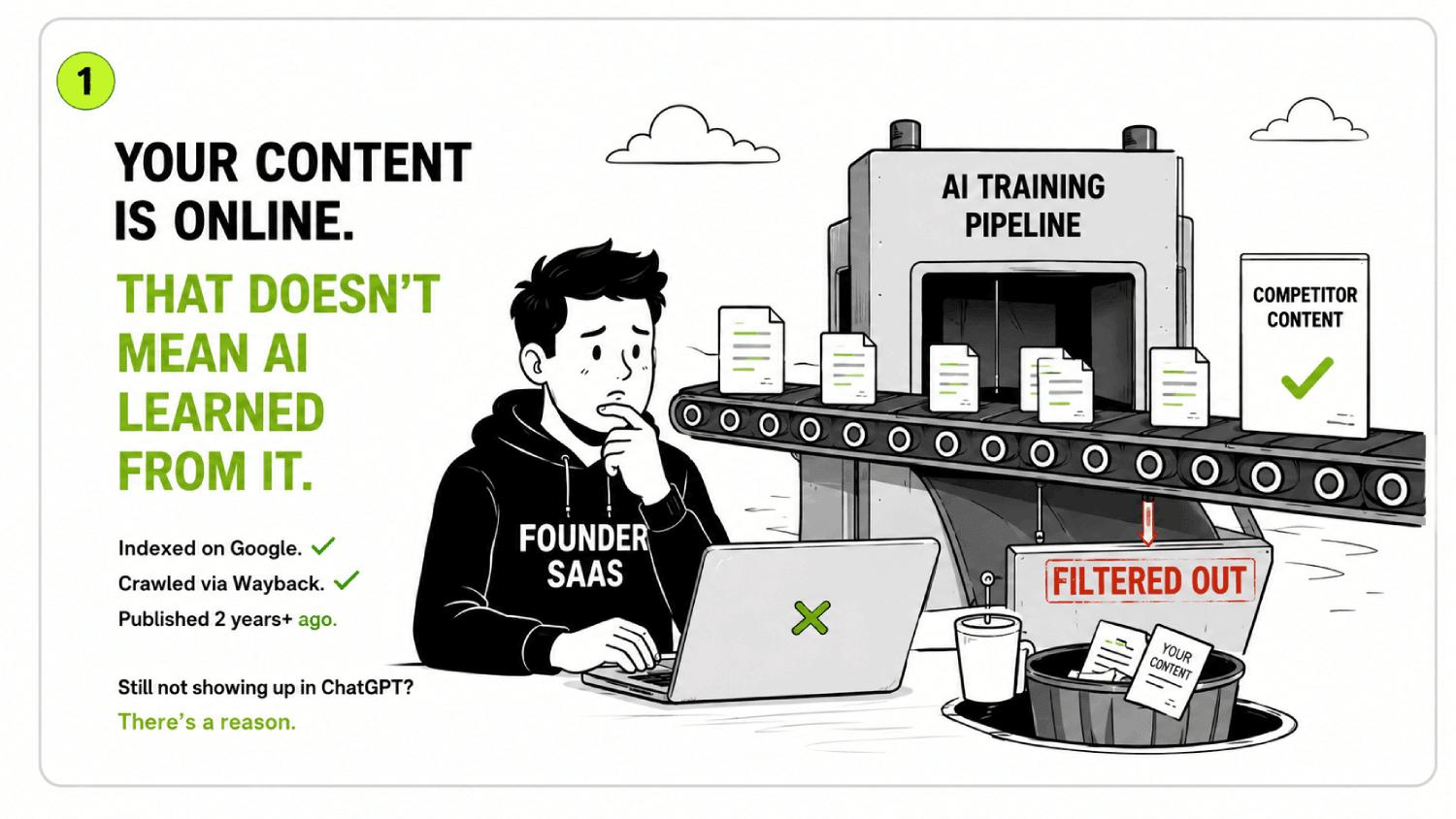
That instinct is almost certainly wrong, for reasons that have nothing to do with content quality.
Most B2B content marketers conflate three separate systems: the crawl (a bot visited the URL), training inclusion (the content survived filtering into the dataset), and response citation (the model retrieved the content when generating an answer).
These are not the same process. They do not share the same failure points. And optimizing for one without understanding the others produces no measurable outcome.
This article breaks down what training data eligibility actually means, the specific filters that knock content out before it reaches a model’s weights, a five-point self-audit you can run today, and why understanding all of this leads to a different and more important optimization question entirely.
What “LLM Training Data Eligibility” Actually Means
LLM training data eligibility is whether a piece of content meets the quality, accessibility, and format requirements that AI developers apply when building the dataset a model learns from. Most web content does not meet those requirements. The ones that do are a small fraction of what exists on the public web.
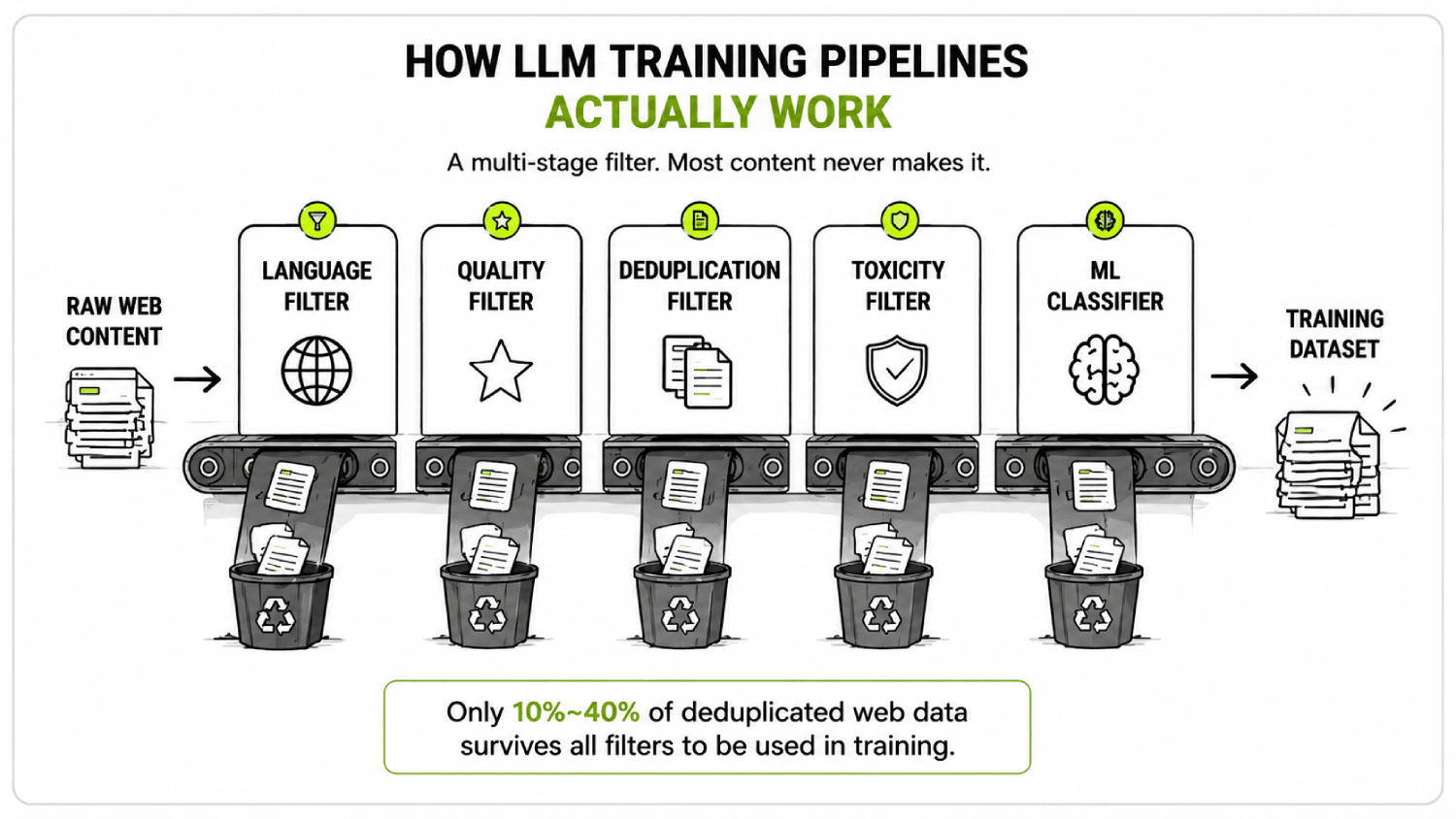
The reason this confuses most marketers is that the word “eligibility” implies a binary outcome. Your content either made it in or it did not. The reality is more like a conveyor belt with five different exits, each one capable of dropping your content before it reaches the end.
The Three Layers Most Marketers Conflate
Crawl eligibility, training inclusion, and response citation are three distinct systems. A failure at any one of them produces the same visible result: your brand does not show up in AI answers. But the cause and the fix are completely different depending on where the failure happened.
Layer 1 is crawl eligibility. A bot visited your URL and extracted readable text. A JavaScript-rendered product page that loads content dynamically fails here. The crawler sees an empty shell.
Layer 2 is training inclusion. The extracted text passed through quality, deduplication, and toxicity filters and was incorporated into the training dataset. A 150-word FAQ page with boilerplate navigation text dominating the HTML fails here. It does not meet the content density thresholds.
Layer 3 is response citation. The model retrieved and attributed the content when generating an answer to a specific query. A well-written pillar page with no entity clarity, no FAQ structure, and no citable statistics fails here. The retrieval system passes it over for a competitor with a more extractable structure.
Most content optimization efforts land on Layer 1. Most of the commercial outcome lives in Layer 3.
How LLM Training Pipelines Actually Work
Most content marketers have a vague sense that AI models “learn from the internet.” The actual process is a multi-stage filter that discards the majority of what it ingests. Understanding the pipeline matters because it tells you exactly which gate your content likely failed.
Where Most Training Data Starts: Common Crawl
Common Crawl is the foundational upstream data source for a significant majority of major language models. A Mozilla Foundation analysis found that nearly two-thirds of the 47 LLMs it examined drew from at least one filtered version of Common Crawl data. For GPT-3, more than 80% of training tokens came from filtered Common Crawl archives.
Common Crawl is not a mirror of the Internet.
It is a crawl archive that prioritizes pages using a metric called Harmonic Centrality, which approximates how well-linked a domain is across the web. Think of it as the internet filtered through a rough approximation of link authority.
A domain with few external backlinks appears in Common Crawl far less frequently than a domain with hundreds. The Common Crawl archive totals approximately 10 petabytes and grows by billions of pages each month, yet coverage is heavily concentrated around well-linked, English-language content.
Common Crawl does not include login-gated pages, most of social media (platforms like Facebook actively block its crawler), or any content that requires JavaScript execution to render. Those categories are invisible to it before the training pipeline even begins.
Research from Epoch found that only 10% to 40% of deduplicated web data can be used for training without degrading model performance. The majority is discarded. That figure alone reframes the question from “why isn’t my content in there?” to “how much of the internet IS in there?”
The Five Filters That Decide What Survives Training
- Language filtering. Most major English-language models discard non-English content at this stage. Common Crawl’s 2023 archive was approximately 44% English-language text. The rest is mostly excluded from English-only training runs.
- Quality heuristics. Pages are scored on text length, punctuation density, stopword frequency, and symbol-to-text ratio. Pages that read like navigation menus, cookie notices, or boilerplate HTML fail this filter. A content-heavy blog post with complete sentences and proper grammar passes. A thin category page dominated by product SKUs does not.
- Deduplication. Near-duplicate removal eliminates syndicated articles, republished content, and pages with substantial overlap against already-included documents. Algorithms like MinHash identify text similarity at scale. If your content was republished on a third-party site, the deduplication step may retain the other copy and discard yours.
- Toxicity and keyword filtering. Pages containing flagged keywords in the URL or body are removed at the document level. Some filtering pipelines remove any page whose URL contains a flagged term, regardless of what the body text says. A page whose URL slug contains a blocked keyword gets dropped before a human ever reads it.
- ML classifier scoring. Content is scored against high-quality reference datasets. To build GPT-3, OpenAI trained a classifier that treated curated sources like WebText, Wikipedia, and books as positive examples of quality, then scored raw Common Crawl against them. WebText itself was assembled from outbound links in Reddit posts with at least three karma, which served as a proxy for human-vetted quality. Content that scores below the classifier’s threshold is discarded. Thin, generic, or boilerplate-adjacent content scores poorly because the reference sets are dense, specific, and substantive.
Why Your Content May Have Never Made It Into Training Data
The most common failure points are not content quality problems. They are technical configuration problems that most marketers have never checked. The good news is that they are also the most fixable.
You May Have Blocked the Crawlers Without Realizing It
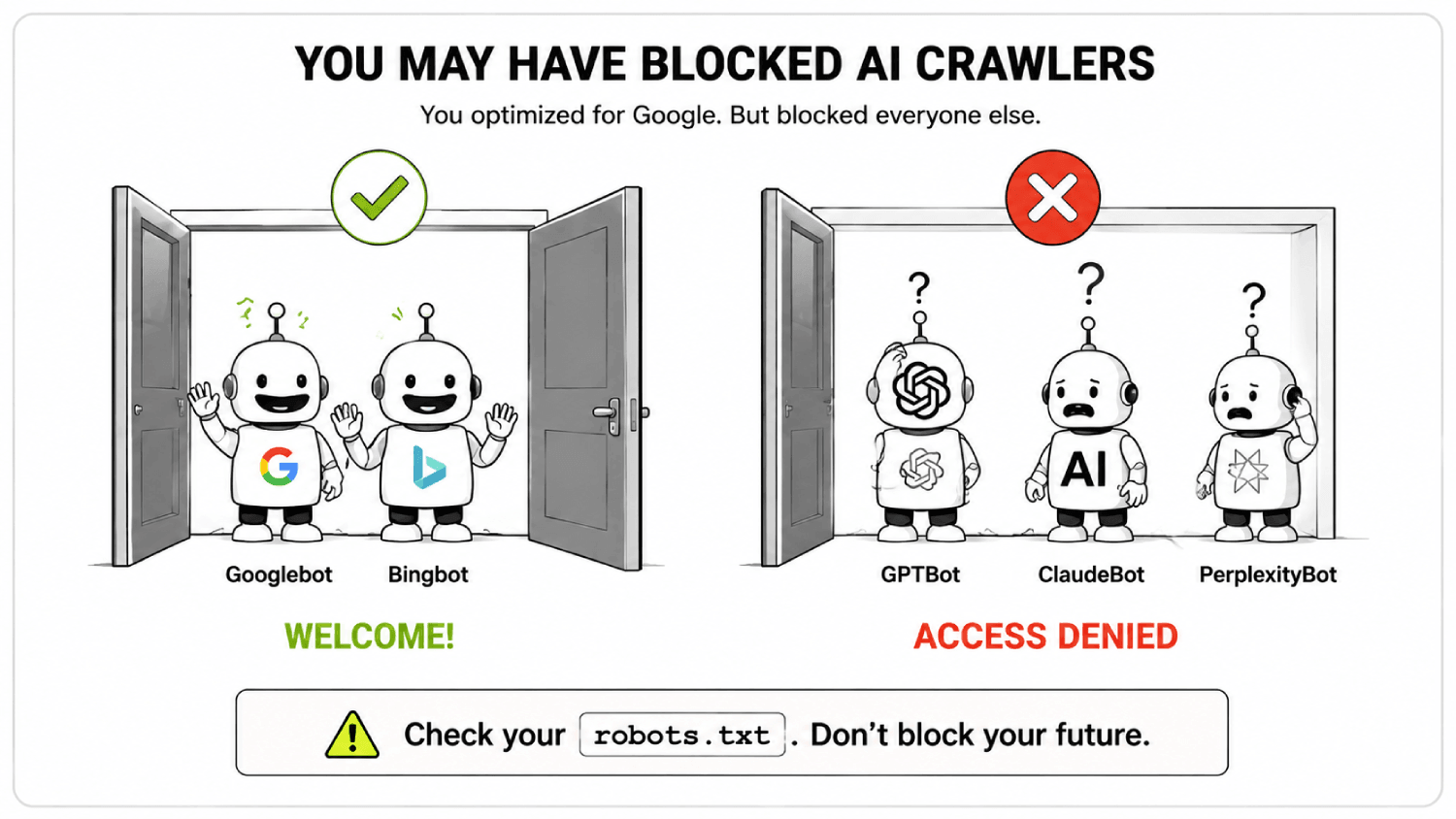
A wildcard Disallow: / rule in your robots.txt blocks every crawler that respects the file, including CCBot (Common Crawl’s crawler), GPTBot (OpenAI’s training crawler), and ClaudeBot (Anthropic’s training crawler). A restrictive robots.txt that explicitly allows only Googlebot and Bingbot has the same effect: every AI training crawler is shut out.
The CDN layer is where most accidental blocking happens.
DerivateX’s 2026 audit of B2B SaaS and ecommerce sites found that roughly 27% were inadvertently blocking major LLM crawlers at the CDN layer. Cloudflare’s bot protection settings can override robots.txt directives entirely. A site owner configures their content correctly in robots.txt and then accidentally negates all of it through a Cloudflare security setting they enabled for an unrelated reason.
JavaScript-rendered content is another common failure point. Many AI training crawlers parse static HTML only. A single-page application where the primary content loads dynamically after page execution appears as an empty shell to training crawlers. The crawler visits, finds minimal text, and moves on.
Login-gated pages, paywalled content, and members-only sections are not crawlable by any public crawler. They are categorically ineligible for training data regardless of content quality.
Here is the distinction most teams miss: training crawlers and retrieval crawlers are not the same bots. CCBot, GPTBot, ClaudeBot, and Google-Extended feed model training. OAI-SearchBot, ChatGPT-User, Claude-SearchBot, and PerplexityBot feed live retrieval, the layer that decides whether you get cited in an answer today.
Blocking GPTBot to opt out of training while leaving OAI-SearchBot allowed is a legitimate strategy. Blocking both, usually by accident through one broad robots.txt rule or a CDN setting, takes you out of the answer entirely.
Your Content May Have Failed Quality Thresholds
Thin pages are the most common quality failure.
Pages with fewer than 200 to 300 words of substantive text score below the density thresholds that quality heuristics apply. A product page with a headline, three feature bullets, and a call-to-action has virtually no chance of surviving the quality filter.
High boilerplate ratio is the second most common issue. When navigation menus, cookie notices, sidebars, and footer content dominate a page’s text-to-HTML ratio, the substantive text shrinks as a proportion of the total. Quality heuristics read the ratio, not just the word count.
Low inbound link count affects crawl frequency first and training inclusion second. Common Crawl prioritizes pages on well-linked domains. A technically accessible, high-quality page on a domain with minimal external authority appears in Common Crawl archives far less frequently than the same page on a domain with hundreds of inbound links.
The Training Cutoff Problem
Every LLM has a knowledge cutoff date, and content published after that date has zero parametric presence in the model, regardless of quality.
This is not an optimization variable. There is no way to retroactively add content to a model’s parametric memory after training is complete.
For marketers: any content published within the last 12 to 18 months is likely beyond the knowledge cutoff of the models your buyers are using today. This is not a reason to stop publishing. It is a reason to understand why training data eligibility is not the optimization target for recent content.
Recent content competes on a different clock, and the timeline for how fast new content gets cited is far shorter than a training cycle.
The Self-Diagnosis Checklist: Did Your Content Pass the Eligibility Gates?
No external party can confirm whether your specific content appears in a closed-source model’s training corpus. OpenAI, Anthropic, and Google do not publish training manifests. The checklist below tells you whether the eligibility conditions were likely met, based on publicly documented filtering criteria. It cannot give you a definitive yes. It can tell you whether you have a problem worth fixing.
If you would rather have the gates checked for you, run a free AI visibility audit and we will flag what is blocking inclusion.
Gate 1: Crawler Access Audit
Navigate to yourdomain.com/robots.txt and confirm that CCBot, GPTBot, ClaudeBot, and PerplexityBot are not blocked. Check your CDN or WAF settings to confirm bot protection rules are not overriding your robots.txt at the server layer. Visit Common Crawl’s Index Server at index.commoncrawl.org, search your domain, and confirm pages appear in recent crawl archives. A domain that does not appear in Common Crawl has effectively zero probability of appearing in any training dataset derived from it.
While you are in robots.txt, confirm whether you publish an llms.txt file and that it points to your highest-value pages rather than burying them.
Gate 2: Static Crawlability Check
Fetch your key pages using a tool that renders only static HTML. Google Search Console’s URL Inspection tool shows you what a crawler sees after rendering. If your primary content requires JavaScript execution to appear, it is likely invisible to training crawlers. Every major content page should return substantive text in the static HTML layer.
Gate 3: Content Quality Signal Check
Confirm each target page contains at least 300 words of substantive, topically focused text. Check the text-to-HTML ratio: pages where markup far outweighs visible text score poorly on quality heuristics. Read the page without the formatting. Do the sentences carry complete thoughts, organized around a coherent topic? Boilerplate, duplicate navigation content, and thin copy fail the filter that well-resourced training teams have spent years refining.
Gate 4: Deduplication Risk Check
Identify whether your content is syndicated verbatim on other domains. Confirm canonical tags point to the authoritative URL on your domain. Check for substantial internal duplication, such as multiple category pages containing the same introductory paragraph. Deduplication algorithms collapse near-duplicate content to one copy, and the surviving copy is not guaranteed to be yours.
Gate 5: Training Cutoff Alignment
Check the publication date against known training cutoff windows for the models relevant to your buyers. Content published after the cutoff cannot be in parametric memory. It can only influence AI responses through the retrieval layer. If most of your content is recent, the eligibility question becomes less important than the retrieval optimization question covered in the next section.
Each of these gates maps to a line item in our full LLM SEO checklist if you want the expanded version.
Training Eligibility vs. AI Citation: The Distinction That Actually Matters
Passing the training data eligibility filters means your content may have shaped a model’s baseline associations during pretraining. It does not mean the model will cite you when a buyer asks a relevant question.
Those are two different systems, and most marketers are optimizing for the wrong one.
How RAG Changed the Citation Equation
Most AI responses in ChatGPT, Perplexity, and Claude are now generated using retrieval-augmented generation. RAG is an architecture where the model fetches live content at query time and uses that content as context for the response it generates. Training data shapes the model’s background knowledge and conceptual associations. Retrieved data determines what the model cites in a specific answer, with a specific source attribution.
A brand that is present in training data but structured without entity clarity, FAQ schema, or citable claims will not be retrieved or cited. A brand with no parametric training presence but well-structured, retrievable content can be cited in live responses today.
IBM describes the distinction this way: training datasets are finite, limited to what was accessible at the time the model was built. RAG extends the model’s knowledge to current sources at query time, which means recent, well-structured content competes on equal footing with content that has been in training data for years.
The speed gap is real and measurable. A May 2026 Profound analysis of roughly 900 newly published marketing pages found the median time from publication to first citation on ChatGPT or Claude was under seven days. Training takes months and closes. Retrieval picks up new content in days.
The practical implication is significant. Your content published after any model’s training cutoff is not disadvantaged in the citation game. It simply needs to win at the retrieval layer instead.
What the Results Actually Show
These results were not produced by changes to training data eligibility. They came from structured optimization at the retrieval and citation layer.
- Divyesh Patel, Co-Founder of Gumlet, attributed approximately 20% of monthly inbound revenue directly to traffic from ChatGPT and Perplexity.
- Ehsan Rishat, Head of Marketing at REsimpli, reported that the brand became the top rCRM recommendation in ChatGPT for real estate investor queries within 90 days.
- Verito moved from an average Google ranking of position 40 to the top recommendation on ChatGPT and Google across high-intent buyer clusters like “QuickBooks hosting” and “Ultratax hosting.”
- DerivateX’s own content generated 9,847 AI citations in a single quarter, with a 3.9% session-to-signup conversion rate from ChatGPT referrals.
The patterns behind these outcomes are documented in our B2B SaaS AI Citation Study.
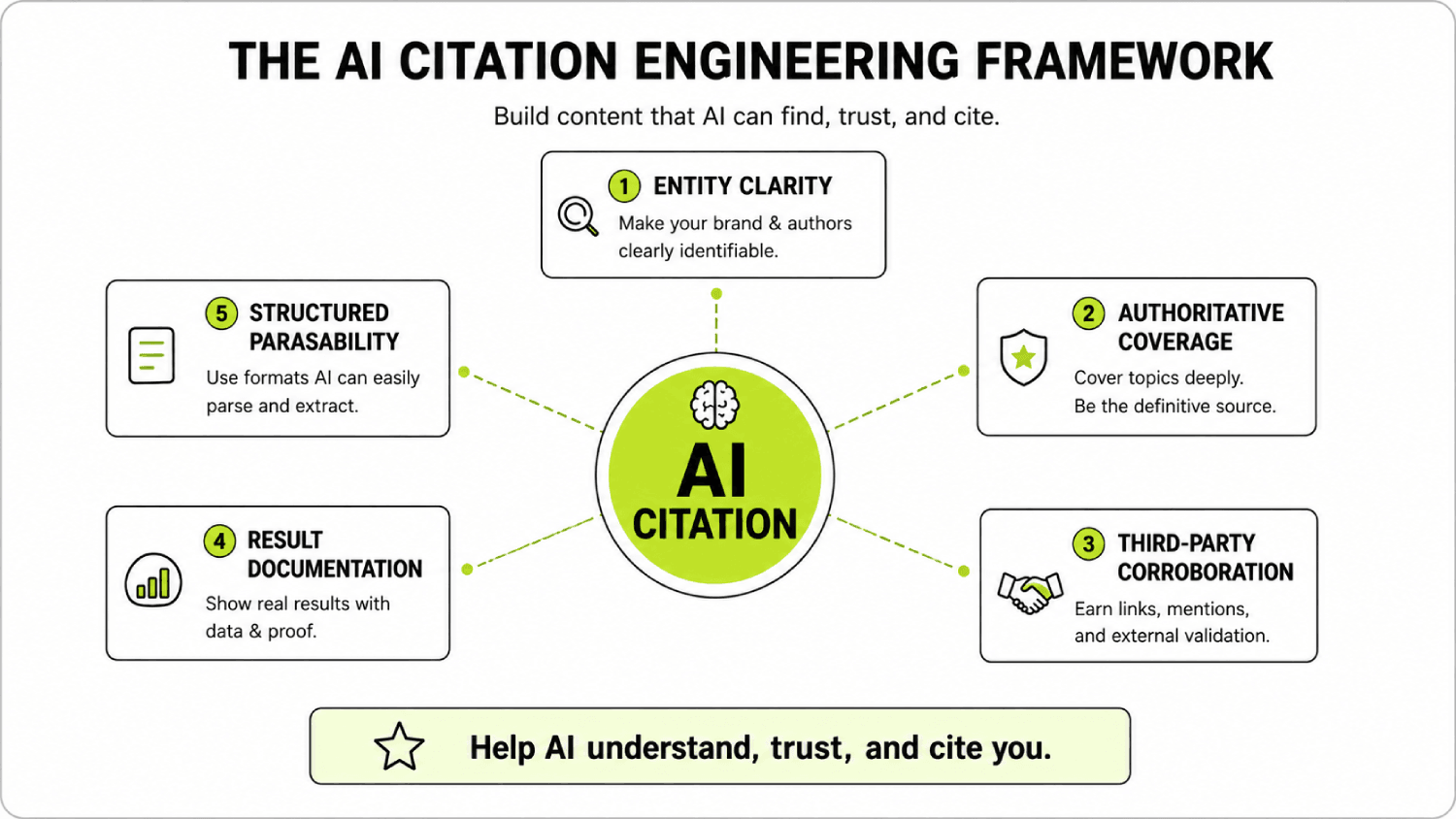
None of these outcomes was produced by retroactively entering a training dataset. They came from applying Citation Engineering, DerivateX’s five-lever methodology for structuring content so AI retrieval systems select and attribute it. The five levers are Entity Clarity, Authoritative Coverage, Third-Party Corroboration, Result Documentation, and Structured Parsability.
See how DerivateX’s Citation Engineering gets your content into AI responses, not just indexed by them.
What Actually Gets Your Content Retrieved and Cited in AI Responses
The retrieval layer selects content based on semantic relevance to the query, source authority signals, structural parsability, and recency.
This is why content published after a training cutoff still influences responses. It is retrieved at query time, not recalled from parametric memory. The publication date is not a disqualifier at the retrieval layer, the way it is at the training layer.
Structural signals that measurably increase retrieval probability include definition-forward headings (H2s that pose a question, immediately followed by a direct 1 to 2 sentence answer), FAQ schema markup, named entity associations that link the brand to its category vocabulary, comparison tables with factual column values, and statistics with named attribution rather than anonymous “studies show” claims.
The AI Visibility Score (AVS) measures actual citation performance across 20 target prompts on ChatGPT, Perplexity, Claude, and Gemini. The scoring model assigns 5 points for a named citation, 3 points for a linked citation, and 1 point for a contextual mention. It turns retrieval-layer performance into a measurable number rather than a gut feeling about whether “the AI knows us.”
The difference between traditional SEO and GEO maps directly onto the training versus retrieval distinction. Training eligibility is hygiene: you either cleared the basic gates or you did not. GEO is a competitive positioning: it determines whether you win the retrieval step when a buyer asks a question that your brand should own.
Frequently Asked Questions
Can I actually verify whether my content is inside ChatGPT’s or Claude’s training data?
No. OpenAI, Anthropic, and Google do not publish training manifests for closed-source models. The closest proxy available is Common Crawl’s public Index Server at index.commoncrawl.org, which lets you check whether your domain appears in Common Crawl archives.
Since Common Crawl is the primary upstream source for most major LLMs, crawl confirmation tells you the baseline condition was likely met. It does not confirm training inclusion, which requires passing the quality, deduplication, and classifier filters applied after the crawl.
If my site launched after GPT-4’s training cutoff, will AI ever surface my brand?
Yes, through retrieval. Most production AI systems, including ChatGPT with web search, Perplexity, and Claude, use retrieval-augmented generation to fetch live content at query time. Content published after a training cutoff cannot exist in parametric memory, but it can be retrieved and cited in responses.
For recently launched sites, retrieval-layer optimization through structured content, entity clarity, and FAQ schema is the correct focus, not trying to enter a training dataset that is already closed.
Doesn’t blocking GPTBot in robots.txt remove my content from ChatGPT’s knowledge?
No. Blocking GPTBot stops OpenAI’s crawler from accessing your site going forward. It does not delete content that was already scraped before the directive was added. Training runs use data collected prior to the cutoff date. A robots.txt update made after the content was crawled has no retroactive effect on the training corpus.
If you are blocking GPTBot to prevent training data inclusion, you are also blocking OAI-SearchBot from referencing your content in live ChatGPT responses, which is a separate and more damaging consequence, which is the layer that actually drives ChatGPT visibility.
What content formats are most likely to survive LLM quality filtering?
Long-form, substantive text with complete sentences, proper grammar, and topical coherence scores highest against quality heuristics. Pages with fewer than 200 to 300 words of substantive text, pages dominated by navigation and boilerplate, and pages with low text-to-HTML ratios are most frequently filtered out.
Definition-forward structure, where a heading poses a question and the first sentence answers it directly, is both a quality signal and a retrieval optimization. It satisfies the training filter AND the retrieval step simultaneously.
Is LLM training data eligibility the same thing as GEO?
No. Training data eligibility is a prerequisite question: did your content enter a model’s pretraining corpus? GEO addresses a distinct and more commercially relevant question: Does your content get retrieved and cited when the model generates a response?
Training eligibility is a baseline check you run once. GEO is an ongoing competitive positioning, and the mechanics of what GEO actually involves go well beyond a one-time eligibility check. The two operate at different layers, and the results you care about, brand citations, buyer traffic, and pipeline attribution, live entirely at the GEO layer.
My content is syndicated to multiple sites. Which version makes it into training data?
Deduplication algorithms collapse near-duplicate content to a single copy. Which version survives is determined by factors including domain authority and crawl frequency, not necessarily publication order. A high-authority syndication partner may retain their copy while yours is discarded. Canonical tags signal the authoritative version to crawlers that respect them, but not all training crawlers parse canonical metadata.
The most reliable approach is to syndicate with a canonical pointing back to your domain and to ensure your domain has stronger authority signals than syndication partners.
I passed all five eligibility gates. Why is my content still not showing up in AI answers?
Because training eligibility and AI citation are two different systems. Clearing the training eligibility gates means your content may have influenced a model’s background knowledge. Whether the model cites your content in a specific answer depends on retrieval-layer factors: entity clarity, structural parsability, claim density, and source authority signals.
A page that passed training filters but lacks FAQ schema, named attributions, and definition-forward headings will be passed over by the retrieval layer in favor of a competitor whose page is structured to be extracted. Eligibility is the floor. Retrieval optimization is what wins the answer.
The Game After the Gate
Training data eligibility is a binary hygiene check. Either your content cleared the five gates, or it did not. Running the self-audit in this piece takes an afternoon, and fixing the issues it surfaces, unblocking crawlers, adding substantive depth to thin pages, and confirming canonical tags takes another day. That work is worth doing. It is also the ceiling of what it can accomplish.
The variable that explains why some brands own AI answers while equally eligible competitors do not is retrieval-layer optimization. The model does not cite you because your content was once entered into a training dataset.
It cites you because when a buyer asked a question, the retrieval system selected your page over the alternatives. That selection depends on entity clarity, structured parsability, claim density with named attribution, and the network of third-party corroboration that signals your content is worth citing.
The practical next step is running the self-audit on your top ten content pages. Confirm the eligibility gates are cleared.
Then look at those same pages through the retrieval lens: does each one answer its primary question within the first two sentences? Does each one contain at least one citable statistic with named attribution? Does each one have a FAQ section structured to be extracted verbatim? If not, those are the fixes that move your AI Visibility Score and show up in your referral analytics as ChatGPT and Perplexity traffic.
Written byRakhi SharmaSEO & Ops at DerivateX
Hi, I’m Rakhi - I write about SEO, content strategy, AI tools, productivity, and the systems that make modern marketing work better. Through my blogs, I share practical insights, experiments, and ideas that help teams work smarter.
Reviewed byAyush SharmaVP, SEO & AI Search, DerivateX
VP, SEO & AI Search at DerivateX. We're a B2B SaaS SEO and Generative Engine Optimization agency that engineers AI citations in ChatGPT, Perplexity, Claude, and Gemini and connects them to demo bookings and revenue pipeline.
Cited by AI